Self in Interpersonal Communication Chapter 3, Part 1 Devito 10 th  ed .
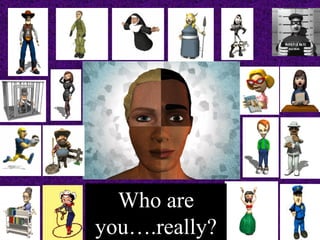
Chapter 3 Who are you….really?
Objectives:  Self-Concept Define self-concept; explain how it develops. Explain how culture influences self-concept. Define & give examples of ego boosters/busters. List & explain 5 characteristics of self-concept. Define self-fulfilling prophecy & give example. Explain why self-concept is often distorted. Suggest how a distorted self-concept can be changed.
I.  Self-Concept Definition How you view yourself;  self-image Feelings & thoughts about  your strengths, weaknesses Relatively stable set of perceptions you hold of yourself:  emotional states, talents, likes, dislikes, values, roles, etc.
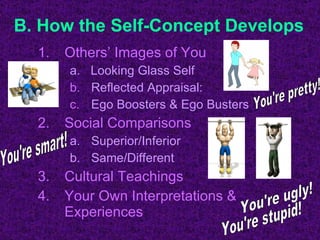
B. How the Self-Concept Develops Others’ Images of You a.  Looking Glass Self Reflected Appraisal:  Ego Boosters & Ego Busters Social Comparisons Superior/Inferior Same/Different Cultural Teachings Your Own Interpretations & Experiences You're ugly! You're stupid! You're pretty! You're smart!
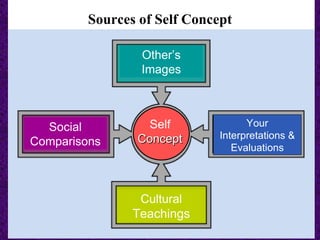
Other’s Images Social Comparisons Your Interpretations & Evaluations Cultural  Teachings Self  Concept Sources of Self Concept
Ego Boosters/Ego Busters Exercise Recall an “ego booster” who helped enhance your self-esteem. Recall an “ego buster” from your life. Recall a time when you were an “ego booster” to someone else. Recall a time when you were an “ego buster”.
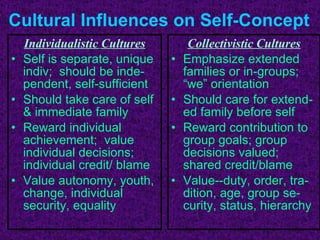
Cultural Influences on Self-Concept Individualistic   Cultures Self is separate, unique indiv;  should be inde-pendent, self-sufficient Should take care of self & immediate family Reward individual achievement;  value individual decisions;  individual credit/ blame Value autonomy, youth, change, individual security, equality Collectivistic Cultures Emphasize extended families or in-groups; “we” orientation Should care for extend-ed family before self Reward contribution to group goals; group decisions valued; shared credit/blame Value--duty, order, tra-dition, age, group se-curity, status, hierarchy
C.  Characteristics of Self-Concept affects communication. is subjective. resists change. is flexible, if it is healthy. is multi-dimensional The self-concept:
1. Self-concept affects communication. High Self-Esteem 1. Likely to think well of others 2. Expect to be accepted  3. Evaluate own performance more favorably 4. Perform well when being watched 5. Work harder for those who demand high standards 6. Feel comfortable with those perceived as superior 7. Able to defend self against criticism Low Self-Esteem 1. Likely to disapprove of others 2. Expect to be rejected 3. Evaluate own performance less favorably 4. Perform poorly when being watched 5. Work harder for undemand-ing less critical people 6. Feel threatened by those perceived as superior 7. Have difficulty defending self against criticism; easily influenced
Self-Fulfilling Prophecy We make a prediction based on a belief. We act toward person/situation as if prediction/belief is true. BECAUSE we act as if the belief is true, it becomes true. We observe this effect, which strengthens our belief.
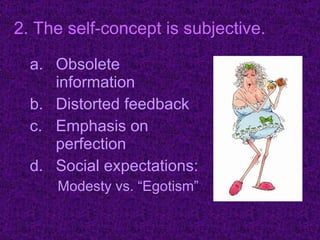
Obsolete information Distorted feedback Emphasis on perfection Social expectations: Modesty vs. “Egotism”  2. The self-concept is subjective.
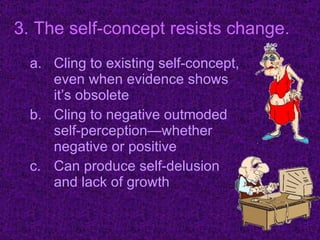
Cling to existing self-concept, even when evidence shows it’s obsolete Cling to negative outmoded self-perception—whether negative or positive Can produce self-delusion and lack of growth 3. The self-concept resists change.
“Can’t” Exercise Write a sentence which states something you can’t do. Cross out the “can’t” and replace it with “won’t” or “haven’t yet”. How does this change the meaning of this sentence? What does this have to do with self-concept?
We change: -from moment to moment. -from situation to situation. -over longer periods of time. We need to constantly adjust our  self-concept as new data becomes available. 4. A healthy self-concept is flexible.
Changing the Self-Concept Have realistic expectations Strive for a realistic perception of yourself Have the will to change Develop the skill to change
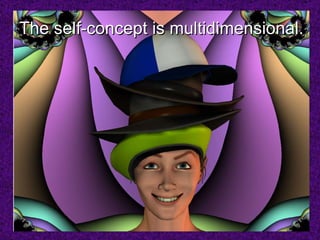
The self-concept is multidimensional.
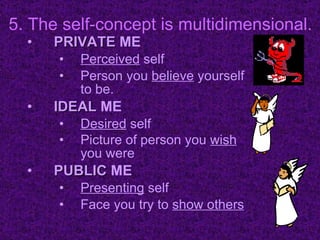
PRIVATE  ME Perceived  self  Person you  believe  yourself to be. IDEAL  ME Desired  self Picture of person you  wish  you were   PUBLIC  ME Presenting  self Face you try to  show others 5. The self-concept is multidimensional.
Defining My Three Selves Exercise Divide a sheet of paper into 3 equal parts.  Label the first column, “Perceived Self”.  Write words and/or draw pictures that best describe the person you know yourself to be. Label the second area, “Desired Self,” and repeat the process using words/pictures that describe the way you would like to be. Label the third area, “Presenting Self.”  Us words/pictures that represent the way to present yourself to others. Reflect on similarities & differences in the 3 areas. (Out/In, 4 th  ed. P. 60)
Explain the Johari window. Compare & contrast Johari window for two different relationships. Discuss rewards & risks of self-disclosure. List & explain guidelines for self-disclosure. List & explain guidelines for responding to self-disclosures of others. Objectives:  Self-Awareness &    Self-Esteem
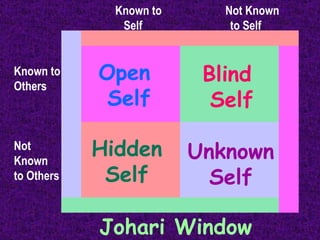
Johari Window  -- a tool that represents your communication behaviors II.  Self-Awareness Goal is to be  as open a communicator as  appropriate .
Known to     Not Known Self     to Self Known to  Others Not Known to Others Johari Window Open  Self Blind  Self Hidden Self Unknown Self
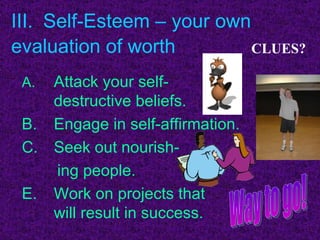
III. Self-Esteem – your own  evaluation of worth   A.  Attack your self-  destructive beliefs. B. Engage in self-affirmation. Seek out nourish- ing people. Work on projects that  will result in success. Way to go! CLUES?
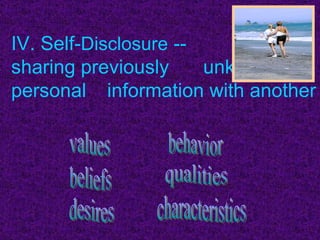
IV. Self- Disclosure  --      sharing previously  unknown personal  information with another values beliefs desires behavior qualities characteristics
 
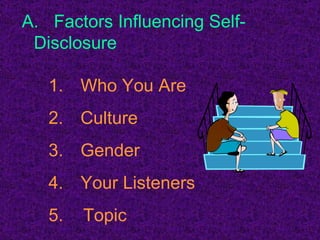
A. Factors Influencing Self- Disclosure 1. Who You Are 2. Culture 3. Gender 4. Your Listeners 5.  Topic
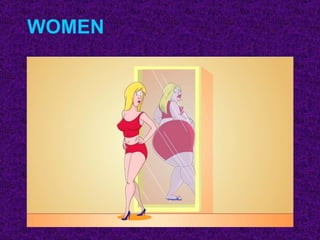
WOMEN
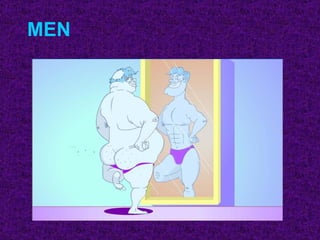
MEN
Weigh the rewards against the risks before deciding to self- disclose. CAUTION!
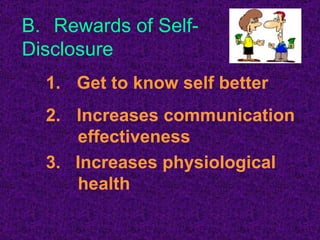
B. Rewards of Self- Disclosure 1.   Get to know self better Increases communication  effectiveness 3.  Increases physiological  health
C. Dangers of Self- Disclosure 1. Personal risks 2. Relational risks 3. Professional risks Experiential Vehicle, Devito Website
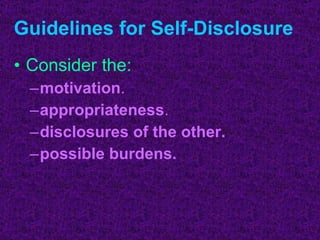
Guidelines for Self-Disclosure Consider the: motivation . appropriateness . disclosures of the other. possible burdens.
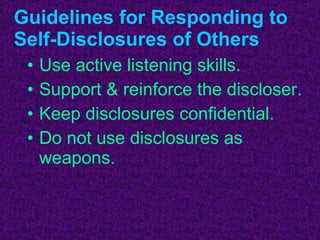
Guidelines for Responding to Self-Disclosures of Others Use active listening skills. Support & reinforce the discloser. Keep disclosures confidential. Do not use disclosures as weapons.
Objectives:  Apprehension Define communication apprehension & distinguish between state & trait apprehension. List 7 apprehensive behaviors. List & explain 7 influences on apprehension. Explain how cultural differences impact apprehension. Briefly describe 3 apprehension management theories.
V.  Apprehension A.  Nature of comm. apprehension 1.  Comm. apprehension--fear/anxiety    about interaction 2.  Trait apprehension--fear of comm.,    regardless of situation 3.  State apprehension--specific to a      given comm. situation
B.  Apprehensive Behaviors 1.  Decrease in frequency, strength, &    likelihood of engaging in comm. 2.  Less willing to volunteer 3.  Lack of satisfaction w/dating 4.  Talk less & avoid leadership 5.  Disclose less 6.  Avoid jobs requiring comm. 7.  Less likely to get job interviews
C.  Influences on comm. apprehension 1.  Degree of evaluation 2.  Subordinate status 3.  Degree of conspicuousness 4.  Degree of unpredictability 5.  Degree of dissimilarity 6.  Prior success & failures 7.  Lack of comm. skills & experience
D.  Culture & apprehension 1. Apprehension increases w/unfamiliarity 2. Higher if you have stereotypes,    prejudices 3. Situation influences--ambiguity, status,    perception of evaluation
E.  Apprehension Management Theories   1.  Cognitive Restructuring --change unreal-    istic beliefs which cause fear of failure   2.  Systematic Desensitization --unlearn      apprehension--creating hierarchy of      behaviors leading up to desired behavior   3.  Skill Acquisition -- a.   Prepare & practice b.  Focus on success c.  Familiarize yourself w/situation d.  Try to relax
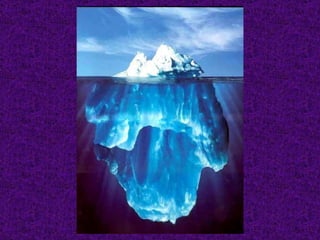
The End Presenting Self?  NOT!!!!! Appropriate Self-Disclosure?
Surveys/Exercises *Weighing Rewards & Costs of Self-Disclosure Self-Concept Scales Locus of Control Scales  Self-Fulfilling Prophecy cartoons & stories Self-Actualization Survey Self-Disclosure Survey Self-Monitoring Survey

Self in Interpersonal Communication

  • 1.
    Self in InterpersonalCommunication Chapter 3, Part 1 Devito 10 th ed .
  • 2.
    Chapter 3 Whoare you….really?
  • 3.
    Objectives: Self-ConceptDefine self-concept; explain how it develops. Explain how culture influences self-concept. Define & give examples of ego boosters/busters. List & explain 5 characteristics of self-concept. Define self-fulfilling prophecy & give example. Explain why self-concept is often distorted. Suggest how a distorted self-concept can be changed.
  • 4.
    I. Self-ConceptDefinition How you view yourself; self-image Feelings & thoughts about your strengths, weaknesses Relatively stable set of perceptions you hold of yourself: emotional states, talents, likes, dislikes, values, roles, etc.
  • 5.
    B. How theSelf-Concept Develops Others’ Images of You a. Looking Glass Self Reflected Appraisal: Ego Boosters & Ego Busters Social Comparisons Superior/Inferior Same/Different Cultural Teachings Your Own Interpretations & Experiences You're ugly! You're stupid! You're pretty! You're smart!
  • 6.
    Other’s Images SocialComparisons Your Interpretations & Evaluations Cultural Teachings Self Concept Sources of Self Concept
  • 7.
    Ego Boosters/Ego BustersExercise Recall an “ego booster” who helped enhance your self-esteem. Recall an “ego buster” from your life. Recall a time when you were an “ego booster” to someone else. Recall a time when you were an “ego buster”.
  • 8.
    Cultural Influences onSelf-Concept Individualistic Cultures Self is separate, unique indiv; should be inde-pendent, self-sufficient Should take care of self & immediate family Reward individual achievement; value individual decisions; individual credit/ blame Value autonomy, youth, change, individual security, equality Collectivistic Cultures Emphasize extended families or in-groups; “we” orientation Should care for extend-ed family before self Reward contribution to group goals; group decisions valued; shared credit/blame Value--duty, order, tra-dition, age, group se-curity, status, hierarchy
  • 9.
    C. Characteristicsof Self-Concept affects communication. is subjective. resists change. is flexible, if it is healthy. is multi-dimensional The self-concept:
  • 10.
    1. Self-concept affectscommunication. High Self-Esteem 1. Likely to think well of others 2. Expect to be accepted 3. Evaluate own performance more favorably 4. Perform well when being watched 5. Work harder for those who demand high standards 6. Feel comfortable with those perceived as superior 7. Able to defend self against criticism Low Self-Esteem 1. Likely to disapprove of others 2. Expect to be rejected 3. Evaluate own performance less favorably 4. Perform poorly when being watched 5. Work harder for undemand-ing less critical people 6. Feel threatened by those perceived as superior 7. Have difficulty defending self against criticism; easily influenced
  • 11.
    Self-Fulfilling Prophecy Wemake a prediction based on a belief. We act toward person/situation as if prediction/belief is true. BECAUSE we act as if the belief is true, it becomes true. We observe this effect, which strengthens our belief.
  • 12.
    Obsolete information Distortedfeedback Emphasis on perfection Social expectations: Modesty vs. “Egotism” 2. The self-concept is subjective.
  • 13.
    Cling to existingself-concept, even when evidence shows it’s obsolete Cling to negative outmoded self-perception—whether negative or positive Can produce self-delusion and lack of growth 3. The self-concept resists change.
  • 14.
    “Can’t” Exercise Writea sentence which states something you can’t do. Cross out the “can’t” and replace it with “won’t” or “haven’t yet”. How does this change the meaning of this sentence? What does this have to do with self-concept?
  • 15.
    We change: -frommoment to moment. -from situation to situation. -over longer periods of time. We need to constantly adjust our self-concept as new data becomes available. 4. A healthy self-concept is flexible.
  • 16.
    Changing the Self-ConceptHave realistic expectations Strive for a realistic perception of yourself Have the will to change Develop the skill to change
  • 17.
    The self-concept ismultidimensional.
  • 18.
    PRIVATE MEPerceived self Person you believe yourself to be. IDEAL ME Desired self Picture of person you wish you were PUBLIC ME Presenting self Face you try to show others 5. The self-concept is multidimensional.
  • 19.
    Defining My ThreeSelves Exercise Divide a sheet of paper into 3 equal parts. Label the first column, “Perceived Self”. Write words and/or draw pictures that best describe the person you know yourself to be. Label the second area, “Desired Self,” and repeat the process using words/pictures that describe the way you would like to be. Label the third area, “Presenting Self.” Us words/pictures that represent the way to present yourself to others. Reflect on similarities & differences in the 3 areas. (Out/In, 4 th ed. P. 60)
  • 20.
    Explain the Johariwindow. Compare & contrast Johari window for two different relationships. Discuss rewards & risks of self-disclosure. List & explain guidelines for self-disclosure. List & explain guidelines for responding to self-disclosures of others. Objectives: Self-Awareness & Self-Esteem
  • 21.
    Johari Window -- a tool that represents your communication behaviors II. Self-Awareness Goal is to be as open a communicator as appropriate .
  • 22.
    Known to Not Known Self to Self Known to Others Not Known to Others Johari Window Open Self Blind Self Hidden Self Unknown Self
  • 23.
    III. Self-Esteem –your own evaluation of worth A. Attack your self- destructive beliefs. B. Engage in self-affirmation. Seek out nourish- ing people. Work on projects that will result in success. Way to go! CLUES?
  • 24.
    IV. Self- Disclosure -- sharing previously unknown personal information with another values beliefs desires behavior qualities characteristics
  • 25.
  • 26.
    A. Factors InfluencingSelf- Disclosure 1. Who You Are 2. Culture 3. Gender 4. Your Listeners 5. Topic
  • 27.
  • 28.
  • 29.
    Weigh the rewardsagainst the risks before deciding to self- disclose. CAUTION!
  • 30.
    B. Rewards ofSelf- Disclosure 1. Get to know self better Increases communication effectiveness 3. Increases physiological health
  • 31.
    C. Dangers ofSelf- Disclosure 1. Personal risks 2. Relational risks 3. Professional risks Experiential Vehicle, Devito Website
  • 32.
    Guidelines for Self-DisclosureConsider the: motivation . appropriateness . disclosures of the other. possible burdens.
  • 33.
    Guidelines for Respondingto Self-Disclosures of Others Use active listening skills. Support & reinforce the discloser. Keep disclosures confidential. Do not use disclosures as weapons.
  • 34.
    Objectives: ApprehensionDefine communication apprehension & distinguish between state & trait apprehension. List 7 apprehensive behaviors. List & explain 7 influences on apprehension. Explain how cultural differences impact apprehension. Briefly describe 3 apprehension management theories.
  • 35.
    V. ApprehensionA. Nature of comm. apprehension 1. Comm. apprehension--fear/anxiety about interaction 2. Trait apprehension--fear of comm., regardless of situation 3. State apprehension--specific to a given comm. situation
  • 36.
    B. ApprehensiveBehaviors 1. Decrease in frequency, strength, & likelihood of engaging in comm. 2. Less willing to volunteer 3. Lack of satisfaction w/dating 4. Talk less & avoid leadership 5. Disclose less 6. Avoid jobs requiring comm. 7. Less likely to get job interviews
  • 37.
    C. Influenceson comm. apprehension 1. Degree of evaluation 2. Subordinate status 3. Degree of conspicuousness 4. Degree of unpredictability 5. Degree of dissimilarity 6. Prior success & failures 7. Lack of comm. skills & experience
  • 38.
    D. Culture& apprehension 1. Apprehension increases w/unfamiliarity 2. Higher if you have stereotypes, prejudices 3. Situation influences--ambiguity, status, perception of evaluation
  • 39.
    E. ApprehensionManagement Theories 1. Cognitive Restructuring --change unreal- istic beliefs which cause fear of failure 2. Systematic Desensitization --unlearn apprehension--creating hierarchy of behaviors leading up to desired behavior 3. Skill Acquisition -- a. Prepare & practice b. Focus on success c. Familiarize yourself w/situation d. Try to relax
  • 40.
    The End PresentingSelf? NOT!!!!! Appropriate Self-Disclosure?
  • 41.
    Surveys/Exercises *Weighing Rewards& Costs of Self-Disclosure Self-Concept Scales Locus of Control Scales Self-Fulfilling Prophecy cartoons & stories Self-Actualization Survey Self-Disclosure Survey Self-Monitoring Survey