Alternative Assessment Techniques Sanjaya Mishra
What is Assessment? Meaning?
What is Assessment? Meaning? Purposes?
What is Assessment? Meaning? Purposes? (assessing... Critical thinking and higher order cognitive abilities Solving problems and developing plans Performing procedures and demonstrating techniques Managing and developing oneself Assessing and managing information Demonstrating knowledge and understanding Designing, creating and performing Communicating
What is Assessment? Meaning? Purposes? Types? Assessment  of  Learning Assessment  for  Learning
What is Assessment? Meaning? Purposes? Types? Methods? Common methods Alternative methods
Problems in Assessment Subjectivity in Essays Time  Promotion of rote learning Quantification in objective tests Poor recognition of abilities Poor feedback and diminished chance of development
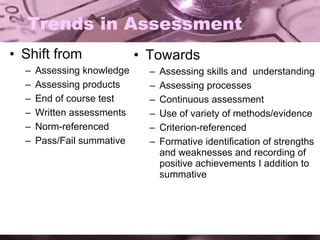
Trends in Assessment Shift from Assessing knowledge Assessing products End of course test Written assessments Norm-referenced Pass/Fail summative Towards Assessing skills and  understanding Assessing processes Continuous assessment Use of variety of methods/evidence Criterion-referenced Formative identification of strengths and weaknesses and recording of positive achievements I addition to summative
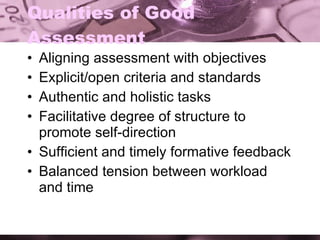
Qualities of Good Assessment Aligning assessment with objectives Explicit/open criteria and standards  Authentic and holistic tasks Facilitative degree of structure to promote self-direction Sufficient and timely formative feedback Balanced tension between workload and time
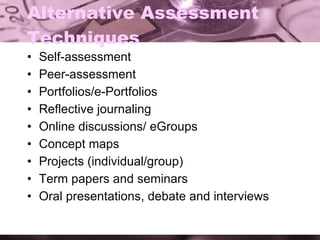
Alternative Assessment Techniques Self-assessment Peer-assessment Portfolios/e-Portfolios Reflective journaling Online discussions/ eGroups Concept maps Projects (individual/group) Term papers and seminars Oral presentations, debate and interviews
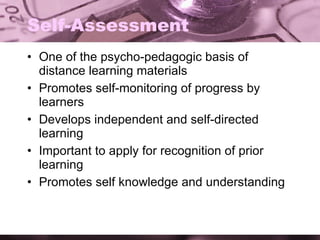
Self-Assessment One of the psycho-pedagogic basis of distance learning materials Promotes self-monitoring of progress by learners Develops independent and self-directed learning Important to apply for recognition of prior learning Promotes self knowledge and understanding
Self-Assessment Research shows that high achievers tend to under-estimate and low achievers tend to over-estimate (Falchikov and Boud, 1989; and Mishra, 2004). Tutor feedback is important Assessment criteria for self-assessment What I have been doing? How have I been doing? What do I think of what I have been doing? How could I improve my approach?
Peer-Assessment Used for Developing learners' skills of assessment Deepening their understanding of the process of assessment Strengthening their understanding of the topic and methods Develop their skills of group, task management, and power of articulation to provide feedback Facilitate self-assessment and reflective thinking
Peer-Assessment Is useful, when Adequate training in small group work is given Adequate training on self- and peer-assessment given Learning task is clearly defined with marking criteria It is moderated by the teacher and feedback given to students Group tasks are to be evaluated
Portfolios Collection of evidence that learning has taken place Collection of what learners themselves judge to be most meaningful representation of their learning in a subject Both a learning as well as assessment tool Developmental growth of a learner over a period of time can be tracked Also useful to prospective employers Provides opportunity for self-reflection
Portfolios Reflects evidence of: Progress over time Understanding of key principles and/or processes Lack of understanding and hence future learning needs Originality and creativity Achievements in different context and application Key skills development
Reflective Journaling Reflection is important for learning Two types:  Reflection-on-action  and  Reflection-in-action Reflection is a systematic meaning making process  that requires attitude to value the personal and intellectual growth of oneself and others. It is not just writing diary
Reflective Journaling Use action verbs in the level beyond "Remember" in revised Blooms Taxonomy Cover critical reflection approach by using questions such as what, how and why  Provide opportunity for contextualize, theorize, personalize, and generalize (Source:  Mishra and Panda, 2007)
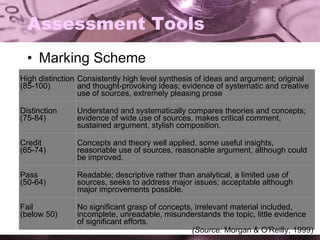
Assessment Tools Marking Scheme (Source:  Morgan & O'Reilly, 1999) High distinction (85-100) Consistently high level synthesis of ideas and argument; original and thought-provoking ideas; evidence of systematic and creative use of sources, extremely pleasing prose Distinction (75-84) Understand and systematically compares theories and concepts; evidence of wide use of sources, makes critical comment, sustained argument, stylish composition. Credit (65-74) Concepts and theory well applied, some useful insights, reasonable use of sources, reasonable argument, although could be improved. Pass (50-64) Readable; descriptive rather than analytical, a limited use of sources, seeks to address major issues; acceptable although major improvements possible. Fail (below 50) No significant grasp of concepts, irrelevant material included, incomplete, unreadable, misunderstands the topic, little evidence of significant efforts.
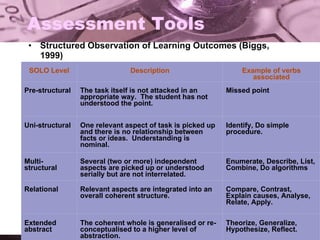
Assessment Tools Structured Observation of Learning Outcomes (Biggs, 1999) SOLO Level Description Example of verbs associated Pre-structural The task itself is not attacked in an appropriate way.  The student has not understood the point. Missed point Uni-structural One relevant aspect of task is picked up and there is no relationship between facts or ideas.  Understanding is nominal. Identify, Do simple procedure. Multi-structural Several (two or more) independent aspects are picked up or understood serially but are not interrelated. Enumerate, Describe, List, Combine, Do algorithms  Relational Relevant aspects are integrated into an overall coherent structure. Compare, Contrast, Explain causes, Analyse, Relate, Apply. Extended abstract The coherent whole is generalised or re-conceptualised to a higher level of abstraction. Theorize, Generalize, Hypothesize, Reflect.
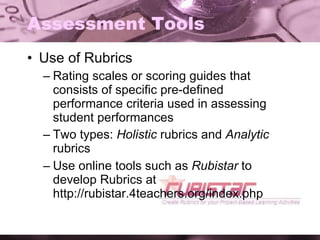
Assessment Tools Use of Rubrics Rating scales or scoring guides that consists of specific pre-defined performance criteria used in assessing student performances Two types:  Holistic  rubrics and  Analytic  rubrics Use online tools such as  Rubistar  to develop Rubrics at http://rubistar.4teachers.org/index.php
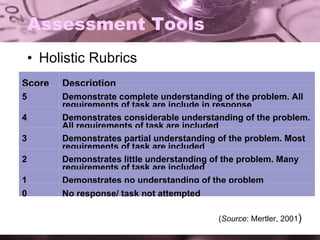
Assessment Tools Holistic Rubrics ( Source : Mertler, 2001 ) Score Description 5 Demonstrate complete understanding of the problem. All requirements of task are include in response 4 Demonstrates considerable understanding of the problem. All requirements of task are included 3 Demonstrates partial understanding of the problem. Most requirements of task are included 2 Demonstrates little understanding of the problem. Many  requirements of task are included 1 Demonstrates no understanding of the problem 0 No response/ task not attempted
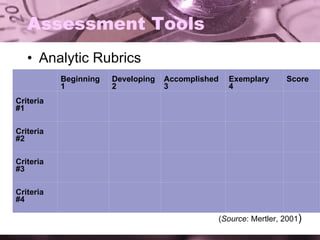
Assessment Tools Analytic Rubrics ( Source : Mertler, 2001 ) Beginning 1 Developing 2 Accomplished 3 Exemplary 4 Score Criteria #1 Criteria #2 Criteria #3 Criteria #4
Designing Scoring Rubrics Consider the table of specifications in your Blueprint (re-examine the learning objectives) Consider the grading pattern and schemes List the objectives covered in the item/test, as criteria Identify the observable attributes for each of the objectives/criteria For holistic rubrics, write narrative descriptions for each level of the grading scheme incorporating specific attributes For analytic rubrics, write narrative descriptions for each individual criteria for the grading scheme incorporating specific attributes Conduct peer-review of the rubrics and apply to representative student work to identify problems, if any Notify to students prior to the assessment task.
Implementing Alternative Assessment Techniques Is change necessary? What is the cost of not changing to contemporary practices? What are the problems to change? Policy, and policy-makers Attitudes of teachers Administrative procedures
Implementing Alternative Assessment Techniques Is change necessary? What is the cost of not changing to contemporary practices? What are the problems to change? Policy, and policy-makers Attitudes of teachers Administrative procedures Certainly knowledge and skill is not the problem....
Thank You... Your comments and questions are welcome...

Alternative Assessment Techniques

  • 1.
  • 2.
  • 3.
    What is Assessment?Meaning? Purposes?
  • 4.
    What is Assessment?Meaning? Purposes? (assessing... Critical thinking and higher order cognitive abilities Solving problems and developing plans Performing procedures and demonstrating techniques Managing and developing oneself Assessing and managing information Demonstrating knowledge and understanding Designing, creating and performing Communicating
  • 5.
    What is Assessment?Meaning? Purposes? Types? Assessment of Learning Assessment for Learning
  • 6.
    What is Assessment?Meaning? Purposes? Types? Methods? Common methods Alternative methods
  • 7.
    Problems in AssessmentSubjectivity in Essays Time Promotion of rote learning Quantification in objective tests Poor recognition of abilities Poor feedback and diminished chance of development
  • 8.
    Trends in AssessmentShift from Assessing knowledge Assessing products End of course test Written assessments Norm-referenced Pass/Fail summative Towards Assessing skills and understanding Assessing processes Continuous assessment Use of variety of methods/evidence Criterion-referenced Formative identification of strengths and weaknesses and recording of positive achievements I addition to summative
  • 9.
    Qualities of GoodAssessment Aligning assessment with objectives Explicit/open criteria and standards Authentic and holistic tasks Facilitative degree of structure to promote self-direction Sufficient and timely formative feedback Balanced tension between workload and time
  • 10.
    Alternative Assessment TechniquesSelf-assessment Peer-assessment Portfolios/e-Portfolios Reflective journaling Online discussions/ eGroups Concept maps Projects (individual/group) Term papers and seminars Oral presentations, debate and interviews
  • 11.
    Self-Assessment One ofthe psycho-pedagogic basis of distance learning materials Promotes self-monitoring of progress by learners Develops independent and self-directed learning Important to apply for recognition of prior learning Promotes self knowledge and understanding
  • 12.
    Self-Assessment Research showsthat high achievers tend to under-estimate and low achievers tend to over-estimate (Falchikov and Boud, 1989; and Mishra, 2004). Tutor feedback is important Assessment criteria for self-assessment What I have been doing? How have I been doing? What do I think of what I have been doing? How could I improve my approach?
  • 13.
    Peer-Assessment Used forDeveloping learners' skills of assessment Deepening their understanding of the process of assessment Strengthening their understanding of the topic and methods Develop their skills of group, task management, and power of articulation to provide feedback Facilitate self-assessment and reflective thinking
  • 14.
    Peer-Assessment Is useful,when Adequate training in small group work is given Adequate training on self- and peer-assessment given Learning task is clearly defined with marking criteria It is moderated by the teacher and feedback given to students Group tasks are to be evaluated
  • 15.
    Portfolios Collection ofevidence that learning has taken place Collection of what learners themselves judge to be most meaningful representation of their learning in a subject Both a learning as well as assessment tool Developmental growth of a learner over a period of time can be tracked Also useful to prospective employers Provides opportunity for self-reflection
  • 16.
    Portfolios Reflects evidenceof: Progress over time Understanding of key principles and/or processes Lack of understanding and hence future learning needs Originality and creativity Achievements in different context and application Key skills development
  • 17.
    Reflective Journaling Reflectionis important for learning Two types: Reflection-on-action and Reflection-in-action Reflection is a systematic meaning making process that requires attitude to value the personal and intellectual growth of oneself and others. It is not just writing diary
  • 18.
    Reflective Journaling Useaction verbs in the level beyond "Remember" in revised Blooms Taxonomy Cover critical reflection approach by using questions such as what, how and why Provide opportunity for contextualize, theorize, personalize, and generalize (Source: Mishra and Panda, 2007)
  • 19.
    Assessment Tools MarkingScheme (Source: Morgan & O'Reilly, 1999) High distinction (85-100) Consistently high level synthesis of ideas and argument; original and thought-provoking ideas; evidence of systematic and creative use of sources, extremely pleasing prose Distinction (75-84) Understand and systematically compares theories and concepts; evidence of wide use of sources, makes critical comment, sustained argument, stylish composition. Credit (65-74) Concepts and theory well applied, some useful insights, reasonable use of sources, reasonable argument, although could be improved. Pass (50-64) Readable; descriptive rather than analytical, a limited use of sources, seeks to address major issues; acceptable although major improvements possible. Fail (below 50) No significant grasp of concepts, irrelevant material included, incomplete, unreadable, misunderstands the topic, little evidence of significant efforts.
  • 20.
    Assessment Tools StructuredObservation of Learning Outcomes (Biggs, 1999) SOLO Level Description Example of verbs associated Pre-structural The task itself is not attacked in an appropriate way. The student has not understood the point. Missed point Uni-structural One relevant aspect of task is picked up and there is no relationship between facts or ideas. Understanding is nominal. Identify, Do simple procedure. Multi-structural Several (two or more) independent aspects are picked up or understood serially but are not interrelated. Enumerate, Describe, List, Combine, Do algorithms Relational Relevant aspects are integrated into an overall coherent structure. Compare, Contrast, Explain causes, Analyse, Relate, Apply. Extended abstract The coherent whole is generalised or re-conceptualised to a higher level of abstraction. Theorize, Generalize, Hypothesize, Reflect.
  • 21.
    Assessment Tools Useof Rubrics Rating scales or scoring guides that consists of specific pre-defined performance criteria used in assessing student performances Two types: Holistic rubrics and Analytic rubrics Use online tools such as Rubistar to develop Rubrics at http://rubistar.4teachers.org/index.php
  • 22.
    Assessment Tools HolisticRubrics ( Source : Mertler, 2001 ) Score Description 5 Demonstrate complete understanding of the problem. All requirements of task are include in response 4 Demonstrates considerable understanding of the problem. All requirements of task are included 3 Demonstrates partial understanding of the problem. Most requirements of task are included 2 Demonstrates little understanding of the problem. Many requirements of task are included 1 Demonstrates no understanding of the problem 0 No response/ task not attempted
  • 23.
    Assessment Tools AnalyticRubrics ( Source : Mertler, 2001 ) Beginning 1 Developing 2 Accomplished 3 Exemplary 4 Score Criteria #1 Criteria #2 Criteria #3 Criteria #4
  • 24.
    Designing Scoring RubricsConsider the table of specifications in your Blueprint (re-examine the learning objectives) Consider the grading pattern and schemes List the objectives covered in the item/test, as criteria Identify the observable attributes for each of the objectives/criteria For holistic rubrics, write narrative descriptions for each level of the grading scheme incorporating specific attributes For analytic rubrics, write narrative descriptions for each individual criteria for the grading scheme incorporating specific attributes Conduct peer-review of the rubrics and apply to representative student work to identify problems, if any Notify to students prior to the assessment task.
  • 25.
    Implementing Alternative AssessmentTechniques Is change necessary? What is the cost of not changing to contemporary practices? What are the problems to change? Policy, and policy-makers Attitudes of teachers Administrative procedures
  • 26.
    Implementing Alternative AssessmentTechniques Is change necessary? What is the cost of not changing to contemporary practices? What are the problems to change? Policy, and policy-makers Attitudes of teachers Administrative procedures Certainly knowledge and skill is not the problem....
  • 27.
    Thank You... Yourcomments and questions are welcome...