TYPES OF TEST ITEMS
• A written test composed a number of
test items.
• Items differ on the basis of the type of
responses they involve.
• Two categories of test items
•Free response
•Fixed response
TYPES OF TEST ITEMS
•Objective type items
•Short answer type items
•Essay type items
Objective Type Items
• Classification
–Supply type (Recall Type)
the respondents have to supply the
responses
–Selection Type (Recognition Type)
the students to select the responses
among the given responses
Completion types items
• Test items which requires to fill in the blank.
• He/she has to supply the word or pharse.
Eg:
- To draw the chart ………….. has to be
selected in insert menu.
Multiple Choice items
• A question had to be answered by the
respondent by selecting the correct response
out of the alternative responses.
Eg:
- 20%of 20
a. 4 B. 8 C. 100 D. 400
Matching type Questions
• In this type questions are given in one column
and a word or phrase associate as answer to
questions are given in another column.
• Students has to match the question and its
answer
True or False
• In this type, student is asked to read a
statement and say whether it is true or false.
Eg: We can change the font through Short cut
key.
Advantages
• Better coverage of content than any other type
questions
• Chances to get more marks in less time
• More reliable questions
• To measure knowledge, logical thinking, analysis
of the ideas
• Easy to evaluate
• Very comprehensive
Limitations
• Difficult to prepare
• Loss of full mark for wrong answer
• Demands high printing cost
• Does not help students’ language ability
• Creates a problem of guessing
Short Answer Type questions
• A question which can be answered in less
than four lines may be called short answer
type question.
• These type of questions cover a wider
content area
• Its scoring is reliable and objective.
Advantages of short Answer Type questions
• It gives training to the students to present
the subject matter in a concise manner
• Students make it full marks
• Scoring is reliable and objective
• Covers the entire syllabus deeply
Essay Type questions
• Essay type question is a question for which
student has to give written response upto
several paragraphs and pages.
–Logical thinking
–Critical reasoning
–Systematic presentation can be evaluated.
• Measures expression of skills and language
ability.
• Help to develop good study habit to prepare
evidence for and against a topic.
Purposes
• Power of selective recall information
• Capacity of comparison and contrast
• Ability of establishing relationships
• Power of establishing relationships
• Power of interpretation and application
• Ability of creative thinking
• Ability of problem solving
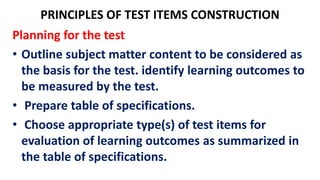
PRINCIPLES OF TEST ITEMS CONSTRUCTION
Planning for the test
• Outline subject matter content to be considered as
the basis for the test. identify learning outcomes to
be measured by the test.
• Prepare table of specifications.
• Choose appropriate type(s) of test items for
evaluation of learning outcomes as summarized in
the table of specifications.
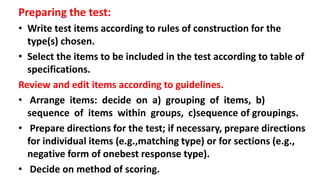
Preparing the test:
• Write test items according to rules of construction for the
type(s) chosen.
• Select the items to be included in the test according to table of
specifications.
Review and edit items according to guidelines.
• Arrange items: decide on a) grouping of items, b)
sequence of items within groups, c)sequence of groupings.
• Prepare directions for the test; if necessary, prepare directions
for individual items (e.g.,matching type) or for sections (e.g.,
negative form of onebest response type).
• Decide on method of scoring.
Analyzing and revising the test:
• Perform test analysis to determine
difficulty, discrimination and reliability.
• Retain, edit as necessary, or discard
items on basis of analysis outcomes.
• Revise the test as a whole if necessary.
1.Require definite clear-cut short term answers.
2.Don’t take statements directly from text book to use as a basis for
short items.
3.A direct question is generally desirable then incomplete statements.
4.When the answer is to be expressed in numerical units, indicate the
type of answer required.
5.Blanks for answer should be equal in length.
6.Don’t have too many blanks in an item.
CONSTRUCTING SUPPLY TYPE ITEMS
CONSTRUCTING MULTIPLE CHOICE
Stem/ Question
1. Use direct question scheme
2. Item should be clear, definite and explicit.
3. Eliminate excess language or non-functioning words.
4. Avoid negatively stated items.
5. Avoid double jeopardy.
6. Avoid items which contain irrelevant clues.
CHOICES
1.Present alternatives in logical alphabetical or numerical order.
2.Present four or more options.
3.Response alternatives should be mutually exclusive.
4.Use attractive and plausible alternatives.
5.Make responses appear in random order.
6.Use responses “all of the above” , “ none of the above” with
caution.
7.Follow rules of grammar.
8.There should be no order in the placement of the correct
response.
CONSTRUCTING MATCHING TYPE
1.Use homogenous material or related material
should be used in a single matching exercise.
2.Include unequal number of responses and premise.
3.Keep the list of items to be matched brief and place
the shorter responses at the right.
4.Arrange the responses in alphabetical or logical
order.
5.Place all the items for the matching type on the
same page.
6.Diagrams may also used for matching.
CONSTRUCTING TRUE/FALSE OR ALTERNATIVE RESPONSE
1.Make statements 100% True or False if they are to be judged.
2.Avoid the use of negative and double negatives.
3.Avoid long complex sentences.
4.Avoid two ideas in one statement unless cause-effect relation.
5.If option if used, attribute it to the source.
6.True and False statements should be approximately equal in
number, equal in length and randomly arranged to avoid clues.
7.The correct responses should not follow a pattern.
1.Words should be clear and meaningful.
2.Structure the question so that the range of acceptable
responses should consist of few sentences or a short list of
items.
3.When using computational problems, specify the units and
degree of precision that should be used in expressing the
answer.
PRINCIPLES OF SHORT ANSWER QUESTIONS
1.Use words that conveys meaning to the students
2.Use essay questions for the purpose it best serves
3.Determine in advance the weightage expected for the complete
answer.
4.Essay question can be controlled or uncontrolled.
5.Essay questions should measure students’ ability to analyse,
synthesize or evaluate.
CONSTRUCTING ESSAY TYPE ITEMS
6. types of test items

6. types of test items

  • 1.
    TYPES OF TESTITEMS • A written test composed a number of test items. • Items differ on the basis of the type of responses they involve. • Two categories of test items •Free response •Fixed response
  • 2.
    TYPES OF TESTITEMS •Objective type items •Short answer type items •Essay type items
  • 3.
    Objective Type Items •Classification –Supply type (Recall Type) the respondents have to supply the responses –Selection Type (Recognition Type) the students to select the responses among the given responses
  • 4.
    Completion types items •Test items which requires to fill in the blank. • He/she has to supply the word or pharse. Eg: - To draw the chart ………….. has to be selected in insert menu.
  • 5.
    Multiple Choice items •A question had to be answered by the respondent by selecting the correct response out of the alternative responses. Eg: - 20%of 20 a. 4 B. 8 C. 100 D. 400
  • 6.
    Matching type Questions •In this type questions are given in one column and a word or phrase associate as answer to questions are given in another column. • Students has to match the question and its answer
  • 7.
    True or False •In this type, student is asked to read a statement and say whether it is true or false. Eg: We can change the font through Short cut key.
  • 8.
    Advantages • Better coverageof content than any other type questions • Chances to get more marks in less time • More reliable questions • To measure knowledge, logical thinking, analysis of the ideas • Easy to evaluate • Very comprehensive
  • 9.
    Limitations • Difficult toprepare • Loss of full mark for wrong answer • Demands high printing cost • Does not help students’ language ability • Creates a problem of guessing
  • 10.
    Short Answer Typequestions • A question which can be answered in less than four lines may be called short answer type question. • These type of questions cover a wider content area • Its scoring is reliable and objective.
  • 11.
    Advantages of shortAnswer Type questions • It gives training to the students to present the subject matter in a concise manner • Students make it full marks • Scoring is reliable and objective • Covers the entire syllabus deeply
  • 12.
    Essay Type questions •Essay type question is a question for which student has to give written response upto several paragraphs and pages. –Logical thinking –Critical reasoning –Systematic presentation can be evaluated. • Measures expression of skills and language ability. • Help to develop good study habit to prepare evidence for and against a topic.
  • 13.
    Purposes • Power ofselective recall information • Capacity of comparison and contrast • Ability of establishing relationships • Power of establishing relationships • Power of interpretation and application • Ability of creative thinking • Ability of problem solving
  • 17.
    PRINCIPLES OF TESTITEMS CONSTRUCTION Planning for the test • Outline subject matter content to be considered as the basis for the test. identify learning outcomes to be measured by the test. • Prepare table of specifications. • Choose appropriate type(s) of test items for evaluation of learning outcomes as summarized in the table of specifications.
  • 18.
    Preparing the test: •Write test items according to rules of construction for the type(s) chosen. • Select the items to be included in the test according to table of specifications. Review and edit items according to guidelines. • Arrange items: decide on a) grouping of items, b) sequence of items within groups, c)sequence of groupings. • Prepare directions for the test; if necessary, prepare directions for individual items (e.g.,matching type) or for sections (e.g., negative form of onebest response type). • Decide on method of scoring.
  • 19.
    Analyzing and revisingthe test: • Perform test analysis to determine difficulty, discrimination and reliability. • Retain, edit as necessary, or discard items on basis of analysis outcomes. • Revise the test as a whole if necessary.
  • 20.
    1.Require definite clear-cutshort term answers. 2.Don’t take statements directly from text book to use as a basis for short items. 3.A direct question is generally desirable then incomplete statements. 4.When the answer is to be expressed in numerical units, indicate the type of answer required. 5.Blanks for answer should be equal in length. 6.Don’t have too many blanks in an item. CONSTRUCTING SUPPLY TYPE ITEMS
  • 21.
    CONSTRUCTING MULTIPLE CHOICE Stem/Question 1. Use direct question scheme 2. Item should be clear, definite and explicit. 3. Eliminate excess language or non-functioning words. 4. Avoid negatively stated items. 5. Avoid double jeopardy. 6. Avoid items which contain irrelevant clues.
  • 22.
    CHOICES 1.Present alternatives inlogical alphabetical or numerical order. 2.Present four or more options. 3.Response alternatives should be mutually exclusive. 4.Use attractive and plausible alternatives. 5.Make responses appear in random order. 6.Use responses “all of the above” , “ none of the above” with caution. 7.Follow rules of grammar. 8.There should be no order in the placement of the correct response.
  • 23.
    CONSTRUCTING MATCHING TYPE 1.Usehomogenous material or related material should be used in a single matching exercise. 2.Include unequal number of responses and premise. 3.Keep the list of items to be matched brief and place the shorter responses at the right. 4.Arrange the responses in alphabetical or logical order. 5.Place all the items for the matching type on the same page. 6.Diagrams may also used for matching.
  • 24.
    CONSTRUCTING TRUE/FALSE ORALTERNATIVE RESPONSE 1.Make statements 100% True or False if they are to be judged. 2.Avoid the use of negative and double negatives. 3.Avoid long complex sentences. 4.Avoid two ideas in one statement unless cause-effect relation. 5.If option if used, attribute it to the source. 6.True and False statements should be approximately equal in number, equal in length and randomly arranged to avoid clues. 7.The correct responses should not follow a pattern.
  • 25.
    1.Words should beclear and meaningful. 2.Structure the question so that the range of acceptable responses should consist of few sentences or a short list of items. 3.When using computational problems, specify the units and degree of precision that should be used in expressing the answer. PRINCIPLES OF SHORT ANSWER QUESTIONS
  • 26.
    1.Use words thatconveys meaning to the students 2.Use essay questions for the purpose it best serves 3.Determine in advance the weightage expected for the complete answer. 4.Essay question can be controlled or uncontrolled. 5.Essay questions should measure students’ ability to analyse, synthesize or evaluate. CONSTRUCTING ESSAY TYPE ITEMS