

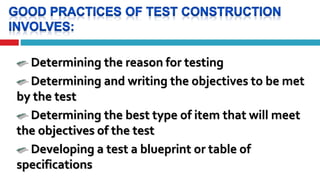




Determining the reason for testing
Determining and writing the objectives to be met
by the test
Determining the best type of item that will meet
the objectives of the test
Developing a test a blueprint or table of
specifications
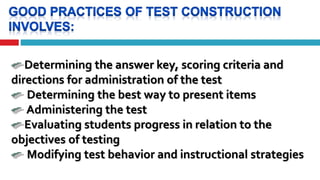
Determining the answer key, scoring criteria and
directions for administration of the test
Determining the best way to present items
Administering the test
Evaluating students progress in relation to the
objectives of testing
Modifying test behavior and instructional strategies
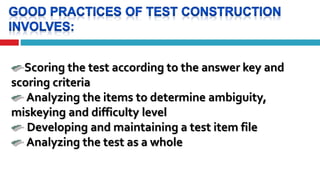
Scoring the test according to the answer key and
scoring criteria
Analyzing the items to determine ambiguity,
miskeying and difficulty level
Developing and maintaining a test item file
Analyzing the test as a whole
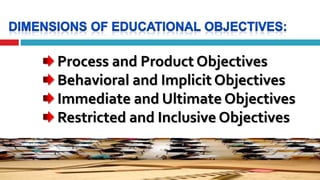
Process and Product Objectives
Behavioral and Implicit Objectives
Immediate and Ultimate Objectives
Restricted and Inclusive Objectives
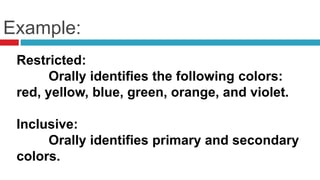
Example:
Restricted:
Orally identifies the following colors:
red, yellow, blue, green, orange, and violet.
Inclusive:
Orally identifies primary and secondary
colors.
TheCognitive,Affectiveand Psychomotor
Domains
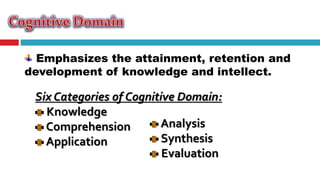
Emphasizes the attainment, retention and
development of knowledge and intellect.
Six Categories of Cognitive Domain:
Knowledge
Comprehension
Application
Analysis
Synthesis
Evaluation
Encompasses those behaviors
characterized by feelings, emotions or
value.
Five Levels of affective Domain:
Receiving or Attending
Responding
Valuing
Organization
Characterization by aValue orValues Complex
Refers to muscular or
motors behaviors
ITEM SAMPLING AND
SELECTION
T H E T E S T B L U E P R I N T
A two-way grid and the most
effective way to ensure adequate
representation of items.
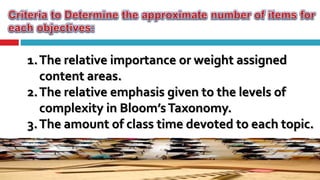
1.The relative importance or weight assigned
content areas.
2.The relative emphasis given to the levels of
complexity in Bloom’sTaxonomy.
3.The amount of class time devoted to each topic.
One of the most important
RESPONSIBILITIES of
teachers is to determine
which students outcomes
are to be GIVEN HIGH
PRIORITY.
Open-Book and Closed-Book Examination
The Frequency ofTesting
The Effect of UnannouncedTest
Modes of Item Presentation

Planning the test

  • 3.
    Determining the reasonfor testing Determining and writing the objectives to be met by the test Determining the best type of item that will meet the objectives of the test Developing a test a blueprint or table of specifications
  • 4.
    Determining the answerkey, scoring criteria and directions for administration of the test Determining the best way to present items Administering the test Evaluating students progress in relation to the objectives of testing Modifying test behavior and instructional strategies
  • 5.
    Scoring the testaccording to the answer key and scoring criteria Analyzing the items to determine ambiguity, miskeying and difficulty level Developing and maintaining a test item file Analyzing the test as a whole
  • 6.
    Process and ProductObjectives Behavioral and Implicit Objectives Immediate and Ultimate Objectives Restricted and Inclusive Objectives
  • 7.
    Example: Restricted: Orally identifies thefollowing colors: red, yellow, blue, green, orange, and violet. Inclusive: Orally identifies primary and secondary colors.
  • 8.
  • 9.
    Emphasizes the attainment,retention and development of knowledge and intellect. Six Categories of Cognitive Domain: Knowledge Comprehension Application Analysis Synthesis Evaluation
  • 10.
    Encompasses those behaviors characterizedby feelings, emotions or value. Five Levels of affective Domain: Receiving or Attending Responding Valuing Organization Characterization by aValue orValues Complex
  • 11.
    Refers to muscularor motors behaviors
  • 12.
    ITEM SAMPLING AND SELECTION TH E T E S T B L U E P R I N T
  • 13.
    A two-way gridand the most effective way to ensure adequate representation of items.
  • 14.
    1.The relative importanceor weight assigned content areas. 2.The relative emphasis given to the levels of complexity in Bloom’sTaxonomy. 3.The amount of class time devoted to each topic.
  • 15.
    One of themost important RESPONSIBILITIES of teachers is to determine which students outcomes are to be GIVEN HIGH PRIORITY.
  • 16.
    Open-Book and Closed-BookExamination The Frequency ofTesting The Effect of UnannouncedTest Modes of Item Presentation