For automotive and industrial applications: car infotainment,
body control modules, video cameras, industrial computers,
and test & measurement equipment
Application guide: ESD protection
Contents
2
1. Automotive interfaces........................................................................................................................................................... 4
1.1 CAN...................................................................................................................................................................................... 4
1.2 LIN........................................................................................................................................................................................ 5
1.3 FlexRay ................................................................................................................................................................................ 6
1.4 Car Infotainment.................................................................................................................................................................. 7
2. NFC antennas......................................................................................................................................................................... 8
3. General I/O Protection.......................................................................................................................................................... 9
3.1 Digital I/O ........................................................................................................................................................................... 9
3.2 Analog I/O......................................................................................................................................................................... 10
3.3 Low-voltage comparator................................................................................................................................................... 11
4. Serial buses............................................................................................................................................................................ 12
4.1 Legacy: I2
C......................................................................................................................................................................... 12
4.2 Legacy: SPI/SSI.................................................................................................................................................................. 13
4.3 Legacy: RS-232 and RS-485.............................................................................................................................................. 14
4.4 USB2.0 and USB OTG........................................................................................................................................................ 15
4.5 USB 3.0.............................................................................................................................................................................. 16
4.6 eSATA................................................................................................................................................................................. 17
4.7 High-speed Differential Mode signaling (LVDS, CML, TMDS, etc.).................................................................................. 18
5. Display interfaces.................................................................................................................................................................. 19
5.1 HDMI.................................................................................................................................................................................. 19
5.2 DisplayPort........................................................................................................................................................................ 20
6. Ethernet................................................................................................................................................................................ 21
6.1 Ethernet ESD protection................................................................................................................................................... 19
6.2 BroadR-Reach ESD protection.......................................................................................................................................... 20
7. RF........................................................................................................................................................................................... 23
7.1 GPS /GNSS......................................................................................................................................................................... 19
7.2 WLAN................................................................................................................................................................................. 20
8. Support tools........................................................................................................................................................................ 23
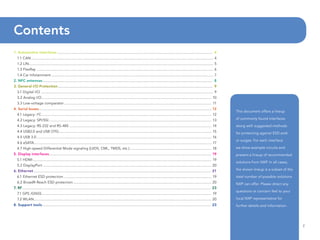
This document offers a lineup
of commonly found interfaces
along with suggested methods
for protecting against ESD and/
or surges. For each interface
we show example circuits and
present a lineup of recommended
solutions from NXP. In all cases,
the shown lineup is a subset of the
total number of possible solutions
NXP can offer. Please direct any
questions or concern feel to your
local NXP representative for
further details and information.
3
NXP – your partner for ESD protection
ESD protection has been an important part of electronic design for many
years. Now, as integration levels continue to increase, and process geometries
continue to shrink, the ESD-induced damage is a more present threat than
ever before. Add this to the growing demand for portable electronics, and ESD
protection has become an essential issue at the system level.
Adding comprehensive ESD protection to a system isn’t just smart engineering,
it’s also a low-cost, easy way to prevent problems later in the product life cycle:
An ESD problem that remains hidden in a system, poses an increased risk of
field failures, reduced system life, and other quality-related problems that are
difficult to manage and expensive to resolve. The after-market costs associated
with field repair and product recalls can be crippling, and quality issues can do
serious harm to the brand reputation.
NXP offers more than 400 protection devices, ranging from single-protection
diodes to complete, highly integrated companion ICs. Our ESD solutions are
offered in a wide package portfolio, ranging from leaded to leadless packages.
Moreover, package innovations like solderable side pads enable visual
inspection while a package innovation like pass-through routing assures an
optimal board layout as well as enhanced ESD protection as the device can be
positioned closed to the interface.
This application guide covers automotive and industrial applications. But what
you see here is just the tip of the iceberg. For a full listing of our most up-to-
date ESD protection solutions, visit www.nxp.com/circuit-protection.
Introduction
What you get when you choose NXP for ESD protection
 Greater system-level immunity (IEC61000-4-2 level 4 standard and
beyond)
 Ultra-low clamping voltages, to safeguard even the latest, smallest
geometries in SoC devices
 Minimized impact on bus and interface signal integrity
 Low leakage current, for maximum energy efficiency and minimum
distortion on analog interfaces
 Arrays that combine multiline protection in single devices
 Packages that simplify PCB design for optimized layouts
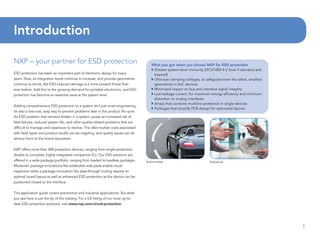
Automotive Industrial
4
1.	 Automotive interfaces
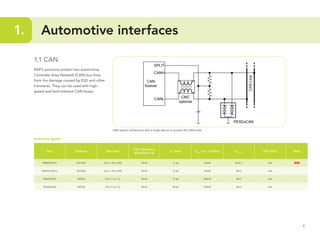
1.1 CAN
NXP’s solutions protect two automotive
Controller Area Network (CAN) bus lines
from the damage caused by ESD and other
transients. They can be used with high-
speed and fault-tolerant CAN buses.
Selection guide
Part Package Size (mm)
ESD robustness
(IEC61000-4-2)
Cd
(max) Pppm
at tp
= 8/20µs VRWM
AEC-Q101 Note
PESD2IVN-U SOT323 2.0 x 1.25 x 0.95 18 kV 11 pF 150 W 26.5 V Yes NEW
PESD1CAN-U SOT323 2.0 x 1.25 x 0.95 23 kV 12 pF 150 W 24 V Yes
PESD1CAN SOT23 2.9 x 1.3 x 1.0 23 kV 17 pF 200 W 24 V Yes
PESD2CAN SOT23 2.9 x 1.3 x 1.0 30 kV 30 pF 230 W 24 V Yes
CAN system architecture with a single device to protect the CAN node
5
1.	 Automotive interfaces
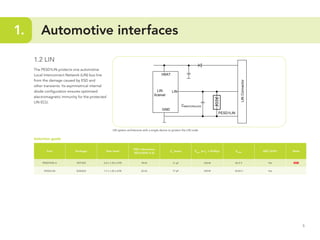
1.2 LIN
The PESD1LIN protects one automotive
Local Interconnect Network (LIN) bus line
from the damage caused by ESD and
other transients. Its asymmetrical internal
diode configuration ensures optimized
electromagnetic immunity for the protected
LIN ECU.
Selection guide
Part Package Size (mm)
ESD robustness
(IEC61000-4-2)
Cd
(max) Pppm
at tp
= 8/20µs VRWM
AEC-Q101 Note
PESD1IVN-U SOT323 2.0 x 1.25 x 0.95 18 kV 11 pF 150 W 26.5 V Yes NEW
PESD1LIN SOD323 1.7 x 1.25 x 0.95 23 kV 17 pF 160 W 15/24 V Yes
LIN system architecture with a single device to protect the LIN node
6
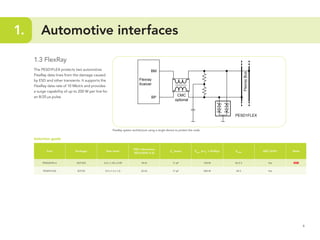
1.3 FlexRay
The PESD1FLEX protects two automotive
FlexRay data lines from the damage caused
by ESD and other transients. It supports the
FlexRay data rate of 10 Mbit/s and provides
a surge capability of up to 200 W per line for
an 8/20 μs pulse.
Selection guide
Part Package Size (mm)
ESD robustness
(IEC61000-4-2)
Cd
(max) Pppm
at tp
= 8/20µs VRWM
AEC-Q101 Note
PESD2IVN-U SOT323 2.0 x 1.25 x 0.95 18 kV 11 pF 150 W 26.5 V Yes NEW
PESD1FLEX SOT23 2.9 x 1.3 x 1.0 23 kV 17 pF 200 W 24 V Yes
FlexRay system architecture using a single device to protect the node
1.	 Automotive interfaces
7
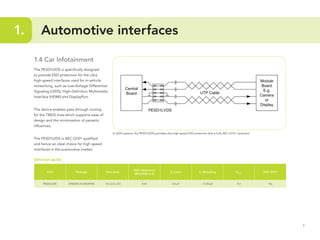
1.4 Car Infotainment
The PESD1LVDS is specifically designed
to provide ESD protection for the ultra
high-speed interfaces used for in-vehicle
networking, such as Low-Voltage Differential
Signaling (LVDS), High-Definition Multimedia
Interface (HDMI) and DisplayPort.
The device enables pass-through routing
for the TMDS lines which supports ease of
design and the minimization of parasitic
influences.
The PESD1LVDS is AEC-Q101 qualified
and hence an ideal choice for high speed
interfaces in the automotive market.
Selection guide
Part Package Size (mm)
ESD robustness
(IEC61000-4-2)
Cd
(max) Cd
Matching VRWM
AEC-Q101
PESD1LVDS DFN2510-10 (XSON10) 1.0 x 2.5 x 0.5 8 kV 0.6 pF  0.05 pF 5 V Yes
In LVDS systems, the PESD1LVDS provides ultra high-speed ESD protection that is fully AEC-Q101 compliant
1.	 Automotive interfaces
8
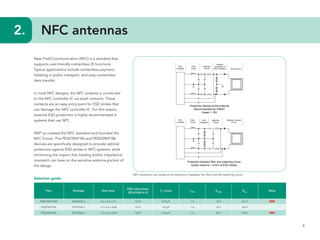
2.	 NFC antennas
Near Field Communication (NFC) is a standard that
supports user-friendly contactless ID functions.
Typical applications include contactless payment,
ticketing in public transport, and easy contactless
data transfer.
In most NFC designs, the NFC antenna is connected
to the NFC controller IC via small contacts. These
contacts are an easy entry point for ESD strikes that
can damage the NFC controller IC. For this reason,
external ESD protection is highly recommended in
systems that use NFC.
NXP co-created the NFC standard and founded the
NFC Forum. The PESD18VF1Bx and PESD24VF1Bx
devices are specifically designed to provide optimal
protection against ESD strikes in NFC systems, while
minimizing the impact that loading and/or impedance
mismatch can have on the sensitive antenna portion of
the design.
Selection guide
Part Package Size (mm)
ESD robustness
(IEC61000-4-2)
Cd
(max) IPPM
VRWM
Rdyn
Note
PESD18VF1BSF DSN0603-2 0.6 x 0.3 x 0.3 10 kV 0.45 pF 1 A 18 V 0.6 Ω NEW
PESD18VF1BL DFN1006-2 1.0 x 0.6 x 0.48 10 kV 0.5 pF 1 A 18 V 0.8 Ω
PESD24VF1BL DFN1006-2 1.0 x 0.6 x 0.48 10 kV 0.45 pF 1 A 24 V 0.8 Ω NEW
NFC protection can reside at the antenna or between the filter and the matching circuit
9
3.	 General I/O Protection
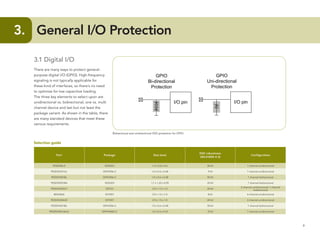
3.1 Digital I/O
There are many ways to protect general-
purpose digital I/O (GPIO). High-frequency
signaling is not typically applicable for
these kind of interfaces, so there’s no need
to optimize for low capacitive loading.
The three key elements to select upon are
unidirectional vs. bidirectional, one vs. multi
channel device and last but not least the
package variant. As shown in the table, there
are many standard devices that meet these
various requirements.
Selection guide
Part Package Size (mm)
ESD robustness
(IEC61000-4-2)
Configuration
PESD5Z6.0 SOD523 1.2 x 0.8 x 0.6 30 kV 1 channel unidirectional
PESD3V3U1UL DFN1006-2 1.0 x 0.6 x 0.48 9 kV 1 channel unidirectional
PESD5V0S1BL DFN1006-2 1.0 x 0.6 x 0.48 30 kV 1 channel bidirectional
PESD5V0S1BA SOD323 1.7 x 1.25 x 0.95 30 kV 1 channel bidirectional
PESD5V2S2UT SOT23 2.9 x 1.3 x 1.0 30 kV
2 channel unidirectional/ 1 channel
bidirectional
BZA456A SOT457 2.9 x 1.5 x 1.0 8 kV 4 channel unidirectional
PESD3V3S4UD SOT457 2.9 x 1.5 x 1.0 30 kV 4 channel unidirectional
PESD5V0V1BL DFN1006-2 1.0 x 0.6 x 0.48 30 kV 1 channel bidirectional
PESD5V0X1UALD DFN1006D-2 1.0 x 0.6 x 0.37 15 kV 1 channel unidirectional
Bidirectional and unidirectional ESD protection for GPIO
10
3.	 General I/O Protection
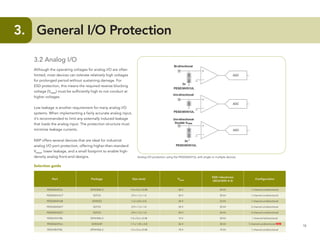
3.2 Analog I/O
Although the operating voltages for analog I/O are often
limited, most devices can tolerate relatively high voltages
for prolonged period without sustaining damage. For
ESD protection, this means the required reverse blocking
voltage (VRWM
) must be sufficiently high to not conduct at
higher voltages.
Low leakage is another requirement for many analog I/O
systems. When implementing a fairly accurate analog input,
it’s recommended to limit any externally induced leakage
that loads the analog input. The protection structure must
minimize leakage currents.
NXP offers several devices that are ideal for industrial
analog I/O port protection, offering higher-than-standard
VRWM
, lower leakage, and a small footprint to enable high-
density analog front-end designs.
Selection guide
Part Package Size (mm) VRWM
ESD robustness
(IEC61000-4-2)
Configuration
PESD36VS1UL DFN1006-2 1.0 x 0.6 x 0.48 36 V 30 kV 1 channel unidirectional
PESD24VU1UT SOT23 2.9 x 1.3 x 1.0 24 V 30 kV 1 channel unidirectional
PESD24VS1UB SOD523 1.2 x 0.8 x 0.6 24 V 23 kV 1 channel unidirectional
PESD36VS2UT SOT23 2.9 x 1.3 x 1.0 36 V 30 kV 2 channel unidirectional
PESD24VS2UT SOT23 2.9 x 1.3 x 1.0 24 V 23 kV 2 channel unidirectional
PESD12VV1BL DFN1006-2 1.0 x 0.6 x 0.48 12 V 30 kV 1 channel bidirectional
PESD36VS1UJ SOD323F 1.7 x 1.25 x 0.8 36 V 30 kV 1 channel unidirectional NEW
PESD18VF1BL DFN1006-2 1.0 x 0.6 x 0.48 18 V 10 kV 1 channel unidirectional
Analog I/O protection using the PESD36VS1UL with single or multiple devices
11
3.	 General I/O Protection
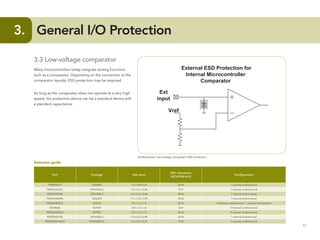
3.3 Low-voltage comparator
Many microcontrollers today integrate analog functions
such as a comparator. Depending on the connection to the
comparator input(s), ESD protection may be required.
As long as the comparator does not operate at a very high
speed, the protection device can be a standard device with
a standard capacitance.
External ESD Protection for
Internal Microcontroller
Comparator
Vref
Ext
input
Selection guide
Part Package Size (mm)
ESD robustness
(IEC61000-4-2)
Configuration
PESD5Z6.0 SOD523 1.2 x 0.8 x 0.6 30 kV 1 channel unidirectional
PESD3V3U1UL DFN1006-2 1.0 x 0.6 x 0.48 9 kV 1 channel unidirectional
PESD5V0S1BL DFN1006-2 1.0 x 0.6 x 0.48 30 kV 1 channel bidirectional
PESD5V0S1BA SOD323 1.7 x 1.25 x 0.95 30 kV 1 channel bidirectional
PESD5V2S2UT SOT23 2.9 x 1.3 x 1.0 30 kV 2 channel unidirectional / 1 channel bidirectional
BZA456A SOT457 2.9 x 1.5 x 1.0 8 kV 4 channel unidirectional
PESD3V3S4UD SOT457 2.9 x 1.5 x 1.0 30 kV 4 channel unidirectional
PESD5V0V1BL DFN1006-2 1.0 x 0.6 x 0.48 30 kV 1 channel bidirectional
PESD5V0X1UALD DFN1006D-2 1.0 x 0.6 x 0.37 15 kV 1 channel unidirectional
Unidirectional, low-voltage comparator ESD protection
12
4.	 Serial buses
4.1 Legacy: I2
C
I2
C speeds range from the original 100 KHz up to 5 MHz
in Ultra Fast mode. The solutions shown here are more
tailored for I2
C solutions running at speeds of 100 kHz
(standard) to 400 kHz (Fast Mode).
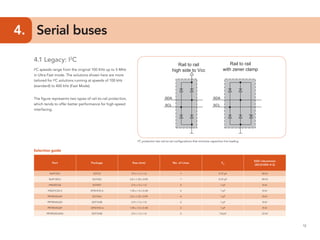
The figure represents two types of rail-to-rail protection,
which tends to offer better performance for high-speed
interfacing.
SDA
SCL
SDA
SCL
Rail to rail
high side to Vcc
SDA
SCL
Rail to rail
with zener clamp
Selection guide
Part Package Size (mm) No. of Lines Cd
ESD robustness
(IEC61000-4-2)
NUP1301 SOT23 2.9 x 1.3 x 1.0 1 0.75 pF 30 kV
NUP1301U SOT323 2.0 x 1.25 x 0.95 1 0.75 pF 30 kV
IP4220CZ6 SOT457 2.9 x 1.5 x 1.0 4 1 pF 8 kV
IP4221CZ6-S DFN1410-6 1.45 x 1.0 x 0.48 4 1 pF 8 kV
PRTR5V0U4Y SOT363 2.0 x 1.25 x 0.95 4 1 pF 8 kV
PRTR5V0U2X SOT143B 2.9 x 1.3 x 1.0 2 1 pF 8 kV
PRTR5V0U2F DFN1410-6 1.45 x 1.0 x 0.48 2 1 pF 8 kV
PRTR5V0U2AX SOT143B 2.9 x 1.3 x 1.0 2 1.8 pF 12 kV
I2
C protection two rail-to-rail configurations that minimize capacitive line loading
13
4.	 Serial buses
4.2 Legacy: SPI/SSI
The Serial Peripheral Interface (SPI), also known as the
Synchronous Serial Interface (SSI), is a synchronous serial
data link that has devices communicate in master/slave
mode. Common clock frequencies are in the range of 10
kHz to 100 MHz.
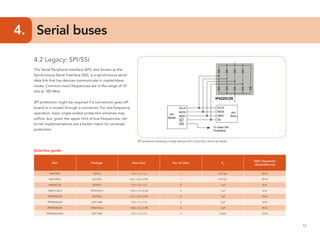
SPI protection might be required if a connection goes off-
board or is routed through a connector. For low-frequency
operation, basic single-ended protection schemes may
suffice, but, given the upper limit of bus frequencies, rail-
to-rail implementations are a better match for universal
protection.
Selection guide
Part Package Size (mm) No. of Lines Cd
ESD robustness
(IEC61000-4-2)
NUP1301 SOT23 2.9 x 1.3 x 1.0 1 0.75 pF 30 kV
NUP1301U SOT323 2.0 x 1.25 x 0.95 1 0.75 pF 30 kV
IP4220CZ6 SOT457 2.9 x 1.5 x 1.0 4 1 pF 8 kV
IP4221CZ6-S DFN1410-6 1.45 x 1.0 x 0.48 4 1 pF 8 kV
PRTR5V0U4Y SOT363 2.0 x 1.25 x 0.95 4 1 pF 8 kV
PRTR5V0U2X SOT143B 2.9 x 1.3 x 1.0 2 1 pF 8 kV
PRTR5V0U2F DFN1410-6 1.45 x 1.0 x 0.48 2 1 pF 8 kV
PRTR5V0U2AX SOT143B 2.9 x 1.3 x 1.0 2 1.8 pF 12 kV
SPI protection showing a single device with a four-line, rail-to-rail diode
14
4.	 Serial buses
4.3 Legacy: RS-232 and RS-485
NXP offers several devices that are well suited for
protection of RS-485 or RS-232 interfaces.
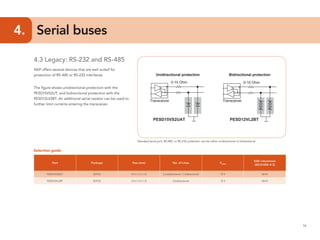
The figure shows unidirectional protection with the
PESD15VS2UT, and bidirectional protection with the
PESD12LV2BT. An additional serial resistor can be used to
further limit currents entering the transceiver.
Selection guide
Part Package Size (mm) No. of Lines VRWM
ESD robustness
(IEC61000-4-2)
PESD15VS2UT SOT23 2.9 x 1.3 x 1.0 2 unidirectional / 1 bidirectional 15 V 30 kV
PESD12VL2BT SOT23 2.9 x 1.3 x 1.0 2 bidirectional 12 V 30 kV
Standard serial port, RS-485, or RS-232 protection can be either unidirectional or bidirectional
Transceiver Transceiver
Unidirectional protection Bidirectional protection
15
4.	 Serial buses
4.4 USB2.0 and USB OTG
The USB 2.0 standard features a maximum signaling rate of 480 Mbit/s with
an effective throughput of up to 35 MByte/s or 280 Mbit/s.
USB 2.0 is a mainstream interface in today’s electronic systems and is one of
the most common interfaces used in microcontrollers.
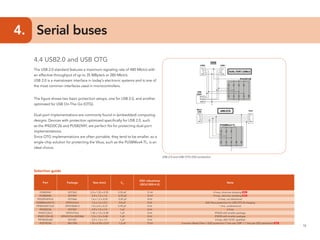
The figure shows two basic protection setups, one for USB 2.0, and another
optimized for USB On-The-Go (OTG).
Dual-port implementations are commonly found in (embedded) computing
designs. Devices with protection optimized specifically for USB 2.0, such
as the IP4220CZ6 and PUSB2X4Y, are perfect fits for protecting dual-port
implementations.
Since OTG implementations are often portable, they tend to be smaller, so a
single-chip solution for protecting the Vbus, such as the PUSBMxx4-TL, is an
ideal choice.
USB 2.0 and USB OTG ESD protection
Selection guide
Part Package Size (mm) Cd
ESD robustness
(IEC61000-4-2)
Note
PUSB2X4Y SOT363 2.0 x 1.25 x 0.95 0.55 pF 12 kV 4 lines, ultra-low clamping NEW
PUSB2X4D SOT457 2.9 x 1.5 x 1.0 0.55 pF 12 kV 4 lines, ultra-low clamping NEW
PESD5V0F5UV SOT666 1.6 x 1.2 x 0.55 0.55 pF 8 kV 5 lines, uni-directional
PUSBMxxVX4-TL DFN1616-6 1.6 x 1.6 x 0.5 0.8 pF 8 kV Add Vbus protection for USB OTG  charging
PESD5V0X1ULD DFN1006D-2 1.0 x 0.6 x 0.37 0.95 pF 8 kV 1 line, unidirectional
IP4220CZ6 SOT457 2.9 x 1.5 x 1.0 1 pF 8 kV 4 lines
IP4221CZ6-S DFN1410-6 1.45 x 1.0 x 0.48 1 pF 8 kV IP4220 with smaller package
IP4221CZ6-XS DFN1010-6 (XSON6) 1.0 x 1.0 x 0.48 1 pF 8 kV IP4220 with smaller package
PRTR5V0U4D SOT457 2.9 x 1.5 x 1.0 1 pF 8 kV 4 lines, AEC-Q101 qualified
IP3319CX6 WLCSP6 1.35 x 0.95 x 0.57 1.5 pF 15 kV Common Mode Filter + ESD protection (1 line pair CMF + 1 line pair ESD protection) NEW
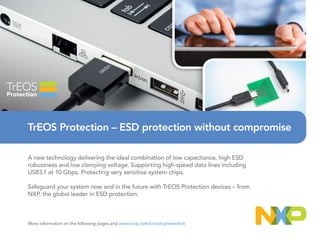
A new technology delivering the ideal combination of low capacitance, high ESD
robustness and low clamping voltage. Supporting high-speed data lines including
USB3.1 at 10 Gbps. Protecting very sensitive system chips.
Safeguard your system now and in the future with TrEOS Protection devices – from
NXP, the global leader in ESD protection.
More information on the following pages and www.nxp.com/circuit-protection
TrEOS Protection – ESD protection without compromise
17
4.	 Serial buses
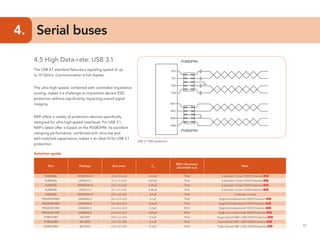
4.5 High Data-rate: USB 3.1
The USB 3.1 standard features a signaling speed of up
to 10 Gbit/s. Communication is full-duplex.
The ultra-high speed, combined with controlled impedance
routing, makes it a challenge to implement decent ESD
protection without significantly impacting overall signal
integrity.
NXP offers a variety of protection devices specifically
designed for ultra high-speed interfaces. For USB 3.1,
NXP’s latest offer is based on the PUSB3FR4. Its excellent
clamping performance, combined with ultra-low and
well-matched capacitance, makes it an ideal fit for USB 3.1
protection.	
PUSB3FR4
PUSB3FR4
Selection guide
Part Package Size (mm) Cd
ESD robustness
(IEC61000-4-2)
Note
PUSB3AB4 DFN2510A-10 2.5 x 1.0 x 0.5 0.2 pF 15 kV 2 channels / 4 lines TrEOS Protection NEW
PUSB3TB6 DFN2111-7 2.1 x 1.1 x 0.5 0.27 pF 10 kV 3 channels / 6 lines TrEOS Protection NEW
PUSB3FR4 DFN2510A-10 2.5 x 1.0 x 0.5 0.29 pF 15 kV 2 channels / 4 lines TrEOS Protection NEW
PUSB3FR6 DFN2111-7 2.1 x 1.1 x 0.5 0.35 pF 15 kV 3 channels / 6 lines TrEOS Protection NEW
PUSB3F96 DFN2510A-10 2.5 x 1.0 x 0.5 0.5 pF 10 kV 2 channels / 4 lines
PESD5V0R1BSF DSN0603-2 0.6 x 0.3 x 0.3 0.1 pF 10 kV Single line bidirectional TrEOS Protection NEW
PESD5V0H1BSF DSN0603-2 0.6 x 0.3 x 0.3 0.15 pF 15 kV Single line bidirectional TrEOS Protection NEW
PESD5V0C1BSF DSN0603-2 0.6 x 0.3 x 0.3 0.2 pF 20 kV Single line bidirectional TrEOS Protection NEW
PESD5V0C1USF DSN0603-2 0.6 x 0.3 x 0.3 0.45 pF 20 kV Single line unidirectional TrEOS Protection NEW
PCMF1USB3 WLCSP5 0.8 x 1.2 x 0.5 0.3 pF 15 kV Single channel CMF + ESD TrEOS Protection NEW
PCMF2USB3 WLCSP10 1.6 x 1.2 x 0.5 0.3 pF 15 kV Dual channel CMF + ESD TrEOS Protection NEW
PCMF3USB3 WLCSP15 2.4 x 1.2 x 0.5 0.3 pF 15 kV Triple channel CMF + ESD TrEOS Protection NEW
USB 3.1 ESD protection
18
4.	 Serial buses
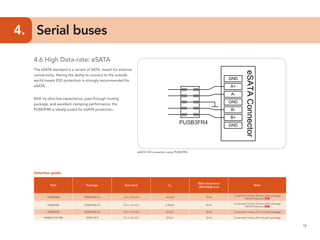
4.6 High Data-rate: eSATA
The eSATA standard is a variant of SATA, meant for external
connectivity. Having the ability to connect to the outside
world means ESD protection is strongly recommended for
eSATA.
With its ultra-low capacitance, pass through routing
package, and excellent clamping performance, the
PUSB3FR4 is ideally suited for eSATA protection.	
PUSB3FR4
Selection guide
Part Package Size (mm) Cd
ESD robustness
(IEC61000-4-2)
Note
PUSB3AB4 DFN2510A-10 2.5 x 1.0 x 0.5 0.2 pF 15 kV
2 channels/ 4 lines, 0.5 mm pitch package
TrEOS Protection NEW
PUSB3FR4 DFN2510A-10 2.5 x 1.0 x 0.5 0.29 pF 15 kV
2 channels/ 4 lines, 0.5 mm pitch package
TrEOS Protection NEW
PUSB3F96 DFN2510A-10 2.5 x 1.0 x 0.5 0.5 pF 10 kV 2 channels/ 4 lines, 0.5 mm pitch package
IP4285CZ10-TBB DFN2110-9 2.1 x 1.0 x 0.5 0.8 pF 12 kV 2 channels/ 4 lines, 0.4 mm pitch package
eSATA ESD protection using PUSB3FR4
19
4.	 Serial buses
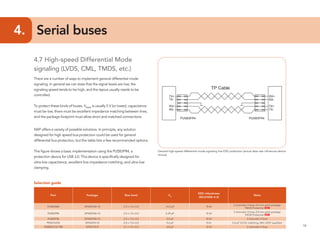
4.7 High-speed Differential Mode
signaling (LVDS, CML, TMDS, etc.)
There are a number of ways to implement general differential mode
signaling. In general we can state that the signal levels are low, the
signaling speed tends to be high, and the layout usually needs to be
controlled.
To protect these kinds of buses, VRWM
is usually 5 V (or lower), capacitance
must be low, there must be excellent impedance matching between lines,
and the package footprint must allow short and matched connections.
NXP offers a variety of possible solutions. In principle, any solution
designed for high speed bus protection could be used for general
differential bus protection, but the table lists a few recommended options.
The figure shows a basic implementation using the PUSB3FR4, a
protection device for USB 3.0. This device is specifically designed for
ultra-low capacitance, excellent line-impedance matching, and ultra-low
clamping.
TP Cable
TX+
TX-
RX+
RX-
TX+
TX-
RX+
RX-
PUSB3FR4 PUSB3FR4
Selection guide
Part Package Size (mm) Cd
ESD robustness
(IEC61000-4-2)
Note
PUSB3AB4 DFN2510A-10 2.5 x 1.0 x 0.5 0.2 pF 15 kV
2 channels/ 4 lines, 0.5 mm pitch package
TrEOS Protection NEW
PUSB3FR4 DFN2510A-10 2.5 x 1.0 x 0.5 0.29 pF 15 kV
2 channels/ 4 lines, 0.5 mm pitch package
TrEOS Protection NEW
PUSB3F96 DFN2510A-10 2.5 x 1.0 x 0.5 0.5 pF 10 kV 2 channels/ 4 lines
PESD1LVDS DFN2510-10 2.5 x 1.0 x 0.5 0.6 pF 8 kV 0.6 pF Ch/Ch matching, AEC-Q101 qualified
IP4285CZ10-TBB DFN2110-9 2.1 x 1.0 x 0.5 0.8 pF 12 kV 2 channels/ 4 lines
General high-speed differential mode signaling line ESD protection (actual data rate influences device
choice)
20
5.	 Display interfaces
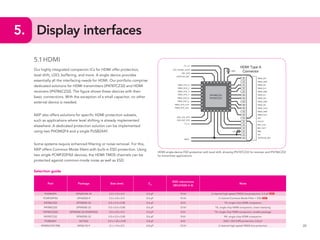
5.1	HDMI
Our highly integrated companion ICs for HDMI offer protection,
level shift, LDO, buffering, and more. A single device provides
essentially all the interfacing needs for HDMI. Our portfolio comprise
dedicated solutions for HDMI transmitters (IP4787CZ32) and HDMI
receivers (IP4786CZ32). The figure shows these devices with their
basic connections. With the exception of a small capacitor, no other
external device is needed.
NXP also offers solutions for specific HDMI protection subsets,
such as applications where level shifting is already implemented
elsewhere. A dedicated protection solution can be implemented
using two PHDMI2F4 and a single PUSB2X4Y.
Some systems require enhanced filtering or noise removal. For this,
NXP offers Common Mode filters with built-in ESD protection. Using
two single PCMF2DFN2 devices, the HDMI TMDS channels can be
protected against common-mode noise as well as ESD.
Selection guide
Part Package Size (mm) Cd
ESD robustness
(IEC61000-4-2)
Note
PHDMI2F4 DFN2510A-10 2.5 x 1.0 x 0.5 0.5 pF 10 kV 2 channel high-speed TMDS line protection, 0.5 pF NEW
PCMF2DFN2 DFN2520-9 2.5 x 2.0 x 0.5 0.6 pF 15 kV 2 channel Common Mode Filter + ESD NEW
IP4786CZ32 DFN5050-32 5.0 x 5.0 x 0.85 0.6 pF 8 kV TX, single-chip HDMI companion
IP4788CZ32 DFN5050-32 5.0 x 5.0 x 0.85 0.6 pF 12 kV TX, single chip HDMI companion, lower clamping
IP4786CZ32S DFN4040-32 (HXQFN32) 4.0 x 4.0 x 0.5 0.6 pF 8 kV TX, single chip HDMI companion, smaller package
IP4787CZ32 DFN5050-32 5.0 x 5.0 x 0.85 0.6 pF 8 kV RX, single-chip HDMI companion
PUSB2X4Y SOT363 2.0 x 1.25 x 0.95 0.8 pF 8 kV DDC/ CEC/HPD protection, 0.8 pF
IP4285CZ10-TBB DFN2110-9 2.1 x 1.0 x 0.5 0.8 pF 12 kV 2 channel high-speed TMDS line protection
HDMI single-device ESD protection with level shift, showing IP4787CZ32 for receiver and IP4786CZ32
for transmitter applications.
21
5.	 Display interfaces
5.2	 DisplayPort
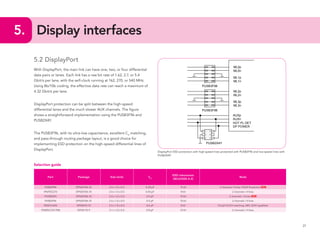
With DisplayPort, the main link can have one, two, or four differential
data pairs or lanes. Each link has a raw bit rate of 1.62, 2.7, or 5.4
Gbit/s per lane, with the self-clock running at 162, 270, or 540 MHz.
Using 8b/10b coding, the effective data rate can reach a maximum of
4.32 Gbit/s per lane.
DisplayPort protection can be split between the high-speed
differential lanes and the much slower AUX channels. The figure
shows a straightforward implementation using the PUSB3F96 and
PUSB2X4Y.
The PUSB3F96, with its ultra-low capacitance, excellent Cd
matching,
and pass-through routing package layout, is a good choice for
implementing ESD protection on the high-speed differential lines of
DisplayPort.
Selection guide
Part Package Size (mm) Cd
ESD robustness
(IEC61000-4-2)
Note
PUSB3FR4 DFN2510A-10 2.5 x 1.0 x 0.5 0.29 pF 15 kV 2 channels/ 4 lines TrEOS Protection NEW
IP4292CZ10 DFN2510A-10 2.5 x 1.0 x 0.5 0.45 pF 8 kV 2 channels / 4 lines
PHDMI2F4 DFN2510A-10 2.5 x 1.0 x 0.5 0.5 pF 10 kV 2 channels / 4 lines NEW
PUSB3F96 DFN2510A-10 2.5 x 1.0 x 0.5 0.5 pF 10 kV 2 channels / 4 lines
PESD1LVDS DFN2510-10 2.5 x 1.0 x 0.5 0.6 pF 8 kV 0.6 pF Ch/Ch matching, AEC-Q101 qualified
IP4285CZ10-TBB DFN2110-9 2.1 x 1.0 x 0.5 0.8 pF 12 kV 2 channels / 4 lines
DisplayPort ESD protection with high-speed lines protected with PUSB3F96 and low-speed lines with
PUSB2X4Y
22
6.	 Ethernet
6.1	Ethernet ESD Protection
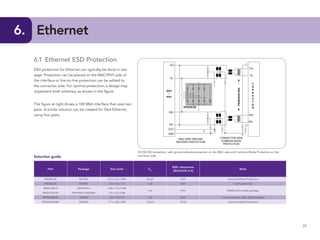
ESD protection for Ethernet can typically be done in two
ways. Protection can be placed on the MAC/PHY side of
the interface or line-to-line protection can be added to
the connector side. For optimal protection, a design may
implement both schemes, as shown in the figure.
The figure at right shows a 100 Mbit interface that uses two
pairs. A similar solution can be created for Gbit Ethernet,
using four pairs.
Selection guide
Part Package Size (mm) Cd
ESD robustness
(IEC61000-4-2)
Note
IP4233CZ6 SOT363 2.0 x 1.25 x 0.95 0.9 pF 8 kV Common Mode Protection
IP4220CZ6 SOT457 2.9 x 1.5 x 1.0 1 pF 8 kV 1 port protection
IP4221CZ6-S DFN1410-6 1.45 x 1.0 x 0.48
1 pF 8 kV IP4220 with smaller package
IP4221CZ6-XS DFN1010-6 (XSON6) 1.0 x 1.0 x 0.48
PRTR5V0U4D SOT457 2.9 x 1.5 x 1.0 1 pF 8 kV 1 port protection, AEC-Q101 qualified
PESD5V0U1BA SOD323 1.7 x 1.25 x 0.95 2.9 pF 10 kV Common Mode Protection
10/100 ESD protection, with ground-referred protection on the MAC side and Common Mode Protection on the
connector side
23
6.	 Ethernet
6.2	BroadR-Reach ESD protection
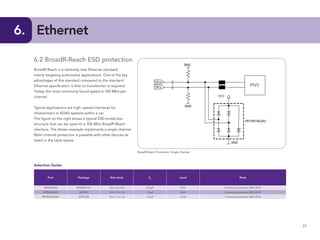
BroadR-Reach is a relatively new Ethernet standard
mainly targeting automotive applications. One of the key
advantages of this standard compared to the standard
Ethernet specification is that no transformer is required.
Today, the most commonly found speed is 100 Mbit per
channel.
Typical applications are high -speed interfaces for
infotainment or ADAS systems within a car.
The figure on the right shows a typical ESD protection
structure that can be used on a 100 Mbit BroadR-Reach
interface. The shown example implements a single channel.
Multi-channel protection is possible with other devices as
listed in the table below.
Selection Guide
Part Package Size (mm) Cd
Level Note
PESD1LVDS DFN2510-10 1.0 x 2.5 x 0.5 0.6 pF 8 kV 2-channel protection, AEC-Q101
PRTR5V0U4D SOT457 2.9 x 1.5 x 1.0 1.0 pF 8 kV 2-channel protection, AEC-Q101
PRTR5V0U2AX SOT143B 2.9 x 1.3 x 1.0 1.8 pF 12 kV 1-channel protection, AEC-Q101
BroadR-Reach Protection, Single Channel
24
7.	 RF
7.1	 GPS / GNSS
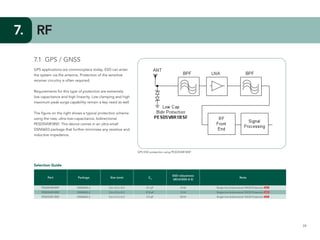
GPS applications are commonplace today. ESD can enter
the system via the antenna. Protection of the sensitive
receiver circuitry is often required.
Requirements for this type of protection are extremely
low capacitance and high linearity. Low clamping and high
maximum peak surge capability remain a key need as well.
The figure on the right shows a typical protection scheme
using the new, ultra-low-capacitance, bidirectional
PESD5V0R1BSF. This device comes in an ultra-small
DSN0603 package that further minimizes any resistive and
inductive impedance.
Selection Guide
Part Package Size (mm) Cd
ESD robustness
(IEC61000-4-2)
Note
PESD5V0R1BSF DSN0603-2 0.6 x 0.3 x 0.3 0.1 pF 10 kV Single-line bidirectional TrEOS Protection NEW
PESD5V0H1BSF DSN0603-2 0.6 x 0.3 x 0.3 0.15 pF 15 kV Single-line bidirectional TrEOS Protection NEW
PESD5V0C1BSF DSN0603-2 0.6 x 0.3 x 0.3 0.2 pF 20 kV Single-line bidirectional TrEOS Protection NEW
GPS ESD protection using PESD5V0R1BSF
25
7.	 RF
7.2	 WLAN
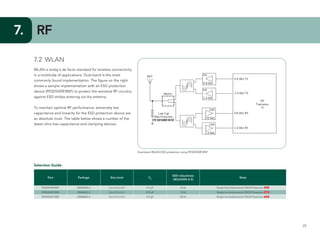
WLAN is today’s de facto standard for wireless connectivity
in a multitude of applications. Dual-band is the most
commonly found implementation. The figure on the right
shows a sample implementation with an ESD protection
device (PESD5V0R1BSF) to protect the sensitive RF circuitry
against ESD strikes entering via the antenna.
To maintain optimal RF performance, extremely low
capacitance and linearity for the ESD protection device are
an absolute must. The table below shows a number of the
latest ultra-low-capacitance and clamping devices.
Selection Guide
Part Package Size (mm) Cd
ESD robustness
(IEC61000-4-2)
Note
PESD5V0R1BSF DSN0603-2 0.6 x 0.3 x 0.3 0.1 pF 10 kV Single-line bidirectional TrEOS Protection NEW
PESD5V0H1BSF DSN0603-2 0.6 x 0.3 x 0.3 0.15 pF 15 kV Single-line bidirectional TrEOS Protection NEW
PESD5V0C1BSF DSN0603-2 0.6 x 0.3 x 0.3 0.2 pF 20 kV Single-line bidirectional TrEOS Protection NEW
Dual-band WLAN ESD protection using PESD5V0R1BSF
26
To help you achieve the best, most efficient design with our products, we offer a wide variety of support tools, available on the
NXP Semiconductors website www.nxp.com/circuit-protection.
Documents  technical support
Find and download application notes, datasheets or literature with product details, find links to additional technical details and contact
information for further questions. NXP’s technical support portal: http://www.nxp.com/technical-support-portal
Offline X-reference tool  selector guide
Find NXP alternates to industry part numbers and download the X-Reference offline tool or install the latest version of the offline product
selector: http://www.nxp.com/products/x-reference-offline-tool
Download NXP App
This free NXP application allows engineers to search, buy and share more than 10,000 products parts from NXP‘s product portfolio on
your iPhone, iPad and iPod Touch or Android: http://www.nxp.com/news/mobile-app.html
Models and test data
A selection of our spice models can be found at: http://www.nxp.com/models
Samples
Order samples directly from our online system: http://www.nxp.com/help/samples
Sales offices and distributors
Dedicated and skilled sales and distribution teams provide support on a regional level: http://www.nxp.com/profile/sales
Selection Guide – digital version
The pdf file of this selection guide can be downloaded here: http://www.nxp.com/discrete_selection_guide
8.	 Support tools
Notes
www.nxp.com
© 2015 NXP Semiconductors N.V.
All rights reserved. Reproduction in whole or in part is prohibited without the prior written consent of the copyright owner. The information presented in this document
does not form part of any quotation or contract, is believed to be accurate and reliable and may be changed without notice. No liability will be accepted by the
publisher for any consequence of its use. Publication thereof does not convey nor imply any license under patent- or other industrial or intellectual property rights.
Date of release: July 2015
Document order number: 9397 750 17664
Printed in the Netherlands

NXP Automotive ESD Protection Application Guide

  • 1.
    For automotive andindustrial applications: car infotainment, body control modules, video cameras, industrial computers, and test & measurement equipment Application guide: ESD protection
  • 2.
    Contents 2 1. Automotive interfaces...........................................................................................................................................................4 1.1 CAN...................................................................................................................................................................................... 4 1.2 LIN........................................................................................................................................................................................ 5 1.3 FlexRay ................................................................................................................................................................................ 6 1.4 Car Infotainment.................................................................................................................................................................. 7 2. NFC antennas......................................................................................................................................................................... 8 3. General I/O Protection.......................................................................................................................................................... 9 3.1 Digital I/O ........................................................................................................................................................................... 9 3.2 Analog I/O......................................................................................................................................................................... 10 3.3 Low-voltage comparator................................................................................................................................................... 11 4. Serial buses............................................................................................................................................................................ 12 4.1 Legacy: I2 C......................................................................................................................................................................... 12 4.2 Legacy: SPI/SSI.................................................................................................................................................................. 13 4.3 Legacy: RS-232 and RS-485.............................................................................................................................................. 14 4.4 USB2.0 and USB OTG........................................................................................................................................................ 15 4.5 USB 3.0.............................................................................................................................................................................. 16 4.6 eSATA................................................................................................................................................................................. 17 4.7 High-speed Differential Mode signaling (LVDS, CML, TMDS, etc.).................................................................................. 18 5. Display interfaces.................................................................................................................................................................. 19 5.1 HDMI.................................................................................................................................................................................. 19 5.2 DisplayPort........................................................................................................................................................................ 20 6. Ethernet................................................................................................................................................................................ 21 6.1 Ethernet ESD protection................................................................................................................................................... 19 6.2 BroadR-Reach ESD protection.......................................................................................................................................... 20 7. RF........................................................................................................................................................................................... 23 7.1 GPS /GNSS......................................................................................................................................................................... 19 7.2 WLAN................................................................................................................................................................................. 20 8. Support tools........................................................................................................................................................................ 23 This document offers a lineup of commonly found interfaces along with suggested methods for protecting against ESD and/ or surges. For each interface we show example circuits and present a lineup of recommended solutions from NXP. In all cases, the shown lineup is a subset of the total number of possible solutions NXP can offer. Please direct any questions or concern feel to your local NXP representative for further details and information.
  • 3.
    3 NXP – yourpartner for ESD protection ESD protection has been an important part of electronic design for many years. Now, as integration levels continue to increase, and process geometries continue to shrink, the ESD-induced damage is a more present threat than ever before. Add this to the growing demand for portable electronics, and ESD protection has become an essential issue at the system level. Adding comprehensive ESD protection to a system isn’t just smart engineering, it’s also a low-cost, easy way to prevent problems later in the product life cycle: An ESD problem that remains hidden in a system, poses an increased risk of field failures, reduced system life, and other quality-related problems that are difficult to manage and expensive to resolve. The after-market costs associated with field repair and product recalls can be crippling, and quality issues can do serious harm to the brand reputation. NXP offers more than 400 protection devices, ranging from single-protection diodes to complete, highly integrated companion ICs. Our ESD solutions are offered in a wide package portfolio, ranging from leaded to leadless packages. Moreover, package innovations like solderable side pads enable visual inspection while a package innovation like pass-through routing assures an optimal board layout as well as enhanced ESD protection as the device can be positioned closed to the interface. This application guide covers automotive and industrial applications. But what you see here is just the tip of the iceberg. For a full listing of our most up-to- date ESD protection solutions, visit www.nxp.com/circuit-protection. Introduction What you get when you choose NXP for ESD protection  Greater system-level immunity (IEC61000-4-2 level 4 standard and beyond)  Ultra-low clamping voltages, to safeguard even the latest, smallest geometries in SoC devices  Minimized impact on bus and interface signal integrity  Low leakage current, for maximum energy efficiency and minimum distortion on analog interfaces  Arrays that combine multiline protection in single devices  Packages that simplify PCB design for optimized layouts Automotive Industrial
  • 4.
    4 1. Automotive interfaces 1.1CAN NXP’s solutions protect two automotive Controller Area Network (CAN) bus lines from the damage caused by ESD and other transients. They can be used with high- speed and fault-tolerant CAN buses. Selection guide Part Package Size (mm) ESD robustness (IEC61000-4-2) Cd (max) Pppm at tp = 8/20µs VRWM AEC-Q101 Note PESD2IVN-U SOT323 2.0 x 1.25 x 0.95 18 kV 11 pF 150 W 26.5 V Yes NEW PESD1CAN-U SOT323 2.0 x 1.25 x 0.95 23 kV 12 pF 150 W 24 V Yes PESD1CAN SOT23 2.9 x 1.3 x 1.0 23 kV 17 pF 200 W 24 V Yes PESD2CAN SOT23 2.9 x 1.3 x 1.0 30 kV 30 pF 230 W 24 V Yes CAN system architecture with a single device to protect the CAN node
  • 5.
    5 1. Automotive interfaces 1.2LIN The PESD1LIN protects one automotive Local Interconnect Network (LIN) bus line from the damage caused by ESD and other transients. Its asymmetrical internal diode configuration ensures optimized electromagnetic immunity for the protected LIN ECU. Selection guide Part Package Size (mm) ESD robustness (IEC61000-4-2) Cd (max) Pppm at tp = 8/20µs VRWM AEC-Q101 Note PESD1IVN-U SOT323 2.0 x 1.25 x 0.95 18 kV 11 pF 150 W 26.5 V Yes NEW PESD1LIN SOD323 1.7 x 1.25 x 0.95 23 kV 17 pF 160 W 15/24 V Yes LIN system architecture with a single device to protect the LIN node
  • 6.
    6 1.3 FlexRay The PESD1FLEXprotects two automotive FlexRay data lines from the damage caused by ESD and other transients. It supports the FlexRay data rate of 10 Mbit/s and provides a surge capability of up to 200 W per line for an 8/20 μs pulse. Selection guide Part Package Size (mm) ESD robustness (IEC61000-4-2) Cd (max) Pppm at tp = 8/20µs VRWM AEC-Q101 Note PESD2IVN-U SOT323 2.0 x 1.25 x 0.95 18 kV 11 pF 150 W 26.5 V Yes NEW PESD1FLEX SOT23 2.9 x 1.3 x 1.0 23 kV 17 pF 200 W 24 V Yes FlexRay system architecture using a single device to protect the node 1. Automotive interfaces
  • 7.
    7 1.4 Car Infotainment ThePESD1LVDS is specifically designed to provide ESD protection for the ultra high-speed interfaces used for in-vehicle networking, such as Low-Voltage Differential Signaling (LVDS), High-Definition Multimedia Interface (HDMI) and DisplayPort. The device enables pass-through routing for the TMDS lines which supports ease of design and the minimization of parasitic influences. The PESD1LVDS is AEC-Q101 qualified and hence an ideal choice for high speed interfaces in the automotive market. Selection guide Part Package Size (mm) ESD robustness (IEC61000-4-2) Cd (max) Cd Matching VRWM AEC-Q101 PESD1LVDS DFN2510-10 (XSON10) 1.0 x 2.5 x 0.5 8 kV 0.6 pF 0.05 pF 5 V Yes In LVDS systems, the PESD1LVDS provides ultra high-speed ESD protection that is fully AEC-Q101 compliant 1. Automotive interfaces
  • 8.
    8 2. NFC antennas NearField Communication (NFC) is a standard that supports user-friendly contactless ID functions. Typical applications include contactless payment, ticketing in public transport, and easy contactless data transfer. In most NFC designs, the NFC antenna is connected to the NFC controller IC via small contacts. These contacts are an easy entry point for ESD strikes that can damage the NFC controller IC. For this reason, external ESD protection is highly recommended in systems that use NFC. NXP co-created the NFC standard and founded the NFC Forum. The PESD18VF1Bx and PESD24VF1Bx devices are specifically designed to provide optimal protection against ESD strikes in NFC systems, while minimizing the impact that loading and/or impedance mismatch can have on the sensitive antenna portion of the design. Selection guide Part Package Size (mm) ESD robustness (IEC61000-4-2) Cd (max) IPPM VRWM Rdyn Note PESD18VF1BSF DSN0603-2 0.6 x 0.3 x 0.3 10 kV 0.45 pF 1 A 18 V 0.6 Ω NEW PESD18VF1BL DFN1006-2 1.0 x 0.6 x 0.48 10 kV 0.5 pF 1 A 18 V 0.8 Ω PESD24VF1BL DFN1006-2 1.0 x 0.6 x 0.48 10 kV 0.45 pF 1 A 24 V 0.8 Ω NEW NFC protection can reside at the antenna or between the filter and the matching circuit
  • 9.
    9 3. General I/OProtection 3.1 Digital I/O There are many ways to protect general- purpose digital I/O (GPIO). High-frequency signaling is not typically applicable for these kind of interfaces, so there’s no need to optimize for low capacitive loading. The three key elements to select upon are unidirectional vs. bidirectional, one vs. multi channel device and last but not least the package variant. As shown in the table, there are many standard devices that meet these various requirements. Selection guide Part Package Size (mm) ESD robustness (IEC61000-4-2) Configuration PESD5Z6.0 SOD523 1.2 x 0.8 x 0.6 30 kV 1 channel unidirectional PESD3V3U1UL DFN1006-2 1.0 x 0.6 x 0.48 9 kV 1 channel unidirectional PESD5V0S1BL DFN1006-2 1.0 x 0.6 x 0.48 30 kV 1 channel bidirectional PESD5V0S1BA SOD323 1.7 x 1.25 x 0.95 30 kV 1 channel bidirectional PESD5V2S2UT SOT23 2.9 x 1.3 x 1.0 30 kV 2 channel unidirectional/ 1 channel bidirectional BZA456A SOT457 2.9 x 1.5 x 1.0 8 kV 4 channel unidirectional PESD3V3S4UD SOT457 2.9 x 1.5 x 1.0 30 kV 4 channel unidirectional PESD5V0V1BL DFN1006-2 1.0 x 0.6 x 0.48 30 kV 1 channel bidirectional PESD5V0X1UALD DFN1006D-2 1.0 x 0.6 x 0.37 15 kV 1 channel unidirectional Bidirectional and unidirectional ESD protection for GPIO
  • 10.
    10 3. General I/OProtection 3.2 Analog I/O Although the operating voltages for analog I/O are often limited, most devices can tolerate relatively high voltages for prolonged period without sustaining damage. For ESD protection, this means the required reverse blocking voltage (VRWM ) must be sufficiently high to not conduct at higher voltages. Low leakage is another requirement for many analog I/O systems. When implementing a fairly accurate analog input, it’s recommended to limit any externally induced leakage that loads the analog input. The protection structure must minimize leakage currents. NXP offers several devices that are ideal for industrial analog I/O port protection, offering higher-than-standard VRWM , lower leakage, and a small footprint to enable high- density analog front-end designs. Selection guide Part Package Size (mm) VRWM ESD robustness (IEC61000-4-2) Configuration PESD36VS1UL DFN1006-2 1.0 x 0.6 x 0.48 36 V 30 kV 1 channel unidirectional PESD24VU1UT SOT23 2.9 x 1.3 x 1.0 24 V 30 kV 1 channel unidirectional PESD24VS1UB SOD523 1.2 x 0.8 x 0.6 24 V 23 kV 1 channel unidirectional PESD36VS2UT SOT23 2.9 x 1.3 x 1.0 36 V 30 kV 2 channel unidirectional PESD24VS2UT SOT23 2.9 x 1.3 x 1.0 24 V 23 kV 2 channel unidirectional PESD12VV1BL DFN1006-2 1.0 x 0.6 x 0.48 12 V 30 kV 1 channel bidirectional PESD36VS1UJ SOD323F 1.7 x 1.25 x 0.8 36 V 30 kV 1 channel unidirectional NEW PESD18VF1BL DFN1006-2 1.0 x 0.6 x 0.48 18 V 10 kV 1 channel unidirectional Analog I/O protection using the PESD36VS1UL with single or multiple devices
  • 11.
    11 3. General I/OProtection 3.3 Low-voltage comparator Many microcontrollers today integrate analog functions such as a comparator. Depending on the connection to the comparator input(s), ESD protection may be required. As long as the comparator does not operate at a very high speed, the protection device can be a standard device with a standard capacitance. External ESD Protection for Internal Microcontroller Comparator Vref Ext input Selection guide Part Package Size (mm) ESD robustness (IEC61000-4-2) Configuration PESD5Z6.0 SOD523 1.2 x 0.8 x 0.6 30 kV 1 channel unidirectional PESD3V3U1UL DFN1006-2 1.0 x 0.6 x 0.48 9 kV 1 channel unidirectional PESD5V0S1BL DFN1006-2 1.0 x 0.6 x 0.48 30 kV 1 channel bidirectional PESD5V0S1BA SOD323 1.7 x 1.25 x 0.95 30 kV 1 channel bidirectional PESD5V2S2UT SOT23 2.9 x 1.3 x 1.0 30 kV 2 channel unidirectional / 1 channel bidirectional BZA456A SOT457 2.9 x 1.5 x 1.0 8 kV 4 channel unidirectional PESD3V3S4UD SOT457 2.9 x 1.5 x 1.0 30 kV 4 channel unidirectional PESD5V0V1BL DFN1006-2 1.0 x 0.6 x 0.48 30 kV 1 channel bidirectional PESD5V0X1UALD DFN1006D-2 1.0 x 0.6 x 0.37 15 kV 1 channel unidirectional Unidirectional, low-voltage comparator ESD protection
  • 12.
    12 4. Serial buses 4.1Legacy: I2 C I2 C speeds range from the original 100 KHz up to 5 MHz in Ultra Fast mode. The solutions shown here are more tailored for I2 C solutions running at speeds of 100 kHz (standard) to 400 kHz (Fast Mode). The figure represents two types of rail-to-rail protection, which tends to offer better performance for high-speed interfacing. SDA SCL SDA SCL Rail to rail high side to Vcc SDA SCL Rail to rail with zener clamp Selection guide Part Package Size (mm) No. of Lines Cd ESD robustness (IEC61000-4-2) NUP1301 SOT23 2.9 x 1.3 x 1.0 1 0.75 pF 30 kV NUP1301U SOT323 2.0 x 1.25 x 0.95 1 0.75 pF 30 kV IP4220CZ6 SOT457 2.9 x 1.5 x 1.0 4 1 pF 8 kV IP4221CZ6-S DFN1410-6 1.45 x 1.0 x 0.48 4 1 pF 8 kV PRTR5V0U4Y SOT363 2.0 x 1.25 x 0.95 4 1 pF 8 kV PRTR5V0U2X SOT143B 2.9 x 1.3 x 1.0 2 1 pF 8 kV PRTR5V0U2F DFN1410-6 1.45 x 1.0 x 0.48 2 1 pF 8 kV PRTR5V0U2AX SOT143B 2.9 x 1.3 x 1.0 2 1.8 pF 12 kV I2 C protection two rail-to-rail configurations that minimize capacitive line loading
  • 13.
    13 4. Serial buses 4.2Legacy: SPI/SSI The Serial Peripheral Interface (SPI), also known as the Synchronous Serial Interface (SSI), is a synchronous serial data link that has devices communicate in master/slave mode. Common clock frequencies are in the range of 10 kHz to 100 MHz. SPI protection might be required if a connection goes off- board or is routed through a connector. For low-frequency operation, basic single-ended protection schemes may suffice, but, given the upper limit of bus frequencies, rail- to-rail implementations are a better match for universal protection. Selection guide Part Package Size (mm) No. of Lines Cd ESD robustness (IEC61000-4-2) NUP1301 SOT23 2.9 x 1.3 x 1.0 1 0.75 pF 30 kV NUP1301U SOT323 2.0 x 1.25 x 0.95 1 0.75 pF 30 kV IP4220CZ6 SOT457 2.9 x 1.5 x 1.0 4 1 pF 8 kV IP4221CZ6-S DFN1410-6 1.45 x 1.0 x 0.48 4 1 pF 8 kV PRTR5V0U4Y SOT363 2.0 x 1.25 x 0.95 4 1 pF 8 kV PRTR5V0U2X SOT143B 2.9 x 1.3 x 1.0 2 1 pF 8 kV PRTR5V0U2F DFN1410-6 1.45 x 1.0 x 0.48 2 1 pF 8 kV PRTR5V0U2AX SOT143B 2.9 x 1.3 x 1.0 2 1.8 pF 12 kV SPI protection showing a single device with a four-line, rail-to-rail diode
  • 14.
    14 4. Serial buses 4.3Legacy: RS-232 and RS-485 NXP offers several devices that are well suited for protection of RS-485 or RS-232 interfaces. The figure shows unidirectional protection with the PESD15VS2UT, and bidirectional protection with the PESD12LV2BT. An additional serial resistor can be used to further limit currents entering the transceiver. Selection guide Part Package Size (mm) No. of Lines VRWM ESD robustness (IEC61000-4-2) PESD15VS2UT SOT23 2.9 x 1.3 x 1.0 2 unidirectional / 1 bidirectional 15 V 30 kV PESD12VL2BT SOT23 2.9 x 1.3 x 1.0 2 bidirectional 12 V 30 kV Standard serial port, RS-485, or RS-232 protection can be either unidirectional or bidirectional Transceiver Transceiver Unidirectional protection Bidirectional protection
  • 15.
    15 4. Serial buses 4.4USB2.0 and USB OTG The USB 2.0 standard features a maximum signaling rate of 480 Mbit/s with an effective throughput of up to 35 MByte/s or 280 Mbit/s. USB 2.0 is a mainstream interface in today’s electronic systems and is one of the most common interfaces used in microcontrollers. The figure shows two basic protection setups, one for USB 2.0, and another optimized for USB On-The-Go (OTG). Dual-port implementations are commonly found in (embedded) computing designs. Devices with protection optimized specifically for USB 2.0, such as the IP4220CZ6 and PUSB2X4Y, are perfect fits for protecting dual-port implementations. Since OTG implementations are often portable, they tend to be smaller, so a single-chip solution for protecting the Vbus, such as the PUSBMxx4-TL, is an ideal choice. USB 2.0 and USB OTG ESD protection Selection guide Part Package Size (mm) Cd ESD robustness (IEC61000-4-2) Note PUSB2X4Y SOT363 2.0 x 1.25 x 0.95 0.55 pF 12 kV 4 lines, ultra-low clamping NEW PUSB2X4D SOT457 2.9 x 1.5 x 1.0 0.55 pF 12 kV 4 lines, ultra-low clamping NEW PESD5V0F5UV SOT666 1.6 x 1.2 x 0.55 0.55 pF 8 kV 5 lines, uni-directional PUSBMxxVX4-TL DFN1616-6 1.6 x 1.6 x 0.5 0.8 pF 8 kV Add Vbus protection for USB OTG charging PESD5V0X1ULD DFN1006D-2 1.0 x 0.6 x 0.37 0.95 pF 8 kV 1 line, unidirectional IP4220CZ6 SOT457 2.9 x 1.5 x 1.0 1 pF 8 kV 4 lines IP4221CZ6-S DFN1410-6 1.45 x 1.0 x 0.48 1 pF 8 kV IP4220 with smaller package IP4221CZ6-XS DFN1010-6 (XSON6) 1.0 x 1.0 x 0.48 1 pF 8 kV IP4220 with smaller package PRTR5V0U4D SOT457 2.9 x 1.5 x 1.0 1 pF 8 kV 4 lines, AEC-Q101 qualified IP3319CX6 WLCSP6 1.35 x 0.95 x 0.57 1.5 pF 15 kV Common Mode Filter + ESD protection (1 line pair CMF + 1 line pair ESD protection) NEW
  • 16.
    A new technologydelivering the ideal combination of low capacitance, high ESD robustness and low clamping voltage. Supporting high-speed data lines including USB3.1 at 10 Gbps. Protecting very sensitive system chips. Safeguard your system now and in the future with TrEOS Protection devices – from NXP, the global leader in ESD protection. More information on the following pages and www.nxp.com/circuit-protection TrEOS Protection – ESD protection without compromise
  • 17.
    17 4. Serial buses 4.5High Data-rate: USB 3.1 The USB 3.1 standard features a signaling speed of up to 10 Gbit/s. Communication is full-duplex. The ultra-high speed, combined with controlled impedance routing, makes it a challenge to implement decent ESD protection without significantly impacting overall signal integrity. NXP offers a variety of protection devices specifically designed for ultra high-speed interfaces. For USB 3.1, NXP’s latest offer is based on the PUSB3FR4. Its excellent clamping performance, combined with ultra-low and well-matched capacitance, makes it an ideal fit for USB 3.1 protection. PUSB3FR4 PUSB3FR4 Selection guide Part Package Size (mm) Cd ESD robustness (IEC61000-4-2) Note PUSB3AB4 DFN2510A-10 2.5 x 1.0 x 0.5 0.2 pF 15 kV 2 channels / 4 lines TrEOS Protection NEW PUSB3TB6 DFN2111-7 2.1 x 1.1 x 0.5 0.27 pF 10 kV 3 channels / 6 lines TrEOS Protection NEW PUSB3FR4 DFN2510A-10 2.5 x 1.0 x 0.5 0.29 pF 15 kV 2 channels / 4 lines TrEOS Protection NEW PUSB3FR6 DFN2111-7 2.1 x 1.1 x 0.5 0.35 pF 15 kV 3 channels / 6 lines TrEOS Protection NEW PUSB3F96 DFN2510A-10 2.5 x 1.0 x 0.5 0.5 pF 10 kV 2 channels / 4 lines PESD5V0R1BSF DSN0603-2 0.6 x 0.3 x 0.3 0.1 pF 10 kV Single line bidirectional TrEOS Protection NEW PESD5V0H1BSF DSN0603-2 0.6 x 0.3 x 0.3 0.15 pF 15 kV Single line bidirectional TrEOS Protection NEW PESD5V0C1BSF DSN0603-2 0.6 x 0.3 x 0.3 0.2 pF 20 kV Single line bidirectional TrEOS Protection NEW PESD5V0C1USF DSN0603-2 0.6 x 0.3 x 0.3 0.45 pF 20 kV Single line unidirectional TrEOS Protection NEW PCMF1USB3 WLCSP5 0.8 x 1.2 x 0.5 0.3 pF 15 kV Single channel CMF + ESD TrEOS Protection NEW PCMF2USB3 WLCSP10 1.6 x 1.2 x 0.5 0.3 pF 15 kV Dual channel CMF + ESD TrEOS Protection NEW PCMF3USB3 WLCSP15 2.4 x 1.2 x 0.5 0.3 pF 15 kV Triple channel CMF + ESD TrEOS Protection NEW USB 3.1 ESD protection
  • 18.
    18 4. Serial buses 4.6High Data-rate: eSATA The eSATA standard is a variant of SATA, meant for external connectivity. Having the ability to connect to the outside world means ESD protection is strongly recommended for eSATA. With its ultra-low capacitance, pass through routing package, and excellent clamping performance, the PUSB3FR4 is ideally suited for eSATA protection. PUSB3FR4 Selection guide Part Package Size (mm) Cd ESD robustness (IEC61000-4-2) Note PUSB3AB4 DFN2510A-10 2.5 x 1.0 x 0.5 0.2 pF 15 kV 2 channels/ 4 lines, 0.5 mm pitch package TrEOS Protection NEW PUSB3FR4 DFN2510A-10 2.5 x 1.0 x 0.5 0.29 pF 15 kV 2 channels/ 4 lines, 0.5 mm pitch package TrEOS Protection NEW PUSB3F96 DFN2510A-10 2.5 x 1.0 x 0.5 0.5 pF 10 kV 2 channels/ 4 lines, 0.5 mm pitch package IP4285CZ10-TBB DFN2110-9 2.1 x 1.0 x 0.5 0.8 pF 12 kV 2 channels/ 4 lines, 0.4 mm pitch package eSATA ESD protection using PUSB3FR4
  • 19.
    19 4. Serial buses 4.7High-speed Differential Mode signaling (LVDS, CML, TMDS, etc.) There are a number of ways to implement general differential mode signaling. In general we can state that the signal levels are low, the signaling speed tends to be high, and the layout usually needs to be controlled. To protect these kinds of buses, VRWM is usually 5 V (or lower), capacitance must be low, there must be excellent impedance matching between lines, and the package footprint must allow short and matched connections. NXP offers a variety of possible solutions. In principle, any solution designed for high speed bus protection could be used for general differential bus protection, but the table lists a few recommended options. The figure shows a basic implementation using the PUSB3FR4, a protection device for USB 3.0. This device is specifically designed for ultra-low capacitance, excellent line-impedance matching, and ultra-low clamping. TP Cable TX+ TX- RX+ RX- TX+ TX- RX+ RX- PUSB3FR4 PUSB3FR4 Selection guide Part Package Size (mm) Cd ESD robustness (IEC61000-4-2) Note PUSB3AB4 DFN2510A-10 2.5 x 1.0 x 0.5 0.2 pF 15 kV 2 channels/ 4 lines, 0.5 mm pitch package TrEOS Protection NEW PUSB3FR4 DFN2510A-10 2.5 x 1.0 x 0.5 0.29 pF 15 kV 2 channels/ 4 lines, 0.5 mm pitch package TrEOS Protection NEW PUSB3F96 DFN2510A-10 2.5 x 1.0 x 0.5 0.5 pF 10 kV 2 channels/ 4 lines PESD1LVDS DFN2510-10 2.5 x 1.0 x 0.5 0.6 pF 8 kV 0.6 pF Ch/Ch matching, AEC-Q101 qualified IP4285CZ10-TBB DFN2110-9 2.1 x 1.0 x 0.5 0.8 pF 12 kV 2 channels/ 4 lines General high-speed differential mode signaling line ESD protection (actual data rate influences device choice)
  • 20.
    20 5. Display interfaces 5.1 HDMI Ourhighly integrated companion ICs for HDMI offer protection, level shift, LDO, buffering, and more. A single device provides essentially all the interfacing needs for HDMI. Our portfolio comprise dedicated solutions for HDMI transmitters (IP4787CZ32) and HDMI receivers (IP4786CZ32). The figure shows these devices with their basic connections. With the exception of a small capacitor, no other external device is needed. NXP also offers solutions for specific HDMI protection subsets, such as applications where level shifting is already implemented elsewhere. A dedicated protection solution can be implemented using two PHDMI2F4 and a single PUSB2X4Y. Some systems require enhanced filtering or noise removal. For this, NXP offers Common Mode filters with built-in ESD protection. Using two single PCMF2DFN2 devices, the HDMI TMDS channels can be protected against common-mode noise as well as ESD. Selection guide Part Package Size (mm) Cd ESD robustness (IEC61000-4-2) Note PHDMI2F4 DFN2510A-10 2.5 x 1.0 x 0.5 0.5 pF 10 kV 2 channel high-speed TMDS line protection, 0.5 pF NEW PCMF2DFN2 DFN2520-9 2.5 x 2.0 x 0.5 0.6 pF 15 kV 2 channel Common Mode Filter + ESD NEW IP4786CZ32 DFN5050-32 5.0 x 5.0 x 0.85 0.6 pF 8 kV TX, single-chip HDMI companion IP4788CZ32 DFN5050-32 5.0 x 5.0 x 0.85 0.6 pF 12 kV TX, single chip HDMI companion, lower clamping IP4786CZ32S DFN4040-32 (HXQFN32) 4.0 x 4.0 x 0.5 0.6 pF 8 kV TX, single chip HDMI companion, smaller package IP4787CZ32 DFN5050-32 5.0 x 5.0 x 0.85 0.6 pF 8 kV RX, single-chip HDMI companion PUSB2X4Y SOT363 2.0 x 1.25 x 0.95 0.8 pF 8 kV DDC/ CEC/HPD protection, 0.8 pF IP4285CZ10-TBB DFN2110-9 2.1 x 1.0 x 0.5 0.8 pF 12 kV 2 channel high-speed TMDS line protection HDMI single-device ESD protection with level shift, showing IP4787CZ32 for receiver and IP4786CZ32 for transmitter applications.
  • 21.
    21 5. Display interfaces 5.2 DisplayPort With DisplayPort, the main link can have one, two, or four differential data pairs or lanes. Each link has a raw bit rate of 1.62, 2.7, or 5.4 Gbit/s per lane, with the self-clock running at 162, 270, or 540 MHz. Using 8b/10b coding, the effective data rate can reach a maximum of 4.32 Gbit/s per lane. DisplayPort protection can be split between the high-speed differential lanes and the much slower AUX channels. The figure shows a straightforward implementation using the PUSB3F96 and PUSB2X4Y. The PUSB3F96, with its ultra-low capacitance, excellent Cd matching, and pass-through routing package layout, is a good choice for implementing ESD protection on the high-speed differential lines of DisplayPort. Selection guide Part Package Size (mm) Cd ESD robustness (IEC61000-4-2) Note PUSB3FR4 DFN2510A-10 2.5 x 1.0 x 0.5 0.29 pF 15 kV 2 channels/ 4 lines TrEOS Protection NEW IP4292CZ10 DFN2510A-10 2.5 x 1.0 x 0.5 0.45 pF 8 kV 2 channels / 4 lines PHDMI2F4 DFN2510A-10 2.5 x 1.0 x 0.5 0.5 pF 10 kV 2 channels / 4 lines NEW PUSB3F96 DFN2510A-10 2.5 x 1.0 x 0.5 0.5 pF 10 kV 2 channels / 4 lines PESD1LVDS DFN2510-10 2.5 x 1.0 x 0.5 0.6 pF 8 kV 0.6 pF Ch/Ch matching, AEC-Q101 qualified IP4285CZ10-TBB DFN2110-9 2.1 x 1.0 x 0.5 0.8 pF 12 kV 2 channels / 4 lines DisplayPort ESD protection with high-speed lines protected with PUSB3F96 and low-speed lines with PUSB2X4Y
  • 22.
    22 6. Ethernet 6.1 Ethernet ESDProtection ESD protection for Ethernet can typically be done in two ways. Protection can be placed on the MAC/PHY side of the interface or line-to-line protection can be added to the connector side. For optimal protection, a design may implement both schemes, as shown in the figure. The figure at right shows a 100 Mbit interface that uses two pairs. A similar solution can be created for Gbit Ethernet, using four pairs. Selection guide Part Package Size (mm) Cd ESD robustness (IEC61000-4-2) Note IP4233CZ6 SOT363 2.0 x 1.25 x 0.95 0.9 pF 8 kV Common Mode Protection IP4220CZ6 SOT457 2.9 x 1.5 x 1.0 1 pF 8 kV 1 port protection IP4221CZ6-S DFN1410-6 1.45 x 1.0 x 0.48 1 pF 8 kV IP4220 with smaller package IP4221CZ6-XS DFN1010-6 (XSON6) 1.0 x 1.0 x 0.48 PRTR5V0U4D SOT457 2.9 x 1.5 x 1.0 1 pF 8 kV 1 port protection, AEC-Q101 qualified PESD5V0U1BA SOD323 1.7 x 1.25 x 0.95 2.9 pF 10 kV Common Mode Protection 10/100 ESD protection, with ground-referred protection on the MAC side and Common Mode Protection on the connector side
  • 23.
    23 6. Ethernet 6.2 BroadR-Reach ESDprotection BroadR-Reach is a relatively new Ethernet standard mainly targeting automotive applications. One of the key advantages of this standard compared to the standard Ethernet specification is that no transformer is required. Today, the most commonly found speed is 100 Mbit per channel. Typical applications are high -speed interfaces for infotainment or ADAS systems within a car. The figure on the right shows a typical ESD protection structure that can be used on a 100 Mbit BroadR-Reach interface. The shown example implements a single channel. Multi-channel protection is possible with other devices as listed in the table below. Selection Guide Part Package Size (mm) Cd Level Note PESD1LVDS DFN2510-10 1.0 x 2.5 x 0.5 0.6 pF 8 kV 2-channel protection, AEC-Q101 PRTR5V0U4D SOT457 2.9 x 1.5 x 1.0 1.0 pF 8 kV 2-channel protection, AEC-Q101 PRTR5V0U2AX SOT143B 2.9 x 1.3 x 1.0 1.8 pF 12 kV 1-channel protection, AEC-Q101 BroadR-Reach Protection, Single Channel
  • 24.
    24 7. RF 7.1 GPS/ GNSS GPS applications are commonplace today. ESD can enter the system via the antenna. Protection of the sensitive receiver circuitry is often required. Requirements for this type of protection are extremely low capacitance and high linearity. Low clamping and high maximum peak surge capability remain a key need as well. The figure on the right shows a typical protection scheme using the new, ultra-low-capacitance, bidirectional PESD5V0R1BSF. This device comes in an ultra-small DSN0603 package that further minimizes any resistive and inductive impedance. Selection Guide Part Package Size (mm) Cd ESD robustness (IEC61000-4-2) Note PESD5V0R1BSF DSN0603-2 0.6 x 0.3 x 0.3 0.1 pF 10 kV Single-line bidirectional TrEOS Protection NEW PESD5V0H1BSF DSN0603-2 0.6 x 0.3 x 0.3 0.15 pF 15 kV Single-line bidirectional TrEOS Protection NEW PESD5V0C1BSF DSN0603-2 0.6 x 0.3 x 0.3 0.2 pF 20 kV Single-line bidirectional TrEOS Protection NEW GPS ESD protection using PESD5V0R1BSF
  • 25.
    25 7. RF 7.2 WLAN WLANis today’s de facto standard for wireless connectivity in a multitude of applications. Dual-band is the most commonly found implementation. The figure on the right shows a sample implementation with an ESD protection device (PESD5V0R1BSF) to protect the sensitive RF circuitry against ESD strikes entering via the antenna. To maintain optimal RF performance, extremely low capacitance and linearity for the ESD protection device are an absolute must. The table below shows a number of the latest ultra-low-capacitance and clamping devices. Selection Guide Part Package Size (mm) Cd ESD robustness (IEC61000-4-2) Note PESD5V0R1BSF DSN0603-2 0.6 x 0.3 x 0.3 0.1 pF 10 kV Single-line bidirectional TrEOS Protection NEW PESD5V0H1BSF DSN0603-2 0.6 x 0.3 x 0.3 0.15 pF 15 kV Single-line bidirectional TrEOS Protection NEW PESD5V0C1BSF DSN0603-2 0.6 x 0.3 x 0.3 0.2 pF 20 kV Single-line bidirectional TrEOS Protection NEW Dual-band WLAN ESD protection using PESD5V0R1BSF
  • 26.
    26 To help youachieve the best, most efficient design with our products, we offer a wide variety of support tools, available on the NXP Semiconductors website www.nxp.com/circuit-protection. Documents technical support Find and download application notes, datasheets or literature with product details, find links to additional technical details and contact information for further questions. NXP’s technical support portal: http://www.nxp.com/technical-support-portal Offline X-reference tool selector guide Find NXP alternates to industry part numbers and download the X-Reference offline tool or install the latest version of the offline product selector: http://www.nxp.com/products/x-reference-offline-tool Download NXP App This free NXP application allows engineers to search, buy and share more than 10,000 products parts from NXP‘s product portfolio on your iPhone, iPad and iPod Touch or Android: http://www.nxp.com/news/mobile-app.html Models and test data A selection of our spice models can be found at: http://www.nxp.com/models Samples Order samples directly from our online system: http://www.nxp.com/help/samples Sales offices and distributors Dedicated and skilled sales and distribution teams provide support on a regional level: http://www.nxp.com/profile/sales Selection Guide – digital version The pdf file of this selection guide can be downloaded here: http://www.nxp.com/discrete_selection_guide 8. Support tools
  • 27.
  • 28.
    www.nxp.com © 2015 NXPSemiconductors N.V. All rights reserved. Reproduction in whole or in part is prohibited without the prior written consent of the copyright owner. The information presented in this document does not form part of any quotation or contract, is believed to be accurate and reliable and may be changed without notice. No liability will be accepted by the publisher for any consequence of its use. Publication thereof does not convey nor imply any license under patent- or other industrial or intellectual property rights. Date of release: July 2015 Document order number: 9397 750 17664 Printed in the Netherlands