‹#›
Eeng 224
Chapter 12
Three Phase Circuits
Huseyin Bilgekul
Eeng224 Circuit Theory II
Department of Electrical and Electronic Engineering
Eastern Mediterranean University
Chapter Objectives:
 Be familiar with different three-phase configurations and how
to analyze them.
 Know the difference between balanced and unbalanced circuits
 Learn about power in a balanced three-phase system
 Know how to analyze unbalanced three-phase systems
 Be able to use PSpice to analyze three-phase circuits
 Apply what is learnt to three-phase measurement and
residential wiring
‹#›
Eeng 224
Three phase Circuits
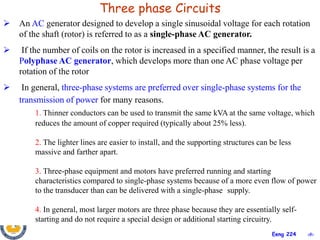
 An AC generator designed to develop a single sinusoidal voltage for each rotation
of the shaft (rotor) is referred to as a single-phase AC generator.
 If the number of coils on the rotor is increased in a specified manner, the result is a
Polyphase AC generator, which develops more than one AC phase voltage per
rotation of the rotor
 In general, three-phase systems are preferred over single-phase systems for the
transmission of power for many reasons.
1. Thinner conductors can be used to transmit the same kVA at the same voltage, which
reduces the amount of copper required (typically about 25% less).
2. The lighter lines are easier to install, and the supporting structures can be less
massive and farther apart.
3. Three-phase equipment and motors have preferred running and starting
characteristics compared to single-phase systems because of a more even flow of power
to the transducer than can be delivered with a single-phase supply.
4. In general, most larger motors are three phase because they are essentially self-
starting and do not require a special design or additional starting circuitry.
‹#›
Eeng 224
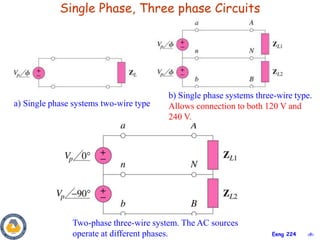
a) Single phase systems two-wire type
b) Single phase systems three-wire type.
Allows connection to both 120 V and
240 V.
Two-phase three-wire system. The AC sources
operate at different phases.
Single Phase, Three phase Circuits
‹#›
Eeng 224
Three-phase Generator
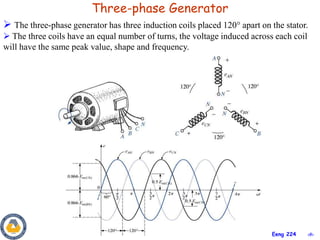
 The three-phase generator has three induction coils placed 120° apart on the stator.
 The three coils have an equal number of turns, the voltage induced across each coil
will have the same peak value, shape and frequency.
‹#›
Eeng 224
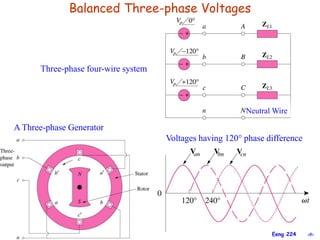
Balanced Three-phase Voltages
Three-phase four-wire system
Neutral Wire
A Three-phase Generator
Voltages having 120 phase difference
‹#›
Eeng 224
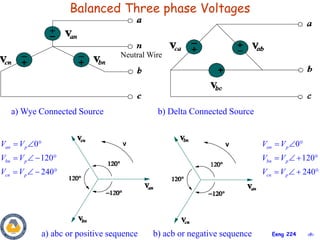
Balanced Three phase Voltages
a) Wye Connected Source b) Delta Connected Source
a) abc or positive sequence b) acb or negative sequence
0
120
240
an p
bn p
cn p
V V
V V
V V
  
   
   
0
120
240
an p
bn p
cn p
V V
V V
V V
  
   
   
Neutral Wire
‹#›
Eeng 224
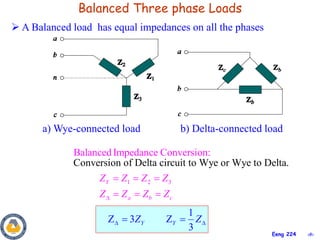
Balanced Three phase Loads
a) Wye-connected load b) Delta-connected load
1 2 3
Conversion of Delta circuit to Wye or Wye to Delta.
Balanced Impedance Conversion:
Y
a b c
Z Z Z Z
Z Z Z Z

  
  
1
Z 3 Z
3
Y Y
Z Z
 
 
 A Balanced load has equal impedances on all the phases
‹#›
Eeng 224
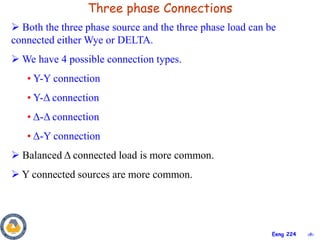
Three phase Connections
 Both the three phase source and the three phase load can be
connected either Wye or DELTA.
 We have 4 possible connection types.
• Y-Y connection
• Y-Δ connection
• Δ-Δ connection
• Δ-Y connection
 Balanced Δ connected load is more common.
 Y connected sources are more common.
‹#›
Eeng 224
Balanced Wye-wye Connection
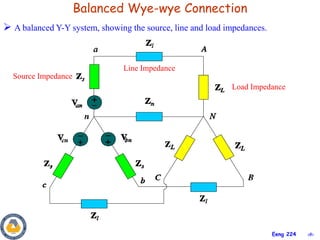
 A balanced Y-Y system, showing the source, line and load impedances.
Source Impedance
Line Impedance
Load Impedance
‹#›
Eeng 224
Balanced Wye-wye Connection
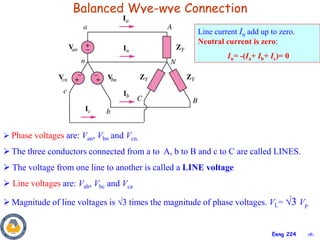
 Phase voltages are: Van, Vbn and Vcn.
 The three conductors connected from a to A, b to B and c to C are called LINES.
 The voltage from one line to another is called a LINE voltage
 Line voltages are: Vab, Vbc and Vca
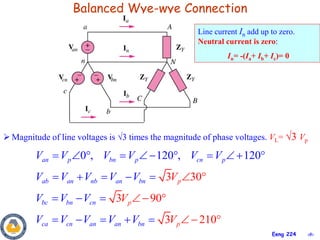
 Magnitude of line voltages is √3 times the magnitude of phase voltages. VL= √3 Vp
Line current In add up to zero.
Neutral current is zero:
In= -(Ia+ Ib+ Ic)= 0
‹#›
Eeng 224
Balanced Wye-wye Connection
 Magnitude of line voltages is √3 times the magnitude of phase voltages. VL= √3 Vp
3
0 , 120 ,
30
3 90
3 21
120
0
an p bn p cn p
ab an nb an bn
bc bn cn
ca cn an
p
p
an bn p
V
V V V V V V
V V V V V
V V V
V V V
V
V V
V
        
    
  
 
 
  
   
Line current In add up to zero.
Neutral current is zero:
In= -(Ia+ Ib+ Ic)= 0
‹#›
Eeng 224
Balanced Wye-wye Connection
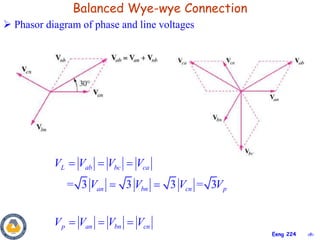
 Phasor diagram of phase and line voltages
= 3 3 3 = 3
L ab bc ca
an bn cn p
p an bn cn
V V V V
V V V V
V V V V
  
 
  
‹#›
Eeng 224
Single Phase Equivalent of Balanced Y-Y Connection
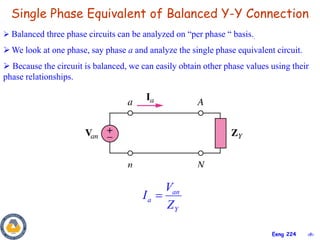
 Balanced three phase circuits can be analyzed on “per phase “ basis..
 We look at one phase, say phase a and analyze the single phase equivalent circuit.
 Because the circuıit is balanced, we can easily obtain other phase values using their
phase relationships.
an
a
Y
V
I
Z

‹#›
Eeng 224
‹#›
Eeng 224
Balanced Wye-delta Connection
AB
AB
BC
BC
CA
CA
V
I
Z
V
I
Z
V
I
Z






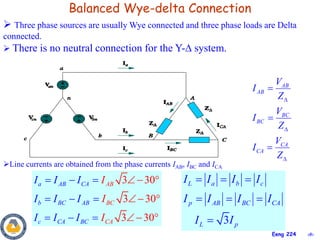
Line currents are obtained from the phase currents IAB, IBC and ICA
3 30
3 30
3 30
a AB CA
b BC AB
c CA BC
AB
BC
CA
I I I
I I I
I
I
I I
I
I
  
  
 
 

 
   3
L a b c
p AB BC CA
L p
I I I I
I I I I
I I
  
  

 Three phase sources are usually Wye connected and three phase loads are Delta
connected.
 There is no neutral connection for the Y-∆ system.
‹#›
Eeng 224
Balanced Wye-delta Connection
3
Z
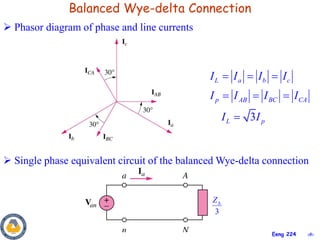
 Single phase equivalent circuit of the balanced Wye-delta connection
 Phasor diagram of phase and line currents
3
L a b c
p AB BC CA
L p
I I I I
I I I I
I I
  
  

‹#›
Eeng 224
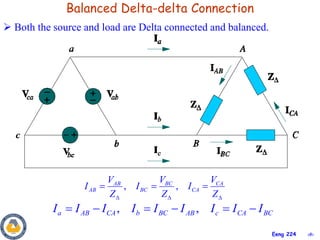
Balanced Delta-delta Connection
 Both the source and load are Delta connected and balanced.
, ,
a AB CA b BC AB c CA BC
I I I I I I I I I
     
, ,
BC CA
AB
AB BC CA
V V
V
I I I
Z Z Z
  
  
‹#›
Eeng 224
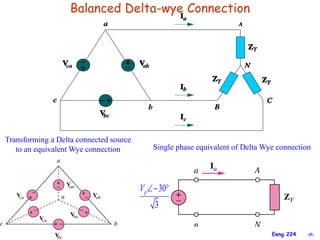
Balanced Delta-wye Connection
30
3
p
V  
Transforming a Delta connected source
to an equivalent Wye connection Single phase equivalent of Delta Wye connection

AC Generator.ppt

  • 1.
    ‹#› Eeng 224 Chapter 12 ThreePhase Circuits Huseyin Bilgekul Eeng224 Circuit Theory II Department of Electrical and Electronic Engineering Eastern Mediterranean University Chapter Objectives:  Be familiar with different three-phase configurations and how to analyze them.  Know the difference between balanced and unbalanced circuits  Learn about power in a balanced three-phase system  Know how to analyze unbalanced three-phase systems  Be able to use PSpice to analyze three-phase circuits  Apply what is learnt to three-phase measurement and residential wiring
  • 2.
    ‹#› Eeng 224 Three phaseCircuits  An AC generator designed to develop a single sinusoidal voltage for each rotation of the shaft (rotor) is referred to as a single-phase AC generator.  If the number of coils on the rotor is increased in a specified manner, the result is a Polyphase AC generator, which develops more than one AC phase voltage per rotation of the rotor  In general, three-phase systems are preferred over single-phase systems for the transmission of power for many reasons. 1. Thinner conductors can be used to transmit the same kVA at the same voltage, which reduces the amount of copper required (typically about 25% less). 2. The lighter lines are easier to install, and the supporting structures can be less massive and farther apart. 3. Three-phase equipment and motors have preferred running and starting characteristics compared to single-phase systems because of a more even flow of power to the transducer than can be delivered with a single-phase supply. 4. In general, most larger motors are three phase because they are essentially self- starting and do not require a special design or additional starting circuitry.
  • 3.
    ‹#› Eeng 224 a) Singlephase systems two-wire type b) Single phase systems three-wire type. Allows connection to both 120 V and 240 V. Two-phase three-wire system. The AC sources operate at different phases. Single Phase, Three phase Circuits
  • 4.
    ‹#› Eeng 224 Three-phase Generator The three-phase generator has three induction coils placed 120° apart on the stator.  The three coils have an equal number of turns, the voltage induced across each coil will have the same peak value, shape and frequency.
  • 5.
    ‹#› Eeng 224 Balanced Three-phaseVoltages Three-phase four-wire system Neutral Wire A Three-phase Generator Voltages having 120 phase difference
  • 6.
    ‹#› Eeng 224 Balanced Threephase Voltages a) Wye Connected Source b) Delta Connected Source a) abc or positive sequence b) acb or negative sequence 0 120 240 an p bn p cn p V V V V V V            0 120 240 an p bn p cn p V V V V V V            Neutral Wire
  • 7.
    ‹#› Eeng 224 Balanced Threephase Loads a) Wye-connected load b) Delta-connected load 1 2 3 Conversion of Delta circuit to Wye or Wye to Delta. Balanced Impedance Conversion: Y a b c Z Z Z Z Z Z Z Z        1 Z 3 Z 3 Y Y Z Z      A Balanced load has equal impedances on all the phases
  • 8.
    ‹#› Eeng 224 Three phaseConnections  Both the three phase source and the three phase load can be connected either Wye or DELTA.  We have 4 possible connection types. • Y-Y connection • Y-Δ connection • Δ-Δ connection • Δ-Y connection  Balanced Δ connected load is more common.  Y connected sources are more common.
  • 9.
    ‹#› Eeng 224 Balanced Wye-wyeConnection  A balanced Y-Y system, showing the source, line and load impedances. Source Impedance Line Impedance Load Impedance
  • 10.
    ‹#› Eeng 224 Balanced Wye-wyeConnection  Phase voltages are: Van, Vbn and Vcn.  The three conductors connected from a to A, b to B and c to C are called LINES.  The voltage from one line to another is called a LINE voltage  Line voltages are: Vab, Vbc and Vca  Magnitude of line voltages is √3 times the magnitude of phase voltages. VL= √3 Vp Line current In add up to zero. Neutral current is zero: In= -(Ia+ Ib+ Ic)= 0
  • 11.
    ‹#› Eeng 224 Balanced Wye-wyeConnection  Magnitude of line voltages is √3 times the magnitude of phase voltages. VL= √3 Vp 3 0 , 120 , 30 3 90 3 21 120 0 an p bn p cn p ab an nb an bn bc bn cn ca cn an p p an bn p V V V V V V V V V V V V V V V V V V V V V V                             Line current In add up to zero. Neutral current is zero: In= -(Ia+ Ib+ Ic)= 0
  • 12.
    ‹#› Eeng 224 Balanced Wye-wyeConnection  Phasor diagram of phase and line voltages = 3 3 3 = 3 L ab bc ca an bn cn p p an bn cn V V V V V V V V V V V V        
  • 13.
    ‹#› Eeng 224 Single PhaseEquivalent of Balanced Y-Y Connection  Balanced three phase circuits can be analyzed on “per phase “ basis..  We look at one phase, say phase a and analyze the single phase equivalent circuit.  Because the circuıit is balanced, we can easily obtain other phase values using their phase relationships. an a Y V I Z 
  • 14.
  • 15.
    ‹#› Eeng 224 Balanced Wye-deltaConnection AB AB BC BC CA CA V I Z V I Z V I Z       Line currents are obtained from the phase currents IAB, IBC and ICA 3 30 3 30 3 30 a AB CA b BC AB c CA BC AB BC CA I I I I I I I I I I I I                 3 L a b c p AB BC CA L p I I I I I I I I I I         Three phase sources are usually Wye connected and three phase loads are Delta connected.  There is no neutral connection for the Y-∆ system.
  • 16.
    ‹#› Eeng 224 Balanced Wye-deltaConnection 3 Z  Single phase equivalent circuit of the balanced Wye-delta connection  Phasor diagram of phase and line currents 3 L a b c p AB BC CA L p I I I I I I I I I I       
  • 17.
    ‹#› Eeng 224 Balanced Delta-deltaConnection  Both the source and load are Delta connected and balanced. , , a AB CA b BC AB c CA BC I I I I I I I I I       , , BC CA AB AB BC CA V V V I I I Z Z Z      
  • 18.
    ‹#› Eeng 224 Balanced Delta-wyeConnection 30 3 p V   Transforming a Delta connected source to an equivalent Wye connection Single phase equivalent of Delta Wye connection