KOEN VERHAEGE, SOFICS – SEPTEMBER 27, 2018
Is 1kV enough for IoT ESD protection?
Do current test methods and models apply?
IoT WORKSHOP
SOFICS © 2018 Proprietary & Confidential 2
Is 1kV enough for IoT ESD protection?
• Problem statement
• Challenges for IoT semiconductor design
• Risk analysis
• Case studies
• Conclusions
Problem statement – why these 2 questions?
SOFICS © 2018 Proprietary & Confidential 3
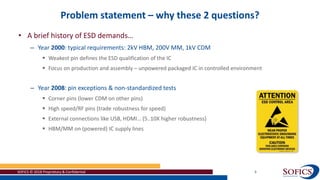
• A brief history of ESD demands…
– Year 2000: typical requirements: 2kV HBM, 200V MM, 1kV CDM
 Weakest pin defines the ESD qualification of the IC
 Focus on production and assembly – unpowered packaged IC in controlled environment
– Year 2008: pin exceptions & non-standardized tests
 Corner pins (lower CDM on other pins)
 High speed/RF pins (trade robustness for speed)
 External connections like USB, HDMI… (5..10X higher robustness)
 HBM/MM on (powered) IC supply lines
Problem statement – why these 2 questions?
SOFICS © 2018 Proprietary & Confidential 4
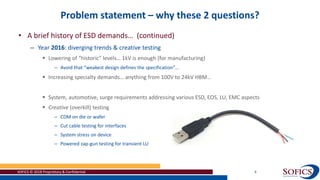
• A brief history of ESD demands… (continued)
– Year 2016: diverging trends & creative testing
 Lowering of “historic” levels… 1kV is enough (for manufacturing)
– Avoid that “weakest design defines the specification”…
 Increasing specialty demands… anything from 100V to 24kV HBM…
 System, automotive, surge requirements addressing various ESD, EOS, LU, EMC aspects
 Creative (overkill) testing
– CDM on die or wafer
– Cut cable testing for interfaces
– System stress on device
– Powered zap-gun testing for transient LU
Problem statement – why these 2 questions?
SOFICS © 2018 Proprietary & Confidential 5
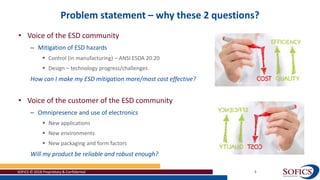
• Voice of the ESD community
– Mitigation of ESD hazards
 Control (in manufacturing) – ANSI ESDA 20.20
 Design – technology progress/challenges
How can I make my ESD mitigation more/most cost effective?
• Voice of the customer of the ESD community
– Omnipresence and use of electronics
 New applications
 New environments
 New packaging and form factors
Will my product be reliable and robust enough?
SOFICS © 2018 Proprietary & Confidential 6
Is 1kV enough for IoT ESD protection?
• Problem statement
• Challenges for IoT semiconductor design
• Risk analysis
• Case studies
• Conclusions
Challenges for IoT semiconductor design
SOFICS © 2018 Proprietary & Confidential 7
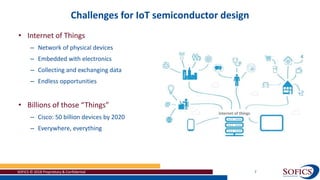
• Internet of Things
– Network of physical devices
– Embedded with electronics
– Collecting and exchanging data
– Endless opportunities
• Billions of those “Things”
– Cisco: 50 billion devices by 2020
– Everywhere, everything
Challenges for IoT semiconductor design
SOFICS © 2018 Proprietary & Confidential 8
• (Wireless) connectivity
• Standards (compatibility)
• Security
• Privacy
• Sensor integration
• Cost reduction
• High performance
• Low power consumption
• Small form factor
• Silicon/system packaging
• Robustness
• Reliability
SOFICS © 2018 Proprietary & Confidential 9
Is 1kV enough for IoT ESD protection?
• Problem statement
• Challenges for IoT semiconductor design
• Risk analysis
• Case studies
• Conclusions
Risk analysis – ISO 31000
SOFICS © 2018 Proprietary & Confidential 10
• Risk assesment matrix
– Identify threats
– Assess vulnerability
– Determine likelihood
– Determine impact
– Define risk and mitigation
Impact
RISK
Negligible
[1]
Minor
[2]
Serious
[3]
Critical
[4]
Catastrophic
[5]
Likelihood
Extremely
unlikely
[A]
None Trivial Low
Below
moderate
Moderate
Remote
[B]
Trivial Low
Below
moderate
Moderate Tolerable
Occasional
[C]
Low
Below
moderate
Moderate Tolerable Substantial
Reasonably
possible
[D]
Below
moderate
Moderate Tolerable Substantial Major
Frequent
[E]
Moderate Tolerable Substantial Major Intolerable
Risk analysis – threats
SOFICS © 2018 Proprietary & Confidential 11
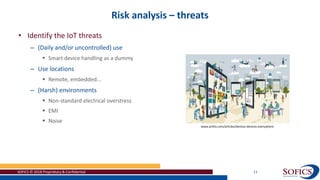
• Identify the IoT threats
– (Daily and/or uncontrolled) use
 Smart device handling as a dummy
– Use locations
 Remote, embedded...
– (Harsh) environments
 Non-standard electrical overstress
 EMI
 Noise
www.anttix.com/articles/devices-devices-everywhere
Risk analysis – vulnerability
SOFICS © 2018 Proprietary & Confidential 12
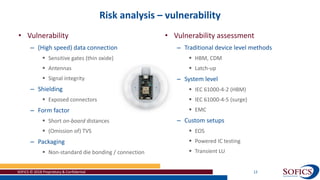
• Vulnerability
– (High speed) data connection
 Sensitive gates (thin oxide)
 Antennas
 Signal integrity
– Shielding
 Exposed connectors
– Form factor
 Short on-board distances
 (Omission of) TVS
– Packaging
 Non-standard die bonding / connection
• Vulnerability assessment
– Traditional device level methods
 HBM, CDM
 Latch-up
– System level
 IEC 61000-4-2 (HBM)
 IEC 61000-4-5 (surge)
 EMC
– Custom setups
 EOS
 Powered IC testing
 Transient LU
Risk analysis – likelihood
SOFICS © 2018 Proprietary & Confidential 13
• ESD exposure well covered by traditional approaches during...
– Manufacturing
– IC assembly
– IoT assembly
One 1kV and traditional models are likely enough... provided good ESD control is in place
• ESD exposure more likely and more unknown during...
– Functional operation in varying environments, locations and applications
Risk analysis – impact
SOFICS © 2018 Proprietary & Confidential 14
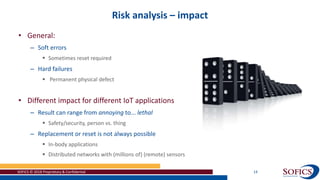
• General:
– Soft errors
 Sometimes reset required
– Hard failures
 Permanent physical defect
• Different impact for different IoT applications
– Result can range from annoying to... lethal
 Safety/security, person vs. thing
– Replacement or reset is not always possible
 In-body applications
 Distributed networks with (millions of) (remote) sensors
Risk analysis – adequate protection
SOFICS © 2018 Proprietary & Confidential 15
Impact
RISK Negligible
[1]
Minor
[2]
Serious
[3]
Critical
[4]
Catastrophic
[5]
Likelihood
Extremely
unlikely
[A]
None Trivial Low
Below
moderate
Moderate
Remote
[B]
Trivial Low
Below
moderate
Moderate Tolerable
Occasional
[C]
Low
Below
moderate
Moderate Tolerable Substantial
Reasonably
possible
[D]
Below
moderate
Moderate Tolerable Substantial Major
Frequent
[E]
Moderate Tolerable Substantial Major Intolerable
SOFICS © 2018 Proprietary & Confidential 16
Is 1kV enough for IoT ESD protection?
• Problem statement
• Challenges for IoT semiconductor design
• Risk analysis
• Case studies
– 7 EOS/ESD protected IoT applications
• Conclusions
Case 1: IoT at the cloud side
SOFICS © 2018 Proprietary & Confidential 17
• IoT connectivity for billions of ‘things’
occurs via the cloud consisting of…
– About 8M data centers worldwide
– Multiple 10K servers per data center
• Server network connections
– Short and long distances
– (Very) high speed
 10-100 gigabit-per-second
– Optical communication
 Silicon Photonics
Case 1: IoT at the cloud side
SOFICS © 2018 Proprietary & Confidential 18
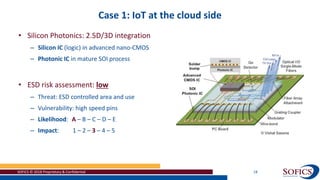
• Silicon Photonics: 2.5D/3D integration
– Silicon IC (logic) in advanced nano-CMOS
– Photonic IC in mature SOI process
• ESD risk assessment: low
– Threat: ESD controlled area and use
– Vulnerability: high speed pins
– Likelihood: A – B – C – D – E
– Impact: 1 – 2 – 3 – 4 – 5
Case 1: IoT at the cloud side
SOFICS © 2018 Proprietary & Confidential 19
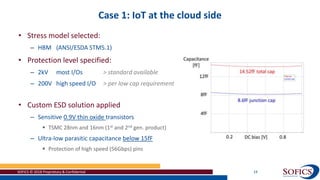
• Stress model selected:
– HBM (ANSI/ESDA STM5.1)
• Protection level specified:
– 2kV most I/Os > standard available
– 200V high speed I/O > per low cap requirement
• Custom ESD solution applied
– Sensitive 0.9V thin oxide transistors
 TSMC 28nm and 16nm (1st and 2nd gen. product)
– Ultra-low parasitic capacitance below 15fF
 Protection of high speed (56Gbps) pins
Case 2: industrial, indoor positioning
SOFICS © 2018 Proprietary & Confidential 20
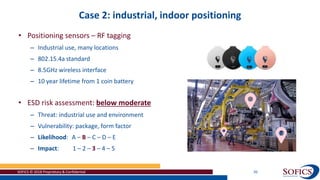
• Positioning sensors – RF tagging
– Industrial use, many locations
– 802.15.4a standard
– 8.5GHz wireless interface
– 10 year lifetime from 1 coin battery
• ESD risk assessment: below moderate
– Threat: industrial use and environment
– Vulnerability: package, form factor
– Likelihood: A – B – C – D – E
– Impact: 1 – 2 – 3 – 4 – 5
Case 2: industrial, indoor positioning
SOFICS © 2018 Proprietary & Confidential 21
• Stress model selected:
– HBM (ANSI/ESDA STM5.1)
• Protection level specified:
– 2kV incl. wireless I/O > by customer choice
• Custom ESD solution applied
– Sensitive thin oxide transistors
 TSMC 90nm and 40nm (1st and 2nd gen. product)
– Low parasitic capacitance below 100fF
 Protection of high bandwidth (8.5GHz) pins
– Low leakage below 100pA
 10 years on 1 coin battery
Case 3: Near Field Communication (NFC)
SOFICS © 2018 Proprietary & Confidential 22
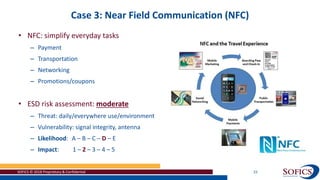
• NFC: simplify everyday tasks
– Payment
– Transportation
– Networking
– Promotions/coupons
• ESD risk assessment: moderate
– Threat: daily/everywhere use/environment
– Vulnerability: signal integrity, antenna
– Likelihood: A – B – C – D – E
– Impact: 1 – 2 – 3 – 4 – 5
Case 3: Near Field Communication (NFC)
SOFICS © 2018 Proprietary & Confidential 23
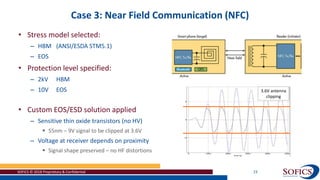
• Stress model selected:
– HBM (ANSI/ESDA STM5.1)
– EOS
• Protection level specified:
– 2kV HBM
– 10V EOS
• Custom EOS/ESD solution applied
– Sensitive thin oxide transistors (no HV)
 55nm – 9V signal to be clipped at 3.6V
– Voltage at receiver depends on proximity
 Signal shape preserved – no HF distortions
3.6V antenna
clipping
Case 4: body implanted devices
SOFICS © 2018 Proprietary & Confidential 24
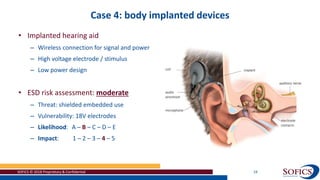
• Implanted hearing aid
– Wireless connection for signal and power
– High voltage electrode / stimulus
– Low power design
• ESD risk assessment: moderate
– Threat: shielded embedded use
– Vulnerability: 18V electrodes
– Likelihood: A – B – C – D – E
– Impact: 1 – 2 – 3 – 4 – 5
Case 4: body implanted devices
SOFICS © 2018 Proprietary & Confidential 25
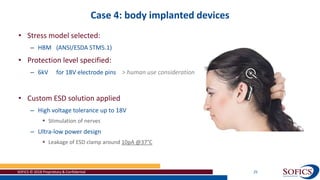
• Stress model selected:
– HBM (ANSI/ESDA STM5.1)
• Protection level specified:
– 6kV for 18V electrode pins > human use consideration
• Custom ESD solution applied
– High voltage tolerance up to 18V
 Stimulation of nerves
– Ultra-low power design
 Leakage of ESD clamp around 10pA @37°C
Case 4: other networked medical devices
SOFICS © 2018 Proprietary & Confidential 26
• Likelihood and impact differ significantly between applications
– Wearable, external devices have higher likelihood of ESD events
– Life supporting devices (pacemakers) have a bigger impact if things go wrong
Impact
RISK [1] [2] [3] [4] [5]
Likelihood
[A]
[B]
[C]
[D]
[E]
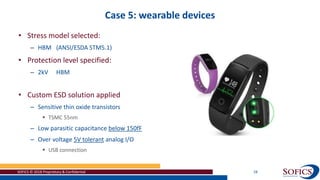
Case 5: wearable devices
SOFICS © 2018 Proprietary & Confidential 27
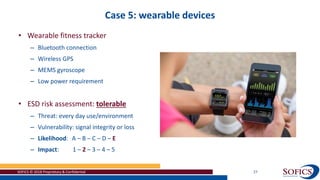
• Wearable fitness tracker
– Bluetooth connection
– Wireless GPS
– MEMS gyroscope
– Low power requirement
• ESD risk assessment: tolerable
– Threat: every day use/environment
– Vulnerability: signal integrity or loss
– Likelihood: A – B – C – D – E
– Impact: 1 – 2 – 3 – 4 – 5
Case 5: wearable devices
SOFICS © 2018 Proprietary & Confidential 28
• Stress model selected:
– HBM (ANSI/ESDA STM5.1)
• Protection level specified:
– 2kV HBM
• Custom ESD solution applied
– Sensitive thin oxide transistors
 TSMC 55nm
– Low parasitic capacitance below 150fF
– Over voltage 5V tolerant analog I/O
 USB connection
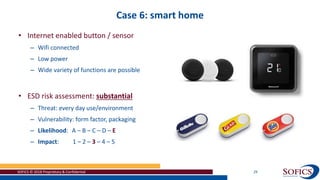
Case 6: smart home
SOFICS © 2018 Proprietary & Confidential 29
• Internet enabled button / sensor
– Wifi connected
– Low power
– Wide variety of functions are possible
• ESD risk assessment: substantial
– Threat: every day use/environment
– Vulnerability: form factor, packaging
– Likelihood: A – B – C – D – E
– Impact: 1 – 2 – 3 – 4 – 5
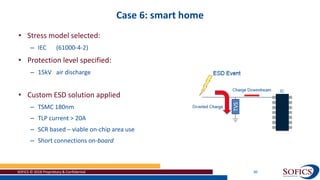
Case 6: smart home
SOFICS © 2018 Proprietary & Confidential 30
• Stress model selected:
– IEC (61000-4-2)
• Protection level specified:
– 15kV air discharge
• Custom ESD solution applied
– TSMC 180nm
– TLP current > 20A
– SCR based – viable on-chip area use
– Short connections on-board
TVS
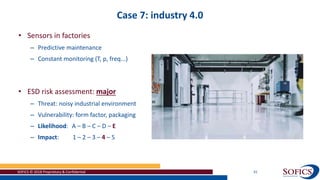
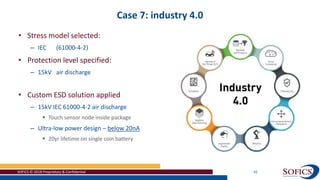
Case 7: industry 4.0
SOFICS © 2018 Proprietary & Confidential 31
• Sensors in factories
– Predictive maintenance
– Constant monitoring (T, p, freq...)
• ESD risk assessment: major
– Threat: noisy industrial environment
– Vulnerability: form factor, packaging
– Likelihood: A – B – C – D – E
– Impact: 1 – 2 – 3 – 4 – 5
Case 7: industry 4.0
SOFICS © 2018 Proprietary & Confidential 32
• Stress model selected:
– IEC (61000-4-2)
• Protection level specified:
– 15kV air discharge
• Custom ESD solution applied
– 15kV IEC 61000-4-2 air discharge
 Touch sensor node inside package
– Ultra-low power design – below 20nA
 20yr lifetime on single coin battery
SOFICS © 2018 Proprietary & Confidential 33
Is 1kV enough for IoT ESD protection?
• Problem statement
• Challenges for IoT semiconductor design
• Risk analysis
• Case studies
• Conclusions
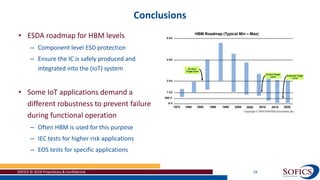
Conclusions
SOFICS © 2018 Proprietary & Confidential 34
• ESDA roadmap for HBM levels
– Component level ESD protection
– Ensure the IC is safely produced and
integrated into the (IoT) system
• Some IoT applications demand a
different robustness to prevent failure
during functional operation
– Often HBM is used for this purpose
– IEC tests for higher risk applications
– EOS tests for specific applications
Conclusions
SOFICS © 2018 Proprietary & Confidential 35
• Is 1kV enough for IoT ESD protection?
– Risk depends on application and process
– Additional trade-offs add complexity
– Not possible to apply a “one spec fits all” ESD stress requirement
• Do current test methods and models apply?
– Frequently additional reliability or custom test methods are required
– Include EOS/ESD consideration early in the design phase to identify solutions for new threats
PowerQubic, TakeCharge, Sofics are registered trademarks of Sofics bvba
Contact us
SOFICS © 2018 Proprietary & Confidential 36
SOFICS
Engineering Offices:
Sint-Godelievestraat 32
9880 Aalter, Belgium
(tel) +32-9-21-68-333
(fax) +32-9-3-746-846
www.sofics.com

IoT workshop - Is 1kV Also Enough for IoT ESD Protection – Do Current Test Methods and Models Apply?

  • 1.
    KOEN VERHAEGE, SOFICS– SEPTEMBER 27, 2018 Is 1kV enough for IoT ESD protection? Do current test methods and models apply? IoT WORKSHOP
  • 2.
    SOFICS © 2018Proprietary & Confidential 2 Is 1kV enough for IoT ESD protection? • Problem statement • Challenges for IoT semiconductor design • Risk analysis • Case studies • Conclusions
  • 3.
    Problem statement –why these 2 questions? SOFICS © 2018 Proprietary & Confidential 3 • A brief history of ESD demands… – Year 2000: typical requirements: 2kV HBM, 200V MM, 1kV CDM  Weakest pin defines the ESD qualification of the IC  Focus on production and assembly – unpowered packaged IC in controlled environment – Year 2008: pin exceptions & non-standardized tests  Corner pins (lower CDM on other pins)  High speed/RF pins (trade robustness for speed)  External connections like USB, HDMI… (5..10X higher robustness)  HBM/MM on (powered) IC supply lines
  • 4.
    Problem statement –why these 2 questions? SOFICS © 2018 Proprietary & Confidential 4 • A brief history of ESD demands… (continued) – Year 2016: diverging trends & creative testing  Lowering of “historic” levels… 1kV is enough (for manufacturing) – Avoid that “weakest design defines the specification”…  Increasing specialty demands… anything from 100V to 24kV HBM…  System, automotive, surge requirements addressing various ESD, EOS, LU, EMC aspects  Creative (overkill) testing – CDM on die or wafer – Cut cable testing for interfaces – System stress on device – Powered zap-gun testing for transient LU
  • 5.
    Problem statement –why these 2 questions? SOFICS © 2018 Proprietary & Confidential 5 • Voice of the ESD community – Mitigation of ESD hazards  Control (in manufacturing) – ANSI ESDA 20.20  Design – technology progress/challenges How can I make my ESD mitigation more/most cost effective? • Voice of the customer of the ESD community – Omnipresence and use of electronics  New applications  New environments  New packaging and form factors Will my product be reliable and robust enough?
  • 6.
    SOFICS © 2018Proprietary & Confidential 6 Is 1kV enough for IoT ESD protection? • Problem statement • Challenges for IoT semiconductor design • Risk analysis • Case studies • Conclusions
  • 7.
    Challenges for IoTsemiconductor design SOFICS © 2018 Proprietary & Confidential 7 • Internet of Things – Network of physical devices – Embedded with electronics – Collecting and exchanging data – Endless opportunities • Billions of those “Things” – Cisco: 50 billion devices by 2020 – Everywhere, everything
  • 8.
    Challenges for IoTsemiconductor design SOFICS © 2018 Proprietary & Confidential 8 • (Wireless) connectivity • Standards (compatibility) • Security • Privacy • Sensor integration • Cost reduction • High performance • Low power consumption • Small form factor • Silicon/system packaging • Robustness • Reliability
  • 9.
    SOFICS © 2018Proprietary & Confidential 9 Is 1kV enough for IoT ESD protection? • Problem statement • Challenges for IoT semiconductor design • Risk analysis • Case studies • Conclusions
  • 10.
    Risk analysis –ISO 31000 SOFICS © 2018 Proprietary & Confidential 10 • Risk assesment matrix – Identify threats – Assess vulnerability – Determine likelihood – Determine impact – Define risk and mitigation Impact RISK Negligible [1] Minor [2] Serious [3] Critical [4] Catastrophic [5] Likelihood Extremely unlikely [A] None Trivial Low Below moderate Moderate Remote [B] Trivial Low Below moderate Moderate Tolerable Occasional [C] Low Below moderate Moderate Tolerable Substantial Reasonably possible [D] Below moderate Moderate Tolerable Substantial Major Frequent [E] Moderate Tolerable Substantial Major Intolerable
  • 11.
    Risk analysis –threats SOFICS © 2018 Proprietary & Confidential 11 • Identify the IoT threats – (Daily and/or uncontrolled) use  Smart device handling as a dummy – Use locations  Remote, embedded... – (Harsh) environments  Non-standard electrical overstress  EMI  Noise www.anttix.com/articles/devices-devices-everywhere
  • 12.
    Risk analysis –vulnerability SOFICS © 2018 Proprietary & Confidential 12 • Vulnerability – (High speed) data connection  Sensitive gates (thin oxide)  Antennas  Signal integrity – Shielding  Exposed connectors – Form factor  Short on-board distances  (Omission of) TVS – Packaging  Non-standard die bonding / connection • Vulnerability assessment – Traditional device level methods  HBM, CDM  Latch-up – System level  IEC 61000-4-2 (HBM)  IEC 61000-4-5 (surge)  EMC – Custom setups  EOS  Powered IC testing  Transient LU
  • 13.
    Risk analysis –likelihood SOFICS © 2018 Proprietary & Confidential 13 • ESD exposure well covered by traditional approaches during... – Manufacturing – IC assembly – IoT assembly One 1kV and traditional models are likely enough... provided good ESD control is in place • ESD exposure more likely and more unknown during... – Functional operation in varying environments, locations and applications
  • 14.
    Risk analysis –impact SOFICS © 2018 Proprietary & Confidential 14 • General: – Soft errors  Sometimes reset required – Hard failures  Permanent physical defect • Different impact for different IoT applications – Result can range from annoying to... lethal  Safety/security, person vs. thing – Replacement or reset is not always possible  In-body applications  Distributed networks with (millions of) (remote) sensors
  • 15.
    Risk analysis –adequate protection SOFICS © 2018 Proprietary & Confidential 15 Impact RISK Negligible [1] Minor [2] Serious [3] Critical [4] Catastrophic [5] Likelihood Extremely unlikely [A] None Trivial Low Below moderate Moderate Remote [B] Trivial Low Below moderate Moderate Tolerable Occasional [C] Low Below moderate Moderate Tolerable Substantial Reasonably possible [D] Below moderate Moderate Tolerable Substantial Major Frequent [E] Moderate Tolerable Substantial Major Intolerable
  • 16.
    SOFICS © 2018Proprietary & Confidential 16 Is 1kV enough for IoT ESD protection? • Problem statement • Challenges for IoT semiconductor design • Risk analysis • Case studies – 7 EOS/ESD protected IoT applications • Conclusions
  • 17.
    Case 1: IoTat the cloud side SOFICS © 2018 Proprietary & Confidential 17 • IoT connectivity for billions of ‘things’ occurs via the cloud consisting of… – About 8M data centers worldwide – Multiple 10K servers per data center • Server network connections – Short and long distances – (Very) high speed  10-100 gigabit-per-second – Optical communication  Silicon Photonics
  • 18.
    Case 1: IoTat the cloud side SOFICS © 2018 Proprietary & Confidential 18 • Silicon Photonics: 2.5D/3D integration – Silicon IC (logic) in advanced nano-CMOS – Photonic IC in mature SOI process • ESD risk assessment: low – Threat: ESD controlled area and use – Vulnerability: high speed pins – Likelihood: A – B – C – D – E – Impact: 1 – 2 – 3 – 4 – 5
  • 19.
    Case 1: IoTat the cloud side SOFICS © 2018 Proprietary & Confidential 19 • Stress model selected: – HBM (ANSI/ESDA STM5.1) • Protection level specified: – 2kV most I/Os > standard available – 200V high speed I/O > per low cap requirement • Custom ESD solution applied – Sensitive 0.9V thin oxide transistors  TSMC 28nm and 16nm (1st and 2nd gen. product) – Ultra-low parasitic capacitance below 15fF  Protection of high speed (56Gbps) pins
  • 20.
    Case 2: industrial,indoor positioning SOFICS © 2018 Proprietary & Confidential 20 • Positioning sensors – RF tagging – Industrial use, many locations – 802.15.4a standard – 8.5GHz wireless interface – 10 year lifetime from 1 coin battery • ESD risk assessment: below moderate – Threat: industrial use and environment – Vulnerability: package, form factor – Likelihood: A – B – C – D – E – Impact: 1 – 2 – 3 – 4 – 5
  • 21.
    Case 2: industrial,indoor positioning SOFICS © 2018 Proprietary & Confidential 21 • Stress model selected: – HBM (ANSI/ESDA STM5.1) • Protection level specified: – 2kV incl. wireless I/O > by customer choice • Custom ESD solution applied – Sensitive thin oxide transistors  TSMC 90nm and 40nm (1st and 2nd gen. product) – Low parasitic capacitance below 100fF  Protection of high bandwidth (8.5GHz) pins – Low leakage below 100pA  10 years on 1 coin battery
  • 22.
    Case 3: NearField Communication (NFC) SOFICS © 2018 Proprietary & Confidential 22 • NFC: simplify everyday tasks – Payment – Transportation – Networking – Promotions/coupons • ESD risk assessment: moderate – Threat: daily/everywhere use/environment – Vulnerability: signal integrity, antenna – Likelihood: A – B – C – D – E – Impact: 1 – 2 – 3 – 4 – 5
  • 23.
    Case 3: NearField Communication (NFC) SOFICS © 2018 Proprietary & Confidential 23 • Stress model selected: – HBM (ANSI/ESDA STM5.1) – EOS • Protection level specified: – 2kV HBM – 10V EOS • Custom EOS/ESD solution applied – Sensitive thin oxide transistors (no HV)  55nm – 9V signal to be clipped at 3.6V – Voltage at receiver depends on proximity  Signal shape preserved – no HF distortions 3.6V antenna clipping
  • 24.
    Case 4: bodyimplanted devices SOFICS © 2018 Proprietary & Confidential 24 • Implanted hearing aid – Wireless connection for signal and power – High voltage electrode / stimulus – Low power design • ESD risk assessment: moderate – Threat: shielded embedded use – Vulnerability: 18V electrodes – Likelihood: A – B – C – D – E – Impact: 1 – 2 – 3 – 4 – 5
  • 25.
    Case 4: bodyimplanted devices SOFICS © 2018 Proprietary & Confidential 25 • Stress model selected: – HBM (ANSI/ESDA STM5.1) • Protection level specified: – 6kV for 18V electrode pins > human use consideration • Custom ESD solution applied – High voltage tolerance up to 18V  Stimulation of nerves – Ultra-low power design  Leakage of ESD clamp around 10pA @37°C
  • 26.
    Case 4: othernetworked medical devices SOFICS © 2018 Proprietary & Confidential 26 • Likelihood and impact differ significantly between applications – Wearable, external devices have higher likelihood of ESD events – Life supporting devices (pacemakers) have a bigger impact if things go wrong Impact RISK [1] [2] [3] [4] [5] Likelihood [A] [B] [C] [D] [E]
  • 27.
    Case 5: wearabledevices SOFICS © 2018 Proprietary & Confidential 27 • Wearable fitness tracker – Bluetooth connection – Wireless GPS – MEMS gyroscope – Low power requirement • ESD risk assessment: tolerable – Threat: every day use/environment – Vulnerability: signal integrity or loss – Likelihood: A – B – C – D – E – Impact: 1 – 2 – 3 – 4 – 5
  • 28.
    Case 5: wearabledevices SOFICS © 2018 Proprietary & Confidential 28 • Stress model selected: – HBM (ANSI/ESDA STM5.1) • Protection level specified: – 2kV HBM • Custom ESD solution applied – Sensitive thin oxide transistors  TSMC 55nm – Low parasitic capacitance below 150fF – Over voltage 5V tolerant analog I/O  USB connection
  • 29.
    Case 6: smarthome SOFICS © 2018 Proprietary & Confidential 29 • Internet enabled button / sensor – Wifi connected – Low power – Wide variety of functions are possible • ESD risk assessment: substantial – Threat: every day use/environment – Vulnerability: form factor, packaging – Likelihood: A – B – C – D – E – Impact: 1 – 2 – 3 – 4 – 5
  • 30.
    Case 6: smarthome SOFICS © 2018 Proprietary & Confidential 30 • Stress model selected: – IEC (61000-4-2) • Protection level specified: – 15kV air discharge • Custom ESD solution applied – TSMC 180nm – TLP current > 20A – SCR based – viable on-chip area use – Short connections on-board TVS
  • 31.
    Case 7: industry4.0 SOFICS © 2018 Proprietary & Confidential 31 • Sensors in factories – Predictive maintenance – Constant monitoring (T, p, freq...) • ESD risk assessment: major – Threat: noisy industrial environment – Vulnerability: form factor, packaging – Likelihood: A – B – C – D – E – Impact: 1 – 2 – 3 – 4 – 5
  • 32.
    Case 7: industry4.0 SOFICS © 2018 Proprietary & Confidential 32 • Stress model selected: – IEC (61000-4-2) • Protection level specified: – 15kV air discharge • Custom ESD solution applied – 15kV IEC 61000-4-2 air discharge  Touch sensor node inside package – Ultra-low power design – below 20nA  20yr lifetime on single coin battery
  • 33.
    SOFICS © 2018Proprietary & Confidential 33 Is 1kV enough for IoT ESD protection? • Problem statement • Challenges for IoT semiconductor design • Risk analysis • Case studies • Conclusions
  • 34.
    Conclusions SOFICS © 2018Proprietary & Confidential 34 • ESDA roadmap for HBM levels – Component level ESD protection – Ensure the IC is safely produced and integrated into the (IoT) system • Some IoT applications demand a different robustness to prevent failure during functional operation – Often HBM is used for this purpose – IEC tests for higher risk applications – EOS tests for specific applications
  • 35.
    Conclusions SOFICS © 2018Proprietary & Confidential 35 • Is 1kV enough for IoT ESD protection? – Risk depends on application and process – Additional trade-offs add complexity – Not possible to apply a “one spec fits all” ESD stress requirement • Do current test methods and models apply? – Frequently additional reliability or custom test methods are required – Include EOS/ESD consideration early in the design phase to identify solutions for new threats
  • 36.
    PowerQubic, TakeCharge, Soficsare registered trademarks of Sofics bvba Contact us SOFICS © 2018 Proprietary & Confidential 36 SOFICS Engineering Offices: Sint-Godelievestraat 32 9880 Aalter, Belgium (tel) +32-9-21-68-333 (fax) +32-9-3-746-846 www.sofics.com

Editor's Notes

  • #30 https://www.disruptive-technologies.com/
  • #31 https://www.disruptive-technologies.com/