Induced Fields
Magnetic fields may vary in time.
Experiments conducted in 1831 showed that an emf can be induced in a
circuit by a changing magnetic field.
 Experiments were done by Michael Faraday and Joseph Henry.
The results of these experiments led to Faraday’s Law of Induction.
An induced current is produced by a changing magnetic field.
There is an induced emf associated with the induced current.
A current can be produced without a battery present in the circuit.
Faraday’s law of induction describes the induced emf.
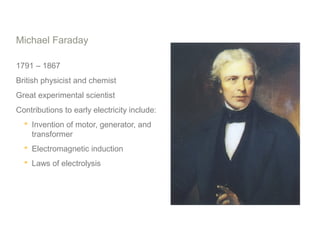
Michael Faraday
1791 – 1867
British physicist and chemist
Great experimental scientist
Contributions to early electricity include:
 Invention of motor, generator, and
transformer
 Electromagnetic induction
 Laws of electrolysis
EMF Produced by a Changing Magnetic Field, 1
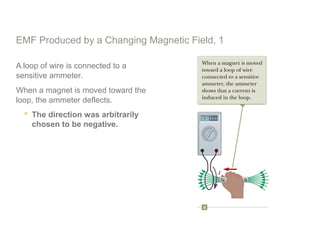
A loop of wire is connected to a
sensitive ammeter.
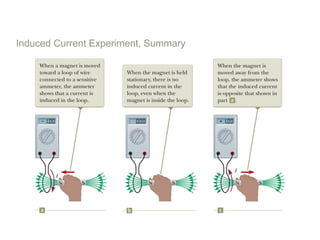
When a magnet is moved toward the
loop, the ammeter deflects.
 The direction was arbitrarily
chosen to be negative.
EMF Produced by a Changing Magnetic Field, 2
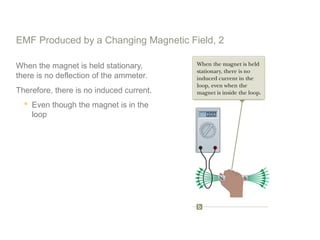
When the magnet is held stationary,
there is no deflection of the ammeter.
Therefore, there is no induced current.
 Even though the magnet is in the
loop
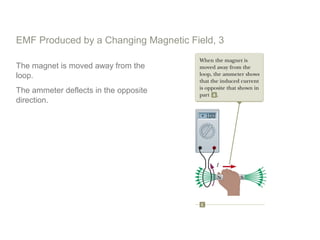
EMF Produced by a Changing Magnetic Field, 3
The magnet is moved away from the
loop.
The ammeter deflects in the opposite
direction.
Induced Current Experiment, Summary
EMF Produced by a Changing Magnetic Field, Summary
The ammeter deflects when the magnet is moving toward or away from the loop.
The ammeter also deflects when the loop is moved toward or away from the
magnet.
Therefore, the loop detects that the magnet is moving relative to it.
 We relate this detection to a change in the magnetic field.
 This is the induced current that is produced by an induced emf.
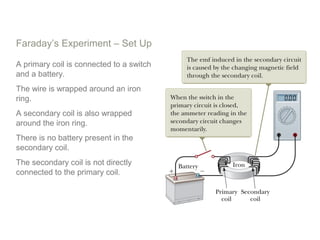
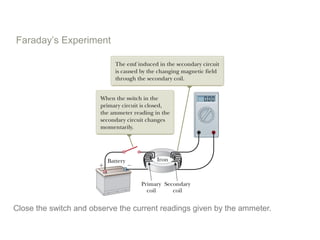
Faraday’s Experiment – Set Up
A primary coil is connected to a switch
and a battery.
The wire is wrapped around an iron
ring.
A secondary coil is also wrapped
around the iron ring.
There is no battery present in the
secondary coil.
The secondary coil is not directly
connected to the primary coil.
Faraday’s Experiment
Close the switch and observe the current readings given by the ammeter.
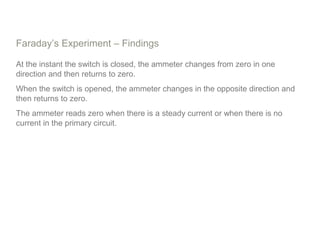
Faraday’s Experiment – Findings
At the instant the switch is closed, the ammeter changes from zero in one
direction and then returns to zero.
When the switch is opened, the ammeter changes in the opposite direction and
then returns to zero.
The ammeter reads zero when there is a steady current or when there is no
current in the primary circuit.
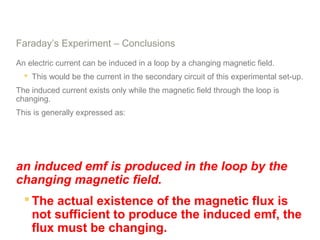
Faraday’s Experiment – Conclusions
An electric current can be induced in a loop by a changing magnetic field.
 This would be the current in the secondary circuit of this experimental set-up.
The induced current exists only while the magnetic field through the loop is
changing.
This is generally expressed as:
an induced emf is produced in the loop by the
changing magnetic field.
 The actual existence of the magnetic flux is
not sufficient to produce the induced emf, the
flux must be changing.
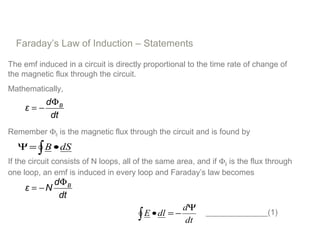
Faraday’s Law of Induction – Statements
The emf induced in a circuit is directly proportional to the time rate of change of
the magnetic flux through the circuit.
Mathematically,
Remember ΦB is the magnetic flux through the circuit and is found by
If the circuit consists of N loops, all of the same area, and if ΦB is the flux through
one loop, an emf is induced in every loop and Faraday’s law becomes
Bd
ε
dt
Φ
= −
Bd
ε N
dt
Φ
= −
dSB •=Ψ ∫
dt
d
dlE
Ψ
−=•∫ ______________(1)
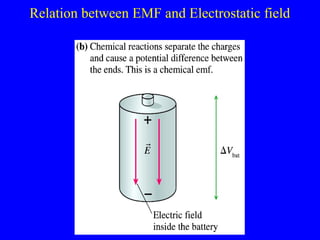
Relation between EMF and Electrostatic field
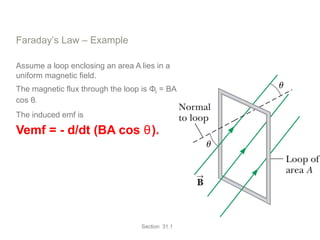
Faraday’s Law – Example
Assume a loop enclosing an area A lies in a
uniform magnetic field.
The magnetic flux through the loop is ΦB = BA
cos θ.
The induced emf is
Vemf = - d/dt (BA cos θ).
Section 31.1
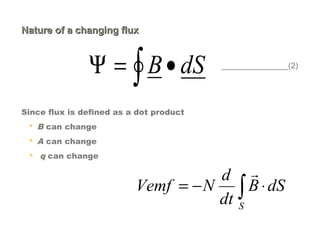
Nature of a changing fluxNature of a changing flux
Since flux is defined as a dot product
 B can change
 A can change
 q can change
∫ ⋅−=
S
dSB
dt
d
NVemf

dSB•=Ψ ∫ _______________(2)
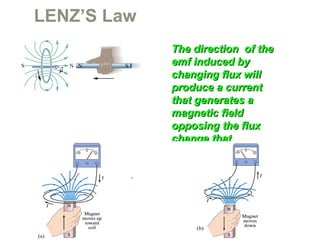
Polarity of the Induced Emf
The polarity (direction) of the induced emf is
determined by Lenz’s law.
LENZ’S Law
The direction of theThe direction of the
emf induced byemf induced by
changing flux willchanging flux will
produce a currentproduce a current
that generates athat generates a
magnetic fieldmagnetic field
opposing the fluxopposing the flux
change thatchange that
produced itproduced it..
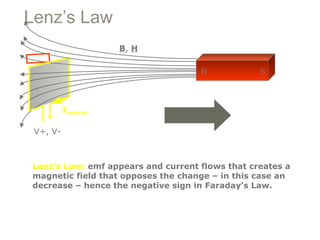
Lenz’s Law
B, H
Lenz’s Law: emf appears and current flows that creates a
magnetic field that opposes the change – in this case an
decrease – hence the negative sign in Faraday’s Law.
B, H
N S
V+, V-

Iinduced
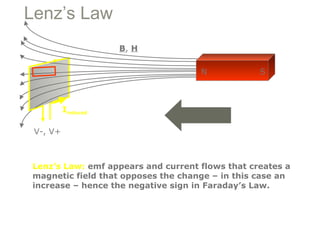
Lenz’s Law
B, H
Lenz’s Law: emf appears and current flows that creates a
magnetic field that opposes the change – in this case an
increase – hence the negative sign in Faraday’s Law.
B, H
N S

V-, V+
Iinduced
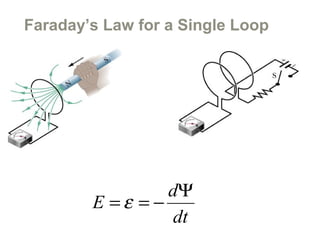
Faraday’s Law for a Single Loop
dt
d
E
Ψ
−== ε
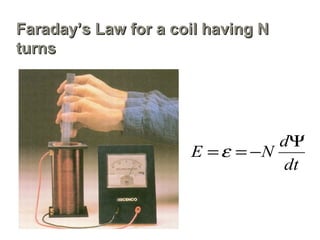
Faraday’s Law for a coil having NFaraday’s Law for a coil having N
turnsturns
dt
d
NE
Ψ
−==ε
Ways of Inducing an emf
1. A stationary loop in a time varying magnetic field B [TRANSFORMER EMF]
i.e. The magnitude of the magnetic field can change with time.
2. A time varying loop area in a static field B [ MOTIONAL EMF]
i.e., The area enclosed by the loop can change with time.
3. Time varying loop area in a time varying magnetic field
i.e., The angle between the magnetic field and the normal to the loop can change
with time.
Any combination of the above can occur.
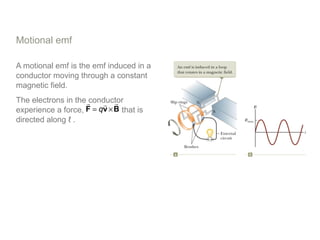
Motional emf
A motional emf is the emf induced in a
conductor moving through a constant
magnetic field.
The electrons in the conductor
experience a force, that is
directed along ℓ .
q= ×F v B
r rr
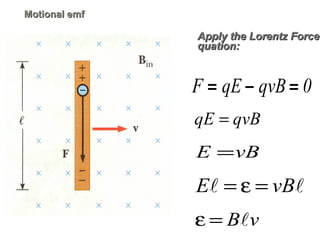
Motional emfMotional emf
Apply the Lorentz ForceApply the Lorentz Force
quation:quation:
0qvBqEF =−=
vBE =
 vBE =ε=
vB=ε
qvBqE =
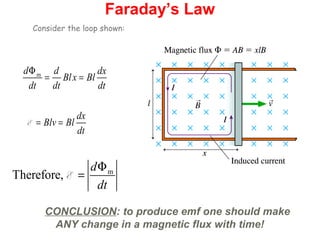
Faraday’s Law
md d dx
Blx Bl
dt dt dt
Φ
= =
dx
Blv Bl
dt
= =E
m
Therefore,
d
dt
Φ
=E
CONCLUSION: to produce emf one should make
ANY change in a magnetic flux with time!
Consider the loop shown:
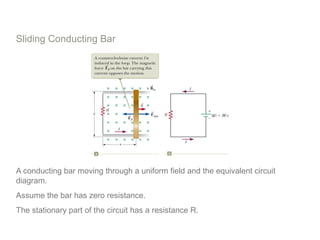
Sliding Conducting Bar
A conducting bar moving through a uniform field and the equivalent circuit
diagram.
Assume the bar has zero resistance.
The stationary part of the circuit has a resistance R.
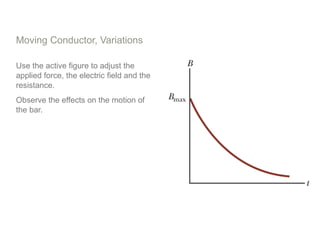
Moving Conductor, Variations
Use the active figure to adjust the
applied force, the electric field and the
resistance.
Observe the effects on the motion of
the bar.
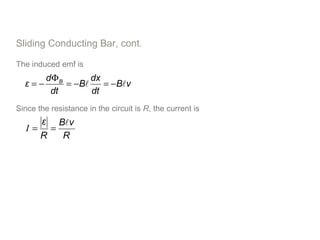
Sliding Conducting Bar, cont.
The induced emf is
Since the resistance in the circuit is R, the current is
Bd dx
ε B B v
dt dt
Φ
= − = − = − 
I
ε B v
R R
= =

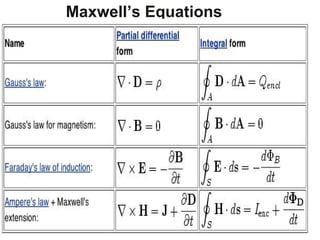
Maxwell’s Equations

Maxwell equation

  • 2.
    Induced Fields Magnetic fieldsmay vary in time. Experiments conducted in 1831 showed that an emf can be induced in a circuit by a changing magnetic field.  Experiments were done by Michael Faraday and Joseph Henry. The results of these experiments led to Faraday’s Law of Induction. An induced current is produced by a changing magnetic field. There is an induced emf associated with the induced current. A current can be produced without a battery present in the circuit. Faraday’s law of induction describes the induced emf.
  • 3.
    Michael Faraday 1791 –1867 British physicist and chemist Great experimental scientist Contributions to early electricity include:  Invention of motor, generator, and transformer  Electromagnetic induction  Laws of electrolysis
  • 4.
    EMF Produced bya Changing Magnetic Field, 1 A loop of wire is connected to a sensitive ammeter. When a magnet is moved toward the loop, the ammeter deflects.  The direction was arbitrarily chosen to be negative.
  • 5.
    EMF Produced bya Changing Magnetic Field, 2 When the magnet is held stationary, there is no deflection of the ammeter. Therefore, there is no induced current.  Even though the magnet is in the loop
  • 6.
    EMF Produced bya Changing Magnetic Field, 3 The magnet is moved away from the loop. The ammeter deflects in the opposite direction.
  • 7.
  • 8.
    EMF Produced bya Changing Magnetic Field, Summary The ammeter deflects when the magnet is moving toward or away from the loop. The ammeter also deflects when the loop is moved toward or away from the magnet. Therefore, the loop detects that the magnet is moving relative to it.  We relate this detection to a change in the magnetic field.  This is the induced current that is produced by an induced emf.
  • 9.
    Faraday’s Experiment –Set Up A primary coil is connected to a switch and a battery. The wire is wrapped around an iron ring. A secondary coil is also wrapped around the iron ring. There is no battery present in the secondary coil. The secondary coil is not directly connected to the primary coil.
  • 10.
    Faraday’s Experiment Close theswitch and observe the current readings given by the ammeter.
  • 11.
    Faraday’s Experiment –Findings At the instant the switch is closed, the ammeter changes from zero in one direction and then returns to zero. When the switch is opened, the ammeter changes in the opposite direction and then returns to zero. The ammeter reads zero when there is a steady current or when there is no current in the primary circuit.
  • 12.
    Faraday’s Experiment –Conclusions An electric current can be induced in a loop by a changing magnetic field.  This would be the current in the secondary circuit of this experimental set-up. The induced current exists only while the magnetic field through the loop is changing. This is generally expressed as: an induced emf is produced in the loop by the changing magnetic field.  The actual existence of the magnetic flux is not sufficient to produce the induced emf, the flux must be changing.
  • 13.
    Faraday’s Law ofInduction – Statements The emf induced in a circuit is directly proportional to the time rate of change of the magnetic flux through the circuit. Mathematically, Remember ΦB is the magnetic flux through the circuit and is found by If the circuit consists of N loops, all of the same area, and if ΦB is the flux through one loop, an emf is induced in every loop and Faraday’s law becomes Bd ε dt Φ = − Bd ε N dt Φ = − dSB •=Ψ ∫ dt d dlE Ψ −=•∫ ______________(1)
  • 14.
    Relation between EMFand Electrostatic field
  • 15.
    Faraday’s Law –Example Assume a loop enclosing an area A lies in a uniform magnetic field. The magnetic flux through the loop is ΦB = BA cos θ. The induced emf is Vemf = - d/dt (BA cos θ). Section 31.1
  • 16.
    Nature of achanging fluxNature of a changing flux Since flux is defined as a dot product  B can change  A can change  q can change ∫ ⋅−= S dSB dt d NVemf  dSB•=Ψ ∫ _______________(2)
  • 17.
    Polarity of theInduced Emf The polarity (direction) of the induced emf is determined by Lenz’s law.
  • 18.
    LENZ’S Law The directionof theThe direction of the emf induced byemf induced by changing flux willchanging flux will produce a currentproduce a current that generates athat generates a magnetic fieldmagnetic field opposing the fluxopposing the flux change thatchange that produced itproduced it..
  • 19.
    Lenz’s Law B, H Lenz’sLaw: emf appears and current flows that creates a magnetic field that opposes the change – in this case an decrease – hence the negative sign in Faraday’s Law. B, H N S V+, V-  Iinduced
  • 20.
    Lenz’s Law B, H Lenz’sLaw: emf appears and current flows that creates a magnetic field that opposes the change – in this case an increase – hence the negative sign in Faraday’s Law. B, H N S  V-, V+ Iinduced
  • 21.
    Faraday’s Law fora Single Loop dt d E Ψ −== ε
  • 22.
    Faraday’s Law fora coil having NFaraday’s Law for a coil having N turnsturns dt d NE Ψ −==ε
  • 23.
    Ways of Inducingan emf 1. A stationary loop in a time varying magnetic field B [TRANSFORMER EMF] i.e. The magnitude of the magnetic field can change with time. 2. A time varying loop area in a static field B [ MOTIONAL EMF] i.e., The area enclosed by the loop can change with time. 3. Time varying loop area in a time varying magnetic field i.e., The angle between the magnetic field and the normal to the loop can change with time. Any combination of the above can occur.
  • 24.
    Motional emf A motionalemf is the emf induced in a conductor moving through a constant magnetic field. The electrons in the conductor experience a force, that is directed along ℓ . q= ×F v B r rr
  • 25.
    Motional emfMotional emf Applythe Lorentz ForceApply the Lorentz Force quation:quation: 0qvBqEF =−= vBE =  vBE =ε= vB=ε qvBqE =
  • 26.
    Faraday’s Law md ddx Blx Bl dt dt dt Φ = = dx Blv Bl dt = =E m Therefore, d dt Φ =E CONCLUSION: to produce emf one should make ANY change in a magnetic flux with time! Consider the loop shown:
  • 27.
    Sliding Conducting Bar Aconducting bar moving through a uniform field and the equivalent circuit diagram. Assume the bar has zero resistance. The stationary part of the circuit has a resistance R.
  • 28.
    Moving Conductor, Variations Usethe active figure to adjust the applied force, the electric field and the resistance. Observe the effects on the motion of the bar.
  • 29.
    Sliding Conducting Bar,cont. The induced emf is Since the resistance in the circuit is R, the current is Bd dx ε B B v dt dt Φ = − = − = −  I ε B v R R = = 
  • 30.

Editor's Notes

  • #20 There is a negative sign in Faraday’s Law – and this is why.
  • #21 There is a negative sign in Faraday’s Law – and this is why.