DISORDERS
OF
PROTEIN
METABOLISM
PRESENTED BY
BAZILA
ILLAHI
BDS 3RD YEAR
ROLL NO : 15
CONTENTS :
 BRIEF OVERVIEW OF PROTEINS
 DEFINITION OF PROTEINS
 TYPES OF PROTEINS
 BIOLOGICAL FUNCTIONS
 ROLE IN DENTISTRY
 PROTEIN METABOLISM OVERVIEW
 METABOLIC DISTURBANCES OF
PROTEINS
PROTEIN ENERGY MALNUTRITION
AMYLOIDOSIS
GOUT
PRION DISEASE
INBORN ERRORS OF METABOLISM
DEFINITION OF PROTEINS
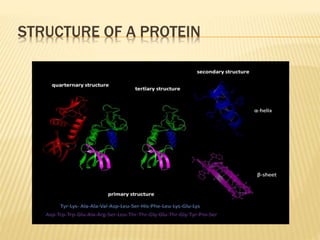
STRUCTURE OF A PROTEIN
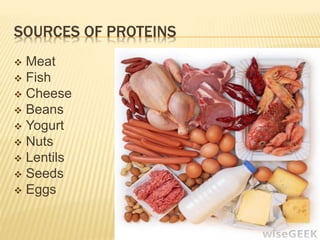
SOURCES OF PROTEINS
 Meat
 Fish
 Cheese
 Beans
 Yogurt
 Nuts
 Lentils
 Seeds
 Eggs
DAILY REQUIREMENTS
One gram of protein is required for each kg of body
weight.
However requirement can increase in various normal
physiological situations like:
 Last half of pregnancy
 During lactation
 Infancy
 Childhood
 Adolescence
TYPES OF PROTEINS
On the basis of composition :
1. Simple proteins :- contain only a.a
2. Conjugate proteins :- contain a non a.a component in addition to
the a.a
3. Complete proteins :- contain sufficient amount of essential a.a
4. Incomplete proteins :- contain insufficient quantities of one or
more essential a.a
5. Complementary proteins :- incomplete when ingested singly,but
when combined provide sufficient essential a.a
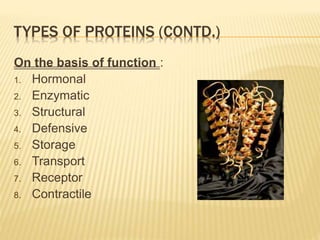
TYPES OF PROTEINS (CONTD.)
On the basis of function :
1. Hormonal
2. Enzymatic
3. Structural
4. Defensive
5. Storage
6. Transport
7. Receptor
8. Contractile
BIOLOGICAL FUNCTIONS
 Static functions :- provides stucture and strength to the body e.g
collagen.
 Dynamic functions :- hormonal, enymatic, defensive etc.
 Source of energy
 Role in dentistry :-
 Pre-eruptive and post-eruptive effects on teeth as they form an
integral component of cells necessary for the normal development
of teeth and specifically for the formation of matrix of hard tissues
of teeth e.g Amelogenin,BMP.
 Chemical nature of protein foods can neutralize the acids produced
by oral bacteria.
 Dental pellicle- an acellular layer of salivary proteins protects the
enamel against abrasion and serves as a diffusion barrier thus
preventing the solubility of enamel surface.
PROTEIN METABOLISM OVERVIEW
Dietary protein body proteins
Protein synthesis amino acids synthesis of N-compounds
α-ketoglutarate
transamination
glutamate
deamination
ketoacids ammonia
urea
Energy Glucose Fat Non-essential amino acids
PROTEIN METABOLISM (CONTD.)
Amino acid contains two components:
 Carbon skeleton- its converted to keto acids
a.a transamination Keto acids
.
 Amino group- its converted to urea as an excretory product.
a.a deamination Urea
METABOLIC DISTURBANCES OF PROTEINS
I. Protein Energy Malnutrition (PEM) :-
PEM is a spectrum of diseases whose
essential feature is a deficiency of protein at
one end as in Kwashiorkor and ; total
inanition(starvation of infant due to severe and
prolonged restriction of all food at other end as
in Marasmus. In the middle of spectrum,there
is Marasmic Kwashiorkor in which there are
clinical features of both disorders.
 Causes of PEM :-
 Dietary deficiency
 Serious illness
 Infections in babies
 Low socio-economic status
 Problems in mother leading to inadequate
production of milk
 Dietary factors like inadequate breast feeding,
ignorance of weaning
 PROTEIN ENERGY MALNUTRITION
a) KWASHIORKOR
b) MARASMUS
 CAUSES
 CLINICAL MANIFESTATIONS
 INVESTIGATIONS
 TREATMENT
PEM IS PRESENTED AS :-
 Kwashiorkor
 Marasmus
KWASHIORKOR
 Introduction –
Its a maladaptive response to starvation due to lack of
physiological adaptation to unbalanced deficiency
where body utilizes proteins and conserves fat
 Occurrence –
Seen predominantly between 1-5 years of age
 Causes –
Due to insufficient intake of proteins, as the diet of
weaning child mainly consists of carbohydrates
 Biological manifestations –
 Decreased plasma albumin levels
 Visceral compartment is severely affected
 Hypoproteinemia and hypoglycemia
 Decreased level of electrolytes
 Low enzyme levels
 Percentage of body water is increased
 Iron deficiency anemia
 Fatty liver (due to decreased synthesis of carrier proteins of
lipoproteins)
 Hypoplastic bone marrow
 Decreased immunity
 Multi-vitamin deficiency
 Clinical symptoms -
 Weight is about 60-80 % of normal as loss of true weight is masked by
increased fluid retention
 Generalized edema (due to decreased colloidal osmotic pressure) of
pitting variety
 Sparing of subcutaneous fat and muscle mass as body utilizes its
proteins to compensate the deficient state
 Swollen abdomen
 Moon face
 Characteristic skin lesions with alternating layers of hyperpigmentation,
desquamation hypopigmentation; giving a flaky paint appearance
 Hair changes like loss of colour or alternate bands of pale and darker
colour, straightening and loss of firm attachment to scalp
 Diarrhoea (due to impaired synthesis of digestive enzymes and loss of
electrolytes in stools)
 Eyelashes give a ‘Broomstick’ appearance
 Dehydration (due to diarrhoea and vomitting)
 Prone to infections
 Psychomotor changes (due to cerebral atrophy)
 Oral manifestations of Kwashiorkor –
 Bright reddening of tongue with loss of papillae
 Bilateral angular cheilosis (inflammation)
 Fissuring of lips
 Loss of circumoral pigmentation
 Crowded and rotated teeth giving an appearance of mouth full of
jumbled teeth
 Delayed eruption and hypoplasia of deciduous teeth
 Mouths of Kwashiorkor patients have been described by Van
Wyk to be dry, dirty, caries free, easily traumatized with
epithelium readily become detached from the underlying
tissue, leaving a raw, beeding surface
 Incisor and molar growth is retarded
 Radicular osteocementum decreased
 Increased acid solubility of enamel of incisors
 Decreased salivary volume
 Oral cytological smear study –
Perinuclear vacuolization or halo around nucleus in a
remarkable number of epithelial cells which is interpreted as
a sign of atrophy
 Investigations –
A. Routine tests :-
• Full blood count -
• Stool and urine study – KETONURIA
• Blood glucose profile - HYPOGLYCEMIA
• Hb estimation - ANEMIA
B. Non-routine tests :-
• Hair analysis – ALTERNATE BANDS OF HAIR
• Skin biopsy - PARAKERATOSIS WITH DESQUAMATION
• Oral findings – BLEEDING SURFACE
 Treatment –
 Provide adequate nutrition by dietary supplements
 Restore normal body composition
 Dietary support in the form of 3-4 gm protein and 200
cal/kg body weight
 Cure the conditions that cause the deficiency
 Prevention –
 Breastfeeding a baby for at least 6 months to prevent
PEM
 Improved food distribution systems, public health
programs and agricultural development should be
promoted
MARASMUS
 Introduction –
Its an adaptive response to starvation
 Occurrence –
Seen mostly in the first year of life
 Causes –
Due to deficiency of calories
 Biological manifestations –
 Serum albumin level normal or slightly decreased
 Somatic compartment of proteins is lost
 Anemia
 Multi vitamin deficiency
 Immune deficiency
 Hypoplastic bone marrow with increased red cell precursors
 Clinical symptoms –
 Growth retardation due to low calorie intake
 Loss of muscle mass as muscle proteins are mobilised as use for
fuel to provide body with a.a as a source of energy to
compensate malnutrition. Due to muscle wasting rib cage is
prominent
 Subcutaneous fat is lost due to lipolysis
 Lean body, so head appears too large
 Body weight falls to 60 % of normal
 Child looks older than his age
 Weakened body is under stress
 More chances of infections
 Dry and baggy skin
 Sparse hair and wrinkled appearance (Old man face)
 No edema
 Bones are prominent due to absence of fat around them
 Hypotension and slow pulse
 Investigations –
 Full blood count -
 Electrolyte, serum protein level study –
ALBUMIN LEVEL NORMAL OR LOW.
 Blood glucose level -
 Treatment –
 Dietary support by giving food as proteins and supplements
 Bring the child out of starvation
POINTS OF DIFFERENTIATION BETWEEN
KWASHIORKOR AND MARASMUS
KWASHIORKOR MARASMUS
1. Malnutrition that occurs due
to insufficient intake of
proteins
2. Large belly, diarrhoea,
pigmented skin, hair changes
3. Children of 1-5 yrs age
4. Weaned from mother’s milk
to a diet low in protein
5. Edema-Present (pitting type)
6. 60-80 % of normal body wt.
7. Decreased plasma albumin
8. Treated by High protein
foods
1. Malnutrition that occurs due
to starvation (i.e deficiency of
proteins, carbs. and fats in
diet
2. Muscle wasting, skin
foldings, prominent rib cage ,
shrunken abdomen
3. Children under 1 yr
4. Failed breastfeeding
(inadequate calorie intake)
5. Absent, rather wasting
6. Less than 60 % of normal
7. Normal / slightly decreased
plasma albumin
8. Treated by a Well banced
diet
KWASHIORKOR MARASMUS
 AMYLOIDOSIS
 INTRODUCTION
 PATHOGENESIS
 CLASSIFICATION
 CLINICAL MANIFESTATIONS
 ORAL MANIFESTATIONS
 DIAGNOSIS
 BIOPSY EXAMINATION
 VARIOUS TESTS
TREATMENT
AMYLOIDOSIS
 Introduction :-
Disorder characterized by extracellular deposits
of fibrillar proteins which is a result of
aggregation of misfolded proteins.
Misfolded proteins being unstable start self
associating forming oligomers and fibrils that r
deposited in tissues.
 Pathogenesis :-
FORMS OF AMYLOID PROTEINS :-
1. Amyloid light chain protein (AL)- Here IG light
chains accumulate due to monoclonal B cell
proliferation affecting heart
2. Amyloid associated protein ( AA)- Here SAA
accumulates due to increased activation by chronic
inflammatory mediators affecting liver mainly.
3. AB amyloid – Here APP deposits in the cerebral
vessels.
4. Transthyretin – Here ATTR accumulates due to
mutation of normal transthyretin.
5. B2 Microglobulin – accumulates in patients with
renal disease ,with deposits in joints.
 Classification :-
 Systemic amyloidosis –
 Immunocyte dyscrasias wth Amy. (AL Protein accumulation)
 Reactive sytsemic Amy. (AA Protein)
 Heriditary amyloidosis –
 Familial mediterranean fever (AA Protein)
 Senile Amy. (ATTR Protein)
 Familial amyloidotic neuropathies (ATTR Protein)
 Localized amyloidosis –
 Senile cerebral (AB Protein)
 Senile cardiac (ATTR Protein)
 Clinical manifestations :-
 Weakness,fatigue,weightloss
 Renal and hepatic diseases
 Proteinuria
 Cardiac arrythemia
 Changes in skin color
 Clay-colored stools
 Feeling of fullness
 Joint pain
 Low red blood cell count (anemia)
 Shortness of breath
 Swelling of the tongue
 Tingling and numbness in legs and feet
 Weak hand grip
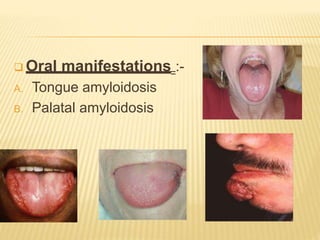
 Oral manifestations :-
A. Tongue amyloidosis
B. Palatal amyloidosis
A. Tongue amyloidosis :-
 Feature of systemic amyloidosis
 Macroglossia with nodular deposits
 Lateral ridging of enlarged tongue due to
teeth indentation
 Firm tongue with yellow nodules on lateral surface
 Interference with taste and hyposalivation may result
from amyloid deposition in salivary glands
 Xerostomia n tongue pain
 Sub mandibular swelling due to tongue enlargement can
lead to respiaratory obstruction.
B. Palatal amyloidosis :-
 Rare condition
 Feature of localized amyloidosis
 Nodular deposits found on palate ,nasal septum
and maxillary sinus.
 Diagnosis :-
It requires
 Demonstration of amyloid in tissues
 Demonstration of plasma cell dyscrasia
o For demonstration of tissue amyloid :-
1. BIOPSY - Fine needle aspiration of abdomenal fat.
Tissues for non-invasive biopsy are gingiva, salivary
glands, rectum and skin.
 Histological feature is Apple Green Birefringence
with Congo red dye and viewed under polarised
microscope. Other dyes like Thioflavin,Hematoxylin
and Eosin are also used.
APPLE GREEN BIREFRINGENCE SEEN IN
HISTOLOGIC SECTION
o For demonstration of plasma cell dyscrasia :-
1. Bone marrow biopsy showing gamma and kappa
light chain producing plasma cells.
2. Presence of monoclonal light chains in serum and
urine.
3. Serum Free Light Chain assay (FLC)
o Imaging techniques for assessment of organ
involvement
 Treatment :-
(Aim is to reduce the supply of amyloidogenic monoclonal light chains by
suppressing the underlying Plasma cell dyscrasia)
 High-dose chemotherapy withstem cell transplant
can help remove the substance that leads to
amyloid formation in those with primary AL
amyloidosis.
 Secondary (AA) amyloidosis is treated with
powerful anti-inflammatory medicines called
steroids, which fight inflammation.
 Liver transplant may stop the disease in those with
hereditary amyloidosis.
 A kidney or heart transplant may also be
recommended.
 Diuretic medicine to remove excess water from
your body
 Thickeners to add to fluids to prevent choking in
those who have swelling of the tongue
 Compression stockings to relieve swelling in the
legs or feet
 Diet modifications, especially for those with
gastrointestinal amyloidosis
 GOUT
 INTRODUCTION
 PATHOGENESIS
 CLINICAL MANIFESTATIONS
 ORAL MANIFESTATIONS
 DIAGNOSIS
 TREATMENT
GOUT
 Introduction –
Gout is an inflammatory disease caused by deposition
of monosodium urate monohydrate crystals in and
around synovial joints.
 Epidemology –
Levels are higher are in men, increase with age and are
associated with body weight
.
 Pathophysiology –
It can be due to diminished renal excretion ; or
increased intake of red meat ; or
over production of uric acid .
 Clinical features –
 Severe pain
 Extreme tenderness
 Marked swelling with overlying red
shiny skin
 Crystals may deposit in joints and soft tissues to produce irregular
firm nodules called TOPHI.
 Investigations –
 Aspiration of urate crystals from a joint, bursa and tophus
 Biochemical screen including renal function, uric acid, glucose
and lipid profile should be performed
 Levels of ESR and CRP
 Radiographs
 Treatment –
 Oral NSAIDs for pain relief
 Local icepacks
 Oral colchicine
 Joint aspiration with intra articular steroid injection
 Oral corticosteroids
 Urate lowering therapy
 Allopurinol drug which reduces conversion of
hypoxanthine and xanthine to uric acid.
PRIONS
 Are the unique proteineceous infectious agents.
 Devoid of nucleic acid.
 Transmitted by acquisition of normal mammalian protein
(prion protein PrPc) which is in an abnormal
conformation(PrPsc ) due to replacement of alpha helices
by beta sheets.
 The abnormal protein inhibits the enzyme proteasome
26S, leading to vicious circle of further accumulation of
abnormally configured PrPsc instead of normally
configured PrPc.
PRIONS DISEASES
 Introduction –
Rare disorders which include diff. forms of
CREUTZFELDT JAKOB Disease (CJD) as well as
animal diseases such as SCRAPIE disease in sheep
and Mad cow disease in cattles.
 Epidemology –
Common in middle aged to elderly.
 Pathology –
Due to mutations in gene coding for prion protein.
PATHOPHYSIOLOGY OF PRION DISEASE
Oral manifestations of prions diseases are
extremely rare with features as :-
 Pseudobulbar palsy may cause dysphagia.
 Dysarthria and Orofacial dysesthesia .
 Paresthesia, as well as loss of taste and smell.
 Clinical features –
 Progressive dementia
 Characteristic EEG pattern due to brain atrophy
 Visual disturbances
 Diagnosis –
 By immunohistochemical staining
 Blood test
 EEG
 Cerebrospinal fluid test
PREVENTION –
The theoretical risk of
transmission of prion
disease through dental
treatment points to the
importance
of maintaining optimal
standards of infection control
and
decontamination for infectious
agents, including prions.
 INBORN ERRORS OF AMINO ACID
METABOLISM
 DISORDERS OF PHENYLALANINE N
TYROSINE
 PHENYLKETONURIA
 TYROSINEMIA
 ALKAPTONURIA
 ALBINISM
 CYSTINURIA
 CYSTINOSIS
 HARTNUP DISEASE
 MAPLE SYRUP DISEASE
INBORN ERRORS OF METABOLISM
INBORN ERRORS OF AMINO ACID METABOLISM:-
Phenylketonuria :-
Enzyme defect in Phenylalanine / tyrosine
degradation leading to metabolic disorder. Here,
the deficiency of hepatic enzyme Phenylalanine
Hydroxylase results in accumulation of
Phenylalanine.
Phenylalanine Tyrosine
P.HYDROXYLASE
Phenyketonuria
 Oral manifestations –
 Prominent cheek and jaw bones
 Widely spaced teeth
 Poor development of tooth enamel.
 Patients are susceptible to tooth wear(erosion)
 Clinical manifestations –
 Mental retardation due to its accumulation
 Hypopigmentation of hair and skin
 Treatment –
 Diet low in phenylalanine amino acid
 Diet with sufficient amount of tyrosine (to
compensate for its absence)
Alkaptonuria :-
Its due to absence of Homogentisate oxidase
activity which is necessary for breakdown of
Homogenetisic acid. As such Homogentisate
accumulates in tissues .
Phenylalanine Tyrosine Homogenitisic
acid
H.OXIDASE
Alkaptonuria Intermediates in TCA
 Clinical features –
 Dark urine : also known as Black Urine disease
Homogenetistic acid urination Alkapton (Black colur)
 Ochronosis (alkapton deposition in bones, nose,
ear,eyes, etc.)
 Arthritis
 Treatment –
Not a dangerous disorder,
so no specific treatment.
Albinism :-
It is due to lack of synthesis of pigment Melanin
which is due to defect in tyrosinase enzyme, the
most responsible enzyme for Melanin synthesis.
PHENYLALNINE TYROSINE
Tyrosinase
DOPA
ALBINISM
 Clinical features –
 Photophobia
 Susceptibility to Parkinson’s disease (as no DOPA
formed)
 Hypopigmentation in the form of :
i. Vitiligo – loss of pigmentation around mouth,
nose, eyes, nipples
ii. Leukoderma – loss of pigmentation begins with
hands
Tryosinemia :-
It results due to loss of Tyrosine
transaminase which is required for the
degradation of Tyrosine. (Type 1)
Phenylalanine Tyrosine
T.transaminase
TYROSINEMIA Breakdown product
 Clinical features –
 Hepatic dysfunction, cirrhosis
 Liver failure
 Hyperkeratosis
 Treatment –
 Diets low in in Tyrosine,
Phenylalanine are
recommended.
Cystinuria :-
Characterized by increased excretion of Cystine
due to defective carrier system which is normally
present for re-absorption of amino acids leading to
excretion of amino acids in urine .
Cystine Reabsorption
carrier system in kidney
Cystinuria
 Clinical features –
 Cystine stones in kidneys (due to its insolubility)
 Treatment –
 Aim of treatment
is to increase its solubility
and thus reduce stone
formation in kidneys.
Homocystinuria :-
Due to accumulation of homocystine
 Features –
 Thrombosis,
 Osteoporosis,
 MI, Stroke, etc
Hartnup’s disease :-
It’s a hereditary disorder of Tryptophan metabolism
characterized by low plasma levels of Tryptophan and
their elevated urinary excretion.
 Clinical manifestations –
 Rash, light sensitivity
 Cerebellar ataxia
 Dermatitis
 Mental retardation
 Treatment –
 Dietary Niacin is given
Maple Syrup Urine Disease :-
It’s a metabolic disorder of branched chain amno
acids. The urine smells like Maple syrup or Burnt
sugar, hence the name .
Branched chain keto a.a Acetyl CO-
A
acid dehyrogenase
MSUD
 Symptoms –
 Lethargy
 Maple syrup odour of urine
 Coma
 Mental retardation
 Treatment –
 To feed with a diet having low content of branched
chain amino acids
Isovaleric acidemia :-
Inborn error of leucine metabolism with defect in
enzyme Isovaleric Co-A dehyrogenase.
 Oral manifestation –
Cheesy odour in breath
 Treatment –
Limit intake of leucine in diet
Cystinosis :-
Cystine storage disease where cystine crystals are
deposited in many tissues n organs of RES .
 Cause –
Lysosomal dysfunction
Glycinuria :-
When excessive amount of glycine is excreted in
urine due to defective renal reabsorption .
 Symptoms –
Increased tendency for formation of oxalate crystal
stones.
BIBLIOGRAPHY
 Shafer’s Textbook of oral pathology (7th edition)
 U.satyanarayan textbook of biochemistry (3rd edition)
 Robbin’s book of basic pathology (9th edition)
 Davidson’s book of medicine (22nd edition)
 Neville’s textbook of oral and maxillofacial pathology (2nd
edition)
 Neurol Neurosurg Psychiatry 2004;75(Suppl I):i36–i42. doi:
10.1136/jnnp.2004.036137
 PEM by Keith P. West, Jr., Dr.P.H.international nutrition
 Oral Manifestations of Malnutrition III. The Effect of
Proteins
Pages with reference to book,
From 119 To 122 Mohammad Iqbal Khadim ( Dentistry
Department, Khyber Medic College, Peshawar. )
Disorders OF PROTEIN METABOLISM

Disorders OF PROTEIN METABOLISM

  • 1.
  • 2.
    CONTENTS :  BRIEFOVERVIEW OF PROTEINS  DEFINITION OF PROTEINS  TYPES OF PROTEINS  BIOLOGICAL FUNCTIONS  ROLE IN DENTISTRY  PROTEIN METABOLISM OVERVIEW  METABOLIC DISTURBANCES OF PROTEINS
  • 3.
  • 4.
  • 5.
  • 6.
    SOURCES OF PROTEINS Meat  Fish  Cheese  Beans  Yogurt  Nuts  Lentils  Seeds  Eggs
  • 7.
    DAILY REQUIREMENTS One gramof protein is required for each kg of body weight. However requirement can increase in various normal physiological situations like:  Last half of pregnancy  During lactation  Infancy  Childhood  Adolescence
  • 8.
    TYPES OF PROTEINS Onthe basis of composition : 1. Simple proteins :- contain only a.a 2. Conjugate proteins :- contain a non a.a component in addition to the a.a 3. Complete proteins :- contain sufficient amount of essential a.a 4. Incomplete proteins :- contain insufficient quantities of one or more essential a.a 5. Complementary proteins :- incomplete when ingested singly,but when combined provide sufficient essential a.a
  • 9.
    TYPES OF PROTEINS(CONTD.) On the basis of function : 1. Hormonal 2. Enzymatic 3. Structural 4. Defensive 5. Storage 6. Transport 7. Receptor 8. Contractile
  • 10.
    BIOLOGICAL FUNCTIONS  Staticfunctions :- provides stucture and strength to the body e.g collagen.  Dynamic functions :- hormonal, enymatic, defensive etc.  Source of energy  Role in dentistry :-  Pre-eruptive and post-eruptive effects on teeth as they form an integral component of cells necessary for the normal development of teeth and specifically for the formation of matrix of hard tissues of teeth e.g Amelogenin,BMP.  Chemical nature of protein foods can neutralize the acids produced by oral bacteria.  Dental pellicle- an acellular layer of salivary proteins protects the enamel against abrasion and serves as a diffusion barrier thus preventing the solubility of enamel surface.
  • 11.
    PROTEIN METABOLISM OVERVIEW Dietaryprotein body proteins Protein synthesis amino acids synthesis of N-compounds α-ketoglutarate transamination glutamate deamination ketoacids ammonia urea Energy Glucose Fat Non-essential amino acids
  • 12.
    PROTEIN METABOLISM (CONTD.) Aminoacid contains two components:  Carbon skeleton- its converted to keto acids a.a transamination Keto acids .  Amino group- its converted to urea as an excretory product. a.a deamination Urea
  • 13.
    METABOLIC DISTURBANCES OFPROTEINS I. Protein Energy Malnutrition (PEM) :- PEM is a spectrum of diseases whose essential feature is a deficiency of protein at one end as in Kwashiorkor and ; total inanition(starvation of infant due to severe and prolonged restriction of all food at other end as in Marasmus. In the middle of spectrum,there is Marasmic Kwashiorkor in which there are clinical features of both disorders.
  • 14.
     Causes ofPEM :-  Dietary deficiency  Serious illness  Infections in babies  Low socio-economic status  Problems in mother leading to inadequate production of milk  Dietary factors like inadequate breast feeding, ignorance of weaning
  • 15.
     PROTEIN ENERGYMALNUTRITION a) KWASHIORKOR b) MARASMUS  CAUSES  CLINICAL MANIFESTATIONS  INVESTIGATIONS  TREATMENT
  • 16.
    PEM IS PRESENTEDAS :-  Kwashiorkor  Marasmus
  • 17.
    KWASHIORKOR  Introduction – Itsa maladaptive response to starvation due to lack of physiological adaptation to unbalanced deficiency where body utilizes proteins and conserves fat  Occurrence – Seen predominantly between 1-5 years of age  Causes – Due to insufficient intake of proteins, as the diet of weaning child mainly consists of carbohydrates
  • 18.
     Biological manifestations–  Decreased plasma albumin levels  Visceral compartment is severely affected  Hypoproteinemia and hypoglycemia  Decreased level of electrolytes  Low enzyme levels  Percentage of body water is increased  Iron deficiency anemia  Fatty liver (due to decreased synthesis of carrier proteins of lipoproteins)  Hypoplastic bone marrow  Decreased immunity  Multi-vitamin deficiency
  • 19.
     Clinical symptoms-  Weight is about 60-80 % of normal as loss of true weight is masked by increased fluid retention  Generalized edema (due to decreased colloidal osmotic pressure) of pitting variety  Sparing of subcutaneous fat and muscle mass as body utilizes its proteins to compensate the deficient state  Swollen abdomen  Moon face  Characteristic skin lesions with alternating layers of hyperpigmentation, desquamation hypopigmentation; giving a flaky paint appearance  Hair changes like loss of colour or alternate bands of pale and darker colour, straightening and loss of firm attachment to scalp  Diarrhoea (due to impaired synthesis of digestive enzymes and loss of electrolytes in stools)  Eyelashes give a ‘Broomstick’ appearance  Dehydration (due to diarrhoea and vomitting)  Prone to infections  Psychomotor changes (due to cerebral atrophy)
  • 21.
     Oral manifestationsof Kwashiorkor –  Bright reddening of tongue with loss of papillae  Bilateral angular cheilosis (inflammation)  Fissuring of lips  Loss of circumoral pigmentation  Crowded and rotated teeth giving an appearance of mouth full of jumbled teeth  Delayed eruption and hypoplasia of deciduous teeth  Mouths of Kwashiorkor patients have been described by Van Wyk to be dry, dirty, caries free, easily traumatized with epithelium readily become detached from the underlying tissue, leaving a raw, beeding surface  Incisor and molar growth is retarded  Radicular osteocementum decreased  Increased acid solubility of enamel of incisors  Decreased salivary volume
  • 22.
     Oral cytologicalsmear study – Perinuclear vacuolization or halo around nucleus in a remarkable number of epithelial cells which is interpreted as a sign of atrophy  Investigations – A. Routine tests :- • Full blood count - • Stool and urine study – KETONURIA • Blood glucose profile - HYPOGLYCEMIA • Hb estimation - ANEMIA B. Non-routine tests :- • Hair analysis – ALTERNATE BANDS OF HAIR • Skin biopsy - PARAKERATOSIS WITH DESQUAMATION • Oral findings – BLEEDING SURFACE
  • 23.
     Treatment – Provide adequate nutrition by dietary supplements  Restore normal body composition  Dietary support in the form of 3-4 gm protein and 200 cal/kg body weight  Cure the conditions that cause the deficiency  Prevention –  Breastfeeding a baby for at least 6 months to prevent PEM  Improved food distribution systems, public health programs and agricultural development should be promoted
  • 24.
    MARASMUS  Introduction – Itsan adaptive response to starvation  Occurrence – Seen mostly in the first year of life  Causes – Due to deficiency of calories  Biological manifestations –  Serum albumin level normal or slightly decreased  Somatic compartment of proteins is lost  Anemia  Multi vitamin deficiency  Immune deficiency  Hypoplastic bone marrow with increased red cell precursors
  • 25.
     Clinical symptoms–  Growth retardation due to low calorie intake  Loss of muscle mass as muscle proteins are mobilised as use for fuel to provide body with a.a as a source of energy to compensate malnutrition. Due to muscle wasting rib cage is prominent  Subcutaneous fat is lost due to lipolysis  Lean body, so head appears too large  Body weight falls to 60 % of normal  Child looks older than his age  Weakened body is under stress  More chances of infections  Dry and baggy skin  Sparse hair and wrinkled appearance (Old man face)  No edema  Bones are prominent due to absence of fat around them  Hypotension and slow pulse
  • 27.
     Investigations – Full blood count -  Electrolyte, serum protein level study – ALBUMIN LEVEL NORMAL OR LOW.  Blood glucose level -  Treatment –  Dietary support by giving food as proteins and supplements  Bring the child out of starvation
  • 28.
    POINTS OF DIFFERENTIATIONBETWEEN KWASHIORKOR AND MARASMUS KWASHIORKOR MARASMUS 1. Malnutrition that occurs due to insufficient intake of proteins 2. Large belly, diarrhoea, pigmented skin, hair changes 3. Children of 1-5 yrs age 4. Weaned from mother’s milk to a diet low in protein 5. Edema-Present (pitting type) 6. 60-80 % of normal body wt. 7. Decreased plasma albumin 8. Treated by High protein foods 1. Malnutrition that occurs due to starvation (i.e deficiency of proteins, carbs. and fats in diet 2. Muscle wasting, skin foldings, prominent rib cage , shrunken abdomen 3. Children under 1 yr 4. Failed breastfeeding (inadequate calorie intake) 5. Absent, rather wasting 6. Less than 60 % of normal 7. Normal / slightly decreased plasma albumin 8. Treated by a Well banced diet
  • 29.
  • 30.
     AMYLOIDOSIS  INTRODUCTION PATHOGENESIS  CLASSIFICATION  CLINICAL MANIFESTATIONS  ORAL MANIFESTATIONS  DIAGNOSIS  BIOPSY EXAMINATION  VARIOUS TESTS TREATMENT
  • 31.
    AMYLOIDOSIS  Introduction :- Disordercharacterized by extracellular deposits of fibrillar proteins which is a result of aggregation of misfolded proteins. Misfolded proteins being unstable start self associating forming oligomers and fibrils that r deposited in tissues.
  • 32.
  • 33.
    FORMS OF AMYLOIDPROTEINS :- 1. Amyloid light chain protein (AL)- Here IG light chains accumulate due to monoclonal B cell proliferation affecting heart 2. Amyloid associated protein ( AA)- Here SAA accumulates due to increased activation by chronic inflammatory mediators affecting liver mainly. 3. AB amyloid – Here APP deposits in the cerebral vessels. 4. Transthyretin – Here ATTR accumulates due to mutation of normal transthyretin. 5. B2 Microglobulin – accumulates in patients with renal disease ,with deposits in joints.
  • 34.
     Classification :- Systemic amyloidosis –  Immunocyte dyscrasias wth Amy. (AL Protein accumulation)  Reactive sytsemic Amy. (AA Protein)  Heriditary amyloidosis –  Familial mediterranean fever (AA Protein)  Senile Amy. (ATTR Protein)  Familial amyloidotic neuropathies (ATTR Protein)  Localized amyloidosis –  Senile cerebral (AB Protein)  Senile cardiac (ATTR Protein)
  • 35.
     Clinical manifestations:-  Weakness,fatigue,weightloss  Renal and hepatic diseases  Proteinuria  Cardiac arrythemia  Changes in skin color  Clay-colored stools  Feeling of fullness  Joint pain  Low red blood cell count (anemia)  Shortness of breath  Swelling of the tongue  Tingling and numbness in legs and feet  Weak hand grip
  • 36.
     Oral manifestations:- A. Tongue amyloidosis B. Palatal amyloidosis
  • 37.
    A. Tongue amyloidosis:-  Feature of systemic amyloidosis  Macroglossia with nodular deposits  Lateral ridging of enlarged tongue due to teeth indentation  Firm tongue with yellow nodules on lateral surface  Interference with taste and hyposalivation may result from amyloid deposition in salivary glands  Xerostomia n tongue pain  Sub mandibular swelling due to tongue enlargement can lead to respiaratory obstruction.
  • 38.
    B. Palatal amyloidosis:-  Rare condition  Feature of localized amyloidosis  Nodular deposits found on palate ,nasal septum and maxillary sinus.
  • 39.
     Diagnosis :- Itrequires  Demonstration of amyloid in tissues  Demonstration of plasma cell dyscrasia o For demonstration of tissue amyloid :- 1. BIOPSY - Fine needle aspiration of abdomenal fat. Tissues for non-invasive biopsy are gingiva, salivary glands, rectum and skin.  Histological feature is Apple Green Birefringence with Congo red dye and viewed under polarised microscope. Other dyes like Thioflavin,Hematoxylin and Eosin are also used.
  • 40.
    APPLE GREEN BIREFRINGENCESEEN IN HISTOLOGIC SECTION
  • 41.
    o For demonstrationof plasma cell dyscrasia :- 1. Bone marrow biopsy showing gamma and kappa light chain producing plasma cells. 2. Presence of monoclonal light chains in serum and urine. 3. Serum Free Light Chain assay (FLC) o Imaging techniques for assessment of organ involvement
  • 42.
     Treatment :- (Aimis to reduce the supply of amyloidogenic monoclonal light chains by suppressing the underlying Plasma cell dyscrasia)  High-dose chemotherapy withstem cell transplant can help remove the substance that leads to amyloid formation in those with primary AL amyloidosis.  Secondary (AA) amyloidosis is treated with powerful anti-inflammatory medicines called steroids, which fight inflammation.  Liver transplant may stop the disease in those with hereditary amyloidosis.
  • 43.
     A kidneyor heart transplant may also be recommended.  Diuretic medicine to remove excess water from your body  Thickeners to add to fluids to prevent choking in those who have swelling of the tongue  Compression stockings to relieve swelling in the legs or feet  Diet modifications, especially for those with gastrointestinal amyloidosis
  • 44.
     GOUT  INTRODUCTION PATHOGENESIS  CLINICAL MANIFESTATIONS  ORAL MANIFESTATIONS  DIAGNOSIS  TREATMENT
  • 45.
    GOUT  Introduction – Goutis an inflammatory disease caused by deposition of monosodium urate monohydrate crystals in and around synovial joints.  Epidemology – Levels are higher are in men, increase with age and are associated with body weight .  Pathophysiology – It can be due to diminished renal excretion ; or increased intake of red meat ; or over production of uric acid .
  • 47.
     Clinical features–  Severe pain  Extreme tenderness  Marked swelling with overlying red shiny skin  Crystals may deposit in joints and soft tissues to produce irregular firm nodules called TOPHI.  Investigations –  Aspiration of urate crystals from a joint, bursa and tophus  Biochemical screen including renal function, uric acid, glucose and lipid profile should be performed  Levels of ESR and CRP  Radiographs
  • 48.
     Treatment – Oral NSAIDs for pain relief  Local icepacks  Oral colchicine  Joint aspiration with intra articular steroid injection  Oral corticosteroids  Urate lowering therapy  Allopurinol drug which reduces conversion of hypoxanthine and xanthine to uric acid.
  • 49.
    PRIONS  Are theunique proteineceous infectious agents.  Devoid of nucleic acid.  Transmitted by acquisition of normal mammalian protein (prion protein PrPc) which is in an abnormal conformation(PrPsc ) due to replacement of alpha helices by beta sheets.  The abnormal protein inhibits the enzyme proteasome 26S, leading to vicious circle of further accumulation of abnormally configured PrPsc instead of normally configured PrPc.
  • 51.
    PRIONS DISEASES  Introduction– Rare disorders which include diff. forms of CREUTZFELDT JAKOB Disease (CJD) as well as animal diseases such as SCRAPIE disease in sheep and Mad cow disease in cattles.  Epidemology – Common in middle aged to elderly.  Pathology – Due to mutations in gene coding for prion protein.
  • 52.
  • 53.
    Oral manifestations ofprions diseases are extremely rare with features as :-  Pseudobulbar palsy may cause dysphagia.  Dysarthria and Orofacial dysesthesia .  Paresthesia, as well as loss of taste and smell.
  • 54.
     Clinical features–  Progressive dementia  Characteristic EEG pattern due to brain atrophy  Visual disturbances  Diagnosis –  By immunohistochemical staining  Blood test  EEG  Cerebrospinal fluid test
  • 55.
    PREVENTION – The theoreticalrisk of transmission of prion disease through dental treatment points to the importance of maintaining optimal standards of infection control and decontamination for infectious agents, including prions.
  • 56.
     INBORN ERRORSOF AMINO ACID METABOLISM  DISORDERS OF PHENYLALANINE N TYROSINE  PHENYLKETONURIA  TYROSINEMIA  ALKAPTONURIA  ALBINISM  CYSTINURIA  CYSTINOSIS  HARTNUP DISEASE  MAPLE SYRUP DISEASE
  • 57.
    INBORN ERRORS OFMETABOLISM
  • 58.
    INBORN ERRORS OFAMINO ACID METABOLISM:- Phenylketonuria :- Enzyme defect in Phenylalanine / tyrosine degradation leading to metabolic disorder. Here, the deficiency of hepatic enzyme Phenylalanine Hydroxylase results in accumulation of Phenylalanine. Phenylalanine Tyrosine P.HYDROXYLASE Phenyketonuria
  • 59.
     Oral manifestations–  Prominent cheek and jaw bones  Widely spaced teeth  Poor development of tooth enamel.  Patients are susceptible to tooth wear(erosion)
  • 60.
     Clinical manifestations–  Mental retardation due to its accumulation  Hypopigmentation of hair and skin  Treatment –  Diet low in phenylalanine amino acid  Diet with sufficient amount of tyrosine (to compensate for its absence)
  • 61.
    Alkaptonuria :- Its dueto absence of Homogentisate oxidase activity which is necessary for breakdown of Homogenetisic acid. As such Homogentisate accumulates in tissues . Phenylalanine Tyrosine Homogenitisic acid H.OXIDASE Alkaptonuria Intermediates in TCA
  • 62.
     Clinical features–  Dark urine : also known as Black Urine disease Homogenetistic acid urination Alkapton (Black colur)  Ochronosis (alkapton deposition in bones, nose, ear,eyes, etc.)  Arthritis  Treatment – Not a dangerous disorder, so no specific treatment.
  • 63.
    Albinism :- It isdue to lack of synthesis of pigment Melanin which is due to defect in tyrosinase enzyme, the most responsible enzyme for Melanin synthesis. PHENYLALNINE TYROSINE Tyrosinase DOPA ALBINISM
  • 65.
     Clinical features–  Photophobia  Susceptibility to Parkinson’s disease (as no DOPA formed)  Hypopigmentation in the form of : i. Vitiligo – loss of pigmentation around mouth, nose, eyes, nipples ii. Leukoderma – loss of pigmentation begins with hands
  • 66.
    Tryosinemia :- It resultsdue to loss of Tyrosine transaminase which is required for the degradation of Tyrosine. (Type 1) Phenylalanine Tyrosine T.transaminase TYROSINEMIA Breakdown product
  • 67.
     Clinical features–  Hepatic dysfunction, cirrhosis  Liver failure  Hyperkeratosis  Treatment –  Diets low in in Tyrosine, Phenylalanine are recommended.
  • 68.
    Cystinuria :- Characterized byincreased excretion of Cystine due to defective carrier system which is normally present for re-absorption of amino acids leading to excretion of amino acids in urine . Cystine Reabsorption carrier system in kidney Cystinuria
  • 69.
     Clinical features–  Cystine stones in kidneys (due to its insolubility)  Treatment –  Aim of treatment is to increase its solubility and thus reduce stone formation in kidneys.
  • 70.
    Homocystinuria :- Due toaccumulation of homocystine  Features –  Thrombosis,  Osteoporosis,  MI, Stroke, etc
  • 71.
    Hartnup’s disease :- It’sa hereditary disorder of Tryptophan metabolism characterized by low plasma levels of Tryptophan and their elevated urinary excretion.  Clinical manifestations –  Rash, light sensitivity  Cerebellar ataxia  Dermatitis  Mental retardation  Treatment –  Dietary Niacin is given
  • 72.
    Maple Syrup UrineDisease :- It’s a metabolic disorder of branched chain amno acids. The urine smells like Maple syrup or Burnt sugar, hence the name . Branched chain keto a.a Acetyl CO- A acid dehyrogenase MSUD
  • 73.
     Symptoms – Lethargy  Maple syrup odour of urine  Coma  Mental retardation  Treatment –  To feed with a diet having low content of branched chain amino acids
  • 74.
    Isovaleric acidemia :- Inbornerror of leucine metabolism with defect in enzyme Isovaleric Co-A dehyrogenase.  Oral manifestation – Cheesy odour in breath  Treatment – Limit intake of leucine in diet
  • 75.
    Cystinosis :- Cystine storagedisease where cystine crystals are deposited in many tissues n organs of RES .  Cause – Lysosomal dysfunction
  • 76.
    Glycinuria :- When excessiveamount of glycine is excreted in urine due to defective renal reabsorption .  Symptoms – Increased tendency for formation of oxalate crystal stones.
  • 77.
    BIBLIOGRAPHY  Shafer’s Textbookof oral pathology (7th edition)  U.satyanarayan textbook of biochemistry (3rd edition)  Robbin’s book of basic pathology (9th edition)  Davidson’s book of medicine (22nd edition)  Neville’s textbook of oral and maxillofacial pathology (2nd edition)  Neurol Neurosurg Psychiatry 2004;75(Suppl I):i36–i42. doi: 10.1136/jnnp.2004.036137  PEM by Keith P. West, Jr., Dr.P.H.international nutrition  Oral Manifestations of Malnutrition III. The Effect of Proteins Pages with reference to book, From 119 To 122 Mohammad Iqbal Khadim ( Dentistry Department, Khyber Medic College, Peshawar. )