D Nagesh Kumar, IISc Optimization Methods: M3L31
Linear Programming
Simplex method - I
D Nagesh Kumar, IISc Optimization Methods: M3L32
Introduction and Objectives
Simplex method is the most popular method
used for the solution of Linear Programming
Problems (LPP).
Objectives
To discuss the motivation of simplex method
To discuss Simplex algorithm
To demonstrate the construction of simplex
tableau
D Nagesh Kumar, IISc Optimization Methods: M3L33
Motivation of Simplex method
Solution of a LPP, if exists, lies at one of the vertices of
the feasible region.
All the basic solutions can be investigated one-by-one
to pick up the optimal solution.
For 10 equations with 15 variables there exists 15C10=
3003 basic feasible solutions!
Too large number to investigate one-by-one.
This can be overcome by simplex method
D Nagesh Kumar, IISc Optimization Methods: M3L34
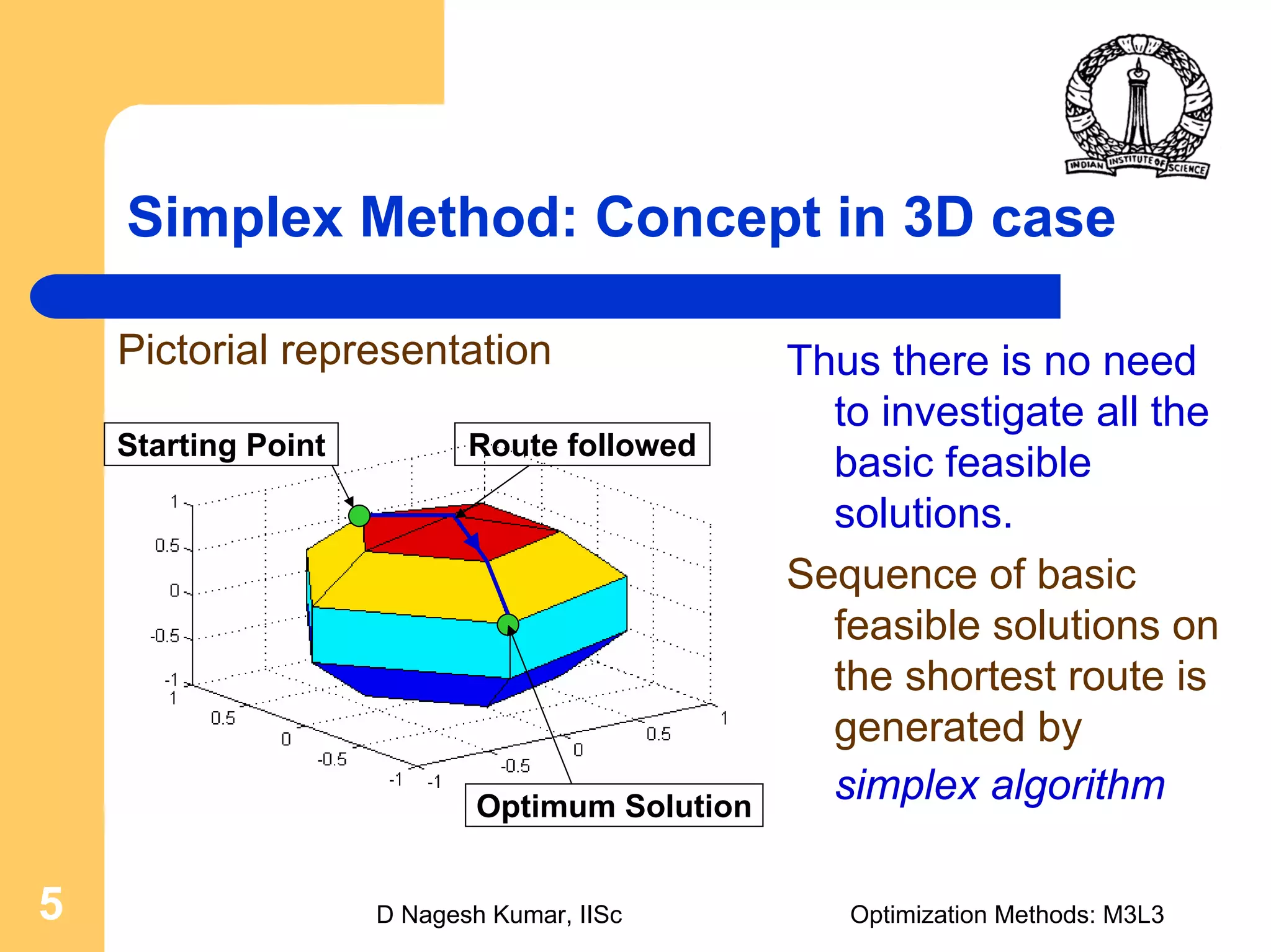
Simplex Method: Concept in 3D case
In 3D, a feasible region (i.e., volume) is bounded by
several surfaces
Each vertex (a basic feasible solution) of this volume
is connected to the three other adjacent vertices by a
straight line to each, being intersection of two
surfaces.
Simplex algorithm helps to move from one vertex to
another adjacent vertex which is closest to the
optimal solution among all other adjacent vertices.
Thus, it follows the shortest route to reach the
optimal solution from the starting point.
D Nagesh Kumar, IISc Optimization Methods: M3L35
Simplex Method: Concept in 3D case
Optimum Solution
Starting Point Route followed
Thus there is no need
to investigate all the
basic feasible
solutions.
Sequence of basic
feasible solutions on
the shortest route is
generated by
simplex algorithm
Pictorial representation
D Nagesh Kumar, IISc Optimization Methods: M3L36
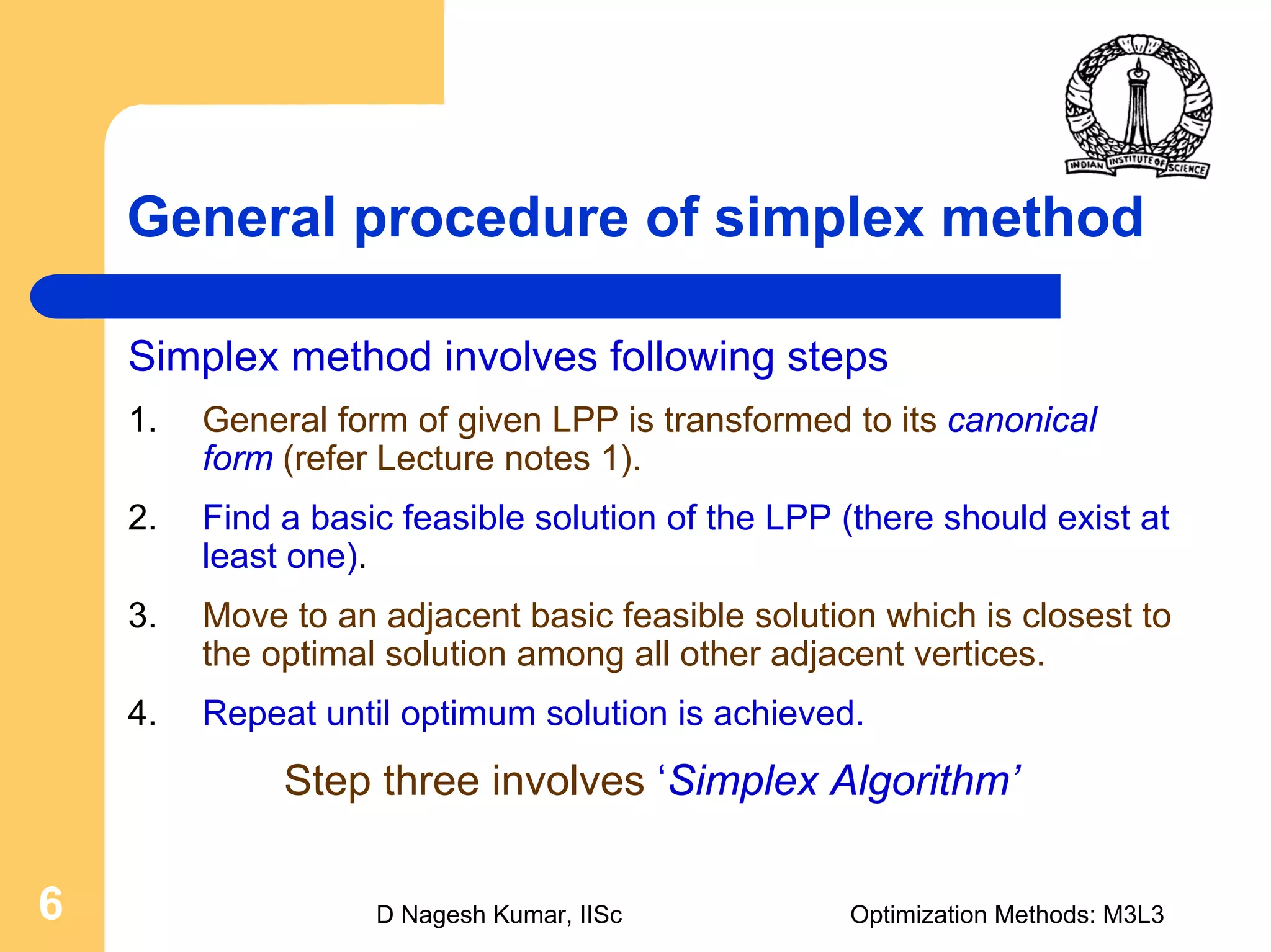
General procedure of simplex method
Simplex method involves following steps
1. General form of given LPP is transformed to its canonical
form (refer Lecture notes 1).
2. Find a basic feasible solution of the LPP (there should exist at
least one).
3. Move to an adjacent basic feasible solution which is closest to
the optimal solution among all other adjacent vertices.
4. Repeat until optimum solution is achieved.
Step three involves ‘Simplex Algorithm’
D Nagesh Kumar, IISc Optimization Methods: M3L37
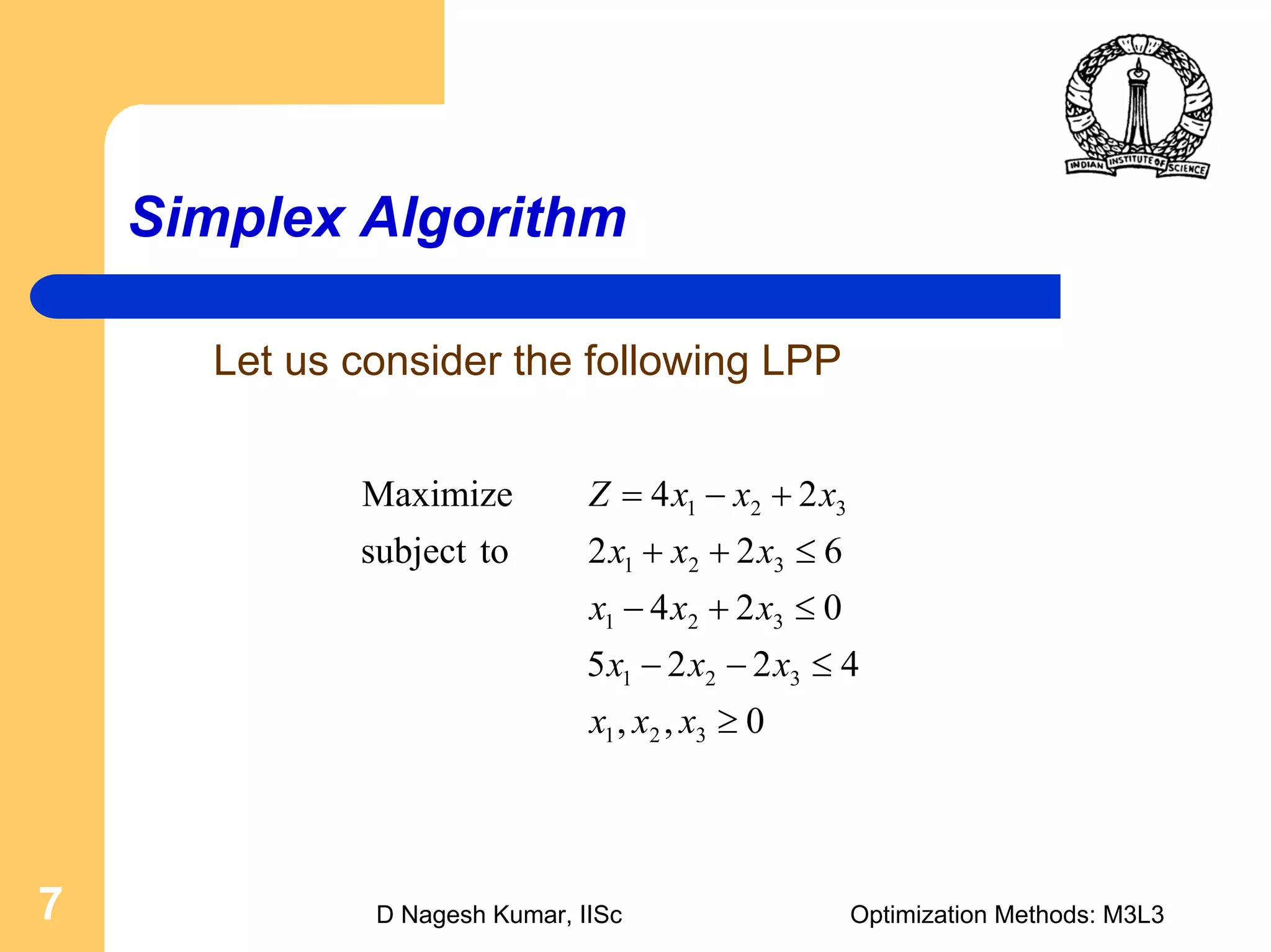
Simplex Algorithm
Let us consider the following LPP
0,,
4225
024
622tosubject
24Maximize
321
321
321
321
321
≥
≤−−
≤+−
≤++
+−=
xxx
xxx
xxx
xxx
xxxZ
D Nagesh Kumar, IISc Optimization Methods: M3L38
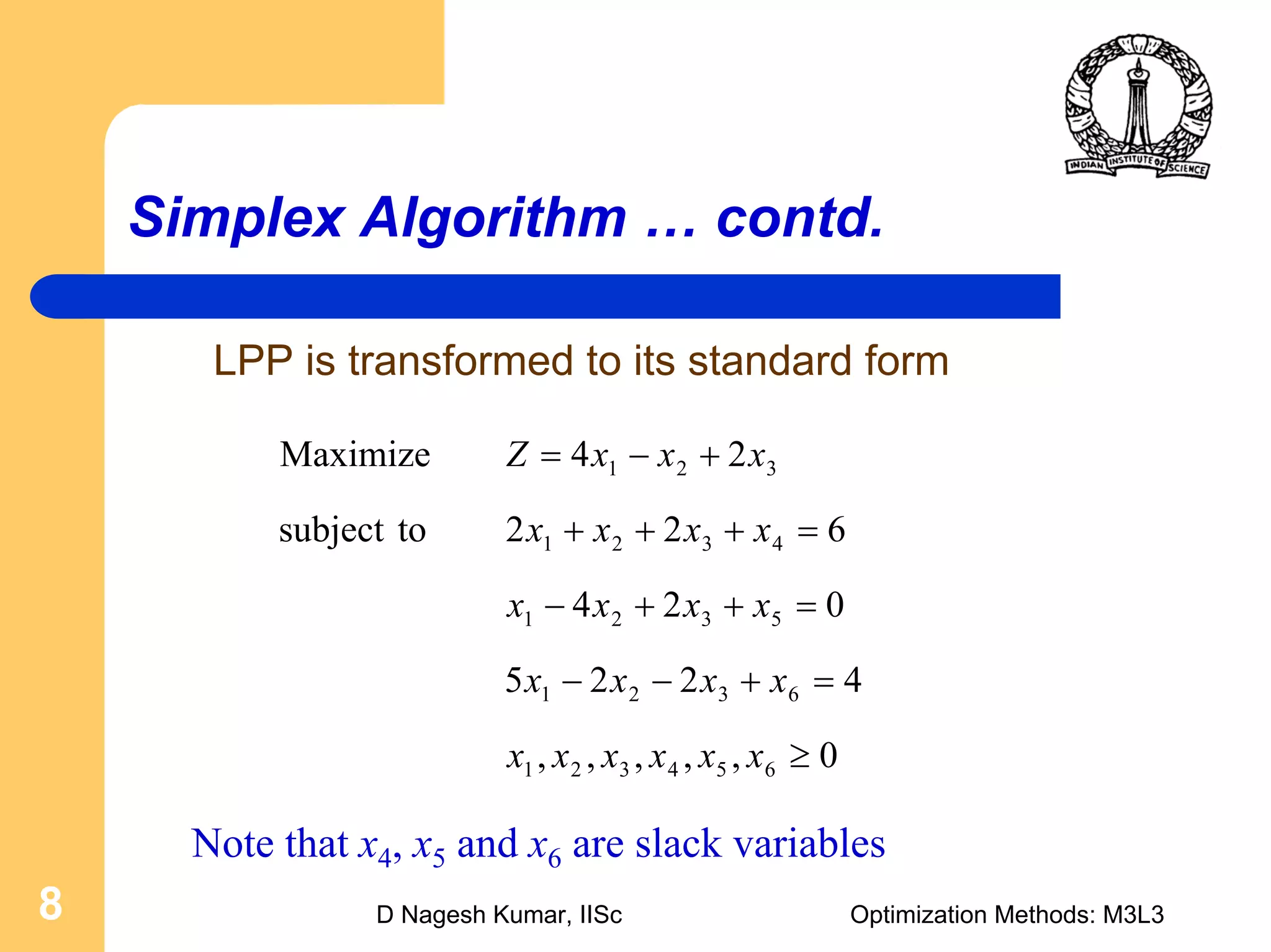
Simplex Algorithm … contd.
LPP is transformed to its standard form
0,,,,,
4225
024
622tosubject
24Maximize
654321
6321
5321
4321
321
≥
=+−−
=++−
=+++
+−=
xxxxxx
xxxx
xxxx
xxxx
xxxZ
Note that x4, x5 and x6 are slack variables
D Nagesh Kumar, IISc Optimization Methods: M3L39
Simplex Algorithm … contd.
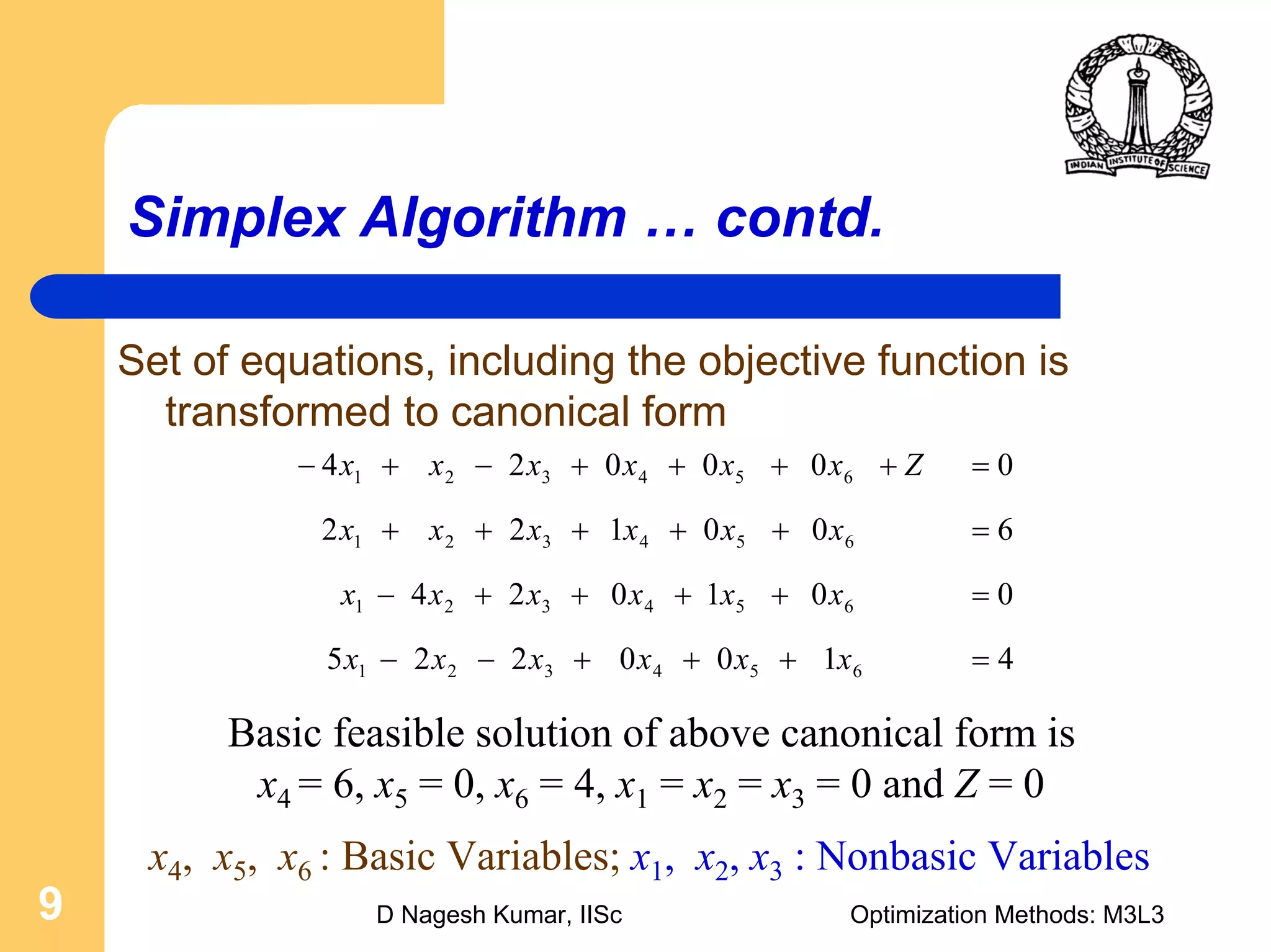
Set of equations, including the objective function is
transformed to canonical form
Basic feasible solution of above canonical form is
x4 = 6, x5 = 0, x6 = 4, x1 = x2 = x3 = 0 and Z = 0
4100225
001024
600122
000024
654321
654321
654321
654321
=+++−−
=++++−
=+++++
=++++−+−
xxxxxx
xxxxxx
xxxxxx
Zxxxxxx
x4, x5, x6 : Basic Variables; x1, x2, x3 : Nonbasic Variables
D Nagesh Kumar, IISc Optimization Methods: M3L310
Simplex Algorithm … contd.
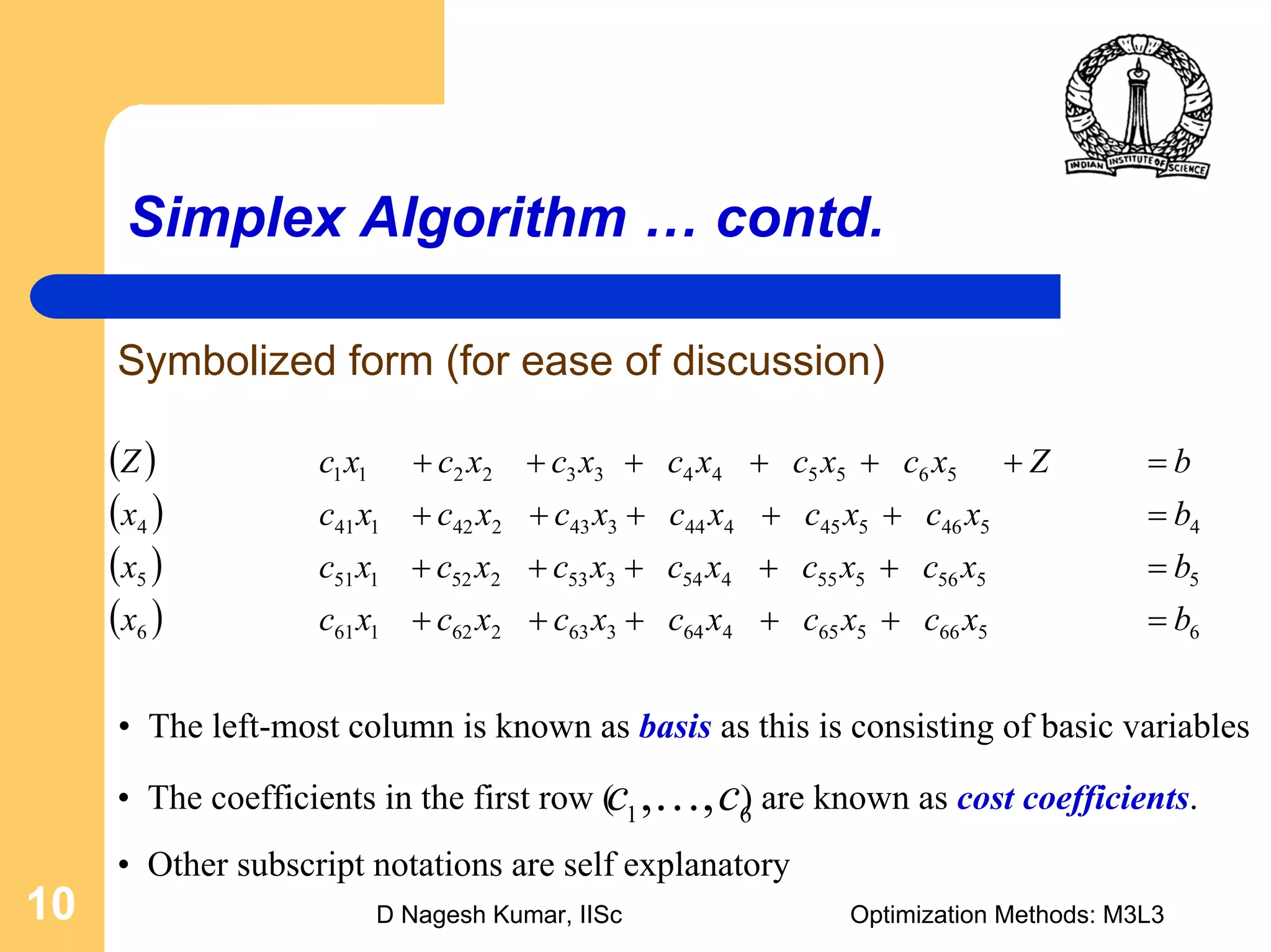
Symbolized form (for ease of discussion)
( )
( )
( )
( ) 65665654643632621616
55565554543532521515
45465454443432421414
565544332211
bxcxcxcxcxcxcx
bxcxcxcxcxcxcx
bxcxcxcxcxcxcx
bZxcxcxcxcxcxcZ
=+++++
=+++++
=+++++
=++++++
• The left-most column is known as basis as this is consisting of basic variables
• The coefficients in the first row ( 61
,, cc K ) are known as cost coefficients.
• Other subscript notations are self explanatory
D Nagesh Kumar, IISc Optimization Methods: M3L311
Simplex Algorithm … contd.
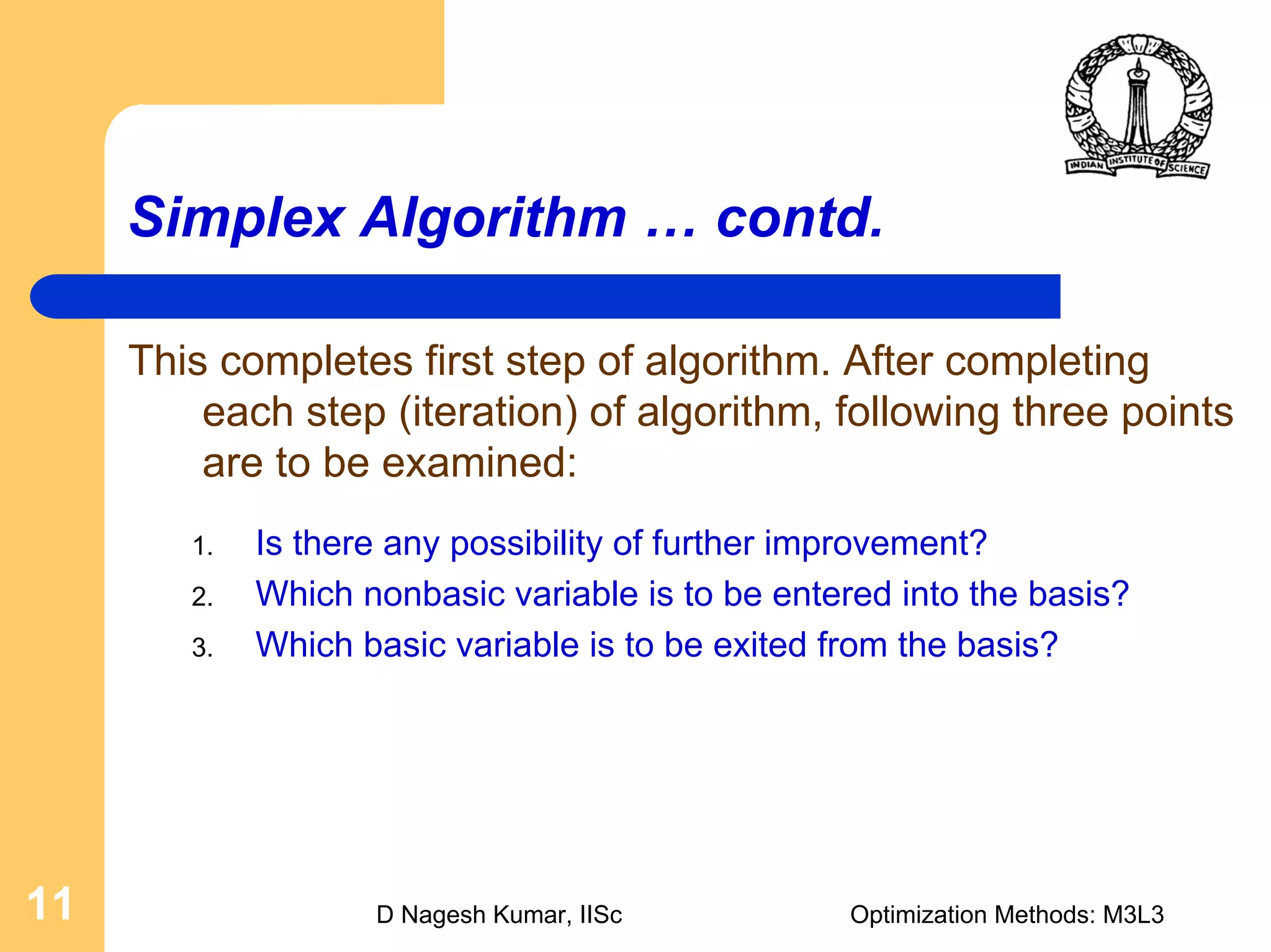
This completes first step of algorithm. After completing
each step (iteration) of algorithm, following three points
are to be examined:
1. Is there any possibility of further improvement?
2. Which nonbasic variable is to be entered into the basis?
3. Which basic variable is to be exited from the basis?
D Nagesh Kumar, IISc Optimization Methods: M3L312
Simplex Algorithm … contd.
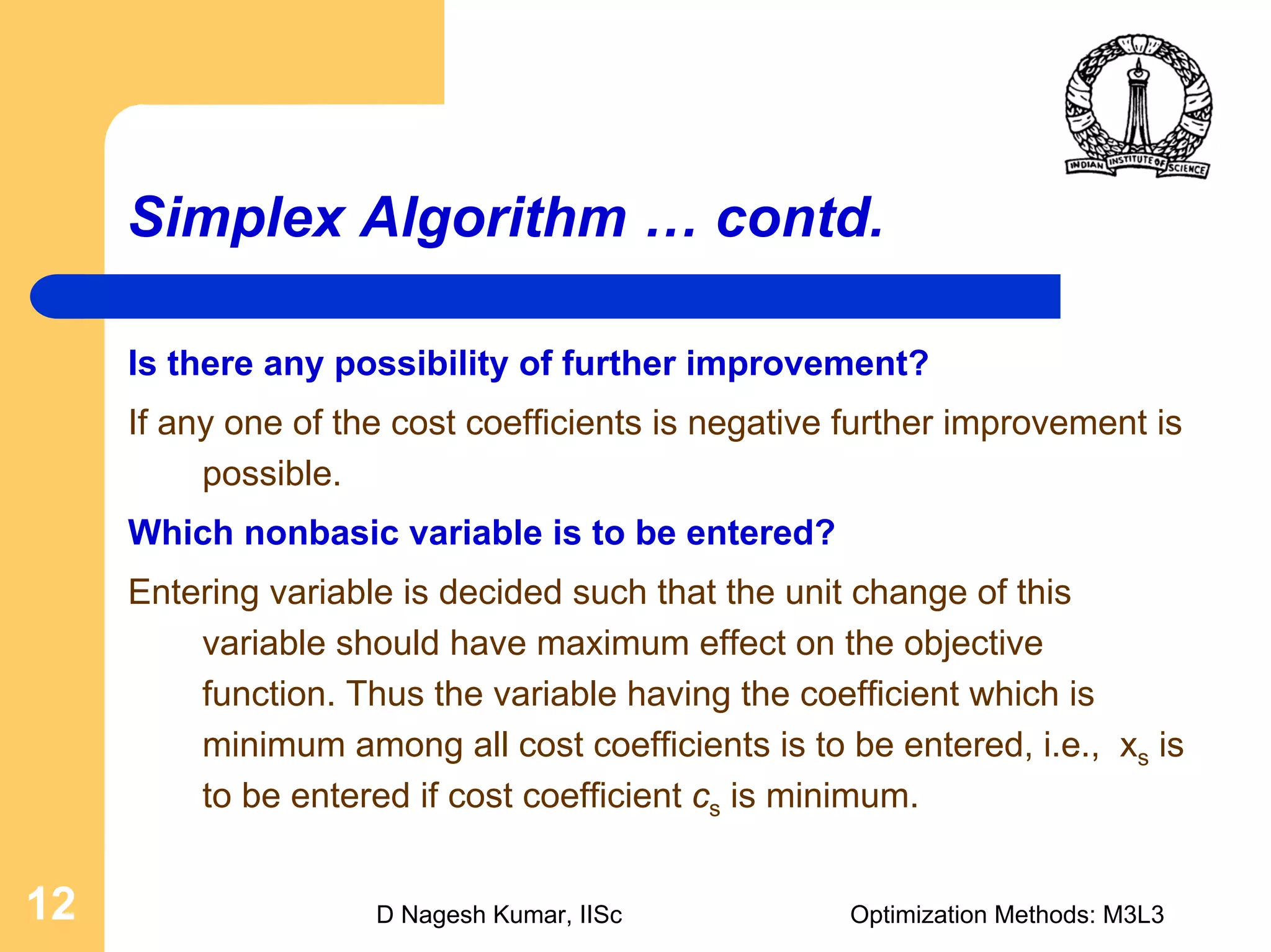
Is there any possibility of further improvement?
If any one of the cost coefficients is negative further improvement is
possible.
Which nonbasic variable is to be entered?
Entering variable is decided such that the unit change of this
variable should have maximum effect on the objective
function. Thus the variable having the coefficient which is
minimum among all cost coefficients is to be entered, i.e., xs is
to be entered if cost coefficient cs is minimum.
D Nagesh Kumar, IISc Optimization Methods: M3L313
Simplex Algorithm … contd.
Which basic variable is to be exited?
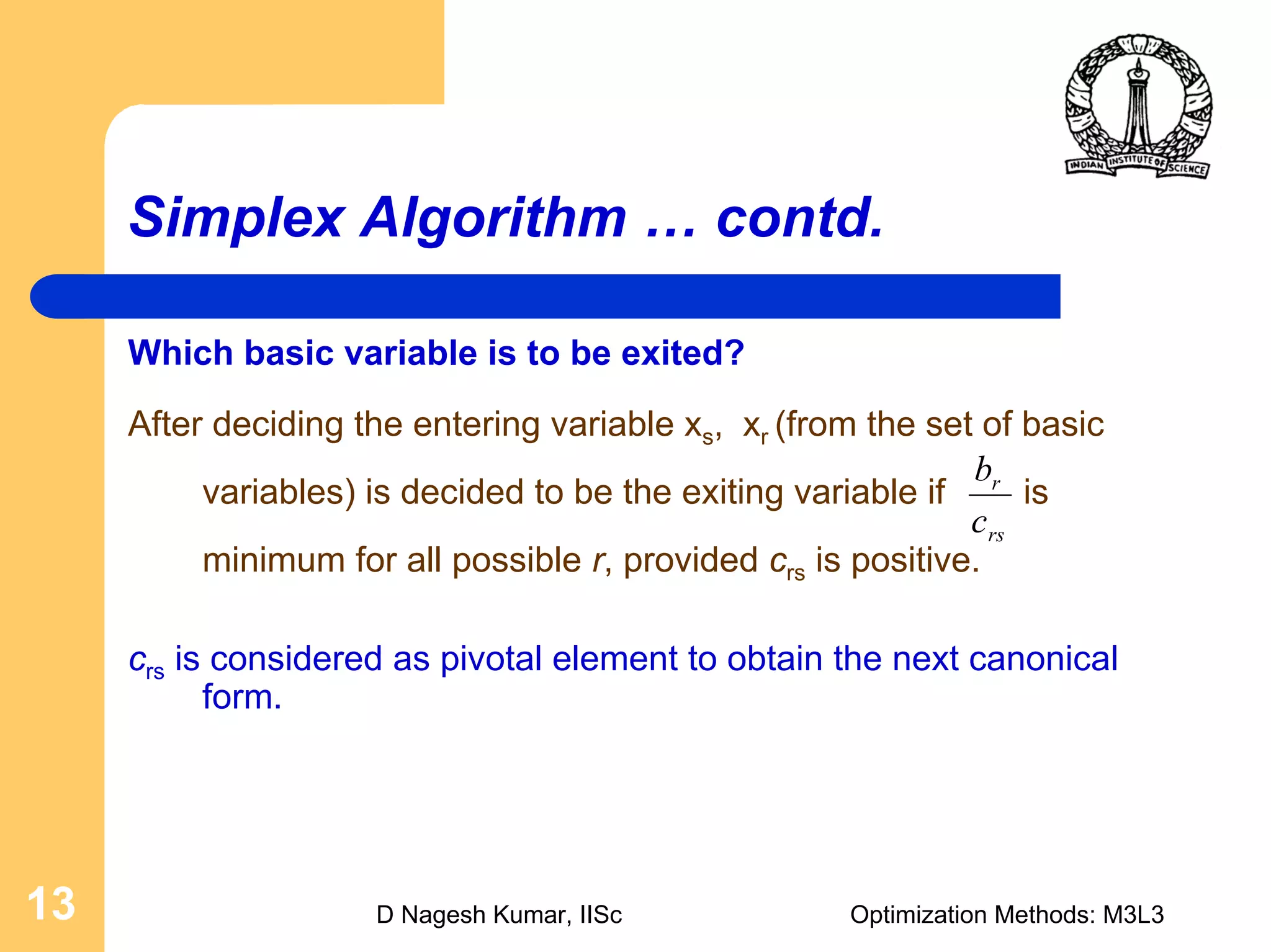
After deciding the entering variable xs, xr (from the set of basic
variables) is decided to be the exiting variable if is
minimum for all possible r, provided crs is positive.
crs is considered as pivotal element to obtain the next canonical
form.
rs
r
c
b
D Nagesh Kumar, IISc Optimization Methods: M3L314
Simplex Algorithm … contd.
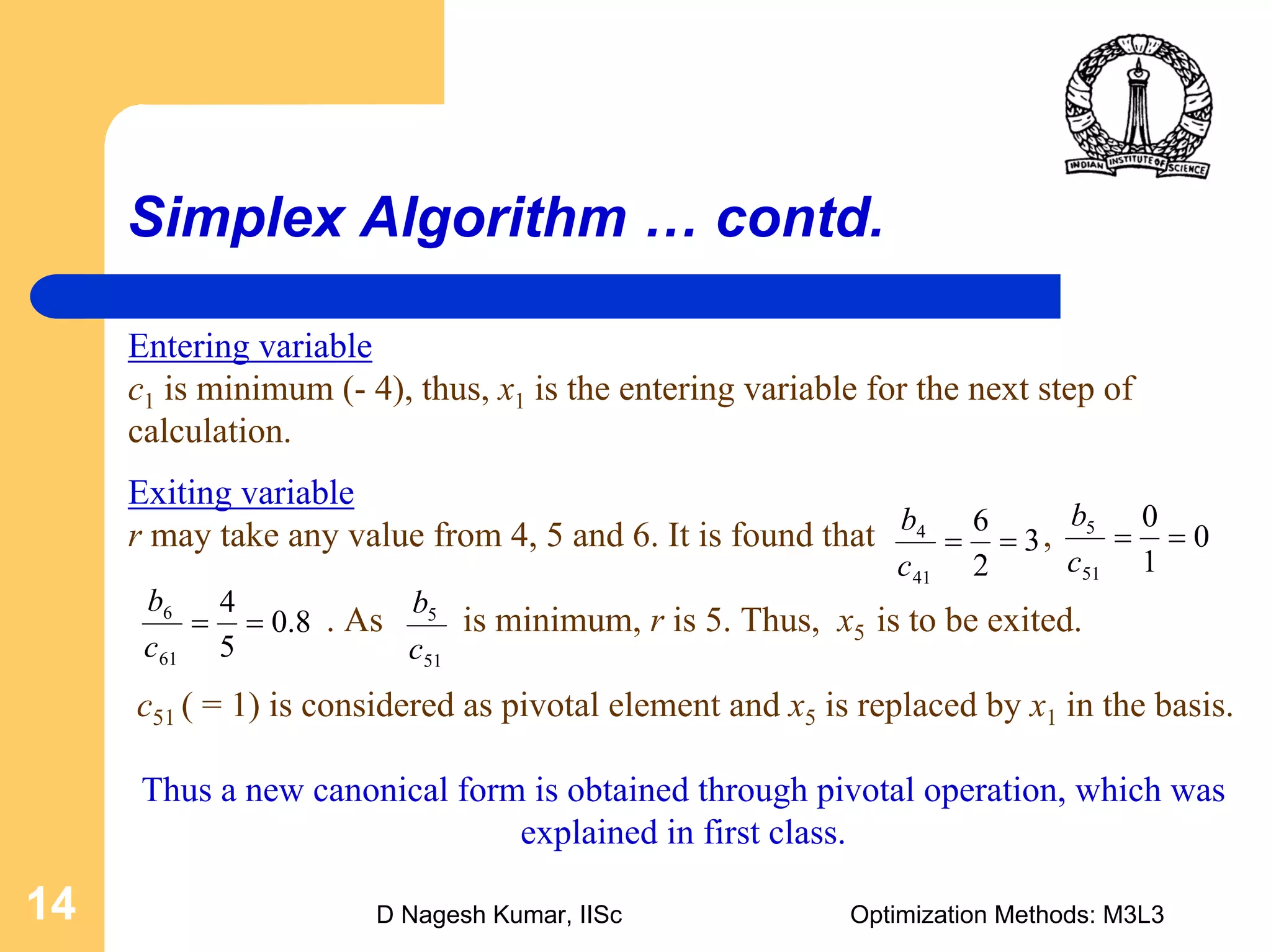
Exiting variable
r may take any value from 4, 5 and 6. It is found that ,
. As is minimum, r is 5. Thus, x5 is to be exited.
c51 ( = 1) is considered as pivotal element and x5 is replaced by x1 in the basis.
Thus a new canonical form is obtained through pivotal operation, which was
explained in first class.
3
2
6
41
4
==
c
b
0
1
0
51
5
==
c
b
8.0
5
4
61
6
==
c
b
Entering variable
c1 is minimum (- 4), thus, x1 is the entering variable for the next step of
calculation.
51
5
c
b
D Nagesh Kumar, IISc Optimization Methods: M3L315
Simplex Algorithm … contd.
Pivotal operation as a refresher
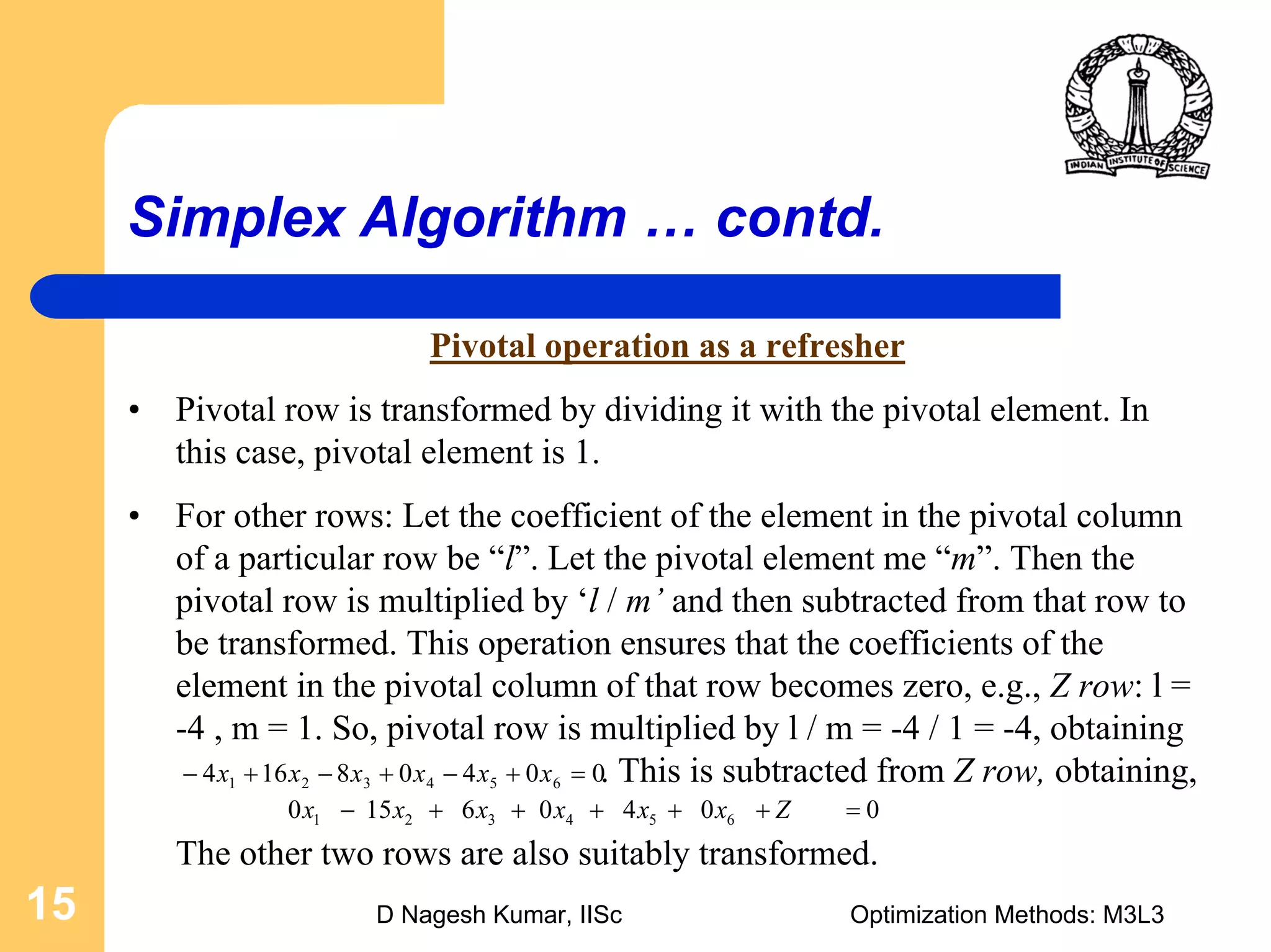
• Pivotal row is transformed by dividing it with the pivotal element. In
this case, pivotal element is 1.
• For other rows: Let the coefficient of the element in the pivotal column
of a particular row be “l”. Let the pivotal element me “m”. Then the
pivotal row is multiplied by ‘l / m’ and then subtracted from that row to
be transformed. This operation ensures that the coefficients of the
element in the pivotal column of that row becomes zero, e.g., Z row: l =
-4 , m = 1. So, pivotal row is multiplied by l / m = -4 / 1 = -4, obtaining
. This is subtracted from Z row, obtaining,
The other two rows are also suitably transformed.
00408164 654321 =+−+−+− xxxxxx
00406150 654321 =+++++− Zxxxxxx
D Nagesh Kumar, IISc Optimization Methods: M3L316
Simplex Algorithm … contd.
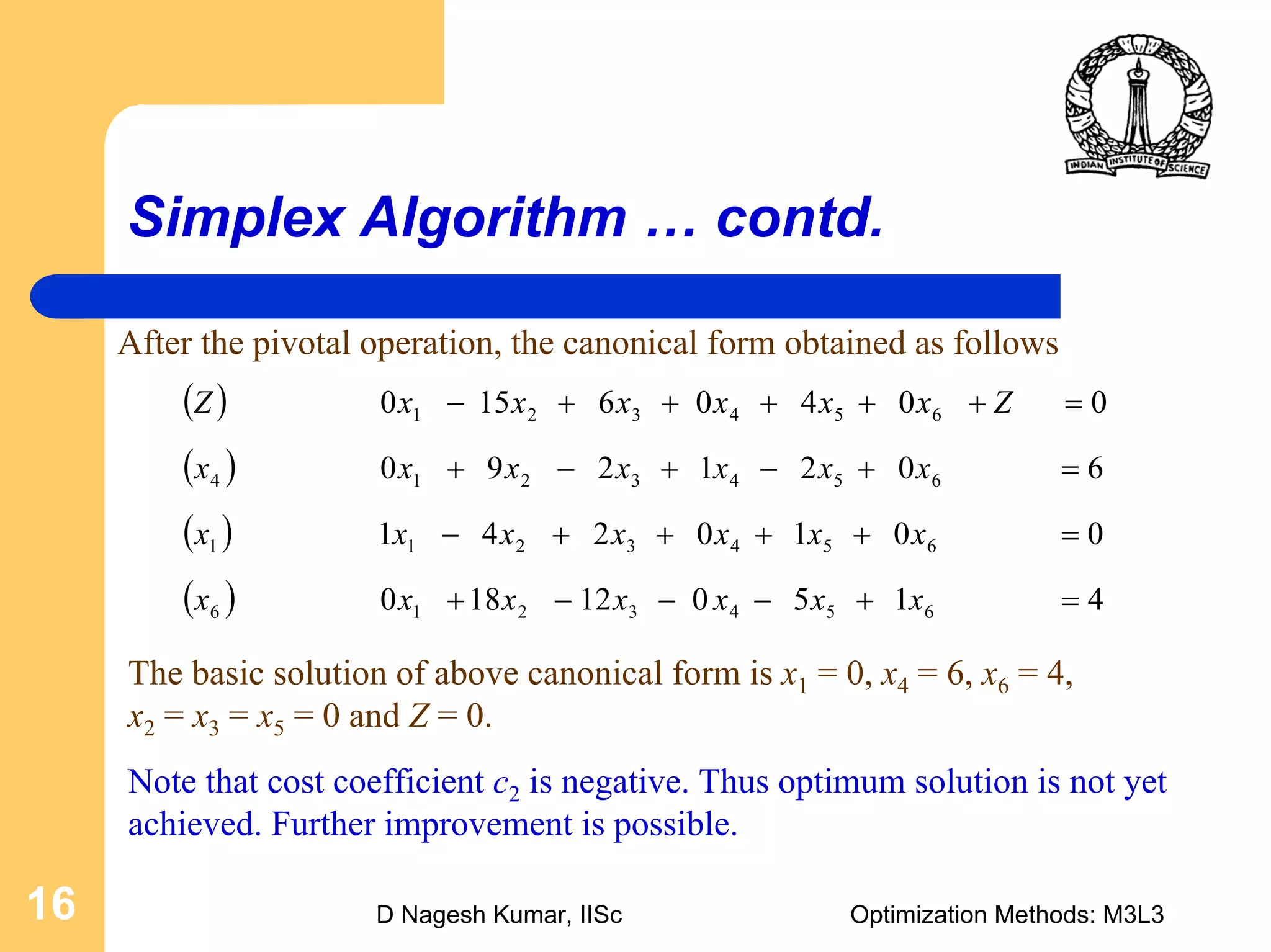
After the pivotal operation, the canonical form obtained as follows
The basic solution of above canonical form is x1 = 0, x4 = 6, x6 = 4,
x2 = x3 = x5 = 0 and Z = 0.
( )
( )
( )
( ) 415012180
0010241
6021290
00406150
6543216
6543211
6543214
654321
=+−−−+
=++++−
=+−+−+
=+++++−
xxxxxxx
xxxxxxx
xxxxxxx
ZxxxxxxZ
Note that cost coefficient c2 is negative. Thus optimum solution is not yet
achieved. Further improvement is possible.
D Nagesh Kumar, IISc Optimization Methods: M3L317
Simplex Algorithm … contd.
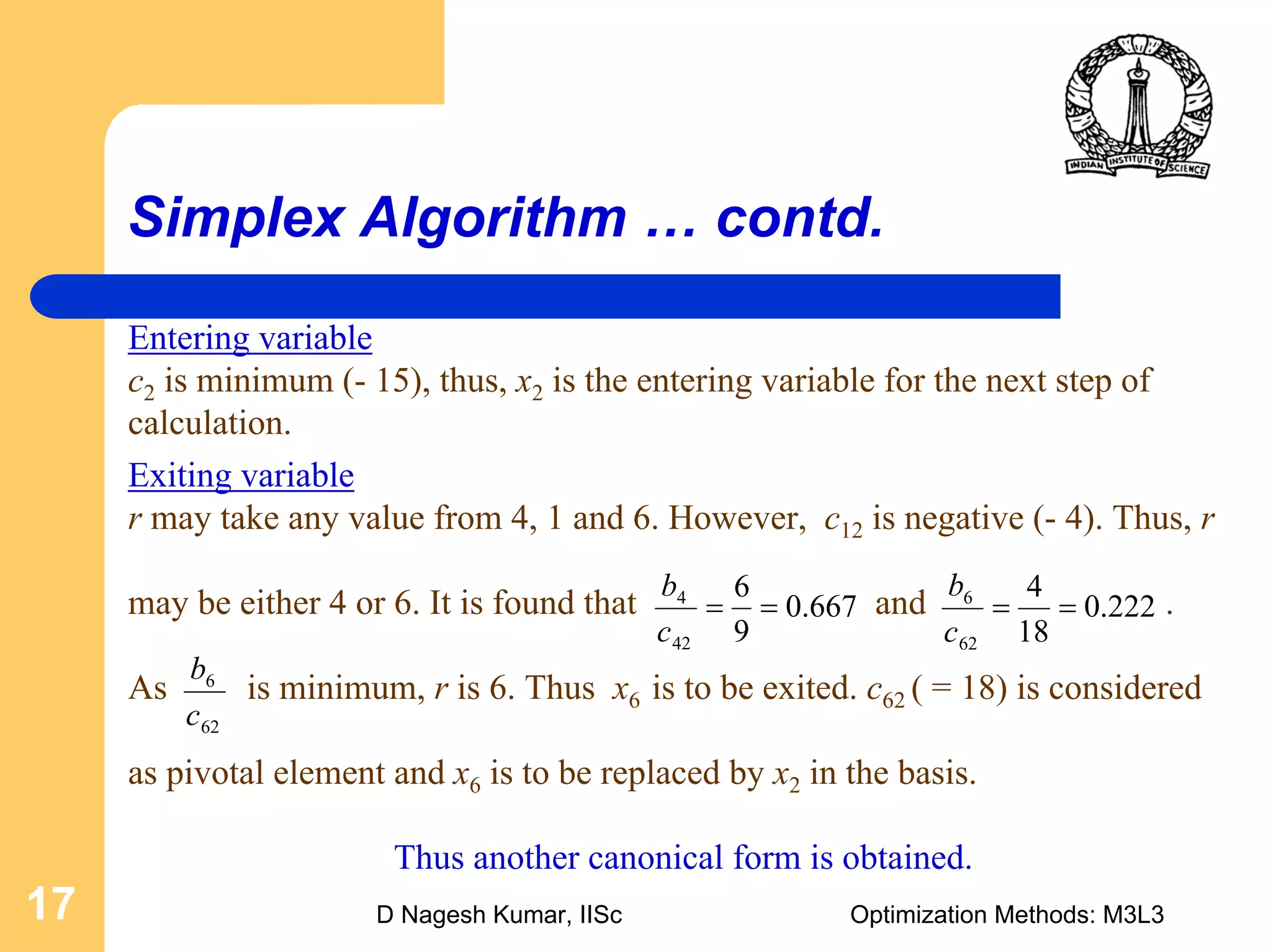
Exiting variable
r may take any value from 4, 1 and 6. However, c12 is negative (- 4). Thus, r
may be either 4 or 6. It is found that and .
As is minimum, r is 6. Thus x6 is to be exited. c62 ( = 18) is considered
as pivotal element and x6 is to be replaced by x2 in the basis.
Thus another canonical form is obtained.
667.0
9
6
42
4
==
c
b
222.0
18
4
62
6
==
c
b
Entering variable
c2 is minimum (- 15), thus, x2 is the entering variable for the next step of
calculation.
62
6
c
b
D Nagesh Kumar, IISc Optimization Methods: M3L318
Simplex Algorithm … contd.
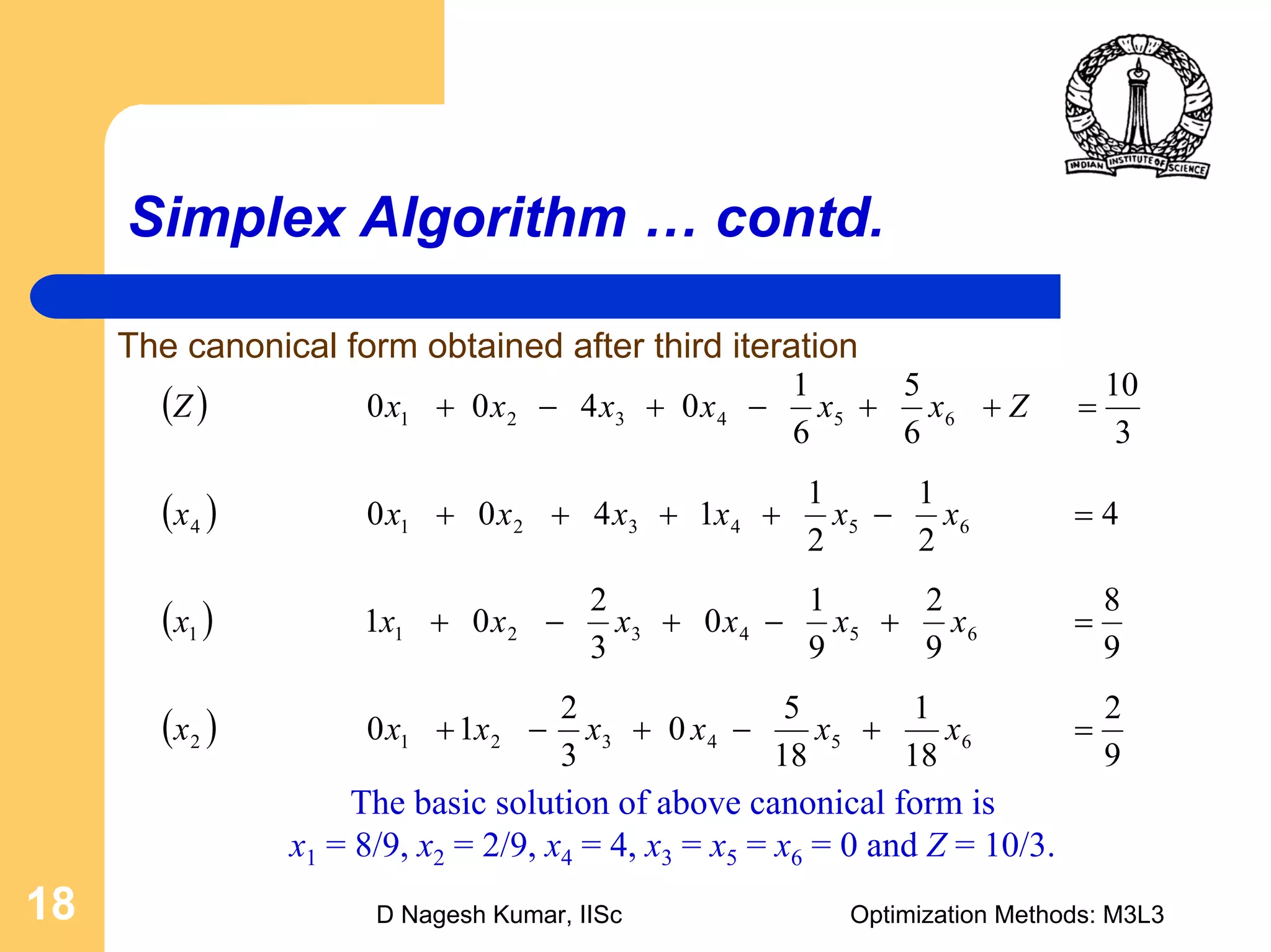
The canonical form obtained after third iteration
( )
( )
( )
( )
9
2
18
1
18
5
0
3
2
10
9
8
9
2
9
1
0
3
2
01
4
2
1
2
1
1400
3
10
6
5
6
1
0400
6543212
6543211
6543214
654321
=+−+−+
=+−+−+
=−++++
=++−+−+
xxxxxxx
xxxxxxx
xxxxxxx
ZxxxxxxZ
The basic solution of above canonical form is
x1 = 8/9, x2 = 2/9, x4 = 4, x3 = x5 = x6 = 0 and Z = 10/3.
D Nagesh Kumar, IISc Optimization Methods: M3L319
Simplex Algorithm … contd.
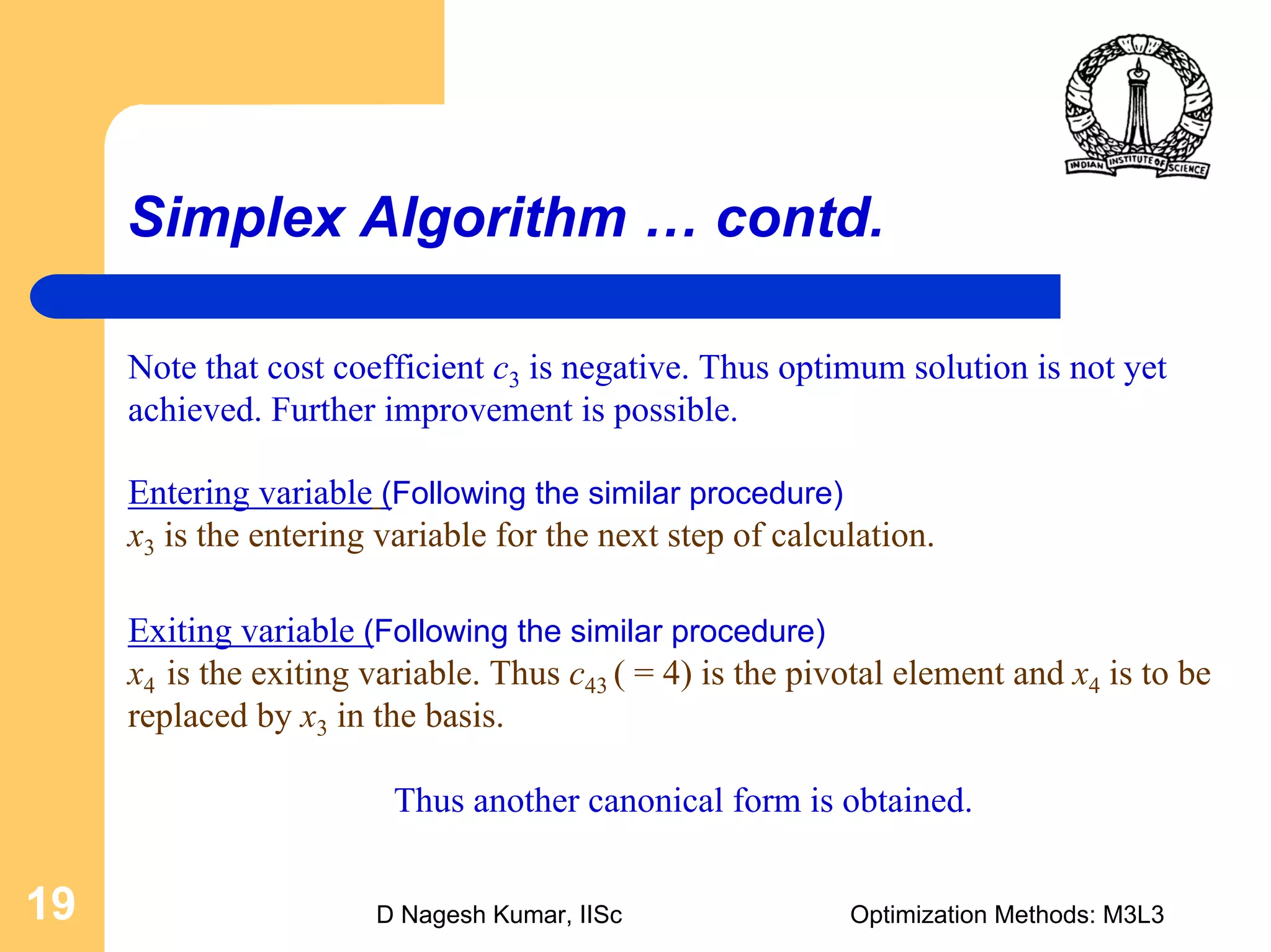
Exiting variable (Following the similar procedure)
x4 is the exiting variable. Thus c43 ( = 4) is the pivotal element and x4 is to be
replaced by x3 in the basis.
Thus another canonical form is obtained.
Entering variable (Following the similar procedure)
x3 is the entering variable for the next step of calculation.
Note that cost coefficient c3 is negative. Thus optimum solution is not yet
achieved. Further improvement is possible.
D Nagesh Kumar, IISc Optimization Methods: M3L320
Simplex Algorithm … contd.
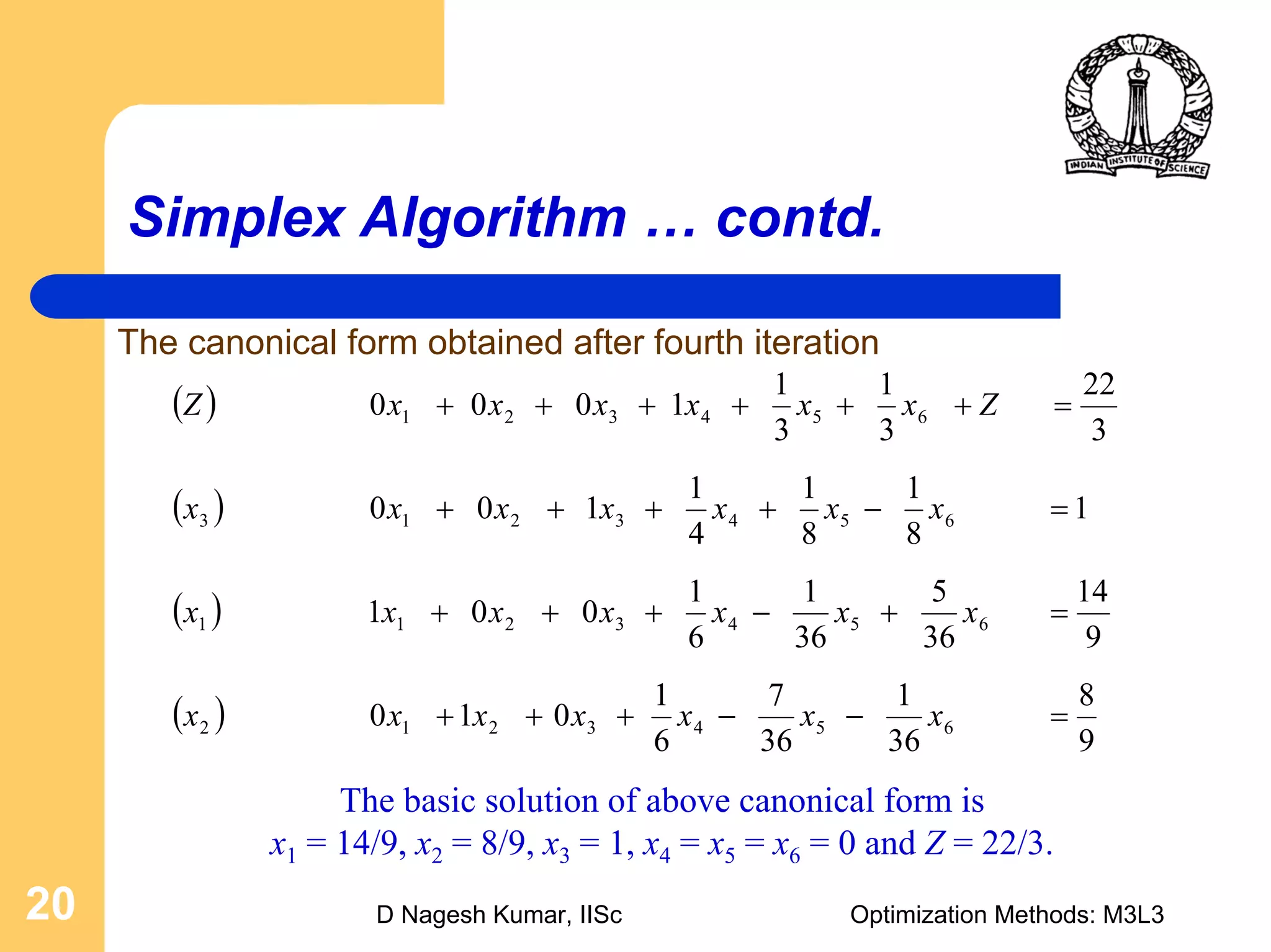
The canonical form obtained after fourth iteration
( )
The basic solution of above canonical form is
x1 = 14/9, x2 = 8/9, x3 = 1, x4 = x5 = x6 = 0 and Z = 22/3.
( )
( )
( )
9
8
36
1
36
7
6
1
010
9
14
36
5
36
1
6
1
001
1
8
1
8
1
4
1
100
3
22
3
1
3
1
1000
6543212
6543211
6543213
654321
=−−+++
=+−+++
=−++++
=++++++
xxxxxxx
xxxxxxx
xxxxxxx
ZxxxxxxZ
D Nagesh Kumar, IISc Optimization Methods: M3L321
Simplex Algorithm … contd.
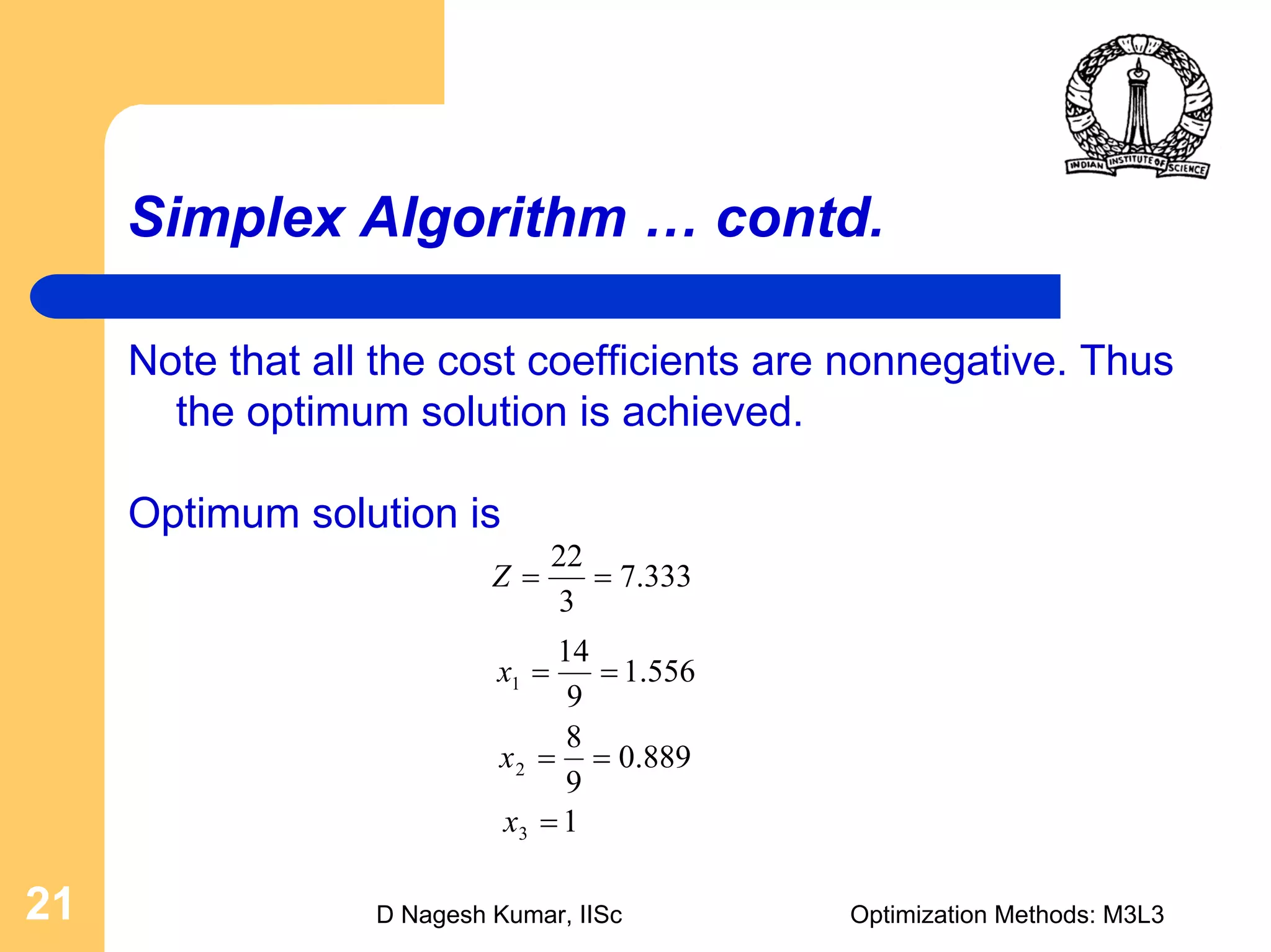
Note that all the cost coefficients are nonnegative. Thus
the optimum solution is achieved.
Optimum solution is
333.7
3
22
==Z
556.1
9
14
1 ==x
889.0
9
8
2 ==x
13 =x
D Nagesh Kumar, IISc Optimization Methods: M3L322
Construction of Simplex Tableau:
General notes
Calculations shown till now can be presented in a tabular form, known
as simplex tableau
After preparing the canonical form of the given LPP, first simplex
tableau is constructed.
After completing each simplex tableau (iteration), few steps
(somewhat mechanical and easy to remember) are followed.
Logically, these steps are exactly similar to the procedure described
earlier.
D Nagesh Kumar, IISc Optimization Methods: M3L323
Construction of Simplex Tableau:
Basic steps
Check for optimum solution:
1. Investigate whether all the elements (coefficients of the variables
headed by that column) in the first row (i.e., Z row) are
nonnegative or not. If all such coefficients are nonnegative,
optimum solution is obtained and no need of further iterations.
If any element in this row is negative follow next steps to obtain
the simplex tableau for next iteration.
D Nagesh Kumar, IISc Optimization Methods: M3L324
Construction of Simplex Tableau:
Basic steps
Operations to obtain next simplex tableau:
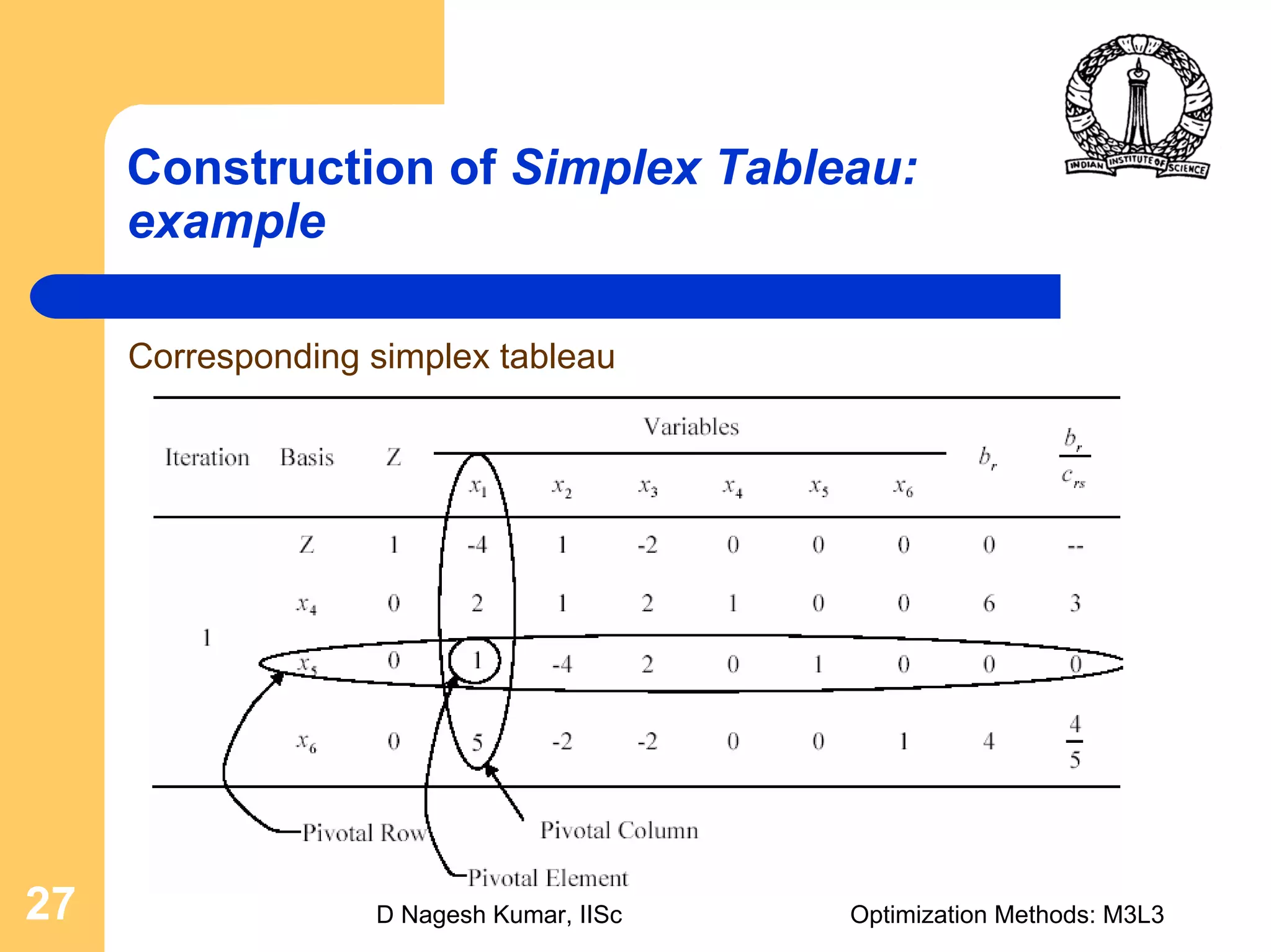
2. Identify the entering variable (described earlier) and mark that
column as Pivotal Column.
3. Identify the exiting variable from the basis as described earlier
and mark that row as Pivotal Row.
4. Mark the coefficient at the intersection of Pivotal Row and
Pivotal Column as Pivotal Element.
D Nagesh Kumar, IISc Optimization Methods: M3L325
Construction of Simplex Tableau:
Basic steps
Operations to obtained simplex tableau…contd.:
5. In the basis, replace the exiting variable by entering variable.
6. Divide all the elements in the pivotal row by pivotal element.
7. For any other row, identify the elementary operation such that the
coefficient in the pivotal column, in that row, becomes zero. Apply
the same operation for all other elements in that row and change
the coefficients.
Follow similar procedure for all other rows.
D Nagesh Kumar, IISc Optimization Methods: M3L326
Construction of Simplex Tableau:
example
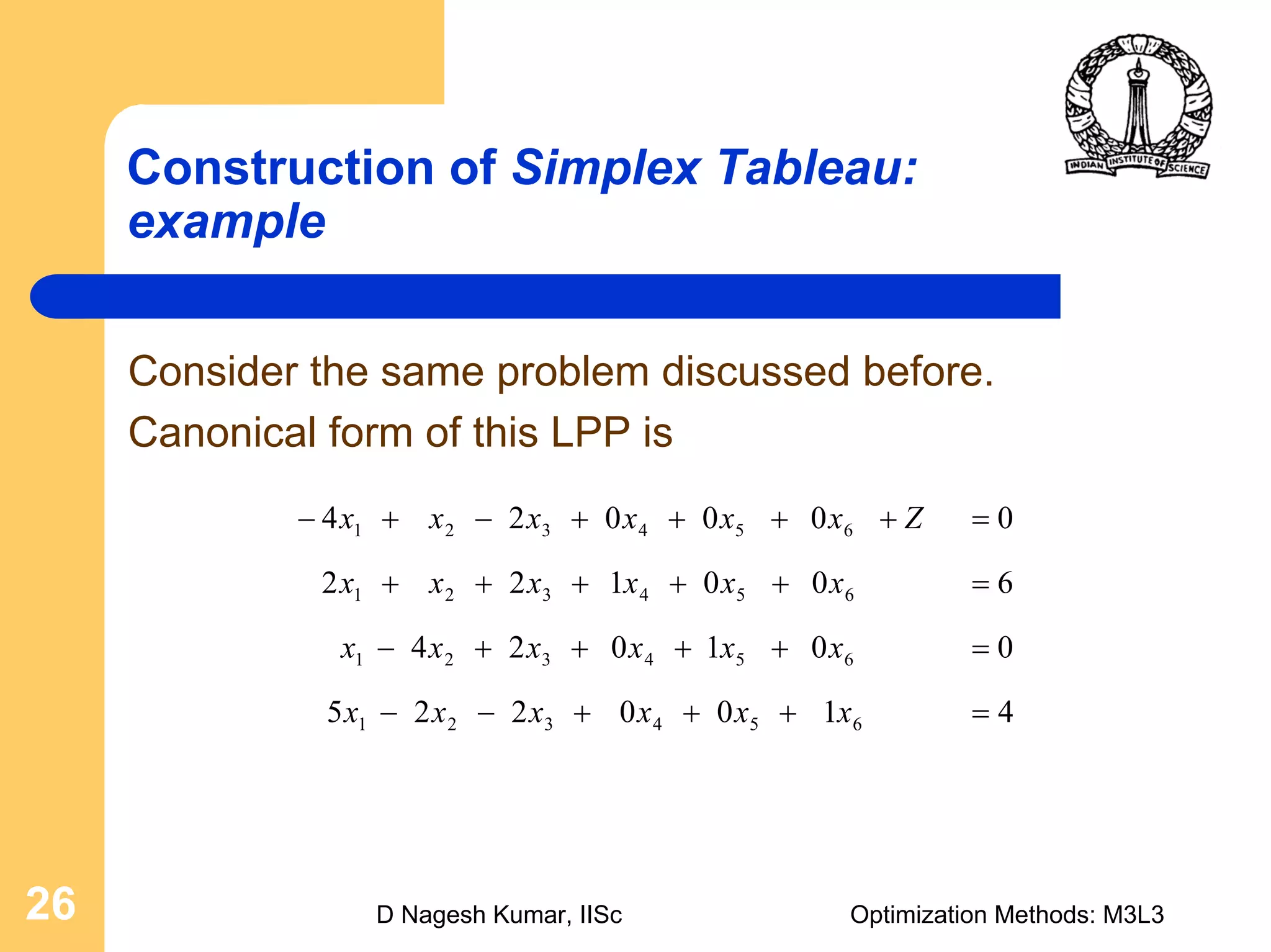
Consider the same problem discussed before.
Canonical form of this LPP is
4100225
001024
600122
000024
654321
654321
654321
654321
=+++−−
=++++−
=+++++
=++++−+−
xxxxxx
xxxxxx
xxxxxx
Zxxxxxx
D Nagesh Kumar, IISc Optimization Methods: M3L327
Construction of Simplex Tableau:
example
Corresponding simplex tableau
D Nagesh Kumar, IISc Optimization Methods: M3L328
Construction of Simplex Tableau:
example
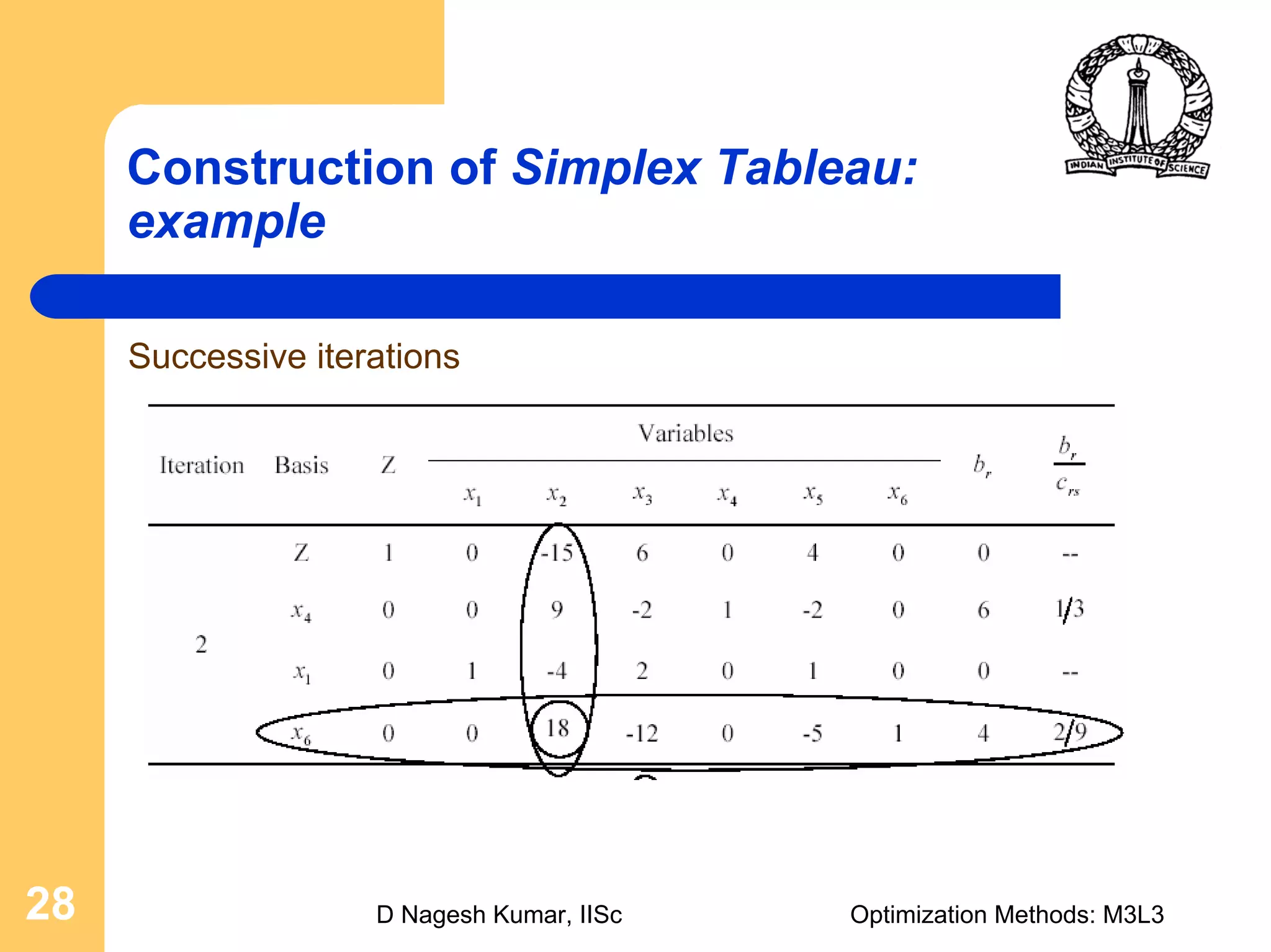
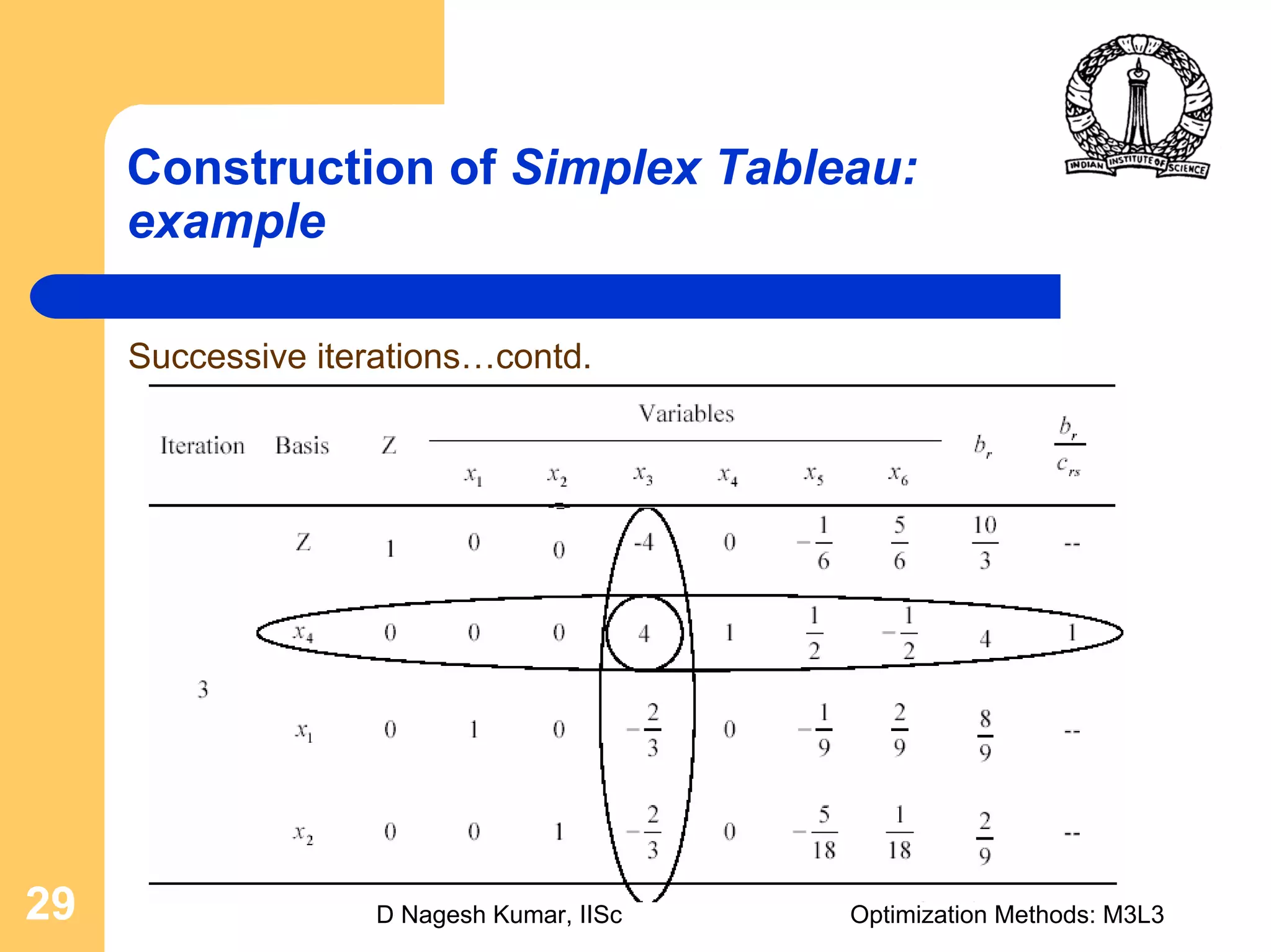
Successive iterations
D Nagesh Kumar, IISc Optimization Methods: M3L329
Construction of Simplex Tableau:
example
Successive iterations…contd.
D Nagesh Kumar, IISc Optimization Methods: M3L330
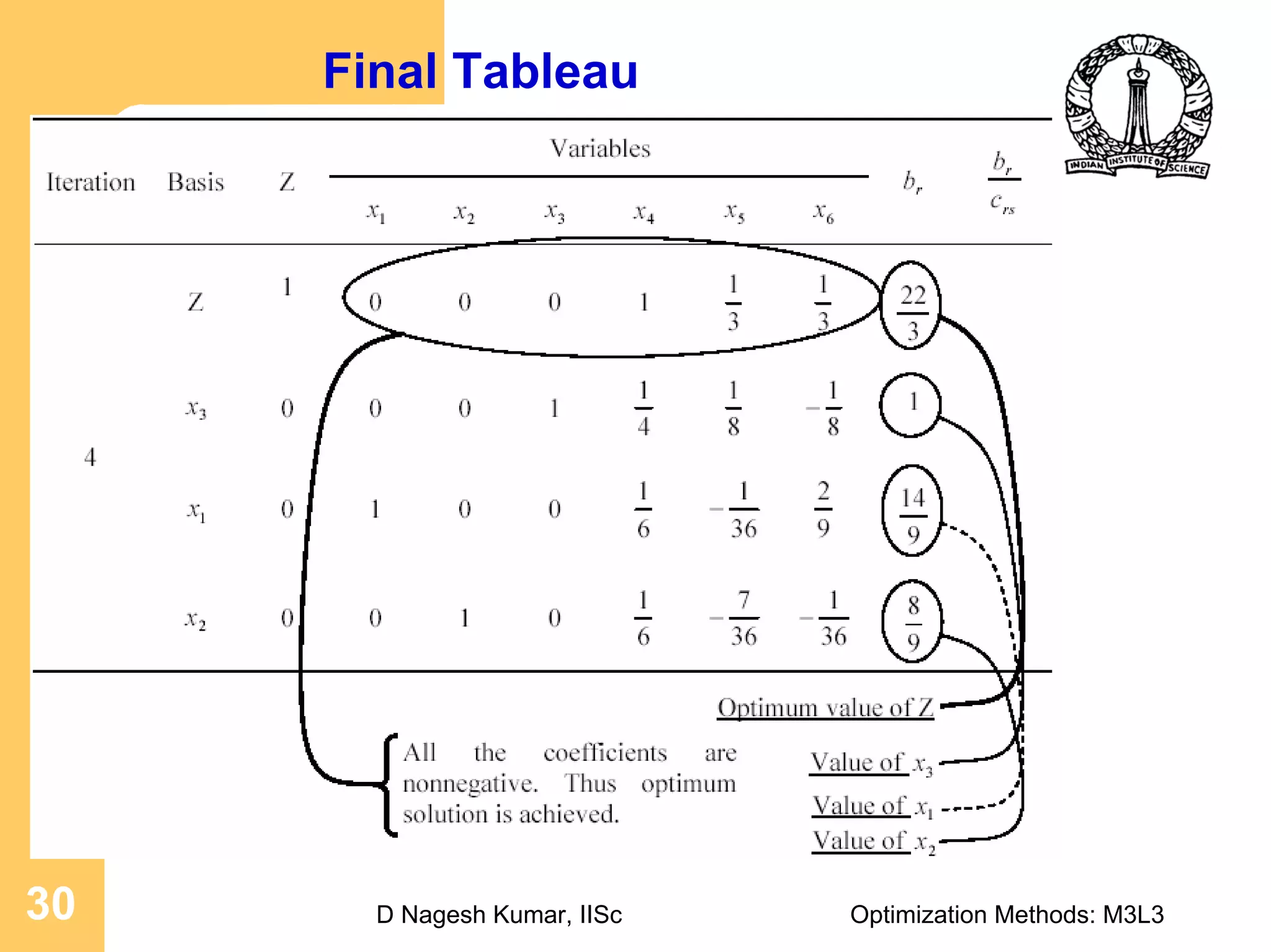
Final Tableau
D Nagesh Kumar, IISc Optimization Methods: M3L331
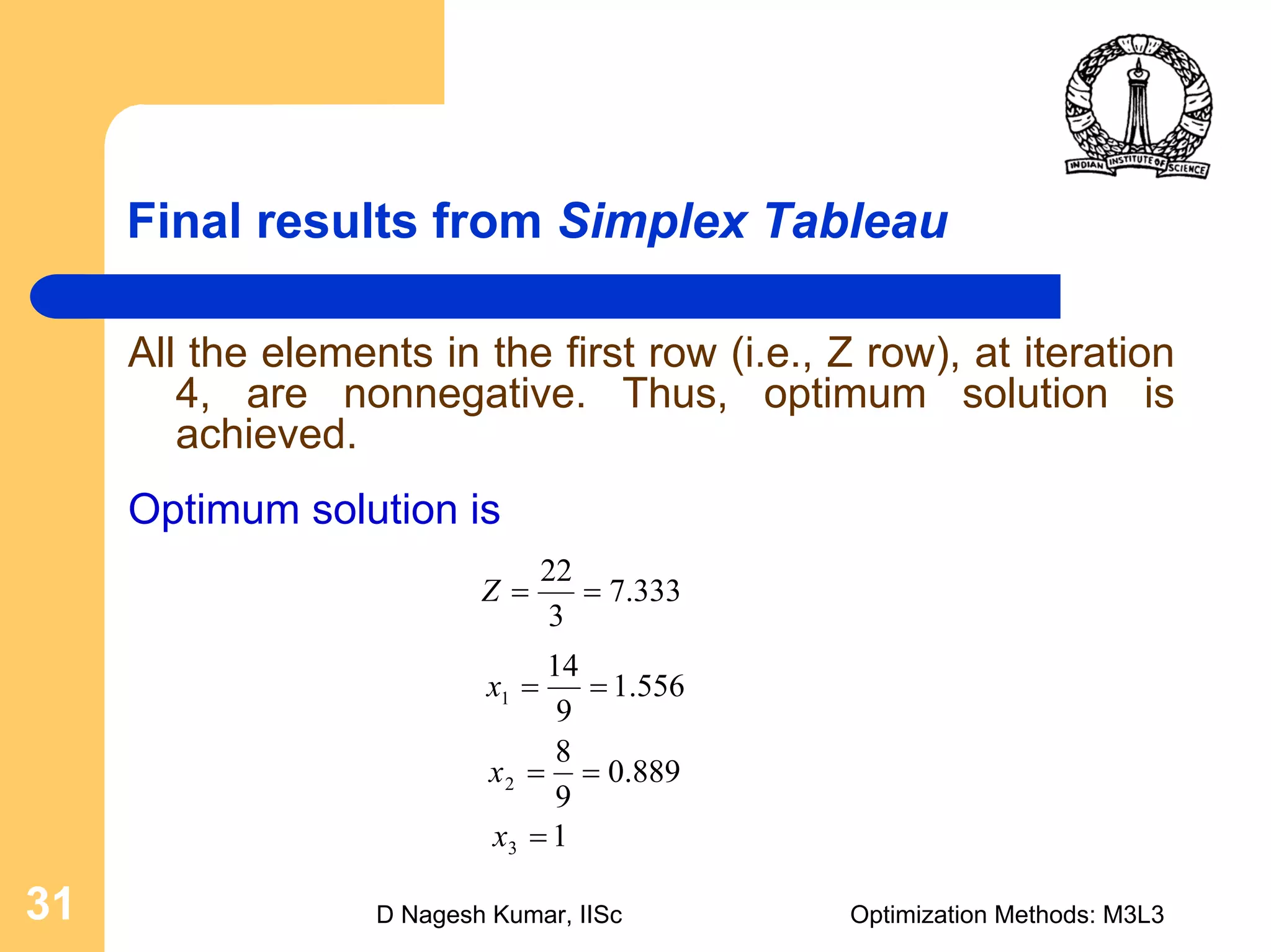
Final results from Simplex Tableau
All the elements in the first row (i.e., Z row), at iteration
4, are nonnegative. Thus, optimum solution is
achieved.
Optimum solution is
333.7
3
22
==Z
556.1
9
14
1 ==x
889.0
9
8
2 ==x
13 =x
D Nagesh Kumar, IISc Optimization Methods: M3L332
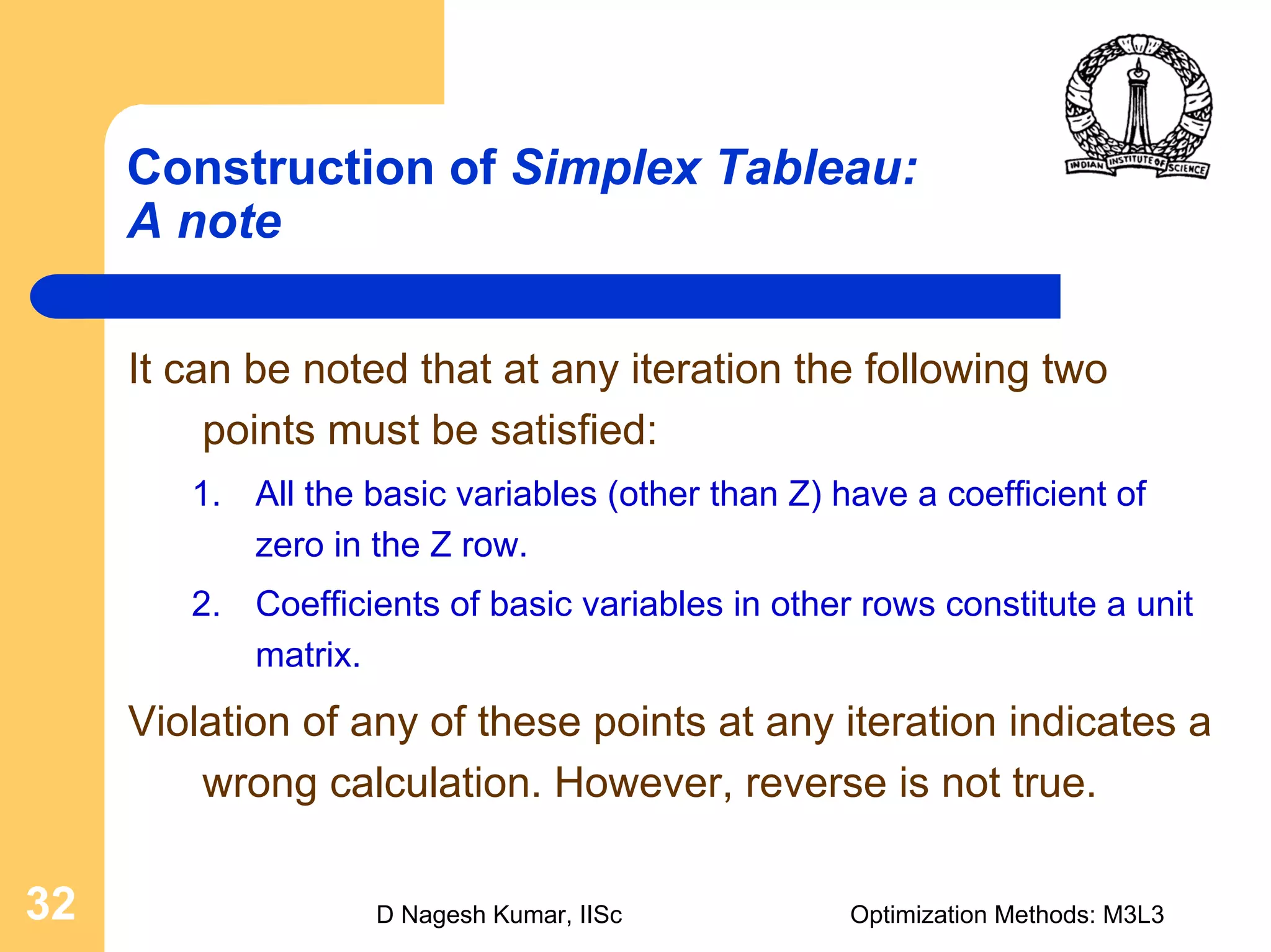
It can be noted that at any iteration the following two
points must be satisfied:
1. All the basic variables (other than Z) have a coefficient of
zero in the Z row.
2. Coefficients of basic variables in other rows constitute a unit
matrix.
Violation of any of these points at any iteration indicates a
wrong calculation. However, reverse is not true.
Construction of Simplex Tableau:
A note
D Nagesh Kumar, IISc Optimization Methods: M3L333
Thank You

Numerical analysis simplex method 1

  • 1.
    D Nagesh Kumar,IISc Optimization Methods: M3L31 Linear Programming Simplex method - I
  • 2.
    D Nagesh Kumar,IISc Optimization Methods: M3L32 Introduction and Objectives Simplex method is the most popular method used for the solution of Linear Programming Problems (LPP). Objectives To discuss the motivation of simplex method To discuss Simplex algorithm To demonstrate the construction of simplex tableau
  • 3.
    D Nagesh Kumar,IISc Optimization Methods: M3L33 Motivation of Simplex method Solution of a LPP, if exists, lies at one of the vertices of the feasible region. All the basic solutions can be investigated one-by-one to pick up the optimal solution. For 10 equations with 15 variables there exists 15C10= 3003 basic feasible solutions! Too large number to investigate one-by-one. This can be overcome by simplex method
  • 4.
    D Nagesh Kumar,IISc Optimization Methods: M3L34 Simplex Method: Concept in 3D case In 3D, a feasible region (i.e., volume) is bounded by several surfaces Each vertex (a basic feasible solution) of this volume is connected to the three other adjacent vertices by a straight line to each, being intersection of two surfaces. Simplex algorithm helps to move from one vertex to another adjacent vertex which is closest to the optimal solution among all other adjacent vertices. Thus, it follows the shortest route to reach the optimal solution from the starting point.
  • 5.
    D Nagesh Kumar,IISc Optimization Methods: M3L35 Simplex Method: Concept in 3D case Optimum Solution Starting Point Route followed Thus there is no need to investigate all the basic feasible solutions. Sequence of basic feasible solutions on the shortest route is generated by simplex algorithm Pictorial representation
  • 6.
    D Nagesh Kumar,IISc Optimization Methods: M3L36 General procedure of simplex method Simplex method involves following steps 1. General form of given LPP is transformed to its canonical form (refer Lecture notes 1). 2. Find a basic feasible solution of the LPP (there should exist at least one). 3. Move to an adjacent basic feasible solution which is closest to the optimal solution among all other adjacent vertices. 4. Repeat until optimum solution is achieved. Step three involves ‘Simplex Algorithm’
  • 7.
    D Nagesh Kumar,IISc Optimization Methods: M3L37 Simplex Algorithm Let us consider the following LPP 0,, 4225 024 622tosubject 24Maximize 321 321 321 321 321 ≥ ≤−− ≤+− ≤++ +−= xxx xxx xxx xxx xxxZ
  • 8.
    D Nagesh Kumar,IISc Optimization Methods: M3L38 Simplex Algorithm … contd. LPP is transformed to its standard form 0,,,,, 4225 024 622tosubject 24Maximize 654321 6321 5321 4321 321 ≥ =+−− =++− =+++ +−= xxxxxx xxxx xxxx xxxx xxxZ Note that x4, x5 and x6 are slack variables
  • 9.
    D Nagesh Kumar,IISc Optimization Methods: M3L39 Simplex Algorithm … contd. Set of equations, including the objective function is transformed to canonical form Basic feasible solution of above canonical form is x4 = 6, x5 = 0, x6 = 4, x1 = x2 = x3 = 0 and Z = 0 4100225 001024 600122 000024 654321 654321 654321 654321 =+++−− =++++− =+++++ =++++−+− xxxxxx xxxxxx xxxxxx Zxxxxxx x4, x5, x6 : Basic Variables; x1, x2, x3 : Nonbasic Variables
  • 10.
    D Nagesh Kumar,IISc Optimization Methods: M3L310 Simplex Algorithm … contd. Symbolized form (for ease of discussion) ( ) ( ) ( ) ( ) 65665654643632621616 55565554543532521515 45465454443432421414 565544332211 bxcxcxcxcxcxcx bxcxcxcxcxcxcx bxcxcxcxcxcxcx bZxcxcxcxcxcxcZ =+++++ =+++++ =+++++ =++++++ • The left-most column is known as basis as this is consisting of basic variables • The coefficients in the first row ( 61 ,, cc K ) are known as cost coefficients. • Other subscript notations are self explanatory
  • 11.
    D Nagesh Kumar,IISc Optimization Methods: M3L311 Simplex Algorithm … contd. This completes first step of algorithm. After completing each step (iteration) of algorithm, following three points are to be examined: 1. Is there any possibility of further improvement? 2. Which nonbasic variable is to be entered into the basis? 3. Which basic variable is to be exited from the basis?
  • 12.
    D Nagesh Kumar,IISc Optimization Methods: M3L312 Simplex Algorithm … contd. Is there any possibility of further improvement? If any one of the cost coefficients is negative further improvement is possible. Which nonbasic variable is to be entered? Entering variable is decided such that the unit change of this variable should have maximum effect on the objective function. Thus the variable having the coefficient which is minimum among all cost coefficients is to be entered, i.e., xs is to be entered if cost coefficient cs is minimum.
  • 13.
    D Nagesh Kumar,IISc Optimization Methods: M3L313 Simplex Algorithm … contd. Which basic variable is to be exited? After deciding the entering variable xs, xr (from the set of basic variables) is decided to be the exiting variable if is minimum for all possible r, provided crs is positive. crs is considered as pivotal element to obtain the next canonical form. rs r c b
  • 14.
    D Nagesh Kumar,IISc Optimization Methods: M3L314 Simplex Algorithm … contd. Exiting variable r may take any value from 4, 5 and 6. It is found that , . As is minimum, r is 5. Thus, x5 is to be exited. c51 ( = 1) is considered as pivotal element and x5 is replaced by x1 in the basis. Thus a new canonical form is obtained through pivotal operation, which was explained in first class. 3 2 6 41 4 == c b 0 1 0 51 5 == c b 8.0 5 4 61 6 == c b Entering variable c1 is minimum (- 4), thus, x1 is the entering variable for the next step of calculation. 51 5 c b
  • 15.
    D Nagesh Kumar,IISc Optimization Methods: M3L315 Simplex Algorithm … contd. Pivotal operation as a refresher • Pivotal row is transformed by dividing it with the pivotal element. In this case, pivotal element is 1. • For other rows: Let the coefficient of the element in the pivotal column of a particular row be “l”. Let the pivotal element me “m”. Then the pivotal row is multiplied by ‘l / m’ and then subtracted from that row to be transformed. This operation ensures that the coefficients of the element in the pivotal column of that row becomes zero, e.g., Z row: l = -4 , m = 1. So, pivotal row is multiplied by l / m = -4 / 1 = -4, obtaining . This is subtracted from Z row, obtaining, The other two rows are also suitably transformed. 00408164 654321 =+−+−+− xxxxxx 00406150 654321 =+++++− Zxxxxxx
  • 16.
    D Nagesh Kumar,IISc Optimization Methods: M3L316 Simplex Algorithm … contd. After the pivotal operation, the canonical form obtained as follows The basic solution of above canonical form is x1 = 0, x4 = 6, x6 = 4, x2 = x3 = x5 = 0 and Z = 0. ( ) ( ) ( ) ( ) 415012180 0010241 6021290 00406150 6543216 6543211 6543214 654321 =+−−−+ =++++− =+−+−+ =+++++− xxxxxxx xxxxxxx xxxxxxx ZxxxxxxZ Note that cost coefficient c2 is negative. Thus optimum solution is not yet achieved. Further improvement is possible.
  • 17.
    D Nagesh Kumar,IISc Optimization Methods: M3L317 Simplex Algorithm … contd. Exiting variable r may take any value from 4, 1 and 6. However, c12 is negative (- 4). Thus, r may be either 4 or 6. It is found that and . As is minimum, r is 6. Thus x6 is to be exited. c62 ( = 18) is considered as pivotal element and x6 is to be replaced by x2 in the basis. Thus another canonical form is obtained. 667.0 9 6 42 4 == c b 222.0 18 4 62 6 == c b Entering variable c2 is minimum (- 15), thus, x2 is the entering variable for the next step of calculation. 62 6 c b
  • 18.
    D Nagesh Kumar,IISc Optimization Methods: M3L318 Simplex Algorithm … contd. The canonical form obtained after third iteration ( ) ( ) ( ) ( ) 9 2 18 1 18 5 0 3 2 10 9 8 9 2 9 1 0 3 2 01 4 2 1 2 1 1400 3 10 6 5 6 1 0400 6543212 6543211 6543214 654321 =+−+−+ =+−+−+ =−++++ =++−+−+ xxxxxxx xxxxxxx xxxxxxx ZxxxxxxZ The basic solution of above canonical form is x1 = 8/9, x2 = 2/9, x4 = 4, x3 = x5 = x6 = 0 and Z = 10/3.
  • 19.
    D Nagesh Kumar,IISc Optimization Methods: M3L319 Simplex Algorithm … contd. Exiting variable (Following the similar procedure) x4 is the exiting variable. Thus c43 ( = 4) is the pivotal element and x4 is to be replaced by x3 in the basis. Thus another canonical form is obtained. Entering variable (Following the similar procedure) x3 is the entering variable for the next step of calculation. Note that cost coefficient c3 is negative. Thus optimum solution is not yet achieved. Further improvement is possible.
  • 20.
    D Nagesh Kumar,IISc Optimization Methods: M3L320 Simplex Algorithm … contd. The canonical form obtained after fourth iteration ( ) The basic solution of above canonical form is x1 = 14/9, x2 = 8/9, x3 = 1, x4 = x5 = x6 = 0 and Z = 22/3. ( ) ( ) ( ) 9 8 36 1 36 7 6 1 010 9 14 36 5 36 1 6 1 001 1 8 1 8 1 4 1 100 3 22 3 1 3 1 1000 6543212 6543211 6543213 654321 =−−+++ =+−+++ =−++++ =++++++ xxxxxxx xxxxxxx xxxxxxx ZxxxxxxZ
  • 21.
    D Nagesh Kumar,IISc Optimization Methods: M3L321 Simplex Algorithm … contd. Note that all the cost coefficients are nonnegative. Thus the optimum solution is achieved. Optimum solution is 333.7 3 22 ==Z 556.1 9 14 1 ==x 889.0 9 8 2 ==x 13 =x
  • 22.
    D Nagesh Kumar,IISc Optimization Methods: M3L322 Construction of Simplex Tableau: General notes Calculations shown till now can be presented in a tabular form, known as simplex tableau After preparing the canonical form of the given LPP, first simplex tableau is constructed. After completing each simplex tableau (iteration), few steps (somewhat mechanical and easy to remember) are followed. Logically, these steps are exactly similar to the procedure described earlier.
  • 23.
    D Nagesh Kumar,IISc Optimization Methods: M3L323 Construction of Simplex Tableau: Basic steps Check for optimum solution: 1. Investigate whether all the elements (coefficients of the variables headed by that column) in the first row (i.e., Z row) are nonnegative or not. If all such coefficients are nonnegative, optimum solution is obtained and no need of further iterations. If any element in this row is negative follow next steps to obtain the simplex tableau for next iteration.
  • 24.
    D Nagesh Kumar,IISc Optimization Methods: M3L324 Construction of Simplex Tableau: Basic steps Operations to obtain next simplex tableau: 2. Identify the entering variable (described earlier) and mark that column as Pivotal Column. 3. Identify the exiting variable from the basis as described earlier and mark that row as Pivotal Row. 4. Mark the coefficient at the intersection of Pivotal Row and Pivotal Column as Pivotal Element.
  • 25.
    D Nagesh Kumar,IISc Optimization Methods: M3L325 Construction of Simplex Tableau: Basic steps Operations to obtained simplex tableau…contd.: 5. In the basis, replace the exiting variable by entering variable. 6. Divide all the elements in the pivotal row by pivotal element. 7. For any other row, identify the elementary operation such that the coefficient in the pivotal column, in that row, becomes zero. Apply the same operation for all other elements in that row and change the coefficients. Follow similar procedure for all other rows.
  • 26.
    D Nagesh Kumar,IISc Optimization Methods: M3L326 Construction of Simplex Tableau: example Consider the same problem discussed before. Canonical form of this LPP is 4100225 001024 600122 000024 654321 654321 654321 654321 =+++−− =++++− =+++++ =++++−+− xxxxxx xxxxxx xxxxxx Zxxxxxx
  • 27.
    D Nagesh Kumar,IISc Optimization Methods: M3L327 Construction of Simplex Tableau: example Corresponding simplex tableau
  • 28.
    D Nagesh Kumar,IISc Optimization Methods: M3L328 Construction of Simplex Tableau: example Successive iterations
  • 29.
    D Nagesh Kumar,IISc Optimization Methods: M3L329 Construction of Simplex Tableau: example Successive iterations…contd.
  • 30.
    D Nagesh Kumar,IISc Optimization Methods: M3L330 Final Tableau
  • 31.
    D Nagesh Kumar,IISc Optimization Methods: M3L331 Final results from Simplex Tableau All the elements in the first row (i.e., Z row), at iteration 4, are nonnegative. Thus, optimum solution is achieved. Optimum solution is 333.7 3 22 ==Z 556.1 9 14 1 ==x 889.0 9 8 2 ==x 13 =x
  • 32.
    D Nagesh Kumar,IISc Optimization Methods: M3L332 It can be noted that at any iteration the following two points must be satisfied: 1. All the basic variables (other than Z) have a coefficient of zero in the Z row. 2. Coefficients of basic variables in other rows constitute a unit matrix. Violation of any of these points at any iteration indicates a wrong calculation. However, reverse is not true. Construction of Simplex Tableau: A note
  • 33.
    D Nagesh Kumar,IISc Optimization Methods: M3L333 Thank You