Linear Programming Fundamentals
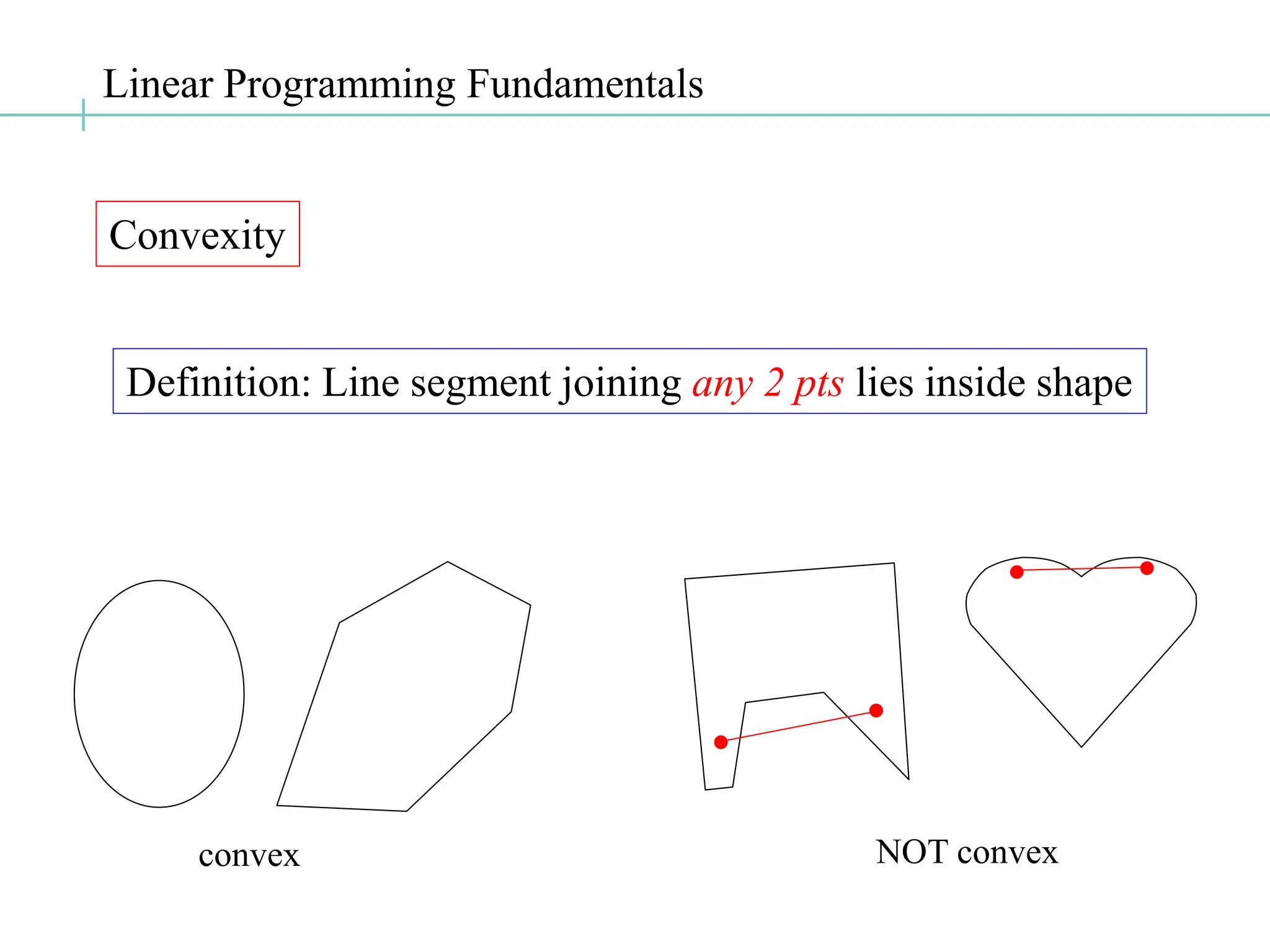
Convexity
Definition: Line segment joining any 2 pts lies inside shape
convex NOT convex
Linear Programming Fundamentals..
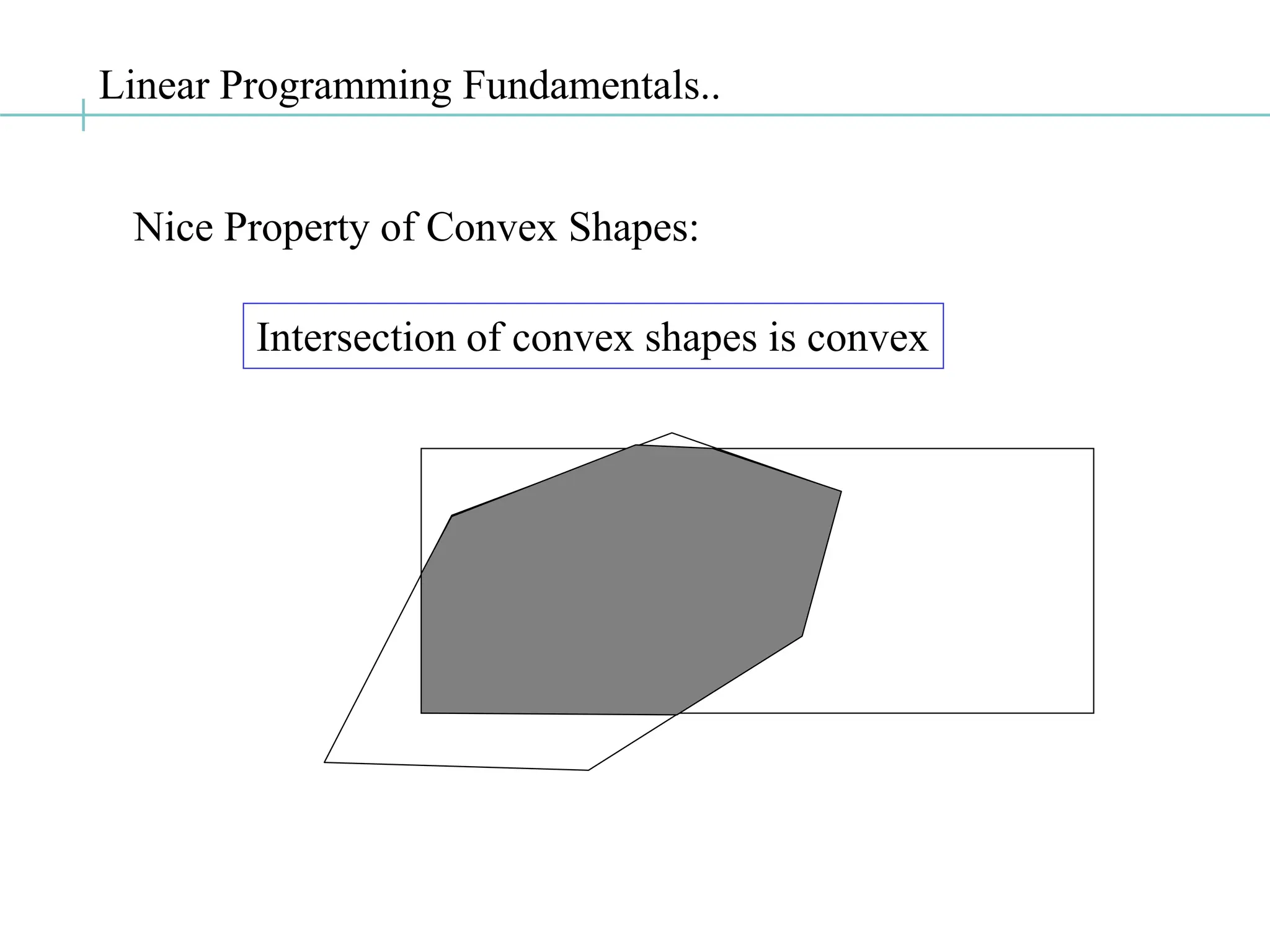
Nice Property of Convex Shapes:
Intersection of convex shapes is convex
Linear Programming Fundamentals…
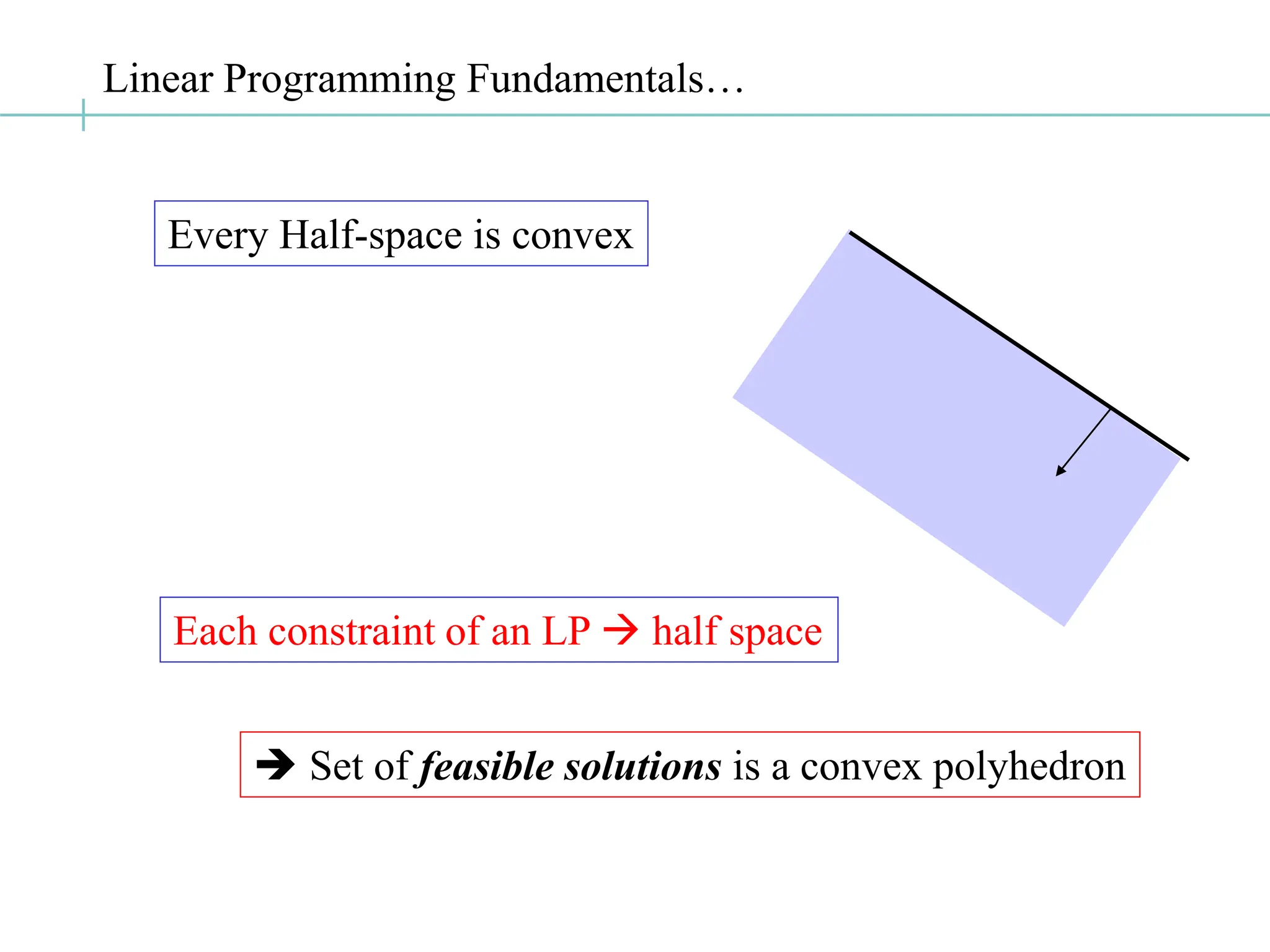
Every Half-space is convex
 Set of feasible solutions is a convex polyhedron
Each constraint of an LP  half space
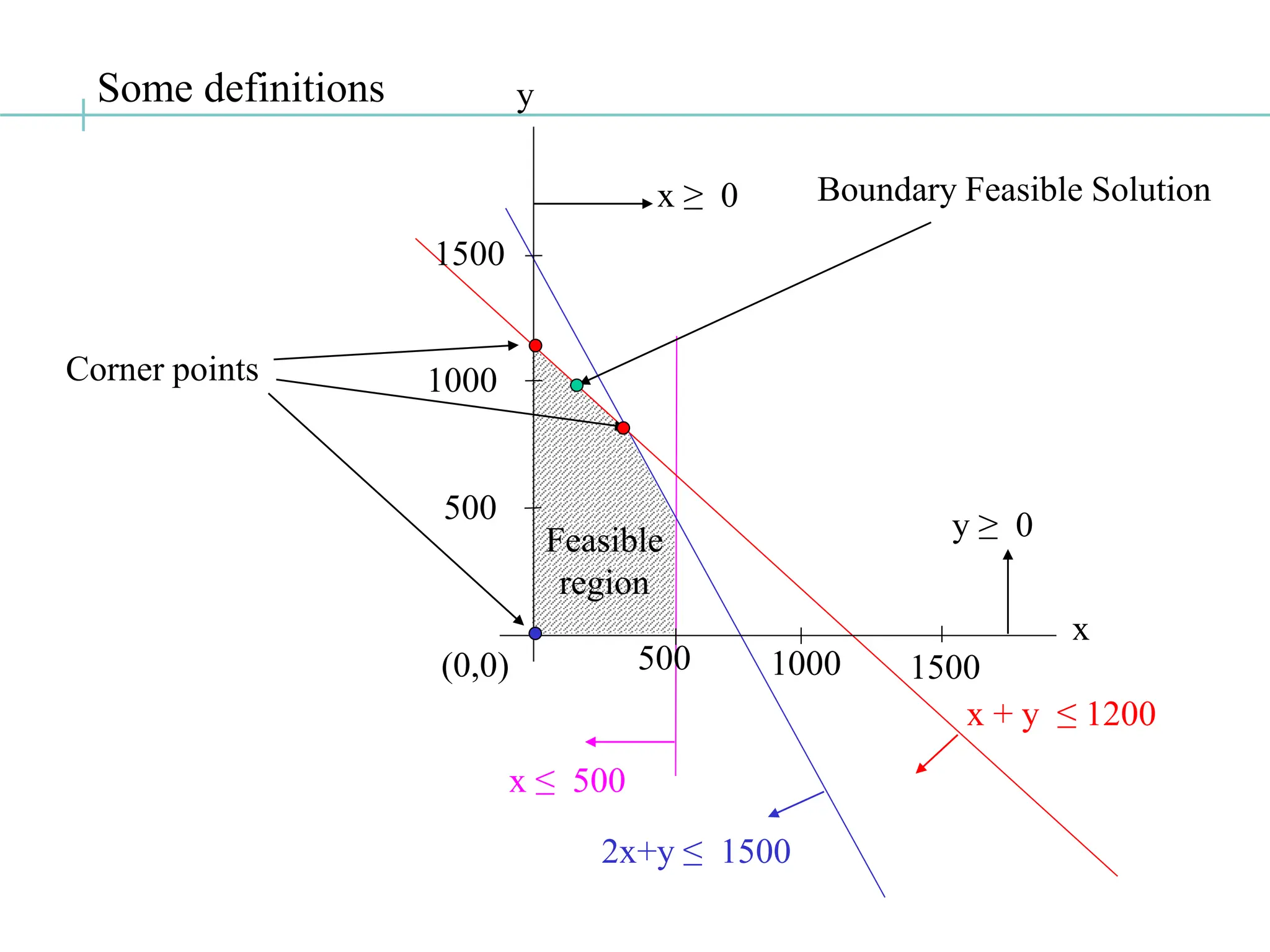
Some definitions
y ≥ 0
x ≥ 0
x ≤ 500
2x+y ≤ 1500
x + y ≤ 1200
(0,0)
1000
1500
500 1000 1500
500
y
x
Feasible
region
Boundary Feasible Solution
Corner points
Important Properties
(0,0)
1000
1500
500 1000 1500
500
y
x
Feasible
region
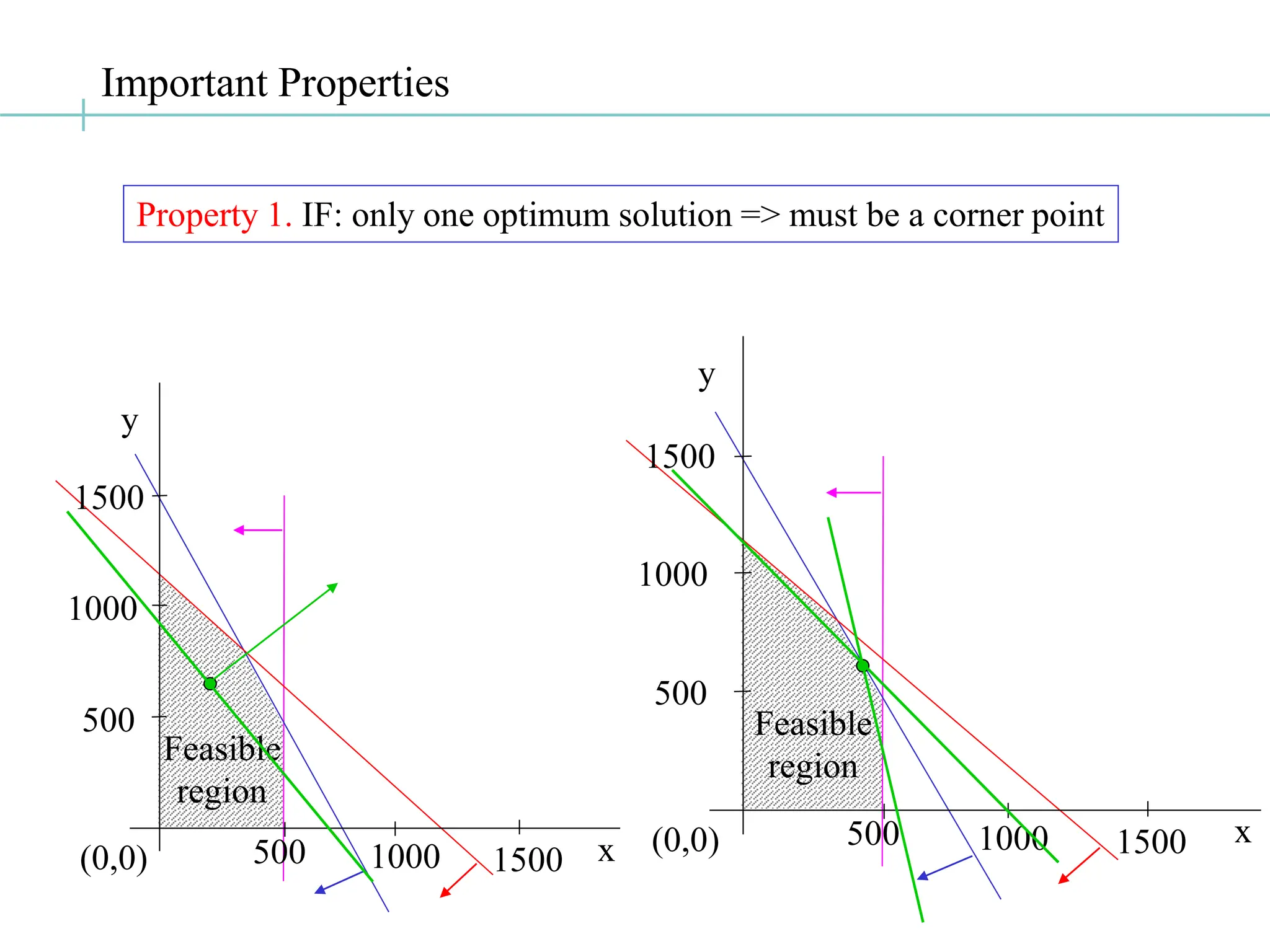
Property 1. IF: only one optimum solution => must be a corner point
(0,0)
1000
1500
500 1000 1500
500
y
x
Feasible
region
Important Properties..
(0,0)
1000
1500
500 1000 1500
500
y
x
Feasible
region
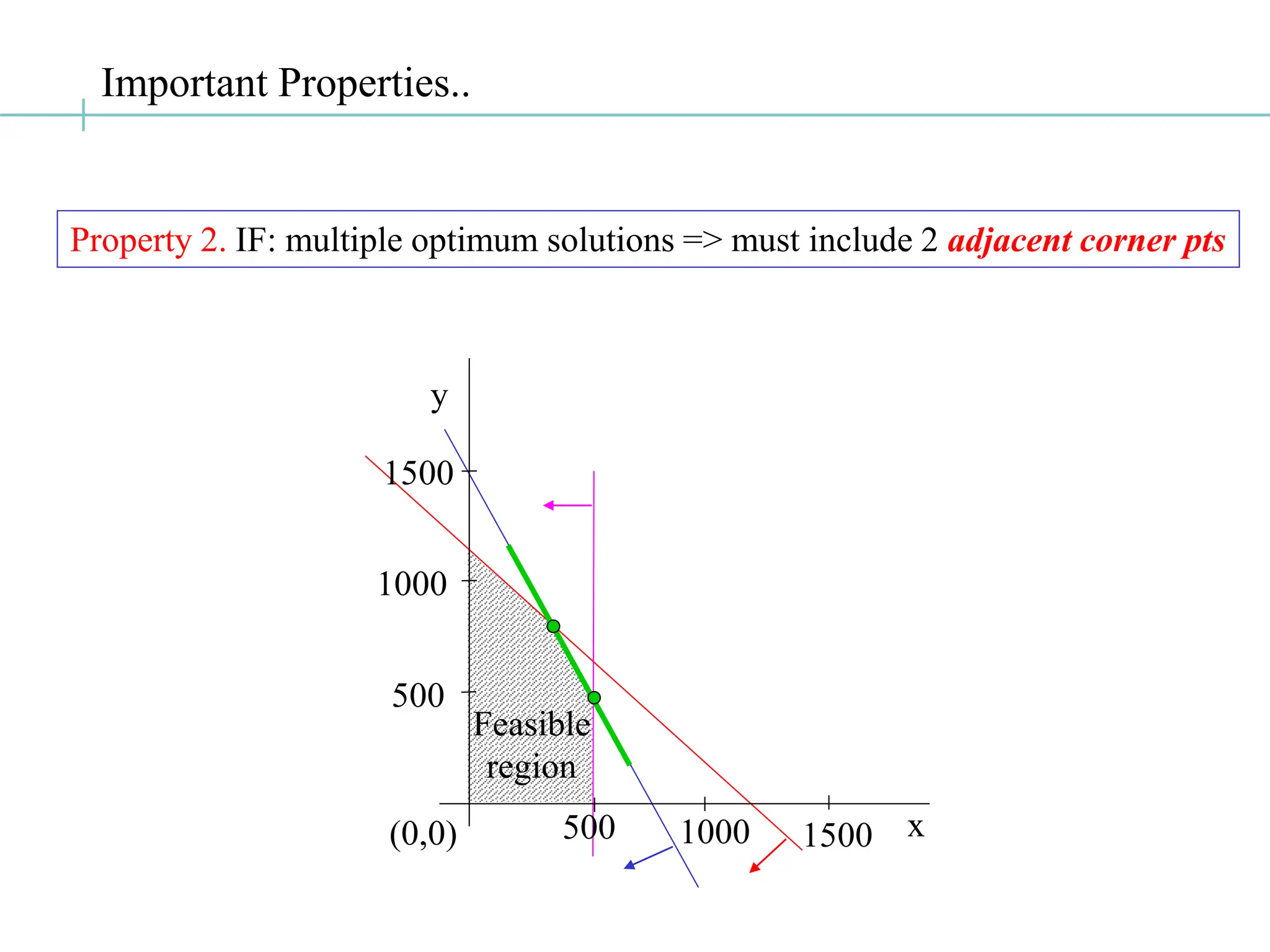
Property 2. IF: multiple optimum solutions => must include 2 adjacent corner pts
Important Properties…
(0,0)
1000
1500
500 1000 1500
500
y
x
Feasible
region
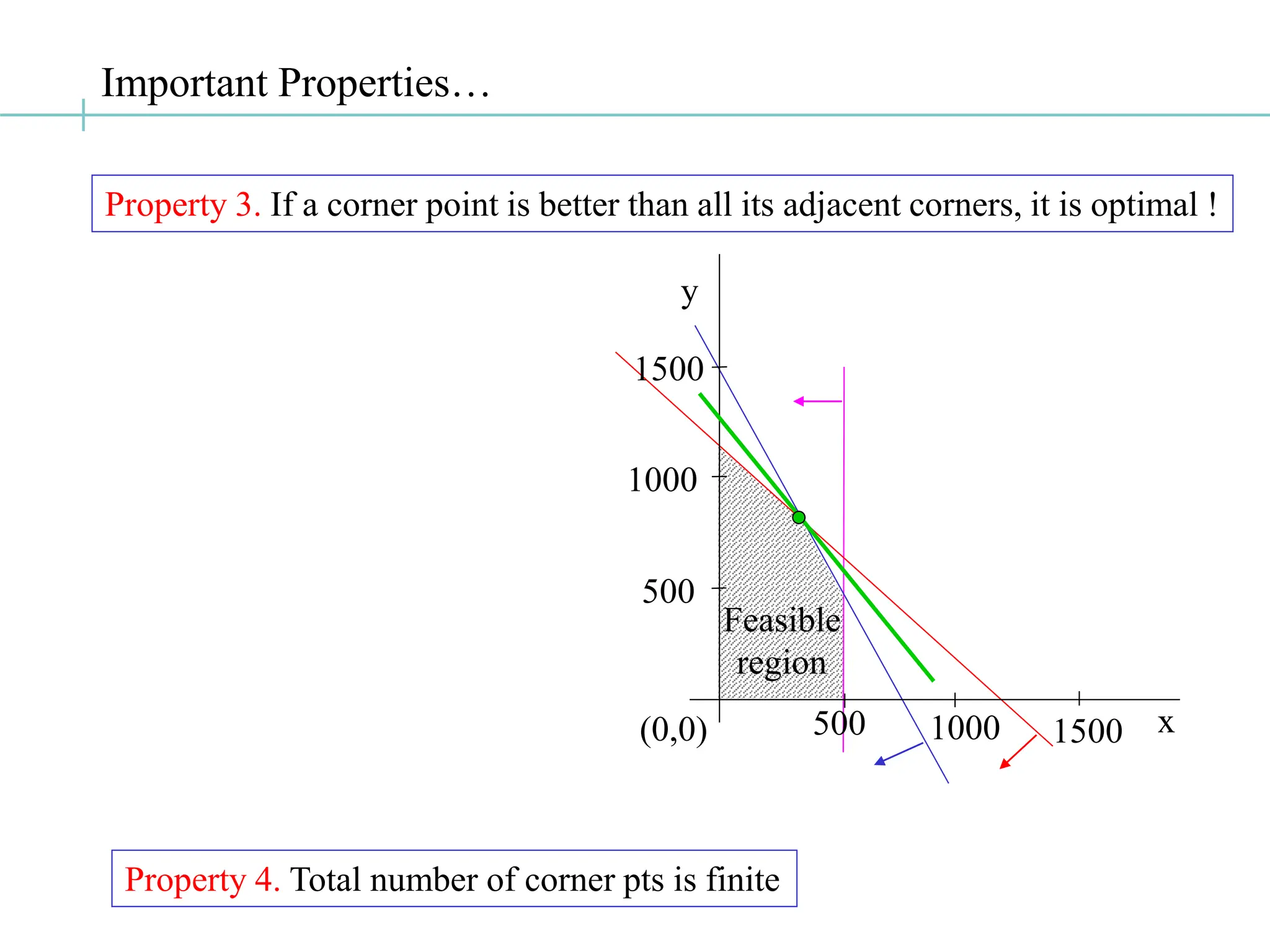
Property 4. Total number of corner pts is finite
Property 3. If a corner point is better than all its adjacent corners, it is optimal !
Important Properties....
(0,0)
1000
1500
500 1000 1500
500
y
x
Feasible
region
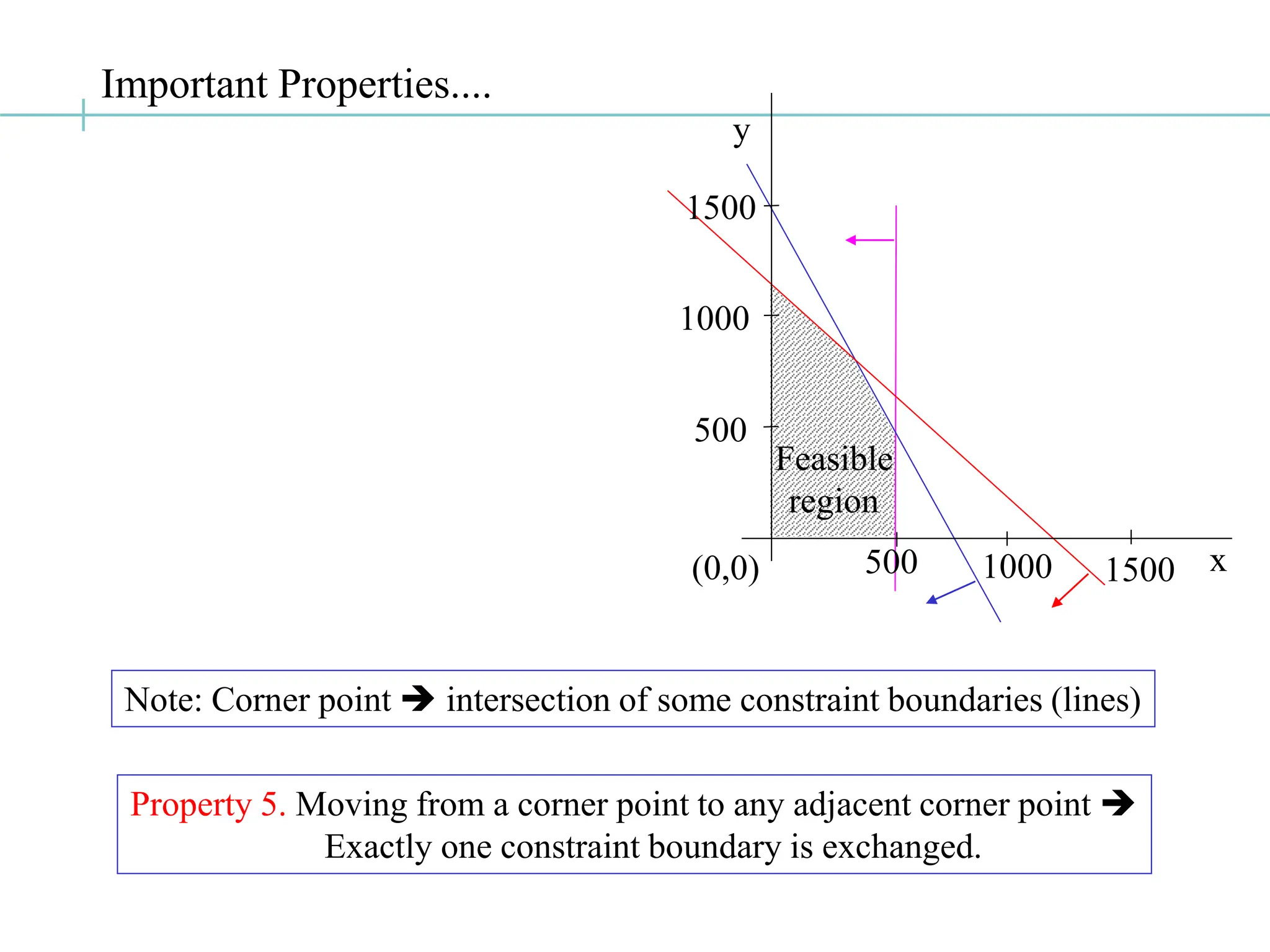
Note: Corner point  intersection of some constraint boundaries (lines)
Property 5. Moving from a corner point to any adjacent corner point 
Exactly one constraint boundary is exchanged.
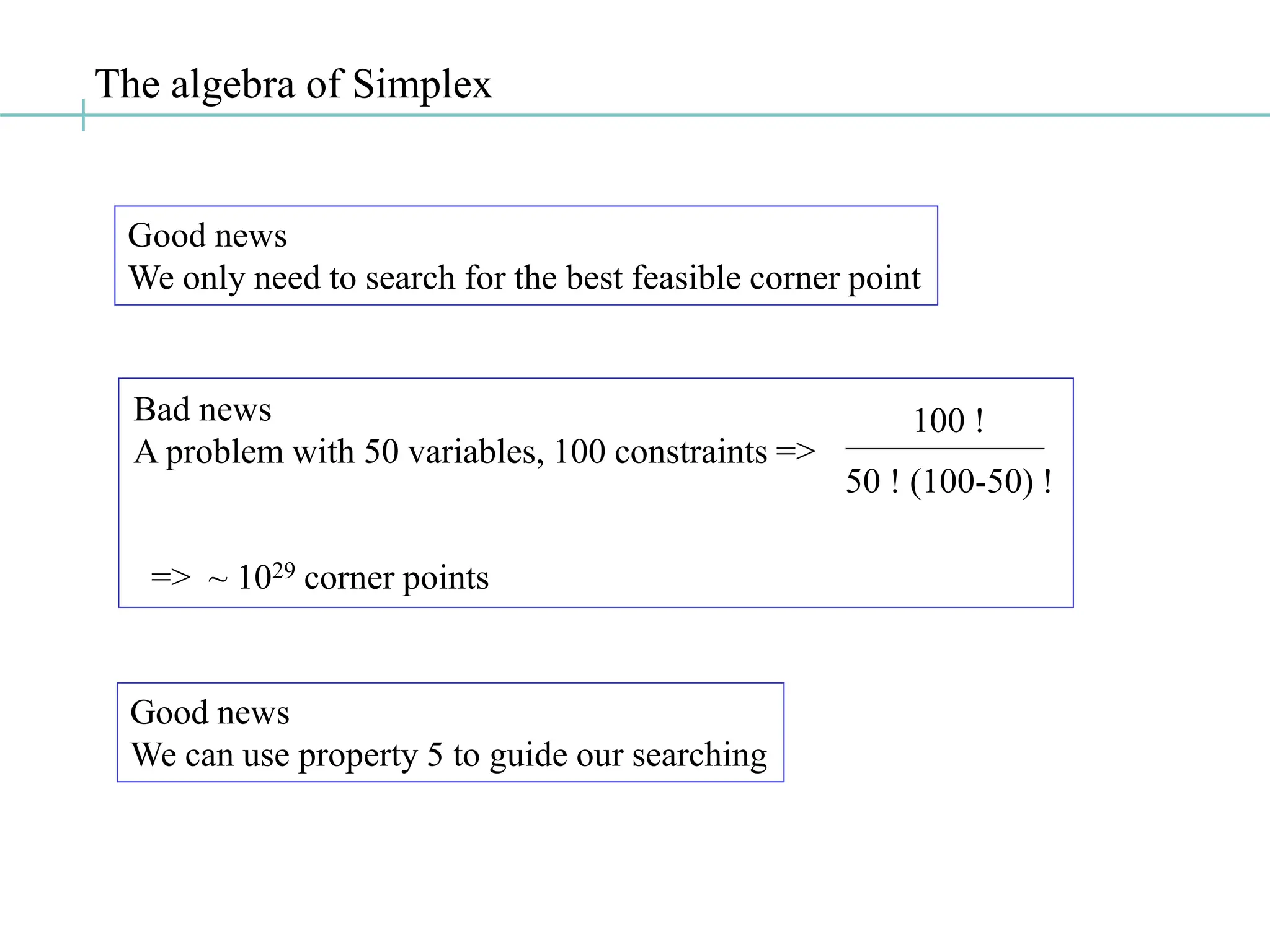
The algebra of Simplex
Good news
We only need to search for the best feasible corner point
Good news
We can use property 5 to guide our searching
Bad news
A problem with 50 variables, 100 constraints =>
100 !
50 ! (100-50) !
=> ~ 1029 corner points
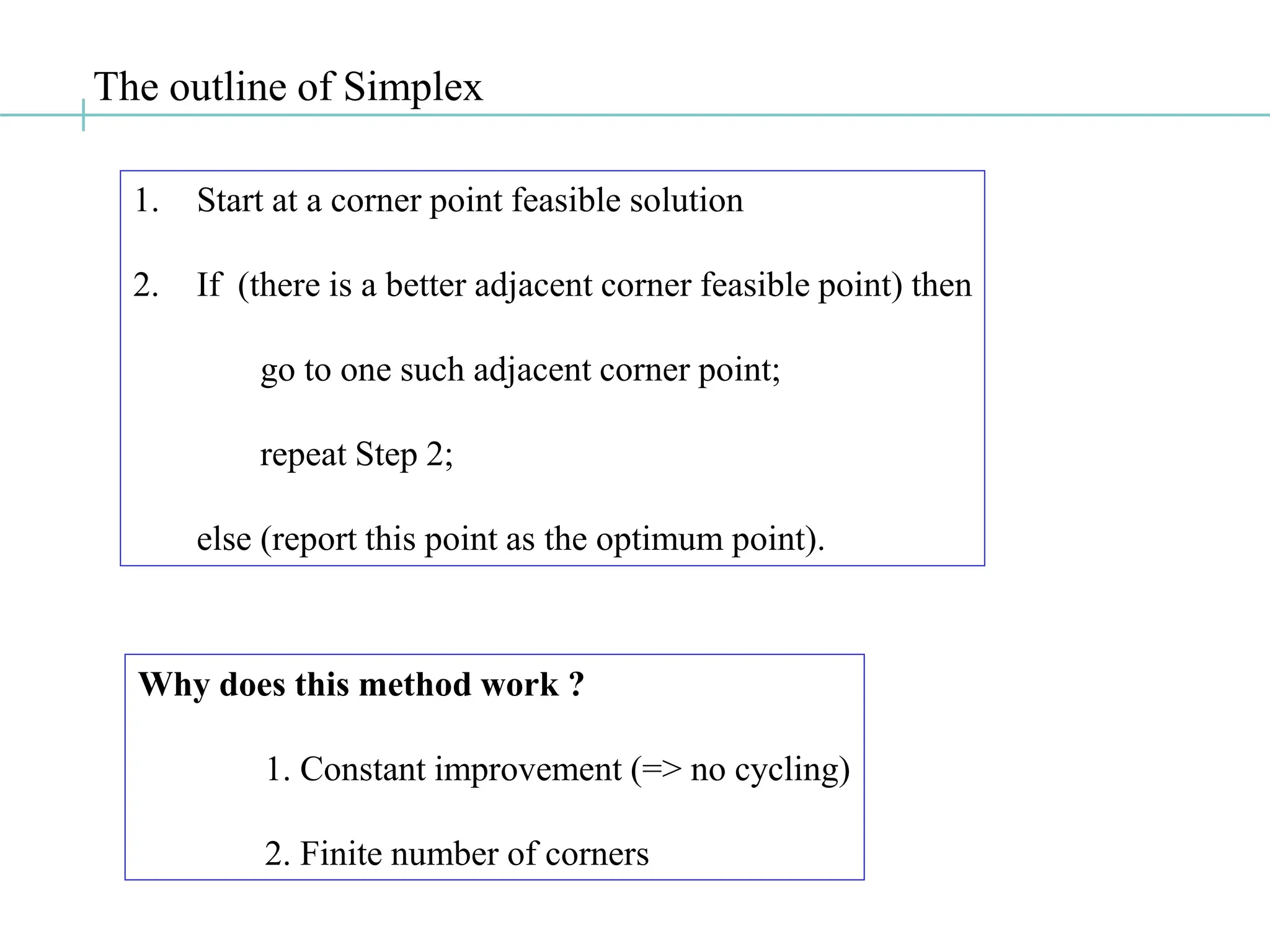
The outline of Simplex
1. Start at a corner point feasible solution
2. If (there is a better adjacent corner feasible point) then
go to one such adjacent corner point;
repeat Step 2;
else (report this point as the optimum point).
Why does this method work ?
1. Constant improvement (=> no cycling)
2. Finite number of corners
The Algebra of Simplex: Gauss elimination
Solving for corner points   solving a set of simultaneous equations
Method: Gaussian elimination
Example:
x + y = 2 [1]
x – 2y = 1 [2]
Solve by:
2x[1] + [2]: 3x = 5 => x = 5/3
[1] - 1x[2]: 3y = 1 => y = 1/3
The Algebra of Simplex: need for Slack !
Cannot add (multiples of) INEQUATIONS !!
Consider:
x >= 0 [1]
y >= 0 [2]
[1] + [2]: x + y >= 0 [3]
x
y
x + y >= 0
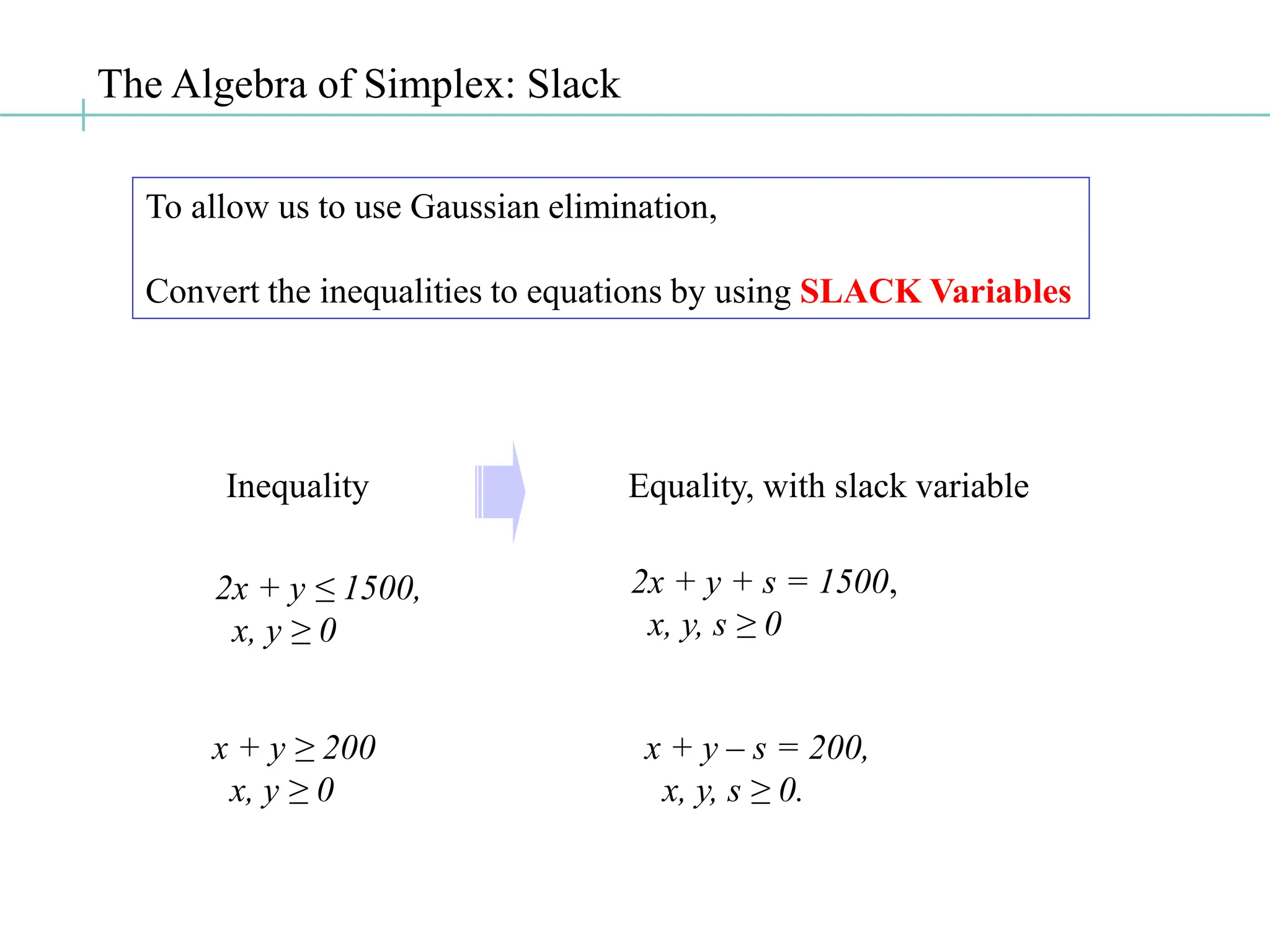
The Algebra of Simplex: Slack
To allow us to use Gaussian elimination,
Convert the inequalities to equations by using SLACK Variables
2x + y ≤ 1500,
x, y ≥ 0
2x + y + s = 1500,
x, y, s ≥ 0
x + y ≥ 200
x, y ≥ 0
x + y – s = 200,
x, y, s ≥ 0.
Inequality Equality, with slack variable
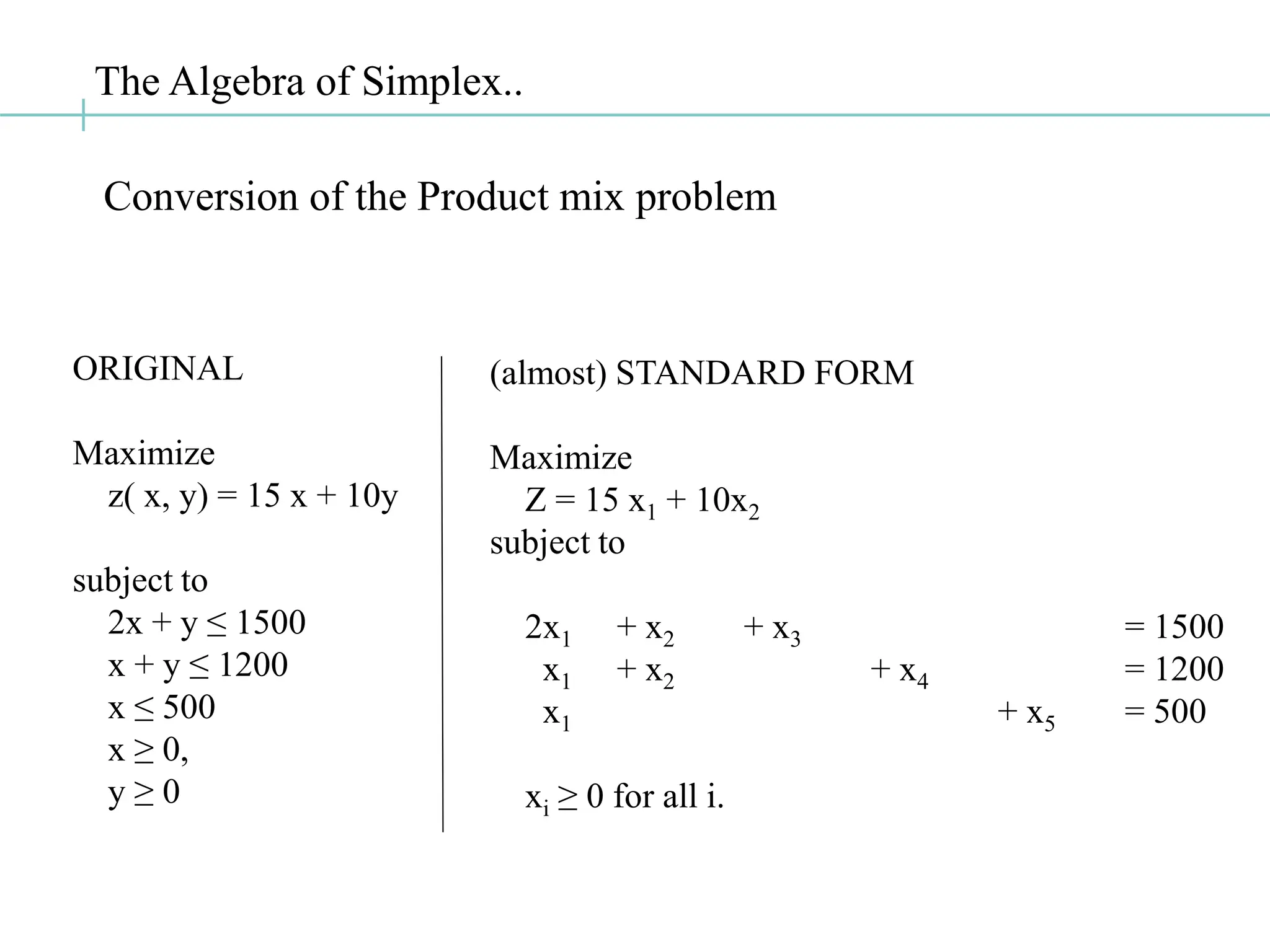
The Algebra of Simplex..
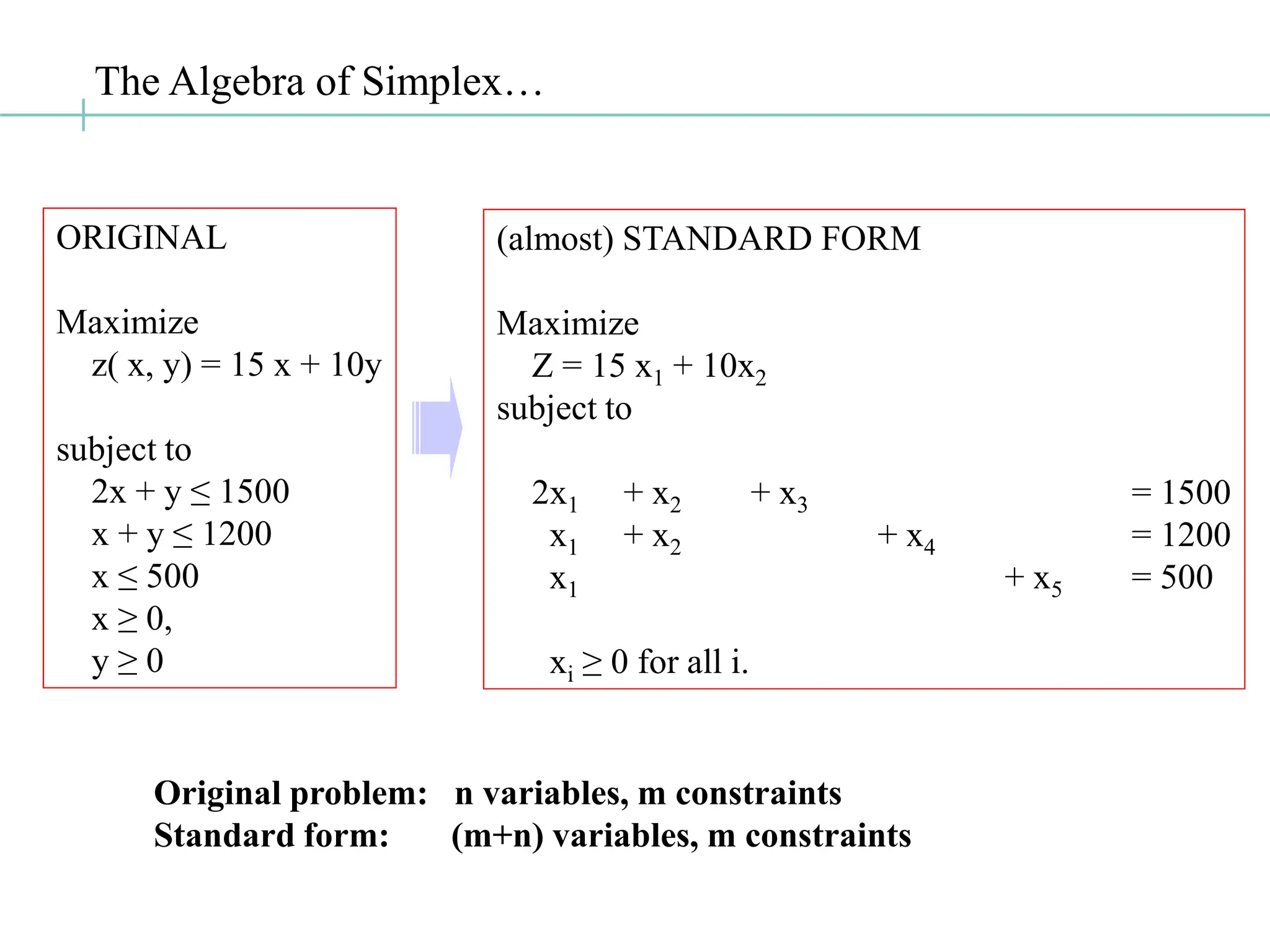
Conversion of the Product mix problem
ORIGINAL
Maximize
z( x, y) = 15 x + 10y
subject to
2x + y ≤ 1500
x + y ≤ 1200
x ≤ 500
x ≥ 0,
y ≥ 0
(almost) STANDARD FORM
Maximize
Z = 15 x1 + 10x2
subject to
2x1 + x2 + x3 = 1500
x1 + x2 + x4 = 1200
x1 + x5 = 500
xi ≥ 0 for all i.
ORIGINAL
Maximize
z( x, y) = 15 x + 10y
subject to
2x + y ≤ 1500
x + y ≤ 1200
x ≤ 500
x ≥ 0,
y ≥ 0
(almost) STANDARD FORM
Maximize
Z = 15 x1 + 10x2
subject to
2x1 + x2 + x3 = 1500
x1 + x2 + x4 = 1200
x1 + x5 = 500
xi ≥ 0 for all i.
Original problem: n variables, m constraints
Standard form: (m+n) variables, m constraints
The Algebra of Simplex…
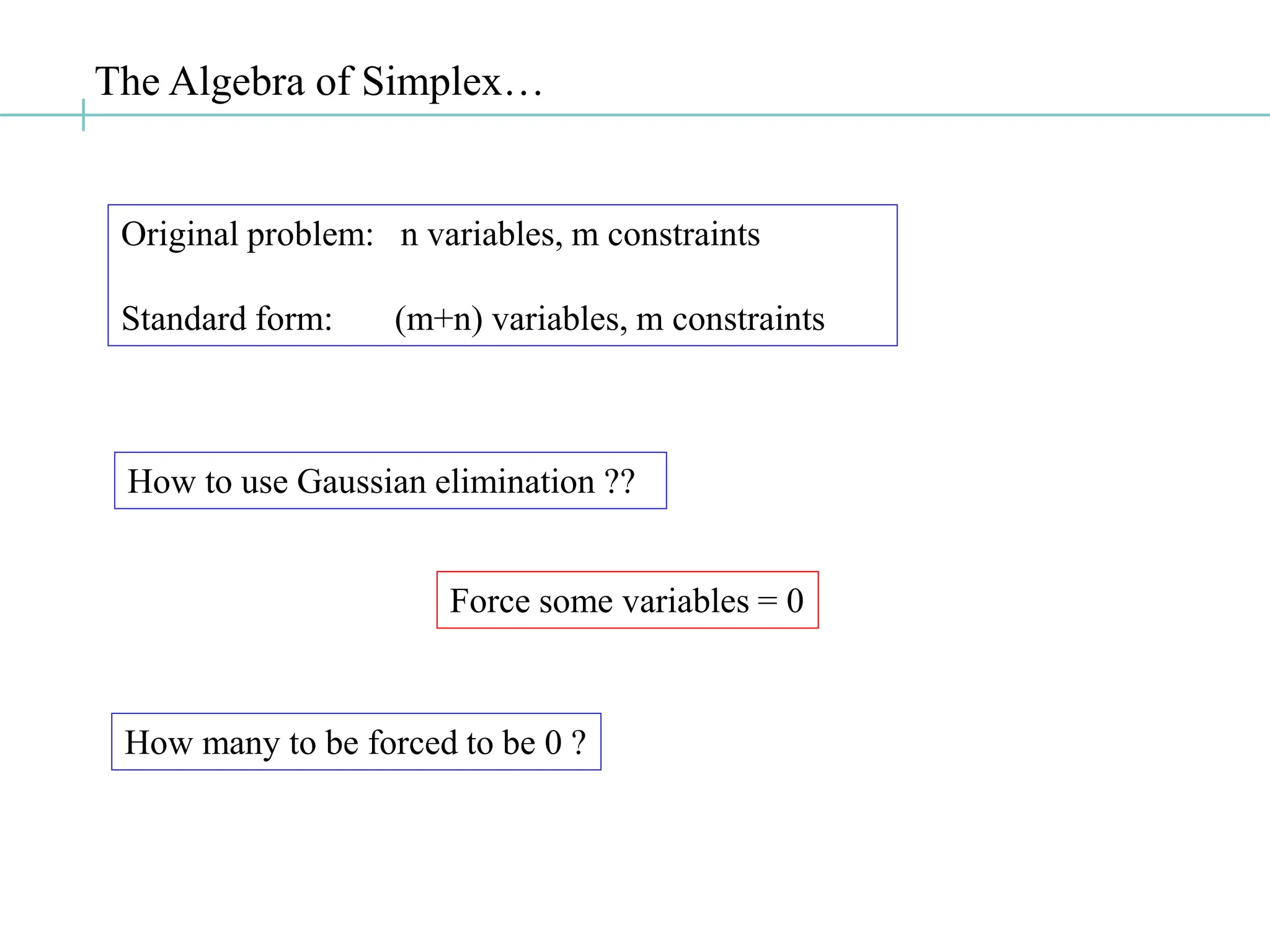
Original problem: n variables, m constraints
Standard form: (m+n) variables, m constraints
How to use Gaussian elimination ??
Force some variables = 0
How many to be forced to be 0 ?
The Algebra of Simplex…
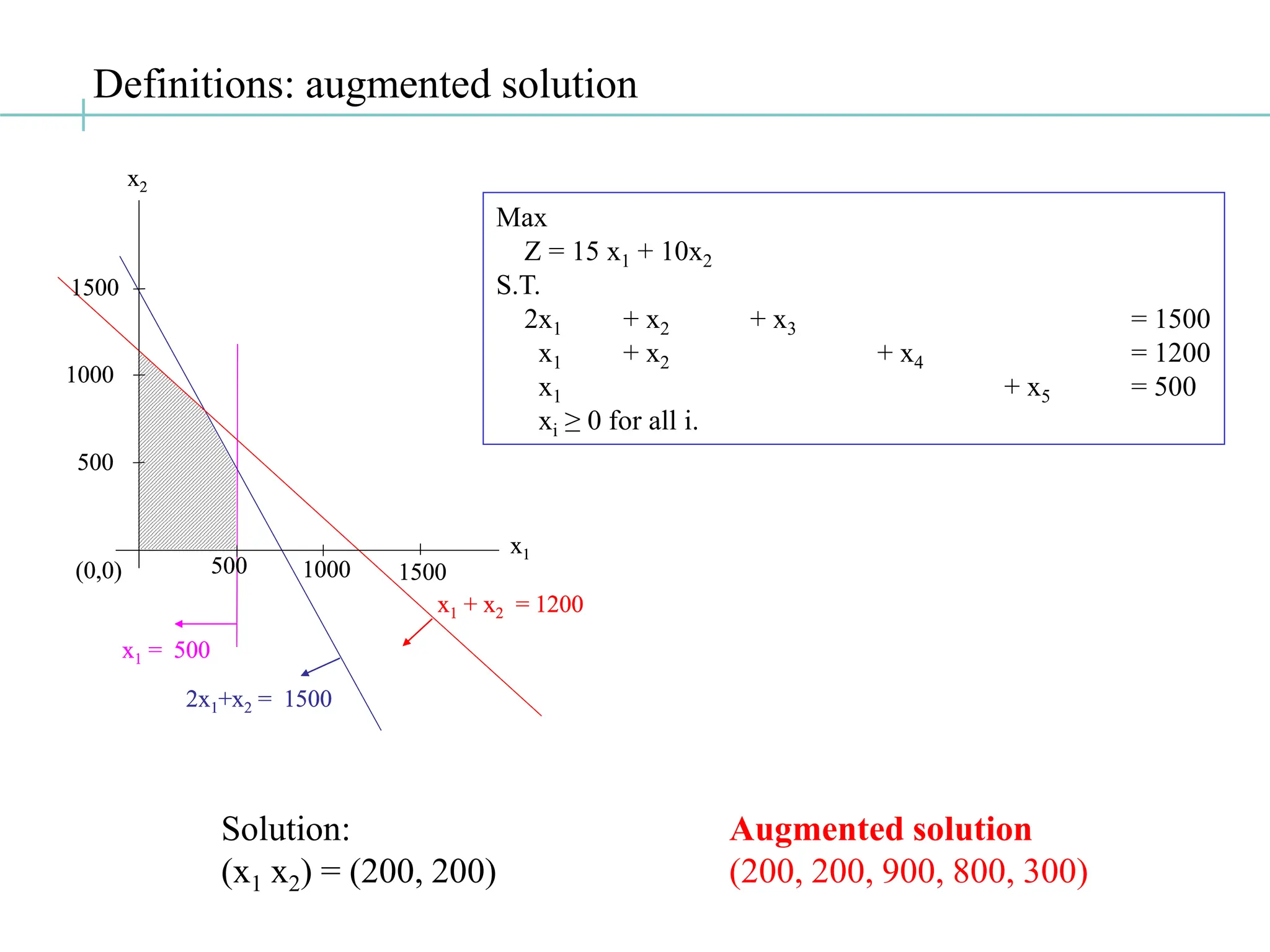
Definitions: augmented solution
x1 = 500
2x1+x2 = 1500
x1 + x2 = 1200
(0,0)
1000
1500
500 1000 1500
500
x2
x1
x1 = 500
x1 = 500
2x1+x2 = 1500
2x1+x2 = 1500
x1 + x2 = 1200
x1 + x2 = 1200
(0,0)
1000
1500
500 1000 1500
500
x2
x1
Solution: Augmented solution
(x1 x2) = (200, 200) (200, 200, 900, 800, 300)
Max
Z = 15 x1 + 10x2
S.T.
2x1 + x2 + x3 = 1500
x1 + x2 + x4 = 1200
x1 + x5 = 500
xi ≥ 0 for all i.
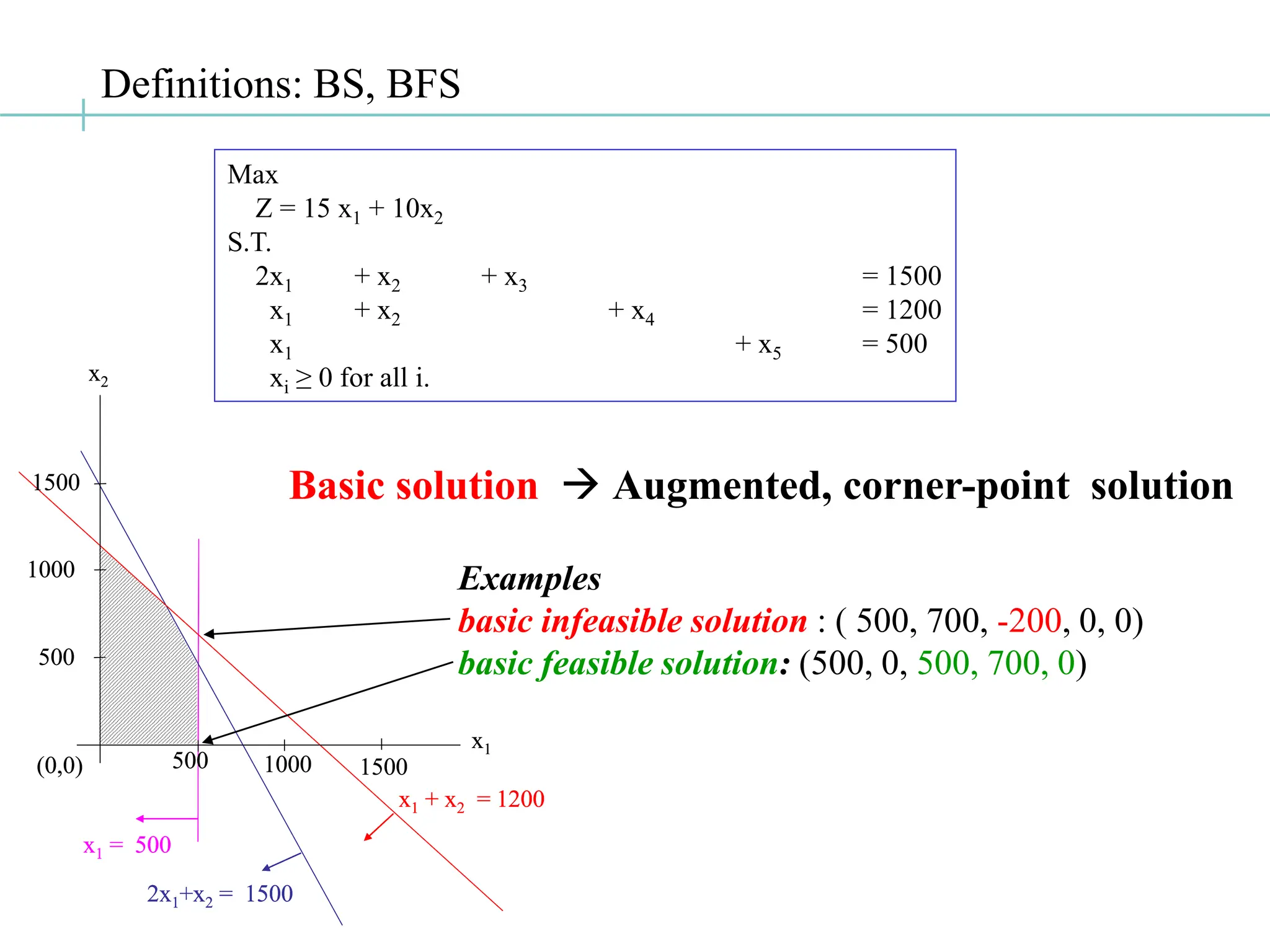
Definitions: BS, BFS
x1 = 500
2x1+x2 = 1500
x1 + x2 = 1200
(0,0)
1000
1500
500 1000 1500
500
x2
x1
x1 = 500
x1 = 500
2x1+x2 = 1500
2x1+x2 = 1500
x1 + x2 = 1200
x1 + x2 = 1200
(0,0)
1000
1500
500 1000 1500
500
x2
x1
Basic solution  Augmented, corner-point solution
Max
Z = 15 x1 + 10x2
S.T.
2x1 + x2 + x3 = 1500
x1 + x2 + x4 = 1200
x1 + x5 = 500
xi ≥ 0 for all i.
Examples
basic infeasible solution : ( 500, 700, -200, 0, 0)
basic feasible solution: (500, 0, 500, 700, 0)
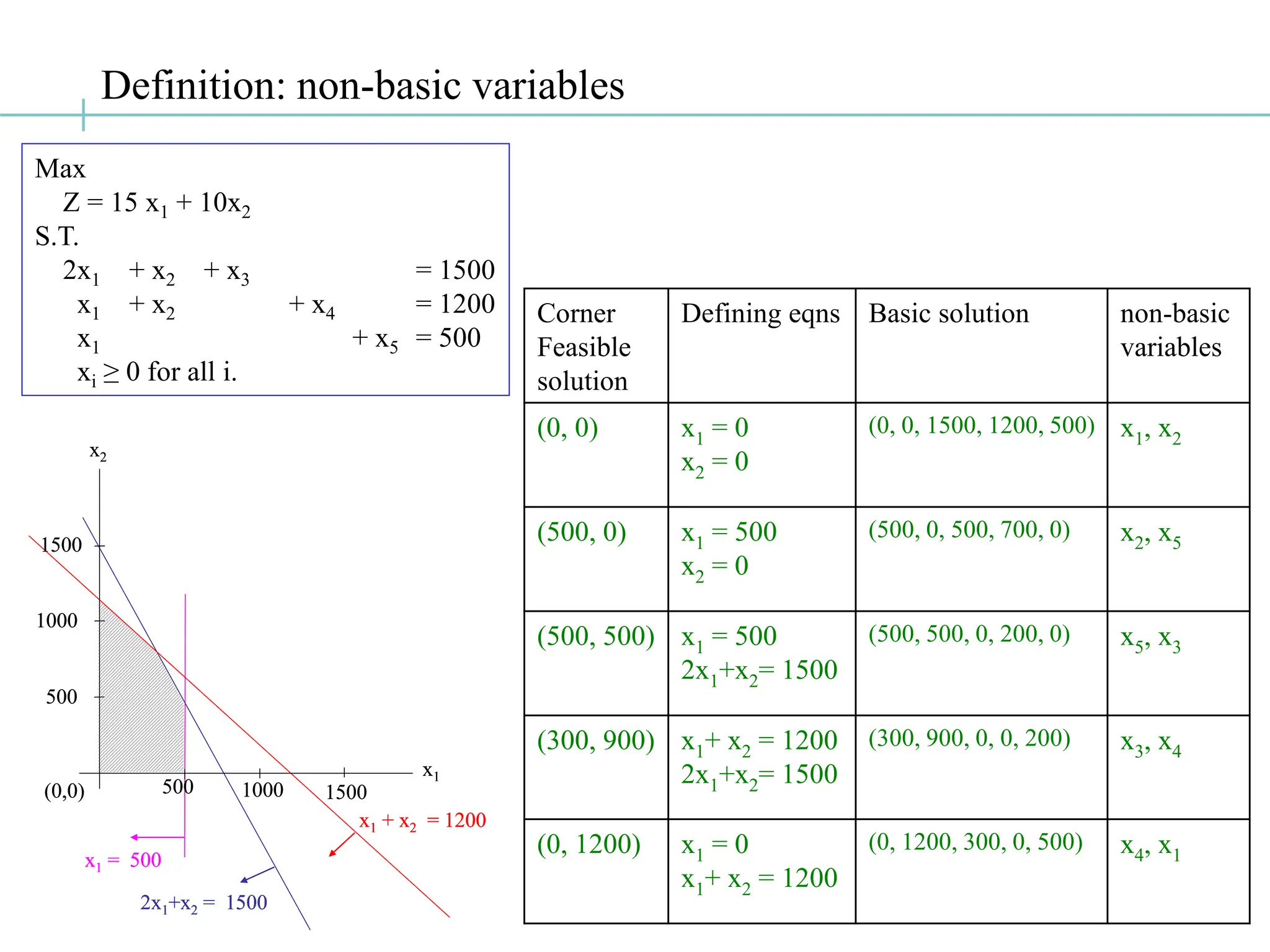
Definition: non-basic variables
x1 = 500
2x1+x2 = 1500
x1 + x2 = 1200
(0,0)
1000
1500
500 1000 1500
500
x2
x1
x1 = 500
x1 = 500
2x1+x2 = 1500
2x1+x2 = 1500
x1 + x2 = 1200
x1 + x2 = 1200
(0,0)
1000
1500
500 1000 1500
500
x2
x1
Max
Z = 15 x1 + 10x2
S.T.
2x1 + x2 + x3 = 1500
x1 + x2 + x4 = 1200
x1 + x5 = 500
xi ≥ 0 for all i.
Corner
Feasible
solution
Defining eqns Basic solution non-basic
variables
(0, 0) x1 = 0
x2 = 0
(0, 0, 1500, 1200, 500) x1, x2
(500, 0) x1 = 500
x2 = 0
(500, 0, 500, 700, 0) x2, x5
(500, 500) x1 = 500
2x1+x2= 1500
(500, 500, 0, 200, 0) x5, x3
(300, 900) x1+ x2 = 1200
2x1+x2= 1500
(300, 900, 0, 0, 200) x3, x4
(0, 1200) x1 = 0
x1+ x2 = 1200
(0, 1200, 300, 0, 500) x4, x1
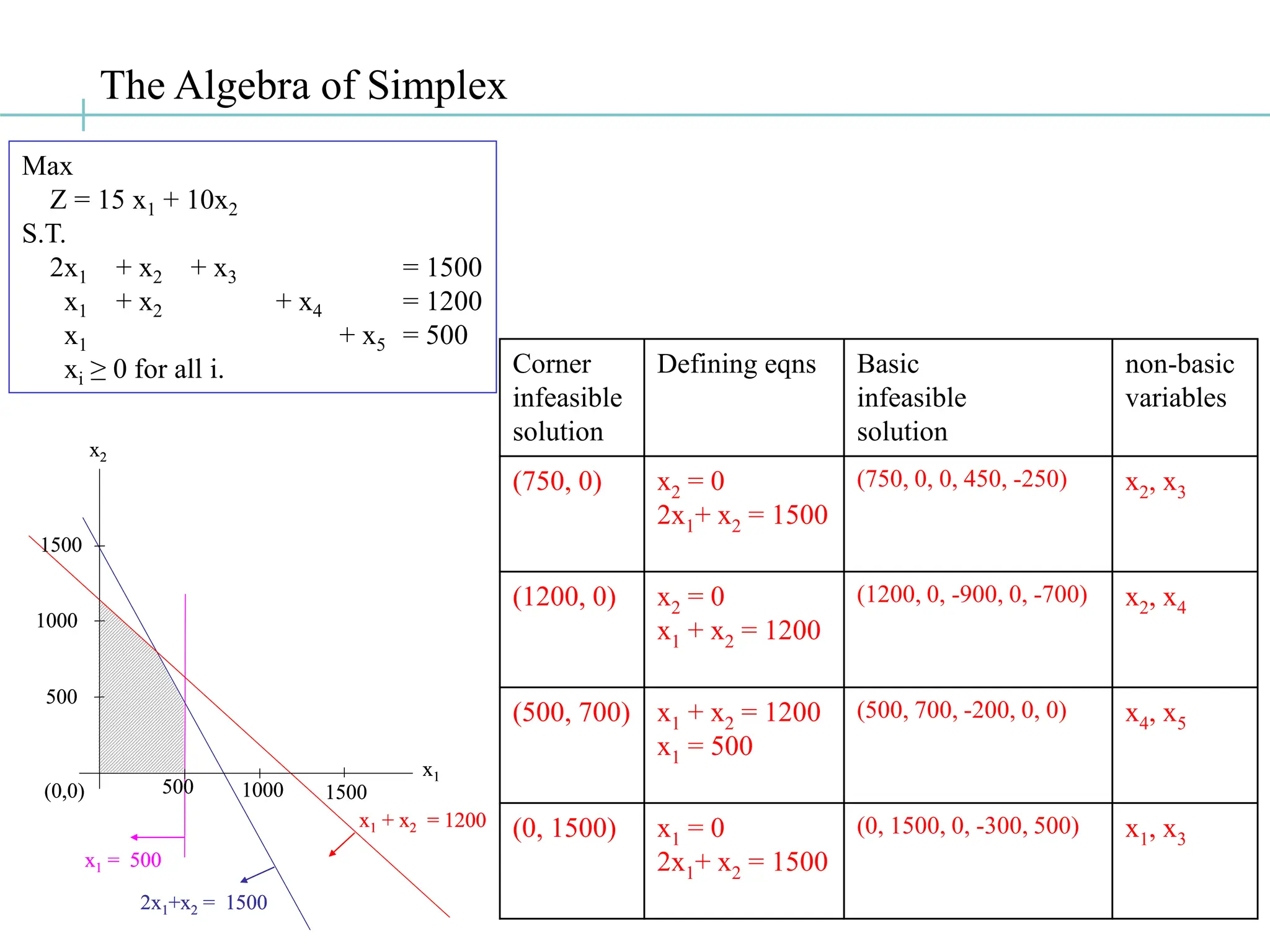
The Algebra of Simplex
x1 = 500
2x1+x2 = 1500
x1 + x2 = 1200
(0,0)
1000
1500
500 1000 1500
500
x2
x1
x1 = 500
x1 = 500
2x1+x2 = 1500
2x1+x2 = 1500
x1 + x2 = 1200
x1 + x2 = 1200
(0,0)
1000
1500
500 1000 1500
500
x2
x1
Max
Z = 15 x1 + 10x2
S.T.
2x1 + x2 + x3 = 1500
x1 + x2 + x4 = 1200
x1 + x5 = 500
xi ≥ 0 for all i. Corner
infeasible
solution
Defining eqns Basic
infeasible
solution
non-basic
variables
(750, 0) x2 = 0
2x1+ x2 = 1500
(750, 0, 0, 450, -250) x2, x3
(1200, 0) x2 = 0
x1 + x2 = 1200
(1200, 0, -900, 0, -700) x2, x4
(500, 700) x1 + x2 = 1200
x1 = 500
(500, 700, -200, 0, 0) x4, x5
(0, 1500) x1 = 0
2x1+ x2 = 1500
(0, 1500, 0, -300, 500) x1, x3
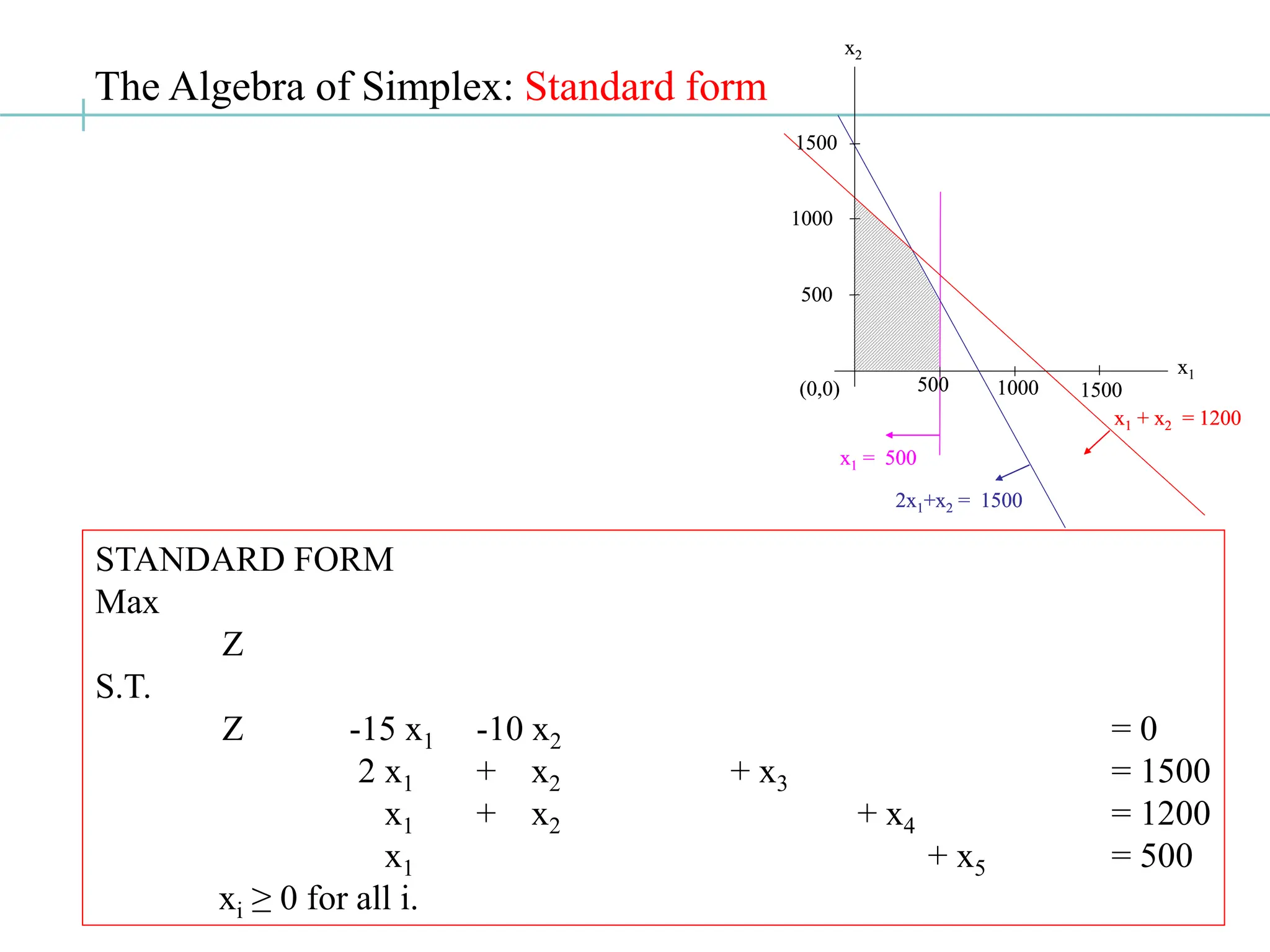
The Algebra of Simplex: Standard form
x1 = 500
2x1+x2 = 1500
x1 + x2 = 1200
(0,0)
1000
1500
500 1000 1500
500
x2
x1
x1 = 500
x1 = 500
2x1+x2 = 1500
2x1+x2 = 1500
x1 + x2 = 1200
x1 + x2 = 1200
(0,0)
1000
1500
500 1000 1500
500
x2
x1
STANDARD FORM
Max
Z
S.T.
Z -15 x1 -10 x2 = 0
2 x1 + x2 + x3 = 1500
x1 + x2 + x4 = 1200
x1 + x5 = 500
xi ≥ 0 for all i.
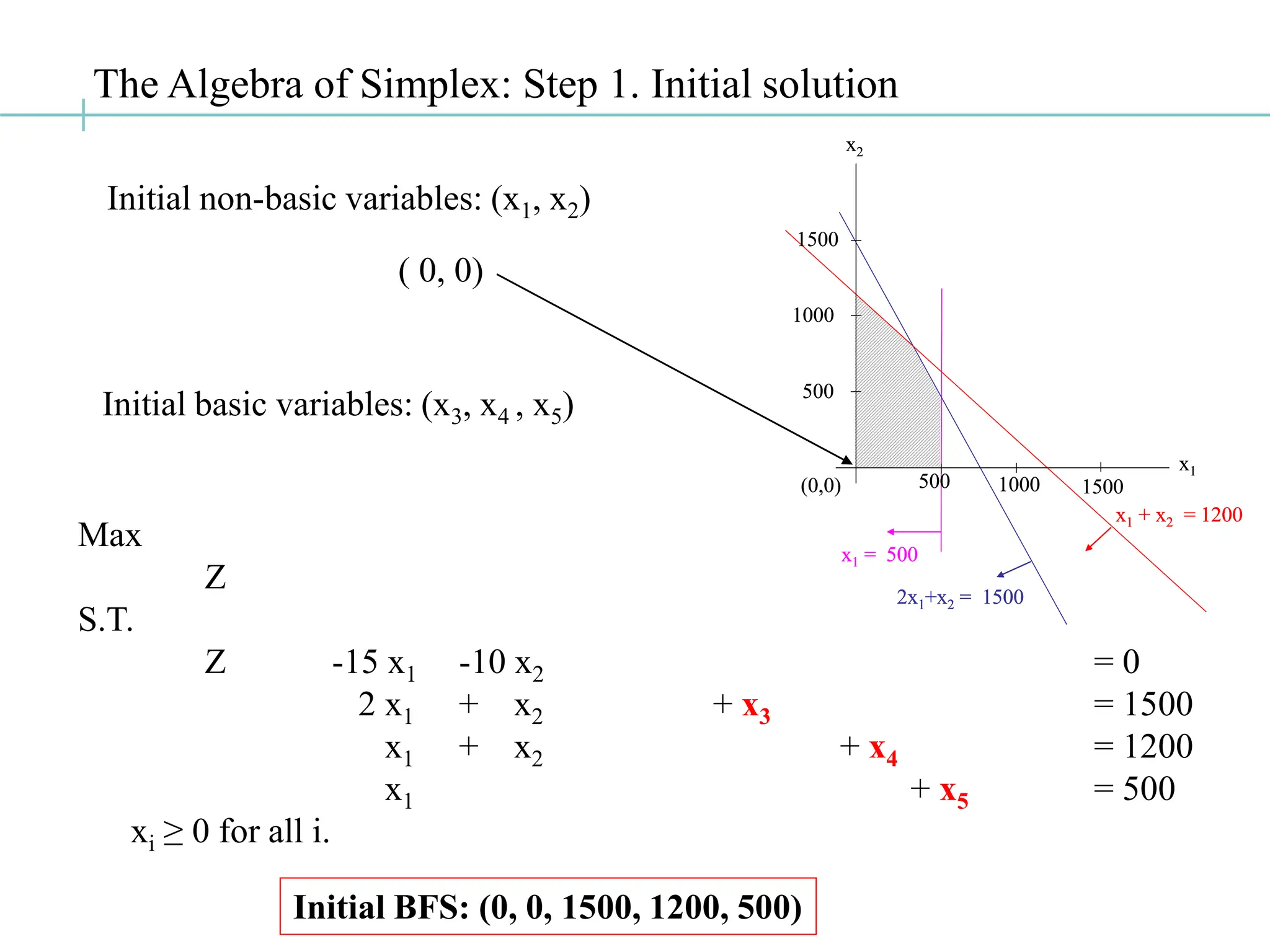
The Algebra of Simplex: Step 1. Initial solution
x1 = 500
2x1+x2 = 1500
x1 + x2 = 1200
(0,0)
1000
1500
500 1000 1500
500
x2
x1
x1 = 500
x1 = 500
2x1+x2 = 1500
2x1+x2 = 1500
x1 + x2 = 1200
x1 + x2 = 1200
(0,0)
1000
1500
500 1000 1500
500
x2
x1
Max
Z
S.T.
Z -15 x1 -10 x2 = 0
2 x1 + x2 + x3 = 1500
x1 + x2 + x4 = 1200
x1 + x5 = 500
xi ≥ 0 for all i.
( 0, 0)
Initial non-basic variables: (x1, x2)
Initial basic variables: (x3, x4 , x5)
Initial BFS: (0, 0, 1500, 1200, 500)
The Algebra of Simplex: Step 2. Iteration Step
x1 = 500
2x1+x2 = 1500
x1 + x2 = 1200
(0,0)
1000
1500
500 1000 1500
500
x2
x1
x1 = 500
x1 = 500
2x1+x2 = 1500
2x1+x2 = 1500
x1 + x2 = 1200
x1 + x2 = 1200
(0,0)
1000
1500
500 1000 1500
500
x2
x1
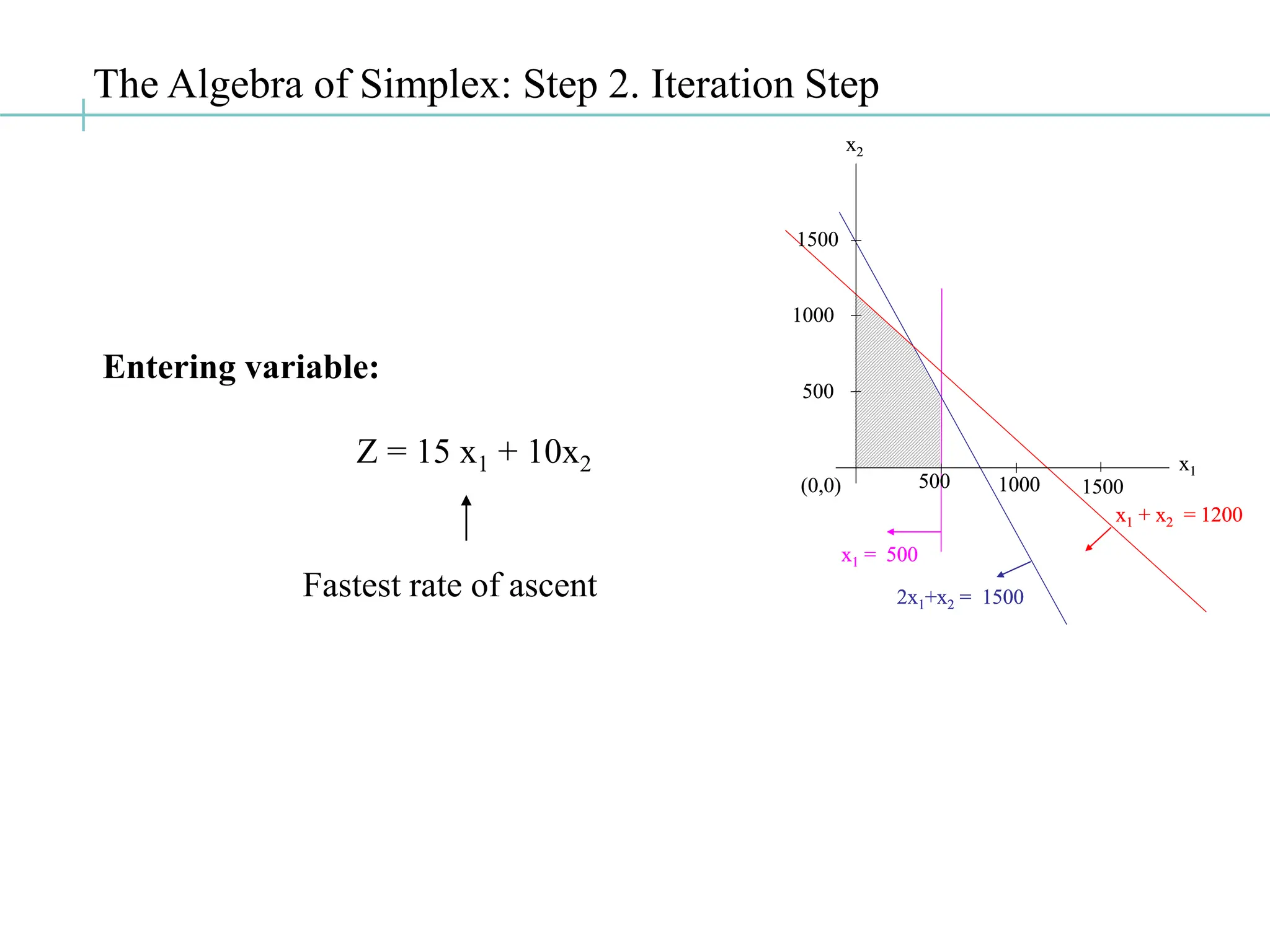
Entering variable:
Z = 15 x1 + 10x2
Fastest rate of ascent
The Algebra of Simplex: Step 2. Iteration Step
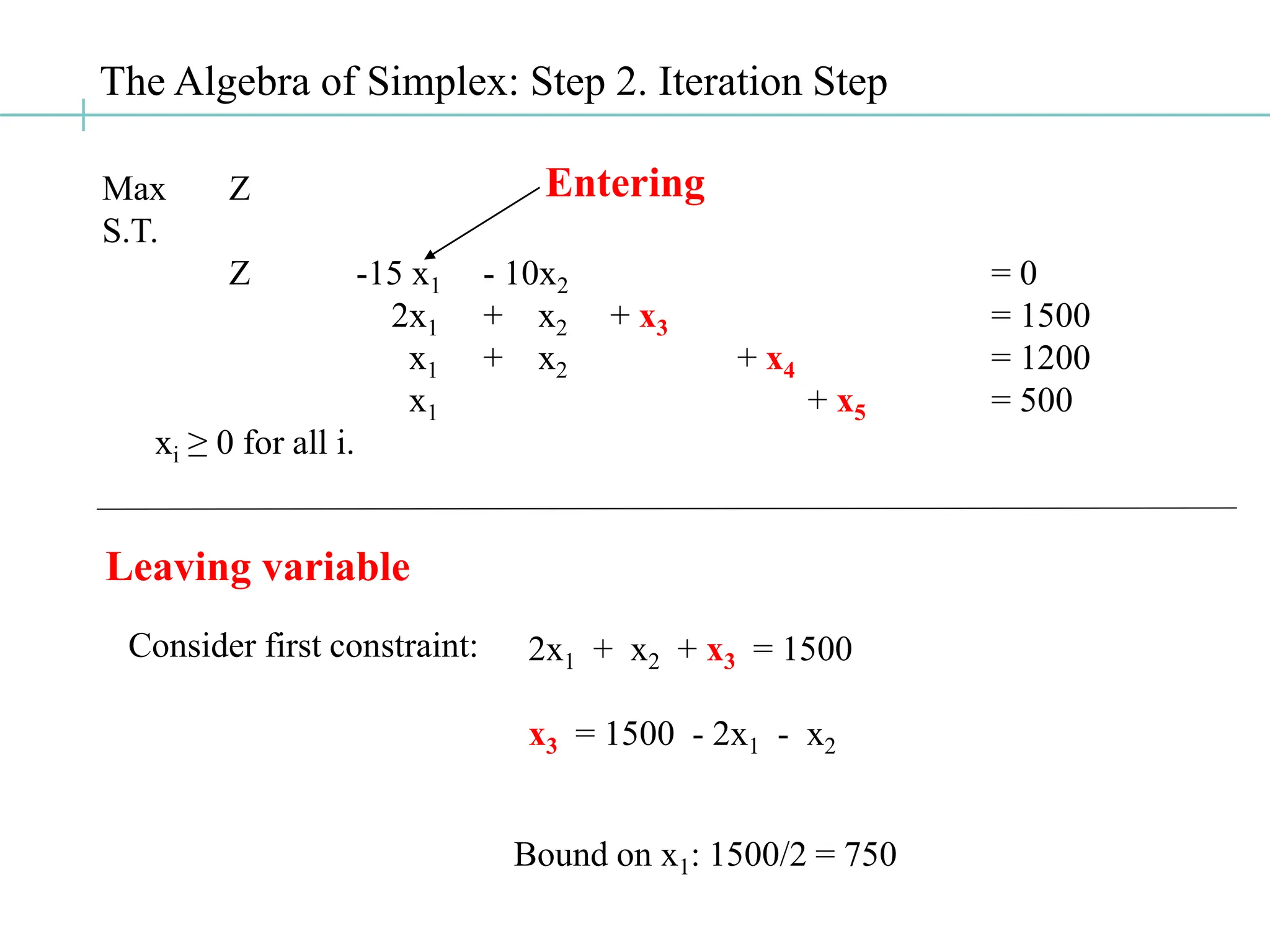
Leaving variable
Max Z
S.T.
Z -15 x1 - 10x2 = 0
2x1 + x2 + x3 = 1500
x1 + x2 + x4 = 1200
x1 + x5 = 500
xi ≥ 0 for all i.
Consider first constraint:
Entering
2x1 + x2 + x3 = 1500
x3 = 1500 - 2x1 - x2
Bound on x1: 1500/2 = 750
The Algebra of Simplex: Step 2. Iteration Step
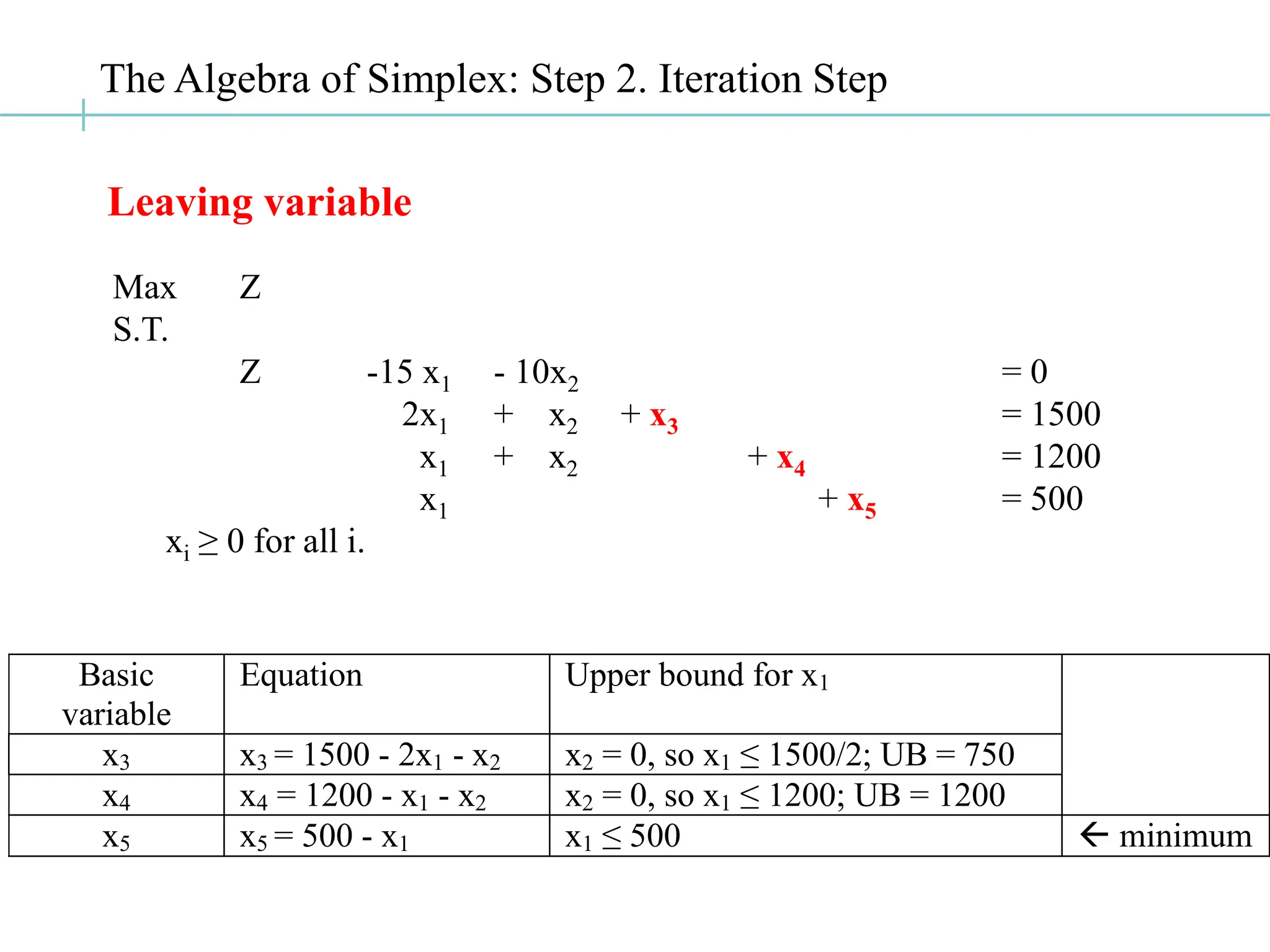
Basic
variable
Equation Upper bound for x1
x3 x3 = 1500 - 2x1 - x2 x2 = 0, so x1 ≤ 1500/2; UB = 750
x4 x4 = 1200 - x1 - x2 x2 = 0, so x1 ≤ 1200; UB = 1200
x5 x5 = 500 - x1 x1 ≤ 500  minimum
Max Z
S.T.
Z -15 x1 - 10x2 = 0
2x1 + x2 + x3 = 1500
x1 + x2 + x4 = 1200
x1 + x5 = 500
xi ≥ 0 for all i.
Leaving variable
The Algebra of Simplex: Step 2. Iteration Step
Enter: x1 Leave: x5
Z -15 x1 -10x2 = 0 [0-0]
2 x1 + x2 + x3 = 1500 [0-1]
x1 + x2 + x4 = 1200 [0-2]
x1 + x5 = 500 [0-3]
ROW OPERATIONS so that
Each row has exactly one basic variable
The coefficient of each basic variable = +1
- [0-3]
- 2x [0-3]
+ 15x [0-3]
The Algebra of Simplex: Step 2. Iteration Step
Z -15 x1 -10x2 = 0 [0-0]
2 x1 + x2 + x3 = 1500 [0-1]
x1 + x2 + x4 = 1200 [0-2]
x1 + x5 = 500 [0-3]
Z -10x2 +15 x5 = 7500 [1-0]
x2 + x3 - 2 x5 = 500 [1-1]
x2 + x4 - x5 = 700 [1-2]
x1 + x5 = 500 [1-3]
Row operations
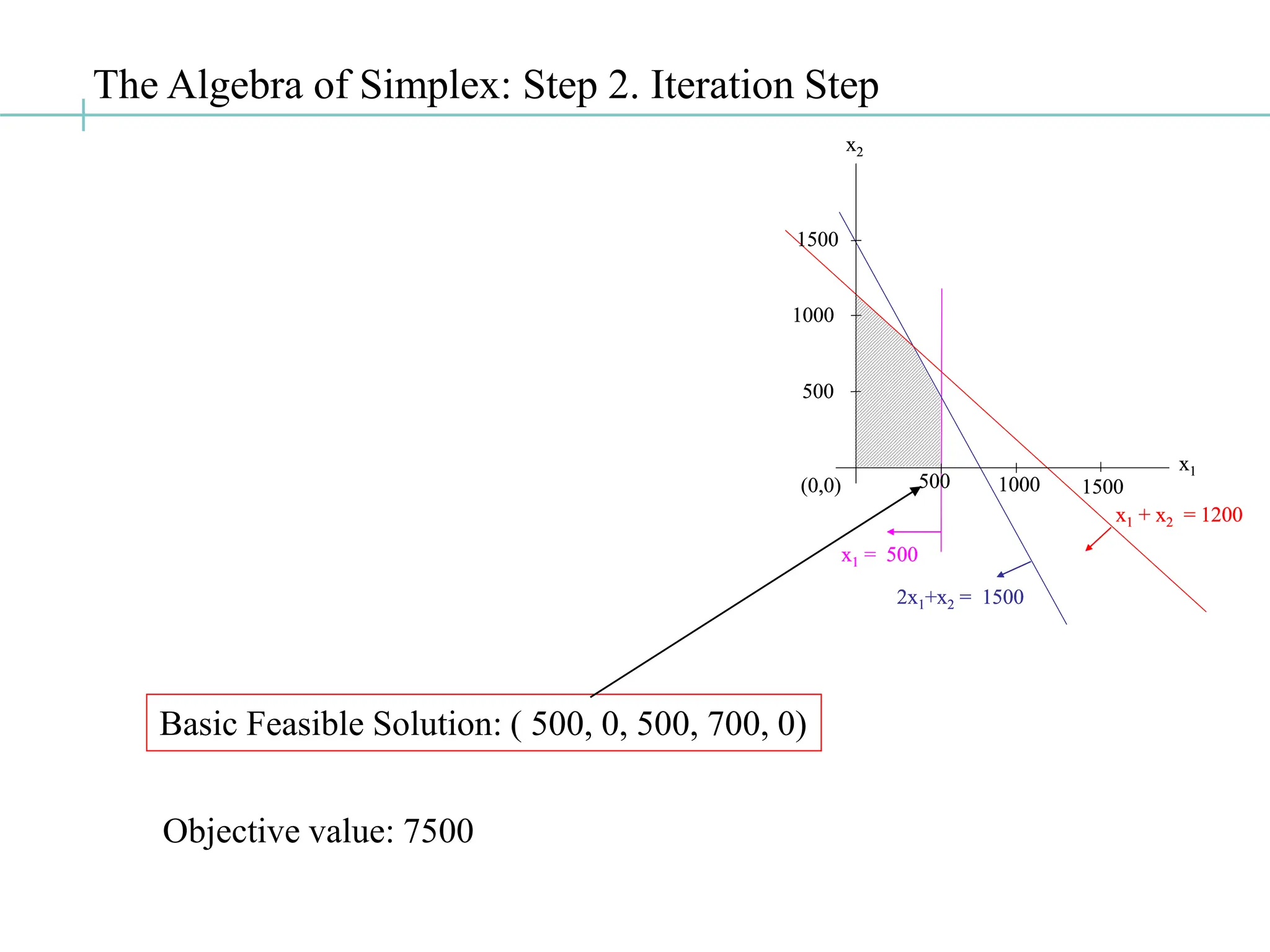
Basic Feasible Solution: ( 500, 0, 500, 700, 0)
The Algebra of Simplex: Step 2. Iteration Step
x1 = 500
2x1+x2 = 1500
x1 + x2 = 1200
(0,0)
1000
1500
500 1000 1500
500
x2
x1
x1 = 500
x1 = 500
2x1+x2 = 1500
2x1+x2 = 1500
x1 + x2 = 1200
x1 + x2 = 1200
(0,0)
1000
1500
500 1000 1500
500
x2
x1
Basic Feasible Solution: ( 500, 0, 500, 700, 0)
Objective value: 7500
The Algebra of Simplex: Step 3. Stopping condition
Z -10x2 +15 x5 = 7500 [1-0]
x2 + x3 - 2 x5 = 500 [1-1]
x2 + x4 - x5 = 700 [1-2]
x1 + x5 = 500 [1-3]
Stopping Rule: Stop when objective cannot be improved.
New entering variable: x2
The Algebra of Simplex: Second Iteration..
Z -10x2 +15 x5 = 7500 [1-0]
x2 + x3 - 2x5 = 500 [1-1]
x2 + x4 - x5 = 700 [1-2]
x1 + x5 = 500 [1-3]
New entering variable: x2
Basic
variable
Equation Upper bound for x2
x3 x3 = 500 – x2 + 2x5 x2 ≤ 500  minimum
x4 x4 = 700 – x2 + x5 x2 ≤ 700
x1 x1 = 500 – x5 no limit on x2
Analysis for leaving variable:
The Algebra of Simplex: Step 2. Iteration Step
Enter: x2 Leave: x3
ROW OPERATIONS so that
Each row has exactly one basic variable
The coefficient of each basic variable = +1
- [1-1]
+ 10x [1-1]
Z -10x2 +15 x5 = 7500 [1-0]
x2 + x3 - 2x5 = 500 [1-1]
x2 + x4 - x5 = 700 [1-2]
x1 + x5 = 500 [1-3]
The Algebra of Simplex: Step 2. Iteration Step
Basic Feasible Solution:
After row operations:
Z +10 x3 -5 x5 = 12,500 [2-0]
x2 + x3 - 2x5 = 500 [2-1]
- x3 + x4 + x5 = 200 [2-2]
x1 + x5 = 500 [2-3]
x1 = 500
2x1+x2 = 1500
x1 + x2 = 1200
(0,0)
1000
1500
500 1000 1500
500
x2
x1
x1 = 500
x1 = 500
2x1+x2 = 1500
2x1+x2 = 1500
x1 + x2 = 1200
x1 + x2 = 1200
(0,0)
1000
1500
500 1000 1500
500
x2
x1
( 500, 500, 0, 200, 0)
Have we found the OPTIMUM ?
The Algebra of Simplex: Third Iteration
New entering variable: x5
Analysis for leaving variable:
Z +10 x3 -5 x5 = 12,500 [2-0]
x2 + x3 - 2x5 = 500 [2-1]
- x3 + x4 + x5 = 200 [2-2]
x1 + x5 = 500 [2-3]
Basic
variable
Equation Upper bound for x5
x2 x2 = 500 + 2x5 - x3 no limit on x5
x4 x4 = 200 + x3 - x5 x5 ≤ 200  minimum
x1 x1 = 500 – x5 x5 ≤ 500
The Algebra of Simplex: Step 2. Third iteration..
ROW OPERATIONS so that
Each row has exactly one basic variable
The coefficient of each basic variable = +1
- [2-2]
+ 5x [2-2]
Enter: x5 Leave: x4
Z +10 x3 -5 x5 = 12,500 [2-0]
x2 + x3 - 2x5 = 500 [2-1]
- x3 + x4 + x5 = 200 [2-2]
x1 + x5 = 500 [2-3]
+ 2x [2-2]
The Algebra of Simplex: Step 2. Iteration Step
Basic Feasible Solution:
x1 = 500
2x1+x2 = 1500
x1 + x2 = 1200
(0,0)
1000
1500
500 1000 1500
500
x2
x1
x1 = 500
x1 = 500
2x1+x2 = 1500
2x1+x2 = 1500
x1 + x2 = 1200
x1 + x2 = 1200
(0,0)
1000
1500
500 1000 1500
500
x2
x1
( 300, 900, 0, 0, 200)
Have we found the OPTIMUM ?
After row operations:
Z +5 x3 + 5x4 = 13,500 [3-0]
x2 - x3 + 2x4 = 900 [3-1]
- x3 + x4 + x5 = 200 [3-2]
x1 + x3 - x4 = 300 [3-3]
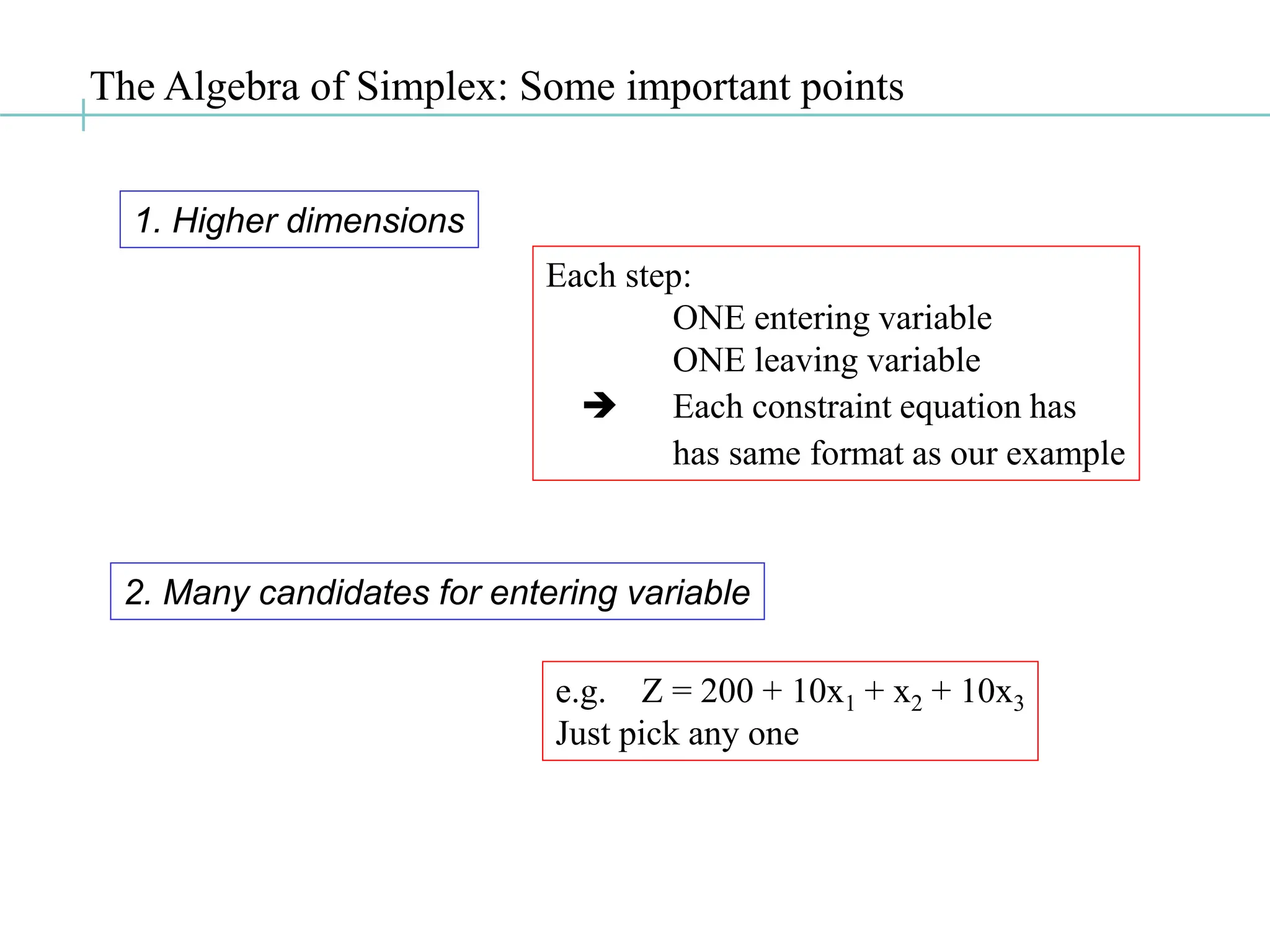
The Algebra of Simplex: Some important points
1. Higher dimensions
2. Many candidates for entering variable
Each step:
ONE entering variable
ONE leaving variable
 Each constraint equation has
has same format as our example
e.g. Z = 200 + 10x1 + x2 + 10x3
Just pick any one
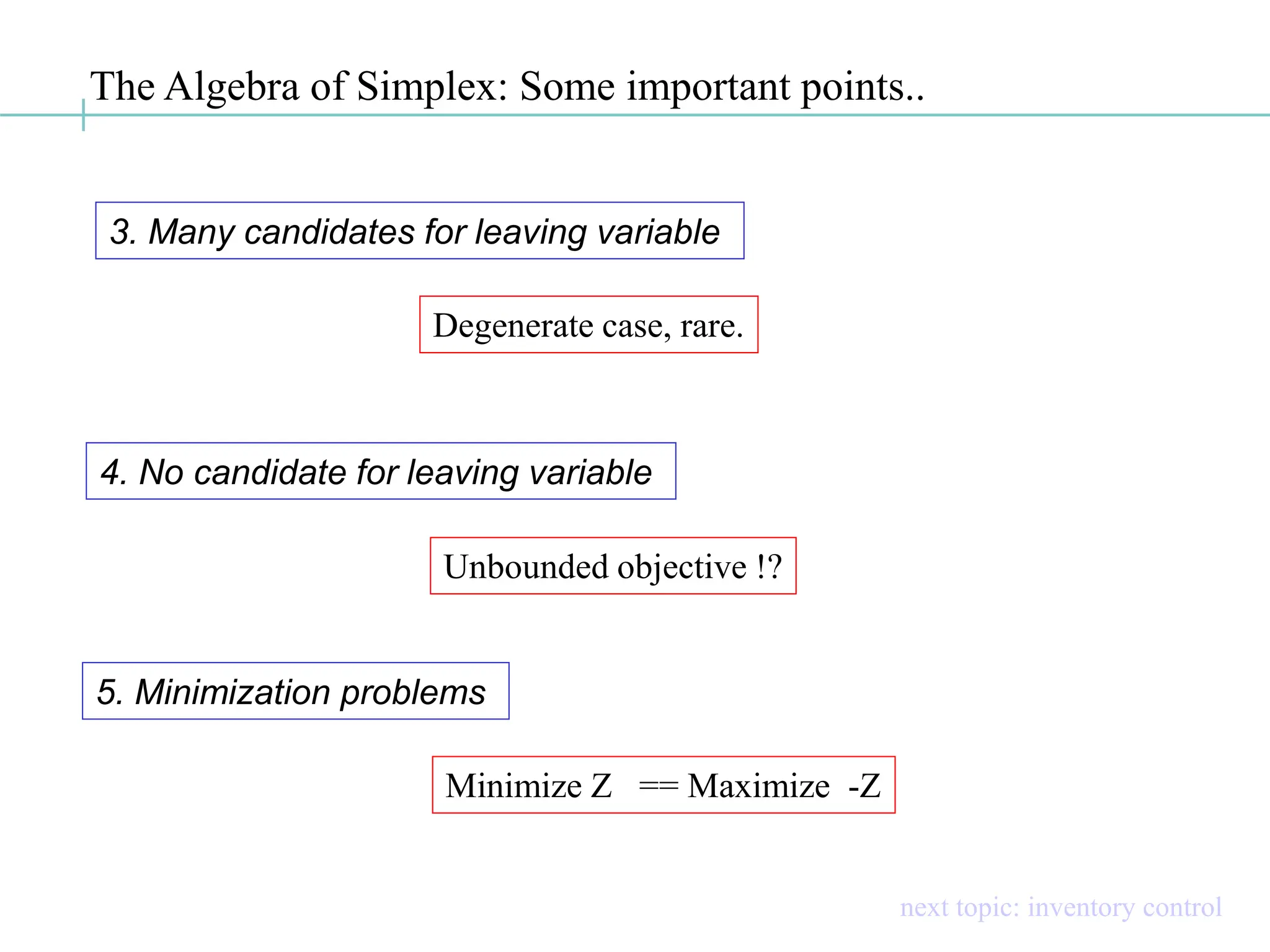
The Algebra of Simplex: Some important points..
3. Many candidates for leaving variable
4. No candidate for leaving variable
5. Minimization problems
Degenerate case, rare.
Unbounded objective !?
Minimize Z == Maximize -Z
next topic: inventory control

lp3 FUNDAMENTOS SIMPLEX SIMPLEX simplex.ppt

  • 1.
    Linear Programming Fundamentals Convexity Definition:Line segment joining any 2 pts lies inside shape convex NOT convex
  • 2.
    Linear Programming Fundamentals.. NiceProperty of Convex Shapes: Intersection of convex shapes is convex
  • 3.
    Linear Programming Fundamentals… EveryHalf-space is convex  Set of feasible solutions is a convex polyhedron Each constraint of an LP  half space
  • 4.
    Some definitions y ≥0 x ≥ 0 x ≤ 500 2x+y ≤ 1500 x + y ≤ 1200 (0,0) 1000 1500 500 1000 1500 500 y x Feasible region Boundary Feasible Solution Corner points
  • 5.
    Important Properties (0,0) 1000 1500 500 10001500 500 y x Feasible region Property 1. IF: only one optimum solution => must be a corner point (0,0) 1000 1500 500 1000 1500 500 y x Feasible region
  • 6.
    Important Properties.. (0,0) 1000 1500 500 10001500 500 y x Feasible region Property 2. IF: multiple optimum solutions => must include 2 adjacent corner pts
  • 7.
    Important Properties… (0,0) 1000 1500 500 10001500 500 y x Feasible region Property 4. Total number of corner pts is finite Property 3. If a corner point is better than all its adjacent corners, it is optimal !
  • 8.
    Important Properties.... (0,0) 1000 1500 500 10001500 500 y x Feasible region Note: Corner point  intersection of some constraint boundaries (lines) Property 5. Moving from a corner point to any adjacent corner point  Exactly one constraint boundary is exchanged.
  • 9.
    The algebra ofSimplex Good news We only need to search for the best feasible corner point Good news We can use property 5 to guide our searching Bad news A problem with 50 variables, 100 constraints => 100 ! 50 ! (100-50) ! => ~ 1029 corner points
  • 10.
    The outline ofSimplex 1. Start at a corner point feasible solution 2. If (there is a better adjacent corner feasible point) then go to one such adjacent corner point; repeat Step 2; else (report this point as the optimum point). Why does this method work ? 1. Constant improvement (=> no cycling) 2. Finite number of corners
  • 11.
    The Algebra ofSimplex: Gauss elimination Solving for corner points   solving a set of simultaneous equations Method: Gaussian elimination Example: x + y = 2 [1] x – 2y = 1 [2] Solve by: 2x[1] + [2]: 3x = 5 => x = 5/3 [1] - 1x[2]: 3y = 1 => y = 1/3
  • 12.
    The Algebra ofSimplex: need for Slack ! Cannot add (multiples of) INEQUATIONS !! Consider: x >= 0 [1] y >= 0 [2] [1] + [2]: x + y >= 0 [3] x y x + y >= 0
  • 13.
    The Algebra ofSimplex: Slack To allow us to use Gaussian elimination, Convert the inequalities to equations by using SLACK Variables 2x + y ≤ 1500, x, y ≥ 0 2x + y + s = 1500, x, y, s ≥ 0 x + y ≥ 200 x, y ≥ 0 x + y – s = 200, x, y, s ≥ 0. Inequality Equality, with slack variable
  • 14.
    The Algebra ofSimplex.. Conversion of the Product mix problem ORIGINAL Maximize z( x, y) = 15 x + 10y subject to 2x + y ≤ 1500 x + y ≤ 1200 x ≤ 500 x ≥ 0, y ≥ 0 (almost) STANDARD FORM Maximize Z = 15 x1 + 10x2 subject to 2x1 + x2 + x3 = 1500 x1 + x2 + x4 = 1200 x1 + x5 = 500 xi ≥ 0 for all i.
  • 15.
    ORIGINAL Maximize z( x, y)= 15 x + 10y subject to 2x + y ≤ 1500 x + y ≤ 1200 x ≤ 500 x ≥ 0, y ≥ 0 (almost) STANDARD FORM Maximize Z = 15 x1 + 10x2 subject to 2x1 + x2 + x3 = 1500 x1 + x2 + x4 = 1200 x1 + x5 = 500 xi ≥ 0 for all i. Original problem: n variables, m constraints Standard form: (m+n) variables, m constraints The Algebra of Simplex…
  • 16.
    Original problem: nvariables, m constraints Standard form: (m+n) variables, m constraints How to use Gaussian elimination ?? Force some variables = 0 How many to be forced to be 0 ? The Algebra of Simplex…
  • 17.
    Definitions: augmented solution x1= 500 2x1+x2 = 1500 x1 + x2 = 1200 (0,0) 1000 1500 500 1000 1500 500 x2 x1 x1 = 500 x1 = 500 2x1+x2 = 1500 2x1+x2 = 1500 x1 + x2 = 1200 x1 + x2 = 1200 (0,0) 1000 1500 500 1000 1500 500 x2 x1 Solution: Augmented solution (x1 x2) = (200, 200) (200, 200, 900, 800, 300) Max Z = 15 x1 + 10x2 S.T. 2x1 + x2 + x3 = 1500 x1 + x2 + x4 = 1200 x1 + x5 = 500 xi ≥ 0 for all i.
  • 18.
    Definitions: BS, BFS x1= 500 2x1+x2 = 1500 x1 + x2 = 1200 (0,0) 1000 1500 500 1000 1500 500 x2 x1 x1 = 500 x1 = 500 2x1+x2 = 1500 2x1+x2 = 1500 x1 + x2 = 1200 x1 + x2 = 1200 (0,0) 1000 1500 500 1000 1500 500 x2 x1 Basic solution  Augmented, corner-point solution Max Z = 15 x1 + 10x2 S.T. 2x1 + x2 + x3 = 1500 x1 + x2 + x4 = 1200 x1 + x5 = 500 xi ≥ 0 for all i. Examples basic infeasible solution : ( 500, 700, -200, 0, 0) basic feasible solution: (500, 0, 500, 700, 0)
  • 19.
    Definition: non-basic variables x1= 500 2x1+x2 = 1500 x1 + x2 = 1200 (0,0) 1000 1500 500 1000 1500 500 x2 x1 x1 = 500 x1 = 500 2x1+x2 = 1500 2x1+x2 = 1500 x1 + x2 = 1200 x1 + x2 = 1200 (0,0) 1000 1500 500 1000 1500 500 x2 x1 Max Z = 15 x1 + 10x2 S.T. 2x1 + x2 + x3 = 1500 x1 + x2 + x4 = 1200 x1 + x5 = 500 xi ≥ 0 for all i. Corner Feasible solution Defining eqns Basic solution non-basic variables (0, 0) x1 = 0 x2 = 0 (0, 0, 1500, 1200, 500) x1, x2 (500, 0) x1 = 500 x2 = 0 (500, 0, 500, 700, 0) x2, x5 (500, 500) x1 = 500 2x1+x2= 1500 (500, 500, 0, 200, 0) x5, x3 (300, 900) x1+ x2 = 1200 2x1+x2= 1500 (300, 900, 0, 0, 200) x3, x4 (0, 1200) x1 = 0 x1+ x2 = 1200 (0, 1200, 300, 0, 500) x4, x1
  • 20.
    The Algebra ofSimplex x1 = 500 2x1+x2 = 1500 x1 + x2 = 1200 (0,0) 1000 1500 500 1000 1500 500 x2 x1 x1 = 500 x1 = 500 2x1+x2 = 1500 2x1+x2 = 1500 x1 + x2 = 1200 x1 + x2 = 1200 (0,0) 1000 1500 500 1000 1500 500 x2 x1 Max Z = 15 x1 + 10x2 S.T. 2x1 + x2 + x3 = 1500 x1 + x2 + x4 = 1200 x1 + x5 = 500 xi ≥ 0 for all i. Corner infeasible solution Defining eqns Basic infeasible solution non-basic variables (750, 0) x2 = 0 2x1+ x2 = 1500 (750, 0, 0, 450, -250) x2, x3 (1200, 0) x2 = 0 x1 + x2 = 1200 (1200, 0, -900, 0, -700) x2, x4 (500, 700) x1 + x2 = 1200 x1 = 500 (500, 700, -200, 0, 0) x4, x5 (0, 1500) x1 = 0 2x1+ x2 = 1500 (0, 1500, 0, -300, 500) x1, x3
  • 21.
    The Algebra ofSimplex: Standard form x1 = 500 2x1+x2 = 1500 x1 + x2 = 1200 (0,0) 1000 1500 500 1000 1500 500 x2 x1 x1 = 500 x1 = 500 2x1+x2 = 1500 2x1+x2 = 1500 x1 + x2 = 1200 x1 + x2 = 1200 (0,0) 1000 1500 500 1000 1500 500 x2 x1 STANDARD FORM Max Z S.T. Z -15 x1 -10 x2 = 0 2 x1 + x2 + x3 = 1500 x1 + x2 + x4 = 1200 x1 + x5 = 500 xi ≥ 0 for all i.
  • 22.
    The Algebra ofSimplex: Step 1. Initial solution x1 = 500 2x1+x2 = 1500 x1 + x2 = 1200 (0,0) 1000 1500 500 1000 1500 500 x2 x1 x1 = 500 x1 = 500 2x1+x2 = 1500 2x1+x2 = 1500 x1 + x2 = 1200 x1 + x2 = 1200 (0,0) 1000 1500 500 1000 1500 500 x2 x1 Max Z S.T. Z -15 x1 -10 x2 = 0 2 x1 + x2 + x3 = 1500 x1 + x2 + x4 = 1200 x1 + x5 = 500 xi ≥ 0 for all i. ( 0, 0) Initial non-basic variables: (x1, x2) Initial basic variables: (x3, x4 , x5) Initial BFS: (0, 0, 1500, 1200, 500)
  • 23.
    The Algebra ofSimplex: Step 2. Iteration Step x1 = 500 2x1+x2 = 1500 x1 + x2 = 1200 (0,0) 1000 1500 500 1000 1500 500 x2 x1 x1 = 500 x1 = 500 2x1+x2 = 1500 2x1+x2 = 1500 x1 + x2 = 1200 x1 + x2 = 1200 (0,0) 1000 1500 500 1000 1500 500 x2 x1 Entering variable: Z = 15 x1 + 10x2 Fastest rate of ascent
  • 24.
    The Algebra ofSimplex: Step 2. Iteration Step Leaving variable Max Z S.T. Z -15 x1 - 10x2 = 0 2x1 + x2 + x3 = 1500 x1 + x2 + x4 = 1200 x1 + x5 = 500 xi ≥ 0 for all i. Consider first constraint: Entering 2x1 + x2 + x3 = 1500 x3 = 1500 - 2x1 - x2 Bound on x1: 1500/2 = 750
  • 25.
    The Algebra ofSimplex: Step 2. Iteration Step Basic variable Equation Upper bound for x1 x3 x3 = 1500 - 2x1 - x2 x2 = 0, so x1 ≤ 1500/2; UB = 750 x4 x4 = 1200 - x1 - x2 x2 = 0, so x1 ≤ 1200; UB = 1200 x5 x5 = 500 - x1 x1 ≤ 500  minimum Max Z S.T. Z -15 x1 - 10x2 = 0 2x1 + x2 + x3 = 1500 x1 + x2 + x4 = 1200 x1 + x5 = 500 xi ≥ 0 for all i. Leaving variable
  • 26.
    The Algebra ofSimplex: Step 2. Iteration Step Enter: x1 Leave: x5 Z -15 x1 -10x2 = 0 [0-0] 2 x1 + x2 + x3 = 1500 [0-1] x1 + x2 + x4 = 1200 [0-2] x1 + x5 = 500 [0-3] ROW OPERATIONS so that Each row has exactly one basic variable The coefficient of each basic variable = +1 - [0-3] - 2x [0-3] + 15x [0-3]
  • 27.
    The Algebra ofSimplex: Step 2. Iteration Step Z -15 x1 -10x2 = 0 [0-0] 2 x1 + x2 + x3 = 1500 [0-1] x1 + x2 + x4 = 1200 [0-2] x1 + x5 = 500 [0-3] Z -10x2 +15 x5 = 7500 [1-0] x2 + x3 - 2 x5 = 500 [1-1] x2 + x4 - x5 = 700 [1-2] x1 + x5 = 500 [1-3] Row operations Basic Feasible Solution: ( 500, 0, 500, 700, 0)
  • 28.
    The Algebra ofSimplex: Step 2. Iteration Step x1 = 500 2x1+x2 = 1500 x1 + x2 = 1200 (0,0) 1000 1500 500 1000 1500 500 x2 x1 x1 = 500 x1 = 500 2x1+x2 = 1500 2x1+x2 = 1500 x1 + x2 = 1200 x1 + x2 = 1200 (0,0) 1000 1500 500 1000 1500 500 x2 x1 Basic Feasible Solution: ( 500, 0, 500, 700, 0) Objective value: 7500
  • 29.
    The Algebra ofSimplex: Step 3. Stopping condition Z -10x2 +15 x5 = 7500 [1-0] x2 + x3 - 2 x5 = 500 [1-1] x2 + x4 - x5 = 700 [1-2] x1 + x5 = 500 [1-3] Stopping Rule: Stop when objective cannot be improved. New entering variable: x2
  • 30.
    The Algebra ofSimplex: Second Iteration.. Z -10x2 +15 x5 = 7500 [1-0] x2 + x3 - 2x5 = 500 [1-1] x2 + x4 - x5 = 700 [1-2] x1 + x5 = 500 [1-3] New entering variable: x2 Basic variable Equation Upper bound for x2 x3 x3 = 500 – x2 + 2x5 x2 ≤ 500  minimum x4 x4 = 700 – x2 + x5 x2 ≤ 700 x1 x1 = 500 – x5 no limit on x2 Analysis for leaving variable:
  • 31.
    The Algebra ofSimplex: Step 2. Iteration Step Enter: x2 Leave: x3 ROW OPERATIONS so that Each row has exactly one basic variable The coefficient of each basic variable = +1 - [1-1] + 10x [1-1] Z -10x2 +15 x5 = 7500 [1-0] x2 + x3 - 2x5 = 500 [1-1] x2 + x4 - x5 = 700 [1-2] x1 + x5 = 500 [1-3]
  • 32.
    The Algebra ofSimplex: Step 2. Iteration Step Basic Feasible Solution: After row operations: Z +10 x3 -5 x5 = 12,500 [2-0] x2 + x3 - 2x5 = 500 [2-1] - x3 + x4 + x5 = 200 [2-2] x1 + x5 = 500 [2-3] x1 = 500 2x1+x2 = 1500 x1 + x2 = 1200 (0,0) 1000 1500 500 1000 1500 500 x2 x1 x1 = 500 x1 = 500 2x1+x2 = 1500 2x1+x2 = 1500 x1 + x2 = 1200 x1 + x2 = 1200 (0,0) 1000 1500 500 1000 1500 500 x2 x1 ( 500, 500, 0, 200, 0) Have we found the OPTIMUM ?
  • 33.
    The Algebra ofSimplex: Third Iteration New entering variable: x5 Analysis for leaving variable: Z +10 x3 -5 x5 = 12,500 [2-0] x2 + x3 - 2x5 = 500 [2-1] - x3 + x4 + x5 = 200 [2-2] x1 + x5 = 500 [2-3] Basic variable Equation Upper bound for x5 x2 x2 = 500 + 2x5 - x3 no limit on x5 x4 x4 = 200 + x3 - x5 x5 ≤ 200  minimum x1 x1 = 500 – x5 x5 ≤ 500
  • 34.
    The Algebra ofSimplex: Step 2. Third iteration.. ROW OPERATIONS so that Each row has exactly one basic variable The coefficient of each basic variable = +1 - [2-2] + 5x [2-2] Enter: x5 Leave: x4 Z +10 x3 -5 x5 = 12,500 [2-0] x2 + x3 - 2x5 = 500 [2-1] - x3 + x4 + x5 = 200 [2-2] x1 + x5 = 500 [2-3] + 2x [2-2]
  • 35.
    The Algebra ofSimplex: Step 2. Iteration Step Basic Feasible Solution: x1 = 500 2x1+x2 = 1500 x1 + x2 = 1200 (0,0) 1000 1500 500 1000 1500 500 x2 x1 x1 = 500 x1 = 500 2x1+x2 = 1500 2x1+x2 = 1500 x1 + x2 = 1200 x1 + x2 = 1200 (0,0) 1000 1500 500 1000 1500 500 x2 x1 ( 300, 900, 0, 0, 200) Have we found the OPTIMUM ? After row operations: Z +5 x3 + 5x4 = 13,500 [3-0] x2 - x3 + 2x4 = 900 [3-1] - x3 + x4 + x5 = 200 [3-2] x1 + x3 - x4 = 300 [3-3]
  • 36.
    The Algebra ofSimplex: Some important points 1. Higher dimensions 2. Many candidates for entering variable Each step: ONE entering variable ONE leaving variable  Each constraint equation has has same format as our example e.g. Z = 200 + 10x1 + x2 + 10x3 Just pick any one
  • 37.
    The Algebra ofSimplex: Some important points.. 3. Many candidates for leaving variable 4. No candidate for leaving variable 5. Minimization problems Degenerate case, rare. Unbounded objective !? Minimize Z == Maximize -Z next topic: inventory control