TOPIC
-
SOLUTION OF LPP BY SIMPLEX
METHOD
C O NT E NT
S
• INTRODUCTION
• WHAT IS LPP?
• THE SIMPLEX METHOD
• STEPS IN THE SIMPLEX METHOD
• EXAMPLE
• ADVANTAGES OF THE SIMPLEX
METHOD
• CONCLUSION
INTRODUCTIO
N
Linear Programming Problems, or LPPs, are mathematical models used
to optimize solutions to complex problems. They are commonly used in
a variety of fields, including business, engineering, and economics.
However, solving these problems
can be quite challenging due to their complexity.
In this presentation, we will explore the concept of LPPs and how they
are solved using the simplex method. We will also discuss the
advantages of using this method over other methods. By the end of this
presentation, you will have a better understanding of LPPs and how to
solve them effectively.
WHAT IS
LPP?
Linear Programming Problem (LPP) is a mathematical optimization technique
used to find the best possible solution for a given problem with linear
relationships. It involves maximizing or minimizing a linear objective function
subject to linear constraints. LPP is widely used in various fields such as business,
economics, engineering, and science to optimize resource allocation, production
planning, transportation scheduling, and more.
For example, a company may use LPP to determine the optimal mix of products to
produce in order to maximize profits while satisfying demand and resource
constraints. Another example is using LPP to optimize the distribution of goods
from warehouses to retail stores while minimizing transportation costs. These are
just a few examples of how LPP is applied in real- world scenarios.
THE SIMPLEX
METHOD
The simplex method is a mathematical algorithm used to solve linear
programming problems (LPP). It was developed by George Dantzig in
1947 and has since become one of the most widely used methods for
solving LPPs.
The basic idea behind the simplex method is to start with an initial feasible
solution and then iteratively improve it until an optimal solution is found.
This is done by moving along the edges of the feasible region, which is
defined by the constraints of the problem, until the optimal solution is
reached. The simplex method is effective because it is able to handle
large-scale problems with many variables and constraints, and can find
optimal solutions quickly.
Steps in the Simplex
Method
The first step in the simplex method is to convert the linear
programming problem into standard form. This involves adding
slack variables to turn inequality constraints into equality
constraints, and ensuring that all variables are non-negative.
Next, we need to identify the pivot element, which is the element in
the tableau with the largest negative value in the bottom row. We
then use this element to perform row operations to transform the
tableau until we arrive at an optimal solution.
The final step is to read off the solution from the final tableau. The
values of the basic variables correspond to the columns with a
single non-zero entry in the last row of the tableau. The value of
the objective function can be found in the bottom-right corner of
the tableau.
Exampl
e
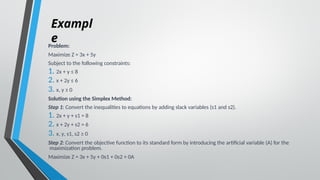
Problem:
Maximize Z = 3x + 5y
Subject to the following constraints:
1. 2x + y ≤ 8
2. x + 2y ≤ 6
3. x, y ≥ 0
Solution using the Simplex Method:
Step 1: Convert the inequalities to equations by adding slack variables (s1 and s2).
1. 2x + y + s1 = 8
2. x + 2y + s2 = 6
3. x, y, s1, s2 ≥ 0
Step 2: Convert the objective function to its standard form by introducing the artificial variable (A) for the
maximization problem.
Maximize Z = 3x + 5y + 0s1 + 0s2 + 0A
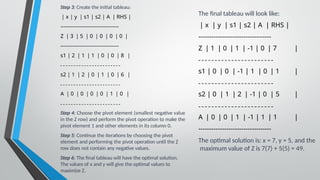
Step 3: Create the initial tableau:
| x | y | s1 | s2 | A | RHS |
----------------------------------
Z | 3 | 5 | 0 | 0 | 0 | 0 |
----------------------------------
s1 | 2 | 1 | 1 | 0 | 0 | 8 |
s2 | 1 | 2 | 0 | 1 | 0 | 6 |
A | 0 | 0 | 0 | 0 | 1 | 0 |
Step 4: Choose the pivot element (smallest negative value
in the Z row) and perform the pivot operation to make the
pivot element 1 and other elements in its column 0.
Step 5: Continue the iterations by choosing the pivot
element and performing the pivot operation until the Z
row does not contain any negative values.
Step 6: The final tableau will have the optimal solution.
The values of x and y will give the optimal values to
maximize Z.
The final tableau will look like:
| x | y | s1 | s2 | A | RHS |
----------------------------------
Z | 1 | 0 | 1 | -1 | 0 | 7 |
s1 | 0 | 0 | -1 | 1 | 0 | 1 |
s2 | 0 | 1 | 2 | -1 | 0 | 5 |
A | 0 | 0 | 1 | -1 | 1 | 1 |
----------------------------------
The optimal solution is: x = 7, y = 5, and the
maximum value of Z is 7(7) + 5(5) = 49.
Advantages of the Simplex
Method
The simplex method is a powerful tool for solving linear programming
problems (LPP) because it is both efficient and effective. It has been
shown to be faster and more accurate than other methods, making it
the preferred choice for many applications.
One of the key advantages of the simplex method is its ability to
handle large- scale problems. With its iterative approach, the
simplex method can quickly converge on the optimal solution, even
when dealing with complex systems. In addition, the algorithm is
highly customizable, allowing users to tailor it to their specific needs
and constraints.
CONCLUSIO
N
In conclusion, we have learned that linear programming problems (LPP)
are complex mathematical problems that require efficient solutions. The
simplex method is one such solution that has proven to be effective in
solving LPPs. By breaking down the problem into smaller steps, the
simplex method allows us to find the optimal solution quickly and
accurately.
The advantages of using the simplex method over other methods include
its efficiency, accuracy, and versatility. It can be used to solve a wide range
of real-world problems, from optimizing production processes to
maximizing profits. By using the simplex method, we can make better
decisions that lead to more successful outcomes.
THANK
YOU

Solution of LPP by Simplex Method with Examples

  • 1.
    TOPIC - SOLUTION OF LPPBY SIMPLEX METHOD
  • 2.
    C O NTE NT S • INTRODUCTION • WHAT IS LPP? • THE SIMPLEX METHOD • STEPS IN THE SIMPLEX METHOD • EXAMPLE • ADVANTAGES OF THE SIMPLEX METHOD • CONCLUSION
  • 3.
    INTRODUCTIO N Linear Programming Problems,or LPPs, are mathematical models used to optimize solutions to complex problems. They are commonly used in a variety of fields, including business, engineering, and economics. However, solving these problems can be quite challenging due to their complexity. In this presentation, we will explore the concept of LPPs and how they are solved using the simplex method. We will also discuss the advantages of using this method over other methods. By the end of this presentation, you will have a better understanding of LPPs and how to solve them effectively.
  • 4.
    WHAT IS LPP? Linear ProgrammingProblem (LPP) is a mathematical optimization technique used to find the best possible solution for a given problem with linear relationships. It involves maximizing or minimizing a linear objective function subject to linear constraints. LPP is widely used in various fields such as business, economics, engineering, and science to optimize resource allocation, production planning, transportation scheduling, and more. For example, a company may use LPP to determine the optimal mix of products to produce in order to maximize profits while satisfying demand and resource constraints. Another example is using LPP to optimize the distribution of goods from warehouses to retail stores while minimizing transportation costs. These are just a few examples of how LPP is applied in real- world scenarios.
  • 5.
    THE SIMPLEX METHOD The simplexmethod is a mathematical algorithm used to solve linear programming problems (LPP). It was developed by George Dantzig in 1947 and has since become one of the most widely used methods for solving LPPs. The basic idea behind the simplex method is to start with an initial feasible solution and then iteratively improve it until an optimal solution is found. This is done by moving along the edges of the feasible region, which is defined by the constraints of the problem, until the optimal solution is reached. The simplex method is effective because it is able to handle large-scale problems with many variables and constraints, and can find optimal solutions quickly.
  • 6.
    Steps in theSimplex Method The first step in the simplex method is to convert the linear programming problem into standard form. This involves adding slack variables to turn inequality constraints into equality constraints, and ensuring that all variables are non-negative. Next, we need to identify the pivot element, which is the element in the tableau with the largest negative value in the bottom row. We then use this element to perform row operations to transform the tableau until we arrive at an optimal solution. The final step is to read off the solution from the final tableau. The values of the basic variables correspond to the columns with a single non-zero entry in the last row of the tableau. The value of the objective function can be found in the bottom-right corner of the tableau.
  • 7.
    Exampl e Problem: Maximize Z =3x + 5y Subject to the following constraints: 1. 2x + y ≤ 8 2. x + 2y ≤ 6 3. x, y ≥ 0 Solution using the Simplex Method: Step 1: Convert the inequalities to equations by adding slack variables (s1 and s2). 1. 2x + y + s1 = 8 2. x + 2y + s2 = 6 3. x, y, s1, s2 ≥ 0 Step 2: Convert the objective function to its standard form by introducing the artificial variable (A) for the maximization problem. Maximize Z = 3x + 5y + 0s1 + 0s2 + 0A
  • 8.
    Step 3: Createthe initial tableau: | x | y | s1 | s2 | A | RHS | ---------------------------------- Z | 3 | 5 | 0 | 0 | 0 | 0 | ---------------------------------- s1 | 2 | 1 | 1 | 0 | 0 | 8 | s2 | 1 | 2 | 0 | 1 | 0 | 6 | A | 0 | 0 | 0 | 0 | 1 | 0 | Step 4: Choose the pivot element (smallest negative value in the Z row) and perform the pivot operation to make the pivot element 1 and other elements in its column 0. Step 5: Continue the iterations by choosing the pivot element and performing the pivot operation until the Z row does not contain any negative values. Step 6: The final tableau will have the optimal solution. The values of x and y will give the optimal values to maximize Z. The final tableau will look like: | x | y | s1 | s2 | A | RHS | ---------------------------------- Z | 1 | 0 | 1 | -1 | 0 | 7 | s1 | 0 | 0 | -1 | 1 | 0 | 1 | s2 | 0 | 1 | 2 | -1 | 0 | 5 | A | 0 | 0 | 1 | -1 | 1 | 1 | ---------------------------------- The optimal solution is: x = 7, y = 5, and the maximum value of Z is 7(7) + 5(5) = 49.
  • 9.
    Advantages of theSimplex Method The simplex method is a powerful tool for solving linear programming problems (LPP) because it is both efficient and effective. It has been shown to be faster and more accurate than other methods, making it the preferred choice for many applications. One of the key advantages of the simplex method is its ability to handle large- scale problems. With its iterative approach, the simplex method can quickly converge on the optimal solution, even when dealing with complex systems. In addition, the algorithm is highly customizable, allowing users to tailor it to their specific needs and constraints.
  • 10.
    CONCLUSIO N In conclusion, wehave learned that linear programming problems (LPP) are complex mathematical problems that require efficient solutions. The simplex method is one such solution that has proven to be effective in solving LPPs. By breaking down the problem into smaller steps, the simplex method allows us to find the optimal solution quickly and accurately. The advantages of using the simplex method over other methods include its efficiency, accuracy, and versatility. It can be used to solve a wide range of real-world problems, from optimizing production processes to maximizing profits. By using the simplex method, we can make better decisions that lead to more successful outcomes.
  • 11.