Chapter 01 - Introduction
 Operations Research (OR): It is a scientific approach to determine the
optimum (best) solution to a decision problem under the restriction of
limited resources. Using the mathematical techniques to model,
analyze, and solve the problem.
 United Kingdom: OR is the application of the methods of science to
complex problems arising in the direction and management of large
systems of men, machines, materials, and money in industry, business,
government, and defense. The distinctive approach is to develop a
scientific model of the system incorporating measurements of factors
such as chance and risk, with which to predict and compare the
outcomes of alternative decisions, strategies, or controls. The purpose
is to help management determine its policy and actions scientifically.
 USA: OR is concerned with scientifically deciding how to best design
and operate man-machine systems, usually under conditions requiring
the allocation of scarce or limited resources.
I. Definition of the problem
 The description of the decision variables.
 The determination of the objective of the study.
 The specification of the limitations under which the system operates.
II. Model construction
 Translating the real world problem into mathematical relationships.
III. Solution of the model
 Using well-defined optimization techniques.
 An important aspect of model solution is sensitivity analysis.
IV. Model validity
 Testing and evaluation of the model by compare its performance with some past
data available for the actual system.
V. Implementation of the solution
 Translation of the model's results into instructions to be understood.
 Do not build a complicated model when a simple one will suffice.
 Beware of molding the problem to fit the technique.
 The deduction phase of modeling must be conducted rigorously.
 Models should be validated before implementation.
 A model should never be taken too literally.
 A model should neither be pressed to do, nor criticized for failing to do,
that for which it was never intended.
 Some of the primary benefits of modeling are associated with the
process of developing the model.
 A model cannot be any better than the information that goes into it.
 Models cannot replace decision makers.
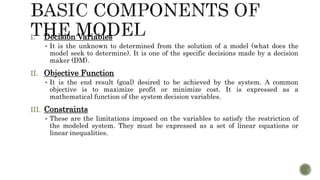
I. Decision Variables
 It is the unknown to determined from the solution of a model (what does the
model seek to determine). It is one of the specific decisions made by a decision
maker (DM).
II. Objective Function
 It is the end result (goal) desired to be achieved by the system. A common
objective is to maximize profit or minimize cost. It is expressed as a
mathematical function of the system decision variables.
III. Constraints
 These are the limitations imposed on the variables to satisfy the restriction of
the modeled system. They must be expressed as a set of linear equations or
linear inequalities.
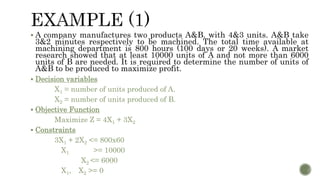
 A company manufactures two products A&B. with 4&3 units. A&B take
3&2 minutes respectively to be machined. The total time available at
machining department is 800 hours (100 days or 20 weeks). A market
research showed that at least 10000 units of A and not more than 6000
units of B are needed. It is required to determine the number of units of
A&B to be produced to maximize profit.
 Decision variables
X1 = number of units produced of A.
X2 = number of units produced of B.
 Objective Function
Maximize Z = 4X1 + 3X2
 Constraints
3X1 + 2X2 <= 800x60
X1 >= 10000
X2 <= 6000
X1, X2 >= 0
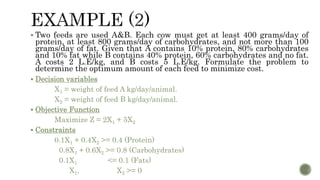
 Two feeds are used A&B. Each cow must get at least 400 grams/day of
protein, at least 800 grams/day of carbohydrates, and not more than 100
grams/day of fat. Given that A contains 10% protein, 80% carbohydrates
and 10% fat while B contains 40% protein, 60% carbohydrates and no fat.
A costs 2 L.E/kg, and B costs 5 L.E/kg. Formulate the problem to
determine the optimum amount of each feed to minimize cost.
 Decision variables
X1 = weight of feed A kg/day/animal.
X2 = weight of feed B kg/day/animal.
 Objective Function
Maximize Z = 2X1 + 5X2
 Constraints
0.1X1 + 0.4X2 >= 0.4 (Protein)
0.8X1 + 0.6X2 >= 0.8 (Carbohydrates)
0.1X1 <= 0.1 (Fats)
X1, X2 >= 0
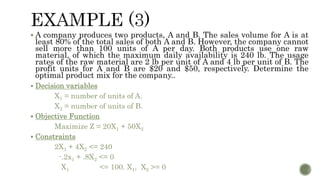
 A company produces two products, A and B. The sales volume for A is at
least 80% of the total sales of both A and B. However, the company cannot
sell more than 100 units of A per day. Both products use one raw
material, of which the maximum daily availability is 240 lb. The usage
rates of the raw material are 2 lb per unit of A and 4 lb per unit of B. The
profit units for A and B are $20 and $50, respectively. Determine the
optimal product mix for the company..
 Decision variables
X1 = number of units of A.
X2 = number of units of B.
 Objective Function
Maximize Z = 20X1 + 50X2
 Constraints
2X1 + 4X2 <= 240
-.2x1 + .8X2 <= 0
X1 <= 100. X1, X2 >= 0
 Linear Programming (LP): Programming Problems in general are
concerned with the use or allocation of scarce resources – labor,
materials, machines, and capital- in the best possible manner so that
the costs are minimized or the profits are maximized or both.
 An LP problem must satisfy the following:
 The decision variables are all nonnegative (>=0).
 The criterion for selecting the best values of the decision variables can be
described by a linear function of these variables, that is a mathematical
function involving only the first powers of the variables with no cross
products. The criterion function is called the objective function.
 The operating rules governing the process can be expressed as a set of
linear equations or linear inequalities, these are called the constraints.
 A Solution: Any specifications of values of X1, X2, ………, Xn.
 A Feasible Solution: Is a solution for which all the constraints are
satisfied.
 A Feasible Region: The set of all feasible solutions.
 An Optimal Solution: Is a feasible solution that has the most favorable
value of the objective function (largest for maximize or smallest for
minimize), or it’s the feasible solution.
 An Optimal Value: The value of the objective function that corresponds
to the optimal solution.
 If there exists an optimal solution to an LPP, then at least one of the
corner points of the feasible region will always qualify to be an optimal
solution.
 The graphical solution is valid only for two-variable problem which is
rarely occurred.
 The graphical solution includes two basic steps:
 The determination of the solution space that defines the feasible solutions
that satisfy all the constraints.
 The determination of the optimum solution from among all the points in
the feasible solution space.
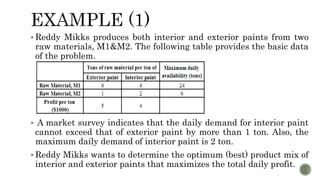
 Reddy Mikks produces both interior and exterior paints from two
raw materials, M1&M2. The following table provides the basic data
of the problem.
 A market survey indicates that the daily demand for interior paint
cannot exceed that of exterior paint by more than 1 ton. Also, the
maximum daily demand of interior paint is 2 ton.
 Reddy Mikks wants to determine the optimum (best) product mix of
interior and exterior paints that maximizes the total daily profit.
Decision variables
X1 = Tons produced daily of exterior paint.
X2 = Tons produced daily of interior paint.
Objective Function
Maximize Z = 5X1 + 4X2
Subject To
6X1 + 4X2 <= 24
X1 + 2X2 <= 6
-X1 + X2 <= 1
X2 <= 2
X1, X2 >= 0
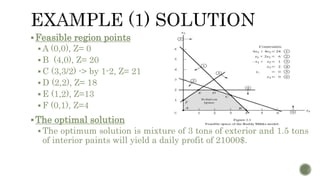
Feasible region points
 A (0,0), Z= 0
 B (4,0), Z= 20
 C (3,3/2) -> by 1-2, Z= 21
 D (2,2), Z= 18
 E (1,2), Z=13
 F (0,1), Z=4
The optimal solution
 The optimum solution is mixture of 3 tons of exterior and 1.5 tons
of interior paints will yield a daily profit of 21000$.
 A company has two grades of inspectors , 1 and 2, who are to be
assigned for a quality control inspection. It is required that at least
1800 pieces be inspected per 8-hour day. Grade 1 inspectors can
check pieces at the rate of 25 per hour, with an accuracy of 98%,
and grade 2 inspectors check at the rate of 15 pieces per hour, with
an accuracy of 95%.
 The wage rate of a grade 1 inspector is $4.00/hour, while that of a
grade 2 inspector is $3.00/hour. Each time an error is made by an
inspector, the cost to the company is $2.00. The company has
available for the inspection job 8 grade 1 inspectors, and 10 grade 2
inspectors. The company wants to determine the optimal
assignment of inspectors which will minimize the total cost of the
inspection.
Objective Function
Cost of inspection = Cost of error + Inspector salary/day
Cost of grade 1/hour = 4 + (2 X 25 X 0.02) = 5 L.E
Cost of grade 2/hour = 3 + (2 X 15 X 0.05) = 4.5 L.E
Minimize Z= 8 (5 X1 + 4.5 X2) = 40X1 +36X2
Subject To
X1 <= 8
X2 <= 10
5X1 + 3X2 >= 45
X1, X2 >= 0
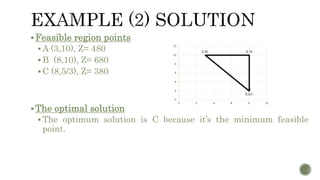
Feasible region points
 A (3,10), Z= 480
 B (8,10), Z= 680
 C (8,5/3), Z= 380
The optimal solution
 The optimum solution is C because it’s the minimum feasible
point.
 Maximize Z= 2X1 + 4X2
 Subject to: X1 + 2X2 <= 5
X1 + X2 <= 4
X1, X2 >=0
 Any point on the line from B to
C is optimal because B and C
have the same answer for Z.
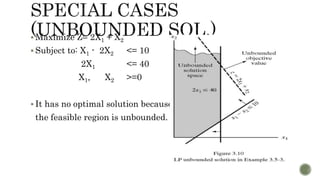
 Maximize Z= 2X1 + X2
 Subject to: X1 - 2X2 <= 10
2X1 <= 40
X1, X2 >=0
 It has no optimal solution because
the feasible region is unbounded.

Operations Research - Introduction

  • 1.
    Chapter 01 -Introduction
  • 2.
     Operations Research(OR): It is a scientific approach to determine the optimum (best) solution to a decision problem under the restriction of limited resources. Using the mathematical techniques to model, analyze, and solve the problem.  United Kingdom: OR is the application of the methods of science to complex problems arising in the direction and management of large systems of men, machines, materials, and money in industry, business, government, and defense. The distinctive approach is to develop a scientific model of the system incorporating measurements of factors such as chance and risk, with which to predict and compare the outcomes of alternative decisions, strategies, or controls. The purpose is to help management determine its policy and actions scientifically.  USA: OR is concerned with scientifically deciding how to best design and operate man-machine systems, usually under conditions requiring the allocation of scarce or limited resources.
  • 3.
    I. Definition ofthe problem  The description of the decision variables.  The determination of the objective of the study.  The specification of the limitations under which the system operates. II. Model construction  Translating the real world problem into mathematical relationships. III. Solution of the model  Using well-defined optimization techniques.  An important aspect of model solution is sensitivity analysis. IV. Model validity  Testing and evaluation of the model by compare its performance with some past data available for the actual system. V. Implementation of the solution  Translation of the model's results into instructions to be understood.
  • 4.
     Do notbuild a complicated model when a simple one will suffice.  Beware of molding the problem to fit the technique.  The deduction phase of modeling must be conducted rigorously.  Models should be validated before implementation.  A model should never be taken too literally.  A model should neither be pressed to do, nor criticized for failing to do, that for which it was never intended.  Some of the primary benefits of modeling are associated with the process of developing the model.  A model cannot be any better than the information that goes into it.  Models cannot replace decision makers.
  • 5.
    I. Decision Variables It is the unknown to determined from the solution of a model (what does the model seek to determine). It is one of the specific decisions made by a decision maker (DM). II. Objective Function  It is the end result (goal) desired to be achieved by the system. A common objective is to maximize profit or minimize cost. It is expressed as a mathematical function of the system decision variables. III. Constraints  These are the limitations imposed on the variables to satisfy the restriction of the modeled system. They must be expressed as a set of linear equations or linear inequalities.
  • 6.
     A companymanufactures two products A&B. with 4&3 units. A&B take 3&2 minutes respectively to be machined. The total time available at machining department is 800 hours (100 days or 20 weeks). A market research showed that at least 10000 units of A and not more than 6000 units of B are needed. It is required to determine the number of units of A&B to be produced to maximize profit.  Decision variables X1 = number of units produced of A. X2 = number of units produced of B.  Objective Function Maximize Z = 4X1 + 3X2  Constraints 3X1 + 2X2 <= 800x60 X1 >= 10000 X2 <= 6000 X1, X2 >= 0
  • 7.
     Two feedsare used A&B. Each cow must get at least 400 grams/day of protein, at least 800 grams/day of carbohydrates, and not more than 100 grams/day of fat. Given that A contains 10% protein, 80% carbohydrates and 10% fat while B contains 40% protein, 60% carbohydrates and no fat. A costs 2 L.E/kg, and B costs 5 L.E/kg. Formulate the problem to determine the optimum amount of each feed to minimize cost.  Decision variables X1 = weight of feed A kg/day/animal. X2 = weight of feed B kg/day/animal.  Objective Function Maximize Z = 2X1 + 5X2  Constraints 0.1X1 + 0.4X2 >= 0.4 (Protein) 0.8X1 + 0.6X2 >= 0.8 (Carbohydrates) 0.1X1 <= 0.1 (Fats) X1, X2 >= 0
  • 8.
     A companyproduces two products, A and B. The sales volume for A is at least 80% of the total sales of both A and B. However, the company cannot sell more than 100 units of A per day. Both products use one raw material, of which the maximum daily availability is 240 lb. The usage rates of the raw material are 2 lb per unit of A and 4 lb per unit of B. The profit units for A and B are $20 and $50, respectively. Determine the optimal product mix for the company..  Decision variables X1 = number of units of A. X2 = number of units of B.  Objective Function Maximize Z = 20X1 + 50X2  Constraints 2X1 + 4X2 <= 240 -.2x1 + .8X2 <= 0 X1 <= 100. X1, X2 >= 0
  • 9.
     Linear Programming(LP): Programming Problems in general are concerned with the use or allocation of scarce resources – labor, materials, machines, and capital- in the best possible manner so that the costs are minimized or the profits are maximized or both.  An LP problem must satisfy the following:  The decision variables are all nonnegative (>=0).  The criterion for selecting the best values of the decision variables can be described by a linear function of these variables, that is a mathematical function involving only the first powers of the variables with no cross products. The criterion function is called the objective function.  The operating rules governing the process can be expressed as a set of linear equations or linear inequalities, these are called the constraints.
  • 10.
     A Solution:Any specifications of values of X1, X2, ………, Xn.  A Feasible Solution: Is a solution for which all the constraints are satisfied.  A Feasible Region: The set of all feasible solutions.  An Optimal Solution: Is a feasible solution that has the most favorable value of the objective function (largest for maximize or smallest for minimize), or it’s the feasible solution.  An Optimal Value: The value of the objective function that corresponds to the optimal solution.  If there exists an optimal solution to an LPP, then at least one of the corner points of the feasible region will always qualify to be an optimal solution.
  • 11.
     The graphicalsolution is valid only for two-variable problem which is rarely occurred.  The graphical solution includes two basic steps:  The determination of the solution space that defines the feasible solutions that satisfy all the constraints.  The determination of the optimum solution from among all the points in the feasible solution space.
  • 12.
     Reddy Mikksproduces both interior and exterior paints from two raw materials, M1&M2. The following table provides the basic data of the problem.  A market survey indicates that the daily demand for interior paint cannot exceed that of exterior paint by more than 1 ton. Also, the maximum daily demand of interior paint is 2 ton.  Reddy Mikks wants to determine the optimum (best) product mix of interior and exterior paints that maximizes the total daily profit.
  • 13.
    Decision variables X1 =Tons produced daily of exterior paint. X2 = Tons produced daily of interior paint. Objective Function Maximize Z = 5X1 + 4X2 Subject To 6X1 + 4X2 <= 24 X1 + 2X2 <= 6 -X1 + X2 <= 1 X2 <= 2 X1, X2 >= 0
  • 14.
    Feasible region points A (0,0), Z= 0  B (4,0), Z= 20  C (3,3/2) -> by 1-2, Z= 21  D (2,2), Z= 18  E (1,2), Z=13  F (0,1), Z=4 The optimal solution  The optimum solution is mixture of 3 tons of exterior and 1.5 tons of interior paints will yield a daily profit of 21000$.
  • 15.
     A companyhas two grades of inspectors , 1 and 2, who are to be assigned for a quality control inspection. It is required that at least 1800 pieces be inspected per 8-hour day. Grade 1 inspectors can check pieces at the rate of 25 per hour, with an accuracy of 98%, and grade 2 inspectors check at the rate of 15 pieces per hour, with an accuracy of 95%.  The wage rate of a grade 1 inspector is $4.00/hour, while that of a grade 2 inspector is $3.00/hour. Each time an error is made by an inspector, the cost to the company is $2.00. The company has available for the inspection job 8 grade 1 inspectors, and 10 grade 2 inspectors. The company wants to determine the optimal assignment of inspectors which will minimize the total cost of the inspection.
  • 16.
    Objective Function Cost ofinspection = Cost of error + Inspector salary/day Cost of grade 1/hour = 4 + (2 X 25 X 0.02) = 5 L.E Cost of grade 2/hour = 3 + (2 X 15 X 0.05) = 4.5 L.E Minimize Z= 8 (5 X1 + 4.5 X2) = 40X1 +36X2 Subject To X1 <= 8 X2 <= 10 5X1 + 3X2 >= 45 X1, X2 >= 0
  • 17.
    Feasible region points A (3,10), Z= 480  B (8,10), Z= 680  C (8,5/3), Z= 380 The optimal solution  The optimum solution is C because it’s the minimum feasible point.
  • 18.
     Maximize Z=2X1 + 4X2  Subject to: X1 + 2X2 <= 5 X1 + X2 <= 4 X1, X2 >=0  Any point on the line from B to C is optimal because B and C have the same answer for Z.
  • 19.
     Maximize Z=2X1 + X2  Subject to: X1 - 2X2 <= 10 2X1 <= 40 X1, X2 >=0  It has no optimal solution because the feasible region is unbounded.