Digital Signal Processing
.
Mrs.R.Chitra, Assistant Professor(SS),
Department of ECE,
Faculty of Engineering,
Avinashilingam Institute for Home Science
and Higher Education for Women,
Coimbatore
SYSTEM
DEFINITION:
 Combination of set of elements.
 It will process or manipulate over input signal to
produce output signal
Classification of systems
 Continuous time and discrete time signal
 Lumped-parameter and distributed -parameter
systems
 Static and dynamic systems
 Causal and non-causal systems
 Linear and non-linear systems
 Time variant and time -invariant systems
 Stable and unstable system
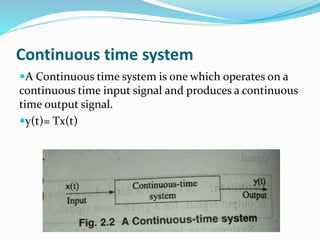
Continuous time system
A Continuous time system is one which operates on a
continuous time input signal and produces a continuous
time output signal.
y(t)= Tx(t)
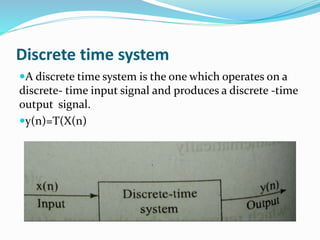
Discrete time system
A discrete time system is the one which operates on a
discrete- time input signal and produces a discrete -time
output signal.
y(n)=T(X(n)
Lumped and distributed parameter
 In lumped parameter system each component is
lumped at one point in space.
 In distributed parameter systems the signals are
functions of space as well as time.
Static and dynamic system
 A system is called static or memory less if its output at
any instant depends on the input at that instant.
 A system output is depends up on the past and future
values of input.
Causal and non causal system
 A causal system is one for which the output at any time
t depends on the present and past inputs.
 A non-causal system output depends on the future
values of inputs.
Linear and non linear system
A System is said to be linear if it follows super position
principle is called as linear other wise non-linear.
T[ax1(t)+bx2(t)]=aT[x1(t)]+bT[x2(t)]
Similarly for a discrete-time linear system,
T[ax1(n)+bx2(n)]=aT[x1(n)]+bT[x2(n)]
Stable and unstable system
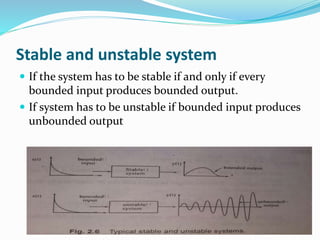
 If the system has to be stable if and only if every
bounded input produces bounded output.
 If system has to be unstable if bounded input produces
unbounded output
Time variant and invariant system
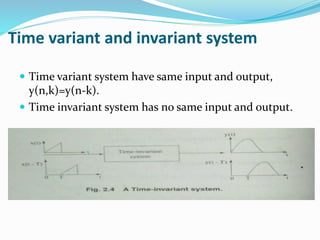
 Time variant system have same input and output,
y(n,k)=y(n-k).
 Time invariant system has no same input and output.
CONVOLUTION
 Convolution is the process by which an input interacts
 with an LTI system to produce an output
 Convolution between of an input signal x[n] with a
 system having impulse response h[n] is given as,
 where * denotes the convolution
 x [ n ] * h [ n ] = x [ k ] h [ n - k ]
EXAMPLE
 Convolution
 We can write x[n] (a periodic function) as an infinite
sum of the function xo[n] (a non-periodic function)
shifted N units at a time
Properties of convolution
Commutative…
 x1[n]* x2[n] = x2[n]* x1[n]
Associative…
 {x1[n]* x2 [n]}* x3[n] = x1[n]*{x2 [n]* x3[n]}
Distributive…
 {x1[n] *x2[n]}* x3[n] = x1[n]x3[n] * x2[n]x3[n]
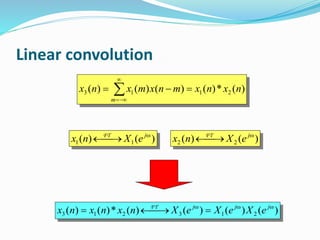
Linear convolution
)(*)()()()( 2113 nxnxmnxmxnx
m
 


)()( 11

 j
eXnx FT
)()( 22

 j
eXnx FT
)()()()(*)()( 213213

 jjj
eXeXeXnxnxnx FT
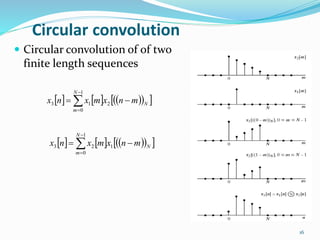
Circular convolution
 Circular convolution of of two
finite length sequences
16
       



1
0
213
N
m
Nmnxmxnx
       



1
0
123
N
m
Nmnxmxnx
Circular convolution
)()())(()()( 21
1
0
13 nxnxmnxmxnx
N
m
N  


)()( 11 kXnx  DFT
)()( 22 kXnx  DFT
)()()()()()( 213213 kXkXkXnxnxnx   DFT
both of length N
EXAMPLE
)()( 01 nnnx 
)(2 nx
)(*)( 21 nxnx
0
0 N
0 n0 N
)()( 21 nxnx 
n0=2, N=7
0
DISCRETE FOURIER TRANSFORM
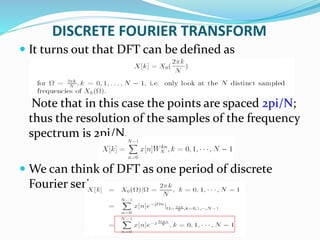
 It turns out that DFT can be defined as
Note that in this case the points are spaced 2pi/N;
thus the resolution of the samples of the frequency
spectrum is 2pi/N.
 We can think of DFT as one period of discrete
Fourier series
EXAMPLE OF DFT
 Find X[k]
 We know k=1,.., 7; N=8
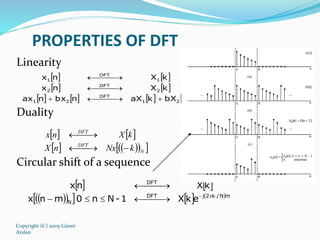
PROPERTIES OF DFT
Linearity
Duality
Circular shift of a sequence
Copyright (C) 2005 Güner
Arslan
   
   
       kbXkaXnbxnax
kXnx
kXnx
21
DFT
21
2
DFT
2
1
DFT
1
 
 
 
   
       mN/k2jDFT
N
DFT
ekX1-Nn0mnx
kXnx

 
 
   
     N
DFT
DFT
kNxnX
kXnx
 
 
INVERSE OF DFT
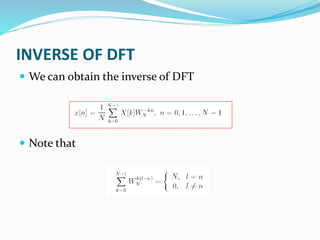
 We can obtain the inverse of DFT
 Note that
EXAMPLE OF IDFT
Remember:

Digital signal processing

  • 1.
    Digital Signal Processing . Mrs.R.Chitra,Assistant Professor(SS), Department of ECE, Faculty of Engineering, Avinashilingam Institute for Home Science and Higher Education for Women, Coimbatore
  • 2.
    SYSTEM DEFINITION:  Combination ofset of elements.  It will process or manipulate over input signal to produce output signal
  • 3.
    Classification of systems Continuous time and discrete time signal  Lumped-parameter and distributed -parameter systems  Static and dynamic systems  Causal and non-causal systems  Linear and non-linear systems  Time variant and time -invariant systems  Stable and unstable system
  • 4.
    Continuous time system AContinuous time system is one which operates on a continuous time input signal and produces a continuous time output signal. y(t)= Tx(t)
  • 5.
    Discrete time system Adiscrete time system is the one which operates on a discrete- time input signal and produces a discrete -time output signal. y(n)=T(X(n)
  • 6.
    Lumped and distributedparameter  In lumped parameter system each component is lumped at one point in space.  In distributed parameter systems the signals are functions of space as well as time.
  • 7.
    Static and dynamicsystem  A system is called static or memory less if its output at any instant depends on the input at that instant.  A system output is depends up on the past and future values of input.
  • 8.
    Causal and noncausal system  A causal system is one for which the output at any time t depends on the present and past inputs.  A non-causal system output depends on the future values of inputs.
  • 9.
    Linear and nonlinear system A System is said to be linear if it follows super position principle is called as linear other wise non-linear. T[ax1(t)+bx2(t)]=aT[x1(t)]+bT[x2(t)] Similarly for a discrete-time linear system, T[ax1(n)+bx2(n)]=aT[x1(n)]+bT[x2(n)]
  • 10.
    Stable and unstablesystem  If the system has to be stable if and only if every bounded input produces bounded output.  If system has to be unstable if bounded input produces unbounded output
  • 11.
    Time variant andinvariant system  Time variant system have same input and output, y(n,k)=y(n-k).  Time invariant system has no same input and output.
  • 12.
    CONVOLUTION  Convolution isthe process by which an input interacts  with an LTI system to produce an output  Convolution between of an input signal x[n] with a  system having impulse response h[n] is given as,  where * denotes the convolution  x [ n ] * h [ n ] = x [ k ] h [ n - k ]
  • 13.
    EXAMPLE  Convolution  Wecan write x[n] (a periodic function) as an infinite sum of the function xo[n] (a non-periodic function) shifted N units at a time
  • 14.
    Properties of convolution Commutative… x1[n]* x2[n] = x2[n]* x1[n] Associative…  {x1[n]* x2 [n]}* x3[n] = x1[n]*{x2 [n]* x3[n]} Distributive…  {x1[n] *x2[n]}* x3[n] = x1[n]x3[n] * x2[n]x3[n]
  • 15.
    Linear convolution )(*)()()()( 2113nxnxmnxmxnx m     )()( 11   j eXnx FT )()( 22   j eXnx FT )()()()(*)()( 213213   jjj eXeXeXnxnxnx FT
  • 16.
    Circular convolution  Circularconvolution of of two finite length sequences 16            1 0 213 N m Nmnxmxnx            1 0 123 N m Nmnxmxnx
  • 17.
    Circular convolution )()())(()()( 21 1 0 13nxnxmnxmxnx N m N     )()( 11 kXnx  DFT )()( 22 kXnx  DFT )()()()()()( 213213 kXkXkXnxnxnx   DFT both of length N
  • 18.
    EXAMPLE )()( 01 nnnx )(2 nx )(*)( 21 nxnx 0 0 N 0 n0 N )()( 21 nxnx  n0=2, N=7 0
  • 19.
    DISCRETE FOURIER TRANSFORM It turns out that DFT can be defined as Note that in this case the points are spaced 2pi/N; thus the resolution of the samples of the frequency spectrum is 2pi/N.  We can think of DFT as one period of discrete Fourier series
  • 20.
    EXAMPLE OF DFT Find X[k]  We know k=1,.., 7; N=8
  • 21.
    PROPERTIES OF DFT Linearity Duality Circularshift of a sequence Copyright (C) 2005 Güner Arslan                kbXkaXnbxnax kXnx kXnx 21 DFT 21 2 DFT 2 1 DFT 1                  mN/k2jDFT N DFT ekX1-Nn0mnx kXnx               N DFT DFT kNxnX kXnx    
  • 22.
    INVERSE OF DFT We can obtain the inverse of DFT  Note that
  • 23.