Combinatorial Optimization
CS-724
Lec-7:
Date: 03-03-2021
Dr. Parikshit Saikia
Assistant Professor
Department of Computer Science and Engineering
NIT Hamirpur (HP)
India
Simplex Algorithm
 [1947]. George B. Dantzig developed a technique to solve linear
programs----known as Simplex Algorithm
 The simplex method is an iterative method that generates a sequence
of basic feasible solutions (corresponding to different bases) and
eventually stops when it has found an optimal basic feasible solution.
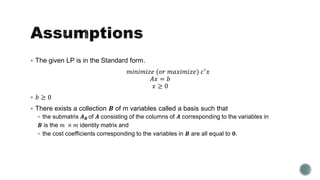
 The given LP is in the Standard form.
𝑚𝑖𝑛𝑖𝑚𝑖𝑧𝑒 (𝑜𝑟 𝑚𝑎𝑥𝑖𝑚𝑖𝑧𝑒) 𝑐′𝑥
𝐴𝑥 = 𝑏
𝑥 ≥ 0
 𝑏 ≥ 0
 There exists a collection 𝑩 of m variables called a basis such that
 the submatrix 𝑨𝑩 of 𝑨 consisting of the columns of 𝑨 corresponding to the variables in
𝑩 is the 𝑚 × 𝑚 identity matrix and
 the cost coefficients corresponding to the variables in 𝑩 are all equal to 𝟎.
Simplex Algorithm: Tabular Method
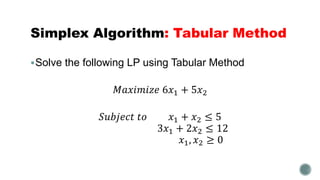
Solve the following LP using Tabular Method
𝑀𝑎𝑥𝑖𝑚𝑖𝑧𝑒 6𝑥1 + 5𝑥2
𝑆𝑢𝑏𝑗𝑒𝑐𝑡 𝑡𝑜 𝑥1 + 𝑥2 ≤ 5
3𝑥1 + 2𝑥2 ≤ 12
𝑥1, 𝑥2 ≥ 0
Simplex Algorithm: Tabular Method
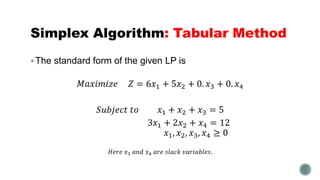
The standard form of the given LP is
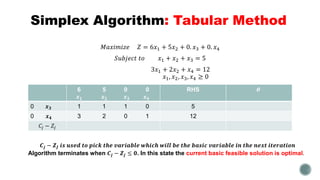
𝑀𝑎𝑥𝑖𝑚𝑖𝑧𝑒 𝑍 = 6𝑥1 + 5𝑥2 + 0. 𝑥3 + 0. 𝑥4
𝑆𝑢𝑏𝑗𝑒𝑐𝑡 𝑡𝑜 𝑥1 + 𝑥2 + 𝑥3 = 5
3𝑥1 + 2𝑥2 + 𝑥4 = 12
𝑥1, 𝑥2, 𝑥3, 𝑥4 ≥ 0
𝐻𝑒𝑟𝑒 𝑥3 𝑎𝑛𝑑 𝑥4 𝑎𝑟𝑒 𝑠𝑙𝑎𝑐𝑘 𝑣𝑎𝑟𝑖𝑎𝑏𝑙𝑒𝑠.
Simplex Algorithm: Tabular Method
𝑀𝑎𝑥𝑖𝑚𝑖𝑧𝑒 𝑍 = 6𝑥1 + 5𝑥2 + 0. 𝑥3 + 0. 𝑥4
𝑆𝑢𝑏𝑗𝑒𝑐𝑡 𝑡𝑜 𝑥1 + 𝑥2 + 𝑥3 = 5
3𝑥1 + 2𝑥2 + 𝑥4 = 12
𝑥1, 𝑥2, 𝑥3, 𝑥4 ≥ 0
6 5 0 0
𝒙𝟏 𝒙𝟐 𝒙𝟑 𝒙𝟒
RHS 𝜽
0 𝒙𝟑 1 1 1 0 5
0 𝒙𝟒 3 2 0 1 12
𝐶𝑗 − 𝑍𝑗
𝑪𝒋 − 𝒁𝑱 𝒊𝒔 𝒖𝒔𝒆𝒅 𝒕𝒐 𝒑𝒊𝒄𝒌 𝒕𝒉𝒆 𝒗𝒂𝒓𝒊𝒂𝒃𝒍𝒆 𝒘𝒉𝒊𝒄𝒉 𝒘𝒊𝒍𝒍 𝒃𝒆 𝒕𝒉𝒆 𝒃𝒂𝒔𝒊𝒄 𝒗𝒂𝒓𝒊𝒂𝒃𝒍𝒆 𝒊𝒏 𝒕𝒉𝒆 𝒏𝒆𝒙𝒕 𝒊𝒕𝒆𝒓𝒂𝒕𝒊𝒐𝒏
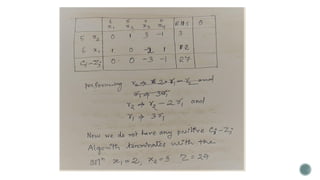
Algorithm terminates when 𝑪𝒋 − 𝒁𝒋 ≤ 𝟎. In this state the current basic feasible solution is optimal.
Simplex Algorithm: Tabular Method
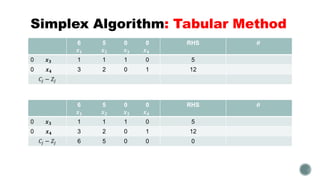
6 5 0 0
𝒙𝟏 𝒙𝟐 𝒙𝟑 𝒙𝟒
RHS 𝜽
0 𝒙𝟑 1 1 1 0 5
0 𝒙𝟒 3 2 0 1 12
𝐶𝑗 − 𝑍𝑗
6 5 0 0
𝒙𝟏 𝒙𝟐 𝒙𝟑 𝒙𝟒
RHS 𝜽
0 𝒙𝟑 1 1 1 0 5
0 𝒙𝟒 3 2 0 1 12
𝐶𝑗 − 𝑍𝑗 6 5 0 0 0
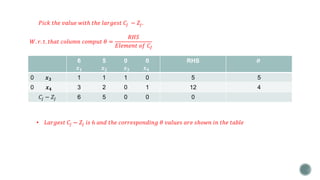
6 5 0 0
𝒙𝟏 𝒙𝟐 𝒙𝟑 𝒙𝟒
RHS 𝜽
0 𝒙𝟑 1 1 1 0 5 5
0 𝒙𝟒 3 2 0 1 12 4
𝐶𝑗 − 𝑍𝑗 6 5 0 0 0
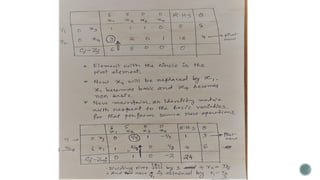
• 𝐿𝑎𝑟𝑔𝑒𝑠𝑡 𝐶𝑗 − 𝑍𝑗 𝑖𝑠 6 𝑎𝑛𝑑 𝑡ℎ𝑒 𝑐𝑜𝑟𝑟𝑒𝑠𝑝𝑜𝑛𝑑𝑖𝑛𝑔 𝜃 𝑣𝑎𝑙𝑢𝑒𝑠 𝑎𝑟𝑒 𝑠ℎ𝑜𝑤𝑛 𝑖𝑛 𝑡ℎ𝑒 𝑡𝑎𝑏𝑙𝑒
𝑃𝑖𝑐𝑘 𝑡ℎ𝑒 𝑣𝑎𝑙𝑢𝑒 𝑤𝑖𝑡ℎ 𝑡ℎ𝑒 𝑙𝑎𝑟𝑔𝑒𝑠𝑡 𝐶𝑗 − 𝑍𝑗.
𝑊. 𝑟. 𝑡. 𝑡ℎ𝑎𝑡 𝑐𝑜𝑙𝑢𝑚𝑛 𝑐𝑜𝑚𝑝𝑢𝑡 𝜃 =
𝑅𝐻𝑆
𝐸𝑙𝑒𝑚𝑒𝑛𝑡 𝑜𝑓 𝐶𝐽
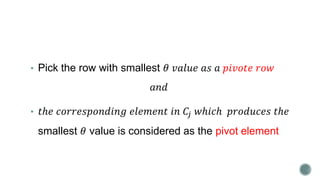
• Pick the row with smallest 𝜃 𝑣𝑎𝑙𝑢𝑒 𝑎𝑠 𝑎 𝑝𝑖𝑣𝑜𝑡𝑒 𝑟𝑜𝑤
𝑎𝑛𝑑
• 𝑡ℎ𝑒 𝑐𝑜𝑟𝑟𝑒𝑠𝑝𝑜𝑛𝑑𝑖𝑛𝑔 𝑒𝑙𝑒𝑚𝑒𝑛𝑡 𝑖𝑛 𝐶𝑗 𝑤ℎ𝑖𝑐ℎ 𝑝𝑟𝑜𝑑𝑢𝑐𝑒𝑠 𝑡ℎ𝑒
smallest 𝜃 value is considered as the pivot element
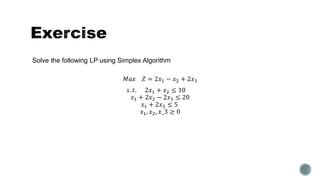
Solve the following LP using Simplex Algorithm
𝑀𝑎𝑥 𝑍 = 2𝑥1 − 𝑥2 + 2𝑥3
𝑠. 𝑡. 2𝑥1 + 𝑥2 ≤ 10
𝑥1 + 2𝑥2 − 2𝑥3 ≤ 20
𝑥1 + 2𝑥3 ≤ 5
𝑥1, 𝑥2, 𝑥_3 ≥ 0

Combinatorial optimization CO-7

  • 1.
    Combinatorial Optimization CS-724 Lec-7: Date: 03-03-2021 Dr.Parikshit Saikia Assistant Professor Department of Computer Science and Engineering NIT Hamirpur (HP) India
  • 2.
    Simplex Algorithm  [1947].George B. Dantzig developed a technique to solve linear programs----known as Simplex Algorithm  The simplex method is an iterative method that generates a sequence of basic feasible solutions (corresponding to different bases) and eventually stops when it has found an optimal basic feasible solution.
  • 3.
     The givenLP is in the Standard form. 𝑚𝑖𝑛𝑖𝑚𝑖𝑧𝑒 (𝑜𝑟 𝑚𝑎𝑥𝑖𝑚𝑖𝑧𝑒) 𝑐′𝑥 𝐴𝑥 = 𝑏 𝑥 ≥ 0  𝑏 ≥ 0  There exists a collection 𝑩 of m variables called a basis such that  the submatrix 𝑨𝑩 of 𝑨 consisting of the columns of 𝑨 corresponding to the variables in 𝑩 is the 𝑚 × 𝑚 identity matrix and  the cost coefficients corresponding to the variables in 𝑩 are all equal to 𝟎.
  • 4.
    Simplex Algorithm: TabularMethod Solve the following LP using Tabular Method 𝑀𝑎𝑥𝑖𝑚𝑖𝑧𝑒 6𝑥1 + 5𝑥2 𝑆𝑢𝑏𝑗𝑒𝑐𝑡 𝑡𝑜 𝑥1 + 𝑥2 ≤ 5 3𝑥1 + 2𝑥2 ≤ 12 𝑥1, 𝑥2 ≥ 0
  • 5.
    Simplex Algorithm: TabularMethod The standard form of the given LP is 𝑀𝑎𝑥𝑖𝑚𝑖𝑧𝑒 𝑍 = 6𝑥1 + 5𝑥2 + 0. 𝑥3 + 0. 𝑥4 𝑆𝑢𝑏𝑗𝑒𝑐𝑡 𝑡𝑜 𝑥1 + 𝑥2 + 𝑥3 = 5 3𝑥1 + 2𝑥2 + 𝑥4 = 12 𝑥1, 𝑥2, 𝑥3, 𝑥4 ≥ 0 𝐻𝑒𝑟𝑒 𝑥3 𝑎𝑛𝑑 𝑥4 𝑎𝑟𝑒 𝑠𝑙𝑎𝑐𝑘 𝑣𝑎𝑟𝑖𝑎𝑏𝑙𝑒𝑠.
  • 6.
    Simplex Algorithm: TabularMethod 𝑀𝑎𝑥𝑖𝑚𝑖𝑧𝑒 𝑍 = 6𝑥1 + 5𝑥2 + 0. 𝑥3 + 0. 𝑥4 𝑆𝑢𝑏𝑗𝑒𝑐𝑡 𝑡𝑜 𝑥1 + 𝑥2 + 𝑥3 = 5 3𝑥1 + 2𝑥2 + 𝑥4 = 12 𝑥1, 𝑥2, 𝑥3, 𝑥4 ≥ 0 6 5 0 0 𝒙𝟏 𝒙𝟐 𝒙𝟑 𝒙𝟒 RHS 𝜽 0 𝒙𝟑 1 1 1 0 5 0 𝒙𝟒 3 2 0 1 12 𝐶𝑗 − 𝑍𝑗 𝑪𝒋 − 𝒁𝑱 𝒊𝒔 𝒖𝒔𝒆𝒅 𝒕𝒐 𝒑𝒊𝒄𝒌 𝒕𝒉𝒆 𝒗𝒂𝒓𝒊𝒂𝒃𝒍𝒆 𝒘𝒉𝒊𝒄𝒉 𝒘𝒊𝒍𝒍 𝒃𝒆 𝒕𝒉𝒆 𝒃𝒂𝒔𝒊𝒄 𝒗𝒂𝒓𝒊𝒂𝒃𝒍𝒆 𝒊𝒏 𝒕𝒉𝒆 𝒏𝒆𝒙𝒕 𝒊𝒕𝒆𝒓𝒂𝒕𝒊𝒐𝒏 Algorithm terminates when 𝑪𝒋 − 𝒁𝒋 ≤ 𝟎. In this state the current basic feasible solution is optimal.
  • 7.
    Simplex Algorithm: TabularMethod 6 5 0 0 𝒙𝟏 𝒙𝟐 𝒙𝟑 𝒙𝟒 RHS 𝜽 0 𝒙𝟑 1 1 1 0 5 0 𝒙𝟒 3 2 0 1 12 𝐶𝑗 − 𝑍𝑗 6 5 0 0 𝒙𝟏 𝒙𝟐 𝒙𝟑 𝒙𝟒 RHS 𝜽 0 𝒙𝟑 1 1 1 0 5 0 𝒙𝟒 3 2 0 1 12 𝐶𝑗 − 𝑍𝑗 6 5 0 0 0
  • 8.
    6 5 00 𝒙𝟏 𝒙𝟐 𝒙𝟑 𝒙𝟒 RHS 𝜽 0 𝒙𝟑 1 1 1 0 5 5 0 𝒙𝟒 3 2 0 1 12 4 𝐶𝑗 − 𝑍𝑗 6 5 0 0 0 • 𝐿𝑎𝑟𝑔𝑒𝑠𝑡 𝐶𝑗 − 𝑍𝑗 𝑖𝑠 6 𝑎𝑛𝑑 𝑡ℎ𝑒 𝑐𝑜𝑟𝑟𝑒𝑠𝑝𝑜𝑛𝑑𝑖𝑛𝑔 𝜃 𝑣𝑎𝑙𝑢𝑒𝑠 𝑎𝑟𝑒 𝑠ℎ𝑜𝑤𝑛 𝑖𝑛 𝑡ℎ𝑒 𝑡𝑎𝑏𝑙𝑒 𝑃𝑖𝑐𝑘 𝑡ℎ𝑒 𝑣𝑎𝑙𝑢𝑒 𝑤𝑖𝑡ℎ 𝑡ℎ𝑒 𝑙𝑎𝑟𝑔𝑒𝑠𝑡 𝐶𝑗 − 𝑍𝑗. 𝑊. 𝑟. 𝑡. 𝑡ℎ𝑎𝑡 𝑐𝑜𝑙𝑢𝑚𝑛 𝑐𝑜𝑚𝑝𝑢𝑡 𝜃 = 𝑅𝐻𝑆 𝐸𝑙𝑒𝑚𝑒𝑛𝑡 𝑜𝑓 𝐶𝐽
  • 9.
    • Pick therow with smallest 𝜃 𝑣𝑎𝑙𝑢𝑒 𝑎𝑠 𝑎 𝑝𝑖𝑣𝑜𝑡𝑒 𝑟𝑜𝑤 𝑎𝑛𝑑 • 𝑡ℎ𝑒 𝑐𝑜𝑟𝑟𝑒𝑠𝑝𝑜𝑛𝑑𝑖𝑛𝑔 𝑒𝑙𝑒𝑚𝑒𝑛𝑡 𝑖𝑛 𝐶𝑗 𝑤ℎ𝑖𝑐ℎ 𝑝𝑟𝑜𝑑𝑢𝑐𝑒𝑠 𝑡ℎ𝑒 smallest 𝜃 value is considered as the pivot element
  • 12.
    Solve the followingLP using Simplex Algorithm 𝑀𝑎𝑥 𝑍 = 2𝑥1 − 𝑥2 + 2𝑥3 𝑠. 𝑡. 2𝑥1 + 𝑥2 ≤ 10 𝑥1 + 2𝑥2 − 2𝑥3 ≤ 20 𝑥1 + 2𝑥3 ≤ 5 𝑥1, 𝑥2, 𝑥_3 ≥ 0