USFDA GUIDELINES ON PROCESS
VALIDATION
SUBJECT: 202T PHARMACEUTICAL VALIDATION
Presented by:Riya rai
MPharm Semester 2
Department of Pharmaceutical Quality Assurance
2
Contents
■ Introduction
■ Background
■ Regulatory requirements
■ Recommendations
 Stage 1: Process Design
 Stage 2: Process Qualification
 Stage 3: Continued Process verification
■ Concurrent release of PPQ batches
■ Documentation
■ Analytical Methodology
■ Conclusion
■ References
3
Introduction
■ This guidance outlines the general principles and approaches that FDA
considers appropriate elements of process validation for the
manufacture of drugs or products.
■ This guidance aligns process validation activities with a product
lifecycle concept and with existing FDA guidance, including the FDA/ICH
guidances for industry, Q8(R2) Pharmaceutical Development, Q9
Quality Risk Management, and Q10 Pharmaceutical Quality System.
4
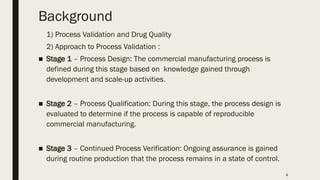
Background
1) Process Validation and Drug Quality
2) Approach to Process Validation :
■ Stage 1 – Process Design: The commercial manufacturing process is
defined during this stage based on knowledge gained through
development and scale-up activities.
■ Stage 2 – Process Qualification: During this stage, the process design is
evaluated to determine if the process is capable of reproducible
commercial manufacturing.
■ Stage 3 – Continued Process Verification: Ongoing assurance is gained
during routine production that the process remains in a state of control.
5
Regulatory requirements for process
validation
■ Process validation for drugs (finished pharmaceuticals and
components) is a legally enforceable requirement.
■ Process validation is required by the CGMP regulations in parts 210
and 211 of 21 CFR.
Validation requires that control procedures are established for
■ to monitor the output and to validate the manufacturing process so
that the factors responsible for variability are controlled.
6
■ Sampling and testing of in-process materials and drug products.
■ in-process specifications and to control batch-to-batch variability.
■ Equipment must be of appropriate design, adequate size, and suitably
located to facilitate operations for its intended use.
■ the CGMP regulations require that manufacturing processes be
designed and controlled to assure that in-process materials and the
finished product meet predetermined quality requirements and do so
consistently and reliably.
7
Recommendations for process validation
General Considerations :
■ An integrated team approach to process validation that includes
expertise from a variety of disciplines.
e.g., process engineering, industrial pharmacy, analytical chemistry,
microbiology, statistics, manufacturing, and quality assurance.
■ Risk based decision making should be employed.
■ All attributes and parameters should be evaluated in terms of their
roles in the process and impact on the product or in-process material.
8
■ The degree of control over those attributes or parameters should be
commensurate with their risk to the process and process output.
■ Homogeneity within a batch and consistency between batches are
goals of process validation activities.
9
Stage 1 ― Process Design :
The goal of this stage is to design a process suitable for routine
commercial manufacturing that can consistently deliver a product that
meets its quality attributes.
It consists of two steps –
■ Building and Capturing Process Knowledge and Understanding
■ Establishing a Strategy for Process Control
10
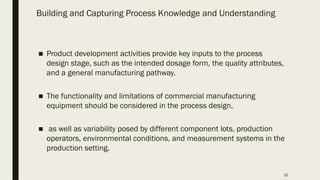
Building and Capturing Process Knowledge and Understanding
■ Product development activities provide key inputs to the process
design stage, such as the intended dosage form, the quality attributes,
and a general manufacturing pathway.
■ The functionality and limitations of commercial manufacturing
equipment should be considered in the process design,
■ as well as variability posed by different component lots, production
operators, environmental conditions, and measurement systems in the
production setting.
11
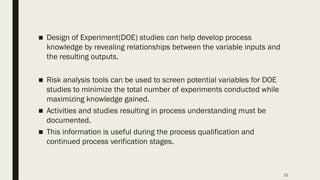
■ Design of Experiment(DOE) studies can help develop process
knowledge by revealing relationships between the variable inputs and
the resulting outputs.
■ Risk analysis tools can be used to screen potential variables for DOE
studies to minimize the total number of experiments conducted while
maximizing knowledge gained.
■ Activities and studies resulting in process understanding must be
documented.
■ This information is useful during the process qualification and
continued process verification stages.
12
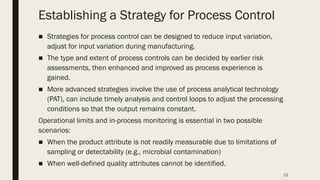
Establishing a Strategy for Process Control
■ Strategies for process control can be designed to reduce input variation,
adjust for input variation during manufacturing.
■ The type and extent of process controls can be decided by earlier risk
assessments, then enhanced and improved as process experience is
gained.
■ More advanced strategies involve the use of process analytical technology
(PAT), can include timely analysis and control loops to adjust the processing
conditions so that the output remains constant.
Operational limits and in-process monitoring is essential in two possible
scenarios:
■ When the product attribute is not readily measurable due to limitations of
sampling or detectability (e.g., microbial contamination)
■ When well-defined quality attributes cannot be identified.
13
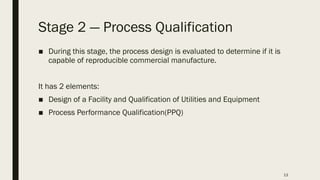
Stage 2 ― Process Qualification
■ During this stage, the process design is evaluated to determine if it is
capable of reproducible commercial manufacture.
It has 2 elements:
■ Design of a Facility and Qualification of Utilities and Equipment
■ Process Performance Qualification(PPQ)
14
Design of a Facility and Qualification of Utilities and
Equipment
■ Design qualification
■ Installation qualification
■ Operational qualification
■ Performance qualification
15
Process Performance Qualification(PPQ)
■ The approach to PPQ should be based on sound science and the
manufacturer’s overall level of product and process understanding
and demonstrable control.
■ The cumulative data from all relevant studies(e.g., designed
experiments; laboratory, pilot, & commercial batches) should be used
to establish the manufacturing conditions in the PPQ.
■ In most cases, PPQ will have a higher level of sampling, additional
testing, and greater scrutiny of process performance than would be
typical of routine commercial production.
16
PPQ Protocol
■ A written protocol that specifies the manufacturing conditions,
controls, testing, and expected outcomes is essential for this stage of
process validation.
It includes:
■ The manufacturing conditions, including operating parameters,
processing limits, and component (raw material) inputs.
■ The data to be collected and when and how it will be evaluated.
■ Tests to be performed and the sampling plan
■ Review and approval of the protocol by appropriate departments and
the quality unit.
17
PPQ Protocol Execution
■ Execution of the PPQ protocol should not begin until the
protocol has been reviewed and approved by all appropriate
departments, including the quality unit.
■ The commercial manufacturing process and routine
procedures must be followed during PPQ protocol execution.
18
PPQ Report
■ A report documenting and assessing adherence to the written PPQ
protocol should be prepared in a timely manner after the completion of
the protocol.
This report should:
■ Summarize data collected and analyse the data, as specified by the
protocol.
■ Summarize and discuss all manufacturing nonconformances such as
deviations, aberrant test results, or other information that has bearing on
the validity of the process.
■ Describe in sufficient detail any corrective actions or changes that should
be made to existing procedures and controls.
■ Include all appropriate department and quality unit review and approvals.
19
Stage 3 ― Continued Process Verification
■ A system or systems for detecting unplanned departures from the
process as designed is essential to assurance that the process
remains in a state of control (the validated state) during commercial
manufacture.
■ An ongoing program to collect and analyse product and process data
that relate to product quality must be established
■ The data should be statistically trended and reviewed by trained
personnel.
20
■ a process is likely to encounter sources of variation that were not
previously detected or to which the process was not previously
exposed. Many tools and techniques, some statistical and others
more qualitative, can be used to detect variation, characterize it, and
determine the root cause.
■ Data gathered during this stage might suggest ways to improve and/or
optimize the process.
■ Depending on the impact of change, additional process design and
process qualification activities could be warranted.
21
22
Concurrent release of PPQ batches
■ In special situations, the PPQ protocol can be designed to release a
PPQ batch for distribution before complete execution of the protocol
steps and activities, i.e., concurrent release.
Ex: Drugs for which there is limited demand (e.g., orphan drugs, minor
use and minor species veterinary drugs) or which have short half-lives
(e.g., radiopharmaceuticals).
■ for drugs that are medically necessary and are being manufactured in
coordination with the Agency to alleviate a short supply.
23
Documentation
■ Documentation at each stage of the process validation lifecycle is
essential for effective communication .
■ knowledge gained about a product and process is accessible and
comprehensible to others involved in each stage of the lifecycle.
■ Helps in informed science-based decision to support the release.
■ The degree and type of documentation required by CGMP vary during
the validation lifecycle.
■ Greatest during Stage 2, and Stage 3.
24
Analytical methodology
■ Process knowledge depends on accurate and precise measuring
techniques used to test and examine the quality of drug components,
in-process materials, and finished products.
■ Validated analytical methods are not necessarily required during
product and process development activities.
■ Nevertheless, analytical methods should be scientifically sound (e.g.,
specific, sensitive, and accurate) and provide results that are reliable.
■ There should be assurance of proper equipment function for
laboratory experiments.
25
Conclusion
■ Validation offers assurance that a process is reasonably protected
against sources of variability that could affect production output,
cause supply problems, and negatively affect public health.
■ Process validation is considered as a one-time event or a focused one-
time task performed just prior to commercial launch.
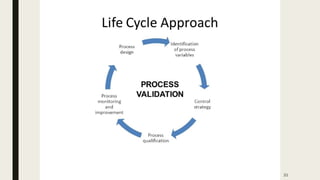
■ Lifecycle approach to process validation encom­
passes product and
process activities beginning in development and continuing
throughout the com­
mercial life of the product.
26
References
■ USFDA Guidance for Industry, Process validation: General principles
and practices; January 2011.
27

USFDA process validation.pptx PEOCESS VALIDATION

  • 1.
    USFDA GUIDELINES ONPROCESS VALIDATION SUBJECT: 202T PHARMACEUTICAL VALIDATION Presented by:Riya rai MPharm Semester 2 Department of Pharmaceutical Quality Assurance
  • 2.
    2 Contents ■ Introduction ■ Background ■Regulatory requirements ■ Recommendations  Stage 1: Process Design  Stage 2: Process Qualification  Stage 3: Continued Process verification ■ Concurrent release of PPQ batches ■ Documentation ■ Analytical Methodology ■ Conclusion ■ References
  • 3.
    3 Introduction ■ This guidanceoutlines the general principles and approaches that FDA considers appropriate elements of process validation for the manufacture of drugs or products. ■ This guidance aligns process validation activities with a product lifecycle concept and with existing FDA guidance, including the FDA/ICH guidances for industry, Q8(R2) Pharmaceutical Development, Q9 Quality Risk Management, and Q10 Pharmaceutical Quality System.
  • 4.
    4 Background 1) Process Validationand Drug Quality 2) Approach to Process Validation : ■ Stage 1 – Process Design: The commercial manufacturing process is defined during this stage based on knowledge gained through development and scale-up activities. ■ Stage 2 – Process Qualification: During this stage, the process design is evaluated to determine if the process is capable of reproducible commercial manufacturing. ■ Stage 3 – Continued Process Verification: Ongoing assurance is gained during routine production that the process remains in a state of control.
  • 5.
    5 Regulatory requirements forprocess validation ■ Process validation for drugs (finished pharmaceuticals and components) is a legally enforceable requirement. ■ Process validation is required by the CGMP regulations in parts 210 and 211 of 21 CFR. Validation requires that control procedures are established for ■ to monitor the output and to validate the manufacturing process so that the factors responsible for variability are controlled.
  • 6.
    6 ■ Sampling andtesting of in-process materials and drug products. ■ in-process specifications and to control batch-to-batch variability. ■ Equipment must be of appropriate design, adequate size, and suitably located to facilitate operations for its intended use. ■ the CGMP regulations require that manufacturing processes be designed and controlled to assure that in-process materials and the finished product meet predetermined quality requirements and do so consistently and reliably.
  • 7.
    7 Recommendations for processvalidation General Considerations : ■ An integrated team approach to process validation that includes expertise from a variety of disciplines. e.g., process engineering, industrial pharmacy, analytical chemistry, microbiology, statistics, manufacturing, and quality assurance. ■ Risk based decision making should be employed. ■ All attributes and parameters should be evaluated in terms of their roles in the process and impact on the product or in-process material.
  • 8.
    8 ■ The degreeof control over those attributes or parameters should be commensurate with their risk to the process and process output. ■ Homogeneity within a batch and consistency between batches are goals of process validation activities.
  • 9.
    9 Stage 1 ―Process Design : The goal of this stage is to design a process suitable for routine commercial manufacturing that can consistently deliver a product that meets its quality attributes. It consists of two steps – ■ Building and Capturing Process Knowledge and Understanding ■ Establishing a Strategy for Process Control
  • 10.
    10 Building and CapturingProcess Knowledge and Understanding ■ Product development activities provide key inputs to the process design stage, such as the intended dosage form, the quality attributes, and a general manufacturing pathway. ■ The functionality and limitations of commercial manufacturing equipment should be considered in the process design, ■ as well as variability posed by different component lots, production operators, environmental conditions, and measurement systems in the production setting.
  • 11.
    11 ■ Design ofExperiment(DOE) studies can help develop process knowledge by revealing relationships between the variable inputs and the resulting outputs. ■ Risk analysis tools can be used to screen potential variables for DOE studies to minimize the total number of experiments conducted while maximizing knowledge gained. ■ Activities and studies resulting in process understanding must be documented. ■ This information is useful during the process qualification and continued process verification stages.
  • 12.
    12 Establishing a Strategyfor Process Control ■ Strategies for process control can be designed to reduce input variation, adjust for input variation during manufacturing. ■ The type and extent of process controls can be decided by earlier risk assessments, then enhanced and improved as process experience is gained. ■ More advanced strategies involve the use of process analytical technology (PAT), can include timely analysis and control loops to adjust the processing conditions so that the output remains constant. Operational limits and in-process monitoring is essential in two possible scenarios: ■ When the product attribute is not readily measurable due to limitations of sampling or detectability (e.g., microbial contamination) ■ When well-defined quality attributes cannot be identified.
  • 13.
    13 Stage 2 ―Process Qualification ■ During this stage, the process design is evaluated to determine if it is capable of reproducible commercial manufacture. It has 2 elements: ■ Design of a Facility and Qualification of Utilities and Equipment ■ Process Performance Qualification(PPQ)
  • 14.
    14 Design of aFacility and Qualification of Utilities and Equipment ■ Design qualification ■ Installation qualification ■ Operational qualification ■ Performance qualification
  • 15.
    15 Process Performance Qualification(PPQ) ■The approach to PPQ should be based on sound science and the manufacturer’s overall level of product and process understanding and demonstrable control. ■ The cumulative data from all relevant studies(e.g., designed experiments; laboratory, pilot, & commercial batches) should be used to establish the manufacturing conditions in the PPQ. ■ In most cases, PPQ will have a higher level of sampling, additional testing, and greater scrutiny of process performance than would be typical of routine commercial production.
  • 16.
    16 PPQ Protocol ■ Awritten protocol that specifies the manufacturing conditions, controls, testing, and expected outcomes is essential for this stage of process validation. It includes: ■ The manufacturing conditions, including operating parameters, processing limits, and component (raw material) inputs. ■ The data to be collected and when and how it will be evaluated. ■ Tests to be performed and the sampling plan ■ Review and approval of the protocol by appropriate departments and the quality unit.
  • 17.
    17 PPQ Protocol Execution ■Execution of the PPQ protocol should not begin until the protocol has been reviewed and approved by all appropriate departments, including the quality unit. ■ The commercial manufacturing process and routine procedures must be followed during PPQ protocol execution.
  • 18.
    18 PPQ Report ■ Areport documenting and assessing adherence to the written PPQ protocol should be prepared in a timely manner after the completion of the protocol. This report should: ■ Summarize data collected and analyse the data, as specified by the protocol. ■ Summarize and discuss all manufacturing nonconformances such as deviations, aberrant test results, or other information that has bearing on the validity of the process. ■ Describe in sufficient detail any corrective actions or changes that should be made to existing procedures and controls. ■ Include all appropriate department and quality unit review and approvals.
  • 19.
    19 Stage 3 ―Continued Process Verification ■ A system or systems for detecting unplanned departures from the process as designed is essential to assurance that the process remains in a state of control (the validated state) during commercial manufacture. ■ An ongoing program to collect and analyse product and process data that relate to product quality must be established ■ The data should be statistically trended and reviewed by trained personnel.
  • 20.
    20 ■ a processis likely to encounter sources of variation that were not previously detected or to which the process was not previously exposed. Many tools and techniques, some statistical and others more qualitative, can be used to detect variation, characterize it, and determine the root cause. ■ Data gathered during this stage might suggest ways to improve and/or optimize the process. ■ Depending on the impact of change, additional process design and process qualification activities could be warranted.
  • 21.
  • 22.
    22 Concurrent release ofPPQ batches ■ In special situations, the PPQ protocol can be designed to release a PPQ batch for distribution before complete execution of the protocol steps and activities, i.e., concurrent release. Ex: Drugs for which there is limited demand (e.g., orphan drugs, minor use and minor species veterinary drugs) or which have short half-lives (e.g., radiopharmaceuticals). ■ for drugs that are medically necessary and are being manufactured in coordination with the Agency to alleviate a short supply.
  • 23.
    23 Documentation ■ Documentation ateach stage of the process validation lifecycle is essential for effective communication . ■ knowledge gained about a product and process is accessible and comprehensible to others involved in each stage of the lifecycle. ■ Helps in informed science-based decision to support the release. ■ The degree and type of documentation required by CGMP vary during the validation lifecycle. ■ Greatest during Stage 2, and Stage 3.
  • 24.
    24 Analytical methodology ■ Processknowledge depends on accurate and precise measuring techniques used to test and examine the quality of drug components, in-process materials, and finished products. ■ Validated analytical methods are not necessarily required during product and process development activities. ■ Nevertheless, analytical methods should be scientifically sound (e.g., specific, sensitive, and accurate) and provide results that are reliable. ■ There should be assurance of proper equipment function for laboratory experiments.
  • 25.
    25 Conclusion ■ Validation offersassurance that a process is reasonably protected against sources of variability that could affect production output, cause supply problems, and negatively affect public health. ■ Process validation is considered as a one-time event or a focused one- time task performed just prior to commercial launch. ■ Lifecycle approach to process validation encom­ passes product and process activities beginning in development and continuing throughout the com­ mercial life of the product.
  • 26.
    26 References ■ USFDA Guidancefor Industry, Process validation: General principles and practices; January 2011.
  • 27.