Process validation
Guru Balaji.S
Global product development (R&D)
s.gurubalaji@gmail.com
Process
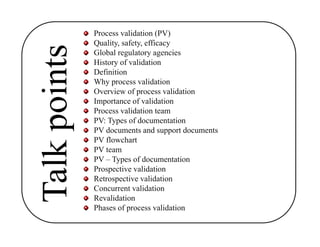
Process validation (PV)
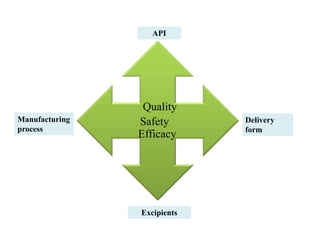
Quality, safety, efficacy
Global regulatory agencies
History of validation
Definition
Why process validation
Overview of process validation
Importance of validation
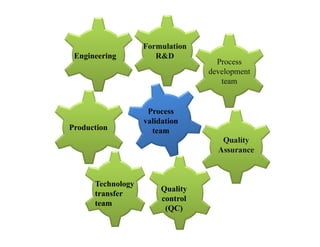
Process validation team
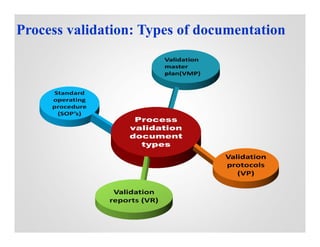
PV: Types of documentation
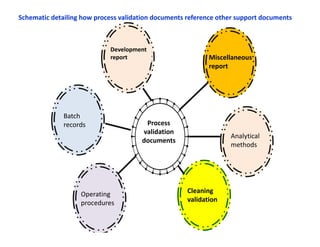
PV documents and support documents
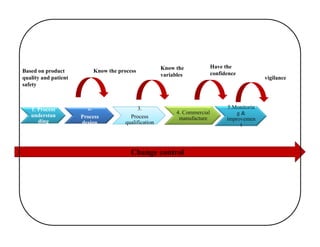
PV flowchart
PV team
PV – Types of documentation
Prospective validation
Retrospective validation
Concurrent validation
Revalidation
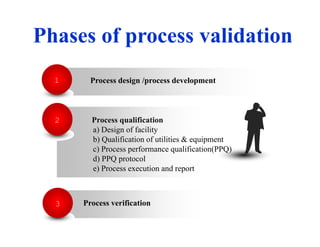
Phases of process validation
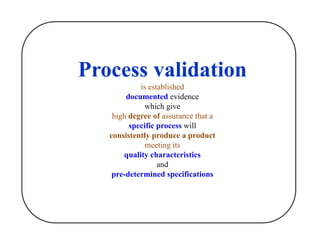
Process validation
is established
documented evidence
which give
high degree of assurance that a
specific process will
consistently produce a product
meeting its
quality characteristics
and
pre-determined specifications
API
Manufacturing
process
Excipients
Delivery
form
Quality
Safety
Efficacy
Global regulatory agencies
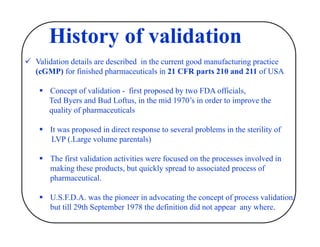
 Validation details are described in the current good manufacturing practice
(cGMP) for finished pharmaceuticals in 21 CFR parts 210 and 211 of USA
 Concept of validation - first proposed by two FDA officials,
Ted Byers and Bud Loftus, in the mid 1970’s in order to improve the
quality of pharmaceuticals
 It was proposed in direct response to several problems in the sterility of
LVP (.Large volume parentals)
 The first validation activities were focused on the processes involved in
making these products, but quickly spread to associated process of
pharmaceutical.
 U.S.F.D.A. was the pioneer in advocating the concept of process validation,
but till 29th September 1978 the definition did not appear any where.
History of validation
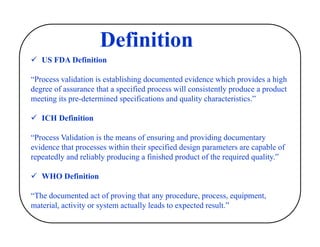
 US FDA Definition
“Process validation is establishing documented evidence which provides a high
degree of assurance that a specified process will consistently produce a product
meeting its pre-determined specifications and quality characteristics.”
 ICH Definition
“Process Validation is the means of ensuring and providing documentary
evidence that processes within their specified design parameters are capable of
repeatedly and reliably producing a finished product of the required quality.”
 WHO Definition
“The documented act of proving that any procedure, process, equipment,
material, activity or system actually leads to expected result.”
Definition
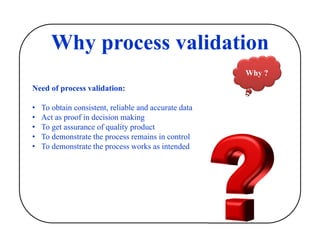
Why process validation
Why ?
Need of process validation:
• To obtain consistent, reliable and accurate data
• Act as proof in decision making
• To get assurance of quality product
• To demonstrate the process remains in control
• To demonstrate the process works as intended
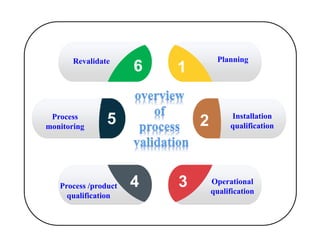
1
2
34
5
6Revalidate Planning
Process
monitoring
Installation
qualification
Process /product
qualification
Operational
qualification
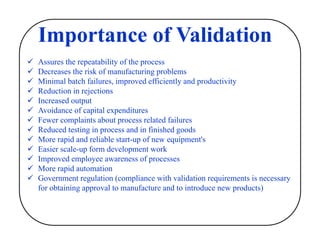
Importance of Validation
 Assures the repeatability of the process
 Decreases the risk of manufacturing problems
 Minimal batch failures, improved efficiently and productivity
 Reduction in rejections
 Increased output
 Avoidance of capital expenditures
 Fewer complaints about process related failures
 Reduced testing in process and in finished goods
 More rapid and reliable start-up of new equipment's
 Easier scale-up form development work
 Improved employee awareness of processes
 More rapid automation
 Government regulation (compliance with validation requirements is necessary
for obtaining approval to manufacture and to introduce new products)
Quality
Assurance
Quality
control
(QC)
Production
Engineering
Formulation
R&D
Process
development
team
Technology
transfer
team
Process
validation
team
Process validation: Types of documentation
Change control
1. Process
understan
ding
2.
Process
design
3
qualification
3.
Process
qualification
4. Commercial
manufacture
5.Monitorin
g &
improvemen
t
Based on product
quality and patient
safety
Know the process Know the
variables
Have the
confidence
vigilance
Process 
validation 
documents
Miscellaneous 
report
Development 
report
Batch 
records
Cleaning 
validation
Operating 
procedures
Analytical 
methods
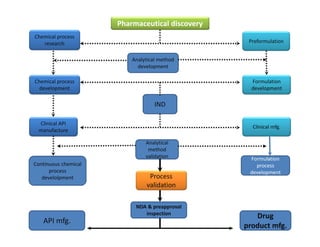
Schematic detailing how process validation documents reference other support documents
Chemical process 
research
Chemical process 
development
Clinical API 
manufacture
Continuous chemical 
process 
develolpment
API mfg.
Preformulation
Formulation 
development
Clinical mfg.
Formulation 
process 
development
Drug 
product mfg.
Pharmaceutical discovery
IND
Process 
validation
NDA & preapproval 
inspection
Analytical method 
development
Analytical 
method 
validation
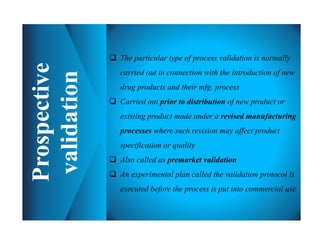
 The particular type of process validation is normally
carried out in connection with the introduction of new
drug products and their mfg. process
 Carried out prior to distribution of new product or
existing product made under a revised manufacturing
processes where such revision may affect product
specification or quality
 Also called as premarket validation
 An experimental plan called the validation protocol is
executed before the process is put into commercial use
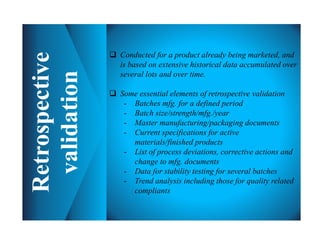
 Conducted for a product already being marketed, and
is based on extensive historical data accumulated over
several lots and over time.
 Some essential elements of retrospective validation
- Batches mfg. for a defined period
- Batch size/strength/mfg./year
- Master manufacturing/packaging documents
- Current specifications for active
materials/finished products
- List of process deviations, corrective actions and
change to mfg. documents
- Data for stability testing for several batches
- Trend analysis including those for quality related
compliants
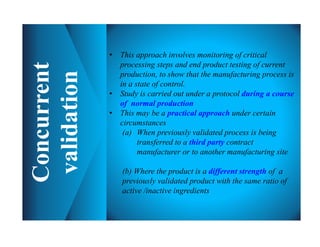
• This approach involves monitoring of critical
processing steps and end product testing of current
production, to show that the manufacturing process is
in a state of control.
• Study is carried out under a protocol during a course
of normal production
• This may be a practical approach under certain
circumstances
(a) When previously validated process is being
transferred to a third party contract
manufacturer or to another manufacturing site
(b) Where the product is a different strength of a
previously validated product with the same ratio of
active /inactive ingredients
It is repeating/ part of the original validation activity. It
is essential to maintain the validated status of the plant,
equipment, manufacturing processes and computer
systems.
Possible reasons for doing :
(1) The transfer of a product from one plant to another.
(2) Changes to the product, the plant, the manufacturing
process, the cleaning process, or other changes that
could affect product quality.
(3) Change - equipment (type,function,location,control
system,major repairs)
(4) Periodic revision
(5) Significant (usually order of magnitude) increase or
decrease in batch size.
(4) Sequential batches that fail to meet product and
process specifications.
It depends on the extent of the changes and the effect
upon the product.
Phases of process validation
Process design /process development1
Process qualification
a) Design of facility
b) Qualification of utilities & equipment
c) Process performance qualification(PPQ)
d) PPQ protocol
e) Process execution and report
2
Process verification3
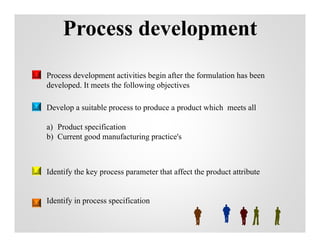
Process development
Process development activities begin after the formulation has been
developed. It meets the following objectives
Develop a suitable process to produce a product which meets all
a) Product specification
b) Current good manufacturing practice's
Identify the key process parameter that affect the product attribute
Identify in process specification
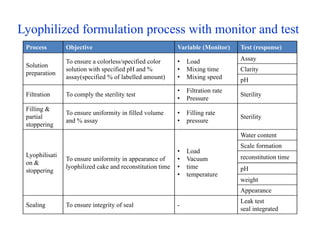
Process Objective Variable (Monitor) Test (response)
Solution
preparation
To ensure a colorless/specified color
solution with specified pH and %
assay(specified % of labelled amount)
• Load
• Mixing time
• Mixing speed
Assay
Clarity
pH
Filtration To comply the sterility test
• Filtration rate
• Pressure
Sterility
Filling &
partial
stoppering
To ensure uniformity in filled volume
and % assay
• Filling rate
• pressure
Sterility
Lyophilisati
on &
stoppering
To ensure uniformity in appearance of
lyophilized cake and reconstitution time
• Load
• Vacuum
• time
• temperature
Water content
Scale formation
reconstitution time
pH
weight
Appearance
Sealing To ensure integrity of seal -
Leak test
seal integrated
Lyophilized formulation process with monitor and test
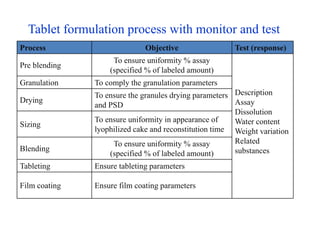
Process Objective Test (response)
Pre blending
To ensure uniformity % assay
(specified % of labeled amount)
Description
Assay
Dissolution
Water content
Weight variation
Related
substances
Granulation To comply the granulation parameters
Drying
To ensure the granules drying parameters
and PSD
Sizing
To ensure uniformity in appearance of
lyophilized cake and reconstitution time
Blending
To ensure uniformity % assay
(specified % of labeled amount)
Tableting Ensure tableting parameters
Film coating Ensure film coating parameters
Tablet formulation process with monitor and test
Knowledge……
is proud that he has learnt so much
Wisdom…
Is humble that he knows no more
William cowper
Guru Balaji.S
Global product development(R&D)
91-99 44 33 08 34
s.gurubalaji@gmail.com

Pharmaceutical process validation (PV)

  • 1.
    Process validation Guru Balaji.S Globalproduct development (R&D) s.gurubalaji@gmail.com
  • 2.
  • 3.
    Process validation (PV) Quality,safety, efficacy Global regulatory agencies History of validation Definition Why process validation Overview of process validation Importance of validation Process validation team PV: Types of documentation PV documents and support documents PV flowchart PV team PV – Types of documentation Prospective validation Retrospective validation Concurrent validation Revalidation Phases of process validation
  • 4.
    Process validation is established documentedevidence which give high degree of assurance that a specific process will consistently produce a product meeting its quality characteristics and pre-determined specifications
  • 5.
  • 6.
  • 7.
     Validation detailsare described in the current good manufacturing practice (cGMP) for finished pharmaceuticals in 21 CFR parts 210 and 211 of USA  Concept of validation - first proposed by two FDA officials, Ted Byers and Bud Loftus, in the mid 1970’s in order to improve the quality of pharmaceuticals  It was proposed in direct response to several problems in the sterility of LVP (.Large volume parentals)  The first validation activities were focused on the processes involved in making these products, but quickly spread to associated process of pharmaceutical.  U.S.F.D.A. was the pioneer in advocating the concept of process validation, but till 29th September 1978 the definition did not appear any where. History of validation
  • 8.
     US FDADefinition “Process validation is establishing documented evidence which provides a high degree of assurance that a specified process will consistently produce a product meeting its pre-determined specifications and quality characteristics.”  ICH Definition “Process Validation is the means of ensuring and providing documentary evidence that processes within their specified design parameters are capable of repeatedly and reliably producing a finished product of the required quality.”  WHO Definition “The documented act of proving that any procedure, process, equipment, material, activity or system actually leads to expected result.” Definition
  • 9.
    Why process validation Why? Need of process validation: • To obtain consistent, reliable and accurate data • Act as proof in decision making • To get assurance of quality product • To demonstrate the process remains in control • To demonstrate the process works as intended
  • 10.
  • 11.
    Importance of Validation Assures the repeatability of the process  Decreases the risk of manufacturing problems  Minimal batch failures, improved efficiently and productivity  Reduction in rejections  Increased output  Avoidance of capital expenditures  Fewer complaints about process related failures  Reduced testing in process and in finished goods  More rapid and reliable start-up of new equipment's  Easier scale-up form development work  Improved employee awareness of processes  More rapid automation  Government regulation (compliance with validation requirements is necessary for obtaining approval to manufacture and to introduce new products)
  • 12.
  • 13.
    Process validation: Typesof documentation
  • 14.
    Change control 1. Process understan ding 2. Process design 3 qualification 3. Process qualification 4.Commercial manufacture 5.Monitorin g & improvemen t Based on product quality and patient safety Know the process Know the variables Have the confidence vigilance
  • 15.
  • 16.
  • 17.
     The particulartype of process validation is normally carried out in connection with the introduction of new drug products and their mfg. process  Carried out prior to distribution of new product or existing product made under a revised manufacturing processes where such revision may affect product specification or quality  Also called as premarket validation  An experimental plan called the validation protocol is executed before the process is put into commercial use
  • 18.
     Conducted fora product already being marketed, and is based on extensive historical data accumulated over several lots and over time.  Some essential elements of retrospective validation - Batches mfg. for a defined period - Batch size/strength/mfg./year - Master manufacturing/packaging documents - Current specifications for active materials/finished products - List of process deviations, corrective actions and change to mfg. documents - Data for stability testing for several batches - Trend analysis including those for quality related compliants
  • 19.
    • This approachinvolves monitoring of critical processing steps and end product testing of current production, to show that the manufacturing process is in a state of control. • Study is carried out under a protocol during a course of normal production • This may be a practical approach under certain circumstances (a) When previously validated process is being transferred to a third party contract manufacturer or to another manufacturing site (b) Where the product is a different strength of a previously validated product with the same ratio of active /inactive ingredients
  • 20.
    It is repeating/part of the original validation activity. It is essential to maintain the validated status of the plant, equipment, manufacturing processes and computer systems. Possible reasons for doing : (1) The transfer of a product from one plant to another. (2) Changes to the product, the plant, the manufacturing process, the cleaning process, or other changes that could affect product quality. (3) Change - equipment (type,function,location,control system,major repairs) (4) Periodic revision (5) Significant (usually order of magnitude) increase or decrease in batch size. (4) Sequential batches that fail to meet product and process specifications. It depends on the extent of the changes and the effect upon the product.
  • 21.
    Phases of processvalidation Process design /process development1 Process qualification a) Design of facility b) Qualification of utilities & equipment c) Process performance qualification(PPQ) d) PPQ protocol e) Process execution and report 2 Process verification3
  • 22.
    Process development Process developmentactivities begin after the formulation has been developed. It meets the following objectives Develop a suitable process to produce a product which meets all a) Product specification b) Current good manufacturing practice's Identify the key process parameter that affect the product attribute Identify in process specification
  • 23.
    Process Objective Variable(Monitor) Test (response) Solution preparation To ensure a colorless/specified color solution with specified pH and % assay(specified % of labelled amount) • Load • Mixing time • Mixing speed Assay Clarity pH Filtration To comply the sterility test • Filtration rate • Pressure Sterility Filling & partial stoppering To ensure uniformity in filled volume and % assay • Filling rate • pressure Sterility Lyophilisati on & stoppering To ensure uniformity in appearance of lyophilized cake and reconstitution time • Load • Vacuum • time • temperature Water content Scale formation reconstitution time pH weight Appearance Sealing To ensure integrity of seal - Leak test seal integrated Lyophilized formulation process with monitor and test
  • 24.
    Process Objective Test(response) Pre blending To ensure uniformity % assay (specified % of labeled amount) Description Assay Dissolution Water content Weight variation Related substances Granulation To comply the granulation parameters Drying To ensure the granules drying parameters and PSD Sizing To ensure uniformity in appearance of lyophilized cake and reconstitution time Blending To ensure uniformity % assay (specified % of labeled amount) Tableting Ensure tableting parameters Film coating Ensure film coating parameters Tablet formulation process with monitor and test
  • 25.
    Knowledge…… is proud thathe has learnt so much Wisdom… Is humble that he knows no more William cowper
  • 26.
    Guru Balaji.S Global productdevelopment(R&D) 91-99 44 33 08 34 s.gurubalaji@gmail.com