9
Presentation prepared by Drug Regulations – a not for
profit organization. Visit www.drugregulations.org for
the latest in Pharmaceuticals.
06-11-2015
10
 CGMP’s 21 211.192
 U.S.A. vs. Barr Laboratories, Inc.
 Able Laboratories
 Reportable Results
 Specifications
 OOS flowchart
 Specific OOS topics
06-11-2015
11
 “Any unexplained discrepancy of the failure
of a batch or any of its contents to meet any
of its specifications shall be thoroughly
investigated, whether or not the batch has
already been distributed.”
06-11-2015
12
 “ The investigation shall extend to other
batches of the same drug product and other
drug products that may have been associated
with the specific failure or discrepancy.
 A written record of the investigation shall be
made and shall include the conclusions and
follow-up.”
06-11-2015
13
 Civil action by FDA, June 12, 1992.
 Judge Alfred M. Wolin
 Can the FDA expand the CGMP ’ s
interpretation into the statistical areas of
outliers, retesting, resampling, averaging and
sample size and other areas of failure
investigations, …”
06-11-2015
14
 “The current conflict surrounding these rules
is best characterized as a confrontation
between a humorless warden and his
uncooperative prisoner. … These witnesses
revealed an industry mired in uncertainty and
conflict, guided by vague regulations which
produce tugs-of-war of varying intensity.”
06-11-2015
15
 On May 23, 2005, Able labs issued a Class II
recall of all of its 46 drug products
 The company immediately suspended
operations and laid off 200 employees.
 The stock price in the last two weeks of May
dropped by more than 90%.
 The company went out of business.
06-11-2015
16
 “ Testing lies at the heart of a drug
manufacturer ’ s successful operation.
Through testing companies validate their
processes and ensure the quality of batches
for release.” Judge Wolin
 If we can’t trust our measurements, we don’t
have anything.
06-11-2015
06-11-2015 17
 September 30 , 1998
 “Guidance for Industry – Investigating Out of
Specification (OOS) Test Results for
Pharmaceutical Production”
 Submitted comments by 30 November 1998
 These comments can be inspected by going
to the FDA offices.
06-11-2015 18
 12 October 2006 in the Federal Register
 FDA authors include:
◦ Richard Friedman – Director of the Division of
Manufacturing & Product Quality
◦ Paul Haynie is responsible for the Guidance
◦ (301) 827-9020
◦ Hayniep@cder.fda.gov
06-11-2015 19
 12 October 2006 in the Federal Register
 FDA authors include:
◦ Richard Friedman – Director of the Division of
Manufacturing & Product Quality
◦ Paul Haynie is responsible for the Guidance
◦ (301) 827-9020
◦ Hayniep@cder.fda.gov
20
 Definition of reportable values?
 Use of averaging?
 Number of retests?
 Second analyst?
 Use of outlier testing?
 What specification limits?
 Defining testing into compliance?
06-11-2015
06-11-2015 21
 “… the term OOS results includes all test results
that fall outside the specification or acceptance
criteria established in drug applications, drug
master files, official compendia, or by the
manufacturer.
 Two Major Issues:
◦ What test results?
◦ What specifications?
06-11-2015 22
 “These laboratory tests are performed on active
pharmaceutical ingredients, excipients and other
components, in-process materials and finished
drug products.
 “Laboratory testing … is necessary to confirm that
components, container and closures, in-process
materials and finished products conform to
specifications, including stability specifications.
06-11-2015 23
 This guidance applies to chemistry-based
laboratory testing of drugs regulated by
CDER.
 “ The term also applies to all in-process
laboratory tests ….”
 “ … applies to in-house testing of drug
product components that are purchased …”
06-11-2015 24
 “It should be noted that a test might consist of
replicates to arrive at a result.
 For instance, an HPLC assay result may be
determined by averaging the peak responses
from a number of consecutive, replicate
injections from the same preparation.
 The assay result would be calculated using the
peak response average.”
06-11-2015 25
This determination is
considered
◦One test and
◦One result.
06-11-2015 26
 A reportable value is the end result of the
complete measurement method as
documented.
 It is the value compared to the specifications.
 It is the value used for official reports.
 It is the value used for statistical analysis.
06-11-2015 27
Batch
Sample
Preparation
Figure 1
Reportable
Value, RV
Inj
Torbeck, Pharm Tech, Oct 2002
06-11-2015 28
Batch
Sample
Inj1
Preparation 3Preparation 2Preparation 1
Inj 2 Inj 3
Figure 2
Inj 7 Inj 8 Inj 9
Reportable
Value, RV
Inj 4 Inj 5 Inj 6
Torbeck, Pharm Tech, Oct 2002
06-11-2015 29
Batch
Sample Resample
Reinjection
Reportable
Value, RV
Inj1
Preparation 1C
Preparation 1B
Preparation 1A
Inj 2 Inj 3 Inj 4 Inj 5 Inj 6
Repreparation
2C
Repreparation
2B
Inj 7 Inj8 Inj 9
Retest
Remeasure Remeasure
RV RV
Figure 3
Torbeck, Pharm Tech, Oct 2002
06-11-2015 30
 The individual determinations do not have to
meet the specification.
 Determinations are not reported out of the lab.
 The variability of determinations is like a system
suitability issue.
 Set an upper limit on the standard deviation or
%RSD.
06-11-2015 31
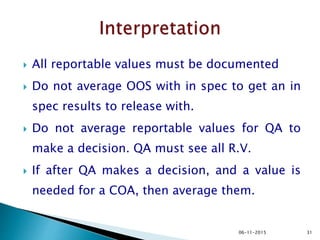
 All reportable values must be documented
 Do not average OOS with in spec to get an in
spec results to release with.
 Do not average reportable values for QA to
make a decision. QA must see all R.V.
 If after QA makes a decision, and a value is
needed for a COA, then average them.
06-11-2015 32
Types of Limits
1.Regulatory specifications (External)
2.Accept/reject limits (Includes stability)
3.Action (Cpk=1.33 ?)
4.Alert or Trend (Cpk=1.0 ?)
5.In-process adjustment limits ?
06-11-2015 33
 An investigation is required for an OOS.
 The purpose is to find the cause of the OOS.
 Is it measurement or manufacturing?
 “Batch rejection does not negate the need to
perform the investigation.”
 The first phase should include an assessment
of the accuracy of results.
06-11-2015 34
 For contract laboratories, the laboratory
should convey its data, findings, and
supporting documentation to the
manufacturing firm’s quality control unit who
should then initiate the full scale
investigation.
06-11-2015 35
 “ The first responsibility for achieving
accurate laboratory results lies with the
analysts who is performing the test.”
 “The analysts should be aware of potential
problems that could occur …”
06-11-2015 36
 “ Analysts should check the data for
compliance with test specifications before
discarding test preparations or standard
preparations.”
 An assessment of the accuracy of the results
should be started immediately.
06-11-2015 37
 Supervisors assessment should be:
◦ Objective
◦ Timely
◦ No preconceived assumptions
◦ Prompt assessment of data
◦ Laboratory or manufacturing?
06-11-2015 38
1. Discuss the method with analysts
2. Examine raw data
3. Verify calculations
4. Confirm performance of instruments.
5. Confirm reference standards, reagents
6. Evaluate performance of method
7. Document, document, document
06-11-2015 39
 Unconfirmed OOS requires a full scale OOS
investigation with predefined procedure.
 Find the root cause and do CAPA
 Review production and sampling procedures
 Investigations given the highest priority
06-11-2015 40
 Quality Control Unit conducts the
investigation.
 Other departments participate:
1. Manufacturing
2. Process Development
3. Maintenance
4. Engineering
06-11-2015 41
 In cases where manufacturing occurs off-site
(i.e., performed by a contract manufacturer or
at multiple manufacturing sites), all sites
potentially involved should be included in the
investigation.
 Review all documents and records of the
manufacturing process.
06-11-2015 42
 A written record of the review includes:
1. A clear statement of the reason
2. Summary of manufacturing process aspects that
could cause the problem
3. Results of documentation review with probable
cause.
4. Results of previous reviews
5. Description of corrective actions to be taken.
06-11-2015 43
 A retest is another test of a portion of the
original sample brought into the lab.
 FDA prefers a second analysts do the retest.
 Don’t “test into compliance.”
 Specify the number of retests.
 Prepare a protocol before retesting.
 If the error is found the retest substitutes.
06-11-2015 44
 This is still and unresolved issue and the
statisticians are still publishing journal
articles and discussing it.
 Bar case n=7 not fully supported by statistics
 Could be too much or not enough
 Currently n= 3 to n=9
06-11-2015 45
 Testing into compliance is the practice of
ignoring valid information that should be
used to make decisions.
 Such a practice is at best not scientific and at
worst is fraudulent, illegal, and immoral.
 Such practices must be found and stopped.
06-11-2015 46
 Averaging OOS with in specification results to
get an in specification result.
 Physically averaging powers, granulations and
liquids to get in specifications results.
 Not recording data until is known to be in
specification.
 Missing samples
06-11-2015 47
 Large initial sample sizes are acceptable if all
data generated is reported.
 Large number of retests are acceptable if all
data generated is reported.
 Failing system suitability is not an OOS
 Out of limits for an in-process adjustment is
not an OOS
06-11-2015 48
 Resampling involves analyzing a specimen
from any additional units collected as part of
the original sampling procedure or from a
new sample collected from the batch.
 Original should be large enough for retests
 Original sample must representative
 Resampling should be a rare event.
06-11-2015 49
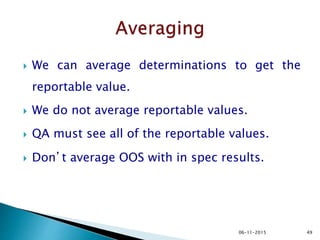
 We can average determinations to get the
reportable value.
 We do not average reportable values.
 QA must see all of the reportable values.
 Don’t average OOS with in spec results.
06-11-2015 50
 In a sample of n observations it is possible for a
limited number to be so far separated in value from
the remainder that they give rise to the question
whether they are not from a different population,
or that the sampling technique is at fault.
 Such values are called outliers.
 Tests are available to ascertain whether they can be
accepted as homogeneous with the rest of the
sample.
06-11-2015 51
 "The USP expressly allows firms to apply this
test to biological and antibiotic assays, ...,
but is silent on its use with chemical tests.”
 "In the Court's view the silence of the USP
with respect to chemical testing and outliers
is prohibitory."
06-11-2015 52
 Use of outlier tests is determined in advance
 Specify the test and the sample size.
 Can reject biological data but not chemical.
◦ The outlier can be omitted.
 Outlier tests to be used sparingly.
 No application variability or homogeneity is
being assessed.
06-11-2015 53
 If a cause is found, invalidate the initial result
and use the retest value(s) in its place.
 If the OOS is confirmed the batch is rejected.
 If the OOS is inconclusive and the retests are
within specification, then QA may be able to
justify releasing the batch.
06-11-2015 54
 For those product that are the subject of
approved full and abbreviated new drug
applications, regulation require submitting
within 3 working days a field alert report of
information concerning any failure of a
distributed batch to meet any of the
specifications ….”
55
Presentation prepared by Drug Regulations – a not for
profit organization. Visit www.drugregulations.org for
the latest in Pharmaceuticals.
06-11-2015

Handling of Out of Specification Results

  • 1.
    9 Presentation prepared byDrug Regulations – a not for profit organization. Visit www.drugregulations.org for the latest in Pharmaceuticals. 06-11-2015
  • 2.
    10  CGMP’s 21211.192  U.S.A. vs. Barr Laboratories, Inc.  Able Laboratories  Reportable Results  Specifications  OOS flowchart  Specific OOS topics 06-11-2015
  • 3.
    11  “Any unexplaineddiscrepancy of the failure of a batch or any of its contents to meet any of its specifications shall be thoroughly investigated, whether or not the batch has already been distributed.” 06-11-2015
  • 4.
    12  “ Theinvestigation shall extend to other batches of the same drug product and other drug products that may have been associated with the specific failure or discrepancy.  A written record of the investigation shall be made and shall include the conclusions and follow-up.” 06-11-2015
  • 5.
    13  Civil actionby FDA, June 12, 1992.  Judge Alfred M. Wolin  Can the FDA expand the CGMP ’ s interpretation into the statistical areas of outliers, retesting, resampling, averaging and sample size and other areas of failure investigations, …” 06-11-2015
  • 6.
    14  “The currentconflict surrounding these rules is best characterized as a confrontation between a humorless warden and his uncooperative prisoner. … These witnesses revealed an industry mired in uncertainty and conflict, guided by vague regulations which produce tugs-of-war of varying intensity.” 06-11-2015
  • 7.
    15  On May23, 2005, Able labs issued a Class II recall of all of its 46 drug products  The company immediately suspended operations and laid off 200 employees.  The stock price in the last two weeks of May dropped by more than 90%.  The company went out of business. 06-11-2015
  • 8.
    16  “ Testinglies at the heart of a drug manufacturer ’ s successful operation. Through testing companies validate their processes and ensure the quality of batches for release.” Judge Wolin  If we can’t trust our measurements, we don’t have anything. 06-11-2015
  • 9.
    06-11-2015 17  September30 , 1998  “Guidance for Industry – Investigating Out of Specification (OOS) Test Results for Pharmaceutical Production”  Submitted comments by 30 November 1998  These comments can be inspected by going to the FDA offices.
  • 10.
    06-11-2015 18  12October 2006 in the Federal Register  FDA authors include: ◦ Richard Friedman – Director of the Division of Manufacturing & Product Quality ◦ Paul Haynie is responsible for the Guidance ◦ (301) 827-9020 ◦ Hayniep@cder.fda.gov
  • 11.
    06-11-2015 19  12October 2006 in the Federal Register  FDA authors include: ◦ Richard Friedman – Director of the Division of Manufacturing & Product Quality ◦ Paul Haynie is responsible for the Guidance ◦ (301) 827-9020 ◦ Hayniep@cder.fda.gov
  • 12.
    20  Definition ofreportable values?  Use of averaging?  Number of retests?  Second analyst?  Use of outlier testing?  What specification limits?  Defining testing into compliance? 06-11-2015
  • 13.
    06-11-2015 21  “…the term OOS results includes all test results that fall outside the specification or acceptance criteria established in drug applications, drug master files, official compendia, or by the manufacturer.  Two Major Issues: ◦ What test results? ◦ What specifications?
  • 14.
    06-11-2015 22  “Theselaboratory tests are performed on active pharmaceutical ingredients, excipients and other components, in-process materials and finished drug products.  “Laboratory testing … is necessary to confirm that components, container and closures, in-process materials and finished products conform to specifications, including stability specifications.
  • 15.
    06-11-2015 23  Thisguidance applies to chemistry-based laboratory testing of drugs regulated by CDER.  “ The term also applies to all in-process laboratory tests ….”  “ … applies to in-house testing of drug product components that are purchased …”
  • 16.
    06-11-2015 24  “Itshould be noted that a test might consist of replicates to arrive at a result.  For instance, an HPLC assay result may be determined by averaging the peak responses from a number of consecutive, replicate injections from the same preparation.  The assay result would be calculated using the peak response average.”
  • 17.
    06-11-2015 25 This determinationis considered ◦One test and ◦One result.
  • 18.
    06-11-2015 26  Areportable value is the end result of the complete measurement method as documented.  It is the value compared to the specifications.  It is the value used for official reports.  It is the value used for statistical analysis.
  • 19.
  • 20.
    06-11-2015 28 Batch Sample Inj1 Preparation 3Preparation2Preparation 1 Inj 2 Inj 3 Figure 2 Inj 7 Inj 8 Inj 9 Reportable Value, RV Inj 4 Inj 5 Inj 6 Torbeck, Pharm Tech, Oct 2002
  • 21.
    06-11-2015 29 Batch Sample Resample Reinjection Reportable Value,RV Inj1 Preparation 1C Preparation 1B Preparation 1A Inj 2 Inj 3 Inj 4 Inj 5 Inj 6 Repreparation 2C Repreparation 2B Inj 7 Inj8 Inj 9 Retest Remeasure Remeasure RV RV Figure 3 Torbeck, Pharm Tech, Oct 2002
  • 22.
    06-11-2015 30  Theindividual determinations do not have to meet the specification.  Determinations are not reported out of the lab.  The variability of determinations is like a system suitability issue.  Set an upper limit on the standard deviation or %RSD.
  • 23.
    06-11-2015 31  Allreportable values must be documented  Do not average OOS with in spec to get an in spec results to release with.  Do not average reportable values for QA to make a decision. QA must see all R.V.  If after QA makes a decision, and a value is needed for a COA, then average them.
  • 24.
    06-11-2015 32 Types ofLimits 1.Regulatory specifications (External) 2.Accept/reject limits (Includes stability) 3.Action (Cpk=1.33 ?) 4.Alert or Trend (Cpk=1.0 ?) 5.In-process adjustment limits ?
  • 25.
    06-11-2015 33  Aninvestigation is required for an OOS.  The purpose is to find the cause of the OOS.  Is it measurement or manufacturing?  “Batch rejection does not negate the need to perform the investigation.”  The first phase should include an assessment of the accuracy of results.
  • 26.
    06-11-2015 34  Forcontract laboratories, the laboratory should convey its data, findings, and supporting documentation to the manufacturing firm’s quality control unit who should then initiate the full scale investigation.
  • 27.
    06-11-2015 35  “The first responsibility for achieving accurate laboratory results lies with the analysts who is performing the test.”  “The analysts should be aware of potential problems that could occur …”
  • 28.
    06-11-2015 36  “Analysts should check the data for compliance with test specifications before discarding test preparations or standard preparations.”  An assessment of the accuracy of the results should be started immediately.
  • 29.
    06-11-2015 37  Supervisorsassessment should be: ◦ Objective ◦ Timely ◦ No preconceived assumptions ◦ Prompt assessment of data ◦ Laboratory or manufacturing?
  • 30.
    06-11-2015 38 1. Discussthe method with analysts 2. Examine raw data 3. Verify calculations 4. Confirm performance of instruments. 5. Confirm reference standards, reagents 6. Evaluate performance of method 7. Document, document, document
  • 31.
    06-11-2015 39  UnconfirmedOOS requires a full scale OOS investigation with predefined procedure.  Find the root cause and do CAPA  Review production and sampling procedures  Investigations given the highest priority
  • 32.
    06-11-2015 40  QualityControl Unit conducts the investigation.  Other departments participate: 1. Manufacturing 2. Process Development 3. Maintenance 4. Engineering
  • 33.
    06-11-2015 41  Incases where manufacturing occurs off-site (i.e., performed by a contract manufacturer or at multiple manufacturing sites), all sites potentially involved should be included in the investigation.  Review all documents and records of the manufacturing process.
  • 34.
    06-11-2015 42  Awritten record of the review includes: 1. A clear statement of the reason 2. Summary of manufacturing process aspects that could cause the problem 3. Results of documentation review with probable cause. 4. Results of previous reviews 5. Description of corrective actions to be taken.
  • 35.
    06-11-2015 43  Aretest is another test of a portion of the original sample brought into the lab.  FDA prefers a second analysts do the retest.  Don’t “test into compliance.”  Specify the number of retests.  Prepare a protocol before retesting.  If the error is found the retest substitutes.
  • 36.
    06-11-2015 44  Thisis still and unresolved issue and the statisticians are still publishing journal articles and discussing it.  Bar case n=7 not fully supported by statistics  Could be too much or not enough  Currently n= 3 to n=9
  • 37.
    06-11-2015 45  Testinginto compliance is the practice of ignoring valid information that should be used to make decisions.  Such a practice is at best not scientific and at worst is fraudulent, illegal, and immoral.  Such practices must be found and stopped.
  • 38.
    06-11-2015 46  AveragingOOS with in specification results to get an in specification result.  Physically averaging powers, granulations and liquids to get in specifications results.  Not recording data until is known to be in specification.  Missing samples
  • 39.
    06-11-2015 47  Largeinitial sample sizes are acceptable if all data generated is reported.  Large number of retests are acceptable if all data generated is reported.  Failing system suitability is not an OOS  Out of limits for an in-process adjustment is not an OOS
  • 40.
    06-11-2015 48  Resamplinginvolves analyzing a specimen from any additional units collected as part of the original sampling procedure or from a new sample collected from the batch.  Original should be large enough for retests  Original sample must representative  Resampling should be a rare event.
  • 41.
    06-11-2015 49  Wecan average determinations to get the reportable value.  We do not average reportable values.  QA must see all of the reportable values.  Don’t average OOS with in spec results.
  • 42.
    06-11-2015 50  Ina sample of n observations it is possible for a limited number to be so far separated in value from the remainder that they give rise to the question whether they are not from a different population, or that the sampling technique is at fault.  Such values are called outliers.  Tests are available to ascertain whether they can be accepted as homogeneous with the rest of the sample.
  • 43.
    06-11-2015 51  "TheUSP expressly allows firms to apply this test to biological and antibiotic assays, ..., but is silent on its use with chemical tests.”  "In the Court's view the silence of the USP with respect to chemical testing and outliers is prohibitory."
  • 44.
    06-11-2015 52  Useof outlier tests is determined in advance  Specify the test and the sample size.  Can reject biological data but not chemical. ◦ The outlier can be omitted.  Outlier tests to be used sparingly.  No application variability or homogeneity is being assessed.
  • 45.
    06-11-2015 53  Ifa cause is found, invalidate the initial result and use the retest value(s) in its place.  If the OOS is confirmed the batch is rejected.  If the OOS is inconclusive and the retests are within specification, then QA may be able to justify releasing the batch.
  • 46.
    06-11-2015 54  Forthose product that are the subject of approved full and abbreviated new drug applications, regulation require submitting within 3 working days a field alert report of information concerning any failure of a distributed batch to meet any of the specifications ….”
  • 47.
    55 Presentation prepared byDrug Regulations – a not for profit organization. Visit www.drugregulations.org for the latest in Pharmaceuticals. 06-11-2015