CLEANING VALIDATION
Department of Pharmacy (Pharmaceutics) | Sagar savale
05/16/16 SAGAR SAVALE 1
CONTENTS
• Introduction
• Cleaning Validation
• Rational
• Objective
• Scope
• Contamination
• Procedure for Cleaning validation
• Elements Of Cleaning validation
• New Challenges In Cleaning Validation
• References
05/16/16 SAGAR SAVALE 2
INTRODUCTION1
• Validation: Validation is a documented program that provides
high degree of assurance that a specific process, method or system
consistently produces a result meeting pre-determined acceptance
criteria.
• Types Of Validation
• Analytical Method Validation
• Process Validation
• Software Validation
• Cleaning Validation
05/16/16 SAGAR SAVALE 3
CLEANING VALIDATION2
• Definition specific to cleaning validation
• Cleaning Validation
• Cleaning Certification
• Cleaning Verification
• Basic requirements
05/16/16 SAGAR SAVALE 4
WHY CLEANING VALIDATION IS SO IMPORTANT?
• Pharmaceuticals can be contaminated by potentially
dangerous substances.
• Essential to establish adequate cleaning procedures.
• Particular attention should be accorded to the
validation of cleaning procedures.
• Cleaning validation should be performed in order to
confirm the effectiveness of a cleaning procedure.
• The data should support a conclusion that residues
have been reduced to an ‘acceptable’ level.
05/16/16 SAGAR SAVALE 5
RATIONALII
• It is a customer requirement - it ensures the safety and
purity of the product.
• It is a regulatory requirement in Active
Pharmaceutical Ingredient product manufacture.
• It also assures from an internal control and
compliance point of view the quality of the process.
05/16/16 SAGAR SAVALE 6
OBJECTIVE OF CLEANING VALIDATIONI,II
• To Avoid the Contamination of subsequent
manufactured product by the previously
manufactured product.
• To design the cleaning procedure in such a way
that, the process will reduce the contamination up to
the predetermined acceptance criteria.
05/16/16 SAGAR SAVALE 7
SCOPEII
1. Define the basic concepts and terms associated
with Cleaning Validation in the active
Pharmaceutical Ingredient industry.
2. Serve as a guide from which Master plans,
Protocols and Reports may be compiled.
05/16/16 SAGAR SAVALE 8
CLEANING VALIDATION APPROACHES4
• Equipment based cleaning validation Validating the
cleaning procedure with the product which is worst
on the particular equipment.
• Product based cleaning validation Validating the
cleaning procedure with the worst case product by
considering the common equipment train.
05/16/16 SAGAR SAVALE 9
CONTAMINATION3
• Definition:
• Mechanism Of Contamination
• Cross Contamination
• Microbial Contamination
• By Cleaning Agent
• By Other Materials
05/16/16 SAGAR SAVALE 10
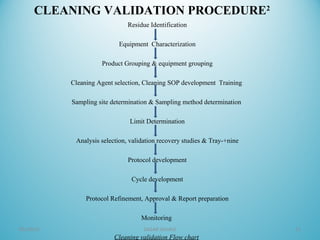
CLEANING VALIDATION PROCEDURE2
Residue Identification
Equipment Characterization
Product Grouping & equipment grouping
Cleaning Agent selection, Cleaning SOP development Training
Sampling site determination & Sampling method determination
Limit Determination
Analysis selection, validation recovery studies & Tray-+nine
Protocol development
Cycle development
Protocol Refinement, Approval & Report preparation
Monitoring
Cleaning validation Flow chart
05/16/16 SAGAR SAVALE 11
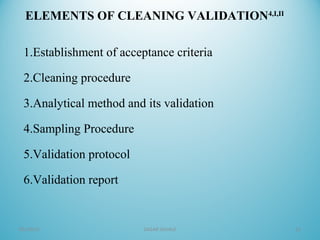
ELEMENTS OF CLEANING VALIDATION4,I,II
1.Establishment of acceptance criteria
2.Cleaning procedure
3.Analytical method and its validation
4.Sampling Procedure
5.Validation protocol
6.Validation report
05/16/16 SAGAR SAVALE 12
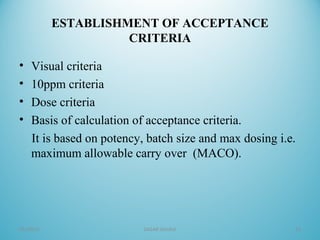
ESTABLISHMENT OF ACCEPTANCE
CRITERIA
• Visual criteria
• 10ppm criteria
• Dose criteria
• Basis of calculation of acceptance criteria.
It is based on potency, batch size and max dosing i.e.
maximum allowable carry over (MACO).
05/16/16 SAGAR SAVALE 13
ESTABLISHMENT OF ACCEPTANCE
CRITERIA
1.Visual Inspection: Visually clean means that the surfaces have no visible
residues when viewed under appropriate lighting.
2. 10 ppm criterion
Any active ingredient can be present in a subsequently manufactured
product at a maximum level of 10 ppm.
Milligrams of active ingredient in product A permitted per 4 inch2
swab area
= R x S x U x T
R = 10mg active ingredient of product A in
one kg of product B
S = Number of kilograms per batch of final
mixture of product B
T = Equipment surface in common between
product A & B expressed as square
inches.
U = 4 inch2
/swab.
05/16/16 SAGAR SAVALE 14
ESTABLISHMENT OF ACCEPTANCE
CRITERIA
1. The limits should be practical, achievable and
verifiable.
a. The approach for setting limits can be:
- product specific Cleaning Validation for all
products,
- grouping into product families and choosing a
"worst case" product,
- grouping into groups of risk (e.g. very soluble
products, similar potency, highly toxic products,
difficult to detect).
b. Carry-over of product residues should meet defined
criteria,
05/16/16 SAGAR SAVALE 15
For example the most stringent of the following
three criteria:
(a) No more than 0.1% of the normal therapeutic dose
of any product will appear in the maximum daily
dose of the following product,
(b) No more than 10 ppm of any product will appear
in another product,
(c) No quantity of residue should be visible on the
equipment after cleaning procedures are performed.
(d) For certain allergenic ingredients, penicillin,
cephalosporin or potent steroids and cytotoxics, the
limit should be below the limit of detection by best
available analytical methods.
05/16/16 SAGAR SAVALE 16
FORMULA FOR CALCULATING MACO2
MACO=T.D*B.S*1000*1000*Safety Factor
L.D.D
Where,MACO=Maximum allowable Carry over
T.D.=Therapeutic Dose of Previous Batch(Product)
B.S.=Minimum Batch Size of Next product
L.D.D=Largest daily dose next batch(Product)
Safety Factor for injectables =0.0001
for solids, orals=0.001
05/16/16 SAGAR SAVALE 17
OR
MACO = I/J x K/L x M
where
I = smallest strength of product ‘A' (previous product)
manufactured (safety factor 1000).
J= maxim number of dose units of product ‘B’ (next
product) administrated / day.
K= number of dose units per batch of product ‘B’.
L= equipment surface area in common between products
‘A’ and ‘B’ expressed as square centimeters.
M= sampling surface area
( product ‘A’ is previous product &product ‘B’is next
product).05/16/16 SAGAR SAVALE 18
SAFETY FACTOR2
Dosage Form Safety Factor
Research compound
allergenics, toxic
1/100,000 to 1/10,000
Intravenous products 1/10,000 to 1/5,000
Opthalmic products 1/5,000 to 1/1,000
Oral dosage form(Tablet
Capsule, Caplets)
1/1,000 to 1/5,000
Topical products(ointment
& creams)
1/100 to 1/1,000
05/16/16 SAGAR SAVALE 19
WHY CLEANING PROCEDURES IS NECESSARY5
?
• Pharmaceutical products and API can be
contaminated by other pharmaceutical products,
cleaning agent & microbiological contamination.
• It is regulatory requirement in pharmaceutical product
manufacture the concern is the same-assurance that
equipment is clean and that product quality and
safety are maintained.
• It is also assure from an internal control and
compliance point of view the quality of manufacture.
05/16/16 SAGAR SAVALE 20
CLEANING PROCEDURE5,6
Cleaning processes:-
- The equipment cleaning procedures involves any one
of the following types of cleaning Process based on
the manufacturing situation.
- Batch to Batch cleaning:
clean with dry duster & Vaccum.
- Product to Product cleaning
cleaning by using soap solution followed by treated
water, finally rinsing with purified water & mopping
with Isopropyl alcohol.
05/16/16 SAGAR SAVALE 21
SAMPLING PROCEDURE6,I
• Direct surface sampling (Swab method)
-Possible to recover dried residues
• Indirect sampling (Rinse method )
-Sampling from wide area is possible
-Sampling is possible from a position not accessible
by hand.
-Sample shall be taken after the final cleaning of
equipment.
05/16/16 SAGAR SAVALE 22
FACTORS AFFECTS CLEANING PROCEDURE4
1. Time
2. Temperature
3. Selection Cleaning agent
4. Mechanical Force
05/16/16 SAGAR SAVALE 23
ANALYTICAL METHOD & ITS VALIDATION1,3
• Analytical methods used to detect residuals or
contaminants should be specific, sensitivity.
• It should be validated before the cleaning validation
study is carried out.
• Only worst cases analytical method validation
perform.
05/16/16 SAGAR SAVALE 24
SPECIFIC AND NON-SPECIFIC METHODS
• A specific method detects unique compounds in
the presence of potential contaminants. Ex: HPLC.
• Non-specific methods are those methods that detect
any compound that produces a certain response.
Ex: Total Organic Carbon (TOC), pH and
conductivity.
05/16/16 SAGAR SAVALE 25
INVESTIGATIONS AND WORST CASE RATING
(WCR)
A worst case rating study, will prioritise existing drug
substances, in a cleaning validation program, based
on information on applicable criteria chosen by the
company.
a) Hardest to clean: experience from production
b) Solubility in used solvent
c) Highest toxicity
d) Lowest therapeutic dose
e) Lowest limit (based on therapeutic doses / tox. data,
batch sizes, surface areas etc.)
f) Other scientific rationales
05/16/16 SAGAR SAVALE 26
ANALYTICAL METHOD VALIDATION1
• System suitability
• Specificity
• Limit of detection and Limit of Quantitation
• Linearity and Limit of Quantitation
• Recovery
• Precision
• Ruggedness
• Stability of sample solution
05/16/16 SAGAR SAVALE 27
VALIDATION PROTOCOL2
• Objective
• Scope
• Equipment Assembly and cleaning procedure
• Cleaning records of the Equipments
• Sampling plan
• Method of Analysis
• Analytical Method Validation
• Validation summary
05/16/16 SAGAR SAVALE 28
• Documents Attached
• Any changes made against the formally agreed
parameters
• Recomendations
• Review
• Post Approval
• Determination of worst case product
• Analytical raw data
• Microbiological Data
• Solubility
• Daily dose reference
05/16/16 SAGAR SAVALE 29
NEW CHALLENGES IN CLEANING
VALIDATIONIII
• Recently, handling multiple cleaning validation
programs became important due to company mergers
and extensive contracting activities among the
industry.
• The challenges will continue to evolve and the ability
to anticipate potential future challenges and
proactively address these potential challenges by
scientific and systematic approach is critical for the
sustainability of a cleaning validation program.
05/16/16 SAGAR SAVALE 30
CONCLUSION
• By using cleaning validation in pharmaceutical
industry, We avoid the contamination which occur
during the production of dosage form.
• To achieve the high quality, purity & safety of of
product, it is necessity to do the cleaning validation of
any product.
• It is the need of patient compliance.
05/16/16 SAGAR SAVALE 31
REFERENCES
1. Potdar MA, Pharmaceutical Quality Assurance, 2nd
ed., Pune: Nirali Prakashan , 2007, p.8.22-8.31
2. Hall WE ,Validation And Verification Of Cleaning
Processes, In: Nash RA, Watcher AH,
Pharmaceutical Process Validation, 3rd
ed., USA:
Informa Healthcare, 2003, p. 465-505
3. Brewer R, Cleaning Validation for Pharmaceutical,
biopharmaceutical, Cosmetics, Neutraceutical,
Medical Devices & Diagnostic Industries, In:
Carleton FJ, Agalloco J, Validation of
Pharmaceutical Processes: Sterile Products, 2nd
ed.,
USA: Informa healthcare, p.491-517
05/16/16 SAGAR SAVALE 32
4. Cleaning Validation in Active Pharmaceutical
Ingredient Manufacturing Plants, CEFIC-APIC,
September 6, 1999.
5. McLaughlin MC, Zisman AS, A Guide to Critical
cleaning procedure, technique and validation,
Technical Services Staff of Alconox, Inc., 3rd ed,
p.105-112
6. Prabu SL, Suriyaprakash TNK, Cleaning Validation
and its importance in Pharmaceutical Industry,
Pharma Times, 2010, 42(07)
7. Yang P, Burson K, Feder D, Macdonald F, Method
Development of Swab Sampling for Cleaning
Validation of a Residual Active Pharmaceutical
Ingredient , Pharmaceutical Technology Jan. 200505/16/16 SAGAR SAVALE 33
WEB REFERENCES
I. http://www.hsa.gov.sg
II. http://www.picscheme.org
III. http://americanpharmaceuticalreview.com/viewartic
le.aspx?ContentID=138- current challenges
05/16/16 SAGAR SAVALE 34

Cleaning validation

  • 1.
    CLEANING VALIDATION Department ofPharmacy (Pharmaceutics) | Sagar savale 05/16/16 SAGAR SAVALE 1
  • 2.
    CONTENTS • Introduction • CleaningValidation • Rational • Objective • Scope • Contamination • Procedure for Cleaning validation • Elements Of Cleaning validation • New Challenges In Cleaning Validation • References 05/16/16 SAGAR SAVALE 2
  • 3.
    INTRODUCTION1 • Validation: Validationis a documented program that provides high degree of assurance that a specific process, method or system consistently produces a result meeting pre-determined acceptance criteria. • Types Of Validation • Analytical Method Validation • Process Validation • Software Validation • Cleaning Validation 05/16/16 SAGAR SAVALE 3
  • 4.
    CLEANING VALIDATION2 • Definitionspecific to cleaning validation • Cleaning Validation • Cleaning Certification • Cleaning Verification • Basic requirements 05/16/16 SAGAR SAVALE 4
  • 5.
    WHY CLEANING VALIDATIONIS SO IMPORTANT? • Pharmaceuticals can be contaminated by potentially dangerous substances. • Essential to establish adequate cleaning procedures. • Particular attention should be accorded to the validation of cleaning procedures. • Cleaning validation should be performed in order to confirm the effectiveness of a cleaning procedure. • The data should support a conclusion that residues have been reduced to an ‘acceptable’ level. 05/16/16 SAGAR SAVALE 5
  • 6.
    RATIONALII • It isa customer requirement - it ensures the safety and purity of the product. • It is a regulatory requirement in Active Pharmaceutical Ingredient product manufacture. • It also assures from an internal control and compliance point of view the quality of the process. 05/16/16 SAGAR SAVALE 6
  • 7.
    OBJECTIVE OF CLEANINGVALIDATIONI,II • To Avoid the Contamination of subsequent manufactured product by the previously manufactured product. • To design the cleaning procedure in such a way that, the process will reduce the contamination up to the predetermined acceptance criteria. 05/16/16 SAGAR SAVALE 7
  • 8.
    SCOPEII 1. Define thebasic concepts and terms associated with Cleaning Validation in the active Pharmaceutical Ingredient industry. 2. Serve as a guide from which Master plans, Protocols and Reports may be compiled. 05/16/16 SAGAR SAVALE 8
  • 9.
    CLEANING VALIDATION APPROACHES4 •Equipment based cleaning validation Validating the cleaning procedure with the product which is worst on the particular equipment. • Product based cleaning validation Validating the cleaning procedure with the worst case product by considering the common equipment train. 05/16/16 SAGAR SAVALE 9
  • 10.
    CONTAMINATION3 • Definition: • MechanismOf Contamination • Cross Contamination • Microbial Contamination • By Cleaning Agent • By Other Materials 05/16/16 SAGAR SAVALE 10
  • 11.
    CLEANING VALIDATION PROCEDURE2 ResidueIdentification Equipment Characterization Product Grouping & equipment grouping Cleaning Agent selection, Cleaning SOP development Training Sampling site determination & Sampling method determination Limit Determination Analysis selection, validation recovery studies & Tray-+nine Protocol development Cycle development Protocol Refinement, Approval & Report preparation Monitoring Cleaning validation Flow chart 05/16/16 SAGAR SAVALE 11
  • 12.
    ELEMENTS OF CLEANINGVALIDATION4,I,II 1.Establishment of acceptance criteria 2.Cleaning procedure 3.Analytical method and its validation 4.Sampling Procedure 5.Validation protocol 6.Validation report 05/16/16 SAGAR SAVALE 12
  • 13.
    ESTABLISHMENT OF ACCEPTANCE CRITERIA •Visual criteria • 10ppm criteria • Dose criteria • Basis of calculation of acceptance criteria. It is based on potency, batch size and max dosing i.e. maximum allowable carry over (MACO). 05/16/16 SAGAR SAVALE 13
  • 14.
    ESTABLISHMENT OF ACCEPTANCE CRITERIA 1.VisualInspection: Visually clean means that the surfaces have no visible residues when viewed under appropriate lighting. 2. 10 ppm criterion Any active ingredient can be present in a subsequently manufactured product at a maximum level of 10 ppm. Milligrams of active ingredient in product A permitted per 4 inch2 swab area = R x S x U x T R = 10mg active ingredient of product A in one kg of product B S = Number of kilograms per batch of final mixture of product B T = Equipment surface in common between product A & B expressed as square inches. U = 4 inch2 /swab. 05/16/16 SAGAR SAVALE 14
  • 15.
    ESTABLISHMENT OF ACCEPTANCE CRITERIA 1.The limits should be practical, achievable and verifiable. a. The approach for setting limits can be: - product specific Cleaning Validation for all products, - grouping into product families and choosing a "worst case" product, - grouping into groups of risk (e.g. very soluble products, similar potency, highly toxic products, difficult to detect). b. Carry-over of product residues should meet defined criteria, 05/16/16 SAGAR SAVALE 15
  • 16.
    For example themost stringent of the following three criteria: (a) No more than 0.1% of the normal therapeutic dose of any product will appear in the maximum daily dose of the following product, (b) No more than 10 ppm of any product will appear in another product, (c) No quantity of residue should be visible on the equipment after cleaning procedures are performed. (d) For certain allergenic ingredients, penicillin, cephalosporin or potent steroids and cytotoxics, the limit should be below the limit of detection by best available analytical methods. 05/16/16 SAGAR SAVALE 16
  • 17.
    FORMULA FOR CALCULATINGMACO2 MACO=T.D*B.S*1000*1000*Safety Factor L.D.D Where,MACO=Maximum allowable Carry over T.D.=Therapeutic Dose of Previous Batch(Product) B.S.=Minimum Batch Size of Next product L.D.D=Largest daily dose next batch(Product) Safety Factor for injectables =0.0001 for solids, orals=0.001 05/16/16 SAGAR SAVALE 17
  • 18.
    OR MACO = I/Jx K/L x M where I = smallest strength of product ‘A' (previous product) manufactured (safety factor 1000). J= maxim number of dose units of product ‘B’ (next product) administrated / day. K= number of dose units per batch of product ‘B’. L= equipment surface area in common between products ‘A’ and ‘B’ expressed as square centimeters. M= sampling surface area ( product ‘A’ is previous product &product ‘B’is next product).05/16/16 SAGAR SAVALE 18
  • 19.
    SAFETY FACTOR2 Dosage FormSafety Factor Research compound allergenics, toxic 1/100,000 to 1/10,000 Intravenous products 1/10,000 to 1/5,000 Opthalmic products 1/5,000 to 1/1,000 Oral dosage form(Tablet Capsule, Caplets) 1/1,000 to 1/5,000 Topical products(ointment & creams) 1/100 to 1/1,000 05/16/16 SAGAR SAVALE 19
  • 20.
    WHY CLEANING PROCEDURESIS NECESSARY5 ? • Pharmaceutical products and API can be contaminated by other pharmaceutical products, cleaning agent & microbiological contamination. • It is regulatory requirement in pharmaceutical product manufacture the concern is the same-assurance that equipment is clean and that product quality and safety are maintained. • It is also assure from an internal control and compliance point of view the quality of manufacture. 05/16/16 SAGAR SAVALE 20
  • 21.
    CLEANING PROCEDURE5,6 Cleaning processes:- -The equipment cleaning procedures involves any one of the following types of cleaning Process based on the manufacturing situation. - Batch to Batch cleaning: clean with dry duster & Vaccum. - Product to Product cleaning cleaning by using soap solution followed by treated water, finally rinsing with purified water & mopping with Isopropyl alcohol. 05/16/16 SAGAR SAVALE 21
  • 22.
    SAMPLING PROCEDURE6,I • Directsurface sampling (Swab method) -Possible to recover dried residues • Indirect sampling (Rinse method ) -Sampling from wide area is possible -Sampling is possible from a position not accessible by hand. -Sample shall be taken after the final cleaning of equipment. 05/16/16 SAGAR SAVALE 22
  • 23.
    FACTORS AFFECTS CLEANINGPROCEDURE4 1. Time 2. Temperature 3. Selection Cleaning agent 4. Mechanical Force 05/16/16 SAGAR SAVALE 23
  • 24.
    ANALYTICAL METHOD &ITS VALIDATION1,3 • Analytical methods used to detect residuals or contaminants should be specific, sensitivity. • It should be validated before the cleaning validation study is carried out. • Only worst cases analytical method validation perform. 05/16/16 SAGAR SAVALE 24
  • 25.
    SPECIFIC AND NON-SPECIFICMETHODS • A specific method detects unique compounds in the presence of potential contaminants. Ex: HPLC. • Non-specific methods are those methods that detect any compound that produces a certain response. Ex: Total Organic Carbon (TOC), pH and conductivity. 05/16/16 SAGAR SAVALE 25
  • 26.
    INVESTIGATIONS AND WORSTCASE RATING (WCR) A worst case rating study, will prioritise existing drug substances, in a cleaning validation program, based on information on applicable criteria chosen by the company. a) Hardest to clean: experience from production b) Solubility in used solvent c) Highest toxicity d) Lowest therapeutic dose e) Lowest limit (based on therapeutic doses / tox. data, batch sizes, surface areas etc.) f) Other scientific rationales 05/16/16 SAGAR SAVALE 26
  • 27.
    ANALYTICAL METHOD VALIDATION1 •System suitability • Specificity • Limit of detection and Limit of Quantitation • Linearity and Limit of Quantitation • Recovery • Precision • Ruggedness • Stability of sample solution 05/16/16 SAGAR SAVALE 27
  • 28.
    VALIDATION PROTOCOL2 • Objective •Scope • Equipment Assembly and cleaning procedure • Cleaning records of the Equipments • Sampling plan • Method of Analysis • Analytical Method Validation • Validation summary 05/16/16 SAGAR SAVALE 28
  • 29.
    • Documents Attached •Any changes made against the formally agreed parameters • Recomendations • Review • Post Approval • Determination of worst case product • Analytical raw data • Microbiological Data • Solubility • Daily dose reference 05/16/16 SAGAR SAVALE 29
  • 30.
    NEW CHALLENGES INCLEANING VALIDATIONIII • Recently, handling multiple cleaning validation programs became important due to company mergers and extensive contracting activities among the industry. • The challenges will continue to evolve and the ability to anticipate potential future challenges and proactively address these potential challenges by scientific and systematic approach is critical for the sustainability of a cleaning validation program. 05/16/16 SAGAR SAVALE 30
  • 31.
    CONCLUSION • By usingcleaning validation in pharmaceutical industry, We avoid the contamination which occur during the production of dosage form. • To achieve the high quality, purity & safety of of product, it is necessity to do the cleaning validation of any product. • It is the need of patient compliance. 05/16/16 SAGAR SAVALE 31
  • 32.
    REFERENCES 1. Potdar MA,Pharmaceutical Quality Assurance, 2nd ed., Pune: Nirali Prakashan , 2007, p.8.22-8.31 2. Hall WE ,Validation And Verification Of Cleaning Processes, In: Nash RA, Watcher AH, Pharmaceutical Process Validation, 3rd ed., USA: Informa Healthcare, 2003, p. 465-505 3. Brewer R, Cleaning Validation for Pharmaceutical, biopharmaceutical, Cosmetics, Neutraceutical, Medical Devices & Diagnostic Industries, In: Carleton FJ, Agalloco J, Validation of Pharmaceutical Processes: Sterile Products, 2nd ed., USA: Informa healthcare, p.491-517 05/16/16 SAGAR SAVALE 32
  • 33.
    4. Cleaning Validationin Active Pharmaceutical Ingredient Manufacturing Plants, CEFIC-APIC, September 6, 1999. 5. McLaughlin MC, Zisman AS, A Guide to Critical cleaning procedure, technique and validation, Technical Services Staff of Alconox, Inc., 3rd ed, p.105-112 6. Prabu SL, Suriyaprakash TNK, Cleaning Validation and its importance in Pharmaceutical Industry, Pharma Times, 2010, 42(07) 7. Yang P, Burson K, Feder D, Macdonald F, Method Development of Swab Sampling for Cleaning Validation of a Residual Active Pharmaceutical Ingredient , Pharmaceutical Technology Jan. 200505/16/16 SAGAR SAVALE 33
  • 34.
    WEB REFERENCES I. http://www.hsa.gov.sg II.http://www.picscheme.org III. http://americanpharmaceuticalreview.com/viewartic le.aspx?ContentID=138- current challenges 05/16/16 SAGAR SAVALE 34