IN THE NAME OF
ALLAH
THE MOST
BENIFICIENT
THE MOST MERCIFUL
PROTEIN
FOLDING
2
3
Protein are amino acids chains that
acquire their biological properties by
folding in to unique 3 D structure i. e.
unfolded to native state.
Some physical forces help the protein
folding such as hydrophobic effect,
electrostatic interaction etc.
DEFINITION
4
Three major problem of protein folding
 Protein code
 Structure prediction
 Folding speed and Mechanism
Folding problem
5
ANFINSEN
EXPERIMENT
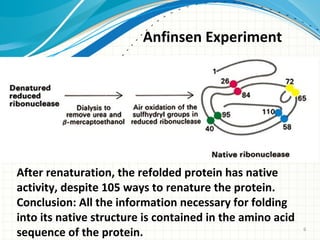
Denaturation of
ribonuclease A (4
disulfide bonds), with
8 M Urea containing
b-mercaptoethanol,
leads to random coil
and no activity
6
Anfinsen Experiment
After renaturation, the refolded protein has native
activity, despite 105 ways to renature the protein.
Conclusion: All the information necessary for folding
into its native structure is contained in the amino acid
sequence of the protein.
7
 Remove b-mercaptoethanol only,
oxidation of the sulfhydryl group,
then remove urea → scrambled
protein, no activity
 Further addition of trace
amounts of b-mercaptoethanol
converts the scrambled form into
native form.
 Conclusion: The native form of
a protein has the thermodynamic-
ally most stable structure
Anfinsen Experiment
8
 Under optimal experimental conditions, proteins
often fold more slowly in vitro than they fold in
vivo.
 Reason is that folding proteins often form disulfide
bonds not present in the native proteins, which
then slowly form native disulfide bonds through
the process of disulfide interchange.
 Protein disulfide Isomerase (PDI) catalyzes this
process.
 Indeed, the observation that RNase A folds so
much faster in vivo than in vitro led “Anfinsen” to
discover this enzyme.
Anfinsen discover Protein
Disulphide Isomerase (PDI)
9
The Levinthal paradox
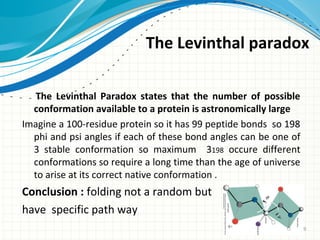
The Levinthal Paradox states that the number of possible
conformation available to a protein is astronomically large
Imagine a 100-residue protein so it has 99 peptide bonds so 198
phi and psi angles if each of these bond angles can be one of
3 stable conformation so maximum 3198 occure different
conformations so require a long time than the age of universe
to arise at its correct native conformation .
Conclusion : folding not a random but
have specific path way
10
11
Protein folding
models
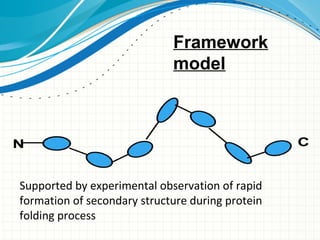
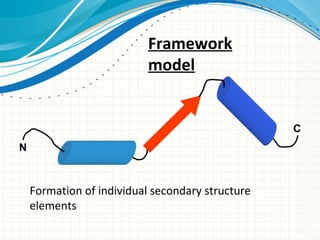
Framework model
This suggest that folding is start with formation of
secondary structure which then interact to form a
more advanced folding intermediate.
Cont.
Framework
model
Supported by experimental observation of rapid
formation of secondary structure during protein
folding process
Framework
model
Formation of individual secondary structure
elements
Molten globule
state
The molten globule state is an intermediate
conformational state between the native and fully
unfold states of globular protein.
Some character of molten state:
The presence of native like content of secondary structure
The absence of specific tertiary structure produced by the
tight packing of amino acid side chain
 Model for early stages of protein folding (hydrophobic
collapse
COLLAPSE
MODEL OF
PROTEIN
FOLDING
 Experimental observations indicate that protein folding
begins with the formation of local segments of secondary
structure (α helices and ß sheets)
 Since native proteins contain compact hydrophobic cores,
it is likely that the driving force in protein folding is what
has been termed a hydrophobic collapse.
 The collapsed state is known as a molten globule, a
species that has much of the secondary structure of the
native protein but little of its tertiary structure.
16
 During this intermediate stage, the native like elements
are thought to take the form of sub domains that are not
yet properly docked to form domains.
 In the final stage of folding, the protein undergoes a
series of complex motions in which it attains its relatively
rigid internal side chain packing and hydrogen bonding
while it expels the remaining water molecules from its
hydrophobic core.
Collapse model of protein
folding
17
A folding protein must proceed from a
high-energy, high-entropy state to a
low-energy, low-entropy state.
An unfolded polypeptide has many
possible conformations (high entropy).
As it folds into an ever-decreasing number
of possible conformations, its entropy
and free energy decrease.
18
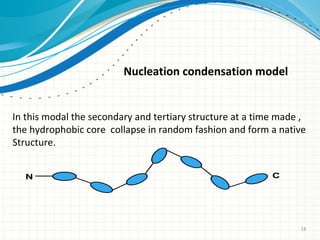
Nucleation condensation model
In this modal the secondary and tertiary structure at a time made ,
the hydrophobic core collapse in random fashion and form a native
Structure.
19
Formation of a nucleus of hydrophobic residues
Expansion of nucleus
Nucleation condensation model
“Evidently, proteins have evolved to have efficient
folding pathways as well as stable native
conformations.”
Nevertheless, misfolded proteins do occur in
nature, and their accumulation is believed to be the
cause of a variety of diseases.
MOLECULAR
CHAPERONES
ASSIST PROTEIN
FOLDING:
21
Definition
In molecular biology , Chaperones are proteins that
assist covalent folding or unfolding and assembly or
disassembly of other macromolecular structure.
They bind to unfolded and partially folded polypeptide
chains to prevent the improper association of exposed
hydrophobic segments that might lead to non-native
folding as well as polypeptide aggregation and
precipitation.
22
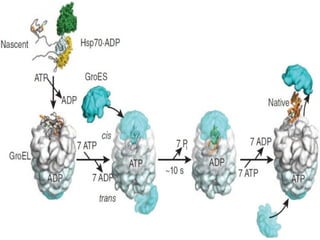
There are two major classes of molecular
chaperones in both prokaryotes and
eukaryotes:
The Hsp70 family of 70-kD proteins
The chaperonins (large multisubunit proteins).
Chaperones
23
Hsp70 proteins:
An Hsp70 protein binds to a newly synthesized polypeptide.
The Hsp70 chaperone probably helps prevent premature
folding.
24
chaperon Protein Folding Process
Unfolded substrate proteins bind to a hydrophobic
binding patch on the interior rim of the open cavity of
GroEL.
Binding of substrate protein in this manner, in addition
to binding of ATP, induces a conformational change
that allows association of the binary complex with a
separate lid structure, GroES.
ATP is hydrolyzed and relase the GroES, which promote
folding of protein
25
Thanks for your
attention please don’t
ask too much

Protein folding slids

  • 1.
    IN THE NAMEOF ALLAH THE MOST BENIFICIENT THE MOST MERCIFUL
  • 2.
  • 3.
    3 Protein are aminoacids chains that acquire their biological properties by folding in to unique 3 D structure i. e. unfolded to native state. Some physical forces help the protein folding such as hydrophobic effect, electrostatic interaction etc. DEFINITION
  • 4.
    4 Three major problemof protein folding  Protein code  Structure prediction  Folding speed and Mechanism Folding problem
  • 5.
    5 ANFINSEN EXPERIMENT Denaturation of ribonuclease A(4 disulfide bonds), with 8 M Urea containing b-mercaptoethanol, leads to random coil and no activity
  • 6.
    6 Anfinsen Experiment After renaturation,the refolded protein has native activity, despite 105 ways to renature the protein. Conclusion: All the information necessary for folding into its native structure is contained in the amino acid sequence of the protein.
  • 7.
    7  Remove b-mercaptoethanolonly, oxidation of the sulfhydryl group, then remove urea → scrambled protein, no activity  Further addition of trace amounts of b-mercaptoethanol converts the scrambled form into native form.  Conclusion: The native form of a protein has the thermodynamic- ally most stable structure Anfinsen Experiment
  • 8.
    8  Under optimalexperimental conditions, proteins often fold more slowly in vitro than they fold in vivo.  Reason is that folding proteins often form disulfide bonds not present in the native proteins, which then slowly form native disulfide bonds through the process of disulfide interchange.  Protein disulfide Isomerase (PDI) catalyzes this process.  Indeed, the observation that RNase A folds so much faster in vivo than in vitro led “Anfinsen” to discover this enzyme. Anfinsen discover Protein Disulphide Isomerase (PDI)
  • 9.
    9 The Levinthal paradox TheLevinthal Paradox states that the number of possible conformation available to a protein is astronomically large Imagine a 100-residue protein so it has 99 peptide bonds so 198 phi and psi angles if each of these bond angles can be one of 3 stable conformation so maximum 3198 occure different conformations so require a long time than the age of universe to arise at its correct native conformation . Conclusion : folding not a random but have specific path way
  • 10.
  • 11.
    11 Protein folding models Framework model Thissuggest that folding is start with formation of secondary structure which then interact to form a more advanced folding intermediate. Cont.
  • 12.
    Framework model Supported by experimentalobservation of rapid formation of secondary structure during protein folding process
  • 13.
    Framework model Formation of individualsecondary structure elements
  • 14.
    Molten globule state The moltenglobule state is an intermediate conformational state between the native and fully unfold states of globular protein. Some character of molten state: The presence of native like content of secondary structure The absence of specific tertiary structure produced by the tight packing of amino acid side chain  Model for early stages of protein folding (hydrophobic collapse
  • 15.
    COLLAPSE MODEL OF PROTEIN FOLDING  Experimentalobservations indicate that protein folding begins with the formation of local segments of secondary structure (α helices and ß sheets)  Since native proteins contain compact hydrophobic cores, it is likely that the driving force in protein folding is what has been termed a hydrophobic collapse.  The collapsed state is known as a molten globule, a species that has much of the secondary structure of the native protein but little of its tertiary structure.
  • 16.
    16  During thisintermediate stage, the native like elements are thought to take the form of sub domains that are not yet properly docked to form domains.  In the final stage of folding, the protein undergoes a series of complex motions in which it attains its relatively rigid internal side chain packing and hydrogen bonding while it expels the remaining water molecules from its hydrophobic core. Collapse model of protein folding
  • 17.
    17 A folding proteinmust proceed from a high-energy, high-entropy state to a low-energy, low-entropy state. An unfolded polypeptide has many possible conformations (high entropy). As it folds into an ever-decreasing number of possible conformations, its entropy and free energy decrease.
  • 18.
    18 Nucleation condensation model Inthis modal the secondary and tertiary structure at a time made , the hydrophobic core collapse in random fashion and form a native Structure.
  • 19.
    19 Formation of anucleus of hydrophobic residues Expansion of nucleus Nucleation condensation model
  • 20.
    “Evidently, proteins haveevolved to have efficient folding pathways as well as stable native conformations.” Nevertheless, misfolded proteins do occur in nature, and their accumulation is believed to be the cause of a variety of diseases.
  • 21.
    MOLECULAR CHAPERONES ASSIST PROTEIN FOLDING: 21 Definition In molecularbiology , Chaperones are proteins that assist covalent folding or unfolding and assembly or disassembly of other macromolecular structure. They bind to unfolded and partially folded polypeptide chains to prevent the improper association of exposed hydrophobic segments that might lead to non-native folding as well as polypeptide aggregation and precipitation.
  • 22.
    22 There are twomajor classes of molecular chaperones in both prokaryotes and eukaryotes: The Hsp70 family of 70-kD proteins The chaperonins (large multisubunit proteins). Chaperones
  • 23.
    23 Hsp70 proteins: An Hsp70protein binds to a newly synthesized polypeptide. The Hsp70 chaperone probably helps prevent premature folding.
  • 24.
    24 chaperon Protein FoldingProcess Unfolded substrate proteins bind to a hydrophobic binding patch on the interior rim of the open cavity of GroEL. Binding of substrate protein in this manner, in addition to binding of ATP, induces a conformational change that allows association of the binary complex with a separate lid structure, GroES. ATP is hydrolyzed and relase the GroES, which promote folding of protein
  • 25.
  • 26.
    Thanks for your attentionplease don’t ask too much

Editor's Notes

  • #2 This template can be used as a starter file for presenting training materials in a group setting. Sections Right-click on a slide to add sections. Sections can help to organize your slides or facilitate collaboration between multiple authors. Notes Use the Notes section for delivery notes or to provide additional details for the audience. View these notes in Presentation View during your presentation. Keep in mind the font size (important for accessibility, visibility, videotaping, and online production) Coordinated colors Pay particular attention to the graphs, charts, and text boxes. Consider that attendees will print in black and white or grayscale. Run a test print to make sure your colors work when printed in pure black and white and grayscale. Graphics, tables, and graphs Keep it simple: If possible, use consistent, non-distracting styles and colors. Label all graphs and tables.