Presented By:
SATYA PRAKASH RANJAN
MCA/25005/18
CONTENTS
INTRODUCTION TO PROTEIN
STRUCTURE
PRIMARY STRUCTURE
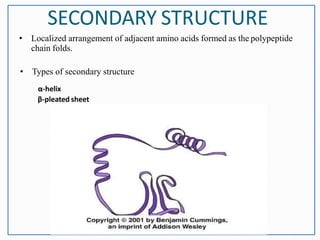
SECONDARY STRUCTURE
TERTIARY STRUCTURE
QUATERNARY STRUCTURE
By,
SATYA PRAKASH RANJAN
• Proteins are an important class of
biological macromolecules
which are the polymers of amino
acids.
• Biochemists have distinguished
several levels of structural
organization of proteins. They
are:
– Primary structure
– Secondary structure
– Tertiary structure
– Quaternary structure
INTRODUCTION
PRIMARY STRUCTURE
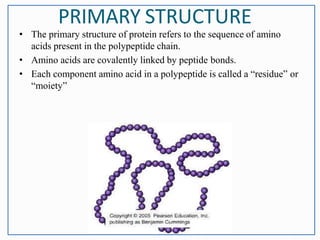
• The primary structure of protein refers to the sequence of amino
acids present in the polypeptide chain.
• Amino acids are covalently linked by peptide bonds.
• Each component amino acid in a polypeptide is called a “residue” or
“moiety”
SECONDARY STRUCTURE
• Localized arrangement of adjacent amino acids formed as the polypeptide
chain folds.
• Types of secondary structure
α-helix
β-pleated sheet
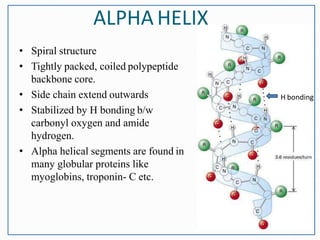
• Spiral structure
• Tightly packed, coiled polypeptide
backbone core.
• Side chain extend outwards
• Stabilized by H bonding b/w
carbonyl oxygen and amide
hydrogen.
• Alpha helical segments are found in
many globular proteins like
myoglobins, troponin- C etc.
ALPHA HELIX
H bonding
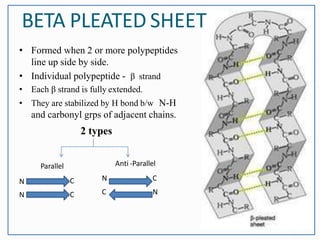
BETA PLEATED SHEET
• Formed when 2 or more polypeptides
line up side by side.
• Individual polypeptide - β strand
• Each β strand is fully extended.
• They are stabilized by H bond b/w N-H
and carbonyl grps of adjacent chains.
2 types
Parallel Anti -Parallel
N
N
C
C
C
N
N
C
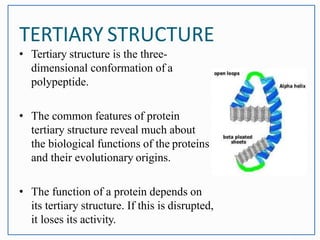
TERTIARY STRUCTURE
• Tertiary structure is the three-
dimensional conformation of a
polypeptide.
• The common features of protein
tertiary structure reveal much about
the biological functions of the proteins
and their evolutionary origins.
• The function of a protein depends on
its tertiary structure. If this is disrupted,
it loses its activity.
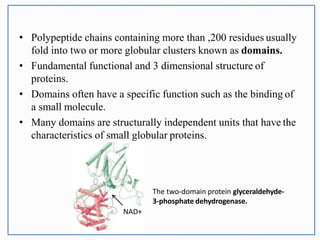
• Polypeptide chains containing more than ,200 residues usually
fold into two or more globular clusters known as domains.
• Fundamental functional and 3 dimensional structure of
proteins.
• Domains often have a specific function such as the binding of
a small molecule.
• Many domains are structurally independent units that have the
characteristics of small globular proteins.
The two-domain protein glyceraldehyde-
3-phosphate dehydrogenase.
NAD+
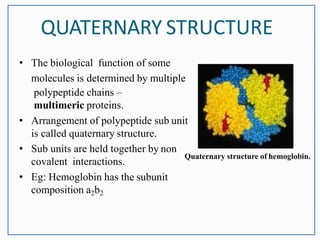
• The biological function of some
molecules is determined by multiple
polypeptide chains –
multimeric proteins.
• Arrangement of polypeptide sub unit
is called quaternary structure.
• Sub units are held together by non
covalent interactions.
• Eg: Hemoglobin has the subunit
composition a2b2
QUATERNARY STRUCTURE
Quaternary structure of hemoglobin.
RECENT DEVELOPMENTS
• A team of scientists at The Scripps Research Institute and the
National Institutes of Health (NIH) has discovered the
structure of a protein – dynamin, that pinches off tiny pouches
from cell’s outer membranes.
• Scientists at the Institute of Structural and MolecularBiology
have revealed the structure of a complex protein called FimD
that acts as an assembly platform for the pili of cystitis
bacteria.
• Researchers from the Walter and Eliza Hall Institute have
found a structural surprise in a type of protein, Bcl-w ,that
encourages cell survival, raising interesting questions about
how the proteins function to influence programmed cell death.
CONCLUSION
• Proteins are extraordinarily complex molecules. Of all the
molecules encountered in living organisms, proteins have the
most diverse functions.
• So a basic understanding of the structure of proteins is
necessary to comprehend its role in organisms.
• Further researches will provide more insight into the structure
of several other proteins in the coming year.
REFERENCE
• https://www.khanacademy.org/science/biology/macromo
lecules/proteins-and-amino-acids/a/orders-of-protein-
structure?utm_account=Grant&utm_campaignname=Gra
nt_Science_Dynamic&gclid=Cj0KCQjw7sDlBRC9ARIsAD-
pDFrIMCZxtuUDmbRmMkoVppDrxrkBpIZh64xit8bD9jK
-jgh93cCE2zwaArahEALw_wcB
• step. closer. with. discovery. protein. structure
• https://wp.nyu.edu/
step.closer.with.discovery.bacterial.protein.structure
• https://www.youtube.com/watch?v=FkjilyNaT3
M s
• Channel name shomu’s biology
THANK YOU

Protein Structure

  • 1.
    Presented By: SATYA PRAKASHRANJAN MCA/25005/18
  • 2.
    CONTENTS INTRODUCTION TO PROTEIN STRUCTURE PRIMARYSTRUCTURE SECONDARY STRUCTURE TERTIARY STRUCTURE QUATERNARY STRUCTURE
  • 3.
  • 4.
    • Proteins arean important class of biological macromolecules which are the polymers of amino acids. • Biochemists have distinguished several levels of structural organization of proteins. They are: – Primary structure – Secondary structure – Tertiary structure – Quaternary structure INTRODUCTION
  • 5.
    PRIMARY STRUCTURE • Theprimary structure of protein refers to the sequence of amino acids present in the polypeptide chain. • Amino acids are covalently linked by peptide bonds. • Each component amino acid in a polypeptide is called a “residue” or “moiety”
  • 6.
    SECONDARY STRUCTURE • Localizedarrangement of adjacent amino acids formed as the polypeptide chain folds. • Types of secondary structure α-helix β-pleated sheet
  • 7.
    • Spiral structure •Tightly packed, coiled polypeptide backbone core. • Side chain extend outwards • Stabilized by H bonding b/w carbonyl oxygen and amide hydrogen. • Alpha helical segments are found in many globular proteins like myoglobins, troponin- C etc. ALPHA HELIX H bonding
  • 8.
    BETA PLEATED SHEET •Formed when 2 or more polypeptides line up side by side. • Individual polypeptide - β strand • Each β strand is fully extended. • They are stabilized by H bond b/w N-H and carbonyl grps of adjacent chains. 2 types Parallel Anti -Parallel N N C C C N N C
  • 9.
    TERTIARY STRUCTURE • Tertiarystructure is the three- dimensional conformation of a polypeptide. • The common features of protein tertiary structure reveal much about the biological functions of the proteins and their evolutionary origins. • The function of a protein depends on its tertiary structure. If this is disrupted, it loses its activity.
  • 10.
    • Polypeptide chainscontaining more than ,200 residues usually fold into two or more globular clusters known as domains. • Fundamental functional and 3 dimensional structure of proteins. • Domains often have a specific function such as the binding of a small molecule. • Many domains are structurally independent units that have the characteristics of small globular proteins. The two-domain protein glyceraldehyde- 3-phosphate dehydrogenase. NAD+
  • 11.
    • The biologicalfunction of some molecules is determined by multiple polypeptide chains – multimeric proteins. • Arrangement of polypeptide sub unit is called quaternary structure. • Sub units are held together by non covalent interactions. • Eg: Hemoglobin has the subunit composition a2b2 QUATERNARY STRUCTURE Quaternary structure of hemoglobin.
  • 12.
    RECENT DEVELOPMENTS • Ateam of scientists at The Scripps Research Institute and the National Institutes of Health (NIH) has discovered the structure of a protein – dynamin, that pinches off tiny pouches from cell’s outer membranes. • Scientists at the Institute of Structural and MolecularBiology have revealed the structure of a complex protein called FimD that acts as an assembly platform for the pili of cystitis bacteria. • Researchers from the Walter and Eliza Hall Institute have found a structural surprise in a type of protein, Bcl-w ,that encourages cell survival, raising interesting questions about how the proteins function to influence programmed cell death.
  • 13.
    CONCLUSION • Proteins areextraordinarily complex molecules. Of all the molecules encountered in living organisms, proteins have the most diverse functions. • So a basic understanding of the structure of proteins is necessary to comprehend its role in organisms. • Further researches will provide more insight into the structure of several other proteins in the coming year.
  • 14.
    REFERENCE • https://www.khanacademy.org/science/biology/macromo lecules/proteins-and-amino-acids/a/orders-of-protein- structure?utm_account=Grant&utm_campaignname=Gra nt_Science_Dynamic&gclid=Cj0KCQjw7sDlBRC9ARIsAD- pDFrIMCZxtuUDmbRmMkoVppDrxrkBpIZh64xit8bD9jK -jgh93cCE2zwaArahEALw_wcB • step.closer. with. discovery. protein. structure • https://wp.nyu.edu/ step.closer.with.discovery.bacterial.protein.structure • https://www.youtube.com/watch?v=FkjilyNaT3 M s • Channel name shomu’s biology
  • 15.