NUCLEAR ENVELOPE
CONTENT
• Introduction
• Occurrence and position
• Ultra structure
INTRODUCTION
• Nuclei were first discovered and named by robert
brown in 1833 in the plant cells and were quikly
recognized as a constant feature of all animal and
plant cells.
• Barbara mcclintock [1934] recognized and named
nucleolar organizers in the chromosomes.
• Ultra sturcture of nuclear envelope, pore kirschner
et al;[1977] scatted and thoman [1978], etc.
Occurrence and position
• The nucleus is found in all the eukaryotic cells
of the plant and animals.
• However,certain eukaryotic cells such as the
mature sieve tubes of higher plants and
mammaliam erythrocytes contain no nucleus.
• The position or location of the nucleus in a cell
is usually the characteristic of the cell type and
it is often variable.
• Usually the nucleus remains located in the
center.
ULTRA STRUCTURE
 The nucleus is compossed of following structures:
1) Nuclear envelope
2) Nucleoplasm
3) The chromatin fibres
4) The nucleolus
Nuclear envelope
 The nuclear envelope enckloses the DNA and define the
nuclear compartment of interphase and prophase nucei.
 The spharical inner nuclear membrane contains specific
proteins that act as binding sites for the supporting
fibrous sheath of intermediate filaments [if] called
nuclear lmina.
NUCLEAR
CHEMICAL COMPOSITION
• Mainly consist of nucleoprotein,inorganic salts
& lipid occur in smaller amounts.
• The nucleoproteins are divided into 3 groups:
1) Basic proteins
2) Acidic proteins
3) Nucleic acids
• The proteins includes DNA poly.,RNA poly.&
histones which are located specifically inside
the nucleus.
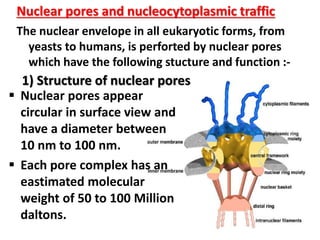
Nuclear pores and nucleocytoplasmic traffic
The nuclear envelope in all eukaryotic forms, from
yeasts to humans, is perforted by nuclear pores
which have the following stucture and function :-
1) Structure of nuclear pores
 Nuclear pores appear
circular in surface view and
have a diameter between
10 nm to 100 nm.
 Each pore complex has an
eastimated molecular
weight of 50 to 100 Million
daltons.
2) Number of nuclear pores (pore density) -:
 in nuclear of mammals it has been calculated
that nuclear pores account for 5 to 15 percent of
the surface area of the nuclear membrane.
 The number pores in the
nuclear envelope or pore
density seems to correlate
with the transcripational
activity of the cell.
These cells are highly
differentiated but
metabolically inactive and
they are non-proliferating
cells.
3) Arrangement of nuclear pores on
nuclear envelope
In somatic cells, the nuclear pores are evenly or
randomly distributed over the surface of nuclear
envelope.
How ever,pore arrangement in other cell types is
not random but rather range from rows. (e.g
spores of Eqisetum) to clusters (e.g.Oocytes of
xenopus leaves) to hexagonal (e.g Malpighian
tubules of leaf hoppers) packing order (see
Thorpe, 1984
Spores of
Equisetum
Oocytes of
xenopus Laevis
4) Nucleo – cytoplasmic traffic
 The pore appears to function like a close fitting
diaphragm that opens to just the right extent
when activated by a signal on an approprite
large protein.
 similar signals are also noted in a short
sequence (126-132 amino acids ) of simian virus
40 T antigen molecule.
 These short sequences when attached to bigger
molecules allow these bigger molecules to enter
the nucleus via the nuclear pores.
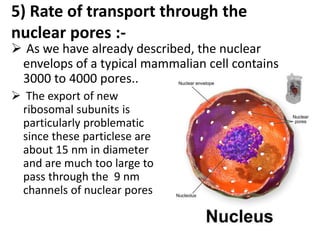
5) Rate of transport through the
nuclear pores :-
 As we have already described, the nuclear
envelops of a typical mammalian cell contains
3000 to 4000 pores..
 The export of new
ribosomal subunits is
particularly problematic
since these particlese are
about 15 nm in diameter
and are much too large to
pass through the 9 nm
channels of nuclear pores
Reference :-
Verma P S
And Agarwal cell Biology
www.nuclear.com
Nuclear envelope

Nuclear envelope

  • 1.
  • 2.
    CONTENT • Introduction • Occurrenceand position • Ultra structure
  • 3.
    INTRODUCTION • Nuclei werefirst discovered and named by robert brown in 1833 in the plant cells and were quikly recognized as a constant feature of all animal and plant cells. • Barbara mcclintock [1934] recognized and named nucleolar organizers in the chromosomes. • Ultra sturcture of nuclear envelope, pore kirschner et al;[1977] scatted and thoman [1978], etc.
  • 4.
    Occurrence and position •The nucleus is found in all the eukaryotic cells of the plant and animals. • However,certain eukaryotic cells such as the mature sieve tubes of higher plants and mammaliam erythrocytes contain no nucleus. • The position or location of the nucleus in a cell is usually the characteristic of the cell type and it is often variable. • Usually the nucleus remains located in the center.
  • 5.
    ULTRA STRUCTURE  Thenucleus is compossed of following structures: 1) Nuclear envelope 2) Nucleoplasm 3) The chromatin fibres 4) The nucleolus Nuclear envelope  The nuclear envelope enckloses the DNA and define the nuclear compartment of interphase and prophase nucei.  The spharical inner nuclear membrane contains specific proteins that act as binding sites for the supporting fibrous sheath of intermediate filaments [if] called nuclear lmina.
  • 6.
  • 7.
    CHEMICAL COMPOSITION • Mainlyconsist of nucleoprotein,inorganic salts & lipid occur in smaller amounts. • The nucleoproteins are divided into 3 groups: 1) Basic proteins 2) Acidic proteins 3) Nucleic acids • The proteins includes DNA poly.,RNA poly.& histones which are located specifically inside the nucleus.
  • 8.
    Nuclear pores andnucleocytoplasmic traffic The nuclear envelope in all eukaryotic forms, from yeasts to humans, is perforted by nuclear pores which have the following stucture and function :- 1) Structure of nuclear pores  Nuclear pores appear circular in surface view and have a diameter between 10 nm to 100 nm.  Each pore complex has an eastimated molecular weight of 50 to 100 Million daltons.
  • 9.
    2) Number ofnuclear pores (pore density) -:  in nuclear of mammals it has been calculated that nuclear pores account for 5 to 15 percent of the surface area of the nuclear membrane.  The number pores in the nuclear envelope or pore density seems to correlate with the transcripational activity of the cell. These cells are highly differentiated but metabolically inactive and they are non-proliferating cells.
  • 10.
    3) Arrangement ofnuclear pores on nuclear envelope In somatic cells, the nuclear pores are evenly or randomly distributed over the surface of nuclear envelope. How ever,pore arrangement in other cell types is not random but rather range from rows. (e.g spores of Eqisetum) to clusters (e.g.Oocytes of xenopus leaves) to hexagonal (e.g Malpighian tubules of leaf hoppers) packing order (see Thorpe, 1984
  • 11.
  • 12.
    4) Nucleo –cytoplasmic traffic  The pore appears to function like a close fitting diaphragm that opens to just the right extent when activated by a signal on an approprite large protein.  similar signals are also noted in a short sequence (126-132 amino acids ) of simian virus 40 T antigen molecule.  These short sequences when attached to bigger molecules allow these bigger molecules to enter the nucleus via the nuclear pores.
  • 13.
    5) Rate oftransport through the nuclear pores :-  As we have already described, the nuclear envelops of a typical mammalian cell contains 3000 to 4000 pores..  The export of new ribosomal subunits is particularly problematic since these particlese are about 15 nm in diameter and are much too large to pass through the 9 nm channels of nuclear pores
  • 14.
    Reference :- Verma PS And Agarwal cell Biology www.nuclear.com