

INTRODUCTION
• TOPIC : CELL NUCLEUS
• DEPARTMENT: ZOOLOGY
• UNIVERSITY OF PESHAWAR
TOPIC OVERVIEW
• HISTORY
• CHARACTERS
• SHAPEANDSIZE
• STRUCTURE
• FUNCTION
History
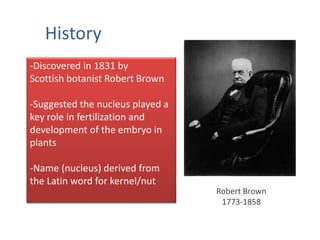
Robert Brown
1773-1858
-Discovered in 1831 by
Scottish botanist Robert Brown
-Suggested the nucleus played a
key role in fertilization and
development of the embryo in
plants
-Name (nucleus) derived from
the Latin word for kernel/nut
Main Characteristics
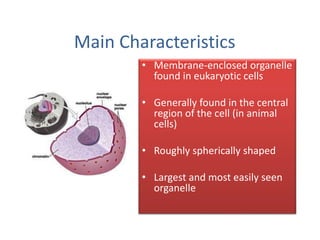
• Membrane-enclosed organelle
found in eukaryotic cells
• Generally found in the central
region of the cell (in animal
cells)
• Roughly spherically shaped
• Largest and most easily seen
organelle
SHAPE AND SIZE
• SPERICAL OR OVAL SHAPE ;
• PARAMISIUM HAVE BEAN SHAPE ,
• SMOTH MUSCLES HAVE ELONGTED
• LOCATED AT THE CENTRE OF CELL
• EXIST IN VERITY OF SHAPES AND SIZES
• DEPEND ON CELL SIZE
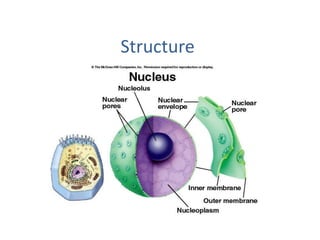
STRUCTURE
• CONSIST OF :
• NUCLEAUR MEMBRANCES
. NUCLEUR PORES
• NUCLEOPLASM
• NUCLEOLUS
• CHROMATIN
.CHROMOSOME
.DNA
.PROTEIN
Structure
NUCLEAR MEMBRANE
• DOUBLE LAYERED COVERING OF NUCLEUS
• SPACE BETWEEN MEMBRANE IS
PERINUCLEUR SPACE (LIPOPROTEIN)
• MAINTAIN SHAPE OF NUCLEUS
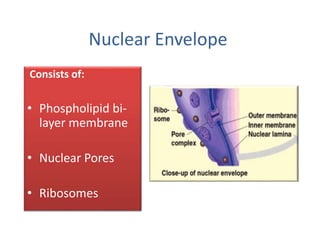
Nuclear Envelope
Consists of:
• Phospholipid bi-
layer membrane
• Nuclear Pores
• Ribosomes
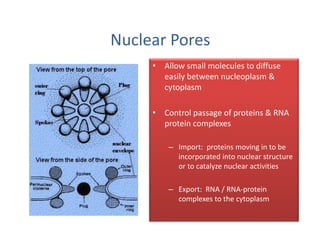
Nuclear Pores
• Allow small molecules to diffuse
easily between nucleoplasm &
cytoplasm
• Control passage of proteins & RNA
protein complexes
– Import: proteins moving in to be
incorporated into nuclear structure
or to catalyze nuclear activities
– Export: RNA / RNA-protein
complexes to the cytoplasm
Nucleoplasm
A jelly-like (made mostly of water) matrix
within the nucleus
All the other materials “float” inside
Also term as “karyolamp”
Helps the nucleus keep its shape and serves
as the median for the transportation of
important molecules within the nucleus
Nucleolus
• Largest structure present inside the
boundaries of the nucleus
• Dark staining zone in center of nucleus
• Where intensive synthesis of ribosomal RNA
takes place
• Main components are ribonucleic acid (RNA),
deoxyribonucleic acid (DNA) and proteins
CHROMATIN
• THIN THREAD LIKE STRUCTURE EMBEDED IN
NUCLEOPLASM CONSISTS OF:
• DNA
• RNA
• HISTONE AND NON HISTONE PROTEIN
• HISTONE ARE BASIC PROTEIN PACKED DNA
TO STRUCTURAL UNIT
• IT CONDENSE TO FORM CHROMOSOME
Chromatin &
Chromosomes
Chromosomes contain DNA in a condensed form
attached to a histone protein.
Chromatin is comprised of DNA. There are two types
based on function.
Heterochromatin: highly condensed,
transcriptionally inactive mostly located
adjacent to the nuclear membrane
Eurochromatin: delicate, less condensed
organization of chromatin, located in a
transcribing cell
* Transcribing means equivalent RNA copies are being made from the DNA to create proteins.
DNA
DNA, or deoxyribonucleic acid, contains
the information needed for the creation
of proteins (which include enzymes and
hormones) and is stored in the nucleus,
as already said, in the form of chromatin
or chromosomes.
The nucleus is the site of DNA
duplication, which is needed for cell
division (mitosis) and organism
reproduction and growth.
Proteins and Cell Regulation
The nucleus oversees cells’ functions and
regulatory mechanisms for keeping the cell
healthy and alive.
The nucleus controls growth of the cell through
the synthesis of structural proteins, energy and
nutrient metabolism.
The nucleus regulates the secretion of ribosomes,
which are made in the nucleolus and are the sites
of gene transcription.
Primary Functions within the Cell
• Repository of genetic information (DNA & RNA)
• Enables the synthesis of nearly all proteins
• Houses the nucleolus
• Responsible for production of ribosomes
• Selective transportation of regulatory factors and
energy molecules through nuclear pores
Functions
The nucleus is often compared to the
“command center,” as it controls all
functions of the cell.
It is important in regulating the actions of
the cells.
It plays an important part in creating the
cell’s proteins.
It is involved in important processes
dealing with DNA and other genetic
molecules.
•Thanks
for bearing
with me
•Any
question
???

Nucleous

  • 1.
    INTRODUCTION • TOPIC :CELL NUCLEUS • DEPARTMENT: ZOOLOGY • UNIVERSITY OF PESHAWAR
  • 2.
    TOPIC OVERVIEW • HISTORY •CHARACTERS • SHAPEANDSIZE • STRUCTURE • FUNCTION
  • 3.
    History Robert Brown 1773-1858 -Discovered in1831 by Scottish botanist Robert Brown -Suggested the nucleus played a key role in fertilization and development of the embryo in plants -Name (nucleus) derived from the Latin word for kernel/nut
  • 4.
    Main Characteristics • Membrane-enclosedorganelle found in eukaryotic cells • Generally found in the central region of the cell (in animal cells) • Roughly spherically shaped • Largest and most easily seen organelle
  • 5.
    SHAPE AND SIZE •SPERICAL OR OVAL SHAPE ; • PARAMISIUM HAVE BEAN SHAPE , • SMOTH MUSCLES HAVE ELONGTED • LOCATED AT THE CENTRE OF CELL • EXIST IN VERITY OF SHAPES AND SIZES • DEPEND ON CELL SIZE
  • 6.
    STRUCTURE • CONSIST OF: • NUCLEAUR MEMBRANCES . NUCLEUR PORES • NUCLEOPLASM • NUCLEOLUS • CHROMATIN .CHROMOSOME .DNA .PROTEIN
  • 7.
  • 8.
    NUCLEAR MEMBRANE • DOUBLELAYERED COVERING OF NUCLEUS • SPACE BETWEEN MEMBRANE IS PERINUCLEUR SPACE (LIPOPROTEIN) • MAINTAIN SHAPE OF NUCLEUS
  • 9.
    Nuclear Envelope Consists of: •Phospholipid bi- layer membrane • Nuclear Pores • Ribosomes
  • 10.
    Nuclear Pores • Allowsmall molecules to diffuse easily between nucleoplasm & cytoplasm • Control passage of proteins & RNA protein complexes – Import: proteins moving in to be incorporated into nuclear structure or to catalyze nuclear activities – Export: RNA / RNA-protein complexes to the cytoplasm
  • 11.
    Nucleoplasm A jelly-like (mademostly of water) matrix within the nucleus All the other materials “float” inside Also term as “karyolamp” Helps the nucleus keep its shape and serves as the median for the transportation of important molecules within the nucleus
  • 12.
    Nucleolus • Largest structurepresent inside the boundaries of the nucleus • Dark staining zone in center of nucleus • Where intensive synthesis of ribosomal RNA takes place • Main components are ribonucleic acid (RNA), deoxyribonucleic acid (DNA) and proteins
  • 13.
    CHROMATIN • THIN THREADLIKE STRUCTURE EMBEDED IN NUCLEOPLASM CONSISTS OF: • DNA • RNA • HISTONE AND NON HISTONE PROTEIN • HISTONE ARE BASIC PROTEIN PACKED DNA TO STRUCTURAL UNIT • IT CONDENSE TO FORM CHROMOSOME
  • 14.
    Chromatin & Chromosomes Chromosomes containDNA in a condensed form attached to a histone protein. Chromatin is comprised of DNA. There are two types based on function. Heterochromatin: highly condensed, transcriptionally inactive mostly located adjacent to the nuclear membrane Eurochromatin: delicate, less condensed organization of chromatin, located in a transcribing cell * Transcribing means equivalent RNA copies are being made from the DNA to create proteins.
  • 15.
    DNA DNA, or deoxyribonucleicacid, contains the information needed for the creation of proteins (which include enzymes and hormones) and is stored in the nucleus, as already said, in the form of chromatin or chromosomes. The nucleus is the site of DNA duplication, which is needed for cell division (mitosis) and organism reproduction and growth.
  • 16.
    Proteins and CellRegulation The nucleus oversees cells’ functions and regulatory mechanisms for keeping the cell healthy and alive. The nucleus controls growth of the cell through the synthesis of structural proteins, energy and nutrient metabolism. The nucleus regulates the secretion of ribosomes, which are made in the nucleolus and are the sites of gene transcription.
  • 17.
    Primary Functions withinthe Cell • Repository of genetic information (DNA & RNA) • Enables the synthesis of nearly all proteins • Houses the nucleolus • Responsible for production of ribosomes • Selective transportation of regulatory factors and energy molecules through nuclear pores
  • 18.
    Functions The nucleus isoften compared to the “command center,” as it controls all functions of the cell. It is important in regulating the actions of the cells. It plays an important part in creating the cell’s proteins. It is involved in important processes dealing with DNA and other genetic molecules.
  • 19.
  • 20.