NUCLEUS(STRUCTURE)NIYATI  A. DIVANM.Sc. – 1(BIO-SCIENCE)
GENERAL INTRODUCTIONMost significant componantIt controls metabolic and heriditory activities of the cell,so that it referred as “control center”It contains DNA with complex of large variety of proteins-histones to form chromosomesThe genes within the chromosomes are the cell’s nuclear genomeIt contains nucleic acid(DNA,RNA),nuclear protiens,nuclear enzymes(e.g. DNA polymarase,RNApolymarase, endonuclease, exonuclease,ligase etc.
HISTORY1831:Robert Brown        [while he was studing orchid’s outer                layer,he observed an opaque area which he called Nucleus] 1838:Mittehias Schleiden           [proposed that the nucleus plays a role in generating cells,introduced name Cytoblast(cell builder)]
Occurrence and positionFound in eukaryotic cell of the plants and animals,absent in mature sieve tubes of higher plants, mammalian erythrocytes and bacteriaLocated in the centre of the cell,but its position may change from time to time according to metabolic states of the cell no. of the nucleus:    -single nucleus(mononucleate)    -two nuclei(binuleate)    -more than two(polynucleate)Syncytial cells    : in animals(e.g.osteblast,straited muscle fibers) Coenocytic cells: in plants(e.g.siphonalalgae,certainfungai)
Shape and sizeIts shape is related with the shape of the cell-certain irregular-spheroid nuclei in isodiametrical cells-ellipsoid nuclei in cylindrical,prismatic or fusiform cellsIts size is related with no. of the chromosomese.g.small in haploid cell      and        large in deploid cellThe size is also depends upon the volume of the cell,amount of DNA,proteins and metabolic phase of the cell
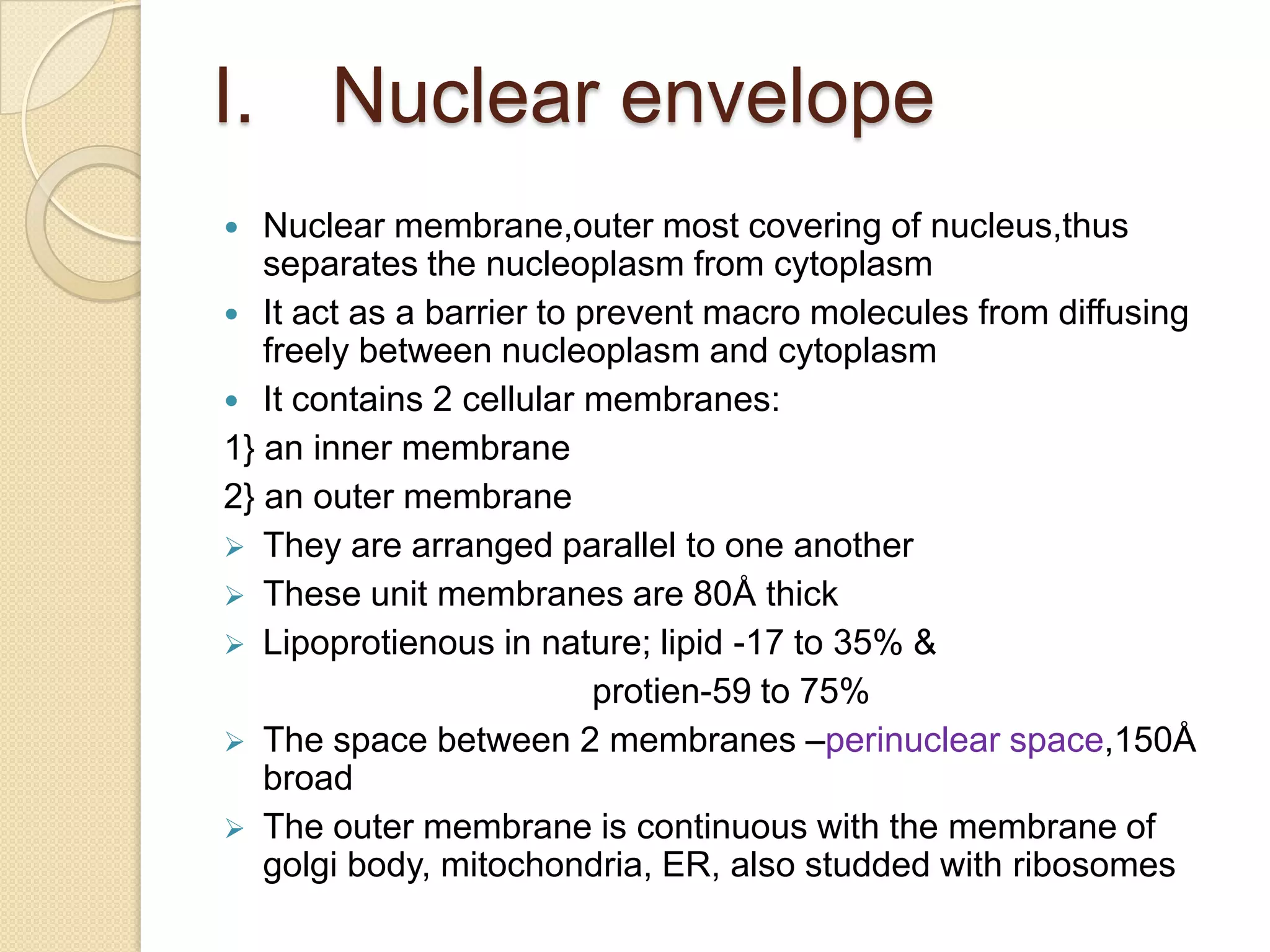
Ultra structure Largest organelle of cell.Approximately 6µm in daimeter.occupies about 10% of total volume of cell.Different parts:Nuclear envelopeNuclear laminaNucleoplasamChromatin fibresnucleolus
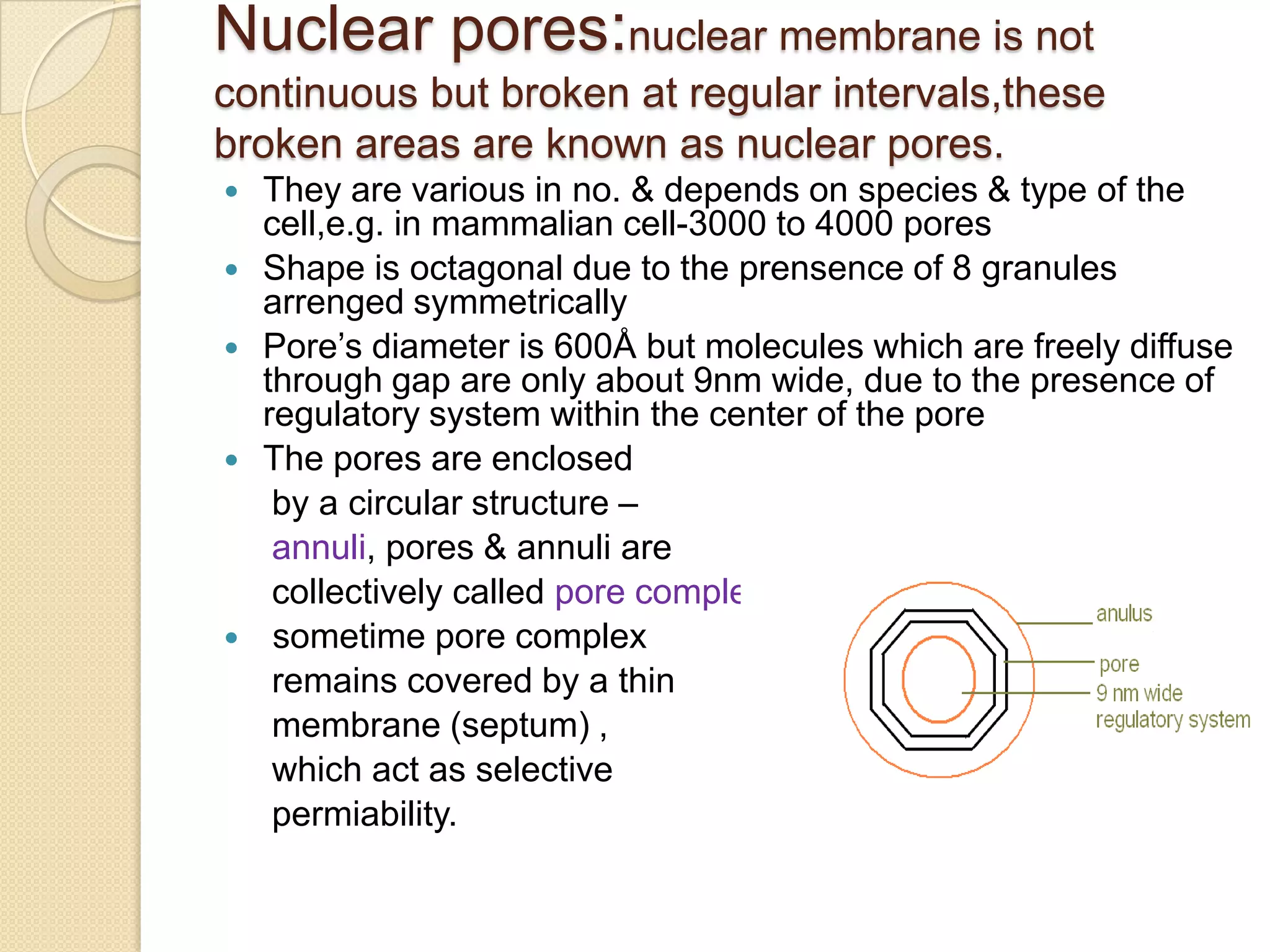
Nuclear envelopeNuclear membrane,outer most covering of nucleus,thus separates the nucleoplasm from cytoplasmIt act as a barrier to prevent macro molecules from diffusing freely between nucleoplasm and cytoplasmIt contains 2 cellular membranes:1} an inner membrane2} an outer membraneThey are arranged parallel to one another
These unit membranes are 80Å thick
Lipoprotienous in nature; lipid -17 to 35% &                                      protien-59 to 75%The space between 2 membranes –perinuclear space,150Å broad
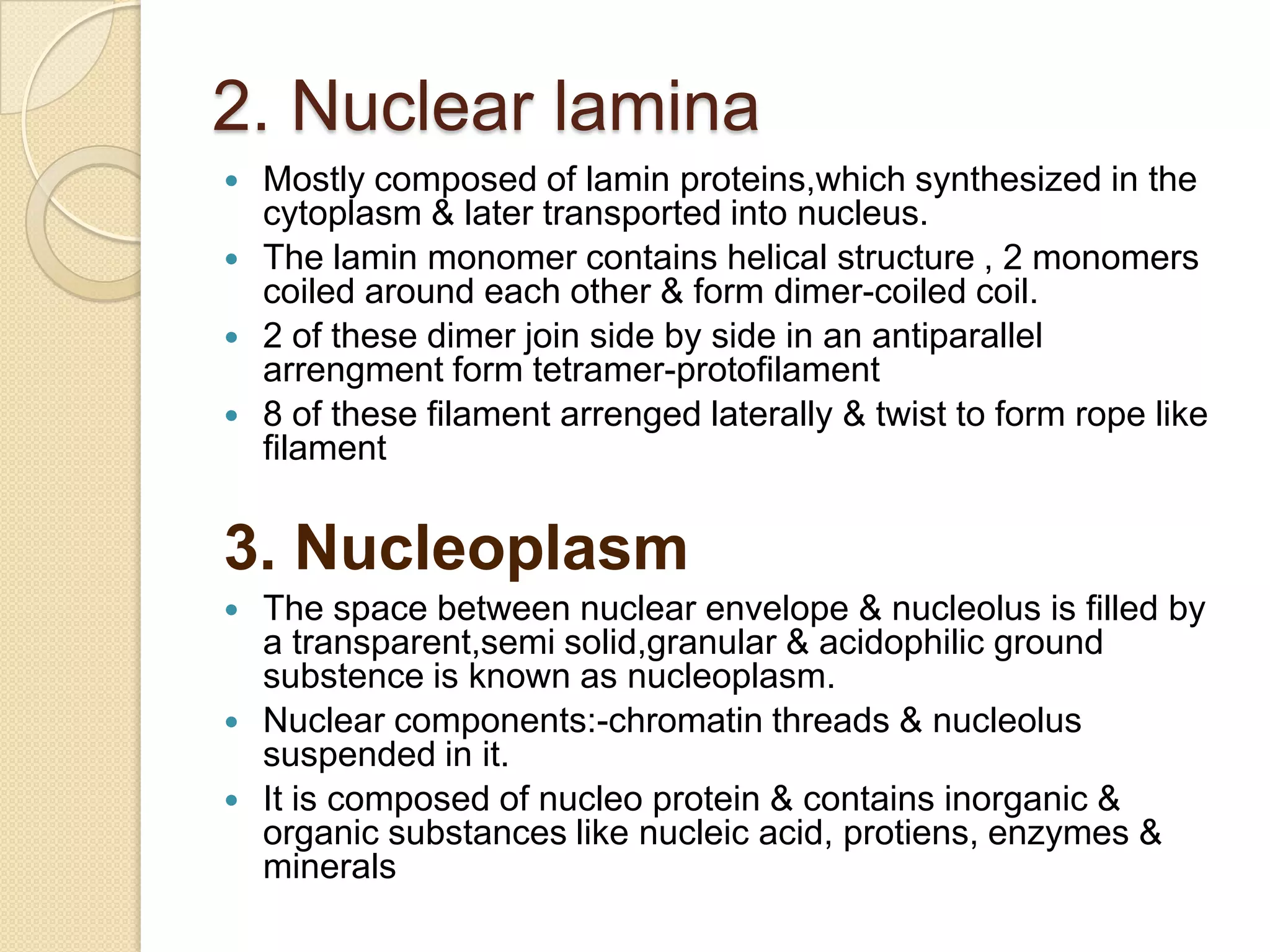
The outer membrane is continuous with the membrane of golgi body, mitochondria, ER, also studded with ribosomesNuclear pores:nuclear membrane is not continuous but broken at regular intervals,these broken areas are known as nuclear pores.They are various in no. & depends on species & type of the cell,e.g. in mammalian cell-3000 to 4000 poresShape is octagonal due to the prensence of 8 granules arrenged symmetricallyPore’s diameter is 600Å but molecules which are freely diffuse through gap are only about 9nm wide, due to the presence of regulatory system within the center of the poreThe pores are enclosed      by a circular structure –annuli, pores & annuli are     collectively called pore complex sometime pore complex      remains covered by a thin      membrane (septum) ,     which act as selectivepermiability.
2. Nuclear laminaMostly composed of laminproteins,which synthesized in the cytoplasm & later transported into nucleus.The lamin monomer contains helical structure , 2 monomers coiled around each other & form dimer-coiled coil.2 of these dimer join side by side in an antiparallelarrengment form tetramer-protofilament8 of these filament arrenged laterally & twist to form rope like filament 3. NucleoplasmThe space between nuclear envelope & nucleolus is filled by a transparent,semisolid,granular & acidophilic ground substence is known as nucleoplasm.Nuclear components:-chromatin threads & nucleolus suspended in it.It is composed of nucleo protein & contains inorganic & organic substances like nucleic acid, protiens, enzymes & minerals

Nucleus

  • 1.
    NUCLEUS(STRUCTURE)NIYATI A.DIVANM.Sc. – 1(BIO-SCIENCE)
  • 2.
    GENERAL INTRODUCTIONMost significantcomponantIt controls metabolic and heriditory activities of the cell,so that it referred as “control center”It contains DNA with complex of large variety of proteins-histones to form chromosomesThe genes within the chromosomes are the cell’s nuclear genomeIt contains nucleic acid(DNA,RNA),nuclear protiens,nuclear enzymes(e.g. DNA polymarase,RNApolymarase, endonuclease, exonuclease,ligase etc.
  • 3.
    HISTORY1831:Robert Brown [while he was studing orchid’s outer layer,he observed an opaque area which he called Nucleus] 1838:Mittehias Schleiden [proposed that the nucleus plays a role in generating cells,introduced name Cytoblast(cell builder)]
  • 4.
    Occurrence and positionFoundin eukaryotic cell of the plants and animals,absent in mature sieve tubes of higher plants, mammalian erythrocytes and bacteriaLocated in the centre of the cell,but its position may change from time to time according to metabolic states of the cell no. of the nucleus: -single nucleus(mononucleate) -two nuclei(binuleate) -more than two(polynucleate)Syncytial cells : in animals(e.g.osteblast,straited muscle fibers) Coenocytic cells: in plants(e.g.siphonalalgae,certainfungai)
  • 5.
    Shape and sizeItsshape is related with the shape of the cell-certain irregular-spheroid nuclei in isodiametrical cells-ellipsoid nuclei in cylindrical,prismatic or fusiform cellsIts size is related with no. of the chromosomese.g.small in haploid cell and large in deploid cellThe size is also depends upon the volume of the cell,amount of DNA,proteins and metabolic phase of the cell
  • 6.
    Ultra structure Largestorganelle of cell.Approximately 6µm in daimeter.occupies about 10% of total volume of cell.Different parts:Nuclear envelopeNuclear laminaNucleoplasamChromatin fibresnucleolus
  • 7.
    Nuclear envelopeNuclear membrane,outermost covering of nucleus,thus separates the nucleoplasm from cytoplasmIt act as a barrier to prevent macro molecules from diffusing freely between nucleoplasm and cytoplasmIt contains 2 cellular membranes:1} an inner membrane2} an outer membraneThey are arranged parallel to one another
  • 8.
    These unit membranesare 80Å thick
  • 9.
    Lipoprotienous in nature;lipid -17 to 35% & protien-59 to 75%The space between 2 membranes –perinuclear space,150Å broad
  • 10.
    The outer membraneis continuous with the membrane of golgi body, mitochondria, ER, also studded with ribosomesNuclear pores:nuclear membrane is not continuous but broken at regular intervals,these broken areas are known as nuclear pores.They are various in no. & depends on species & type of the cell,e.g. in mammalian cell-3000 to 4000 poresShape is octagonal due to the prensence of 8 granules arrenged symmetricallyPore’s diameter is 600Å but molecules which are freely diffuse through gap are only about 9nm wide, due to the presence of regulatory system within the center of the poreThe pores are enclosed by a circular structure –annuli, pores & annuli are collectively called pore complex sometime pore complex remains covered by a thin membrane (septum) , which act as selectivepermiability.
  • 11.
    2. Nuclear laminaMostlycomposed of laminproteins,which synthesized in the cytoplasm & later transported into nucleus.The lamin monomer contains helical structure , 2 monomers coiled around each other & form dimer-coiled coil.2 of these dimer join side by side in an antiparallelarrengment form tetramer-protofilament8 of these filament arrenged laterally & twist to form rope like filament 3. NucleoplasmThe space between nuclear envelope & nucleolus is filled by a transparent,semisolid,granular & acidophilic ground substence is known as nucleoplasm.Nuclear components:-chromatin threads & nucleolus suspended in it.It is composed of nucleo protein & contains inorganic & organic substances like nucleic acid, protiens, enzymes & minerals
  • 12.
    4. Nucleolus Itis a large spherical & acidophilic dense granule also called suborganelleDiscovered by Fontona in 1781Size is depend on synthetic activities of the cellMain function is to synthesize r-RNA & produseribosomes5.Chromatin fibresThe nucleoplasm contains many thread like coiled & much elongated structure –chromatin fibresObserve only in the interphaseDuring cell division it become thick called-chromosomechromatinefibresare of 2 types:Heterochromatin: more compact DNA formEuchromatin: less compact DNA form
  • 13.