EUKARYOTICNUCLEUS
Presented by Muhammad Kamil Khan
Kame Biology
Content
•Introduction to nucleus
•Discovery of nucleus
•Structure of nucleus
1. What is chromatin
2. Nuclear envelope
3. Nuclear pores
4. Nucleolus
Introduction to nucleus
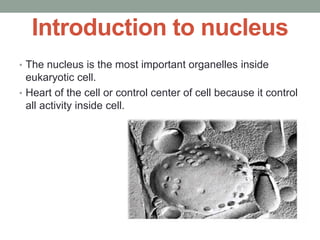
• The nucleus is the most important organelles inside
eukaryotic cell.
• Heart of the cell or control center of cell because it control
all activity inside cell.
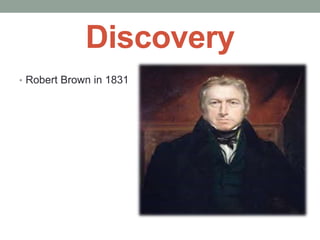
Discovery
• Robert Brown in 1831
Structure of nucleus
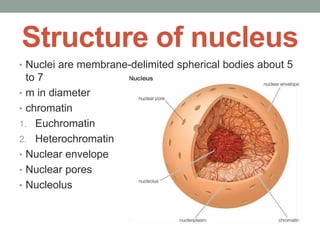
• Nuclei are membrane-delimited spherical bodies about 5
to 7
• m in diameter
• chromatin
1. Euchromatin
2. Heterochromatin
• Nuclear envelope
• Nuclear pores
• Nucleolus
1. Chromatin
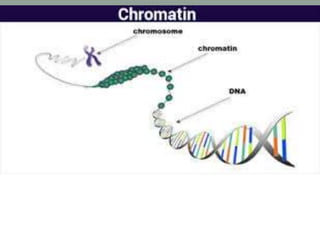
• Chromatin is a dense fibrous material that can be seen within
the nucleoplasm of the nucleus of a stained cell.
• This is the DNA-containing part of the nucleus.
• In nondividing cells, chromatin is dispersed, but it condenses
during cell division to become visible as chromosomes.
• Some chromatin, the euchromatin, is loosely organized and
contains those genes that are actively expressed.
• In contrast, heterochromatin is coiled more tightly, appears
darker in the electron microscope, and is not genetically active
most of the time.
2. Nuclear envelope
• The nucleus is bounded by the nuclear envelope a complex
structure consisting of inner and outer membranes separated
by a 15 to 75 nm perinuclear space.
• The envelope is continuous with the ER at several points and
its outer membrane is covered with ribosomes.
• A network of intermediate filaments, called the nuclear lamina,
is observed in animal cells.
• It lies against the inner surface of the envelope and supports it.
• Chromatin usually is associated with the inner membrane.
3. Nuclear pores
• Many nuclear pores penetrate the envelope and each pore is
formed by a fusion of the outer and inner membranes.
• Pores are about 70 nm in diameter and collectively occupy
about 10 to 25% of the nuclear surface.
• A complex ringlike arrangement of granular and fibrous
material called the annulus is located at the edge of each
pore.
• The nuclear pores serve as a transport route between the
nucleus and surrounding cytoplasm.
• Particles have been observed moving into the nucleus
through the pores.
4. Nucleolus
• Present within the nucleus.
• A nucleus may contain from one to many nucleoli
• Although the nucleolus is not membrane-enclosed, it is a
complex organelle with separate granular and fibrillar regions.
• It is present in nondividing cells, but frequently disappears
during mitosis.
• After mitosis the nucleolus reforms around the nucleolar
organizer, a particular part of a specific chromosome.
• Plays a major role in ribosome synthesis.
• The nucleolar organizer DNA directs the production of rRNA.
Eukaryotic nucleus

Eukaryotic nucleus

  • 1.
  • 2.
    Content •Introduction to nucleus •Discoveryof nucleus •Structure of nucleus 1. What is chromatin 2. Nuclear envelope 3. Nuclear pores 4. Nucleolus
  • 3.
    Introduction to nucleus •The nucleus is the most important organelles inside eukaryotic cell. • Heart of the cell or control center of cell because it control all activity inside cell.
  • 4.
  • 5.
    Structure of nucleus •Nuclei are membrane-delimited spherical bodies about 5 to 7 • m in diameter • chromatin 1. Euchromatin 2. Heterochromatin • Nuclear envelope • Nuclear pores • Nucleolus
  • 6.
    1. Chromatin • Chromatinis a dense fibrous material that can be seen within the nucleoplasm of the nucleus of a stained cell. • This is the DNA-containing part of the nucleus. • In nondividing cells, chromatin is dispersed, but it condenses during cell division to become visible as chromosomes. • Some chromatin, the euchromatin, is loosely organized and contains those genes that are actively expressed. • In contrast, heterochromatin is coiled more tightly, appears darker in the electron microscope, and is not genetically active most of the time.
  • 8.
    2. Nuclear envelope •The nucleus is bounded by the nuclear envelope a complex structure consisting of inner and outer membranes separated by a 15 to 75 nm perinuclear space. • The envelope is continuous with the ER at several points and its outer membrane is covered with ribosomes. • A network of intermediate filaments, called the nuclear lamina, is observed in animal cells. • It lies against the inner surface of the envelope and supports it. • Chromatin usually is associated with the inner membrane.
  • 9.
    3. Nuclear pores •Many nuclear pores penetrate the envelope and each pore is formed by a fusion of the outer and inner membranes. • Pores are about 70 nm in diameter and collectively occupy about 10 to 25% of the nuclear surface. • A complex ringlike arrangement of granular and fibrous material called the annulus is located at the edge of each pore. • The nuclear pores serve as a transport route between the nucleus and surrounding cytoplasm. • Particles have been observed moving into the nucleus through the pores.
  • 10.
    4. Nucleolus • Presentwithin the nucleus. • A nucleus may contain from one to many nucleoli • Although the nucleolus is not membrane-enclosed, it is a complex organelle with separate granular and fibrillar regions. • It is present in nondividing cells, but frequently disappears during mitosis. • After mitosis the nucleolus reforms around the nucleolar organizer, a particular part of a specific chromosome. • Plays a major role in ribosome synthesis. • The nucleolar organizer DNA directs the production of rRNA.