MICROBODIES
TYPES & FUNCTIONS
GROUP: 1
SUBMITTED TO:
PROF. BISMA BASHIR
SUBMITTED BY:
SALMAN YOUNAS (L1S21BSBT0104)
MADIHA ASAD (L1S21BSBT0110)
SAMEERA JAMIL (L1S21BSBT0089)
FACULTY OF LIFE SCIENCES, UCP, LAHORE
1 | P a g e
SALMAN YOUNAS (L1S21BSBT0104)
MICROBODIES
Definition:
“Micro bodies are different type of bodies present in the cytosol, also known as cytostomes.”
Micro bodies are cell organelles present in eukaryotic cells.
In Vertebrates, micro bodies are prevalent in the kidney and liver cells.
History:
Micro bodies were first discovered and named in 1954 by Rhodin. Two years later in 1956,
Rouiller and Bernhard presented the first worldwide accepted images of micro bodies in liver
cells. Then in 1965, Christian de Duve and coworkers isolated micro bodies from the liver of
a rat. De Duve also believed that the name Micro body was too general and chose the name
of Peroxisome because of its relationship with hydrogen peroxide.
In 1967, Breidenbach and Beevers were the first to isolate micro bodies from plants, which
they named Glyoxysomes because they were found to contain enzymes of the Glyoxylate
cycle.
Structure:
A micro body is usually a vesicle with a spherical shape. Micro bodies are very small in size
~0.2-1.5 μm in diameter and can be seen under the electron microscope.
 They are vesicular and mostly spherical in shape
 They are enclosed in a single membrane of a phospholipid bilayer
 The intracellular matrix contains proteins and enzymes
 They do not contain separate DNA
Types:
Glyoxysomes, peroxisomes and glycosomes are included in the micro bodies’ family.
Function:
 They play a role in the metabolism of fatty acids as well as a variety of other metabolite.
 Peroxisomes contain enzymes as well as a variety of other compounds.
 Peroxisomes contain enzymes that rid the cell of poisonous peroxides.
 It contains enzymes that rid the cell of toxic peroxides.
 Import proteins into organelles and help in their formation.
2 | P a g e
 Proliferation is aided by the import of proteins into the organelles.
 Peroxisomes can multiply by growing and multiplying.
 Peroxisomes can replicate by growing larger and then dividing.
 Bile production is also influenced by peroxisomes
 Peroxisomes are also involved in the synthesis of bile acids and proteins.
MADIHA ASAD (L1S21BSBT0110)
PEROXISOMES:
“Peroxisomes are type of microbodies that are small, single membrane organelles present in the
cytoplasmof all eukaryotic cells.”
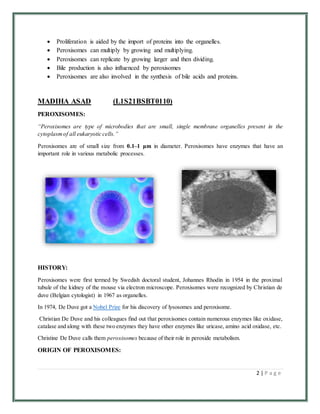
Peroxisomes are of small size from 0.1–1 μm in diameter. Peroxisomes have enzymes that have an
important role in various metabolic processes.
HISTORY:
Peroxisomes were first termed by Swedish doctoral student, Johannes Rhodin in 1954 in the proximal
tubule of the kidney of the mouse via electron microscope. Peroxisomes were recognized by Christian de
duve (Belgian cytologist) in 1967 as organelles.
In 1974, De Duve got a Nobel Prize for his discovery of lysosomes and peroxisome.
Christian De Duve and his colleagues find out that peroxisomes contain numerous enzymes like oxidase,
catalase and along with these two enzymes they have other enzymes like uricase, amino acid oxidase, etc.
Christine De Duve calls them peroxisomes because of their role in peroxide metabolism.
ORIGIN OF PEROXISOMES:
3 | P a g e
Unlike, mitochondria and chloroplasts (endosymbionts), peroxisomes have a single membrane and
do not have DNA; however, the organelle is considered to have a symbiogenetic origin, derived from
an enslaved anaerobic hydrogen-producing prokaryote (de Duve 1996; Cavalier-Smith 1997).This
idea has sought the attention of many people upon the idea that the cells that lack peroxisomes restore on
the introduction of wild-type gene can restore it, and that the formation of peroxisomes takes place in the
Endoplasmic Reticulum.
After performing experiments, it was identified that peroxisomes are formed in Endoplasmic Reticulum,
it was accepted because most of the proteins involved in biogenesis and maintenance are similar to the
proteins found in the endoplasmic reticulum pathway.
FORMATION OF PEROXISOMES:
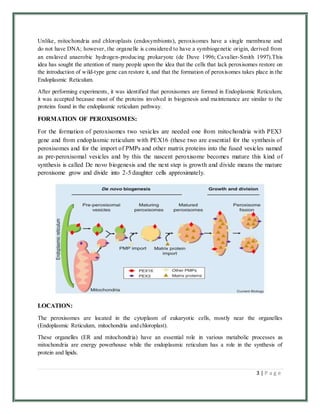
For the formation of peroxisomes two vesicles are needed one from mitochondria with PEX3
gene and from endoplasmic reticulum with PEX16 (these two are essential for the synthesis of
peroxisomes and for the import of PMPs and other matrix proteins into the fused vesicles named
as pre-peroxisomal vesicles and by this the nascent peroxisome becomes mature this kind of
synthesis is called De novo biogenesis and the next step is growth and divide means the mature
peroxisome grow and divide into 2-5 daughter cells approximately.
LOCATION:
The peroxisomes are located in the cytoplasm of eukaryotic cells, mostly near the organelles
(Endoplasmic Reticulum, mitochondria and chloroplast).
These organelles (ER and mitochondria) have an essential role in various metabolic processes as
mitochondria are energy powerhouse while the endoplasmic reticulum has a role in the synthesis of
protein and lipids.
4 | P a g e
STRUCTURE:
Peroxisomes vary in different shapes, sizes, and numbers according to the cell energy demand.
Peroxisomes have phospholipid bilayer and have membrane-bound proteins. Peroxisomes have enzymes
for lipid metabolism (synthesized on free ribosomes and then are transported to peroxisomes).
Peroxisomes do not have Deoxyribonucleic acid and proteins are transported to peroxisomes from the
cytoplasm.
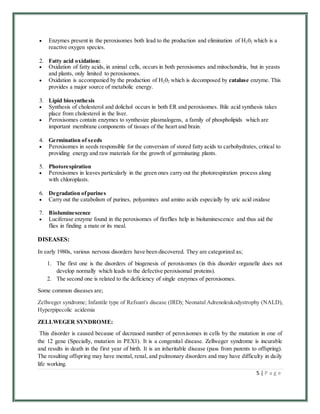
Here the three circles in electron microscopic view are peroxisomes and the dark spots are crystalline core
(highly condensed urate oxidase). These enzymes are stored so that if cells need them they can be rapidly
available for the process.
FUNCTIONS:
Peroxisomes perform diverse functions in eukaryotic cells (both plant and animal cells) according to the
need and stage of the cell. Their key role is toxic degradation and has an important part in various
oxidation reactions (for the breakdown of amino acids and fatty acids). They take part in various
metabolic reactions that are very important for maintaining the cell (cellular homeostasis).
1. Hydrogen Peroxide Metabolism:
5 | P a g e
 Enzymes present in the peroxisomes both lead to the production and elimination of H202 which is a
reactive oxygen species.
2. Fatty acid oxidation:
 Oxidation of fatty acids, in animal cells, occurs in both peroxisomes and mitochondria, but in yeasts
and plants, only limited to peroxisomes.
 Oxidation is accompanied by the production of H202 which is decomposed by catalase enzyme. This
provides a major source of metabolic energy.
3. Lipid biosynthesis
 Synthesis of cholesterol and dolichol occurs in both ER and peroxisomes. Bile acid synthesis takes
place from cholesterol in the liver.
 Peroxisomes contain enzymes to synthesize plasmalogens, a family of phospholipids which are
important membrane components of tissues of the heart and brain.
4. Germination of seeds
 Peroxisomes in seeds responsible for the conversion of stored fatty acids to carbohydrates, critical to
providing energy and raw materials for the growth of germinating plants.
5. Photorespiration
 Peroxisomes in leaves particularly in the green ones carry out the photorespiration process along
with chloroplasts.
6. Degradation ofpurines
 Carry out the catabolism of purines, polyamines and amino acids especially by uric acid oxidase
7. Bioluminescence
 Luciferase enzyme found in the peroxisomes of fireflies help in bioluminescence and thus aid the
flies in finding a mate or its meal.
DISEASES:
In early 1980s, various nervous disorders have been discovered. They are categorized as;
1. The first one is the disorders of biogenesis of peroxisomes (in this disorder organelle does not
develop normally which leads to the defective peroxisomal proteins).
2. The second one is related to the deficiency of single enzymes of peroxisomes.
Some common diseases are;
Zellweger syndrome; Infantile type of Refsum's disease (IRD); Neonatal Adrenoleukodystrophy (NALD),
Hyperpipecolic acidemia
ZELLWEGER SYNDROME:
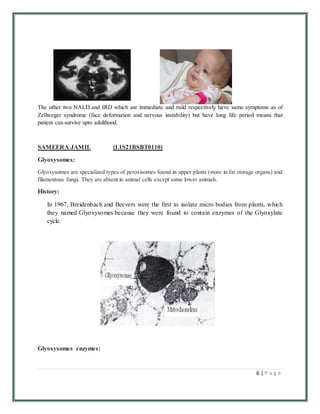
This disorder is caused because of decreased number of peroxisomes in cells by the mutation in one of
the 12 gene (Specially, mutation in PEX1). It is a congenital disease. Zellweger syndrome is incurable
and results in death in the first year of birth. It is an inheritable disease (pass from parents to offspring).
The resulting offspring may have mental, renal, and pulmonary disorders and may have difficulty in daily
life working.
6 | P a g e
The other two NALD and IRD which are immediate and mild respectively have same symptoms as of
Zellweger syndrome (face deformation and nervous instability) but have long life period means that
patient can survive upto adulthood.
SAMEERA JAMIL (L1S21BSBT0110)
Glyoxysomes:
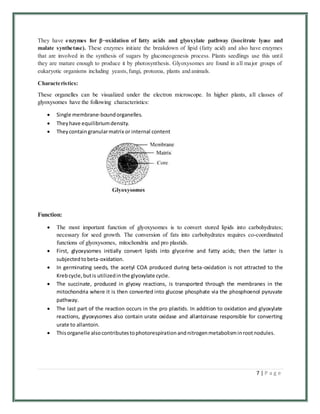
Glyoxysomes are specialized types of peroxisomes found in upper plants (store in fat storage organs) and
filamentous fungi. They are absent in animal cells except some lower animals.
History:
In 1967, Breidenbach and Beevers were the first to isolate micro bodies from plants, which
they named Glyoxysomes because they were found to contain enzymes of the Glyoxylate
cycle.
Glyoxysomes enzymes:
7 | P a g e
They have enzymes for β−oxidation of fatty acids and glyoxylate pathway (isocitrate lyase and
malate synthetase). These enzymes initiate the breakdown of lipid (fatty acid) and also have enzymes
that are involved in the synthesis of sugars by gluconeogenesis process. Plants seedlings use this until
they are mature enough to produce it by photosynthesis. Glyoxysomes are found in all major groups of
eukaryotic organisms including yeasts,fungi, protozoa, plants and animals.
Characteristics:
These organelles can be visualized under the electron microscope. In higher plants, all classes of
glyoxysomes have the following characteristics:
 Single membrane-boundorganelles.
 Theyhave equilibriumdensity.
 Theycontaingranularmatrix or internal content
Function:
 The most important function of glyoxysomes is to convert stored lipids into carbohydrates;
necessary for seed growth. The conversion of fats into carbohydrates requires co-coordinated
functions of glyoxysomes, mitochondria and pro plastids.
 First, glyoxysomes initially convert lipids into glycerine and fatty acids; then the latter is
subjectedtobeta-oxidation.
 In germinating seeds, the acetyl COA produced during beta-oxidation is not attracted to the
Krebcycle,butis utilizedinthe glyoxylate cycle.
 The succinate, produced in glyoxy reactions, is transported through the membranes in the
mitochondria where it is then converted into glucose phosphate via the phosphoenol pyruvate
pathway.
 The last part of the reaction occurs in the pro plastids. In addition to oxidation and glyoxylate
reactions, glyoxysomes also contain urate oxidase and allantoinase responsible for converting
urate to allantoin.
 Thisorganelle alsocontributestophotorespirationandnitrogenmetabolisminrootnodules.
8 | P a g e
Other enzymes:
 These organelles also possess certain enzymes that have no obvious connection with the
conversion of fats into carbohydrates such as urate oxidase and allantoinase. These
enzymes catalyze the conversion of uric acid to allantoin and the subsequent hydration of
allantoin to allantoic acid during the degradation of purine bases. No other urate
oxidizing enzymes were found.
 Also have enzymes whose functions are still unclear such as glycolate oxidase and
several aminotransferases. They may have existed in an ancestral and physiologically
more active microbody.
9 | P a g e
REFERENCES:
https://microbenotes.com/peroxisomes-structure-and-functions/
https://en.wikipedia.org/wiki/Peroxisome#:~:text=A%20peroxisome%20(IPA%3A%20%5Bp%C9%9B%
C9%9C%CB%88%C9%B9%C9%92ks%C9%AA%CB%8Cso%CA%8Am,O2)%20is%20then%20forme
d.
https://byjus.com/biology/peroxisomes/
https://www.cell.com/current-biology/comments/S0960-9822(11)00823-2
https://micro.magnet.fsu.edu/cells/peroxisomes/peroxisomes.html
https://www.ncbi.nlm.nih.gov/pmc/articles/PMC5761812/#:~:text=Peroxisomes%20are%20organelles%2
0that%20sequester,seedling%20growth%2C%20and%20stomatal%20opening.
https://bio.libretexts.org/Bookshelves/Introductory_and_General_Biology/Book%3A_General_Biology_(
Boundless)/04%3A_Cell_Structure/4.4%3A_The_Endomembrane_System_and_Proteins/4.4E%3A_Pero
xisomes
https://www.britannica.com/science/peroxisome

MICROBODIES

  • 1.
    MICROBODIES TYPES & FUNCTIONS GROUP:1 SUBMITTED TO: PROF. BISMA BASHIR SUBMITTED BY: SALMAN YOUNAS (L1S21BSBT0104) MADIHA ASAD (L1S21BSBT0110) SAMEERA JAMIL (L1S21BSBT0089) FACULTY OF LIFE SCIENCES, UCP, LAHORE
  • 2.
    1 | Pa g e SALMAN YOUNAS (L1S21BSBT0104) MICROBODIES Definition: “Micro bodies are different type of bodies present in the cytosol, also known as cytostomes.” Micro bodies are cell organelles present in eukaryotic cells. In Vertebrates, micro bodies are prevalent in the kidney and liver cells. History: Micro bodies were first discovered and named in 1954 by Rhodin. Two years later in 1956, Rouiller and Bernhard presented the first worldwide accepted images of micro bodies in liver cells. Then in 1965, Christian de Duve and coworkers isolated micro bodies from the liver of a rat. De Duve also believed that the name Micro body was too general and chose the name of Peroxisome because of its relationship with hydrogen peroxide. In 1967, Breidenbach and Beevers were the first to isolate micro bodies from plants, which they named Glyoxysomes because they were found to contain enzymes of the Glyoxylate cycle. Structure: A micro body is usually a vesicle with a spherical shape. Micro bodies are very small in size ~0.2-1.5 μm in diameter and can be seen under the electron microscope.  They are vesicular and mostly spherical in shape  They are enclosed in a single membrane of a phospholipid bilayer  The intracellular matrix contains proteins and enzymes  They do not contain separate DNA Types: Glyoxysomes, peroxisomes and glycosomes are included in the micro bodies’ family. Function:  They play a role in the metabolism of fatty acids as well as a variety of other metabolite.  Peroxisomes contain enzymes as well as a variety of other compounds.  Peroxisomes contain enzymes that rid the cell of poisonous peroxides.  It contains enzymes that rid the cell of toxic peroxides.  Import proteins into organelles and help in their formation.
  • 3.
    2 | Pa g e  Proliferation is aided by the import of proteins into the organelles.  Peroxisomes can multiply by growing and multiplying.  Peroxisomes can replicate by growing larger and then dividing.  Bile production is also influenced by peroxisomes  Peroxisomes are also involved in the synthesis of bile acids and proteins. MADIHA ASAD (L1S21BSBT0110) PEROXISOMES: “Peroxisomes are type of microbodies that are small, single membrane organelles present in the cytoplasmof all eukaryotic cells.” Peroxisomes are of small size from 0.1–1 μm in diameter. Peroxisomes have enzymes that have an important role in various metabolic processes. HISTORY: Peroxisomes were first termed by Swedish doctoral student, Johannes Rhodin in 1954 in the proximal tubule of the kidney of the mouse via electron microscope. Peroxisomes were recognized by Christian de duve (Belgian cytologist) in 1967 as organelles. In 1974, De Duve got a Nobel Prize for his discovery of lysosomes and peroxisome. Christian De Duve and his colleagues find out that peroxisomes contain numerous enzymes like oxidase, catalase and along with these two enzymes they have other enzymes like uricase, amino acid oxidase, etc. Christine De Duve calls them peroxisomes because of their role in peroxide metabolism. ORIGIN OF PEROXISOMES:
  • 4.
    3 | Pa g e Unlike, mitochondria and chloroplasts (endosymbionts), peroxisomes have a single membrane and do not have DNA; however, the organelle is considered to have a symbiogenetic origin, derived from an enslaved anaerobic hydrogen-producing prokaryote (de Duve 1996; Cavalier-Smith 1997).This idea has sought the attention of many people upon the idea that the cells that lack peroxisomes restore on the introduction of wild-type gene can restore it, and that the formation of peroxisomes takes place in the Endoplasmic Reticulum. After performing experiments, it was identified that peroxisomes are formed in Endoplasmic Reticulum, it was accepted because most of the proteins involved in biogenesis and maintenance are similar to the proteins found in the endoplasmic reticulum pathway. FORMATION OF PEROXISOMES: For the formation of peroxisomes two vesicles are needed one from mitochondria with PEX3 gene and from endoplasmic reticulum with PEX16 (these two are essential for the synthesis of peroxisomes and for the import of PMPs and other matrix proteins into the fused vesicles named as pre-peroxisomal vesicles and by this the nascent peroxisome becomes mature this kind of synthesis is called De novo biogenesis and the next step is growth and divide means the mature peroxisome grow and divide into 2-5 daughter cells approximately. LOCATION: The peroxisomes are located in the cytoplasm of eukaryotic cells, mostly near the organelles (Endoplasmic Reticulum, mitochondria and chloroplast). These organelles (ER and mitochondria) have an essential role in various metabolic processes as mitochondria are energy powerhouse while the endoplasmic reticulum has a role in the synthesis of protein and lipids.
  • 5.
    4 | Pa g e STRUCTURE: Peroxisomes vary in different shapes, sizes, and numbers according to the cell energy demand. Peroxisomes have phospholipid bilayer and have membrane-bound proteins. Peroxisomes have enzymes for lipid metabolism (synthesized on free ribosomes and then are transported to peroxisomes). Peroxisomes do not have Deoxyribonucleic acid and proteins are transported to peroxisomes from the cytoplasm. Here the three circles in electron microscopic view are peroxisomes and the dark spots are crystalline core (highly condensed urate oxidase). These enzymes are stored so that if cells need them they can be rapidly available for the process. FUNCTIONS: Peroxisomes perform diverse functions in eukaryotic cells (both plant and animal cells) according to the need and stage of the cell. Their key role is toxic degradation and has an important part in various oxidation reactions (for the breakdown of amino acids and fatty acids). They take part in various metabolic reactions that are very important for maintaining the cell (cellular homeostasis). 1. Hydrogen Peroxide Metabolism:
  • 6.
    5 | Pa g e  Enzymes present in the peroxisomes both lead to the production and elimination of H202 which is a reactive oxygen species. 2. Fatty acid oxidation:  Oxidation of fatty acids, in animal cells, occurs in both peroxisomes and mitochondria, but in yeasts and plants, only limited to peroxisomes.  Oxidation is accompanied by the production of H202 which is decomposed by catalase enzyme. This provides a major source of metabolic energy. 3. Lipid biosynthesis  Synthesis of cholesterol and dolichol occurs in both ER and peroxisomes. Bile acid synthesis takes place from cholesterol in the liver.  Peroxisomes contain enzymes to synthesize plasmalogens, a family of phospholipids which are important membrane components of tissues of the heart and brain. 4. Germination of seeds  Peroxisomes in seeds responsible for the conversion of stored fatty acids to carbohydrates, critical to providing energy and raw materials for the growth of germinating plants. 5. Photorespiration  Peroxisomes in leaves particularly in the green ones carry out the photorespiration process along with chloroplasts. 6. Degradation ofpurines  Carry out the catabolism of purines, polyamines and amino acids especially by uric acid oxidase 7. Bioluminescence  Luciferase enzyme found in the peroxisomes of fireflies help in bioluminescence and thus aid the flies in finding a mate or its meal. DISEASES: In early 1980s, various nervous disorders have been discovered. They are categorized as; 1. The first one is the disorders of biogenesis of peroxisomes (in this disorder organelle does not develop normally which leads to the defective peroxisomal proteins). 2. The second one is related to the deficiency of single enzymes of peroxisomes. Some common diseases are; Zellweger syndrome; Infantile type of Refsum's disease (IRD); Neonatal Adrenoleukodystrophy (NALD), Hyperpipecolic acidemia ZELLWEGER SYNDROME: This disorder is caused because of decreased number of peroxisomes in cells by the mutation in one of the 12 gene (Specially, mutation in PEX1). It is a congenital disease. Zellweger syndrome is incurable and results in death in the first year of birth. It is an inheritable disease (pass from parents to offspring). The resulting offspring may have mental, renal, and pulmonary disorders and may have difficulty in daily life working.
  • 7.
    6 | Pa g e The other two NALD and IRD which are immediate and mild respectively have same symptoms as of Zellweger syndrome (face deformation and nervous instability) but have long life period means that patient can survive upto adulthood. SAMEERA JAMIL (L1S21BSBT0110) Glyoxysomes: Glyoxysomes are specialized types of peroxisomes found in upper plants (store in fat storage organs) and filamentous fungi. They are absent in animal cells except some lower animals. History: In 1967, Breidenbach and Beevers were the first to isolate micro bodies from plants, which they named Glyoxysomes because they were found to contain enzymes of the Glyoxylate cycle. Glyoxysomes enzymes:
  • 8.
    7 | Pa g e They have enzymes for β−oxidation of fatty acids and glyoxylate pathway (isocitrate lyase and malate synthetase). These enzymes initiate the breakdown of lipid (fatty acid) and also have enzymes that are involved in the synthesis of sugars by gluconeogenesis process. Plants seedlings use this until they are mature enough to produce it by photosynthesis. Glyoxysomes are found in all major groups of eukaryotic organisms including yeasts,fungi, protozoa, plants and animals. Characteristics: These organelles can be visualized under the electron microscope. In higher plants, all classes of glyoxysomes have the following characteristics:  Single membrane-boundorganelles.  Theyhave equilibriumdensity.  Theycontaingranularmatrix or internal content Function:  The most important function of glyoxysomes is to convert stored lipids into carbohydrates; necessary for seed growth. The conversion of fats into carbohydrates requires co-coordinated functions of glyoxysomes, mitochondria and pro plastids.  First, glyoxysomes initially convert lipids into glycerine and fatty acids; then the latter is subjectedtobeta-oxidation.  In germinating seeds, the acetyl COA produced during beta-oxidation is not attracted to the Krebcycle,butis utilizedinthe glyoxylate cycle.  The succinate, produced in glyoxy reactions, is transported through the membranes in the mitochondria where it is then converted into glucose phosphate via the phosphoenol pyruvate pathway.  The last part of the reaction occurs in the pro plastids. In addition to oxidation and glyoxylate reactions, glyoxysomes also contain urate oxidase and allantoinase responsible for converting urate to allantoin.  Thisorganelle alsocontributestophotorespirationandnitrogenmetabolisminrootnodules.
  • 9.
    8 | Pa g e Other enzymes:  These organelles also possess certain enzymes that have no obvious connection with the conversion of fats into carbohydrates such as urate oxidase and allantoinase. These enzymes catalyze the conversion of uric acid to allantoin and the subsequent hydration of allantoin to allantoic acid during the degradation of purine bases. No other urate oxidizing enzymes were found.  Also have enzymes whose functions are still unclear such as glycolate oxidase and several aminotransferases. They may have existed in an ancestral and physiologically more active microbody.
  • 10.
    9 | Pa g e REFERENCES: https://microbenotes.com/peroxisomes-structure-and-functions/ https://en.wikipedia.org/wiki/Peroxisome#:~:text=A%20peroxisome%20(IPA%3A%20%5Bp%C9%9B% C9%9C%CB%88%C9%B9%C9%92ks%C9%AA%CB%8Cso%CA%8Am,O2)%20is%20then%20forme d. https://byjus.com/biology/peroxisomes/ https://www.cell.com/current-biology/comments/S0960-9822(11)00823-2 https://micro.magnet.fsu.edu/cells/peroxisomes/peroxisomes.html https://www.ncbi.nlm.nih.gov/pmc/articles/PMC5761812/#:~:text=Peroxisomes%20are%20organelles%2 0that%20sequester,seedling%20growth%2C%20and%20stomatal%20opening. https://bio.libretexts.org/Bookshelves/Introductory_and_General_Biology/Book%3A_General_Biology_( Boundless)/04%3A_Cell_Structure/4.4%3A_The_Endomembrane_System_and_Proteins/4.4E%3A_Pero xisomes https://www.britannica.com/science/peroxisome