


PHARMAFABRIKON ,
QUALITY ASSURANCE,
N.MANIKANDAN.

Duration:01hr:30minutes
Content
Definition
Scope of validation
Importance of validation
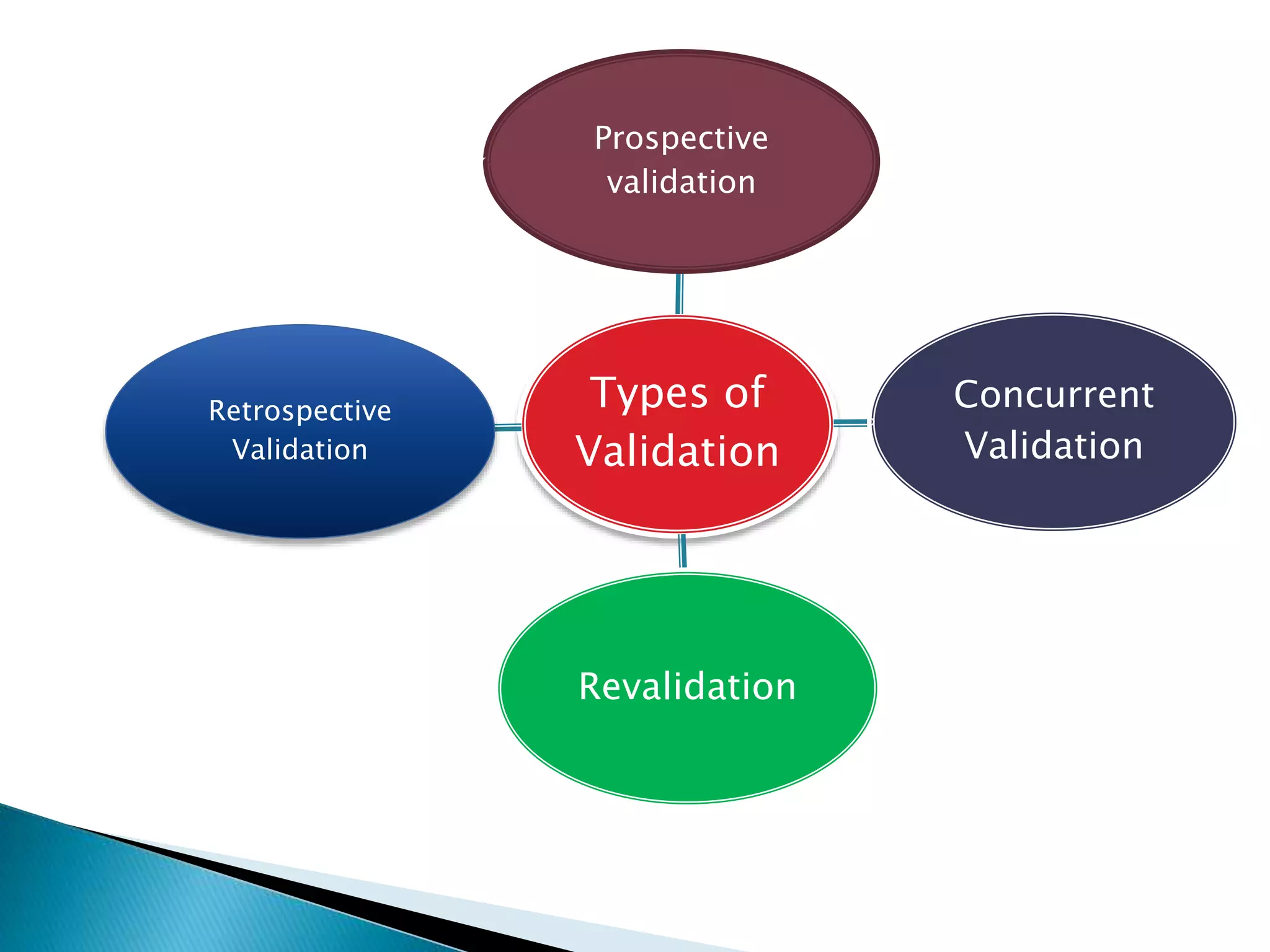
Types of validation
Limitation of validation
Process validation
Types of process validation
Conclusion
References.
Introduction
 The proof of validation is obtained through the collection and
evaluation of data .
 Beginning from the process development phase and continued
through in to the production phase.
 validation is necessary include Process qualification, material,
equipment, system, personnel.
 The control of the entire process for repeated batches or runs.
Definition
“ Validation is a documented program which provide a high
degree of assurance that a specific process will consistently
produce a products to meeting it’s Pre-determined Specification
and quality attributes”
Scope of validation
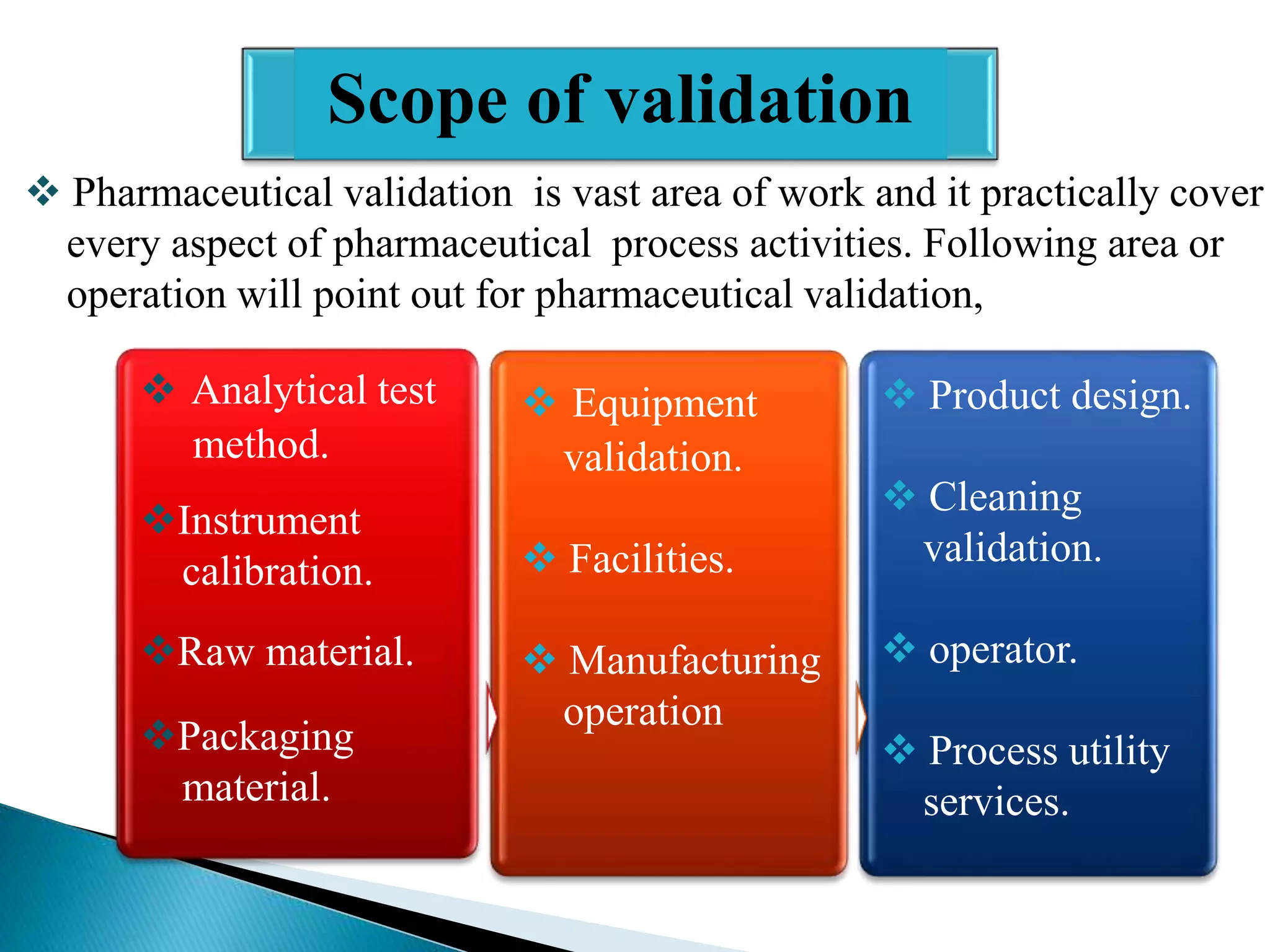
 Pharmaceutical validation is vast area of work and it practically cover
every aspect of pharmaceutical process activities. Following area or
operation will point out for pharmaceutical validation,
 Analytical test
method.
Instrument
calibration.
Raw material.
Packaging
material.

 Equipment
validation.
 Facilities.

 Manufacturing
operation

 Product design.
 Cleaning
validation.
 operator.
 Process utility
services.
Importance of of validation
Importance validation
 Every activity in any business unit is done to get some benefit from
that.
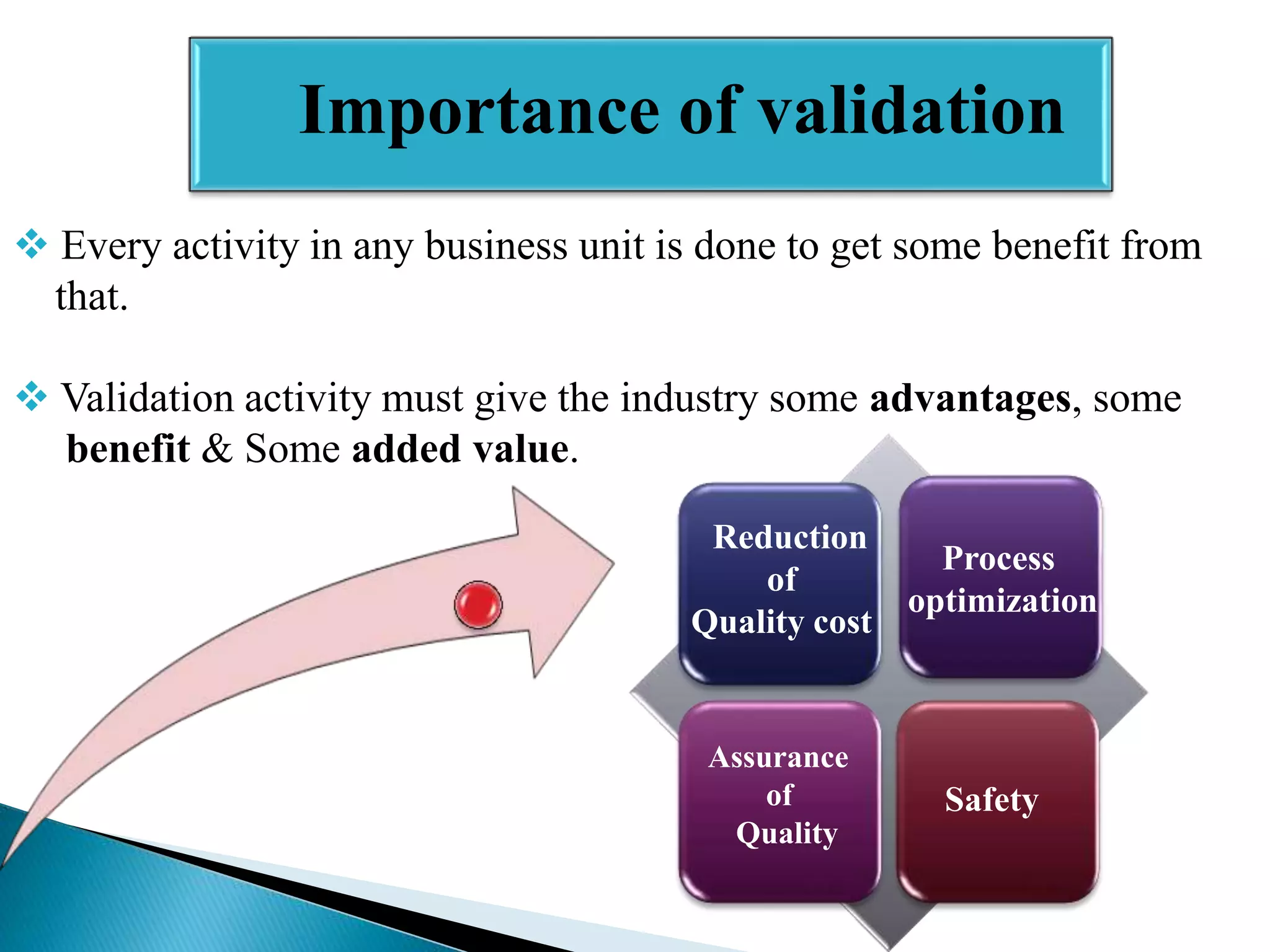
 Validation activity must give the industry some advantages, some
benefit & Some added value.
Reduction
of
Quality cost

Assurance
of
Quality

Process
optimization

Safety
Reduction of Quality cost
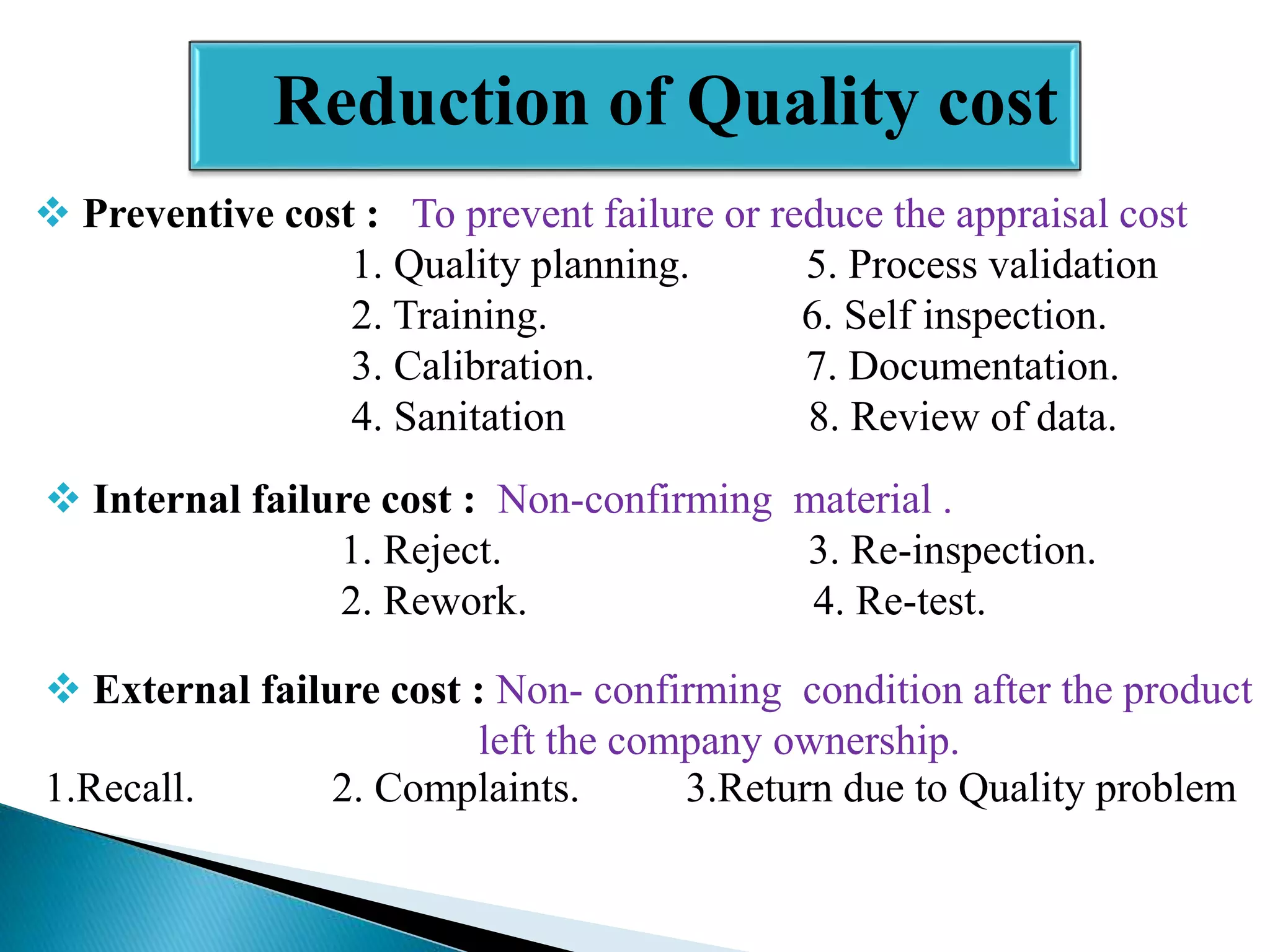
 Preventive cost : To prevent failure or reduce the appraisal cost
1. Quality planning.
5. Process validation
2. Training.
6. Self inspection.
3. Calibration.
7. Documentation.
4. Sanitation
8. Review of data.

 Internal failure cost : Non-confirming material .
1. Reject.
3. Re-inspection.
2. Rework.
4. Re-test.
 External failure cost : Non- confirming condition after the product
left the company ownership.
1.Recall.
2. Complaints.
3.Return due to Quality problem
Process Optimization
 Make the process effective, efficient, perfect or useful as possible
at the minimum cost.
 Trained qualified people are the key element in any process, thus
greatest impact on improving efficiency and productivity.
In this content GMP training program that include how to do the
job correctly, easily and repeatedly.
Assurance of Quality

Validation is a extension of quality assurance, in other words
validation and process control are the heart of GMP.
 Without validated and controlled process it is impossible to
produce quality product consistently.
Safety

Validation can also result in increased operation safety.

e.g. gauges used in equipment that is designed to operate
at certain temperature, and pressure must be reliable
i.e. they must be calibrated.
Limit of validation
 Validation has a practical limit and related cost, hence while
deciding
the limit of validation, we need to balance between the process cost
and the benefits derived from such limit.
e.g.
The cost of controlling weight variation in tablet or capsule, if 1
person keep limit of 5% & other person keep at limit 0.5% using
high tech.& high cost.
We must see what benefit, benefit is not much then we decide
the limit.
Process validation
 Definition:- “The collection and evaluation of data from the process
design stage throughout production which establishes
evidence that a process is capable of consistently
delivering quality product”
Process validation involves a series of activities taking place over the
lifecycle of the product and process.
Phases of validation
Phase of validation
Design Qualification
Phases
Installation Qualification
Of
validation

Operational Qualification
Performance Qualification
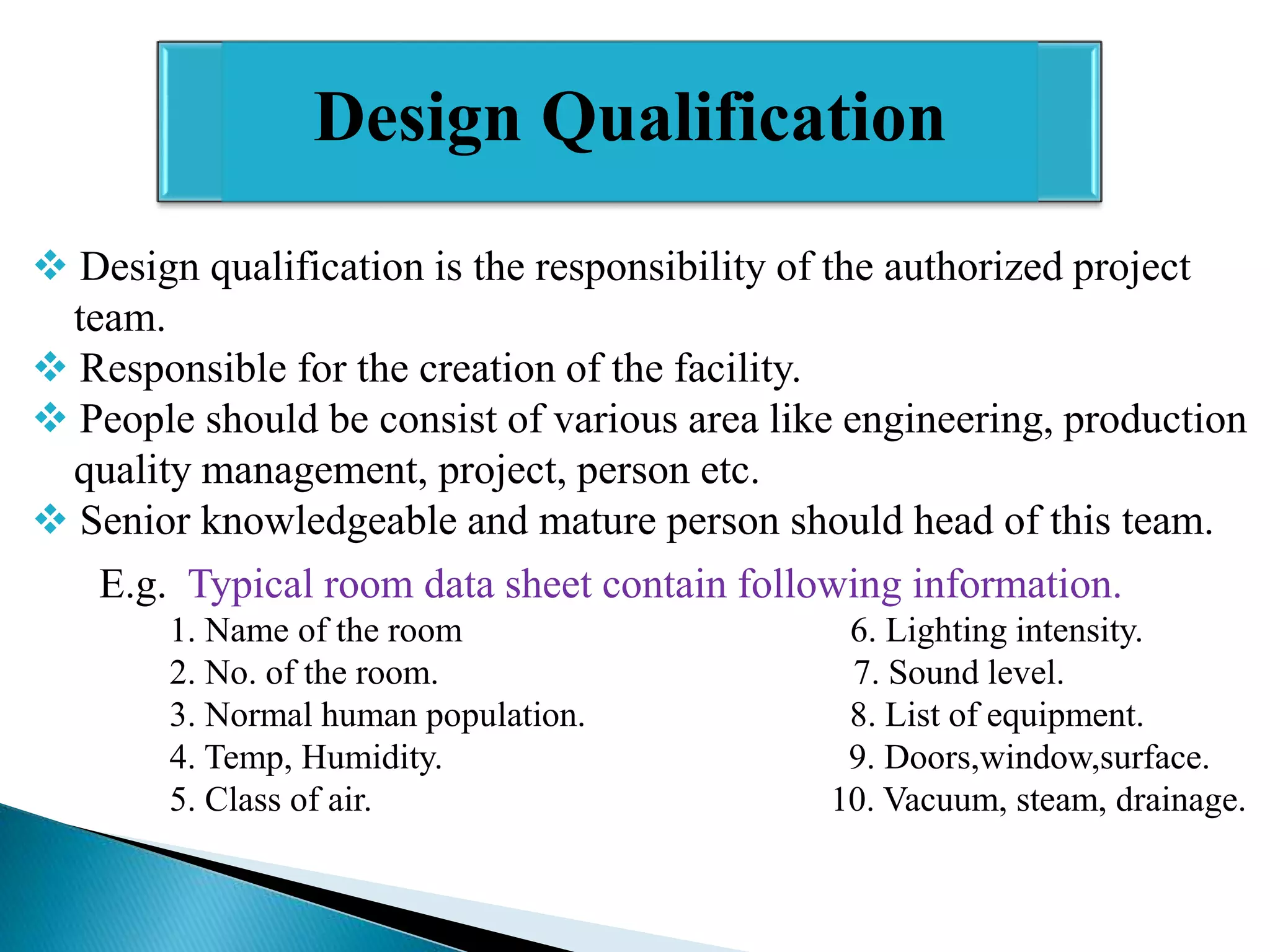
Design Qualification
 Design qualification is the responsibility of the authorized project
team.
 Responsible for the creation of the facility.
 People should be consist of various area like engineering, production
quality management, project, person etc.
 Senior knowledgeable and mature person should head of this team.
E.g. Typical room data sheet contain following information.
1. Name of the room
2. No. of the room.
3. Normal human population.
4. Temp, Humidity.
5. Class of air.

6. Lighting intensity.
7. Sound level.
8. List of equipment.
9. Doors,window,surface.
10. Vacuum, steam, drainage.
Initialization Qualification

The protocol is insure that the system equipment and its component
are installed correctly and to the original manufacturer
specification.
Major calibration of equipment, accessory equipment, or utilities
should be performed in this step.
Operation Qualification
This step proceed after the installation qualification.

This should be done mainly to see if there is any problem related to
the lighting, drainage, men and material movement, sewage and
sanitation, cleaning and maintenance .
Performance Qualification
This is the final step of validation.
Evaluate the premises suitability with :
Equipment in operation.
Material being handled.
People working.
Various sound may be produced.
Dust is getting generated.
Heat is getting generated.
Filtered getting chocked.
Take care of all possible practical problems
Prospective
Prospective
validation
Validation

Retrospective
Retrospective
Validation

validation

Concurrent
Types of
Concurrent
Validation
Validation
Validation

Revalidation

Revalidation
Prospective Validation
 Prospective validation is done during the Product development
stage.
 When we developed a new mfg process and formula each step
will be validated to achieve desire result.
 On the basis of past experience to determine whether they might
lead to critical situation.
Prospective Validation
 Unsatisfactory process must be modified & improve until the
validation exercise prove them to be satisfactory.
 Essential in order to limit the risk of error occurring on the
production scale.
 Every aspect from laboratory scale to commercial scale is
documented on record of Process validation.
 e.g. Injectable preparation.
Concurrent Validation
 Concurrent validation is carried out during production.
 This time the in-process quality control parameter are also decides
& monitor for use of regular production, final control & stability.
 If initial batches use same type of equipment then revalidation may
not be required only IPQC test are enough.
 IPQC test should be carried out for every batch to see the process
is moving forward in the excepted direction.
Concurrent Validation
Process & procedure should undergoes periodic critical revalidation
to ensure that achieving the desire result.
The verification of process parameter are evaluated for the mfg.
facilities batch after batch if any changes is required.
The premises and equipment to be used have been validated
previously and then decision to carry out concurrent validation.
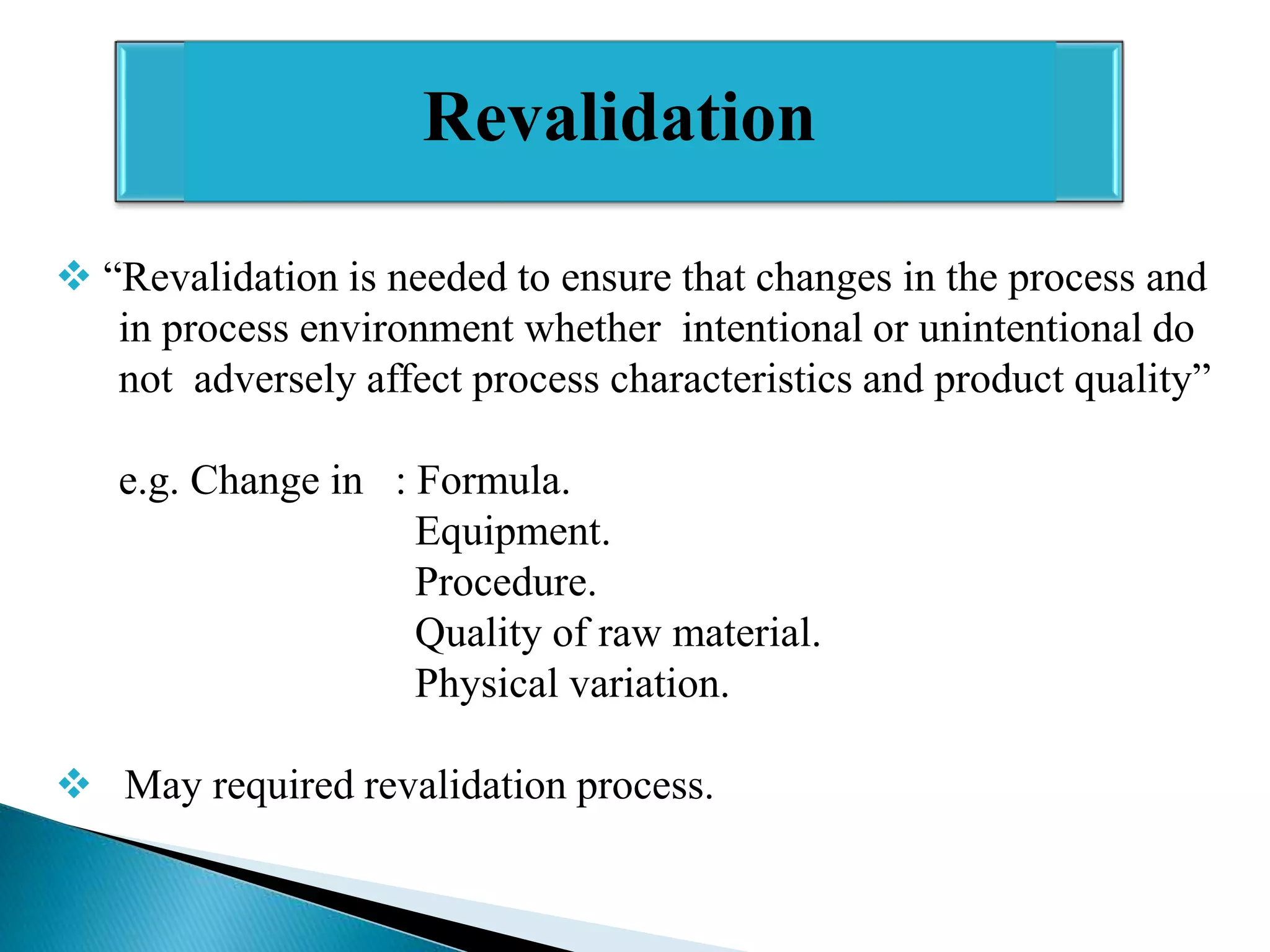
Revalidation
 “Revalidation is needed to ensure that changes in the process and
in process environment whether intentional or unintentional do
not adversely affect process characteristics and product quality”
e.g. Change in : Formula.
Equipment.
Procedure.
Quality of raw material.
Physical variation.
 May required revalidation process.
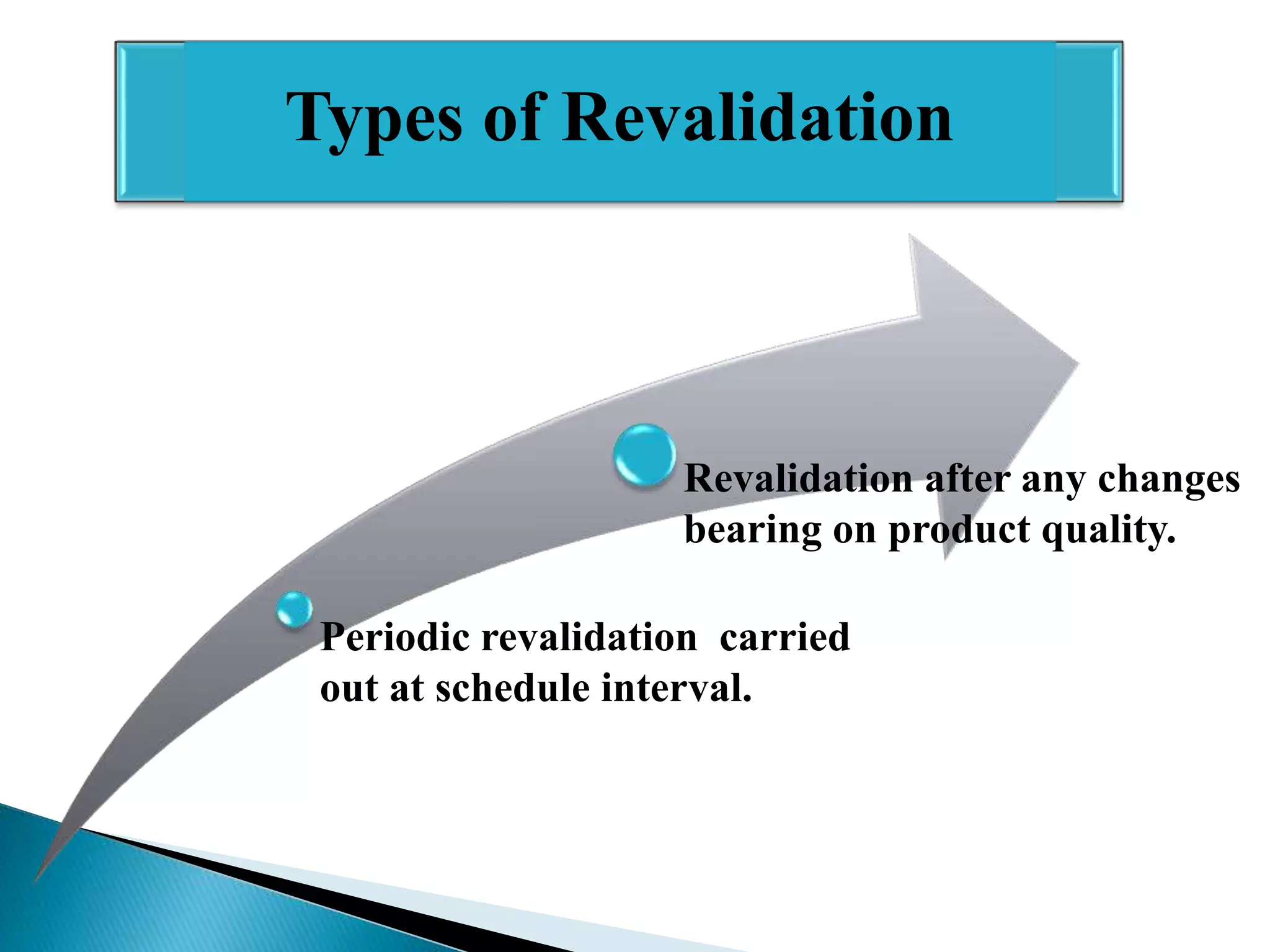
Types of Revalidation

Revalidation after any changes
bearing on product quality.
Periodic revalidation carried
out at schedule interval.
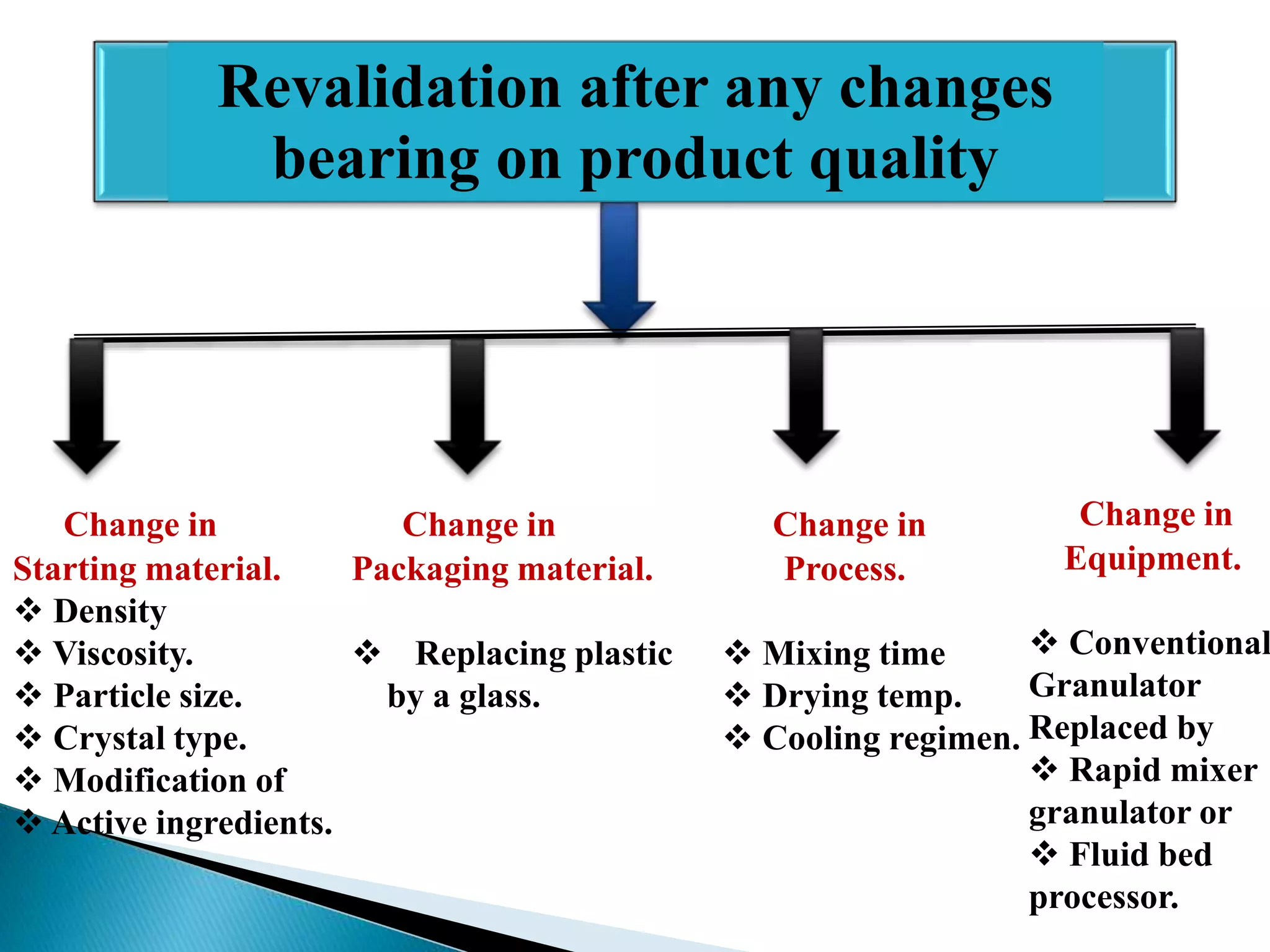
Revalidation after any changes
bearing on product quality

Change in
Change in
Starting material.
Packaging material.
 Density
 Viscosity.
 Replacing plastic
 Particle size.
by a glass.
 Crystal type.
 Modification of
 Active ingredients.

Change in
Process.

Change in
Equipment.

 Conventional
 Mixing time
Granulator
 Drying temp.
 Cooling regimen. Replaced by
 Rapid mixer
granulator or
 Fluid bed
processor.
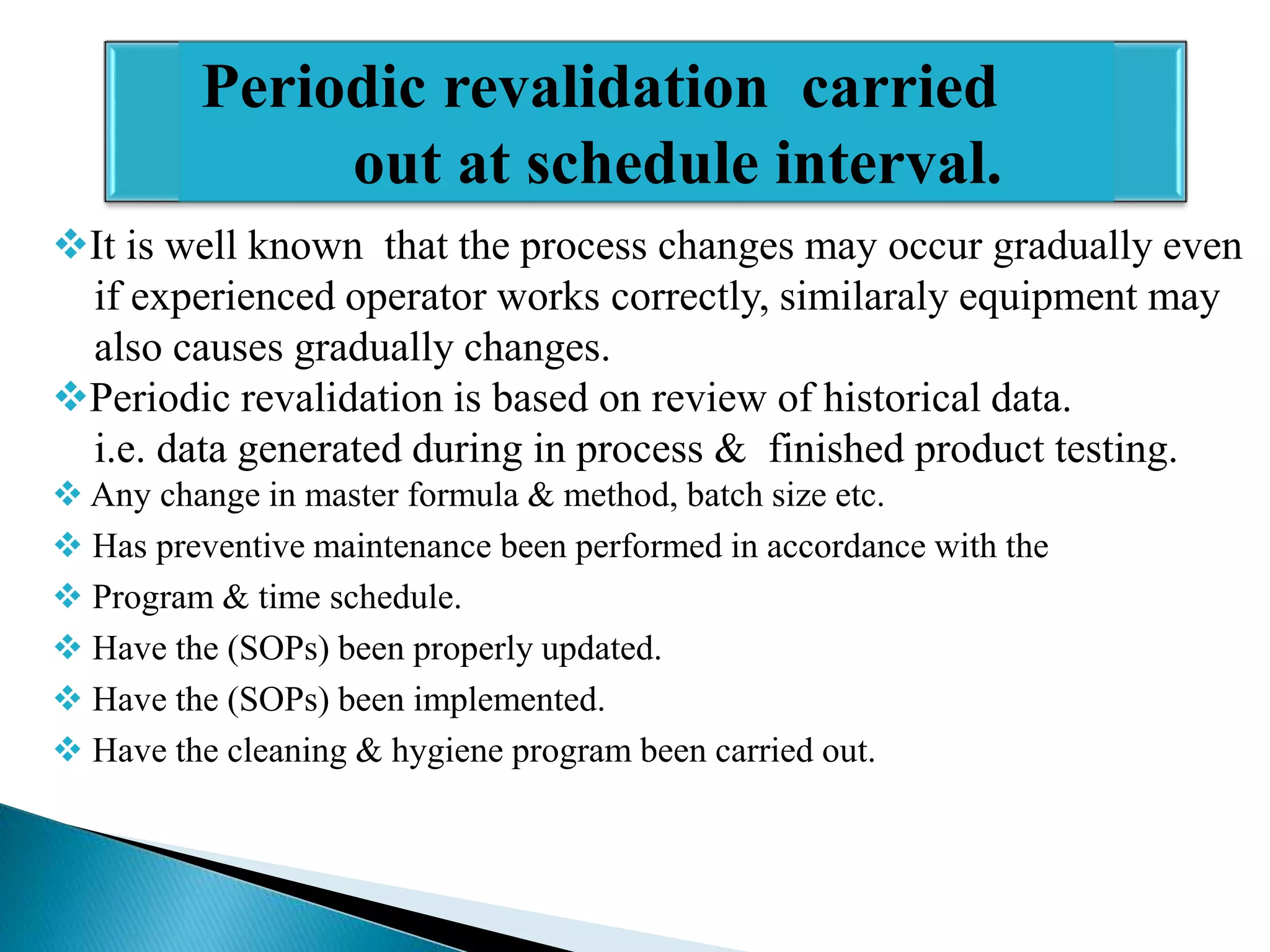
Periodic revalidation carried
out at schedule interval.
It is well known that the process changes may occur gradually even
if experienced operator works correctly, similaraly equipment may
also causes gradually changes.
Periodic revalidation is based on review of historical data.
i.e. data generated during in process & finished product testing.
 Any change in master formula & method, batch size etc.
 Has preventive maintenance been performed in accordance with the
 Program & time schedule.
 Have the (SOPs) been properly updated.
 Have the (SOPs) been implemented.
 Have the cleaning & hygiene program been carried out.
Retrospective validation
 Establishing documented evidence that a system does what if purpose
to do based on a review and analysis of historical data and information
obtained during production of marketable products.
 This validation includes:
 Batch documents.
 Process control chart.
 Maintenance log book.
 Record of personnel changes.
 Finished product data.
 Storage stability result.
Conclusion.
Validation is obtained through beginning from the process
development Phase and continued through in to production phase.
which provide high degree of assurance that will consistently
produce a product meeting its predetermine specification and
quality attributes.
may used to achieve reduction of cost, process optimization,
assurance of quality and safety. Process validation involves series of
activity taking place over the Lifecycle of the product and process.
Processs validation
Processs validation

Processs validation

  • 1.
  • 2.
    Content Definition Scope of validation Importanceof validation Types of validation Limitation of validation Process validation Types of process validation Conclusion References.
  • 3.
    Introduction  The proofof validation is obtained through the collection and evaluation of data .  Beginning from the process development phase and continued through in to the production phase.  validation is necessary include Process qualification, material, equipment, system, personnel.  The control of the entire process for repeated batches or runs.
  • 6.
    Definition “ Validation isa documented program which provide a high degree of assurance that a specific process will consistently produce a products to meeting it’s Pre-determined Specification and quality attributes”
  • 7.
    Scope of validation Pharmaceutical validation is vast area of work and it practically cover every aspect of pharmaceutical process activities. Following area or operation will point out for pharmaceutical validation,  Analytical test method. Instrument calibration. Raw material. Packaging material.  Equipment validation.  Facilities.  Manufacturing operation  Product design.  Cleaning validation.  operator.  Process utility services.
  • 8.
    Importance of ofvalidation Importance validation  Every activity in any business unit is done to get some benefit from that.  Validation activity must give the industry some advantages, some benefit & Some added value. Reduction of Quality cost Assurance of Quality Process optimization Safety
  • 9.
    Reduction of Qualitycost  Preventive cost : To prevent failure or reduce the appraisal cost 1. Quality planning. 5. Process validation 2. Training. 6. Self inspection. 3. Calibration. 7. Documentation. 4. Sanitation 8. Review of data.  Internal failure cost : Non-confirming material . 1. Reject. 3. Re-inspection. 2. Rework. 4. Re-test.  External failure cost : Non- confirming condition after the product left the company ownership. 1.Recall. 2. Complaints. 3.Return due to Quality problem
  • 10.
    Process Optimization  Makethe process effective, efficient, perfect or useful as possible at the minimum cost.  Trained qualified people are the key element in any process, thus greatest impact on improving efficiency and productivity. In this content GMP training program that include how to do the job correctly, easily and repeatedly.
  • 11.
    Assurance of Quality Validationis a extension of quality assurance, in other words validation and process control are the heart of GMP.  Without validated and controlled process it is impossible to produce quality product consistently.
  • 12.
    Safety Validation can alsoresult in increased operation safety. e.g. gauges used in equipment that is designed to operate at certain temperature, and pressure must be reliable i.e. they must be calibrated.
  • 13.
    Limit of validation Validation has a practical limit and related cost, hence while deciding the limit of validation, we need to balance between the process cost and the benefits derived from such limit. e.g. The cost of controlling weight variation in tablet or capsule, if 1 person keep limit of 5% & other person keep at limit 0.5% using high tech.& high cost. We must see what benefit, benefit is not much then we decide the limit.
  • 14.
    Process validation  Definition:-“The collection and evaluation of data from the process design stage throughout production which establishes evidence that a process is capable of consistently delivering quality product” Process validation involves a series of activities taking place over the lifecycle of the product and process.
  • 15.
    Phases of validation Phaseof validation Design Qualification Phases Installation Qualification Of validation Operational Qualification Performance Qualification
  • 16.
    Design Qualification  Designqualification is the responsibility of the authorized project team.  Responsible for the creation of the facility.  People should be consist of various area like engineering, production quality management, project, person etc.  Senior knowledgeable and mature person should head of this team. E.g. Typical room data sheet contain following information. 1. Name of the room 2. No. of the room. 3. Normal human population. 4. Temp, Humidity. 5. Class of air. 6. Lighting intensity. 7. Sound level. 8. List of equipment. 9. Doors,window,surface. 10. Vacuum, steam, drainage.
  • 17.
    Initialization Qualification The protocolis insure that the system equipment and its component are installed correctly and to the original manufacturer specification. Major calibration of equipment, accessory equipment, or utilities should be performed in this step.
  • 18.
    Operation Qualification This stepproceed after the installation qualification. This should be done mainly to see if there is any problem related to the lighting, drainage, men and material movement, sewage and sanitation, cleaning and maintenance .
  • 19.
    Performance Qualification This isthe final step of validation. Evaluate the premises suitability with : Equipment in operation. Material being handled. People working. Various sound may be produced. Dust is getting generated. Heat is getting generated. Filtered getting chocked. Take care of all possible practical problems
  • 20.
  • 21.
    Prospective Validation  Prospectivevalidation is done during the Product development stage.  When we developed a new mfg process and formula each step will be validated to achieve desire result.  On the basis of past experience to determine whether they might lead to critical situation.
  • 22.
    Prospective Validation  Unsatisfactoryprocess must be modified & improve until the validation exercise prove them to be satisfactory.  Essential in order to limit the risk of error occurring on the production scale.  Every aspect from laboratory scale to commercial scale is documented on record of Process validation.  e.g. Injectable preparation.
  • 23.
    Concurrent Validation  Concurrentvalidation is carried out during production.  This time the in-process quality control parameter are also decides & monitor for use of regular production, final control & stability.  If initial batches use same type of equipment then revalidation may not be required only IPQC test are enough.  IPQC test should be carried out for every batch to see the process is moving forward in the excepted direction.
  • 24.
    Concurrent Validation Process &procedure should undergoes periodic critical revalidation to ensure that achieving the desire result. The verification of process parameter are evaluated for the mfg. facilities batch after batch if any changes is required. The premises and equipment to be used have been validated previously and then decision to carry out concurrent validation.
  • 25.
    Revalidation  “Revalidation isneeded to ensure that changes in the process and in process environment whether intentional or unintentional do not adversely affect process characteristics and product quality” e.g. Change in : Formula. Equipment. Procedure. Quality of raw material. Physical variation.  May required revalidation process.
  • 26.
    Types of Revalidation Revalidationafter any changes bearing on product quality. Periodic revalidation carried out at schedule interval.
  • 27.
    Revalidation after anychanges bearing on product quality Change in Change in Starting material. Packaging material.  Density  Viscosity.  Replacing plastic  Particle size. by a glass.  Crystal type.  Modification of  Active ingredients. Change in Process. Change in Equipment.  Conventional  Mixing time Granulator  Drying temp.  Cooling regimen. Replaced by  Rapid mixer granulator or  Fluid bed processor.
  • 28.
    Periodic revalidation carried outat schedule interval. It is well known that the process changes may occur gradually even if experienced operator works correctly, similaraly equipment may also causes gradually changes. Periodic revalidation is based on review of historical data. i.e. data generated during in process & finished product testing.  Any change in master formula & method, batch size etc.  Has preventive maintenance been performed in accordance with the  Program & time schedule.  Have the (SOPs) been properly updated.  Have the (SOPs) been implemented.  Have the cleaning & hygiene program been carried out.
  • 29.
    Retrospective validation  Establishingdocumented evidence that a system does what if purpose to do based on a review and analysis of historical data and information obtained during production of marketable products.  This validation includes:  Batch documents.  Process control chart.  Maintenance log book.  Record of personnel changes.  Finished product data.  Storage stability result.
  • 30.
    Conclusion. Validation is obtainedthrough beginning from the process development Phase and continued through in to production phase. which provide high degree of assurance that will consistently produce a product meeting its predetermine specification and quality attributes. may used to achieve reduction of cost, process optimization, assurance of quality and safety. Process validation involves series of activity taking place over the Lifecycle of the product and process.