VALIDATION
SILAMBARASAN I
M PHARM (PHARMACEUTICS)
MTPG & RIHS
INTRODUCTION
• Proposed by two FDA officials, Ted Byers and Bud Loftus.
• In the mid 1970’s .
• To improve the quality of pharmaceuticals.
DEFINITION
As per FDA Validation
It is defined as “ establishing a Documented evidence, which provides a high
degree of assurance that a specific process will consistently produce a product
meeting its pre-determined specifications and quality attributes”.
As per WHO
Validation means providing documented evidence that any procedure,
process, activity or system actually leads to the expected results.
According to European commission:
Action providing in accordance with the principles of GMP, that any procedure,
process, equipment, material, activity or system actually lead to the expected results.
WHY VALIDATION?
Need of Validation:
• To obtain consistent, reliable and accurate data
• Act as a proof in decision making
• To get assurance of Quality product
SCOPE OF VALIDATION
• Analytical Test Methods
• Instrument Calibrations
• Raw Material
• Equipment
• Facilities
• Product Design
• Cleaning
WHEN SHOULD BE VALIDATED ?
• Changes in established methods
• New method developed for particular problem
• Established method used in different laboratories, different equipment, different staff
MERITS OF VALIDATION
1. the knowledge of the process increases
2. Assures the repeatability of the process
3. Decreases the risk of the manufacturing problems
4. Decreases the expenses caused by the failures in production
5. controls the Production Cost
6. Assurance of quality
7. Safety
8. Customer Satisfaction
9. Time bound
DOCUMENTATION OF
VALIDATION
• Validation Master Plan(VMP)
• Validation Protocol(VP)
• Validation Reports(VR)
• Standard Operating Procedure(SOP)
VALIDATION MASTER PLAN
It gives idea about future performed:
• What activities are to be performed?
• Who is going to perform these activities?
• When the activities should start and when they should get over?
• What documents will be generated?
• What the policy on revalidation?
VALIDATION MASTER PLAN
V.M.P. includes..
• Processes
• Products
• Format for protocol and other documentation
• List of relevant SOPs
• Planning and scheduling
• Location
• Estimation of staffing requirements
• A time plan of the project
VALIDATION MASTER PLAN
Guidelines on Preparing V.M.P.
• V.M.P. write on A4 size paper.
• File in a presentable form.
• Have sufficient explanatory drawings.
• Clearly divide the V.M.P. in different form.
• It must be dated and signed properly by authorized persons.
TYPES OF VALIDATION
• Validation of analytical method
• Cleaning validation
• Equipment validation
• Process validation
ANALYTICAL METHOD
VALIDATION
Methods should be validated when:-
• When they are to be established for routine use.
• When the method is to be changed due to change in conditions.
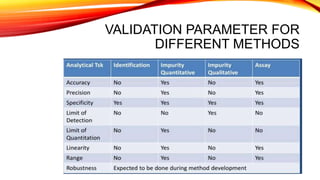
Glossary Description
Accuracy The closeness of agreement between real value and measured value
Precision The closeness of agreement between a series of measurements
Intermediate precision Precision between laboratories, day
Limit of Detection Lowest amount of analyte that can be detected
Limit of Quantification Lowest amount of analyte that can be detected but quantity is necessary
SST Check the theoretical plates, tailing factor , resolution and % RSD
Linearity Proportionality of measured value of concentration
Range “Concentration interval where method is precise , accurate and linear’
Robustness “reproducibility under normal but variable laboratory conditions.’
Specificity “Ability to measure desired analyte in a complex mixture.”
Ruggedness “ruggedness should be established by 2 different system, columns and
analyst.
VALIDATION PARAMETER FOR
DIFFERENT METHODS
CLEANING VALIDATION
• To attain documented evidence, which provides a high degree of assurance that the
Cleaning procedure can effectively remove residues of a product and a cleaning
agent from the manufacturing equipment, to a level that does not raise patient
safety concerns.
CLEANING VALIDATION
ADVANTAGE OF CLEANING VALIDATION
• Assurance of quality & safety
• Government regulations
• Cross contamination integrity
• Batch integrity
• Equipment reuse
• Reduction of quality costs.
• Less down time, fewer batch failures
CLEANING VALIDATION
CLEANING MECHANISM
• brushing
• scrubbing
• pressurized water to remove particulates
CLEANING VALIDATION
CLEANING METHOD
• Manual cleaning
• Semi automatic procedures
• Automatic procedures
• CIP (Clean-in-place)
• COP (Clean-out-of-place)
CLEANING VALIDATION
SAMPLING METHOD
1. Rinse samples (indirect method)
2. Swab sampling
EQUIPMENT VALIDATION
Definition
• As per FDA, May 1987,‘Action of proving that any equipment works correctly and
leads to the expected result.
Steps involved..
• User requirement specification(URS)
• Design qualification
• Installation qualifications
• Operational qualifications
• Performance qualification
EQUIPMENT VALIDATION
PROCESS FLOW CHART
USER REQUIREMENTS SPECIFICATION
• What are the expectations of the customer?
• General requirements may be stated as follows:
1. size of the equipment
2. Speed of the equipment
3. Effectiveness of the equipment
4. Availability of the spares, change parts, prompt services at reasonable cost.
5. Ease of operation, cleaning & maintenance.
6. Low dust & sound generation.
7. Lesser breakdowns.
DESIGN QUALIFICATION
o User requirements should be considered when deciding on the specific design
of a system or equipment.
o A suitable supplier should be selected for the appropriate system or
equipment(approved vendor).
o If the user asks for a specialized type of instrument, then he must submit his
Requirements in the form of a detailed design qualification document to the
supplier.
INSTALLATION QUALIFICATION
(IQ)
 Verifies that the correct equipment has been received and installed as per plan and protocol. Also that it is
complete and undamaged (parts, services, other components).
 Verifies that equipment has been properly installed and calibrated including connections to utilities.
• Documented records for the installation
• Installation qualification report.
Include details, e.g.
• The supplier and manufacturer.
• System or equipment name, model and serial number.
• Date of installation.
• Spare parts, relevant procedures and certificates
OPERATIONAL QUALIFICATION
It is done to provide a high degree of assurance that the equipment functions
as intended as per manufacture specification.
Important OQ considerations:-
• Software procedures
• Finalize and approve SOP operation
• Operation qualification report
• Training records
• Systems and equipment released for routine use after completion of operational
qualification
PERFORMANCE QUALIFICATION
• Verifies that the equipment performs according to design specifications and
user defined requirements in a reliable and reproducible manner under
normal production conditions
Important PQ considerations:-
• Actual product & process parameters
• Process repeatability
• Long term process stability
PROCESS VALIDATION
• USFDA defined Process validation as “Establishing documented evidence, which
provides a high degree of assurance that a specific process will consistently
produce a product meeting its pre-determined specifications and quality attributes”.
PROCESS VALIDATION
Process validation activities in three stages
Stage I : Process Design
Stage II : Process qualification
Stage III: Continued process verification
PROCESS VALIDATION
TYPES OF PROCESS VALIDATION
• Prospective Validation (Premarket validation)
• Retrospective Validation
• Concurrent Validation
• Revalidation
PROSPECTIVE VALIDATION
Definition: It is establishing documented evidence prior to process implementation
that a system does what it proposed to do based on pre-planned protocols.
• An experimental plan called the validation protocol is executed before the process
is put into commercial use.
• It is normally undertaken for a new drug product or new facilities are introduced
into a routine pharmaceutical production.
PROSPECTIVE VALIDATION
Objective:
• To prove that the process will work in accordance with a validation protocol.
• During Product development stage, Production process broken down into individual
steps
• Each steps evaluated on the basis of experience or theoretical considerations
• Critical factors that may affect the quality of the finished product are determined.
Protocol Contains,
a) Objective, scope, responsibilities
b) Process Flow
c) A description of the process
d) A description of the experiment
e) Details of the equipment/facilities to be used together with its calibration status
f) The variables to be monitored
g) The samples to be taken - where, when, how and how many
h) The product performance characteristics/attributes to be monitored, together with the test
methods
i) The acceptable limits
j) Time schedules
k) Details of methods for recording and evaluating results, including statistical analysis
l) Summary / Conclusion
CONCURRENT VALIDATION
• Definition: Concurrent Validation means establishing documented evidence a
process does what it is supposed to do based on data generated during actual
implementation of the process.
• Validation – during routine production
Validation involves –
• In-process monitoring
• End product testing
Personnel – Authorized staff
Documentation – as per Prospective Validation
RETROSPECTIVE VALIDATION
Definition:
• It is an establishing documented evidence that a process does what it is supposed to do
based on review and analysis of historic data.
• Validation of these processes - historical data to provide the necessary documentary
evidence that the process is doing what it is supposed to do.
Steps require for validation
• Protocol preparation
• Validation reports
• Data analysis
• Conclusion
• Recommendations
REVALIDATION
Definition:
• Re-validation provides the evidence that changes in a process and/or the process
environment, introduced either intentionally or unintentionally, do not adversely
affect process characteristics and product quality.
There are two basic categories of Re-validation:
• Re-validation in cases of known change (including transfer of processes from one
company to another or from one site to another)
• Periodic Re-validation carried out at scheduled intervals
REVALIDATION
When we do revalidation?
• Changes of raw materials
• Change of starting material
• Changes of packaging material
• Changes in the process (e.g. mixing times, drying temperatures),
• Changes in the equipment (e.g. addition of automatic detection systems).
• Changes of equipment
• Production area and support system changes (e.g. rearrangement of areas, new
water treatment method),
• Transfer of processes to another site
CALIBRATION
• It is the process of determining its accuracy.
• Defined as “ Comparison of measurement system or device of unknown accuracy
to another measurement system or device of known accuracy.
To maintain the accuracy and precision of test equipment at all times
To determine whether the equipment is still fits for intended purpose
CALIBRATION
Need for calibration:
New instrument
When specified time period elapsed
When operating hours elapsed
Sudden changes in weather
Repair of instrument
CALIBRATION MASTER PLAN
• Instrument features:
Identification, Model and Serial number
Capacity
Location
Dimensions
Purpose
Calibration number and information
Calibration frequency
Calibration SOP number and title
Calibration limits
Utilization range
Compiled by:______ Date:______
VALIDATION OF DOSAGE FORM
Process validation of Tablets
PROCESS VALIDATION OF CAPSULES
VALIDATION OF DOSAGE FORM
VALIDATION GUIDELINES
1. ICH Q2A
• Text on validation of analytical procedures, Definitions and terminology (March
1995)
2. ICH Q2B
• Validation of analytical procedures, Methodology (June 1997)
3. FDA
• (Draft) Guidance for Industry: Analytical procedures and methods validation
4. Pharmacopoeias
• USP and European Pharmacopoeia.
WHO GUIDELINES FOR
VALIDATION OF EQUIPMENT
• Devices used to measure the physical properties of substances must be regularly
calibrated, validated and verified.
• Specific procedures must be established for each type of equipment, instrument
and other device, having regard to the extent to which they are used, verified and
calibrated at regular intervals according to the SOP
• Only authorized personnel should operate equipment, instruments and devices.
• Equipment relevant manuals (provided by the manufacturer) must be readily
available for use by the appropriate laboratory personnel.
WHO GUIDELINES FOR
VALIDATION OF EQUIPMENT
• The records must include at least the following:
a) the identity of the equipment, instrument or other device
b) the manufacturer’s name, the type identification, serial number
c) the verification or calibration required to comply with the specifications
d) the current location
e) the manufacturer’s instructions, if available, or an indication of their location;
f) due date of the next verification and/or calibration
g) the maintenance carried out to date and the maintenance plan
h) a history of any damage, malfunction, modification or repair
GOVERNMENT REGULATION
• Validation is considered to be an integral part of GMPs.
• Worldwide compliance with validation requirements is necessary for obtaining
approval to manufacture and to introduce new products.
• The accuracy, sensitivity, specificity and reproducibility of test methods employed by
the firm shall be established and documented.
Pharmaceutical Validation

Pharmaceutical Validation

  • 1.
    VALIDATION SILAMBARASAN I M PHARM(PHARMACEUTICS) MTPG & RIHS
  • 2.
    INTRODUCTION • Proposed bytwo FDA officials, Ted Byers and Bud Loftus. • In the mid 1970’s . • To improve the quality of pharmaceuticals.
  • 3.
    DEFINITION As per FDAValidation It is defined as “ establishing a Documented evidence, which provides a high degree of assurance that a specific process will consistently produce a product meeting its pre-determined specifications and quality attributes”. As per WHO Validation means providing documented evidence that any procedure, process, activity or system actually leads to the expected results. According to European commission: Action providing in accordance with the principles of GMP, that any procedure, process, equipment, material, activity or system actually lead to the expected results.
  • 4.
    WHY VALIDATION? Need ofValidation: • To obtain consistent, reliable and accurate data • Act as a proof in decision making • To get assurance of Quality product
  • 5.
    SCOPE OF VALIDATION •Analytical Test Methods • Instrument Calibrations • Raw Material • Equipment • Facilities • Product Design • Cleaning
  • 6.
    WHEN SHOULD BEVALIDATED ? • Changes in established methods • New method developed for particular problem • Established method used in different laboratories, different equipment, different staff
  • 7.
    MERITS OF VALIDATION 1.the knowledge of the process increases 2. Assures the repeatability of the process 3. Decreases the risk of the manufacturing problems 4. Decreases the expenses caused by the failures in production 5. controls the Production Cost 6. Assurance of quality 7. Safety 8. Customer Satisfaction 9. Time bound
  • 8.
    DOCUMENTATION OF VALIDATION • ValidationMaster Plan(VMP) • Validation Protocol(VP) • Validation Reports(VR) • Standard Operating Procedure(SOP)
  • 9.
    VALIDATION MASTER PLAN Itgives idea about future performed: • What activities are to be performed? • Who is going to perform these activities? • When the activities should start and when they should get over? • What documents will be generated? • What the policy on revalidation?
  • 10.
    VALIDATION MASTER PLAN V.M.P.includes.. • Processes • Products • Format for protocol and other documentation • List of relevant SOPs • Planning and scheduling • Location • Estimation of staffing requirements • A time plan of the project
  • 11.
    VALIDATION MASTER PLAN Guidelineson Preparing V.M.P. • V.M.P. write on A4 size paper. • File in a presentable form. • Have sufficient explanatory drawings. • Clearly divide the V.M.P. in different form. • It must be dated and signed properly by authorized persons.
  • 12.
    TYPES OF VALIDATION •Validation of analytical method • Cleaning validation • Equipment validation • Process validation
  • 13.
    ANALYTICAL METHOD VALIDATION Methods shouldbe validated when:- • When they are to be established for routine use. • When the method is to be changed due to change in conditions.
  • 14.
    Glossary Description Accuracy Thecloseness of agreement between real value and measured value Precision The closeness of agreement between a series of measurements Intermediate precision Precision between laboratories, day Limit of Detection Lowest amount of analyte that can be detected Limit of Quantification Lowest amount of analyte that can be detected but quantity is necessary SST Check the theoretical plates, tailing factor , resolution and % RSD Linearity Proportionality of measured value of concentration Range “Concentration interval where method is precise , accurate and linear’ Robustness “reproducibility under normal but variable laboratory conditions.’ Specificity “Ability to measure desired analyte in a complex mixture.” Ruggedness “ruggedness should be established by 2 different system, columns and analyst.
  • 15.
  • 16.
    CLEANING VALIDATION • Toattain documented evidence, which provides a high degree of assurance that the Cleaning procedure can effectively remove residues of a product and a cleaning agent from the manufacturing equipment, to a level that does not raise patient safety concerns.
  • 17.
    CLEANING VALIDATION ADVANTAGE OFCLEANING VALIDATION • Assurance of quality & safety • Government regulations • Cross contamination integrity • Batch integrity • Equipment reuse • Reduction of quality costs. • Less down time, fewer batch failures
  • 18.
    CLEANING VALIDATION CLEANING MECHANISM •brushing • scrubbing • pressurized water to remove particulates
  • 19.
    CLEANING VALIDATION CLEANING METHOD •Manual cleaning • Semi automatic procedures • Automatic procedures • CIP (Clean-in-place) • COP (Clean-out-of-place)
  • 20.
    CLEANING VALIDATION SAMPLING METHOD 1.Rinse samples (indirect method) 2. Swab sampling
  • 21.
    EQUIPMENT VALIDATION Definition • Asper FDA, May 1987,‘Action of proving that any equipment works correctly and leads to the expected result. Steps involved.. • User requirement specification(URS) • Design qualification • Installation qualifications • Operational qualifications • Performance qualification
  • 22.
  • 23.
    USER REQUIREMENTS SPECIFICATION •What are the expectations of the customer? • General requirements may be stated as follows: 1. size of the equipment 2. Speed of the equipment 3. Effectiveness of the equipment 4. Availability of the spares, change parts, prompt services at reasonable cost. 5. Ease of operation, cleaning & maintenance. 6. Low dust & sound generation. 7. Lesser breakdowns.
  • 24.
    DESIGN QUALIFICATION o Userrequirements should be considered when deciding on the specific design of a system or equipment. o A suitable supplier should be selected for the appropriate system or equipment(approved vendor). o If the user asks for a specialized type of instrument, then he must submit his Requirements in the form of a detailed design qualification document to the supplier.
  • 25.
    INSTALLATION QUALIFICATION (IQ)  Verifiesthat the correct equipment has been received and installed as per plan and protocol. Also that it is complete and undamaged (parts, services, other components).  Verifies that equipment has been properly installed and calibrated including connections to utilities. • Documented records for the installation • Installation qualification report. Include details, e.g. • The supplier and manufacturer. • System or equipment name, model and serial number. • Date of installation. • Spare parts, relevant procedures and certificates
  • 26.
    OPERATIONAL QUALIFICATION It isdone to provide a high degree of assurance that the equipment functions as intended as per manufacture specification. Important OQ considerations:- • Software procedures • Finalize and approve SOP operation • Operation qualification report • Training records • Systems and equipment released for routine use after completion of operational qualification
  • 27.
    PERFORMANCE QUALIFICATION • Verifiesthat the equipment performs according to design specifications and user defined requirements in a reliable and reproducible manner under normal production conditions Important PQ considerations:- • Actual product & process parameters • Process repeatability • Long term process stability
  • 28.
    PROCESS VALIDATION • USFDAdefined Process validation as “Establishing documented evidence, which provides a high degree of assurance that a specific process will consistently produce a product meeting its pre-determined specifications and quality attributes”.
  • 29.
    PROCESS VALIDATION Process validationactivities in three stages Stage I : Process Design Stage II : Process qualification Stage III: Continued process verification
  • 30.
    PROCESS VALIDATION TYPES OFPROCESS VALIDATION • Prospective Validation (Premarket validation) • Retrospective Validation • Concurrent Validation • Revalidation
  • 31.
    PROSPECTIVE VALIDATION Definition: Itis establishing documented evidence prior to process implementation that a system does what it proposed to do based on pre-planned protocols. • An experimental plan called the validation protocol is executed before the process is put into commercial use. • It is normally undertaken for a new drug product or new facilities are introduced into a routine pharmaceutical production.
  • 32.
    PROSPECTIVE VALIDATION Objective: • Toprove that the process will work in accordance with a validation protocol. • During Product development stage, Production process broken down into individual steps • Each steps evaluated on the basis of experience or theoretical considerations • Critical factors that may affect the quality of the finished product are determined.
  • 33.
    Protocol Contains, a) Objective,scope, responsibilities b) Process Flow c) A description of the process d) A description of the experiment e) Details of the equipment/facilities to be used together with its calibration status f) The variables to be monitored g) The samples to be taken - where, when, how and how many h) The product performance characteristics/attributes to be monitored, together with the test methods i) The acceptable limits j) Time schedules k) Details of methods for recording and evaluating results, including statistical analysis l) Summary / Conclusion
  • 34.
    CONCURRENT VALIDATION • Definition:Concurrent Validation means establishing documented evidence a process does what it is supposed to do based on data generated during actual implementation of the process. • Validation – during routine production Validation involves – • In-process monitoring • End product testing Personnel – Authorized staff Documentation – as per Prospective Validation
  • 35.
    RETROSPECTIVE VALIDATION Definition: • Itis an establishing documented evidence that a process does what it is supposed to do based on review and analysis of historic data. • Validation of these processes - historical data to provide the necessary documentary evidence that the process is doing what it is supposed to do. Steps require for validation • Protocol preparation • Validation reports • Data analysis • Conclusion • Recommendations
  • 37.
    REVALIDATION Definition: • Re-validation providesthe evidence that changes in a process and/or the process environment, introduced either intentionally or unintentionally, do not adversely affect process characteristics and product quality. There are two basic categories of Re-validation: • Re-validation in cases of known change (including transfer of processes from one company to another or from one site to another) • Periodic Re-validation carried out at scheduled intervals
  • 38.
    REVALIDATION When we dorevalidation? • Changes of raw materials • Change of starting material • Changes of packaging material • Changes in the process (e.g. mixing times, drying temperatures), • Changes in the equipment (e.g. addition of automatic detection systems). • Changes of equipment • Production area and support system changes (e.g. rearrangement of areas, new water treatment method), • Transfer of processes to another site
  • 39.
    CALIBRATION • It isthe process of determining its accuracy. • Defined as “ Comparison of measurement system or device of unknown accuracy to another measurement system or device of known accuracy. To maintain the accuracy and precision of test equipment at all times To determine whether the equipment is still fits for intended purpose
  • 40.
    CALIBRATION Need for calibration: Newinstrument When specified time period elapsed When operating hours elapsed Sudden changes in weather Repair of instrument
  • 41.
    CALIBRATION MASTER PLAN •Instrument features: Identification, Model and Serial number Capacity Location Dimensions Purpose Calibration number and information Calibration frequency Calibration SOP number and title Calibration limits Utilization range Compiled by:______ Date:______
  • 42.
    VALIDATION OF DOSAGEFORM Process validation of Tablets
  • 43.
    PROCESS VALIDATION OFCAPSULES VALIDATION OF DOSAGE FORM
  • 44.
    VALIDATION GUIDELINES 1. ICHQ2A • Text on validation of analytical procedures, Definitions and terminology (March 1995) 2. ICH Q2B • Validation of analytical procedures, Methodology (June 1997) 3. FDA • (Draft) Guidance for Industry: Analytical procedures and methods validation 4. Pharmacopoeias • USP and European Pharmacopoeia.
  • 45.
    WHO GUIDELINES FOR VALIDATIONOF EQUIPMENT • Devices used to measure the physical properties of substances must be regularly calibrated, validated and verified. • Specific procedures must be established for each type of equipment, instrument and other device, having regard to the extent to which they are used, verified and calibrated at regular intervals according to the SOP • Only authorized personnel should operate equipment, instruments and devices. • Equipment relevant manuals (provided by the manufacturer) must be readily available for use by the appropriate laboratory personnel.
  • 46.
    WHO GUIDELINES FOR VALIDATIONOF EQUIPMENT • The records must include at least the following: a) the identity of the equipment, instrument or other device b) the manufacturer’s name, the type identification, serial number c) the verification or calibration required to comply with the specifications d) the current location e) the manufacturer’s instructions, if available, or an indication of their location; f) due date of the next verification and/or calibration g) the maintenance carried out to date and the maintenance plan h) a history of any damage, malfunction, modification or repair
  • 47.
    GOVERNMENT REGULATION • Validationis considered to be an integral part of GMPs. • Worldwide compliance with validation requirements is necessary for obtaining approval to manufacture and to introduce new products. • The accuracy, sensitivity, specificity and reproducibility of test methods employed by the firm shall be established and documented.