Presented By :
RONIT GHOSH
ROLL NO : 18901914082
REG NO. : 141890210082
4th Year 7th Semester Section- B
Guided By :
Dr. SUBHRA BHATTACHARYYA
(Associate Professor)
Dr. B.C. Roy College Of Pharmacy And Allied Health Sciences, Durgapur -713206
PROCESS VALIDATION
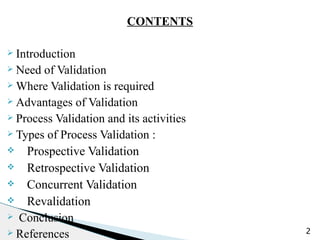
CONTENTS
Ø Introduction
Ø Need of Validation
Ø Where Validation is required
Ø Advantages of Validation
Ø Process Validation and its activities
Ø Types of Process Validation :
v Prospective Validation
v Retrospective Validation
v Concurrent Validation
v Revalidation
Ø Conclusion
Ø References 2
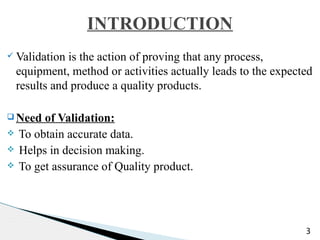
Ăź Validation is the action of proving that any process,
equipment, method or activities actually leads to the expected
results and produce a quality products.
q Need of Validation:
v To obtain accurate data.
v Helps in decision making.
v To get assurance of Quality product.
3
INTRODUCTION
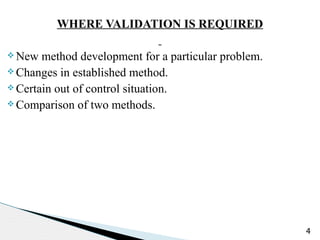
WHERE VALIDATION IS REQUIRED
v New method development for a particular problem.
v Changes in established method.
v Certain out of control situation.
v Comparison of two methods.
4
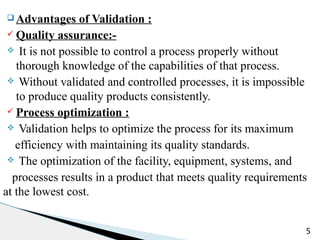
q Advantages of Validation :
Ăź Quality assurance:-
v It is not possible to control a process properly without
thorough knowledge of the capabilities of that process.
v Without validated and controlled processes, it is impossible
to produce quality products consistently.
Ăź Process optimization :
v Validation helps to optimize the process for its maximum
efficiency with maintaining its quality standards.
v The optimization of the facility, equipment, systems, and
processes results in a product that meets quality requirements
at the lowest cost.
5
Ăź Quality cost reduction:
v Any validated and controlled process will result in fewer
internal failures like :-
i. Fewer rejects
ii. Reworks
iii. Re-tests
iv. Re-inspection
6
▸ It is defined as the collection and evaluation of data which provides
an assurance that a process will consistently produce a quality
product.
PROCESS VALIDATION ACTIVITIES
v Process validation involves a series of activities taking place over the
lifecycle of the product and process.
v Process validation activities follows three stages :
• Stage I: Process Design
• Stage II: Process qualification
• Stage III: Continued process verification
7
PROCESS VALIDATION
q Stage I – Process Design:
The commercial manufacturing process is defined during this stage
based on knowledge gained through development and scale-up activities.
q Stage II – Process Qualification:
During this stage, the process design is evaluated to determine
whether the process is capable to produce reproducible results or not.
q Stage III – Continued Process Verification:
On-going assurance is done during routine production, So that the
process remains in a state of control.
8
TYPES OF PROCESS VALIDATION
v Prospective Validation
v Retrospective Validation
v Concurrent Validation
v Revalidation
Ăź Prospective Validation :
It is establishing documented evidence prior to process
implementation that a system does what it proposed to do based on
pre-planned protocols.
It is normally undertaken for a new drug product, which are
introduced into a routine pharmaceutical production.
9
Ăź Retrospective Validation :
It is an establishing documented evidence that a process does
what it is supposed to do based on review and analysis of
historic data.
v Steps require for Retrospective Validation :
• Protocol preparation
• Validation reports
• Data analysis
• Conclusion
• Recommendations
10
Ăź Concurrent Validation :
Is a type of evidence that can be gathered to defend the use of
a test for predicting other outcomes.
q Concurrent Validation involves –
v In-process monitoring
v End product testing
Ăź Revalidation :
It provides the evidence that changes in a process introduced
either intentionally or unintentionally, do not affect product
quality.
11
q There are two basic categories of Revalidation:
v Re-validation in cases of known change.
v Periodic Re-validation carried out at scheduled
Intervals.
q Changes that are likely to require Revalidation are as
follows:
v Changes of raw materials.
v Change of starting material
v Changes of packaging material
v Changes in the process
v Changes of equipment
v Transfer of processes to another site
12
CONCLUSION
Ăź Validation provides the good quality product and equipment.
Ăź Validation gives the surety about the equipment qualification like:
design, operation, installation and performance.
Ăź Validation of equipment can able to produce satisfactory results.
Ăź Validation also helps in process optimization and cost reduction.
13
REFERENCES
v Rockville M D. guideline on General principle of process validation.
U.S Food and Drug Administration., U.S, FDA:1987
v Rockville M D. guideline on General principle of process validation.
U.S Food and Drug Administration., U.S, FDA:2010
v Lamberts J. Validation guidelines for the pharmaceuticals Dosage
forms. Health Products and Food Branches inspectorates,2004,7-15
v Tatzlaff R F, Shepperd RE, LeBianc A.J. The validation development.
Perspectives on the systemic GMP inspection approach and validation
development. Pharm Tec.,1993,100-116
14
15
THANK YOU

Process validation (by ronit ghosh)

  • 1.
    Presented By : RONITGHOSH ROLL NO : 18901914082 REG NO. : 141890210082 4th Year 7th Semester Section- B Guided By : Dr. SUBHRA BHATTACHARYYA (Associate Professor) Dr. B.C. Roy College Of Pharmacy And Allied Health Sciences, Durgapur -713206 PROCESS VALIDATION
  • 2.
    CONTENTS Ø Introduction Ø Needof Validation Ø Where Validation is required Ø Advantages of Validation Ø Process Validation and its activities Ø Types of Process Validation : v Prospective Validation v Retrospective Validation v Concurrent Validation v Revalidation Ø Conclusion Ø References 2
  • 3.
    Ăź Validation isthe action of proving that any process, equipment, method or activities actually leads to the expected results and produce a quality products. q Need of Validation: v To obtain accurate data. v Helps in decision making. v To get assurance of Quality product. 3 INTRODUCTION
  • 4.
    WHERE VALIDATION ISREQUIRED v New method development for a particular problem. v Changes in established method. v Certain out of control situation. v Comparison of two methods. 4
  • 5.
    q Advantages ofValidation : Ăź Quality assurance:- v It is not possible to control a process properly without thorough knowledge of the capabilities of that process. v Without validated and controlled processes, it is impossible to produce quality products consistently. Ăź Process optimization : v Validation helps to optimize the process for its maximum efficiency with maintaining its quality standards. v The optimization of the facility, equipment, systems, and processes results in a product that meets quality requirements at the lowest cost. 5
  • 6.
    Ăź Quality costreduction: v Any validated and controlled process will result in fewer internal failures like :- i. Fewer rejects ii. Reworks iii. Re-tests iv. Re-inspection 6
  • 7.
    ▸ It isdefined as the collection and evaluation of data which provides an assurance that a process will consistently produce a quality product. PROCESS VALIDATION ACTIVITIES v Process validation involves a series of activities taking place over the lifecycle of the product and process. v Process validation activities follows three stages : • Stage I: Process Design • Stage II: Process qualification • Stage III: Continued process verification 7 PROCESS VALIDATION
  • 8.
    q Stage I– Process Design: The commercial manufacturing process is defined during this stage based on knowledge gained through development and scale-up activities. q Stage II – Process Qualification: During this stage, the process design is evaluated to determine whether the process is capable to produce reproducible results or not. q Stage III – Continued Process Verification: On-going assurance is done during routine production, So that the process remains in a state of control. 8
  • 9.
    TYPES OF PROCESSVALIDATION v Prospective Validation v Retrospective Validation v Concurrent Validation v Revalidation Ăź Prospective Validation : It is establishing documented evidence prior to process implementation that a system does what it proposed to do based on pre-planned protocols. It is normally undertaken for a new drug product, which are introduced into a routine pharmaceutical production. 9
  • 10.
    ü Retrospective Validation: It is an establishing documented evidence that a process does what it is supposed to do based on review and analysis of historic data. v Steps require for Retrospective Validation : • Protocol preparation • Validation reports • Data analysis • Conclusion • Recommendations 10
  • 11.
    ü Concurrent Validation: Is a type of evidence that can be gathered to defend the use of a test for predicting other outcomes. q Concurrent Validation involves – v In-process monitoring v End product testing ü Revalidation : It provides the evidence that changes in a process introduced either intentionally or unintentionally, do not affect product quality. 11
  • 12.
    q There aretwo basic categories of Revalidation: v Re-validation in cases of known change. v Periodic Re-validation carried out at scheduled Intervals. q Changes that are likely to require Revalidation are as follows: v Changes of raw materials. v Change of starting material v Changes of packaging material v Changes in the process v Changes of equipment v Transfer of processes to another site 12
  • 13.
    CONCLUSION Ăź Validation providesthe good quality product and equipment. Ăź Validation gives the surety about the equipment qualification like: design, operation, installation and performance. Ăź Validation of equipment can able to produce satisfactory results. Ăź Validation also helps in process optimization and cost reduction. 13
  • 14.
    REFERENCES v Rockville MD. guideline on General principle of process validation. U.S Food and Drug Administration., U.S, FDA:1987 v Rockville M D. guideline on General principle of process validation. U.S Food and Drug Administration., U.S, FDA:2010 v Lamberts J. Validation guidelines for the pharmaceuticals Dosage forms. Health Products and Food Branches inspectorates,2004,7-15 v Tatzlaff R F, Shepperd RE, LeBianc A.J. The validation development. Perspectives on the systemic GMP inspection approach and validation development. Pharm Tec.,1993,100-116 14
  • 15.