Process Validation
Dr. ARTI R. THAKKAR
This presentation was made to solely for students to make them aware/ understand basics of
“Validation”. These slides are part of lectures delivered in M. Pharmacy Curriculum & taken up from
various books and websites
GMP in production: General
• All handling of materials and products;
– receipt
– cleaning
– quarantine
– sampling
– storage
– labelling
– dispensing
– processing
– packaging
– distribution
• should be done in accordance with written procedures i.e. SOPs or
protocols and recorded may be in form of reports.
GMP in production: General
• Checks on yields and reconciliation of quantities to ensure that there are
no discrepancies outside acceptable limits.
• Operation on different products should not be carried out
simultaneously or consecutively in the same room or area unless there is
no risk of mix-up or cross-contamination.
• At all time during processing
– all materials
– bulk containers
– major items of equipment
– rooms
– packaging lines
• being used should be labeled or identified
• Access to production premises should be restricted to authorized
personnel.
• Non-medicinal products should not be produced in areas or with
equipment destined for the production of pharmaceutical products.
Definition
 According to FDA, Process validation is establishing
documented evidence which provides high degree of
assurance that a specific process will consistently produce a
product meeting its predetermined specifications and
quality characteristics.
 The proof of validation is obtained through the collection
and evaluation of data, preferably beginning from the
process development phase and continuing through the
production phase.
 Thus, validation is the documented act of proving that any
procedure, process, equipment, material, activity or system
actually leads to the expected result.
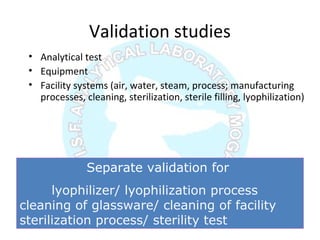
Validation studies
• Analytical test
• Equipment
• Facility systems (air, water, steam, process; manufacturing
processes, cleaning, sterilization, sterile filling, lyophilization)
Separate validation for
lyophilizer/ lyophilization process
cleaning of glassware/ cleaning of facility
sterilization process/ sterility test
Validation studies
• verify the system under test under the extremes
expected during the process to prove that the
system remains in control.
• Critical equipment and processes are routinely
revalidated at appropriate intervals to
demonstrate that the process remains in control.
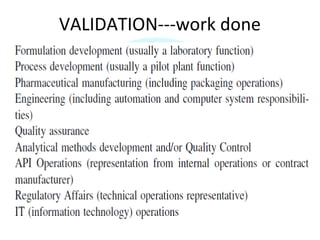
VALIDATION---Done by Whom?
• The Consultant ---- individual or a group of person who are
responsible for the validation work
• The Task Force Concept -----individual from the various
department (may be from QA, Production, Engineering and R
& D)
• The Dedicated group --- A specific team who is just working
on validation
VALIDATION---Done by Whom?
VALIDATION---work done
NEED OF VALIDATION
• To reduce batch to batch variations.
• To achieve reproducible products of the same quality, purity
and strength.
• To assure safety and efficacy and to minimize hazardous
effects
• To reduce the chance of product recall from market
• To save the cost that arises because of lengthy investigation
procedures in case of product variances.
TYPES OF VALIDATION
1. Prospective validation
pre-planned protocol
2. Concurrent validation
– base on data collected during actual performance of a process already
implemented in a manufacturing facility
– suit manufacturers of long standing, have well-controlled manufacturing
process
3. Retrospective validation
– for production for a long time, but has not been validated according to a
prospective protocol and concurrent validation is not realistic
4. Revalidation
Type of validation
• Laboratory-and pilot-scale validations
– some production processes cannot be carried
out in production facility
removal of impurities by individual purification steps in
process
- not acceptable to bring unacceptable impurities
(endotoxin, unwanted protein, contaminating bacteria
and virus) spike into process
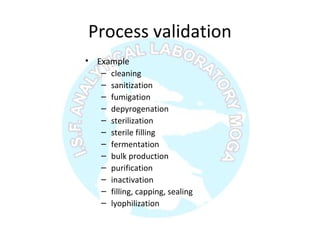
Process validation
• Example
– cleaning
– sanitization
– fumigation
– depyrogenation
– sterilization
– sterile filling
– fermentation
– bulk production
– purification
– inactivation
– filling, capping, sealing
– lyophilization
PROSPECTIVE VALIDATION
 It requires a planned protocol or master plan. This approach
to validation is normally undertaken whenever the process
for new formula must be validated before routine
pharmaceutical production commences.
 It leads to the transfer of the manufacturing process from
development phase to production.
 It should have documentation extending from product
initiation to full scale production and should contain the full
history of a product.
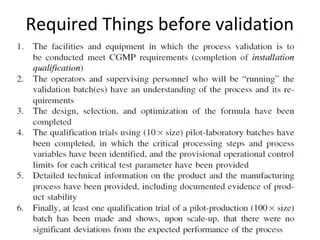
Required Things before validation
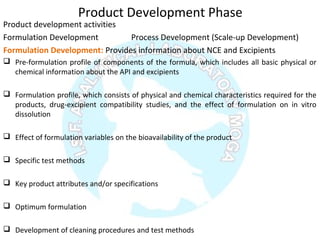
Product Development Phase
Product development activities
Formulation Development Process Development (Scale-up Development)
Formulation Development: Provides information about NCE and Excipients
 Pre-formulation profile of components of the formula, which includes all basic physical or
chemical information about the API and excipients
 Formulation profile, which consists of physical and chemical characteristics required for the
products, drug-excipient compatibility studies, and the effect of formulation on in vitro
dissolution
 Effect of formulation variables on the bioavailability of the product
 Specific test methods
 Key product attributes and/or specifications
 Optimum formulation
 Development of cleaning procedures and test methods
B. Process Development Phase
The majority of the process development activities occur either in the pilot plant or in the pro-
posed manufacturing plant. It should meet the following criteria:
 Develop a suitable process to produce a product that meets all
 Product specifications
 Economic constraints
 Current good manufacturing practices (CGMPs)
 Identify the key process parameters that affect the product attributes
 Identify in-process specifications and test methods
 Identify generic and/or specific equipment that may be required
Process development involves various stages:
• Design
• Challenging of critical process parameters
• Verification of the developed process
B. Process Development Phase - Design
2. Challenging of Process Parameters
It determines
– The feasibility of the designed process
– The criticality of the parameters
– Confirm critical process parameters and determine their effects on product quality
attributes.
– Establish process conditions for each unit operation.
– Determine in-process operating limits to guarantee acceptable finished product and
yield.
– Confirm the validity of the test methods.
A carefully planned and coordinated experimental program is essential in
order to achieve each of these objectives.
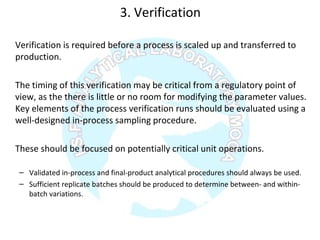
3. Verification
Verification is required before a process is scaled up and transferred to
production.
The timing of this verification may be critical from a regulatory point of
view, as the there is little or no room for modifying the parameter values.
Key elements of the process verification runs should be evaluated using a
well-designed in-process sampling procedure.
These should be focused on potentially critical unit operations.
– Validated in-process and final-product analytical procedures should always be used.
– Sufficient replicate batches should be produced to determine between- and within-
batch variations.
3. Verification
Documentation
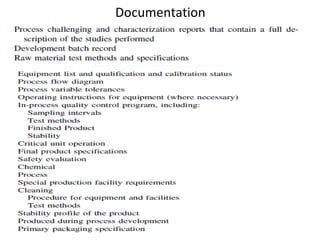
Master Documentation File
An effective prospective validation program must be supported by documentation
extending from product initiation to full-scale production. The complete documentation
package can be referred to as the Master Documentation File.
1. Objective(proving that process works)
2. Type of validation
3. Type of process (chemical, automation, cleaning)
4. Process output( potency, yield, physical features)
5. Test methods( instrumentation, calibration, traceability, precision, accuracy)
6. Analysis of process
7. Control limits of critical variables
8. Preparation of validation protocol
9. Organizing for validation
10.Planning validation trials
11.Validation trials
12.Validation finding
13final report and recommendations
CONTENTS OF MASTER DOCUMENT FILE
 Active component characteristics
 Inactive component characteristics
 Product composition
 Material specifications
 Safety evaluation
 Facilities and equipment specifications
 Analytical method development
 Formulation design, process design, verification
 Finished product specifications
 Stability report
 Method and process validation
 Process data
 Process validation report
CONCURRENT VALIDATION
 It is establishing documented evidence that a process does what
it purports to do based on the information generated during
actual implementation of the process.
 In process monitoring of critical processing steps and end-
product testing of current production can provide documented
evidence to show that the manufacturing process is in state of
control.
CONCURRENT VALIDATION
• It should be evident that concurrent validation is especially useful as a QA
tool. This approach to validation is useful to QA because it enables QA to
set its own objectives as criteria for PV.
– Regulatory control over the processes.
– For the internal audit.
• The quality standards would be measured periodically (monthly, quarterly,
or semiannually), which would depend entirely on the number of batches
made per time interval. At least six batches would be made in the same
manner per chosen time interval.
• The data would be measured, and then it would be determined (through
charting the data) if the data fell between predetermined specification
limits. Each new period’s data would be compared with the data trend that
developed before it. Deviations, which led to a change in the trend, would
be investigated. If the deviation was not caused by a change in process,
further investigation and troubleshooting activity would be required.
TEST PARAMETERS FOR CONCURRENT
VALIDATION
 Average potency
 Content uniformity
 Dissolution time
 Weight variation
 Powder blend uniformity
 Moisture content
 Particle size distribution
 Weight variation
 Tablet hardness
 pH value
 color or clarity
 Viscosity or density
RETROSPECTIVE VALIDATOIN
 It deals with performing the validation after the product is
already in market place. It is defined as a documented
evidence that a system does what it purports to do based on
review and analysis of market information.
 With retrospective validation the generated data already
exists, but must be documented in a manner that clearly
demonstrates that existing process is under control.
RETROSPECTIVE VALIDATOIN
 Numerical data of completed batch record and include assay values,
end-product test results, and in-process data.
 Organize data in a chronological sequence according to batch
manufacturing data, using a spreadsheet format.
 Include data from at least the last 20–30 manufactured batches for
analysis. If the number of batches is less than 20, then include all
manufactured batches and commit to obtain the required number
for analysis.
 Trim the data by eliminating test results from noncritical processing
steps.
 Subject the resultant data to statistical analysis and evaluation.
RETROSPECTIVE VALIDATOIN
 Draw conclusions as to the state of control of the manufacturing
process based on the analysis of retrospective validation data.
 Issue a report of your findings (documented evidence).
Compressed Tablets
Coated Tablets
Softgels
REVALIDATION
Revalidation means repeating the original validation effort or
any part of it, and includes investigative review of existing
performance data.
It is done annually in the form of reviewing and analyzing annual
records in the form of existing data, such as those from
manufacturing batch records, in Process control testing and
stability testing.
It reconfirms formally that control parameter ranges are
appropriate.
CONDITIONS FOR REVALIDATION
1. Change in critical components (raw materials)
2. Change or replacement in equipment.
3. Changes in location or site.
4. Significant increase or decrease in batch size.
5. Sequential batches that fail to meet product and process
qualification.
Validation: Type of Documentation
• Validation master plan (VMP)
• Validation protocol (VP)
• Validation reports (VR)
• Standard operating procedures (SOPs)
Master validation plan (MVP)
• is a document pertaining to the whole facility
that describes which systems, methods and
processes will be validated and when they will
be validated.
• provide the format required for each
particular validation document (IQ, OQ, PQ for
systems; process validation, analytical assay
validation)
Master validation plan (MVP)
• indicate what information is to be contained
within each document
• indicate why and when revalidations will be
performed
• who will decide what validations will be
performed
• order in which each part of the facility is
validated
Master validation plan (MVP)
• indicate how to deal with any deviations
• state the time interval permitted between
each validation
Validation: VMP
• Enables overview of entire validation project
• List items to be validated with planning
schedule as its heart
• like a map
Validation: In summary, VMP
should contain at least
• Validation policy
• Organizational structure
• Summary of facilities, systems, equipment, processes
to be validated
• Documentation format for protocols and reports
• Planning and scheduling
• Change control
• Training requirements
Validation: Protocol
• Objectives of the validation and qualification study
• Site of the study
• Responsible personnel
• Description of the equipment
• SOPs
• Standards
• Criteria for the relevant products and processes
Validation: Report
• Title
• objective of the study
• Refer to the protocol
• Details of material
• Equipment
• Programmes and cycles use
• Details of procedures and test methods
Validation: changes that require
revalidation
• Software changes; controllers
• Site changes; operational changes
• Change of source of material
• Change in the process
• Significant equipment changes
• Production area changes
• Support system changes
Documentation
Scale UP & Post Approval Changes (SUPAC)
• Change is inevitable in a pharmaceutical manufacturing operation.
• Vendors change processes, sources, and specifications for raw
materials, equipment requires repair, service, or replacement,
manufacturing locations are changed, batch sizes are increased or
decreased, and advancements in technology are made that dictate
changes to the operations.
• Changes made in a pharmaceutical manufacturing plant that have
any potential to impact the safety, quality, purity, efficacy, or
potency of a pharmaceutical preparation must be made in a way that
assures these characteristics are not adversely impacted.
• As mentioned above, the FDA also has issued SUPAC (scale up and
post approval changes) guidelines that list filling and data
requirements for many of the most common types of changes.
Scale UP & Post Approval Changes (SUPAC)
• It is the change control process that assures continuous quality. It
identifies the concerns or non objections of all responsible
• functional groups, assuring the proper evaluation, once the testing
and continuity of the change across all systems, procedures, and
documents for that product or dosage everywhere it is made.
• Contents of Change Control Procedures:
– Objectives
– Scope
– Process Flow
Functional group involved
Change control is an interactive process involved with all functions
Functional group responsibility
Thank you

Process validation

  • 1.
    Process Validation Dr. ARTIR. THAKKAR This presentation was made to solely for students to make them aware/ understand basics of “Validation”. These slides are part of lectures delivered in M. Pharmacy Curriculum & taken up from various books and websites
  • 2.
    GMP in production:General • All handling of materials and products; – receipt – cleaning – quarantine – sampling – storage – labelling – dispensing – processing – packaging – distribution • should be done in accordance with written procedures i.e. SOPs or protocols and recorded may be in form of reports.
  • 3.
    GMP in production:General • Checks on yields and reconciliation of quantities to ensure that there are no discrepancies outside acceptable limits. • Operation on different products should not be carried out simultaneously or consecutively in the same room or area unless there is no risk of mix-up or cross-contamination. • At all time during processing – all materials – bulk containers – major items of equipment – rooms – packaging lines • being used should be labeled or identified • Access to production premises should be restricted to authorized personnel. • Non-medicinal products should not be produced in areas or with equipment destined for the production of pharmaceutical products.
  • 4.
    Definition  According toFDA, Process validation is establishing documented evidence which provides high degree of assurance that a specific process will consistently produce a product meeting its predetermined specifications and quality characteristics.  The proof of validation is obtained through the collection and evaluation of data, preferably beginning from the process development phase and continuing through the production phase.  Thus, validation is the documented act of proving that any procedure, process, equipment, material, activity or system actually leads to the expected result.
  • 5.
    Validation studies • Analyticaltest • Equipment • Facility systems (air, water, steam, process; manufacturing processes, cleaning, sterilization, sterile filling, lyophilization) Separate validation for lyophilizer/ lyophilization process cleaning of glassware/ cleaning of facility sterilization process/ sterility test
  • 6.
    Validation studies • verifythe system under test under the extremes expected during the process to prove that the system remains in control. • Critical equipment and processes are routinely revalidated at appropriate intervals to demonstrate that the process remains in control.
  • 7.
    VALIDATION---Done by Whom? •The Consultant ---- individual or a group of person who are responsible for the validation work • The Task Force Concept -----individual from the various department (may be from QA, Production, Engineering and R & D) • The Dedicated group --- A specific team who is just working on validation
  • 8.
  • 9.
  • 10.
    NEED OF VALIDATION •To reduce batch to batch variations. • To achieve reproducible products of the same quality, purity and strength. • To assure safety and efficacy and to minimize hazardous effects • To reduce the chance of product recall from market • To save the cost that arises because of lengthy investigation procedures in case of product variances.
  • 11.
    TYPES OF VALIDATION 1.Prospective validation pre-planned protocol 2. Concurrent validation – base on data collected during actual performance of a process already implemented in a manufacturing facility – suit manufacturers of long standing, have well-controlled manufacturing process 3. Retrospective validation – for production for a long time, but has not been validated according to a prospective protocol and concurrent validation is not realistic 4. Revalidation
  • 12.
    Type of validation •Laboratory-and pilot-scale validations – some production processes cannot be carried out in production facility removal of impurities by individual purification steps in process - not acceptable to bring unacceptable impurities (endotoxin, unwanted protein, contaminating bacteria and virus) spike into process
  • 13.
    Process validation • Example –cleaning – sanitization – fumigation – depyrogenation – sterilization – sterile filling – fermentation – bulk production – purification – inactivation – filling, capping, sealing – lyophilization
  • 14.
    PROSPECTIVE VALIDATION  Itrequires a planned protocol or master plan. This approach to validation is normally undertaken whenever the process for new formula must be validated before routine pharmaceutical production commences.  It leads to the transfer of the manufacturing process from development phase to production.  It should have documentation extending from product initiation to full scale production and should contain the full history of a product.
  • 15.
  • 17.
    Product Development Phase Productdevelopment activities Formulation Development Process Development (Scale-up Development) Formulation Development: Provides information about NCE and Excipients  Pre-formulation profile of components of the formula, which includes all basic physical or chemical information about the API and excipients  Formulation profile, which consists of physical and chemical characteristics required for the products, drug-excipient compatibility studies, and the effect of formulation on in vitro dissolution  Effect of formulation variables on the bioavailability of the product  Specific test methods  Key product attributes and/or specifications  Optimum formulation  Development of cleaning procedures and test methods
  • 18.
    B. Process DevelopmentPhase The majority of the process development activities occur either in the pilot plant or in the pro- posed manufacturing plant. It should meet the following criteria:  Develop a suitable process to produce a product that meets all  Product specifications  Economic constraints  Current good manufacturing practices (CGMPs)  Identify the key process parameters that affect the product attributes  Identify in-process specifications and test methods  Identify generic and/or specific equipment that may be required Process development involves various stages: • Design • Challenging of critical process parameters • Verification of the developed process
  • 19.
    B. Process DevelopmentPhase - Design
  • 20.
    B. Process DevelopmentPhase - Design
  • 21.
    B. Process DevelopmentPhase - Design
  • 22.
    2. Challenging ofProcess Parameters It determines – The feasibility of the designed process – The criticality of the parameters – Confirm critical process parameters and determine their effects on product quality attributes. – Establish process conditions for each unit operation. – Determine in-process operating limits to guarantee acceptable finished product and yield. – Confirm the validity of the test methods. A carefully planned and coordinated experimental program is essential in order to achieve each of these objectives.
  • 23.
    3. Verification Verification isrequired before a process is scaled up and transferred to production. The timing of this verification may be critical from a regulatory point of view, as the there is little or no room for modifying the parameter values. Key elements of the process verification runs should be evaluated using a well-designed in-process sampling procedure. These should be focused on potentially critical unit operations. – Validated in-process and final-product analytical procedures should always be used. – Sufficient replicate batches should be produced to determine between- and within- batch variations.
  • 24.
  • 25.
  • 26.
    Master Documentation File Aneffective prospective validation program must be supported by documentation extending from product initiation to full-scale production. The complete documentation package can be referred to as the Master Documentation File. 1. Objective(proving that process works) 2. Type of validation 3. Type of process (chemical, automation, cleaning) 4. Process output( potency, yield, physical features) 5. Test methods( instrumentation, calibration, traceability, precision, accuracy) 6. Analysis of process 7. Control limits of critical variables 8. Preparation of validation protocol 9. Organizing for validation 10.Planning validation trials 11.Validation trials 12.Validation finding 13final report and recommendations
  • 27.
    CONTENTS OF MASTERDOCUMENT FILE  Active component characteristics  Inactive component characteristics  Product composition  Material specifications  Safety evaluation  Facilities and equipment specifications  Analytical method development  Formulation design, process design, verification  Finished product specifications  Stability report  Method and process validation  Process data  Process validation report
  • 28.
    CONCURRENT VALIDATION  Itis establishing documented evidence that a process does what it purports to do based on the information generated during actual implementation of the process.  In process monitoring of critical processing steps and end- product testing of current production can provide documented evidence to show that the manufacturing process is in state of control.
  • 29.
    CONCURRENT VALIDATION • Itshould be evident that concurrent validation is especially useful as a QA tool. This approach to validation is useful to QA because it enables QA to set its own objectives as criteria for PV. – Regulatory control over the processes. – For the internal audit. • The quality standards would be measured periodically (monthly, quarterly, or semiannually), which would depend entirely on the number of batches made per time interval. At least six batches would be made in the same manner per chosen time interval. • The data would be measured, and then it would be determined (through charting the data) if the data fell between predetermined specification limits. Each new period’s data would be compared with the data trend that developed before it. Deviations, which led to a change in the trend, would be investigated. If the deviation was not caused by a change in process, further investigation and troubleshooting activity would be required.
  • 30.
    TEST PARAMETERS FORCONCURRENT VALIDATION  Average potency  Content uniformity  Dissolution time  Weight variation  Powder blend uniformity  Moisture content  Particle size distribution  Weight variation  Tablet hardness  pH value  color or clarity  Viscosity or density
  • 31.
    RETROSPECTIVE VALIDATOIN  Itdeals with performing the validation after the product is already in market place. It is defined as a documented evidence that a system does what it purports to do based on review and analysis of market information.  With retrospective validation the generated data already exists, but must be documented in a manner that clearly demonstrates that existing process is under control.
  • 32.
    RETROSPECTIVE VALIDATOIN  Numericaldata of completed batch record and include assay values, end-product test results, and in-process data.  Organize data in a chronological sequence according to batch manufacturing data, using a spreadsheet format.  Include data from at least the last 20–30 manufactured batches for analysis. If the number of batches is less than 20, then include all manufactured batches and commit to obtain the required number for analysis.  Trim the data by eliminating test results from noncritical processing steps.  Subject the resultant data to statistical analysis and evaluation.
  • 33.
    RETROSPECTIVE VALIDATOIN  Drawconclusions as to the state of control of the manufacturing process based on the analysis of retrospective validation data.  Issue a report of your findings (documented evidence).
  • 34.
  • 35.
  • 36.
  • 37.
    REVALIDATION Revalidation means repeatingthe original validation effort or any part of it, and includes investigative review of existing performance data. It is done annually in the form of reviewing and analyzing annual records in the form of existing data, such as those from manufacturing batch records, in Process control testing and stability testing. It reconfirms formally that control parameter ranges are appropriate.
  • 38.
    CONDITIONS FOR REVALIDATION 1.Change in critical components (raw materials) 2. Change or replacement in equipment. 3. Changes in location or site. 4. Significant increase or decrease in batch size. 5. Sequential batches that fail to meet product and process qualification.
  • 39.
    Validation: Type ofDocumentation • Validation master plan (VMP) • Validation protocol (VP) • Validation reports (VR) • Standard operating procedures (SOPs)
  • 40.
    Master validation plan(MVP) • is a document pertaining to the whole facility that describes which systems, methods and processes will be validated and when they will be validated. • provide the format required for each particular validation document (IQ, OQ, PQ for systems; process validation, analytical assay validation)
  • 41.
    Master validation plan(MVP) • indicate what information is to be contained within each document • indicate why and when revalidations will be performed • who will decide what validations will be performed • order in which each part of the facility is validated
  • 42.
    Master validation plan(MVP) • indicate how to deal with any deviations • state the time interval permitted between each validation
  • 43.
    Validation: VMP • Enablesoverview of entire validation project • List items to be validated with planning schedule as its heart • like a map
  • 44.
    Validation: In summary,VMP should contain at least • Validation policy • Organizational structure • Summary of facilities, systems, equipment, processes to be validated • Documentation format for protocols and reports • Planning and scheduling • Change control • Training requirements
  • 45.
    Validation: Protocol • Objectivesof the validation and qualification study • Site of the study • Responsible personnel • Description of the equipment • SOPs • Standards • Criteria for the relevant products and processes
  • 46.
    Validation: Report • Title •objective of the study • Refer to the protocol • Details of material • Equipment • Programmes and cycles use • Details of procedures and test methods
  • 47.
    Validation: changes thatrequire revalidation • Software changes; controllers • Site changes; operational changes • Change of source of material • Change in the process • Significant equipment changes • Production area changes • Support system changes
  • 48.
  • 49.
    Scale UP &Post Approval Changes (SUPAC) • Change is inevitable in a pharmaceutical manufacturing operation. • Vendors change processes, sources, and specifications for raw materials, equipment requires repair, service, or replacement, manufacturing locations are changed, batch sizes are increased or decreased, and advancements in technology are made that dictate changes to the operations. • Changes made in a pharmaceutical manufacturing plant that have any potential to impact the safety, quality, purity, efficacy, or potency of a pharmaceutical preparation must be made in a way that assures these characteristics are not adversely impacted. • As mentioned above, the FDA also has issued SUPAC (scale up and post approval changes) guidelines that list filling and data requirements for many of the most common types of changes.
  • 50.
    Scale UP &Post Approval Changes (SUPAC) • It is the change control process that assures continuous quality. It identifies the concerns or non objections of all responsible • functional groups, assuring the proper evaluation, once the testing and continuity of the change across all systems, procedures, and documents for that product or dosage everywhere it is made. • Contents of Change Control Procedures: – Objectives – Scope – Process Flow
  • 51.
  • 52.
    Change control isan interactive process involved with all functions
  • 53.
  • 54.