PROCESS VALIDATION
BY-
AISHWARYA HIREMATH
M-PHARM 2N D SEM.
BAPUJI PHARMACY COLLEGE
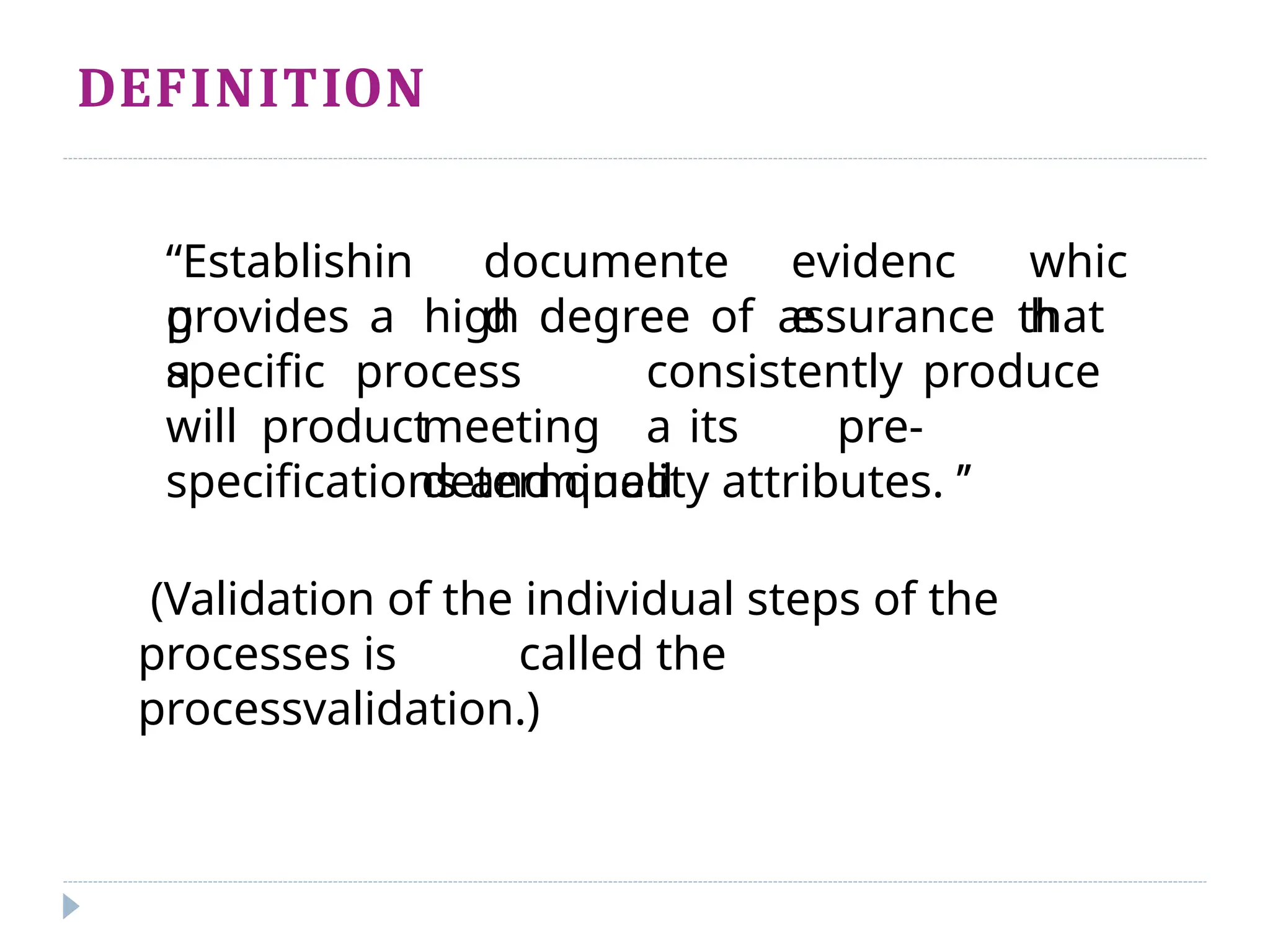
DEFINITION
“Establishin
g
documente
d
evidenc
e
whic
h
provides a high degree of assurance that
a consistently produce
a
specific process
will productmeeting its pre-
determined
specifications and quality attributes. ’’
(Validation of the individual steps of the
processes is called the
processvalidation.)
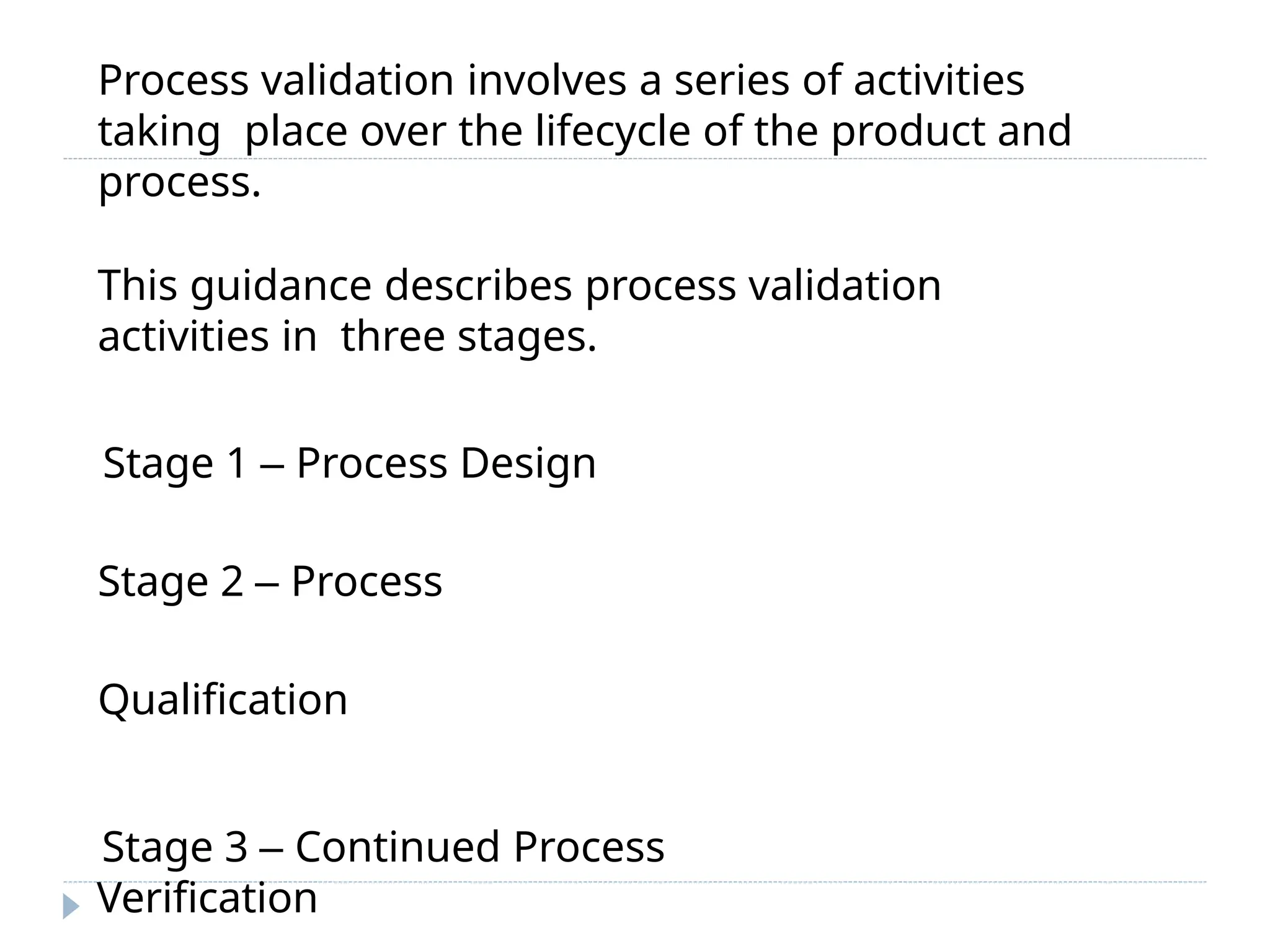
Process validation involves a series of activities
taking place over the lifecycle of the product and
process.
This guidance describes process validation
activities in three stages.
Stage 1 – Process Design
Stage 2 – Process
Qualification
Stage 3 – Continued Process
Verification
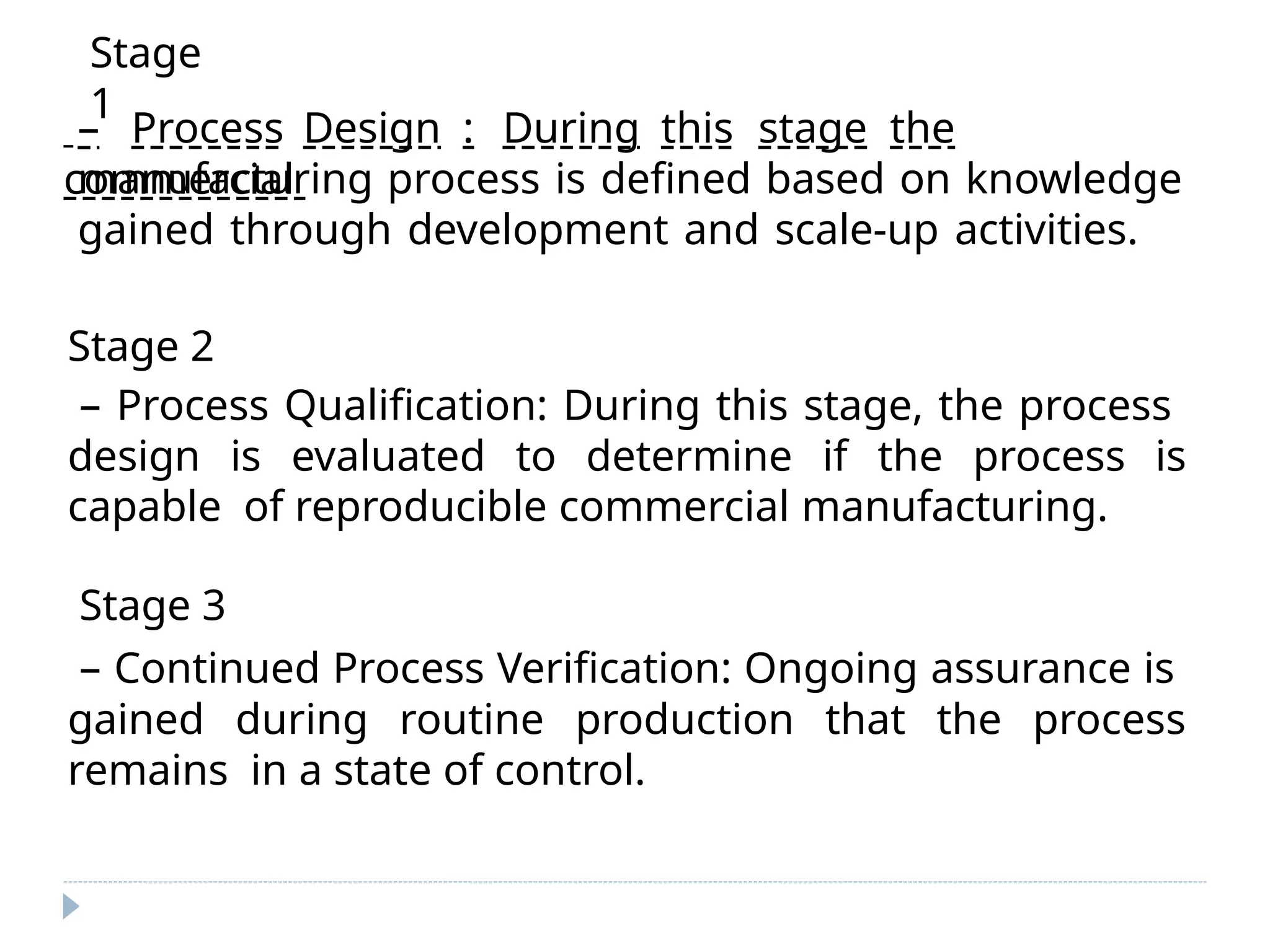
– Process Design : During this stage the
commercial
manufacturing process is defined based on knowledge
gained through development and scale-up activities.
Stage 2
– Process Qualification: During this stage, the process
design is evaluated to determine if the process is
capable of reproducible commercial manufacturing.
Stage 3
– Continued Process Verification: Ongoing assurance is
gained during routine production that the process
remains in a state of control.
Stage
1
A successful validation program depends upon
information and knowledge from product and process
development.
So that manufacturers should.
Understand the sources of variation
Detect the presence and degree of variation
Understand the impact of variation on the process
and ultimately on product attributes.
Control the variation in a manner commensurate
GENERAL CONSIDERATIONS FOR PROCESS VALIDATION
An integrated team approach to process validation
that includes expertise from a variety of disciplines.
Project plans, along with the full support of senior
management, are essential elements for success.
All studies should be planned and conducted
according to sound scientific principles, appropriately
documented, and approved in accordance with the
established procedure
Homogeneity within a batch and consistency between
batches are should be the goals of process validation
activities.
Objectives
⚫To establish a record keeping system that considers all
concept of manufacturing process which includes
controlled testing.
⚫To evaluate all possible sources of variation in process.
⚫To identify all sources of variation those are possible
from
the materials, machines, methods and men.
⚫To evaluate the requirement for in-process testing and
evaluation.
⚫To document everything that is done to follow establish
procedures and protocols as closely as possible.
⚫Quality, safety and effectiveness must be designed and
built
WHEN IS VALIDATION NEEDED?
Before introduction of a new method into routine
use
Whenever the conditions change for which a
method has been validated, e.g., instrument with
different
characteristics
Whenever the method is changed, and the
change is outside the original scope of the
method
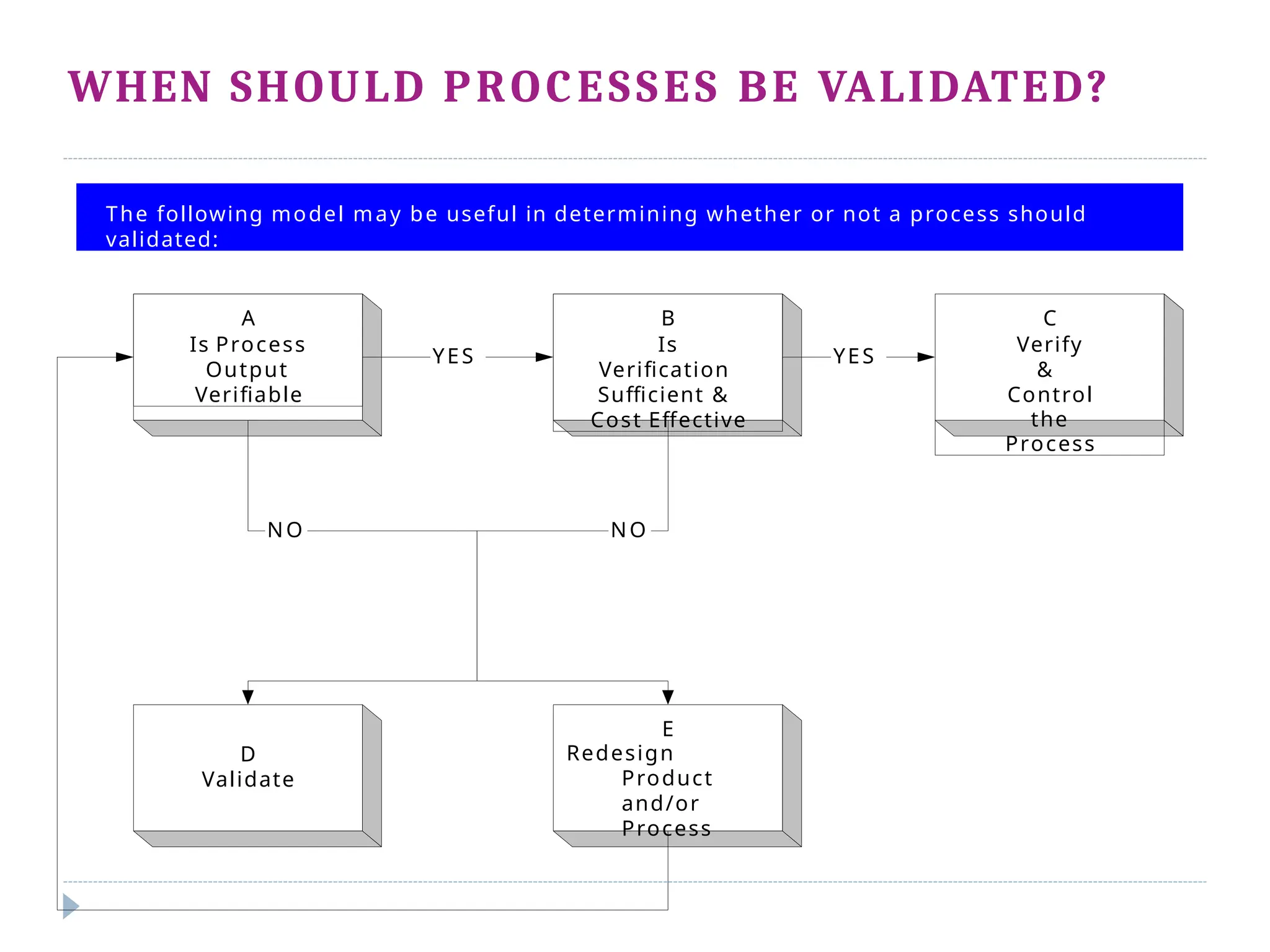
WHEN SHOULD PROCESSES BE VALIDATED?
A
Is Process
Output
Verifiable
B
Is
Verification
Sufficient &
Cost Effective
C
Verify
&
Control
the
Process
D
Validate
E
Redesign
Product
and/or
Process
YES YES
NO NO
The following model may be useful in determining whether or not a process should
validated:
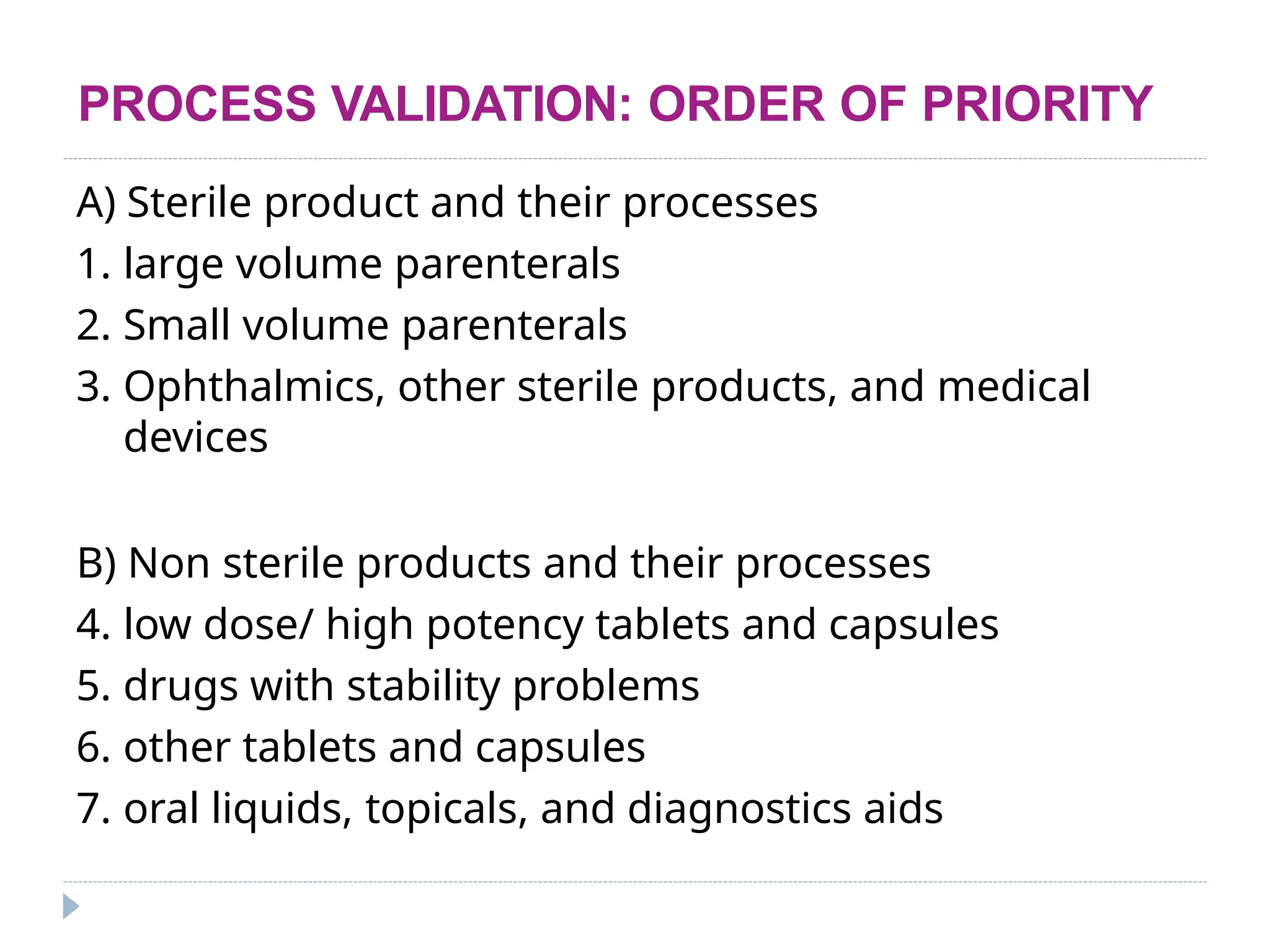
PROCESS VALIDATION: ORDER OF PRIORITY
A) Sterile product and their processes
1. large volume parenterals
2. Small volume parenterals
3. Ophthalmics, other sterile products, and medical
devices
B) Non sterile products and their processes
4. low dose/ high potency tablets and capsules
5. drugs with stability problems
6. other tablets and capsules
7. oral liquids, topicals, and diagnostics aids
TYPES OF PROCESS VALIDATION
Prospective ProcessValidation
an experimental plan called the validation protocols
executed before the process is put into commercial use.
Most validationefforts require some degree of
prospective experimentation to generate validation
support data.
Its is normally carried out in connection with the
introduction
of new drug products and their manufacturing processes.
Requirements
mee
t
cGMP
Equipment / facilities
should requirements.
Personnel have an awakeness about the
requirements.
Critical processing stages and process variables are
identified.
At least one qualification trial (size x 100) made
which shows that there is no significant deviation
from expected performance of process.
Batches should be run at different days, shifts and
Retrospective Process Validation
It is chosen for established products whose
manufacturing processes are considered stable and
when on the basis of economic considerations alone
and resource limitations, prospective validation
programs cannot be justified.
Wherein the numerical in-process and/or end-
product test data of historic production batches are
subjected to statistical analysis.
connection with the manufacturingprocess
must
The equipment, facilities and subsystemsused
in
be
qualified in conformance with CGMP
requirements.
Requirements
Gather all historical data of process/ product
in chronological sequence according to batch
manufactured.
Data should consists of atleast last 20-30
manufactured
batches for analysis.
Trim data by eliminating results of non-critical steps.
Subject the resultant data to statistical analysis
and evaluation.
Draw the control charting & go for conclusion.
Advantages
No additional samples necessory, only need history data.
No additional testing required.
Cost saving compared with prospective.
No additional risk.
No longer time need.
Trained persons are easily available to perform the work.
It can be adopted to various types of processes/
products.
Concurrent Process Validation
It is in-process monitoring of critical processing steps
and end-product testing of current production.
It can provide documented evidence to show that the
manufacturing process is in a state of control.
It provides validation documentation from the test
parameter and data sources disclosed in the section
on retrospective validation.
Process Re-Validation:
Required when there is a change in
any of the critical process parameters,
formulation,
primary packaging components,
raw material ,
major equipment or premises.
Failure to meet product and
process specifications in batches would also
require process re-validation.
BASIC PRNCIPLE FOR PROCESS VALIDATION
the individual qualification steps alone do
not constitute process validation.
1. Installation Qualification (IQ)
2. Operational Qualification (OQ)
3. Performance Qualification (PQ)
1. Installation Qualification (IQ)
“Installation qualification establishes that the
instrument is received as designed and specified, that it
is properly installed in the selected environment, and
that this environment is suitable for the operation and
use of the instrument.”
IQ considerations are:
• Equipment
design
construction clean ability,
etc.)
features (i.e. material
of
functionality,
•Installation conditions (wiring,
utility, etc.)
•Calibration,
preventative schedules.
• Safety features.
•Supplier
documentation, manuals.
• Software documented.
• Spare parts list.
maintanance,
cleaning
prints, drawings
and
•Environmental conditions (such as
cleanroom requirements, temperature, and
humidity).
Operational Qualification (OQ):
"Operational qualification (OQ) is the process of
demonstrating that an instrument will function
according to its operaational specification in the
selected environment.”
The proper operation of equipment is verified by
performing the test functions specified in the
protocol.
A conclusion is drawn regarding the operation of
equipment after the test functions are checked
and all data has been analyzed.
Following are the contents of
equipment operation qualification:
1. Application S.O.P’s,
2. Utilization List,
3. Process Description,
4.Test Instrument Utilized To Conduct
Test, 5.Test Instrument Calibration,
6. Critical Parameters,
7. Test Function (List),
8. Test Function Summaries.
Performance Qualification (PQ):
"Performance Qualification (PQ) is the process of
demonstrating that an instrument consistently
performs according to aspecification appropriate
for its routine use ".
PQ should always be performed under
conditions that are similar to routine sample
analysis.
PQ should be performed on a daily
basis or whenever the equipment is
being used.
PQ considerations include:
•Actual product and process
parameters andprocedures
established in OQ.
• Acceptability of the product.
•Assurance of process capability as established
in OQ.
• Process repeatability, long term process
stability.
VALIDATION TEAM
Personnel qualified by training and experience
in a relevant discipline may conduct such
studies.
The working party would usually include the
following staff members such as;
Head of quality assurance.
Head of engineering.
Validation manager.
Production manager.
Specialist validation discipline: all areas.
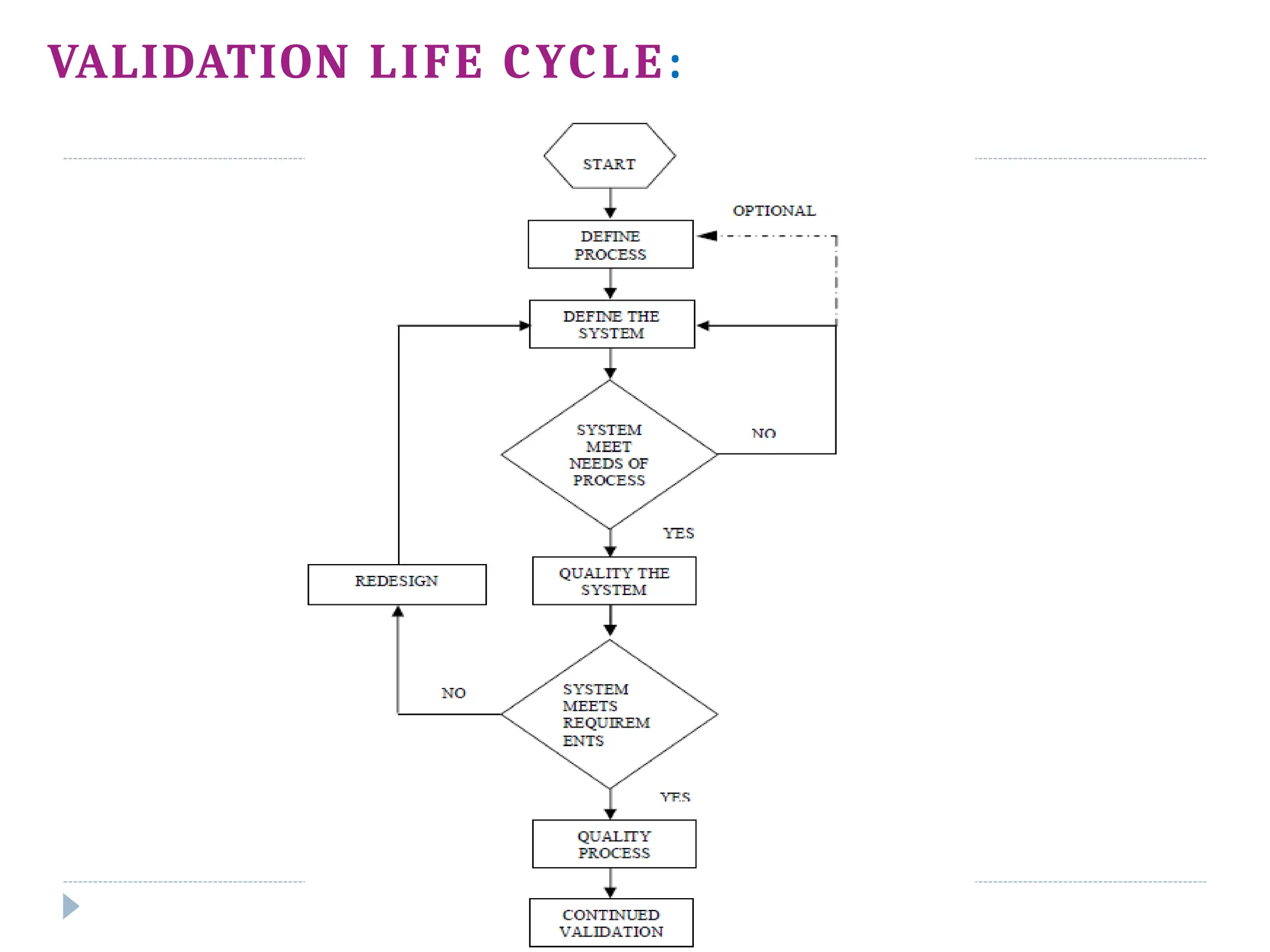
VALIDATION LIFE CYCLE:
VALIDATION PROTOCOL
The validation protocol should contain the
following elements,
Short description of the process.
Summary of critical processing steps to
be investigated.
In process, finished product specification for
release.
Sampling plans.
Departmental responsibility.
Proposed timetable.
🞂 Approval of protocol
THE VALIDATION REPORT
The report should include at least the following
Title and objective of study.
Reference to protocol.
Details of material.
Equipment.
Programes and cycles used.
Details of procedures and test methods.
Result.
Recommendations on the limit and criteria
to be applied on future basis.
IMPORTANCE OF PROCESS VALIDATION
Improve the use of technology
Improve the business benefits
Improve operational efficiency
Improve compliance with
regulations
Reduce the risk of failure
Reduce the cost
Process optimization
Increased customer satisfaction
CONCLUSION:
Validation is one of the important steps in
achieving and maintaining the quality of the final
product. If each step of production process is
validated we can assure that the final product
isof the best quality.
Finally it can be concluded that process validation
is a key element in the quality assurance of
pharmaceutical product as the end product
testing is not sufficient to assure the quality of
finished product.
References:
Sharma sumeet, Singh gurpreet. process validation
in pharmaceutical industry: an overview . J Drug De &
Therap; 2013, 3(4),184-88.
Fraderick J. Carleton, James P
. Agalloco ; validation of
pharmaceutical processes; 2nd edition ,1999 New
York ; page No.257-59.
Berry IR, Nash RA. Pharmaceutical process
validation.
2nd ed. 1993 Newyork: Marcel Dekker.Inc.

Presentation Process validation ppt new.pptx

  • 1.
    PROCESS VALIDATION BY- AISHWARYA HIREMATH M-PHARM2N D SEM. BAPUJI PHARMACY COLLEGE
  • 2.
    DEFINITION “Establishin g documente d evidenc e whic h provides a highdegree of assurance that a consistently produce a specific process will productmeeting its pre- determined specifications and quality attributes. ’’ (Validation of the individual steps of the processes is called the processvalidation.)
  • 3.
    Process validation involvesa series of activities taking place over the lifecycle of the product and process. This guidance describes process validation activities in three stages. Stage 1 – Process Design Stage 2 – Process Qualification Stage 3 – Continued Process Verification
  • 4.
    – Process Design: During this stage the commercial manufacturing process is defined based on knowledge gained through development and scale-up activities. Stage 2 – Process Qualification: During this stage, the process design is evaluated to determine if the process is capable of reproducible commercial manufacturing. Stage 3 – Continued Process Verification: Ongoing assurance is gained during routine production that the process remains in a state of control. Stage 1
  • 5.
    A successful validationprogram depends upon information and knowledge from product and process development. So that manufacturers should. Understand the sources of variation Detect the presence and degree of variation Understand the impact of variation on the process and ultimately on product attributes. Control the variation in a manner commensurate
  • 6.
    GENERAL CONSIDERATIONS FORPROCESS VALIDATION An integrated team approach to process validation that includes expertise from a variety of disciplines. Project plans, along with the full support of senior management, are essential elements for success. All studies should be planned and conducted according to sound scientific principles, appropriately documented, and approved in accordance with the established procedure Homogeneity within a batch and consistency between batches are should be the goals of process validation activities.
  • 7.
    Objectives ⚫To establish arecord keeping system that considers all concept of manufacturing process which includes controlled testing. ⚫To evaluate all possible sources of variation in process. ⚫To identify all sources of variation those are possible from the materials, machines, methods and men. ⚫To evaluate the requirement for in-process testing and evaluation. ⚫To document everything that is done to follow establish procedures and protocols as closely as possible. ⚫Quality, safety and effectiveness must be designed and built
  • 8.
    WHEN IS VALIDATIONNEEDED? Before introduction of a new method into routine use Whenever the conditions change for which a method has been validated, e.g., instrument with different characteristics Whenever the method is changed, and the change is outside the original scope of the method
  • 9.
    WHEN SHOULD PROCESSESBE VALIDATED? A Is Process Output Verifiable B Is Verification Sufficient & Cost Effective C Verify & Control the Process D Validate E Redesign Product and/or Process YES YES NO NO The following model may be useful in determining whether or not a process should validated:
  • 10.
    PROCESS VALIDATION: ORDEROF PRIORITY A) Sterile product and their processes 1. large volume parenterals 2. Small volume parenterals 3. Ophthalmics, other sterile products, and medical devices B) Non sterile products and their processes 4. low dose/ high potency tablets and capsules 5. drugs with stability problems 6. other tablets and capsules 7. oral liquids, topicals, and diagnostics aids
  • 11.
    TYPES OF PROCESSVALIDATION Prospective ProcessValidation an experimental plan called the validation protocols executed before the process is put into commercial use. Most validationefforts require some degree of prospective experimentation to generate validation support data. Its is normally carried out in connection with the introduction of new drug products and their manufacturing processes.
  • 12.
    Requirements mee t cGMP Equipment / facilities shouldrequirements. Personnel have an awakeness about the requirements. Critical processing stages and process variables are identified. At least one qualification trial (size x 100) made which shows that there is no significant deviation from expected performance of process. Batches should be run at different days, shifts and
  • 13.
    Retrospective Process Validation Itis chosen for established products whose manufacturing processes are considered stable and when on the basis of economic considerations alone and resource limitations, prospective validation programs cannot be justified. Wherein the numerical in-process and/or end- product test data of historic production batches are subjected to statistical analysis. connection with the manufacturingprocess must The equipment, facilities and subsystemsused in be qualified in conformance with CGMP requirements.
  • 14.
    Requirements Gather all historicaldata of process/ product in chronological sequence according to batch manufactured. Data should consists of atleast last 20-30 manufactured batches for analysis. Trim data by eliminating results of non-critical steps. Subject the resultant data to statistical analysis and evaluation. Draw the control charting & go for conclusion.
  • 15.
    Advantages No additional samplesnecessory, only need history data. No additional testing required. Cost saving compared with prospective. No additional risk. No longer time need. Trained persons are easily available to perform the work. It can be adopted to various types of processes/ products.
  • 16.
    Concurrent Process Validation Itis in-process monitoring of critical processing steps and end-product testing of current production. It can provide documented evidence to show that the manufacturing process is in a state of control. It provides validation documentation from the test parameter and data sources disclosed in the section on retrospective validation.
  • 17.
    Process Re-Validation: Required whenthere is a change in any of the critical process parameters, formulation, primary packaging components, raw material , major equipment or premises. Failure to meet product and process specifications in batches would also require process re-validation.
  • 18.
    BASIC PRNCIPLE FORPROCESS VALIDATION the individual qualification steps alone do not constitute process validation. 1. Installation Qualification (IQ) 2. Operational Qualification (OQ) 3. Performance Qualification (PQ)
  • 19.
    1. Installation Qualification(IQ) “Installation qualification establishes that the instrument is received as designed and specified, that it is properly installed in the selected environment, and that this environment is suitable for the operation and use of the instrument.”
  • 20.
    IQ considerations are: •Equipment design construction clean ability, etc.) features (i.e. material of functionality, •Installation conditions (wiring, utility, etc.) •Calibration, preventative schedules. • Safety features. •Supplier documentation, manuals. • Software documented. • Spare parts list. maintanance, cleaning prints, drawings and •Environmental conditions (such as cleanroom requirements, temperature, and humidity).
  • 21.
    Operational Qualification (OQ): "Operationalqualification (OQ) is the process of demonstrating that an instrument will function according to its operaational specification in the selected environment.” The proper operation of equipment is verified by performing the test functions specified in the protocol. A conclusion is drawn regarding the operation of equipment after the test functions are checked and all data has been analyzed.
  • 22.
    Following are thecontents of equipment operation qualification: 1. Application S.O.P’s, 2. Utilization List, 3. Process Description, 4.Test Instrument Utilized To Conduct Test, 5.Test Instrument Calibration, 6. Critical Parameters, 7. Test Function (List), 8. Test Function Summaries.
  • 23.
    Performance Qualification (PQ): "PerformanceQualification (PQ) is the process of demonstrating that an instrument consistently performs according to aspecification appropriate for its routine use ". PQ should always be performed under conditions that are similar to routine sample analysis. PQ should be performed on a daily basis or whenever the equipment is being used.
  • 24.
    PQ considerations include: •Actualproduct and process parameters andprocedures established in OQ. • Acceptability of the product. •Assurance of process capability as established in OQ. • Process repeatability, long term process stability.
  • 25.
    VALIDATION TEAM Personnel qualifiedby training and experience in a relevant discipline may conduct such studies. The working party would usually include the following staff members such as; Head of quality assurance. Head of engineering. Validation manager. Production manager. Specialist validation discipline: all areas.
  • 26.
  • 27.
    VALIDATION PROTOCOL The validationprotocol should contain the following elements, Short description of the process. Summary of critical processing steps to be investigated. In process, finished product specification for release. Sampling plans. Departmental responsibility. Proposed timetable. 🞂 Approval of protocol
  • 28.
    THE VALIDATION REPORT Thereport should include at least the following Title and objective of study. Reference to protocol. Details of material. Equipment. Programes and cycles used. Details of procedures and test methods. Result. Recommendations on the limit and criteria to be applied on future basis.
  • 29.
    IMPORTANCE OF PROCESSVALIDATION Improve the use of technology Improve the business benefits Improve operational efficiency Improve compliance with regulations Reduce the risk of failure Reduce the cost Process optimization Increased customer satisfaction
  • 30.
    CONCLUSION: Validation is oneof the important steps in achieving and maintaining the quality of the final product. If each step of production process is validated we can assure that the final product isof the best quality. Finally it can be concluded that process validation is a key element in the quality assurance of pharmaceutical product as the end product testing is not sufficient to assure the quality of finished product.
  • 31.
    References: Sharma sumeet, Singhgurpreet. process validation in pharmaceutical industry: an overview . J Drug De & Therap; 2013, 3(4),184-88. Fraderick J. Carleton, James P . Agalloco ; validation of pharmaceutical processes; 2nd edition ,1999 New York ; page No.257-59. Berry IR, Nash RA. Pharmaceutical process validation. 2nd ed. 1993 Newyork: Marcel Dekker.Inc.