Department of pharmaceutical sciences
Dr. Hari Singh Gour Vishwavidyalaya
Sagar, (M.P.)
(A CENTRAL UNIVERSITY)
PRESENTED BY:-
Anshul Vishwakarma
Y21254007
Process Validation
Session 2021-22
CONTENT
 Introduction
 Types of Validation
 Process Validation
 Phases of Process Validation
 Types of Process Validation
 Advantages of validation
VALIDATION
 Definition
Validation is the documented act of proving that any procedure, process, equipment, material,
activity or system actually leads to the expected result.
ISO definition :
Validation is the confirmation by examination and the provision of objective evidence that the
particular requirements for a specific intended use are fulfilled.
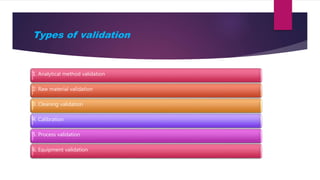
Types of validation
1. Analytical method validation
2. Raw material validation
3. Cleaning validation
4. Calibration
5. Process validation
6. Equipment validation
PROCESS VALIDATION
 It is defined as a documented programme which provides a high degree of assurance that a
specific process will consistently produce a product meeting its predetermined
specification and quality characteristics.
 Effective process validation contributes significantly to assuring drug quality.
 The basic principle of quality assurance is that a drug should be produced that is fit for its
intended use.
 Validation of the individual steps of the processes is called the process validation.
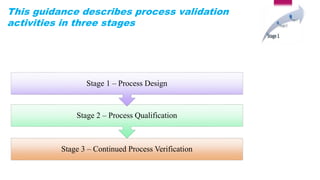
This guidance describes process validation
activities in three stages
Stage 3 – Continued Process Verification
Stage 2 – Process Qualification
Stage 1 – Process Design
Process Design
 This includes all activities relating to product research and development , pilot
batch studies, scale up studies, commercial scale batches, establishing stability
conditions and storage and analysis of in process and finished dosage forms,
equipment qualification, installation qualification, master production document,
operational qualification and process capacity.
Process Qualification
 It is generally designed to verify that all established limits of the critical process parameters
are valid & satisfactory product can be produced even under the worst condition. It
represents the actual study to show:-
 That all system, sub-systems of a mfg. process perform as intended.
 That all critical parameters operate within their assigned control limits.
 Such studies & trials which form the basis of process capability design and testing are
verifiable and certifiable through proper documentation.
Continued Process Verification
 It requires frequent review of all process related requirements/ documents including
validation audit report to assure that there have been no changes, deviation, failures,
modification to the production process & that all SOP’S have been followed including
change control procedures.
 At this stage the validation team also assured that there have been no change/ deviation
that should have results in requalification and revalidation.
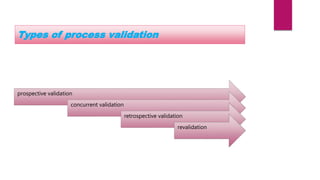
Types of process validation
prospective validation
concurrent validation
retrospective validation
revalidation
prospective validation
 Prospective validation means validation done during the product development stage.
 It is a preplanned scientific approach and includes the initial stages of formulation
development, process development, setting of process sampling plans, designing of batch
records, defining raw material specifications, completion of pilot runs, transfer of
technology from scale-up batches to commercial size batches, listing major process is
executed and environmental controls.
Concurrent Validation
 Concurrent validation is validation which is carried out during production.
 This method is effective only if the development stage has resulted in a proper understanding of the
fundamentals of the process .
 The first three production-scale batches must be monitored as comprehensively as possible.
 The nature and specifications of subsequent in-process and final tests are based on the evaluation of the
results of such monitoring.
 This careful monitoring of the first three production batches is sometimes regarded as prospective
validation.
Retrospective Validation
 Retrospective validation involves the examination of past experience of production
on the assumption that composition, procedures, and equipment remain unchanged
 Retrospective Validation may be used for older products which were not validated
by the fabricator at the time that they were first marketed.
 Recorded difficulties and failures in production are analyzed to determine the limits
of process parameters.
REVALIDATION
 Required when there is a change in any of the critical process parameters, formulation, primary
packaging components, raw material fabricator, major equipment or premises. Failure to meet
product and process specifications in batches would also require process re-validation.
 Re-Validation becomes necessary in certain situations. The following are examples of some of
the planned or unplanned changes that may require re- validation.
 Changes in raw materials (physical properties such as density, viscosity, particle size
distribution, and moisture, etc., that may affect the process or product).
Advantages of validation
 During the process the knowledge of process increases
 Assures the repeatability of the process
 Assures the fluency of production
 Assures that the product is continuously according to the marketing authorisation
 Decreases the risk of the manufacturing problems
 Decreases the expenses caused by the failures in production
 Decreases the risks of failing in GMP
REFERENCES
 Jain N.K. “Pharmaceutical Product Development” , CBS Publishers &
Distributors, 2008. Page no. 524-549.
 Fraderick J. Carleton, James P. Agalloco ; validation of pharmaceutical
processes; 2nd edition ,1999 New York ; page No.257-59.
 Quality Management System – Process Validation, Guidance
GHTF/SG3/N99-10:2004
process validation anshul vishwakarma  dra.pptx

process validation anshul vishwakarma dra.pptx

  • 1.
    Department of pharmaceuticalsciences Dr. Hari Singh Gour Vishwavidyalaya Sagar, (M.P.) (A CENTRAL UNIVERSITY) PRESENTED BY:- Anshul Vishwakarma Y21254007 Process Validation Session 2021-22
  • 2.
    CONTENT  Introduction  Typesof Validation  Process Validation  Phases of Process Validation  Types of Process Validation  Advantages of validation
  • 3.
    VALIDATION  Definition Validation isthe documented act of proving that any procedure, process, equipment, material, activity or system actually leads to the expected result. ISO definition : Validation is the confirmation by examination and the provision of objective evidence that the particular requirements for a specific intended use are fulfilled.
  • 4.
    Types of validation 1.Analytical method validation 2. Raw material validation 3. Cleaning validation 4. Calibration 5. Process validation 6. Equipment validation
  • 5.
    PROCESS VALIDATION  Itis defined as a documented programme which provides a high degree of assurance that a specific process will consistently produce a product meeting its predetermined specification and quality characteristics.  Effective process validation contributes significantly to assuring drug quality.  The basic principle of quality assurance is that a drug should be produced that is fit for its intended use.  Validation of the individual steps of the processes is called the process validation.
  • 6.
    This guidance describesprocess validation activities in three stages Stage 3 – Continued Process Verification Stage 2 – Process Qualification Stage 1 – Process Design
  • 7.
    Process Design  Thisincludes all activities relating to product research and development , pilot batch studies, scale up studies, commercial scale batches, establishing stability conditions and storage and analysis of in process and finished dosage forms, equipment qualification, installation qualification, master production document, operational qualification and process capacity.
  • 8.
    Process Qualification  Itis generally designed to verify that all established limits of the critical process parameters are valid & satisfactory product can be produced even under the worst condition. It represents the actual study to show:-  That all system, sub-systems of a mfg. process perform as intended.  That all critical parameters operate within their assigned control limits.  Such studies & trials which form the basis of process capability design and testing are verifiable and certifiable through proper documentation.
  • 9.
    Continued Process Verification It requires frequent review of all process related requirements/ documents including validation audit report to assure that there have been no changes, deviation, failures, modification to the production process & that all SOP’S have been followed including change control procedures.  At this stage the validation team also assured that there have been no change/ deviation that should have results in requalification and revalidation.
  • 10.
    Types of processvalidation prospective validation concurrent validation retrospective validation revalidation
  • 11.
    prospective validation  Prospectivevalidation means validation done during the product development stage.  It is a preplanned scientific approach and includes the initial stages of formulation development, process development, setting of process sampling plans, designing of batch records, defining raw material specifications, completion of pilot runs, transfer of technology from scale-up batches to commercial size batches, listing major process is executed and environmental controls.
  • 12.
    Concurrent Validation  Concurrentvalidation is validation which is carried out during production.  This method is effective only if the development stage has resulted in a proper understanding of the fundamentals of the process .  The first three production-scale batches must be monitored as comprehensively as possible.  The nature and specifications of subsequent in-process and final tests are based on the evaluation of the results of such monitoring.  This careful monitoring of the first three production batches is sometimes regarded as prospective validation.
  • 13.
    Retrospective Validation  Retrospectivevalidation involves the examination of past experience of production on the assumption that composition, procedures, and equipment remain unchanged  Retrospective Validation may be used for older products which were not validated by the fabricator at the time that they were first marketed.  Recorded difficulties and failures in production are analyzed to determine the limits of process parameters.
  • 14.
    REVALIDATION  Required whenthere is a change in any of the critical process parameters, formulation, primary packaging components, raw material fabricator, major equipment or premises. Failure to meet product and process specifications in batches would also require process re-validation.  Re-Validation becomes necessary in certain situations. The following are examples of some of the planned or unplanned changes that may require re- validation.  Changes in raw materials (physical properties such as density, viscosity, particle size distribution, and moisture, etc., that may affect the process or product).
  • 15.
    Advantages of validation During the process the knowledge of process increases  Assures the repeatability of the process  Assures the fluency of production  Assures that the product is continuously according to the marketing authorisation  Decreases the risk of the manufacturing problems  Decreases the expenses caused by the failures in production  Decreases the risks of failing in GMP
  • 16.
    REFERENCES  Jain N.K.“Pharmaceutical Product Development” , CBS Publishers & Distributors, 2008. Page no. 524-549.  Fraderick J. Carleton, James P. Agalloco ; validation of pharmaceutical processes; 2nd edition ,1999 New York ; page No.257-59.  Quality Management System – Process Validation, Guidance GHTF/SG3/N99-10:2004