M. Pharm
1st Semester
FOOD ANALYSIS
L. Sanathoiba Singha
1
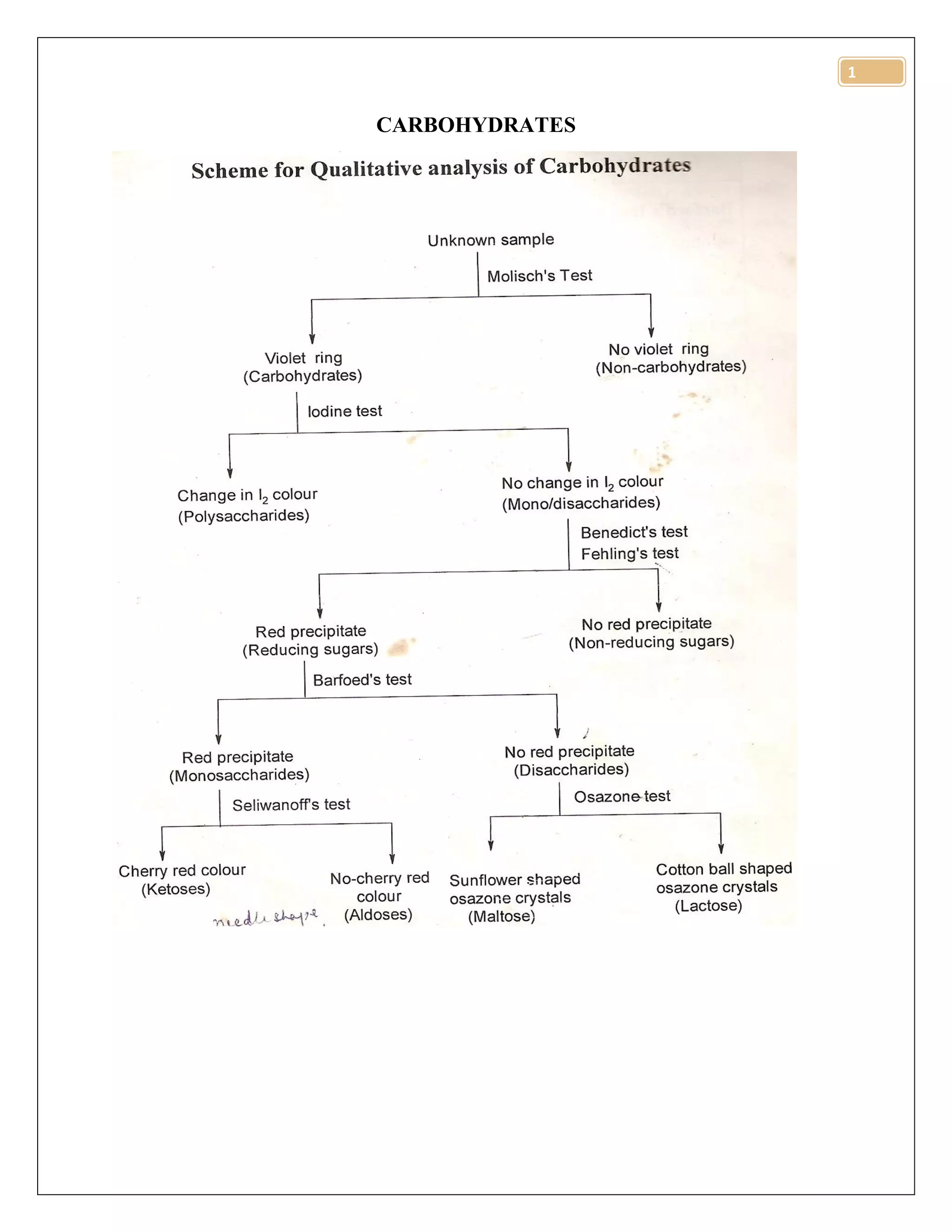
CARBOHYDRATES
2
QUANTITATIVE ANALYSIS OF CARBOHYDRATES:
1. Lane – Eynon method
2. Munson – Walker method
3. Nelson – Somogyi method
4. Alkaline – Ferricyanide method
5. Phenol – sulphuric acid method
Lane-Eynon method (Titration Method)-
Used to determine the conc. of reducing sugar in a sample
Principle:
 Determined based on the reducing property of the sugar.
 Sugars in the sample reduces copper sulfate in the reagent to cuprous oxide.
 Once all the copper sulfate in solution has reacted, any further addition of reducing
sugars causes the indicator to change from blue to white.
Procedure:
 Burette is used to add the carbohydrate solution being analyzed
 Conical flask containing a known amount of copper sulfate solution and a methylene
blue indicator.
 Boil the content of conical flask over flame and titrate against carbohydrate solution
under boiling condition through the titration period.
 Once all the copper sulfate in solution has reacted, any further addition of reducing
sugars causes the indicator to change from blue to white.
 The volume of sugar solution required to reach the end point is recorded.
The disadvantages of method are:
 the results depend on the precise reaction times, temperatures and reagent
concentrations used and so these parameters must be carefully controlled
 it cannot distinguish between different types of reducing sugar
 it cannot directly determine the concentration of non-reducing sugars.
Munson – Walker method:
The Munson and Walker method is an example of a gravimetric method of determining
the concentration of reducing sugars in a sample.
CHO is heated in the presence of an excess of copper sulpate and alkaline tartrate (to
keep Cu 2+ ion in solution) under controlled conditions → leads to the formation of a
copper oxide precipitate:
Reducing sugar + Cu 2+ + base → oxidized sugar + CuO2 (precipitate)
The concentration of precipitate present can be determined:
3
 Gravimetrically – filtration, drying and weighing
 Titrimetrically – redissolving the precipitate and titrating with a suitable indicator
This method has similar disadvantages as Lane-Eynon method.
Nelson – Somogyi method:
Principle:
The reducing sugars when heated with alkaline copper tartarate reduce the copper from
the cupric to cuprous oxide is formed. When cuprous oxide is treated with aresnomolybdic
acid, the reduction of molybdic acid to molybdenum blue takes place. The blue colour
developed is compared with a set of standards in a colorimeter at 620nm.
Procedure:
 Weigh 100mg of the sample and extract the sugars with hot 80% ethanol twice.
 Collect the supernatant and evaporate it by keeping it on a water bath at 80˚C.
 Add 10ml of water and dissolve the sugars.
 Pipette out aliquots of 0.2, 0.4, 0.6, 0.8, 1.0 ml of the working standard solution
into a series of test tubes.
 Pipette out aliquots of 0.1 or 0.2ml to separate test tubes.
 Make up the volume in both sample and standard tubes to 2ml with distilled water.
 Pipette out 2ml distilled water in a separate tube to set the blank.
 Add 1ml of alkaline copper tartrate reagent to each tube.
 Place the tubes in boiling water for 10 min.
 Cool and add 1ml of arsenomolybdic acid reagent to all.
 Make the volume to 10ml with water.
 Read the absorbance of blue colour at 620nm after 10 min.
 Calculate the amount of reducing sugars in the sample.
CHANGES IN FOOD CARBOHYDRATES DURING PROCESSING:
Processing of foods affects carbohydrate and micronutrient content and bioavailability in different
ways with either desirable or adverse effects on the nutritional value. Losses of water-soluble
nutrients at blanching and boiling can be minimized by use of small amounts of water and by
adding back the processing water.
The bioavailability of starch is affected dramatically through processing, regarding both rate and
extent of small-intestinal digestibility. This permits optimizing the digestion of starch by choice
of raw materials and processing conditions.
Processing effects on dietary fibre include solubilization and depolymerization, that can influence
physiological effects both in the upper and lower gastrointestinal tract.
The content and the nutritional quality of food carbohydrates can be altered by processing in a
number of ways:
4
i. Carbohydrate loss through leaching-
During wet heat treatment, as in blanching, boiling and canning of vegetables and fruits,
there is a considerable loss of low molecular weight carbohydrates (i.e. mono- and
disaccharides) as well as micronutrients, into the processing water.
ii. Alterations of low molecular weight carbohydrates-
 Production of resistant oligosaccharides
 Maillard reactions- Non-enzymatic browning reactions (Maillard reactions) occur
between reducing sugars and ammo groups in foods at processing and in storage.
These reactions are temperature dependent and most extensive at intermediate
water activities. They are important nutritionally as they may diminish the
bioavailability of amino acids, especially lysine, thus diminishing the protein
nutritional value.
iii. Starch - heat-induced effects-
 Gelatinization- Gelatinization refers to the irreversible loss of the crystalline
regions in starch granules that occur upon heating in the presence of water. The
temperature range during which the crystalline structure of the starch granule is lost
is dependent on the water content, and on the type of starch. The gelatinization
dramatically increases the availability of starch for digestion by amylolytic
enzymes.
Usually, the starch granules are not completely dissolved during food processing,
and a food can be regarded as a dispersion in which starch granules and/or granular
remnants constitute the dispersed phase. The degree of gelatinization achieved by
most commonly used food processes, however, is sufficient to permit the starch to
be rapidly digested.
 Retrogradation- Gelatinized starch is not in thermodynamic equilibrium. There is,
therefore, a progressive re-association of the starch molecules upon ageing. This
recrystallization is referred to as retro gradation, and may reduce the digestibility
of the starch. The retrogradation of the amylopectin component is a long-term
phenomena occurring gradually upon storage of starchy foods. Amylose, however,
re-associates more quickly. The crystallinity of retrograded amylopectin is lost
following re-heating to approximately 70°C, whereas temperatures above 145°C
are required to remove crystallinity of retrograded amylose. This is a temperature
well above the range used for processing of starchy foods. This implies that
retrograded amylose, once formed, will retain its crystallinity following re-heating
of the food.
 Par-boiling- During par-boiling of rice, the kernels are subjected to a pre-treatment
involving heating and drying. This process reduces the stickiness of the rice,
possibly by allowing leached amylose to retrograde and/or form inclusion
complexes with polar lipids on the kernel surface. Parboiling also affects the final
cooking properties of the rice.
iv. Starch – texturization-
In pasta products, gluten forms a viscoelastic network that surrounds the starch granules,
which restricts swelling and leaching during boiling. Pasta extrusion is known to result in
products where the starch is slowly digested and absorbed. Available data on spaghetti also
suggest that this product group is a comparatively rich source of resistant starch. The slow-
release features of starch in pasta probably relates to the continuous glutenous phase. This
5
not only restricts swelling, but possibly also results in a more gradual release of the starch
substrate for enzymatic digestion. Pasta is now generally acknowledged as a low glycemic
index food suitable in the diabetic diet. However, it should be noted that canning of pasta
importantly increases the enzymic availability of starch, and hence the glycemic response
v. Dietary fibre-
 Milling and peeling- During milling of cereal grains to refined flours the outer
fibre-rich layers are removed, resulting in a lower content of total dietary fibre. This
reduction is due mainly to a decrease of insoluble fibre. The dietary fibre
composition in both whole-grain and refined flours is different. Refined flours of
oats, barley, rice and sorghum contain mainly glucans, while arabinoxylans
dominate in refined flours of wheat, rye and maize. Whole-grain flours all contain
considerable amounts of cellulose. The husk which surrounds barley, rice and oats
also contains considerable amounts of xylans. This fraction is generally removed
before consumption, but oat and rice husks are used for fibre preparation to enrich
foods.
 Heat-treatment- Processes involving heat-treatment may affect the dietary fibre in
different ways. An increased temperature leads to a breakage of weak bonds
between polysaccharide chains. Also glycosidic linkages in the dietary fibre
polysaccharides may be broken. These changes are important from analytical,
functional and nutritional points of view.
A decreased association between fibre molecules, and/or a depolymerization of the
fibre, results in a solubilization. If the depolymerization is extensive, alcohol
soluble fragments can be formed, resulting in a decreased content of dietary fibre
with many of the currently used fibre methods. Moderate depolymerization and/or
decreased association between fibre molecules, may have only minor influence on
the dietary fibre content, but functional (e.g. viscosity and hydration) and
physiological properties of the fibre will be changed. Other reactions during
processing that may affect the dietary fibre content and its properties are leakage
into the processing water, formation of Maillard reaction products thus adding to
the lignin content, and formation of resistant starch fractions. Also structural
alterations in the cell wall architecture are important to follow during processing as
these are highly correlated to sensory and nutritional characteristics.
The architecture of the fibre matrix in the cell wall differs between various types of
plant material. The cross-linking of constituent polysaccharides and phenolics
within the cell wall is important in determining the properties of the fibre matrix,
as the solubility of the fibre is highly dependent on the type and amount of cross-
links present. During heat-treatment the cell-wall matrix is modified and the
structural alterations that occur may be important not only for the nutritional
properties of the product but also for its palatability.
With extrusion-cooking of wheat-flour, even at mild conditions, the solubility of
the dietary fibre increases. The solubilization seems to be dependent on the water
content used in the process, and the lower the content of water, the higher the
solubilization of the fibre, at least for whole-grain wheat flour and wheat bran. The
screw speed and the temperature had minor effects in those experiments. An
increased solubility of the fibre has also been obtained with 'severe' popping of
wheat, whereas baking (conventional and sour-dough baking), steam-flaking and
6
drum-drying had only minor effects on dietary fibre components. One reason why
popping caused an increased solubility of the fibre was that the outer fibrous layers
were removed and the content of insoluble fibre decreased. Considerable amounts
of Maillard reaction products were also formed during this process. A loss of
insoluble dietary fibre has also been reported with autoclaving of wheat flour,
which was attributed to degradation of the arabinoxylans.
vi. Hydration properties (swelling, water-holding and water-binding capacity)-
Most raw materials containing cereal fibres are ground for better acceptance of the final
product and this process can affect hydration properties. Swelling and water-binding
capacity of pea hull fibres are decreased by grinding, whereas the water-holding capacity
was slightly increased. The kinetics of water-uptake was also different, and the ground
product hydrated instantaneously in contrast to the unground product, which reached
equilibrium only after 30 minutes. This was related to the differences in surface area.
Heat-treatment can also change hydration properties. For example, boiling increased the
water-binding capacity slightly in wheat bran and apple fibre products, whereas
autoclaving, steam-cooking and roasting had no significant effects. The kinetics of water
uptake, however, was different for steam-cooking and roasting. Thus, both products
exposed to steam-cooking had a very rapid water-uptake, whereas the roasted sample had
a slow uptake. Extrusion-cooking of pea-hulls, sugar-beet fibres, wheat bran and lemon
fibres had only slight effects on the water-binding capacity.
DIGESTION AND ABSORPTION OF CARBOHYDRATES:
The carbohydrate diet mainly consists of polysaccharides (starch and glycogen) and disaccharides
(sucrose and milk lactose). It also contains indigestible cellulose, hemicelluloses and pentosans
etc.
Digestion of Carbohydrate:
 Mouth- Salivary amylase (ptyalin) starts the digestion of cooked starch in the mouth. But
very little digestion takes places in the mouth since the food remains in the mouth for a
very short period of time.
 Stomach- Since the food gets mixed with the gastric juice the action of amylase ceases due
to high acidity. Some of the sucrose present in the food get hydrolysed by the action of HCl
in the stomach.
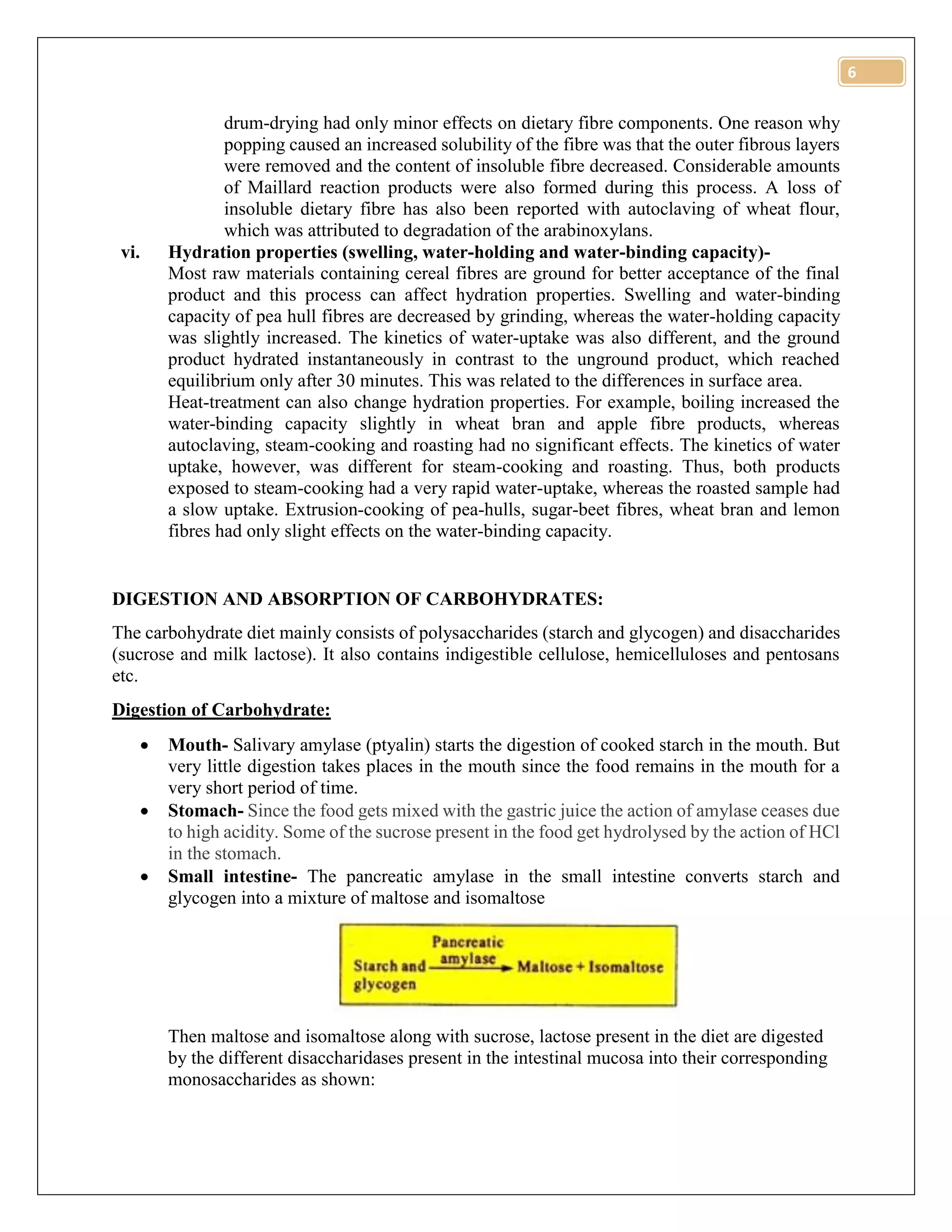
 Small intestine- The pancreatic amylase in the small intestine converts starch and
glycogen into a mixture of maltose and isomaltose
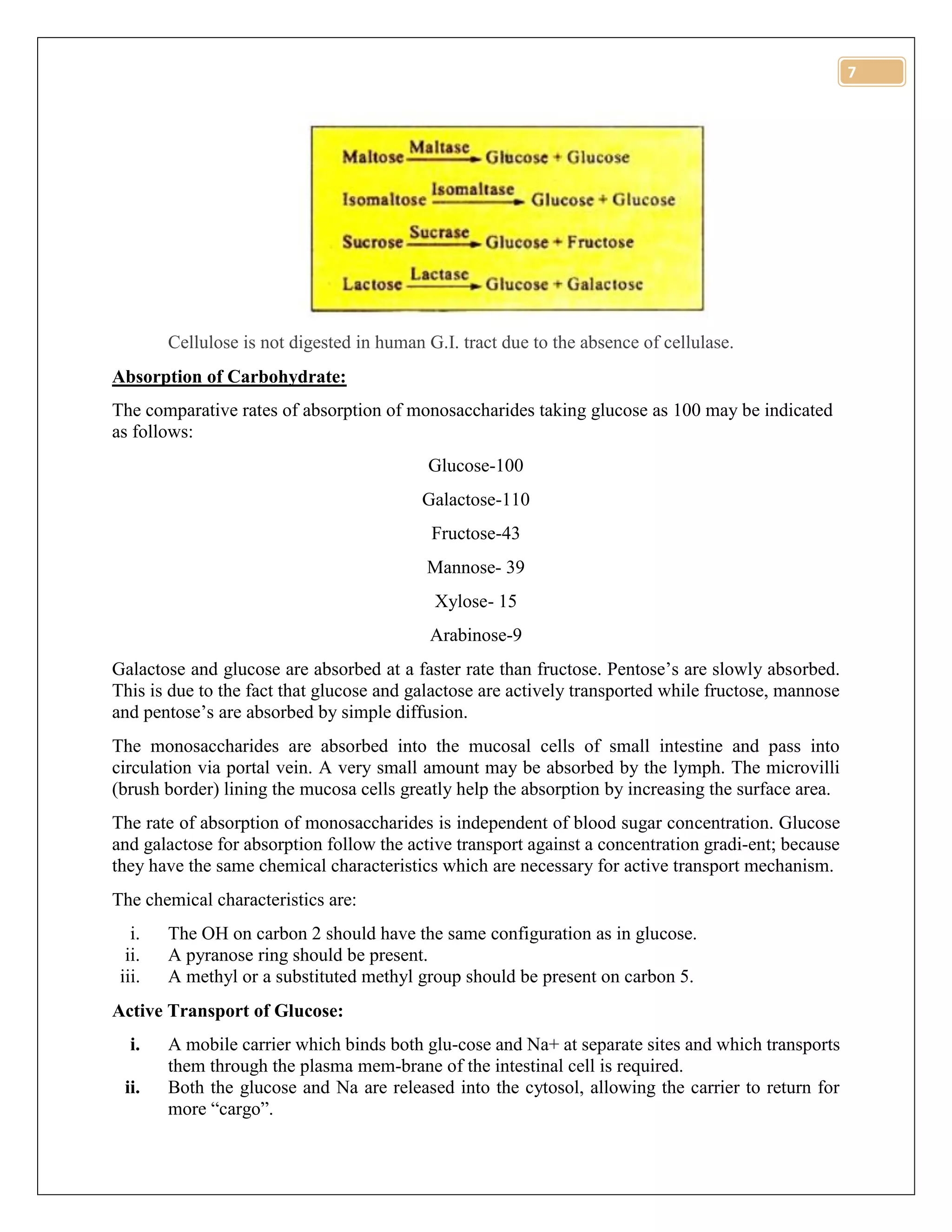
Then maltose and isomaltose along with sucrose, lactose present in the diet are digested
by the different disaccharidases present in the intestinal mucosa into their corresponding
monosaccharides as shown:
7
Cellulose is not digested in human G.I. tract due to the absence of cellulase.
Absorption of Carbohydrate:
The comparative rates of absorption of monosaccharides taking glucose as 100 may be indicated
as follows:
Glucose-100
Galactose-110
Fructose-43
Mannose- 39
Xylose- 15
Arabinose-9
Galactose and glucose are absorbed at a faster rate than fructose. Pentose’s are slowly absorbed.
This is due to the fact that glucose and galactose are actively transported while fructose, mannose
and pentose’s are absorbed by simple diffusion.
The monosaccharides are absorbed into the mucosal cells of small intestine and pass into
circulation via portal vein. A very small amount may be absorbed by the lymph. The microvilli
(brush border) lining the mucosa cells greatly help the absorption by increasing the surface area.
The rate of absorption of monosaccharides is independent of blood sugar concentration. Glucose
and galactose for absorption follow the active transport against a concentration gradi-ent; because
they have the same chemical characteristics which are necessary for active transport mechanism.
The chemical characteristics are:
i. The OH on carbon 2 should have the same configuration as in glucose.
ii. A pyranose ring should be present.
iii. A methyl or a substituted methyl group should be present on carbon 5.
Active Transport of Glucose:
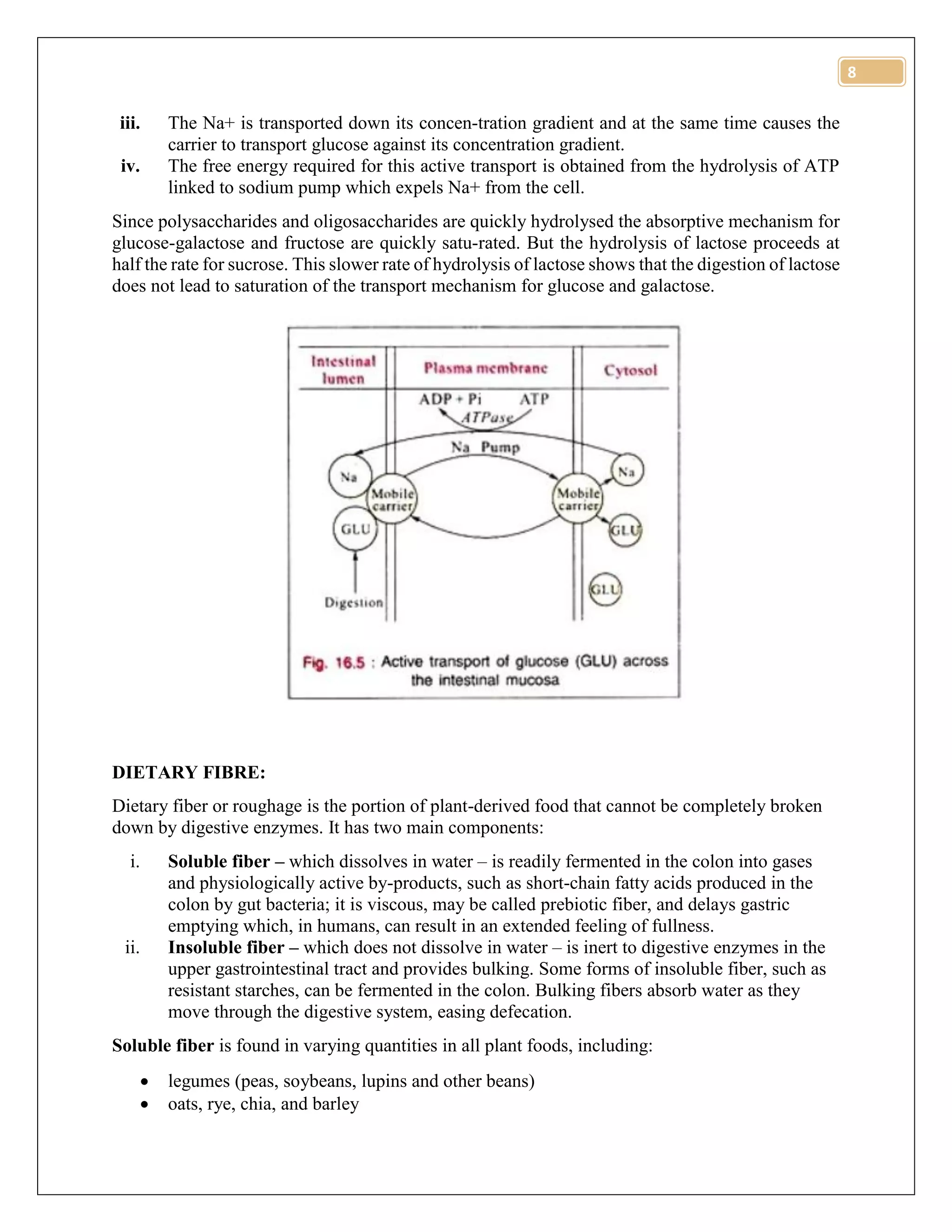
i. A mobile carrier which binds both glu-cose and Na+ at separate sites and which transports
them through the plasma mem-brane of the intestinal cell is required.
ii. Both the glucose and Na are released into the cytosol, allowing the carrier to return for
more “cargo”.
8
iii. The Na+ is transported down its concen-tration gradient and at the same time causes the
carrier to transport glucose against its concentration gradient.
iv. The free energy required for this active transport is obtained from the hydrolysis of ATP
linked to sodium pump which expels Na+ from the cell.
Since polysaccharides and oligosaccharides are quickly hydrolysed the absorptive mechanism for
glucose-galactose and fructose are quickly satu-rated. But the hydrolysis of lactose proceeds at
half the rate for sucrose. This slower rate of hydrolysis of lactose shows that the digestion of lactose
does not lead to saturation of the transport mechanism for glucose and galactose.
DIETARY FIBRE:
Dietary fiber or roughage is the portion of plant-derived food that cannot be completely broken
down by digestive enzymes. It has two main components:
i. Soluble fiber – which dissolves in water – is readily fermented in the colon into gases
and physiologically active by-products, such as short-chain fatty acids produced in the
colon by gut bacteria; it is viscous, may be called prebiotic fiber, and delays gastric
emptying which, in humans, can result in an extended feeling of fullness.
ii. Insoluble fiber – which does not dissolve in water – is inert to digestive enzymes in the
upper gastrointestinal tract and provides bulking. Some forms of insoluble fiber, such as
resistant starches, can be fermented in the colon. Bulking fibers absorb water as they
move through the digestive system, easing defecation.
Soluble fiber is found in varying quantities in all plant foods, including:
 legumes (peas, soybeans, lupins and other beans)
 oats, rye, chia, and barley
9
 some fruits (including figs, avocados, plums, prunes, berries, ripe bananas, and the skin
of apples, quinces and pears)
 certain vegetables such as broccoli, carrots, and Jerusalem artichokes
 root tubers and root vegetables such as sweet potatoes and onions (skins of these are
sources of insoluble fiber also)
 psyllium seed husks (a mucilage soluble fiber) and flax seeds
 nuts, with almonds being the highest in dietary fiber.
Sources of insoluble fiber include:
 whole grain foods
 wheat and corn bran
 legumes such as beans and peas
 nuts and seeds
 potato skins
 lignans
 vegetables such as green beans, cauliflower, zucchini (courgette), celery, and nopal
 some fruits including avocado, and unripe bananas
 the skins of some fruits, including kiwifruit, grapes and tomatoes.
10
These are a few example forms of fiber that have been sold as supplements or food additives.
These may be marketed to consumers for nutritional purposes, treatment of various
gastrointestinal disorders, and for such possible health benefits as lowering cholesterol levels,
reducing risk of colon cancer, and losing weight.
Inulins- Chemically defined as oligosaccharides occurring naturally in most plants, inulins
have nutritional value as carbohydrates, or more specifically as fructans, a polymer of the
natural plant sugar, fructose. Inulin's primary disadvantage is its tolerance. As a soluble
fermentable fiber, it is quickly and easily fermented within the intestinal tract, which may
cause gas and digestive distress at doses higher than 15 grams/day in most people.
Vegetable gums- Vegetable gum fiber supplements are relatively new to the market. Often
sold as a powder, vegetable gum fibers dissolve easily with no aftertaste. In preliminary
clinical trials, they have proven effective for the treatment of irritable bowel syndrome.
Examples of vegetable gum fibers are guar gum and gum arabic.
11
Activity in the gut:
Many molecules that are considered to be "dietary fiber" are so because humans lack the necessary
enzymes to split the glycosidic bond and they reach the large intestine. Many foods contain varying
types of dietary fibers, all of which contribute to health in different ways.
Dietary fibers make three primary contributions:
 bulking
 viscosity
 fermentation.
Bulking fibers can be soluble (i.e., psyllium) or insoluble (i.e., cellulose and hemicellulose). They
absorb water and can significantly increase stool weight and regularity. Most bulking fibers are
not fermented or are minimally fermented throughout the intestinal tract.
Viscous fibers thicken the contents of the intestinal tract and may attenuate the absorption of sugar,
reduce sugar response after eating, and reduce lipid absorption (notably shown with cholesterol
absorption). Their use in food formulations is often limited to low levels, due to their viscosity and
thickening effects. Some viscous fibers may also be partially or fully fermented within the
intestinal tract (guar gum, beta-glucan, glucomannan and pectins), but some viscous fibers are
minimally or not fermented (modified cellulose such as methylcellulose and psyllium)
Fermentable fibers are consumed by the microbiota within the large intestines, mildly increasing
fecal bulk and producing short-chain fatty acids as byproducts with wide-ranging physiological
activities. This fermentation influences the expression of many genes within the large intestine,
which affect digestive function and lipid and glucose metabolism, as well as the immune system,
inflammation and more.
CRUDE FIBRE:
Crude fibre is a measure of the quantity of indigestible cellulose, pentosans, lignin, and other
components of this type in present foods.
It is the residue of plant materials remaining after solvent extraction followed by digestion with
dilute acid and alkali. These components have little food value but provide the bulk necessary for
proper peristaltic action in the intestinal tract.
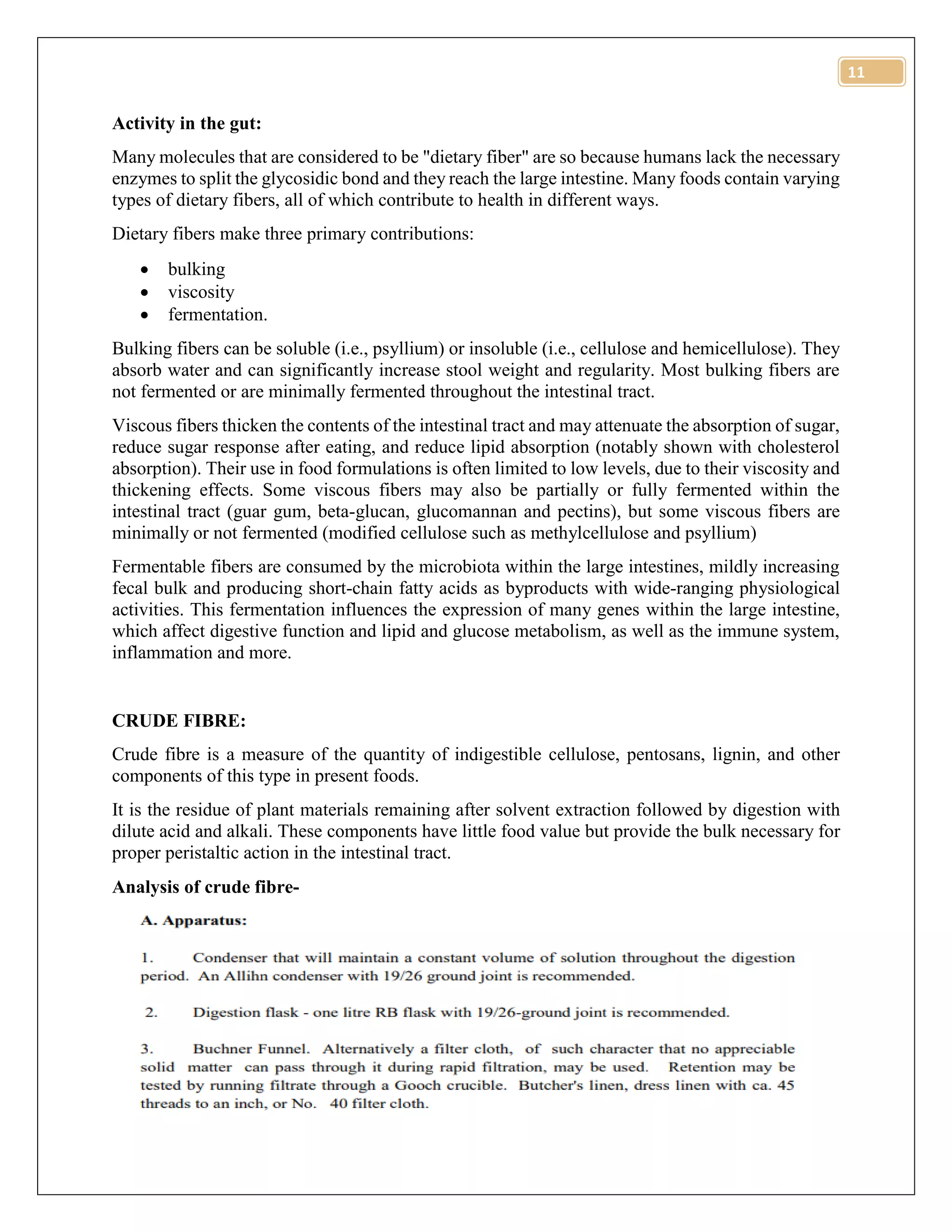
Analysis of crude fibre-
12
13
APPLICATIONS OF FOOD CARBOHYDRATES:
 Monosaccharides are the major source of fuel for metabolism, being used both as an energy
source (glucose being the most important in nature) and in biosynthesis. When
monosaccharides are not immediately needed by many cells they are often converted to
more space-efficient forms, often polysaccharides. In many animals, including humans,
this storage form is glycogen, especially in liver and muscle cells.
 In plants, starch is used for the same purpose. The most abundant carbohydrate, cellulose,
is a structural component of the cell wall of plants and many forms of algae.
 Ribose is a component of RNA. Deoxyribose is a component of DNA.
 Lyxose is a component of lyxoflavin found in the human heart.
 Ribulose and xylulose occur in the pentose phosphate pathway.
14
 Galactose, a component of milk sugar lactose, is found in galactolipids in plant cell
membranes and in glycoproteins in many tissues.
 Fructose, or fruit sugar, is found in many plants and in humans, it is metabolized in the
liver, absorbed directly into the intestines during digestion, and found in semen.
 Cellulose, a polysaccharide found in the cell walls of all plants, is one of the main
components of insoluble dietary fiber. Although it is not digestible, insoluble dietary fiber
helps to maintain a healthy digestive system by easing defecation.
 Trehalose, a major sugar of insects, is rapidly hydrolyzed into two glucose molecules to
support continuous flight.
15
PROTEINS
DIGESTION AND ABSORPTION OF PROTEINS:
Digestion of proteins-
Proteolytic enzymes are absent in the salivary secretions, hence there is no digestion of proteins in
the mouth. Proteolysis takes place in the gastro-intestinal tract (i.e. stomach and intestine). When
the proteins enter the stomach they stimulate the secretion of the hormone called gastrin which in
turn stimulates the secretion of HCl by parietal cells of the stomach and pepsinogen from the chief
cells.
Gastric juice is acidic i.e. the pH is 1.5—2.5. Acidic pH of the stomach has an antiseptic action
that kills the bacteria and other microorganisms. At this pH the dietary proteins also get denatured.
In presence of HCl, pepsinogen is converted to pepsin by autocatalysis resulting in removal of
some of the amino acids from the amino terminal end.
In the stomach the proteins are converted as follows:
Protein → Metaprotein → Proteone → Peptone → Peptide
As the food passes from the stomach to small intestine the low pH of the food triggers the secretion
of the hormone ‘secretin’ into the blood. It stimulates the pancreas to secrete HCO3 into the small
intestine in order to neutralize HCl. The secretion of HCO3 into the intestine abruptly raises the
pH from 2.5 to 7.0. The entry of amino acids into the duodenum releases the hormone
‘cholecystokinin’ which in turn triggers the release of pancreatic juice (that contains many
pancreatic enzymes like trypsinogen, chymotrypsinogen, procarboxypeptidases) by the exocrine
cells of the pancreas (ecbolic and hydrolatic). Most of these enzymes are produced as zymogens
(inactive enzymes) by the pancreas in order to protect the exocrine cells from being digested.
Subsequent to the entry of trypsinogen into the small intestine it is activated to trypsin by
enterokinase secreted by the intestinal cells. Trypsin is formed from trypsinogen by the removal
of hexapeptide from the N-terminal end.
The newly formed trypsin activates the remaining trypsinogen, Trypsin is an endopeptidase,
specific for (acts on) the peptide bonds contributed by the basic amino acids like arginine, histidine
and lysine. Chymotrypsin is secreted in an inactive from called chymotrypsinogen which is
activated by trypsin. Chymotrypsin is an endopeptidase specific to aromatic amino acids i.e.
phenylalanine, tyrosine, tryp-tophan.
16
Carboxypeptidase secreted as procarboxypeptidase is activated again by trypsin. It is an
exopeptidase that cleaves the amino acids from the carboxy terminal end. Amino peptidase
secreted as pro-aminopeptidase is once again activated by trypsin. It is an exopeptidase that cleaves
the amino acids from the free amino terminal end. Dipeptides acts only on dipeptides and
hydrolyses it into 2 amino acids.
Even after the action of all these enzymes most of the proteins remain undigested. Protein like
collagen, fibrin etc., escape digestion and are excreted out.
Absorption of the digested proteins-
There are four distinct carrier systems in the intestinal epithe-lium for the absorption of the
digested proteins. These are:
i. Carrier system for neutral amino acids
ii. Carrier system for basic amino acids
iii. Carrier system for acidic amino acids
iv. Carrier system for glycine and imino acid (proline)
The digested amino acids are carried across the mucosal cell membrane from the intestinal lumen
to the cytoplasm of the cell by one of the above carrier systems specific to that particular amino
acid. Absorption of amino acids is an up-hill process (i.e. against gradient as compared to the Na+
absorption which is downhill i.e. along the gradient).
There are four systems that operate to absorb amino acids from the mucosal cells into the blood.
They are:
i. A — system (alanine system)
ii. L — system (leucine system)
iii. Ly – system (lysine system)
iv. Ala-ser-cyst – system
17
Amino acids are taken up by the blood capillaries of the mucosa and are transported in the plasma
to the liver. Some amounts of amino acids are also absorbed through the lymph. Glucagon
stimulates the absorption of amino acids through ‘A’ system mediated by cAMP. Insulin stimulates
the trans cellular transport of amino acids to minimize the loss in the urine. The proximal tubule
cells reabsorb and return them to the blood stream. It is done by glutathione, a tripeptide. Three
ATPs are utilized for the absorption of each amino acid.
The rate at which proteins degrade depends upon the physiological state of the individual. The
time required to reduce the concentration of a given protein to 50% of its original concentration is
termed as ‘half-life (t½)’. The half-life of liver proteins ranges from 30 minutes to 150 hours. The
half-life of HMG CoA reductase is 0.5-2 hours whereas aldolase, lactate dehydrogenase and
cytochromes have a half-life of 100 hours. Hence it can be said that, almost all the proteins of the
body are degraded within a span of 6-9 months and are replaced by new proteins.
18
LIPIDS
REFINING OF FATS AND OILS:
The fats and oils obtained directly from rendering or from the extraction of the oilseeds are termed
“crude” fats and oils. Crude fats and oils contain varying but relatively small amounts of naturally
occurring non-glyceride materials that are removed through a series of processing steps. For
example, crude soybean oil may contain small amounts of protein, free fatty acids, and
phosphatides which must be removed through subsequent processing to produce the desired
shortening and oil products. Similarly, meat fats may contain some free fatty acids, water, and
protein which must be removed.
It should be pointed out, however, that not all of the nonglyceride materials are undesirable
elements. Tocopherols, for example, perform the important function of protecting the oils from
oxidation and provide vitamin E. Processing is carried out in such a way as to control retention of
these substances.
19
Methods of Refining-
20
21
22
23
HYDROGENATION OF VEGETABLE OILS:
Hydrogenation – meaning, to treat with hydrogen – is a chemical reaction between molecular
hydrogen (H2) and another compound or element, usually in the presence of a catalyst such as
nickel, palladium or platinum. The process is commonly employed to reduce or saturate organic
compounds. Hydrogenation typically constitutes the addition of pairs of hydrogen atoms to a
molecule, often an alkene. Catalysts are required for the reaction to be usable; non-catalytic
hydrogenation takes place only at very high temperatures. Hydrogenation reduces double and triple
bonds in hydrocarbons.
It has three components, the unsaturated substrate, the hydrogen (or hydrogen source) and,
invariably, a catalyst. The reduction reaction is carried out at different temperatures and pressures
depending upon the substrate and the activity of the catalyst.
The largest scale application of hydrogenation is for the processing of vegetable oils. Typical
vegetable oils are derived from polyunsaturated fatty acids (containing more than one carbon-
carbon double bond). Their partial hydrogenation reduces most, but not all, of these carbon-carbon
double bonds. The degree of hydrogenation is controlled by restricting the amount of hydrogen,
reaction temperature and time, and the catalyst.
Hydrogenation converts liquid vegetable oils into solid or semi-solid fats, such as those present in
margarine. Changing the degree of saturation of the fat changes some important physical
properties, such as the melting range, which is why liquid oils become semi-solid. Solid or semi-
solid fats are preferred for baking because the way the fat mixes with flour produces a more
desirable texture in the baked product. Because partially hydrogenated vegetable oils are cheaper
than animal fats, are available in a wide range of consistencies, and have other desirable
characteristics (such as increased oxidative stability and longer shelf life), they are the predominant
fats used as shortening in most commercial baked goods.
Hydrogen sources-For hydrogenation, the obvious source of hydrogen is H2 gas itself, which is
typically available commercially within the storage medium of a pressurized cylinder. The
hydrogenation process often uses greater than 1 atmosphere of H2.
24
Catalysts- With rare exceptions, H2 is unreactive toward organic compounds in the absence of
metal catalysts. The unsaturated substrate is chemisorbed onto the catalyst, with most sites covered
by the substrate. In heterogeneous catalysts, hydrogen forms surface hydrides (M-H) from which
hydrogens can be transferred to the chemisorbed substrate. Platinum, palladium, rhodium, and
ruthenium form highly active catalysts, which operate at lower temperatures and lower pressures
of H2. Non-precious metal catalysts, especially those based on nickel (such as Raney nickel and
Urushibara nickel) have also been developed as economical alternatives, but they are often slower
or require higher temperatures.
Catalysts are usually classified into two broad classes:
 Homogeneous catalysts- Homogeneous catalysts dissolve in the solvent that contains the
unsaturated substrate.
 Heterogeneous catalysts- Heterogeneous catalysts are solids that are suspended in the
same solvent with the substrate or are treated with gaseous substrate.
A side effect of incomplete hydrogenation having implications for human health is the
isomerization of some of the remaining unsaturated carbon bonds to their trans isomers. Trans fats
(resulting from partial hydrogenation) have been implicated in circulatory diseases including heart
disease. The conversion from cis to trans bonds is chemically favored because the trans
configuration has lower energy than the natural cis one. At equilibrium, the trans/cis isomer ratio
is about 2:1. Many countries and regions have introduced mandatory labeling of trans fats on food
products and appealed to the industry for voluntary reductions. The food industry has moved away
from partially hydrogenated fats (i.e. trans fats) and towards fully hydrogenated fats and
interesterified fats in response to bad publicity about trans fats, labeling requirements, and removal
of trans fats from the FDA list of foods Generally Recognized as Safe.
25
VITAMINS
METHODS OF ANALYSIS OF VITAMINS:
Vitamin assays can be classified as follows:
i. Bioassays involving humans and animals.
ii. Microbiological assays making use of protozoan organisms, bacteria, and yeast.
iii. Physicochemical assays that include spectrophotometric, fluorometric,
chromatographic, enzymatic, immunological, and radiometric methods.
Because of the sensitivity of some vitamins to adverse conditions such as light, oxygen, pH, and
heat, proper precautions need to be taken to prevent any deterioration throughout the analytical
process, regardless of the type of assay used.
Extraction Methods-
With the exception of some biological feeding studies, vitamin assays in most instances involve
the extraction of a vitamin from its biological matrix prior to analysis. This generally includes one
or several of the following treatments: heat, acid, alkali, solvents, and enzymes.
Typical extraction procedures are:
 Ascorbic acid: Cold extraction with metaphosphone acid/acetic acid
 Vitamins B1 and B2: Boiling or autoclaving in acid plus enzyme treatment
 Niacin: Autoclaving in acid (noncereal products) or alkali (cereal products)
 Vitamin A, E, or D: Organic solvent extraction, saponification, and reextraction with
organic solvents. For unstable vitamins such as these, antioxidants are routinelv added to
inhibit oxidation.
Bioassay Methods-
Outside of vitamin bioavailability studies, bioassays at the present are used only for the analysis
of Vitamins B12 and D. Since the determination of Vitamin D involves deficiency studies as well
as sacrificing the test organisms, it is limited to animals rather than humans as test organisms.
Microbiological Assays:
Applications-
Microbiological assays are limited to the analysis of water-soluble vitamins. The methods
are very sensitive and specific for each vitamin. The methods are somewhat time
consuming, and strict adherence to the analytical protocol is critical for accurate results.
Principle-
The growth of microorganisms is proportional to their requirement for a specific vitamin.
Thus, in microbiological assays the growth of a certain microorganism, in an extract of a
vitamin-containing sample is compared with the growth of this microorganism in the
presence of known amounts of that vitamin. Bacteria, yeast or protozoans are used as test
26
organisms. Growth can be measured in terms of turbidity, acid production, gravimetry, or
by respiration. With bacteria and yeast, turbidimetry is the most commonly used system. lf
turbiditv measurements are involved, clear sample and standard extracts, versus turbid
ones, are essential. In terms of incubation time turbidity measurement also is a less time-
consuming method.
Niacin-
Lactobacillus plantarum is the test organism. A stock culture needs to be prepared and
maintained by inoculating the freeze-dried culture on bacto-lactobacilli agar and incubating
at 37°C for 24 hrs prior to sample and standard inoculation. A second transfer may be
advisable in the case of poor growth of the inoculum culture.
In general growth is measured bv turbidity. If lactobacilli are used as the test organism,
acidimetric measurements can be used as well. The latter may be necessary if a clear sample
extract cannot be obtained prior to inoculation and incubation (which is a prerequisite for
turbidimetry). In making a choice between the two methods of measurement, one needs to
bear in mind the prolonged incubation period of 72 hr that is required with acidimetry.
27
PHYSIOLOGICAL SIGNIFICANCE OF VITAMIN-B SERIES:
28
29
FOOD ADDITIVES
ARTIFICIAL SWEETENERS:
A sugar substitute is a food additive that provides a sweet taste like that of sugar while containing
significantly less food energy than other sweeteners, making it a zero-calorie or low-calorie
sweetener. Some sugar substitutes are produced naturally, and some synthetically. Those not
produced naturally are, in general, called artificial sweeteners.
Types of artificial sweetener:
 Saccharin
 Aspartame
 Cyclamate
 Acesulfame potassium
 Stevia
 Sucralose
 Sugar alcohols
FLAVORS AND FLAVOR ENHANCERS:
Flavours are additives that give food a particular taste or smell, and may be derived from natural
ingredients or created artificially.
Flavours and flavour enhancers form a divergent group of organic compounds both natural and
synthetic in nature. They are used in trace amounts to impart a characteristic flavour. Menthol,
vanillin and monosodium glutamate are of interest as they are extensively used in various foods.
Menthol is used mainly to flavour confectionery and panmasala. Vanillin is extensively used in
ice creams and monosodium glutamate to enhance flavour of meat, soups etc., and Gas
chromatography is extensively used in determination of various flavouring compounds.
EMULSIFIERS, STABILIZERS, THICKENING AND GELLING AGENTS:
A thickening agent or thickener is a substance which can increase the viscosity of a liquid without
substantially changing its other properties. Edible thickeners are commonly used to thicken sauces,
soups, and puddings without altering their taste.
Thickeners may also improve the suspension of other ingredients or emulsions which increases
the stability of the product. Some thickening agents are gelling agents (gellants), forming a gel,
dissolving in the liquid phase as a colloid mixture that forms a weakly cohesive internal structure.
Others act as mechanical thixotropic additives with discrete particles adhering or interlocking to
resist strain.
Thickening agents can also be used when a medical condition such as dysphagia causes difficulty
in swallowing. Thickened liquids play a vital role in reducing risk of aspiration for dysphagia
patients.
30
A variety of organic compounds form the group of emulsifiers, stabilizers and thickening agents.
Compounds such as stearyl tartarate, glycerol esters like glycerylmonostearate, propylene glycol
esters, and sorbitan esters of fatty acids, cellulose ethers and sodium carboxymethyl cellulose are
in use for making food emulsions and to stabilize them. Pectin, alginates, agar, Irish moss,
cellulose, carboxy methyl cellulose, starch and certain gums like guar gum, gum Arabic, karaya
gum, gum ghathi, tragacanth gum, locust bean gum, gelatin etc. are being used as thickening
agents.
31
PIGMENTS AND SYNTHETIC DYES
Pigments are colored, colorless, or fluorescent particulate organic or inorganic finely divided
solids which are usually insoluble in, and essentially chemically unaffected by, the vehicle or
medium in which they are incorporated. They alter appearance either by selective absorption
and/or scattering of light.
Dyes, on the other hand, are colored substances which are soluble or go into solution during the
application process and impart color by selective absorption of light. In contrast to dyes, whose
coloristic properties are almost exclusively defined by their chemical structure, the properties of
pigments also depend on the physical characteristics of its particles.
Pigments are chemical compounds that absorb light in the wavelength range of the visible region.
Produced color is due to a molecule-specific structure (chromophore); this structure captures the
energy and the excitation of an electron from an external orbital to a higher orbital is produced;
the non-absorbed energy is reflected and/or refracted to be captured by the eye, and generated
neural impulses are transmitted to the brain where they could be interpreted as a color.
Classification of pigments-
Pigments can be classified by their origin as natural, synthetic, or inorganic.
 Natural pigments are produced by living organisms such as plants, animals, fungi, and
microorganisms.
 Synthetic pigments are obtained from laboratories. Natural and synthetic pigments are
organic compounds.
 Inorganic pigments can be found in nature or reproduced by synthesis.
Classification of natural pigments by their structural characteristics and their occurence-
Natural pigments can be classified by their structural characteristics as:
i. Tetrapyrrole derivatives: These compounds have a structure with pyrrole rings in linear
or cyclic arrays. Chlorophylls constitute the most important subgroup of pigments within
the tetrapyrrole derivatives. Chlorophyll is mainly present in the chloroplasts of higher
plants and most algae. Heme group (the porphyrin ring is bonded to an iron atom) is present
in hemoglobin and myoglobin, present in animals, and also in cytochromes, peroxidases,
catalases, and vitamin B12 as a prosthetic group.
Examples- chlorophylls and heme colors.
ii. Isoprenoid derivatives: Isoprenoids, also called terpenoids, represent a big family of
natural compounds; they are found in all kingdoms where they carry out multiple functions
(hormones, pigments, phytoalexins). Over 23,000 individual isoprenoid compounds have
been identified and many new structures are reported each year. By their abundance and
structure, two subgroups of compounds are considered pigments: quinones and
carotenoids.
Quinones are considered another group because not all of them are produced by this
biosynthetic pathway. On the other hand, carotenoids as a major point of our review are
32
described below. In relation to iridoids, these are found in about 70 families
(Capriofilaceae, Rubiaceae, Cornaceae, among others) grouped in some 13 orders. Saffron
(Crocus sativus L.) and cape jasmine fruit (Gardenia jasminoids Ellis) are the best-known
iridoid-containing plants, but their colors are more importantly influenced by carotenoids.
Examples- carotenoids and iridoids.
iii. N-heterocyclic compounds different from tetrapyrroles:
a. Purines- As most of the nucleotides, purines are found in two macromolecules:
deoxyribonucleic acid (DNA) and ribonucleic acid (RNA). These molecules are an
essential component of life, thus they are present in each living organism. Free
purines have been found in animals (golden and silvery fish).
b. Pterins- The pteridin ring system is probably present in every form of life. Pterins
are responsible for color in some insects, in vertebrate eyes, human urine, and
bacteria.
c. Flavins- Riboflavin is the main compound of this group, and it is synthesized in all
live cells of microorganisms and plants. Riboflavin is found in milk. Other sources
are a wide range of leafy vegetables, meat, and fish.
Examples- purines, pterins, flavins, phenazines, phenoxazines, and betalains.
iv. Benzopyran derivatives (oxygenated heterocyclic compounds): The most studied
secondary metabolites are the flavonoids. Flavonoids are water soluble and show a wide
distribution in vascular plants. They are present in each part of the plant. More than 5000
flavonoids have been chemically characterized, and new structures are described
continuously.In the flavonoids, the anthocyanins are the most important pigments; they
produce colors from orange to blue in petals, fruits, leaves, and roots. Flavonoids also
contribute to the yellow color of flowers, where they are present with carotenoids or alone
in 15% of the plant species.
Examples-anthocyanins and other flavonoid pigments.
v. Quinones: Quinones have a great number of coloring compounds. This group is the biggest
one in number and structural variation. Also, they are more widely distributed than other
natural pigments (with the exception of carotenoids and melanins).
Quinones are found in plants: plastoquinones are found in chloroplasts of higher plants and
algae; menaquinones are found in bacteria; naphthoquinones in animals; and
anthraquinones in fungi, lichens, flowering plants, and insects.
Many quinones are byproducts of the metabolic pathways and a few organisms (fungi)
produce large quantities. In general, quinones produce yellow, red, or brown colorations,
but quinone salts show purple, blue, or green colors.
Examples-benzoquinone, naphthoquinone, anthraquinone.
vi. Melanins: Melanins are nitrogenous polymeric compounds whose monomer is the indole
ring. In general, melanins are not homopolymers but present a mixture of macromolecules.
Melanins are responsible of many of the black, gray, and brown colorations of animals,
plants, and microorganisms.
33
PERMITTED SYNTHETIC DYES:
Only 8 coal-tar food colours are permitted to be used in certain food products under the provisions
of FSS (Food Product Standards & Food additives) Regulations, 2011. They include:
 Three red shades namely Carmoisine, Ponceau 4 R, Erythrosine
 Two yellow shades namely Sunset Yellow FCF and Tartrazine
 Two blue shades i.e. Brilliant Blue FCF and Indigo Carmine
 One green shade i.e. Fast Green FCF.
NON-PERMITTED SYNTHETIC DYES:
Unscrupulous manufacturers use non-permitted colours either out of lack of awareness or because
these colours can be bought at very cheap rates. Since permitted natural colours are expensive, a
number of unlicensed vendors and sweet shops continue to use non-permitted colours deliberately
to reduce the cost of the product, seeing the competition and demand. Some of these dyes are :
i. Metanil yellow
ii. Rhodamine B
iii. Orange G
iv. Blue VRS
v. Auramine
vi. Certain unidentified water and oil soluble colours (such as Sudan red colours)
Here are a few harmful effects of non-permitted colours:
i. Long exposure to metanil yellow, which is usually used to colour sweets like jalebis, ladoos
and even biryanis was found to cause neurotoxicity in rats.
ii. Rhodamine B, a food colour that gives a bright pink colour to foods, can cause cancer and
degenerative changes in kidney and liver.
iii. Auramine which is used to colour beverages yellow, can cause dysfunction of the liver and
kidney.
34
CHAPTER-4a
MARGARINE:
Margarine is a spread used for flavoring, baking, and cooking. Whereas butter is made from the
butterfat of milk, modern margarine is made mainly of refined vegetable oil and water, and may
also contain milk.
The basic method of making margarine today consists of emulsifying a blend of vegetable oils
and fats, which can be modified using fractionation, interesterification or hydrogenation, with
skimmed milk, chilling the mixture to solidify it and working it to improve the texture.
Three types of margarine are common:
 Soft vegetable fat spreads, high in mono- or polyunsaturated fats, which are made from
safflower, sunflower, soybean, cottonseed, rapeseed, or olive oil.
 Margarines in bottle to cook or top dishes.
 Hard, generally uncolored margarine for cooking or baking.
CHAPTER-4b
VINEGAR:
35
36
CHAPTER-5b
BIS (BUREAU OF INDIAN STANDARDS):
The Bureau of Indian Standards (BIS) is the national Standards Body of India working under
the aegis of Ministry of Consumer Affairs, Food & Public Distribution, Government of India.
It is established by the Bureau of Indian Standards Act, 1986 which came into effect on 23
December 1986. The Minister in charge of the Ministry or Department having administrative
control of the BIS is the ex-officio President of the BIS.
Its headquarters are in New Delhi, with regional offices in Kolkata, Chennai, Mumbai, Chandigarh
and Delhi and 20 branch offices.
The organisation was formerly the Indian Standards Institution (ISI), set up under the
Resolution of the then Department of Industries and Supplies No. 1 Std.(4)/45, dated 3 September
1946.
The Bureau of Indian Standards(BIS) operates product certification schemes by which it grants
licenses to manufacturers covering practically every industrial discipline from agriculture and
textiles to electronics. The certification allows the licensees to use the popular ISI mark, which
has become synonymous with quality products for the Indian and neighboring markets for over 55
years.
Activities:
 Standard formulation and promotion- One of the major functions of the Bureau is the
formulation, recognition and promotion of the Indian Standards. As on 31 August 2016,
26552 Standards formulated by BIS, are in force. These cover important segments of
economy, which help the industry in upgrading the quality of their products and services.
37
BIS has identified 14 sectors which are important to Indian Industry. For formulation of
Indian Standard, it has separate Division Council to oversee and supervise the work. The
Standards are regularly reviewed and formulated in line with the technological
development to maintain harmony with the International Standards.
 Product Certification- While the scheme itself is voluntary in nature, the Indian
Government has, in public interest, enforced mandatory certification on various products
through various quality control orders issued from time to time, under various acts. While
BIS continues to grant licenses on application, the enforcement of compulsory certification
is done by the authorities notified in such quality control orders. Overseas applicants can
also be granted BIS certification for use of ISI mark for their products under the Foreign
Manufacturers Certification Scheme (FMCS).
 Management System Certification-
 Quality Management System Certification Scheme IS/ISO 9001.
 Food Safety Management System Certification IS/ISO 22000.
 Medical Devices Management System Certification Scheme IS/ISO 13485.
 Integrated Milk Certification Scheme, etc.
The Food Safety and Standards (Prohibition and Restriction on Sales) Regulations, 2011 has
prescribed mandatory certification under the BIS Act for the following products:
• Infant formula (IS14433)
• Milk cereal based weaning food (IS1656)
• Processed cereal based weaning food (IS11536)
• Follow up formula (IS15757)
• Packaged drinking water (IS14543)
• Packaged mineral water (IS13428)
• Milk Powder (IS1165)
• Skimmed Milk Powder (IS13334)
• Partly Skimmed Milk Powder (IS14542)
• Condensed Milk,Partly Skimmed and Skimmed Condensed Milk (IS1166).
38
AGMARK:
AGMARK is a certification mark employed on agricultural products in India, assuring that they
conform to a set of standards approved by the Directorate of Marketing and Inspection an attached
Office of the Department of Agriculture, Cooperation and Farmers Welfare under Ministry of
Agriculture & Farmers Welfare an agency of the Government of India.
The AGMARK Head Office at Faridabad (Haryana) is legally enforced in India by the Agricultural
Produce (Grading and Marking) Act of 1937 (and amended in 1986). The present AGMARK
standards cover quality guidelines for 222 different commodities spanning a variety of pulses,
cereals, essential oils, vegetable oils, fruits and vegetables and semi-processed products like
vermicelli.
The term agmark was coined by joining the words 'Ag' to mean agriculture and 'mark' for a
certification mark. This term was introduced originally in the bill presented in the parliament of
India for the Agricultural Produce (Grading and Marking) Act.
39
Agmark Laboratories-
The Agmark certification is employed through fully state-owned Agmark laboratories located
across the nation which act as testing and certifying centres. In addition to the Central AGMARK
Laboratory (CAL) in Nagpur, there are Regional AGMARK Laboratories (RALs) in 11 nodal
cities (Mumbai, New Delhi, Chennai, Kolkata, Kanpur, Kochi, Guntur, Amritsar, Jaipur, Rajkot,
Bhopal).
Activities of Central Agmark Laboratory-
i. To carry out Research and Developmental Activities in the domain of Standardization of
Agricultural Produce and Food.
ii. To work as an apex laboratory for analysis of challenged samples
iii. To keep a check through proficiency testing on analysis by RALs
iv. To evolve/standardize methods of analysis/tests for quality assurance of agricultural and
food products.
v. Formulation of quality specifications for new commodities based on scientific data, for
bringing under the purview of Agmark.
vi. Revision of specification of various produce under Agmark periodically.
vii. Training to the personnel engaged in the analysis and grading of different produce.
viii. To create awareness with regard to quality, food safety and standardization of various
agricultural and food products.
ix. To guide on establishment of grading laboratories at various levels.
x. Harmonization of Agmark standards of food and agricultural produce based on scientific
data with that of Codex and FSSAI.
xi. In service training and Refresher course for chemists of RALs and CAL.
xii. Publication of research paper.
Activities of Regional Agmark Laboratories-
i. Analysis of food and agricultural produce under Agmark certification scheme.
ii. Technical advice to State Government and other approved grading laboratories, training to
grading chemists in analysis.
iii. Associate with Central Agmark Laboratory, in collaborative
studies/research/standardization work of various agricultural and food products for
collection of scientific data of different quality and safety factors.
iv. Awareness/training in analysis/grading of food and agricultural produce.
40
US-FDA:
The Food and Drug Administration (FDA or USFDA) is a federal agency of the United States
Department of Health and Human Services, one of the United States federal executive
departments. The FDA is responsible for protecting and promoting public health through the
control and supervision of food safety, tobacco products, dietary supplements, prescription and
over-the-counter pharmaceutical drugs (medications), vaccines, biopharmaceuticals, blood
transfusions, medical devices, electromagnetic radiation emitting devices (ERED), cosmetics,
animal foods & feed and veterinary products. As of 2017, 3/4th of the FDA budget (approximately
$700 million) is funded by the pharmaceutical companies due to the Prescription Drug User Fee
Act.
The FDA is led by the Commissioner of Food and Drugs, appointed by the President with the
advice and consent of the Senate. The FDA has its headquarters in unincorporated White Oak,
Maryland. The agency also has 223 field offices and 13 laboratories located throughout the 50
states, the United States Virgin Islands, and Puerto Rico.
Regulatory programs-
 Food and dietary supplements: The regulation of food and dietary supplements by the
U.S. Food and Drug Administration is governed by various statutes enacted by the United
States Congress and interpreted by the FDA. Pursuant to the Federal Food, Drug, and
Cosmetic Act ("the Act") and accompanying legislation, the FDA has authority to oversee
the quality of substances sold as food in the United States, and to monitor claims made in
the labeling about both the composition and the health benefits of foods.
The FDA subdivides substances that it regulates as food into various categories—including
foods, food additives, added substances (man-made substances that are not intentionally
introduced into food, but nevertheless end up in it), and dietary supplements. Specific
standards the FDA exercises differ from one category to the next. Furthermore, legislation
had granted the FDA a variety of means to address violations of standards for a given
substance category.
 Medications: The Center for Drug Evaluation and Research uses different requirements
for the three main drug product types: new drugs, generic drugs, and over-the-counter
drugs. A drug is considered "new" if it is made by a different manufacturer, uses different
excipients or inactive ingredients, is used for a different purpose, or undergoes any
substantial change. The most rigorous requirements apply to new molecular entities: drugs
that are not based on existing medications.
 Vaccines, blood and tissue products, and biotechnology: The Center for Biologics
Evaluation and Research is the branch of the FDA responsible for ensuring the safety and
efficacy of biological therapeutic agents. These include blood and blood products,
vaccines, allergenics, cell and tissue-based products, and gene therapy products. New
41
biologics are required to go through a premarket approval process called a Biologics
License Application (BLA), similar to that for drugs.
The original authority for government regulation of biological products was established by
the 1902 Biologics Control Act, with additional authority established by the 1944 Public
Health Service Act. Along with these Acts, the Federal Food, Drug, and Cosmetic Act
applies to all biologic products, as well. Originally, the entity responsible for regulation of
biological products resided under the National Institutes of Health; this authority was
transferred to the FDA in 1972.
 Cosmetics: Cosmetics are regulated by the Center for Food Safety and Applied Nutrition,
the same branch of the FDA that regulates food. Cosmetic products are not, in general,
subject to premarket approval by the FDA unless they make "structure or function claims"
that make them into drugs (see Cosmeceutical). However, all color additives must be
specifically FDA approved before manufacturers can include them in cosmetic products
sold in the U.S. The FDA regulates cosmetics labeling, and cosmetics that have not been
safety tested must bear a warning to that effect.
Though the cosmetic industry is predominantly responsible in ensuring the safety of its
products, the FDA also has the power to intervene when necessary to protect the public but
in general does not require pre-market approval or testing. Companies are required to place
a warning note on their products if they have not been tested. Experts in cosmetic ingredient
reviews also play a role in monitoring safety through influence on the use of ingredients,
but also lack legal authority. Overall the organization has reviewed about 1,200 ingredients
and has suggested that several hundred be restricted, but there is no standard or systemic
method for reviewing chemicals for safety and a clear definition of what is meant by 'safety'
so that all chemicals are tested on the same basis
 Veterinary products: The Center for Veterinary Medicine (CVM) is the branch of the
FDA that regulates food additives and drugs that are given to animals. CVM does not
regulate vaccines for animals; these are handled by the United States Department of
Agriculture.
CVM's primary focus is on medications that are used in food animals and ensuring that
they do not affect the human food supply. The FDA's requirements to prevent the spread
of bovine spongiform encephalopathy are also administered by CVM through inspections
of feed manufacturers.
 Tobacco products: Since the Family Smoking Prevention and Tobacco Control Act
became law in 2009, the FDA also has had the authority to regulate tobacco products. In
July 2017, the FDA announced a plan that would reduce the current levels of nicotine
permitted in tobacco cigarettes.
GMP Regulations:
These are designed to prevent adulterated food in the marketplace.
It defines requirements for acceptable sanitary operation in food plants and includes the
following relevant to food processing:
1. General provisions that define and interpret the detailed regulations;
42
2. Requirements & expectations for maintaining grounds, buildings and facilities;
3. Requirements & expectations for design, construction and maintenance of equipment;
4. Requirements for production and process controls; and
5. Defect action levels (DALs) for natural and unavoidable defects
Science and research programs-
In addition to its regulatory functions, the FDA carries out research and development activities to
develop technology and standards that support its regulatory role, with the objective of resolving
scientific and technical challenges before they become impediments. The FDA's research efforts
include the areas of biologics, medical devices, drugs, women's health, toxicology, food safety and
applied nutrition, and veterinary medicine.

Notes* for the subject 'Food Analysis'

  • 1.
    M. Pharm 1st Semester FOODANALYSIS L. Sanathoiba Singha
  • 2.
  • 3.
    2 QUANTITATIVE ANALYSIS OFCARBOHYDRATES: 1. Lane – Eynon method 2. Munson – Walker method 3. Nelson – Somogyi method 4. Alkaline – Ferricyanide method 5. Phenol – sulphuric acid method Lane-Eynon method (Titration Method)- Used to determine the conc. of reducing sugar in a sample Principle:  Determined based on the reducing property of the sugar.  Sugars in the sample reduces copper sulfate in the reagent to cuprous oxide.  Once all the copper sulfate in solution has reacted, any further addition of reducing sugars causes the indicator to change from blue to white. Procedure:  Burette is used to add the carbohydrate solution being analyzed  Conical flask containing a known amount of copper sulfate solution and a methylene blue indicator.  Boil the content of conical flask over flame and titrate against carbohydrate solution under boiling condition through the titration period.  Once all the copper sulfate in solution has reacted, any further addition of reducing sugars causes the indicator to change from blue to white.  The volume of sugar solution required to reach the end point is recorded. The disadvantages of method are:  the results depend on the precise reaction times, temperatures and reagent concentrations used and so these parameters must be carefully controlled  it cannot distinguish between different types of reducing sugar  it cannot directly determine the concentration of non-reducing sugars. Munson – Walker method: The Munson and Walker method is an example of a gravimetric method of determining the concentration of reducing sugars in a sample. CHO is heated in the presence of an excess of copper sulpate and alkaline tartrate (to keep Cu 2+ ion in solution) under controlled conditions → leads to the formation of a copper oxide precipitate: Reducing sugar + Cu 2+ + base → oxidized sugar + CuO2 (precipitate) The concentration of precipitate present can be determined:
  • 4.
    3  Gravimetrically –filtration, drying and weighing  Titrimetrically – redissolving the precipitate and titrating with a suitable indicator This method has similar disadvantages as Lane-Eynon method. Nelson – Somogyi method: Principle: The reducing sugars when heated with alkaline copper tartarate reduce the copper from the cupric to cuprous oxide is formed. When cuprous oxide is treated with aresnomolybdic acid, the reduction of molybdic acid to molybdenum blue takes place. The blue colour developed is compared with a set of standards in a colorimeter at 620nm. Procedure:  Weigh 100mg of the sample and extract the sugars with hot 80% ethanol twice.  Collect the supernatant and evaporate it by keeping it on a water bath at 80˚C.  Add 10ml of water and dissolve the sugars.  Pipette out aliquots of 0.2, 0.4, 0.6, 0.8, 1.0 ml of the working standard solution into a series of test tubes.  Pipette out aliquots of 0.1 or 0.2ml to separate test tubes.  Make up the volume in both sample and standard tubes to 2ml with distilled water.  Pipette out 2ml distilled water in a separate tube to set the blank.  Add 1ml of alkaline copper tartrate reagent to each tube.  Place the tubes in boiling water for 10 min.  Cool and add 1ml of arsenomolybdic acid reagent to all.  Make the volume to 10ml with water.  Read the absorbance of blue colour at 620nm after 10 min.  Calculate the amount of reducing sugars in the sample. CHANGES IN FOOD CARBOHYDRATES DURING PROCESSING: Processing of foods affects carbohydrate and micronutrient content and bioavailability in different ways with either desirable or adverse effects on the nutritional value. Losses of water-soluble nutrients at blanching and boiling can be minimized by use of small amounts of water and by adding back the processing water. The bioavailability of starch is affected dramatically through processing, regarding both rate and extent of small-intestinal digestibility. This permits optimizing the digestion of starch by choice of raw materials and processing conditions. Processing effects on dietary fibre include solubilization and depolymerization, that can influence physiological effects both in the upper and lower gastrointestinal tract. The content and the nutritional quality of food carbohydrates can be altered by processing in a number of ways:
  • 5.
    4 i. Carbohydrate lossthrough leaching- During wet heat treatment, as in blanching, boiling and canning of vegetables and fruits, there is a considerable loss of low molecular weight carbohydrates (i.e. mono- and disaccharides) as well as micronutrients, into the processing water. ii. Alterations of low molecular weight carbohydrates-  Production of resistant oligosaccharides  Maillard reactions- Non-enzymatic browning reactions (Maillard reactions) occur between reducing sugars and ammo groups in foods at processing and in storage. These reactions are temperature dependent and most extensive at intermediate water activities. They are important nutritionally as they may diminish the bioavailability of amino acids, especially lysine, thus diminishing the protein nutritional value. iii. Starch - heat-induced effects-  Gelatinization- Gelatinization refers to the irreversible loss of the crystalline regions in starch granules that occur upon heating in the presence of water. The temperature range during which the crystalline structure of the starch granule is lost is dependent on the water content, and on the type of starch. The gelatinization dramatically increases the availability of starch for digestion by amylolytic enzymes. Usually, the starch granules are not completely dissolved during food processing, and a food can be regarded as a dispersion in which starch granules and/or granular remnants constitute the dispersed phase. The degree of gelatinization achieved by most commonly used food processes, however, is sufficient to permit the starch to be rapidly digested.  Retrogradation- Gelatinized starch is not in thermodynamic equilibrium. There is, therefore, a progressive re-association of the starch molecules upon ageing. This recrystallization is referred to as retro gradation, and may reduce the digestibility of the starch. The retrogradation of the amylopectin component is a long-term phenomena occurring gradually upon storage of starchy foods. Amylose, however, re-associates more quickly. The crystallinity of retrograded amylopectin is lost following re-heating to approximately 70°C, whereas temperatures above 145°C are required to remove crystallinity of retrograded amylose. This is a temperature well above the range used for processing of starchy foods. This implies that retrograded amylose, once formed, will retain its crystallinity following re-heating of the food.  Par-boiling- During par-boiling of rice, the kernels are subjected to a pre-treatment involving heating and drying. This process reduces the stickiness of the rice, possibly by allowing leached amylose to retrograde and/or form inclusion complexes with polar lipids on the kernel surface. Parboiling also affects the final cooking properties of the rice. iv. Starch – texturization- In pasta products, gluten forms a viscoelastic network that surrounds the starch granules, which restricts swelling and leaching during boiling. Pasta extrusion is known to result in products where the starch is slowly digested and absorbed. Available data on spaghetti also suggest that this product group is a comparatively rich source of resistant starch. The slow- release features of starch in pasta probably relates to the continuous glutenous phase. This
  • 6.
    5 not only restrictsswelling, but possibly also results in a more gradual release of the starch substrate for enzymatic digestion. Pasta is now generally acknowledged as a low glycemic index food suitable in the diabetic diet. However, it should be noted that canning of pasta importantly increases the enzymic availability of starch, and hence the glycemic response v. Dietary fibre-  Milling and peeling- During milling of cereal grains to refined flours the outer fibre-rich layers are removed, resulting in a lower content of total dietary fibre. This reduction is due mainly to a decrease of insoluble fibre. The dietary fibre composition in both whole-grain and refined flours is different. Refined flours of oats, barley, rice and sorghum contain mainly glucans, while arabinoxylans dominate in refined flours of wheat, rye and maize. Whole-grain flours all contain considerable amounts of cellulose. The husk which surrounds barley, rice and oats also contains considerable amounts of xylans. This fraction is generally removed before consumption, but oat and rice husks are used for fibre preparation to enrich foods.  Heat-treatment- Processes involving heat-treatment may affect the dietary fibre in different ways. An increased temperature leads to a breakage of weak bonds between polysaccharide chains. Also glycosidic linkages in the dietary fibre polysaccharides may be broken. These changes are important from analytical, functional and nutritional points of view. A decreased association between fibre molecules, and/or a depolymerization of the fibre, results in a solubilization. If the depolymerization is extensive, alcohol soluble fragments can be formed, resulting in a decreased content of dietary fibre with many of the currently used fibre methods. Moderate depolymerization and/or decreased association between fibre molecules, may have only minor influence on the dietary fibre content, but functional (e.g. viscosity and hydration) and physiological properties of the fibre will be changed. Other reactions during processing that may affect the dietary fibre content and its properties are leakage into the processing water, formation of Maillard reaction products thus adding to the lignin content, and formation of resistant starch fractions. Also structural alterations in the cell wall architecture are important to follow during processing as these are highly correlated to sensory and nutritional characteristics. The architecture of the fibre matrix in the cell wall differs between various types of plant material. The cross-linking of constituent polysaccharides and phenolics within the cell wall is important in determining the properties of the fibre matrix, as the solubility of the fibre is highly dependent on the type and amount of cross- links present. During heat-treatment the cell-wall matrix is modified and the structural alterations that occur may be important not only for the nutritional properties of the product but also for its palatability. With extrusion-cooking of wheat-flour, even at mild conditions, the solubility of the dietary fibre increases. The solubilization seems to be dependent on the water content used in the process, and the lower the content of water, the higher the solubilization of the fibre, at least for whole-grain wheat flour and wheat bran. The screw speed and the temperature had minor effects in those experiments. An increased solubility of the fibre has also been obtained with 'severe' popping of wheat, whereas baking (conventional and sour-dough baking), steam-flaking and
  • 7.
    6 drum-drying had onlyminor effects on dietary fibre components. One reason why popping caused an increased solubility of the fibre was that the outer fibrous layers were removed and the content of insoluble fibre decreased. Considerable amounts of Maillard reaction products were also formed during this process. A loss of insoluble dietary fibre has also been reported with autoclaving of wheat flour, which was attributed to degradation of the arabinoxylans. vi. Hydration properties (swelling, water-holding and water-binding capacity)- Most raw materials containing cereal fibres are ground for better acceptance of the final product and this process can affect hydration properties. Swelling and water-binding capacity of pea hull fibres are decreased by grinding, whereas the water-holding capacity was slightly increased. The kinetics of water-uptake was also different, and the ground product hydrated instantaneously in contrast to the unground product, which reached equilibrium only after 30 minutes. This was related to the differences in surface area. Heat-treatment can also change hydration properties. For example, boiling increased the water-binding capacity slightly in wheat bran and apple fibre products, whereas autoclaving, steam-cooking and roasting had no significant effects. The kinetics of water uptake, however, was different for steam-cooking and roasting. Thus, both products exposed to steam-cooking had a very rapid water-uptake, whereas the roasted sample had a slow uptake. Extrusion-cooking of pea-hulls, sugar-beet fibres, wheat bran and lemon fibres had only slight effects on the water-binding capacity. DIGESTION AND ABSORPTION OF CARBOHYDRATES: The carbohydrate diet mainly consists of polysaccharides (starch and glycogen) and disaccharides (sucrose and milk lactose). It also contains indigestible cellulose, hemicelluloses and pentosans etc. Digestion of Carbohydrate:  Mouth- Salivary amylase (ptyalin) starts the digestion of cooked starch in the mouth. But very little digestion takes places in the mouth since the food remains in the mouth for a very short period of time.  Stomach- Since the food gets mixed with the gastric juice the action of amylase ceases due to high acidity. Some of the sucrose present in the food get hydrolysed by the action of HCl in the stomach.  Small intestine- The pancreatic amylase in the small intestine converts starch and glycogen into a mixture of maltose and isomaltose Then maltose and isomaltose along with sucrose, lactose present in the diet are digested by the different disaccharidases present in the intestinal mucosa into their corresponding monosaccharides as shown:
  • 8.
    7 Cellulose is notdigested in human G.I. tract due to the absence of cellulase. Absorption of Carbohydrate: The comparative rates of absorption of monosaccharides taking glucose as 100 may be indicated as follows: Glucose-100 Galactose-110 Fructose-43 Mannose- 39 Xylose- 15 Arabinose-9 Galactose and glucose are absorbed at a faster rate than fructose. Pentose’s are slowly absorbed. This is due to the fact that glucose and galactose are actively transported while fructose, mannose and pentose’s are absorbed by simple diffusion. The monosaccharides are absorbed into the mucosal cells of small intestine and pass into circulation via portal vein. A very small amount may be absorbed by the lymph. The microvilli (brush border) lining the mucosa cells greatly help the absorption by increasing the surface area. The rate of absorption of monosaccharides is independent of blood sugar concentration. Glucose and galactose for absorption follow the active transport against a concentration gradi-ent; because they have the same chemical characteristics which are necessary for active transport mechanism. The chemical characteristics are: i. The OH on carbon 2 should have the same configuration as in glucose. ii. A pyranose ring should be present. iii. A methyl or a substituted methyl group should be present on carbon 5. Active Transport of Glucose: i. A mobile carrier which binds both glu-cose and Na+ at separate sites and which transports them through the plasma mem-brane of the intestinal cell is required. ii. Both the glucose and Na are released into the cytosol, allowing the carrier to return for more “cargo”.
  • 9.
    8 iii. The Na+is transported down its concen-tration gradient and at the same time causes the carrier to transport glucose against its concentration gradient. iv. The free energy required for this active transport is obtained from the hydrolysis of ATP linked to sodium pump which expels Na+ from the cell. Since polysaccharides and oligosaccharides are quickly hydrolysed the absorptive mechanism for glucose-galactose and fructose are quickly satu-rated. But the hydrolysis of lactose proceeds at half the rate for sucrose. This slower rate of hydrolysis of lactose shows that the digestion of lactose does not lead to saturation of the transport mechanism for glucose and galactose. DIETARY FIBRE: Dietary fiber or roughage is the portion of plant-derived food that cannot be completely broken down by digestive enzymes. It has two main components: i. Soluble fiber – which dissolves in water – is readily fermented in the colon into gases and physiologically active by-products, such as short-chain fatty acids produced in the colon by gut bacteria; it is viscous, may be called prebiotic fiber, and delays gastric emptying which, in humans, can result in an extended feeling of fullness. ii. Insoluble fiber – which does not dissolve in water – is inert to digestive enzymes in the upper gastrointestinal tract and provides bulking. Some forms of insoluble fiber, such as resistant starches, can be fermented in the colon. Bulking fibers absorb water as they move through the digestive system, easing defecation. Soluble fiber is found in varying quantities in all plant foods, including:  legumes (peas, soybeans, lupins and other beans)  oats, rye, chia, and barley
  • 10.
    9  some fruits(including figs, avocados, plums, prunes, berries, ripe bananas, and the skin of apples, quinces and pears)  certain vegetables such as broccoli, carrots, and Jerusalem artichokes  root tubers and root vegetables such as sweet potatoes and onions (skins of these are sources of insoluble fiber also)  psyllium seed husks (a mucilage soluble fiber) and flax seeds  nuts, with almonds being the highest in dietary fiber. Sources of insoluble fiber include:  whole grain foods  wheat and corn bran  legumes such as beans and peas  nuts and seeds  potato skins  lignans  vegetables such as green beans, cauliflower, zucchini (courgette), celery, and nopal  some fruits including avocado, and unripe bananas  the skins of some fruits, including kiwifruit, grapes and tomatoes.
  • 11.
    10 These are afew example forms of fiber that have been sold as supplements or food additives. These may be marketed to consumers for nutritional purposes, treatment of various gastrointestinal disorders, and for such possible health benefits as lowering cholesterol levels, reducing risk of colon cancer, and losing weight. Inulins- Chemically defined as oligosaccharides occurring naturally in most plants, inulins have nutritional value as carbohydrates, or more specifically as fructans, a polymer of the natural plant sugar, fructose. Inulin's primary disadvantage is its tolerance. As a soluble fermentable fiber, it is quickly and easily fermented within the intestinal tract, which may cause gas and digestive distress at doses higher than 15 grams/day in most people. Vegetable gums- Vegetable gum fiber supplements are relatively new to the market. Often sold as a powder, vegetable gum fibers dissolve easily with no aftertaste. In preliminary clinical trials, they have proven effective for the treatment of irritable bowel syndrome. Examples of vegetable gum fibers are guar gum and gum arabic.
  • 12.
    11 Activity in thegut: Many molecules that are considered to be "dietary fiber" are so because humans lack the necessary enzymes to split the glycosidic bond and they reach the large intestine. Many foods contain varying types of dietary fibers, all of which contribute to health in different ways. Dietary fibers make three primary contributions:  bulking  viscosity  fermentation. Bulking fibers can be soluble (i.e., psyllium) or insoluble (i.e., cellulose and hemicellulose). They absorb water and can significantly increase stool weight and regularity. Most bulking fibers are not fermented or are minimally fermented throughout the intestinal tract. Viscous fibers thicken the contents of the intestinal tract and may attenuate the absorption of sugar, reduce sugar response after eating, and reduce lipid absorption (notably shown with cholesterol absorption). Their use in food formulations is often limited to low levels, due to their viscosity and thickening effects. Some viscous fibers may also be partially or fully fermented within the intestinal tract (guar gum, beta-glucan, glucomannan and pectins), but some viscous fibers are minimally or not fermented (modified cellulose such as methylcellulose and psyllium) Fermentable fibers are consumed by the microbiota within the large intestines, mildly increasing fecal bulk and producing short-chain fatty acids as byproducts with wide-ranging physiological activities. This fermentation influences the expression of many genes within the large intestine, which affect digestive function and lipid and glucose metabolism, as well as the immune system, inflammation and more. CRUDE FIBRE: Crude fibre is a measure of the quantity of indigestible cellulose, pentosans, lignin, and other components of this type in present foods. It is the residue of plant materials remaining after solvent extraction followed by digestion with dilute acid and alkali. These components have little food value but provide the bulk necessary for proper peristaltic action in the intestinal tract. Analysis of crude fibre-
  • 13.
  • 14.
    13 APPLICATIONS OF FOODCARBOHYDRATES:  Monosaccharides are the major source of fuel for metabolism, being used both as an energy source (glucose being the most important in nature) and in biosynthesis. When monosaccharides are not immediately needed by many cells they are often converted to more space-efficient forms, often polysaccharides. In many animals, including humans, this storage form is glycogen, especially in liver and muscle cells.  In plants, starch is used for the same purpose. The most abundant carbohydrate, cellulose, is a structural component of the cell wall of plants and many forms of algae.  Ribose is a component of RNA. Deoxyribose is a component of DNA.  Lyxose is a component of lyxoflavin found in the human heart.  Ribulose and xylulose occur in the pentose phosphate pathway.
  • 15.
    14  Galactose, acomponent of milk sugar lactose, is found in galactolipids in plant cell membranes and in glycoproteins in many tissues.  Fructose, or fruit sugar, is found in many plants and in humans, it is metabolized in the liver, absorbed directly into the intestines during digestion, and found in semen.  Cellulose, a polysaccharide found in the cell walls of all plants, is one of the main components of insoluble dietary fiber. Although it is not digestible, insoluble dietary fiber helps to maintain a healthy digestive system by easing defecation.  Trehalose, a major sugar of insects, is rapidly hydrolyzed into two glucose molecules to support continuous flight.
  • 16.
    15 PROTEINS DIGESTION AND ABSORPTIONOF PROTEINS: Digestion of proteins- Proteolytic enzymes are absent in the salivary secretions, hence there is no digestion of proteins in the mouth. Proteolysis takes place in the gastro-intestinal tract (i.e. stomach and intestine). When the proteins enter the stomach they stimulate the secretion of the hormone called gastrin which in turn stimulates the secretion of HCl by parietal cells of the stomach and pepsinogen from the chief cells. Gastric juice is acidic i.e. the pH is 1.5—2.5. Acidic pH of the stomach has an antiseptic action that kills the bacteria and other microorganisms. At this pH the dietary proteins also get denatured. In presence of HCl, pepsinogen is converted to pepsin by autocatalysis resulting in removal of some of the amino acids from the amino terminal end. In the stomach the proteins are converted as follows: Protein → Metaprotein → Proteone → Peptone → Peptide As the food passes from the stomach to small intestine the low pH of the food triggers the secretion of the hormone ‘secretin’ into the blood. It stimulates the pancreas to secrete HCO3 into the small intestine in order to neutralize HCl. The secretion of HCO3 into the intestine abruptly raises the pH from 2.5 to 7.0. The entry of amino acids into the duodenum releases the hormone ‘cholecystokinin’ which in turn triggers the release of pancreatic juice (that contains many pancreatic enzymes like trypsinogen, chymotrypsinogen, procarboxypeptidases) by the exocrine cells of the pancreas (ecbolic and hydrolatic). Most of these enzymes are produced as zymogens (inactive enzymes) by the pancreas in order to protect the exocrine cells from being digested. Subsequent to the entry of trypsinogen into the small intestine it is activated to trypsin by enterokinase secreted by the intestinal cells. Trypsin is formed from trypsinogen by the removal of hexapeptide from the N-terminal end. The newly formed trypsin activates the remaining trypsinogen, Trypsin is an endopeptidase, specific for (acts on) the peptide bonds contributed by the basic amino acids like arginine, histidine and lysine. Chymotrypsin is secreted in an inactive from called chymotrypsinogen which is activated by trypsin. Chymotrypsin is an endopeptidase specific to aromatic amino acids i.e. phenylalanine, tyrosine, tryp-tophan.
  • 17.
    16 Carboxypeptidase secreted asprocarboxypeptidase is activated again by trypsin. It is an exopeptidase that cleaves the amino acids from the carboxy terminal end. Amino peptidase secreted as pro-aminopeptidase is once again activated by trypsin. It is an exopeptidase that cleaves the amino acids from the free amino terminal end. Dipeptides acts only on dipeptides and hydrolyses it into 2 amino acids. Even after the action of all these enzymes most of the proteins remain undigested. Protein like collagen, fibrin etc., escape digestion and are excreted out. Absorption of the digested proteins- There are four distinct carrier systems in the intestinal epithe-lium for the absorption of the digested proteins. These are: i. Carrier system for neutral amino acids ii. Carrier system for basic amino acids iii. Carrier system for acidic amino acids iv. Carrier system for glycine and imino acid (proline) The digested amino acids are carried across the mucosal cell membrane from the intestinal lumen to the cytoplasm of the cell by one of the above carrier systems specific to that particular amino acid. Absorption of amino acids is an up-hill process (i.e. against gradient as compared to the Na+ absorption which is downhill i.e. along the gradient). There are four systems that operate to absorb amino acids from the mucosal cells into the blood. They are: i. A — system (alanine system) ii. L — system (leucine system) iii. Ly – system (lysine system) iv. Ala-ser-cyst – system
  • 18.
    17 Amino acids aretaken up by the blood capillaries of the mucosa and are transported in the plasma to the liver. Some amounts of amino acids are also absorbed through the lymph. Glucagon stimulates the absorption of amino acids through ‘A’ system mediated by cAMP. Insulin stimulates the trans cellular transport of amino acids to minimize the loss in the urine. The proximal tubule cells reabsorb and return them to the blood stream. It is done by glutathione, a tripeptide. Three ATPs are utilized for the absorption of each amino acid. The rate at which proteins degrade depends upon the physiological state of the individual. The time required to reduce the concentration of a given protein to 50% of its original concentration is termed as ‘half-life (t½)’. The half-life of liver proteins ranges from 30 minutes to 150 hours. The half-life of HMG CoA reductase is 0.5-2 hours whereas aldolase, lactate dehydrogenase and cytochromes have a half-life of 100 hours. Hence it can be said that, almost all the proteins of the body are degraded within a span of 6-9 months and are replaced by new proteins.
  • 19.
    18 LIPIDS REFINING OF FATSAND OILS: The fats and oils obtained directly from rendering or from the extraction of the oilseeds are termed “crude” fats and oils. Crude fats and oils contain varying but relatively small amounts of naturally occurring non-glyceride materials that are removed through a series of processing steps. For example, crude soybean oil may contain small amounts of protein, free fatty acids, and phosphatides which must be removed through subsequent processing to produce the desired shortening and oil products. Similarly, meat fats may contain some free fatty acids, water, and protein which must be removed. It should be pointed out, however, that not all of the nonglyceride materials are undesirable elements. Tocopherols, for example, perform the important function of protecting the oils from oxidation and provide vitamin E. Processing is carried out in such a way as to control retention of these substances.
  • 20.
  • 21.
  • 22.
  • 23.
  • 24.
    23 HYDROGENATION OF VEGETABLEOILS: Hydrogenation – meaning, to treat with hydrogen – is a chemical reaction between molecular hydrogen (H2) and another compound or element, usually in the presence of a catalyst such as nickel, palladium or platinum. The process is commonly employed to reduce or saturate organic compounds. Hydrogenation typically constitutes the addition of pairs of hydrogen atoms to a molecule, often an alkene. Catalysts are required for the reaction to be usable; non-catalytic hydrogenation takes place only at very high temperatures. Hydrogenation reduces double and triple bonds in hydrocarbons. It has three components, the unsaturated substrate, the hydrogen (or hydrogen source) and, invariably, a catalyst. The reduction reaction is carried out at different temperatures and pressures depending upon the substrate and the activity of the catalyst. The largest scale application of hydrogenation is for the processing of vegetable oils. Typical vegetable oils are derived from polyunsaturated fatty acids (containing more than one carbon- carbon double bond). Their partial hydrogenation reduces most, but not all, of these carbon-carbon double bonds. The degree of hydrogenation is controlled by restricting the amount of hydrogen, reaction temperature and time, and the catalyst. Hydrogenation converts liquid vegetable oils into solid or semi-solid fats, such as those present in margarine. Changing the degree of saturation of the fat changes some important physical properties, such as the melting range, which is why liquid oils become semi-solid. Solid or semi- solid fats are preferred for baking because the way the fat mixes with flour produces a more desirable texture in the baked product. Because partially hydrogenated vegetable oils are cheaper than animal fats, are available in a wide range of consistencies, and have other desirable characteristics (such as increased oxidative stability and longer shelf life), they are the predominant fats used as shortening in most commercial baked goods. Hydrogen sources-For hydrogenation, the obvious source of hydrogen is H2 gas itself, which is typically available commercially within the storage medium of a pressurized cylinder. The hydrogenation process often uses greater than 1 atmosphere of H2.
  • 25.
    24 Catalysts- With rareexceptions, H2 is unreactive toward organic compounds in the absence of metal catalysts. The unsaturated substrate is chemisorbed onto the catalyst, with most sites covered by the substrate. In heterogeneous catalysts, hydrogen forms surface hydrides (M-H) from which hydrogens can be transferred to the chemisorbed substrate. Platinum, palladium, rhodium, and ruthenium form highly active catalysts, which operate at lower temperatures and lower pressures of H2. Non-precious metal catalysts, especially those based on nickel (such as Raney nickel and Urushibara nickel) have also been developed as economical alternatives, but they are often slower or require higher temperatures. Catalysts are usually classified into two broad classes:  Homogeneous catalysts- Homogeneous catalysts dissolve in the solvent that contains the unsaturated substrate.  Heterogeneous catalysts- Heterogeneous catalysts are solids that are suspended in the same solvent with the substrate or are treated with gaseous substrate. A side effect of incomplete hydrogenation having implications for human health is the isomerization of some of the remaining unsaturated carbon bonds to their trans isomers. Trans fats (resulting from partial hydrogenation) have been implicated in circulatory diseases including heart disease. The conversion from cis to trans bonds is chemically favored because the trans configuration has lower energy than the natural cis one. At equilibrium, the trans/cis isomer ratio is about 2:1. Many countries and regions have introduced mandatory labeling of trans fats on food products and appealed to the industry for voluntary reductions. The food industry has moved away from partially hydrogenated fats (i.e. trans fats) and towards fully hydrogenated fats and interesterified fats in response to bad publicity about trans fats, labeling requirements, and removal of trans fats from the FDA list of foods Generally Recognized as Safe.
  • 26.
    25 VITAMINS METHODS OF ANALYSISOF VITAMINS: Vitamin assays can be classified as follows: i. Bioassays involving humans and animals. ii. Microbiological assays making use of protozoan organisms, bacteria, and yeast. iii. Physicochemical assays that include spectrophotometric, fluorometric, chromatographic, enzymatic, immunological, and radiometric methods. Because of the sensitivity of some vitamins to adverse conditions such as light, oxygen, pH, and heat, proper precautions need to be taken to prevent any deterioration throughout the analytical process, regardless of the type of assay used. Extraction Methods- With the exception of some biological feeding studies, vitamin assays in most instances involve the extraction of a vitamin from its biological matrix prior to analysis. This generally includes one or several of the following treatments: heat, acid, alkali, solvents, and enzymes. Typical extraction procedures are:  Ascorbic acid: Cold extraction with metaphosphone acid/acetic acid  Vitamins B1 and B2: Boiling or autoclaving in acid plus enzyme treatment  Niacin: Autoclaving in acid (noncereal products) or alkali (cereal products)  Vitamin A, E, or D: Organic solvent extraction, saponification, and reextraction with organic solvents. For unstable vitamins such as these, antioxidants are routinelv added to inhibit oxidation. Bioassay Methods- Outside of vitamin bioavailability studies, bioassays at the present are used only for the analysis of Vitamins B12 and D. Since the determination of Vitamin D involves deficiency studies as well as sacrificing the test organisms, it is limited to animals rather than humans as test organisms. Microbiological Assays: Applications- Microbiological assays are limited to the analysis of water-soluble vitamins. The methods are very sensitive and specific for each vitamin. The methods are somewhat time consuming, and strict adherence to the analytical protocol is critical for accurate results. Principle- The growth of microorganisms is proportional to their requirement for a specific vitamin. Thus, in microbiological assays the growth of a certain microorganism, in an extract of a vitamin-containing sample is compared with the growth of this microorganism in the presence of known amounts of that vitamin. Bacteria, yeast or protozoans are used as test
  • 27.
    26 organisms. Growth canbe measured in terms of turbidity, acid production, gravimetry, or by respiration. With bacteria and yeast, turbidimetry is the most commonly used system. lf turbiditv measurements are involved, clear sample and standard extracts, versus turbid ones, are essential. In terms of incubation time turbidity measurement also is a less time- consuming method. Niacin- Lactobacillus plantarum is the test organism. A stock culture needs to be prepared and maintained by inoculating the freeze-dried culture on bacto-lactobacilli agar and incubating at 37°C for 24 hrs prior to sample and standard inoculation. A second transfer may be advisable in the case of poor growth of the inoculum culture. In general growth is measured bv turbidity. If lactobacilli are used as the test organism, acidimetric measurements can be used as well. The latter may be necessary if a clear sample extract cannot be obtained prior to inoculation and incubation (which is a prerequisite for turbidimetry). In making a choice between the two methods of measurement, one needs to bear in mind the prolonged incubation period of 72 hr that is required with acidimetry.
  • 28.
  • 29.
  • 30.
    29 FOOD ADDITIVES ARTIFICIAL SWEETENERS: Asugar substitute is a food additive that provides a sweet taste like that of sugar while containing significantly less food energy than other sweeteners, making it a zero-calorie or low-calorie sweetener. Some sugar substitutes are produced naturally, and some synthetically. Those not produced naturally are, in general, called artificial sweeteners. Types of artificial sweetener:  Saccharin  Aspartame  Cyclamate  Acesulfame potassium  Stevia  Sucralose  Sugar alcohols FLAVORS AND FLAVOR ENHANCERS: Flavours are additives that give food a particular taste or smell, and may be derived from natural ingredients or created artificially. Flavours and flavour enhancers form a divergent group of organic compounds both natural and synthetic in nature. They are used in trace amounts to impart a characteristic flavour. Menthol, vanillin and monosodium glutamate are of interest as they are extensively used in various foods. Menthol is used mainly to flavour confectionery and panmasala. Vanillin is extensively used in ice creams and monosodium glutamate to enhance flavour of meat, soups etc., and Gas chromatography is extensively used in determination of various flavouring compounds. EMULSIFIERS, STABILIZERS, THICKENING AND GELLING AGENTS: A thickening agent or thickener is a substance which can increase the viscosity of a liquid without substantially changing its other properties. Edible thickeners are commonly used to thicken sauces, soups, and puddings without altering their taste. Thickeners may also improve the suspension of other ingredients or emulsions which increases the stability of the product. Some thickening agents are gelling agents (gellants), forming a gel, dissolving in the liquid phase as a colloid mixture that forms a weakly cohesive internal structure. Others act as mechanical thixotropic additives with discrete particles adhering or interlocking to resist strain. Thickening agents can also be used when a medical condition such as dysphagia causes difficulty in swallowing. Thickened liquids play a vital role in reducing risk of aspiration for dysphagia patients.
  • 31.
    30 A variety oforganic compounds form the group of emulsifiers, stabilizers and thickening agents. Compounds such as stearyl tartarate, glycerol esters like glycerylmonostearate, propylene glycol esters, and sorbitan esters of fatty acids, cellulose ethers and sodium carboxymethyl cellulose are in use for making food emulsions and to stabilize them. Pectin, alginates, agar, Irish moss, cellulose, carboxy methyl cellulose, starch and certain gums like guar gum, gum Arabic, karaya gum, gum ghathi, tragacanth gum, locust bean gum, gelatin etc. are being used as thickening agents.
  • 32.
    31 PIGMENTS AND SYNTHETICDYES Pigments are colored, colorless, or fluorescent particulate organic or inorganic finely divided solids which are usually insoluble in, and essentially chemically unaffected by, the vehicle or medium in which they are incorporated. They alter appearance either by selective absorption and/or scattering of light. Dyes, on the other hand, are colored substances which are soluble or go into solution during the application process and impart color by selective absorption of light. In contrast to dyes, whose coloristic properties are almost exclusively defined by their chemical structure, the properties of pigments also depend on the physical characteristics of its particles. Pigments are chemical compounds that absorb light in the wavelength range of the visible region. Produced color is due to a molecule-specific structure (chromophore); this structure captures the energy and the excitation of an electron from an external orbital to a higher orbital is produced; the non-absorbed energy is reflected and/or refracted to be captured by the eye, and generated neural impulses are transmitted to the brain where they could be interpreted as a color. Classification of pigments- Pigments can be classified by their origin as natural, synthetic, or inorganic.  Natural pigments are produced by living organisms such as plants, animals, fungi, and microorganisms.  Synthetic pigments are obtained from laboratories. Natural and synthetic pigments are organic compounds.  Inorganic pigments can be found in nature or reproduced by synthesis. Classification of natural pigments by their structural characteristics and their occurence- Natural pigments can be classified by their structural characteristics as: i. Tetrapyrrole derivatives: These compounds have a structure with pyrrole rings in linear or cyclic arrays. Chlorophylls constitute the most important subgroup of pigments within the tetrapyrrole derivatives. Chlorophyll is mainly present in the chloroplasts of higher plants and most algae. Heme group (the porphyrin ring is bonded to an iron atom) is present in hemoglobin and myoglobin, present in animals, and also in cytochromes, peroxidases, catalases, and vitamin B12 as a prosthetic group. Examples- chlorophylls and heme colors. ii. Isoprenoid derivatives: Isoprenoids, also called terpenoids, represent a big family of natural compounds; they are found in all kingdoms where they carry out multiple functions (hormones, pigments, phytoalexins). Over 23,000 individual isoprenoid compounds have been identified and many new structures are reported each year. By their abundance and structure, two subgroups of compounds are considered pigments: quinones and carotenoids. Quinones are considered another group because not all of them are produced by this biosynthetic pathway. On the other hand, carotenoids as a major point of our review are
  • 33.
    32 described below. Inrelation to iridoids, these are found in about 70 families (Capriofilaceae, Rubiaceae, Cornaceae, among others) grouped in some 13 orders. Saffron (Crocus sativus L.) and cape jasmine fruit (Gardenia jasminoids Ellis) are the best-known iridoid-containing plants, but their colors are more importantly influenced by carotenoids. Examples- carotenoids and iridoids. iii. N-heterocyclic compounds different from tetrapyrroles: a. Purines- As most of the nucleotides, purines are found in two macromolecules: deoxyribonucleic acid (DNA) and ribonucleic acid (RNA). These molecules are an essential component of life, thus they are present in each living organism. Free purines have been found in animals (golden and silvery fish). b. Pterins- The pteridin ring system is probably present in every form of life. Pterins are responsible for color in some insects, in vertebrate eyes, human urine, and bacteria. c. Flavins- Riboflavin is the main compound of this group, and it is synthesized in all live cells of microorganisms and plants. Riboflavin is found in milk. Other sources are a wide range of leafy vegetables, meat, and fish. Examples- purines, pterins, flavins, phenazines, phenoxazines, and betalains. iv. Benzopyran derivatives (oxygenated heterocyclic compounds): The most studied secondary metabolites are the flavonoids. Flavonoids are water soluble and show a wide distribution in vascular plants. They are present in each part of the plant. More than 5000 flavonoids have been chemically characterized, and new structures are described continuously.In the flavonoids, the anthocyanins are the most important pigments; they produce colors from orange to blue in petals, fruits, leaves, and roots. Flavonoids also contribute to the yellow color of flowers, where they are present with carotenoids or alone in 15% of the plant species. Examples-anthocyanins and other flavonoid pigments. v. Quinones: Quinones have a great number of coloring compounds. This group is the biggest one in number and structural variation. Also, they are more widely distributed than other natural pigments (with the exception of carotenoids and melanins). Quinones are found in plants: plastoquinones are found in chloroplasts of higher plants and algae; menaquinones are found in bacteria; naphthoquinones in animals; and anthraquinones in fungi, lichens, flowering plants, and insects. Many quinones are byproducts of the metabolic pathways and a few organisms (fungi) produce large quantities. In general, quinones produce yellow, red, or brown colorations, but quinone salts show purple, blue, or green colors. Examples-benzoquinone, naphthoquinone, anthraquinone. vi. Melanins: Melanins are nitrogenous polymeric compounds whose monomer is the indole ring. In general, melanins are not homopolymers but present a mixture of macromolecules. Melanins are responsible of many of the black, gray, and brown colorations of animals, plants, and microorganisms.
  • 34.
    33 PERMITTED SYNTHETIC DYES: Only8 coal-tar food colours are permitted to be used in certain food products under the provisions of FSS (Food Product Standards & Food additives) Regulations, 2011. They include:  Three red shades namely Carmoisine, Ponceau 4 R, Erythrosine  Two yellow shades namely Sunset Yellow FCF and Tartrazine  Two blue shades i.e. Brilliant Blue FCF and Indigo Carmine  One green shade i.e. Fast Green FCF. NON-PERMITTED SYNTHETIC DYES: Unscrupulous manufacturers use non-permitted colours either out of lack of awareness or because these colours can be bought at very cheap rates. Since permitted natural colours are expensive, a number of unlicensed vendors and sweet shops continue to use non-permitted colours deliberately to reduce the cost of the product, seeing the competition and demand. Some of these dyes are : i. Metanil yellow ii. Rhodamine B iii. Orange G iv. Blue VRS v. Auramine vi. Certain unidentified water and oil soluble colours (such as Sudan red colours) Here are a few harmful effects of non-permitted colours: i. Long exposure to metanil yellow, which is usually used to colour sweets like jalebis, ladoos and even biryanis was found to cause neurotoxicity in rats. ii. Rhodamine B, a food colour that gives a bright pink colour to foods, can cause cancer and degenerative changes in kidney and liver. iii. Auramine which is used to colour beverages yellow, can cause dysfunction of the liver and kidney.
  • 35.
    34 CHAPTER-4a MARGARINE: Margarine is aspread used for flavoring, baking, and cooking. Whereas butter is made from the butterfat of milk, modern margarine is made mainly of refined vegetable oil and water, and may also contain milk. The basic method of making margarine today consists of emulsifying a blend of vegetable oils and fats, which can be modified using fractionation, interesterification or hydrogenation, with skimmed milk, chilling the mixture to solidify it and working it to improve the texture. Three types of margarine are common:  Soft vegetable fat spreads, high in mono- or polyunsaturated fats, which are made from safflower, sunflower, soybean, cottonseed, rapeseed, or olive oil.  Margarines in bottle to cook or top dishes.  Hard, generally uncolored margarine for cooking or baking. CHAPTER-4b VINEGAR:
  • 36.
  • 37.
    36 CHAPTER-5b BIS (BUREAU OFINDIAN STANDARDS): The Bureau of Indian Standards (BIS) is the national Standards Body of India working under the aegis of Ministry of Consumer Affairs, Food & Public Distribution, Government of India. It is established by the Bureau of Indian Standards Act, 1986 which came into effect on 23 December 1986. The Minister in charge of the Ministry or Department having administrative control of the BIS is the ex-officio President of the BIS. Its headquarters are in New Delhi, with regional offices in Kolkata, Chennai, Mumbai, Chandigarh and Delhi and 20 branch offices. The organisation was formerly the Indian Standards Institution (ISI), set up under the Resolution of the then Department of Industries and Supplies No. 1 Std.(4)/45, dated 3 September 1946. The Bureau of Indian Standards(BIS) operates product certification schemes by which it grants licenses to manufacturers covering practically every industrial discipline from agriculture and textiles to electronics. The certification allows the licensees to use the popular ISI mark, which has become synonymous with quality products for the Indian and neighboring markets for over 55 years. Activities:  Standard formulation and promotion- One of the major functions of the Bureau is the formulation, recognition and promotion of the Indian Standards. As on 31 August 2016, 26552 Standards formulated by BIS, are in force. These cover important segments of economy, which help the industry in upgrading the quality of their products and services.
  • 38.
    37 BIS has identified14 sectors which are important to Indian Industry. For formulation of Indian Standard, it has separate Division Council to oversee and supervise the work. The Standards are regularly reviewed and formulated in line with the technological development to maintain harmony with the International Standards.  Product Certification- While the scheme itself is voluntary in nature, the Indian Government has, in public interest, enforced mandatory certification on various products through various quality control orders issued from time to time, under various acts. While BIS continues to grant licenses on application, the enforcement of compulsory certification is done by the authorities notified in such quality control orders. Overseas applicants can also be granted BIS certification for use of ISI mark for their products under the Foreign Manufacturers Certification Scheme (FMCS).  Management System Certification-  Quality Management System Certification Scheme IS/ISO 9001.  Food Safety Management System Certification IS/ISO 22000.  Medical Devices Management System Certification Scheme IS/ISO 13485.  Integrated Milk Certification Scheme, etc. The Food Safety and Standards (Prohibition and Restriction on Sales) Regulations, 2011 has prescribed mandatory certification under the BIS Act for the following products: • Infant formula (IS14433) • Milk cereal based weaning food (IS1656) • Processed cereal based weaning food (IS11536) • Follow up formula (IS15757) • Packaged drinking water (IS14543) • Packaged mineral water (IS13428) • Milk Powder (IS1165) • Skimmed Milk Powder (IS13334) • Partly Skimmed Milk Powder (IS14542) • Condensed Milk,Partly Skimmed and Skimmed Condensed Milk (IS1166).
  • 39.
    38 AGMARK: AGMARK is acertification mark employed on agricultural products in India, assuring that they conform to a set of standards approved by the Directorate of Marketing and Inspection an attached Office of the Department of Agriculture, Cooperation and Farmers Welfare under Ministry of Agriculture & Farmers Welfare an agency of the Government of India. The AGMARK Head Office at Faridabad (Haryana) is legally enforced in India by the Agricultural Produce (Grading and Marking) Act of 1937 (and amended in 1986). The present AGMARK standards cover quality guidelines for 222 different commodities spanning a variety of pulses, cereals, essential oils, vegetable oils, fruits and vegetables and semi-processed products like vermicelli. The term agmark was coined by joining the words 'Ag' to mean agriculture and 'mark' for a certification mark. This term was introduced originally in the bill presented in the parliament of India for the Agricultural Produce (Grading and Marking) Act.
  • 40.
    39 Agmark Laboratories- The Agmarkcertification is employed through fully state-owned Agmark laboratories located across the nation which act as testing and certifying centres. In addition to the Central AGMARK Laboratory (CAL) in Nagpur, there are Regional AGMARK Laboratories (RALs) in 11 nodal cities (Mumbai, New Delhi, Chennai, Kolkata, Kanpur, Kochi, Guntur, Amritsar, Jaipur, Rajkot, Bhopal). Activities of Central Agmark Laboratory- i. To carry out Research and Developmental Activities in the domain of Standardization of Agricultural Produce and Food. ii. To work as an apex laboratory for analysis of challenged samples iii. To keep a check through proficiency testing on analysis by RALs iv. To evolve/standardize methods of analysis/tests for quality assurance of agricultural and food products. v. Formulation of quality specifications for new commodities based on scientific data, for bringing under the purview of Agmark. vi. Revision of specification of various produce under Agmark periodically. vii. Training to the personnel engaged in the analysis and grading of different produce. viii. To create awareness with regard to quality, food safety and standardization of various agricultural and food products. ix. To guide on establishment of grading laboratories at various levels. x. Harmonization of Agmark standards of food and agricultural produce based on scientific data with that of Codex and FSSAI. xi. In service training and Refresher course for chemists of RALs and CAL. xii. Publication of research paper. Activities of Regional Agmark Laboratories- i. Analysis of food and agricultural produce under Agmark certification scheme. ii. Technical advice to State Government and other approved grading laboratories, training to grading chemists in analysis. iii. Associate with Central Agmark Laboratory, in collaborative studies/research/standardization work of various agricultural and food products for collection of scientific data of different quality and safety factors. iv. Awareness/training in analysis/grading of food and agricultural produce.
  • 41.
    40 US-FDA: The Food andDrug Administration (FDA or USFDA) is a federal agency of the United States Department of Health and Human Services, one of the United States federal executive departments. The FDA is responsible for protecting and promoting public health through the control and supervision of food safety, tobacco products, dietary supplements, prescription and over-the-counter pharmaceutical drugs (medications), vaccines, biopharmaceuticals, blood transfusions, medical devices, electromagnetic radiation emitting devices (ERED), cosmetics, animal foods & feed and veterinary products. As of 2017, 3/4th of the FDA budget (approximately $700 million) is funded by the pharmaceutical companies due to the Prescription Drug User Fee Act. The FDA is led by the Commissioner of Food and Drugs, appointed by the President with the advice and consent of the Senate. The FDA has its headquarters in unincorporated White Oak, Maryland. The agency also has 223 field offices and 13 laboratories located throughout the 50 states, the United States Virgin Islands, and Puerto Rico. Regulatory programs-  Food and dietary supplements: The regulation of food and dietary supplements by the U.S. Food and Drug Administration is governed by various statutes enacted by the United States Congress and interpreted by the FDA. Pursuant to the Federal Food, Drug, and Cosmetic Act ("the Act") and accompanying legislation, the FDA has authority to oversee the quality of substances sold as food in the United States, and to monitor claims made in the labeling about both the composition and the health benefits of foods. The FDA subdivides substances that it regulates as food into various categories—including foods, food additives, added substances (man-made substances that are not intentionally introduced into food, but nevertheless end up in it), and dietary supplements. Specific standards the FDA exercises differ from one category to the next. Furthermore, legislation had granted the FDA a variety of means to address violations of standards for a given substance category.  Medications: The Center for Drug Evaluation and Research uses different requirements for the three main drug product types: new drugs, generic drugs, and over-the-counter drugs. A drug is considered "new" if it is made by a different manufacturer, uses different excipients or inactive ingredients, is used for a different purpose, or undergoes any substantial change. The most rigorous requirements apply to new molecular entities: drugs that are not based on existing medications.  Vaccines, blood and tissue products, and biotechnology: The Center for Biologics Evaluation and Research is the branch of the FDA responsible for ensuring the safety and efficacy of biological therapeutic agents. These include blood and blood products, vaccines, allergenics, cell and tissue-based products, and gene therapy products. New
  • 42.
    41 biologics are requiredto go through a premarket approval process called a Biologics License Application (BLA), similar to that for drugs. The original authority for government regulation of biological products was established by the 1902 Biologics Control Act, with additional authority established by the 1944 Public Health Service Act. Along with these Acts, the Federal Food, Drug, and Cosmetic Act applies to all biologic products, as well. Originally, the entity responsible for regulation of biological products resided under the National Institutes of Health; this authority was transferred to the FDA in 1972.  Cosmetics: Cosmetics are regulated by the Center for Food Safety and Applied Nutrition, the same branch of the FDA that regulates food. Cosmetic products are not, in general, subject to premarket approval by the FDA unless they make "structure or function claims" that make them into drugs (see Cosmeceutical). However, all color additives must be specifically FDA approved before manufacturers can include them in cosmetic products sold in the U.S. The FDA regulates cosmetics labeling, and cosmetics that have not been safety tested must bear a warning to that effect. Though the cosmetic industry is predominantly responsible in ensuring the safety of its products, the FDA also has the power to intervene when necessary to protect the public but in general does not require pre-market approval or testing. Companies are required to place a warning note on their products if they have not been tested. Experts in cosmetic ingredient reviews also play a role in monitoring safety through influence on the use of ingredients, but also lack legal authority. Overall the organization has reviewed about 1,200 ingredients and has suggested that several hundred be restricted, but there is no standard or systemic method for reviewing chemicals for safety and a clear definition of what is meant by 'safety' so that all chemicals are tested on the same basis  Veterinary products: The Center for Veterinary Medicine (CVM) is the branch of the FDA that regulates food additives and drugs that are given to animals. CVM does not regulate vaccines for animals; these are handled by the United States Department of Agriculture. CVM's primary focus is on medications that are used in food animals and ensuring that they do not affect the human food supply. The FDA's requirements to prevent the spread of bovine spongiform encephalopathy are also administered by CVM through inspections of feed manufacturers.  Tobacco products: Since the Family Smoking Prevention and Tobacco Control Act became law in 2009, the FDA also has had the authority to regulate tobacco products. In July 2017, the FDA announced a plan that would reduce the current levels of nicotine permitted in tobacco cigarettes. GMP Regulations: These are designed to prevent adulterated food in the marketplace. It defines requirements for acceptable sanitary operation in food plants and includes the following relevant to food processing: 1. General provisions that define and interpret the detailed regulations;
  • 43.
    42 2. Requirements &expectations for maintaining grounds, buildings and facilities; 3. Requirements & expectations for design, construction and maintenance of equipment; 4. Requirements for production and process controls; and 5. Defect action levels (DALs) for natural and unavoidable defects Science and research programs- In addition to its regulatory functions, the FDA carries out research and development activities to develop technology and standards that support its regulatory role, with the objective of resolving scientific and technical challenges before they become impediments. The FDA's research efforts include the areas of biologics, medical devices, drugs, women's health, toxicology, food safety and applied nutrition, and veterinary medicine.