Presentedby: Facilitated to:
Mr. L. Sanathoiba Singha
M. Pharm 1st Semester
Department of Pharmaceutical Analysis.
Mrs. Akkamma H. Godihal
Assistant Professor
Department of Pharmaceutical Analysis.
A presentation on
Karnataka College of Pharmacy
Bengaluru-64, Karnataka.
‘Analysis of Proteins’
1
Contents
 Introduction
 Importance of protein analysis
 Kjeldahl Method
 Biuret Method
 Lowry method
 UV 280nm Absorption Method
 Ninhydrin method
 Turbidimetric method
 Dumas (Combustion) method
2
Introduction
• The nutritional and technological importance of proteins in agricultural and food products is such that they are very frequently
determined in research as well as in testing laboratories.
• Choice of methods of protein determination will have to be influenced by a good adaptation of the determination principle to
the characteristics of the material to be tested.
• Food proteins are very complex. They vary in molecular mass, ranging from approximately 5000 to more than a million daltons.
• Proteins have unique conformations that could be altered by denaturants such as heat, acid, alkali, organic solvents,
detergents, etc.
• The analysis of proteins is complicated by the fact that some food components possess similar physicochemical properties. Non-
protein nitrogen could come from free amino acids, small peptides, nucleic acids, phospholipids, amino sugars, porphyrin, and
some vitamins, alkaloids, uric acid, urea, and ammonium ions. Therefore, the total organic nitrogen in foods would represent
nitrogen primarily from proteins and to a lesser extent from all organic nitrogen-containing non-protein substances.
• Depending upon methodology, other major food components, including lipids and carbohydrates, may interfere physically with
analysis of food proteins.
• Numerous methods have been developed to measure protein content. The choice of method, therefore, will depend on the nature
of the sample to be tested, utilization of results and availability of means of analysis.
3
Importance of protein analysis-
i. Biological activity determination- Some proteins, including enzymes or enzyme inhibitors, are relevant to food science and
nutrition.
 Proteolytic enzymes in the tenderization of meats.
 Pectinases in the ripening of fruits.
 Trypsin inhibitors in legume seeds are proteins.
ii. Functional property investigation- Proteins in various types of food have unique food functional properties.
 Casein in milk for coagulation into cheese products.
 Egg albumin for foaming.
 Glutenins in wheat flour for bread making.
iii. Nutritional labelling
4
General Methods of Analysis
1. Kjeldahl Method:
Principle-
• In the Kjeldahl method, proteins and other organic food components in a sample are digested with sulfuric
acid in the presence of catalysts.
• The total organic nitrogen is converted to ammonium sulfate.
• The digest is neutralized with alkali and distilled into a boric acid solution.
• The borate anions formed are titrated with standardized acid, which is converted to nitrogen in the sample.
General steps in the original method-
• Digestion with sulfuric acid, with the addition of powdered potassium permanganate to complete oxidation and conversion of
nitrogen to ammonium sulfate.
• Neutralization of the diluted digest, followed by distillation into a known volume of standard acid, which contains potassium
iodide and iodate.
• Titration of the liberated iodine with standard sodium thiosulfate.
5
Modifications of the original Kjeldahl process:
• Metallic catalysts such as mercury, copper, and selenium are added to sulfuric acid for complete digestion. Mercury has
been found to be the most satisfactory. The use of titanium dioxide and copper poses less safety concern than mercury in
the post analysis disposal of the waste.
• Potassium sulfate is used to increase the boiling point of the sulfuric add to accelerate digestion.
• Sulfide or sodium thiosulfate are added to the diluted digest to help release nitrogen from mercury, which tends to bind
ammonium ion.
• The ammonia is distilled directly into a boric acid solution, followed by titration with standard acid.
• Colorimetry, Nesslerization, or ion chromatography to measure ammonia is used to determine nitrogen content after digestion.
General procedures and reactions:
Sample preparation- Solid foods are ground to pass a 20 mesh screen.
Digestion-
• Sample is accurately weighed in a Kjeldahl flask.
• Acid and catalyst is added and digestion is continued until solution becomes clear to get complete breakdown of all
organic matter.
• Nonvolatile ammonium sulfate is formed from the reaction of nitrogen and sulfuric acid.
Protein
H2SO4
Heat,Catalyst
(NH4)2SO4
6
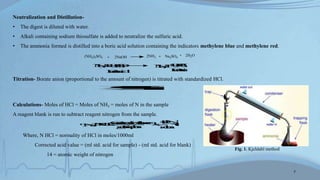
Neutralization and Distillation-
• The digest is diluted with water.
• Alkali containing sodium thiosulfate is added to neutralize the sulfuric acid.
• The ammonia formed is distilled into a boric acid solution containing the indicators methylene blue and methylene red.
(NH4)2SO4 2NaOH 2NH3 Na2SO4
2H2O
NH3+H3BO3
Boricacid
NH4
+H2BO-
3
Borateion
Titration- Borate anion (proportional to the amount of nitrogen) is titrated with standardized HCl.
H3BO3H2BO-
3+H+
Calculations- Moles of HCl = Moles of NH3 = moles of N in the sample
A reagent blank is run to subtract reagent nitrogen from the sample.
%N=NHClxCorrectedacidvolume
gofsample
x
14gN
mole
x100
Where, N HCl = normality of HCl in moles/1000ml
Corrected acid value = (ml std. acid for sample) - (ml std. acid for blank)
14 = atomic weight of nitrogen
Fig. 1. Kjeldahl method
7
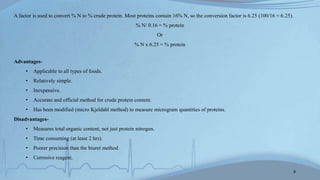
A factor is used to convert % N to % crude protein. Most proteins contain 16% N, so the conversion factor is 6.25 (100/16 = 6.25).
% N/ 0.16 = % protein
Or
% N x 6.25 = % protein
Advantages-
• Applicable to all types of foods.
• Relatively simple.
• Inexpensive.
• Accurate and official method for crude protein content.
• Has been modified (micro Kjeldahl method) to measure microgram quantities of proteins.
Disadvantages-
• Measures total organic content, not just protein nitrogen.
• Time consuming (at least 2 hrs).
• Poorer precision than the biuret method.
• Corrosive reagent.
8
2. Biuret Method:
Principle-
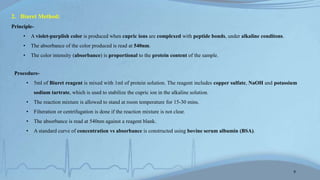
• A violet-purplish color is produced when cupric ions are complexed with peptide bonds, under alkaline conditons.
• The absorbance of the color produced is read at 540nm.
• The color intensity (absorbance) is proportional to the protein content of the sample.
Procedure-
• 5ml of Biuret reagent is mixed with 1ml of protein solution. The reagent includes copper sulfate, NaOH and potassium
sodium tartrate, which is used to stabilize the cupric ion in the alkaline solution.
• The reaction mixture is allowed to stand at room temperature for 15-30 mins.
• Filteration or centrifugation is done if the reaction mixture is not clear.
• The absorbance is read at 540nm against a reagent blank.
• A standard curve of concentration vs absorbance is constructed using bovine serum albumin (BSA).
9
Applications-
• To determine proteins in cereal, meat, soyabean proteins, etc.
• As a qualitative test for animal feed.
• To measure the protein content of isolated proteins.
Advantages-
• Simplest method of protein analysis.
• Less expensive than Kjeldahl method.
• Rapid method (can be completed in less than 30 mins).
• Color deviations are encountered less frequently than with Lowry, UV absorption or turbidimetric methods.
• Very few substances other than proteins in foods interfere with biuret reaction.
• Does not detect nitrogen from non-peptide or non-protein sources.
Disadvantages-
• Not very sensitive as compared to Lowry method, requires at least 2-4mg protein for assay.
• Absorbance could be contributed from bile pigments if present.
• High concentration of ammonium salts (if buffer is used) interfere with the reaction.
• Color varies with different proteins; gelatin gives a pinkish-purple color.
• Opalescence could occur in the final solution if high levels of lipid or carbohydrate are present.
• Not an absolute method: color must be standardized against known protein. 10
3. Lowry method:
Principle-
• The Lowry method combines the biuret reaction with the reduction of the Folin-Ciocalteu phenol reagent (phosphomolybdic
- phosphotungstic acid) by tyrosine and tryptophan resides in the proteins.
• The bluish color developed is read at 750nm (high sensitivity for low protein concentration) or 500nm (low sensitivity for high
protein concentration).
Procedure-
• Proteins to be analyzed are diluted to an appropriate range (20-100µg).
• K Na tartrate- Na2CO3 solution is added after cooling and incubated at room temperature for 10 mins.
• CuSO4-K Na tartrate-NaOH solution is added after cooling and incubated at room temperature for 10 mins.
• Freshly prepared Folin reagent is added, then the reaction mixture is mixed and incubated at 50°C for 10 mins.
• Absorbance is read at 650nm.
• A standard curve of BSA (Bovine Serum Albumin) is carefully constructed for estimating protein concentration of the
unknown.
11
Applications-
• Because of its simplicity and sensitivity, the Lowry method has been widely used in protein biochemistry.
• It has not been widely used to determine proteins in food systems without first extracting the proteins from the food
mixture.
Advantages-
• Very sensitive:
 50-100 times more sensitive than biuret method.
 10-20 times more senstitive than 280nm UV absorption method.
 Several times more senstitive than ninhydrin method.
• Less affected by turbidity of the sample.
• More specific than most other methods.
• Relatively simple; can be done in 1-1.5 hrs.
Disadvantages-
• Color varies with different proteins to a greater extent than the biuret method.
• Color is not strictly proportional to protein concentration.
12
• The reaction is interfered with to varying degrees by sucrose, lipids, phosphate buffers, monosaccharides and hexoamines.
• High concentrations of reducing sugars, ammonium sulfate and sulfhydryl compounds interfere with the reaction.
4. UV 280nm Absorption Method:
Principle-
• Proteins show strong absorption at UV 280nm, primarily due to tryptophan and tyrosine residues in the proteins.
• Because the content of tryptophan and tyrosine in proteins from each source is fairly constant, the absorbance at 280nm
could be used to estimate the concentration of proteins, using Beer’s law.
• Since each protein has a unique aromatic amino acid composition, the extinction coefficient (E280) or molar absorptivity
(Em) must be determined for individual proteins for protein content estimation.
Procedure-
• Proteins are solubilized in buffer or alkali.
• Absorbance of protein solution is read at 280nm against a reagent blank.
• Protein concentration is calculated according to the equation:
A = abc
Where, A = absorbance
a = molar absorptivity
b = cell or cuvette path length
c = concentration
13
Applications-
• To determine protein content of milk and meat products. It has not been widely used in food systems.
• This technique is better applied in a purified protein system.
Advantages-
• Rapid and relatively sensitive.
• No interference from ammonium sulfate and other buffer salts.
• Non-destructive; samples can be used for other analysis after protein determination.
Disadvantages-
• Nucleic acids also absorb at 280nm. The absorption 280nm/260nm ratios for pure protein and nucleic acids are 1.75 and
0.5, respectively. One can correct the absorption of nucleic acids at 280nm if the ratio of the absorption of 280nm/260nm is
known.
• Aromatic amino acid contents in the proteins from various food sources differ considerably.
• The solution must be clear and colorless.
• A relatively pure system is required to use this method.
14
5. Ninhydrin method:
Principle-
Amino acids, ammonia and primary amino groups in a protein, when boiled in a pH 5.5 buffer in the presence of ninhydrin and
hydrindantin, form a Ruhemann purple color.
Procedure-
• 1ml of sample solution is mixed with 1ml of ninhydrin solution in a test tube.
• Heated in a boiling bath for 15mins.
• 5ml of ethanol or propanol diluent is added, shaken and cooled.
• The absorbance is read at 570nm against a water blank.
Applications-
It has not been used widely for determination of protein quantity in foods. However, it can be used to determine the hydrolysis of
peptide bonds during food processing and to quantitate amino acids.
Advantages-
• Relatively rapid as compared to the Kjeldahl method.
Disadvantages-
• The presence of a small quantity of amino acids, peptides, primary amines and ammonia causes an overestimation of the
protein content.
15
• Low precision.
• Color varies with different amino acid compositions. Proline absorbs maximum at 440nm; other amino acids at 570nm.
• A standard calibration curve must be prepared on each occasion.
6. Turbidimetric method:
Principle-
• Low concentrations (3-10%) of trichloroacetic acid, sulfosalicyclic acid and potassium ferricyanide in acetic acid can be
used to precipitate extracted proteins to form a turbid suspension of protein particles.
• The turbidity can be measured from the reduction in the transmission of radiation.
• The reduction in radiation transmission is due to radiation scattering by the protein particles.
• The intensity of the radiation reduction can be related to protein concentration in the solution.
Procedure-
• Wheat flour is extracted with 0.05 N sodium hydroxide.
• Protein solubilized in alkali is separated from the nonsoluble materials by centrifugation.
• Sulfosalicylic acid is mixed with a portion of the protein solution.
• The degree of turbidity is measured by reading the light transmittance at 540nm against a reagent blank.
• The protein content can be estimated from a calibration curve, which is established using the Kjeldahl nitrogen method.
16
Applications-
To measure the protein content of wheat flour and corn.
Advantages-
• Rapid; can be completed in 15 mins.
• Does not measure non-protein nitrogen other than that in nucleic acids.
Disadvantages-
• Different proteins precipitate at different rates.
• Turbidity varies with different concentrations of acid reagents.
• Nucleic acids also are precipitated by acid reagents.
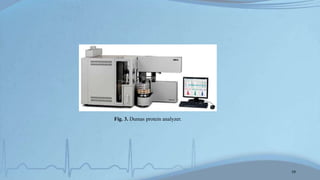
7. Dumas (Combustion) method:
Principle-
• Samples are combusted at high temperature (700-800°C).
• The nitrogen released is quantitated by gas chromatography using a thermal conductivity detector (TCD).
• The nitrogen determined is converted to protein content in the sample.
17
Fig. 2. Circuit diagram of TCD
Procedure-
• Samples (100-500mg) are weighed into a tin capsule and introduced to a combustion reactor in an automated equipment.
• The nitrogen released is measured by a built-in gas chromatograph.
Applications-
Suitable for all types of foods including meat and cereal grains.
Advantages-
• Alternative to Kjeldahl method.
• Requires no hazardous chemicals.
• Can be accomplished in 3 mins.
• Recent automated instruments can analyze up to 150 samples without attention.
Disadvantages-
• Expensive equipment is required.
• Non-protein nitrogen also is included.
18
Fig. 3. Dumas protein analyzer.
19
REFERENCES:
• Multon J. L. Analysis of Food Constituents. Wiley-VCH, Inc. USA. 1997. 221-225 : 229-230 : 235.
• Nielsen S. Suzanne. Food Analysis. Aspen Publishers, Inc. Gaithersburg, Maryland, USA. 1998. 239-246.
20

Protein analysis

  • 1.
    Presentedby: Facilitated to: Mr.L. Sanathoiba Singha M. Pharm 1st Semester Department of Pharmaceutical Analysis. Mrs. Akkamma H. Godihal Assistant Professor Department of Pharmaceutical Analysis. A presentation on Karnataka College of Pharmacy Bengaluru-64, Karnataka. ‘Analysis of Proteins’ 1
  • 2.
    Contents  Introduction  Importanceof protein analysis  Kjeldahl Method  Biuret Method  Lowry method  UV 280nm Absorption Method  Ninhydrin method  Turbidimetric method  Dumas (Combustion) method 2
  • 3.
    Introduction • The nutritionaland technological importance of proteins in agricultural and food products is such that they are very frequently determined in research as well as in testing laboratories. • Choice of methods of protein determination will have to be influenced by a good adaptation of the determination principle to the characteristics of the material to be tested. • Food proteins are very complex. They vary in molecular mass, ranging from approximately 5000 to more than a million daltons. • Proteins have unique conformations that could be altered by denaturants such as heat, acid, alkali, organic solvents, detergents, etc. • The analysis of proteins is complicated by the fact that some food components possess similar physicochemical properties. Non- protein nitrogen could come from free amino acids, small peptides, nucleic acids, phospholipids, amino sugars, porphyrin, and some vitamins, alkaloids, uric acid, urea, and ammonium ions. Therefore, the total organic nitrogen in foods would represent nitrogen primarily from proteins and to a lesser extent from all organic nitrogen-containing non-protein substances. • Depending upon methodology, other major food components, including lipids and carbohydrates, may interfere physically with analysis of food proteins. • Numerous methods have been developed to measure protein content. The choice of method, therefore, will depend on the nature of the sample to be tested, utilization of results and availability of means of analysis. 3
  • 4.
    Importance of proteinanalysis- i. Biological activity determination- Some proteins, including enzymes or enzyme inhibitors, are relevant to food science and nutrition.  Proteolytic enzymes in the tenderization of meats.  Pectinases in the ripening of fruits.  Trypsin inhibitors in legume seeds are proteins. ii. Functional property investigation- Proteins in various types of food have unique food functional properties.  Casein in milk for coagulation into cheese products.  Egg albumin for foaming.  Glutenins in wheat flour for bread making. iii. Nutritional labelling 4
  • 5.
    General Methods ofAnalysis 1. Kjeldahl Method: Principle- • In the Kjeldahl method, proteins and other organic food components in a sample are digested with sulfuric acid in the presence of catalysts. • The total organic nitrogen is converted to ammonium sulfate. • The digest is neutralized with alkali and distilled into a boric acid solution. • The borate anions formed are titrated with standardized acid, which is converted to nitrogen in the sample. General steps in the original method- • Digestion with sulfuric acid, with the addition of powdered potassium permanganate to complete oxidation and conversion of nitrogen to ammonium sulfate. • Neutralization of the diluted digest, followed by distillation into a known volume of standard acid, which contains potassium iodide and iodate. • Titration of the liberated iodine with standard sodium thiosulfate. 5
  • 6.
    Modifications of theoriginal Kjeldahl process: • Metallic catalysts such as mercury, copper, and selenium are added to sulfuric acid for complete digestion. Mercury has been found to be the most satisfactory. The use of titanium dioxide and copper poses less safety concern than mercury in the post analysis disposal of the waste. • Potassium sulfate is used to increase the boiling point of the sulfuric add to accelerate digestion. • Sulfide or sodium thiosulfate are added to the diluted digest to help release nitrogen from mercury, which tends to bind ammonium ion. • The ammonia is distilled directly into a boric acid solution, followed by titration with standard acid. • Colorimetry, Nesslerization, or ion chromatography to measure ammonia is used to determine nitrogen content after digestion. General procedures and reactions: Sample preparation- Solid foods are ground to pass a 20 mesh screen. Digestion- • Sample is accurately weighed in a Kjeldahl flask. • Acid and catalyst is added and digestion is continued until solution becomes clear to get complete breakdown of all organic matter. • Nonvolatile ammonium sulfate is formed from the reaction of nitrogen and sulfuric acid. Protein H2SO4 Heat,Catalyst (NH4)2SO4 6
  • 7.
    Neutralization and Distillation- •The digest is diluted with water. • Alkali containing sodium thiosulfate is added to neutralize the sulfuric acid. • The ammonia formed is distilled into a boric acid solution containing the indicators methylene blue and methylene red. (NH4)2SO4 2NaOH 2NH3 Na2SO4 2H2O NH3+H3BO3 Boricacid NH4 +H2BO- 3 Borateion Titration- Borate anion (proportional to the amount of nitrogen) is titrated with standardized HCl. H3BO3H2BO- 3+H+ Calculations- Moles of HCl = Moles of NH3 = moles of N in the sample A reagent blank is run to subtract reagent nitrogen from the sample. %N=NHClxCorrectedacidvolume gofsample x 14gN mole x100 Where, N HCl = normality of HCl in moles/1000ml Corrected acid value = (ml std. acid for sample) - (ml std. acid for blank) 14 = atomic weight of nitrogen Fig. 1. Kjeldahl method 7
  • 8.
    A factor isused to convert % N to % crude protein. Most proteins contain 16% N, so the conversion factor is 6.25 (100/16 = 6.25). % N/ 0.16 = % protein Or % N x 6.25 = % protein Advantages- • Applicable to all types of foods. • Relatively simple. • Inexpensive. • Accurate and official method for crude protein content. • Has been modified (micro Kjeldahl method) to measure microgram quantities of proteins. Disadvantages- • Measures total organic content, not just protein nitrogen. • Time consuming (at least 2 hrs). • Poorer precision than the biuret method. • Corrosive reagent. 8
  • 9.
    2. Biuret Method: Principle- •A violet-purplish color is produced when cupric ions are complexed with peptide bonds, under alkaline conditons. • The absorbance of the color produced is read at 540nm. • The color intensity (absorbance) is proportional to the protein content of the sample. Procedure- • 5ml of Biuret reagent is mixed with 1ml of protein solution. The reagent includes copper sulfate, NaOH and potassium sodium tartrate, which is used to stabilize the cupric ion in the alkaline solution. • The reaction mixture is allowed to stand at room temperature for 15-30 mins. • Filteration or centrifugation is done if the reaction mixture is not clear. • The absorbance is read at 540nm against a reagent blank. • A standard curve of concentration vs absorbance is constructed using bovine serum albumin (BSA). 9
  • 10.
    Applications- • To determineproteins in cereal, meat, soyabean proteins, etc. • As a qualitative test for animal feed. • To measure the protein content of isolated proteins. Advantages- • Simplest method of protein analysis. • Less expensive than Kjeldahl method. • Rapid method (can be completed in less than 30 mins). • Color deviations are encountered less frequently than with Lowry, UV absorption or turbidimetric methods. • Very few substances other than proteins in foods interfere with biuret reaction. • Does not detect nitrogen from non-peptide or non-protein sources. Disadvantages- • Not very sensitive as compared to Lowry method, requires at least 2-4mg protein for assay. • Absorbance could be contributed from bile pigments if present. • High concentration of ammonium salts (if buffer is used) interfere with the reaction. • Color varies with different proteins; gelatin gives a pinkish-purple color. • Opalescence could occur in the final solution if high levels of lipid or carbohydrate are present. • Not an absolute method: color must be standardized against known protein. 10
  • 11.
    3. Lowry method: Principle- •The Lowry method combines the biuret reaction with the reduction of the Folin-Ciocalteu phenol reagent (phosphomolybdic - phosphotungstic acid) by tyrosine and tryptophan resides in the proteins. • The bluish color developed is read at 750nm (high sensitivity for low protein concentration) or 500nm (low sensitivity for high protein concentration). Procedure- • Proteins to be analyzed are diluted to an appropriate range (20-100µg). • K Na tartrate- Na2CO3 solution is added after cooling and incubated at room temperature for 10 mins. • CuSO4-K Na tartrate-NaOH solution is added after cooling and incubated at room temperature for 10 mins. • Freshly prepared Folin reagent is added, then the reaction mixture is mixed and incubated at 50°C for 10 mins. • Absorbance is read at 650nm. • A standard curve of BSA (Bovine Serum Albumin) is carefully constructed for estimating protein concentration of the unknown. 11
  • 12.
    Applications- • Because ofits simplicity and sensitivity, the Lowry method has been widely used in protein biochemistry. • It has not been widely used to determine proteins in food systems without first extracting the proteins from the food mixture. Advantages- • Very sensitive:  50-100 times more sensitive than biuret method.  10-20 times more senstitive than 280nm UV absorption method.  Several times more senstitive than ninhydrin method. • Less affected by turbidity of the sample. • More specific than most other methods. • Relatively simple; can be done in 1-1.5 hrs. Disadvantages- • Color varies with different proteins to a greater extent than the biuret method. • Color is not strictly proportional to protein concentration. 12
  • 13.
    • The reactionis interfered with to varying degrees by sucrose, lipids, phosphate buffers, monosaccharides and hexoamines. • High concentrations of reducing sugars, ammonium sulfate and sulfhydryl compounds interfere with the reaction. 4. UV 280nm Absorption Method: Principle- • Proteins show strong absorption at UV 280nm, primarily due to tryptophan and tyrosine residues in the proteins. • Because the content of tryptophan and tyrosine in proteins from each source is fairly constant, the absorbance at 280nm could be used to estimate the concentration of proteins, using Beer’s law. • Since each protein has a unique aromatic amino acid composition, the extinction coefficient (E280) or molar absorptivity (Em) must be determined for individual proteins for protein content estimation. Procedure- • Proteins are solubilized in buffer or alkali. • Absorbance of protein solution is read at 280nm against a reagent blank. • Protein concentration is calculated according to the equation: A = abc Where, A = absorbance a = molar absorptivity b = cell or cuvette path length c = concentration 13
  • 14.
    Applications- • To determineprotein content of milk and meat products. It has not been widely used in food systems. • This technique is better applied in a purified protein system. Advantages- • Rapid and relatively sensitive. • No interference from ammonium sulfate and other buffer salts. • Non-destructive; samples can be used for other analysis after protein determination. Disadvantages- • Nucleic acids also absorb at 280nm. The absorption 280nm/260nm ratios for pure protein and nucleic acids are 1.75 and 0.5, respectively. One can correct the absorption of nucleic acids at 280nm if the ratio of the absorption of 280nm/260nm is known. • Aromatic amino acid contents in the proteins from various food sources differ considerably. • The solution must be clear and colorless. • A relatively pure system is required to use this method. 14
  • 15.
    5. Ninhydrin method: Principle- Aminoacids, ammonia and primary amino groups in a protein, when boiled in a pH 5.5 buffer in the presence of ninhydrin and hydrindantin, form a Ruhemann purple color. Procedure- • 1ml of sample solution is mixed with 1ml of ninhydrin solution in a test tube. • Heated in a boiling bath for 15mins. • 5ml of ethanol or propanol diluent is added, shaken and cooled. • The absorbance is read at 570nm against a water blank. Applications- It has not been used widely for determination of protein quantity in foods. However, it can be used to determine the hydrolysis of peptide bonds during food processing and to quantitate amino acids. Advantages- • Relatively rapid as compared to the Kjeldahl method. Disadvantages- • The presence of a small quantity of amino acids, peptides, primary amines and ammonia causes an overestimation of the protein content. 15
  • 16.
    • Low precision. •Color varies with different amino acid compositions. Proline absorbs maximum at 440nm; other amino acids at 570nm. • A standard calibration curve must be prepared on each occasion. 6. Turbidimetric method: Principle- • Low concentrations (3-10%) of trichloroacetic acid, sulfosalicyclic acid and potassium ferricyanide in acetic acid can be used to precipitate extracted proteins to form a turbid suspension of protein particles. • The turbidity can be measured from the reduction in the transmission of radiation. • The reduction in radiation transmission is due to radiation scattering by the protein particles. • The intensity of the radiation reduction can be related to protein concentration in the solution. Procedure- • Wheat flour is extracted with 0.05 N sodium hydroxide. • Protein solubilized in alkali is separated from the nonsoluble materials by centrifugation. • Sulfosalicylic acid is mixed with a portion of the protein solution. • The degree of turbidity is measured by reading the light transmittance at 540nm against a reagent blank. • The protein content can be estimated from a calibration curve, which is established using the Kjeldahl nitrogen method. 16
  • 17.
    Applications- To measure theprotein content of wheat flour and corn. Advantages- • Rapid; can be completed in 15 mins. • Does not measure non-protein nitrogen other than that in nucleic acids. Disadvantages- • Different proteins precipitate at different rates. • Turbidity varies with different concentrations of acid reagents. • Nucleic acids also are precipitated by acid reagents. 7. Dumas (Combustion) method: Principle- • Samples are combusted at high temperature (700-800°C). • The nitrogen released is quantitated by gas chromatography using a thermal conductivity detector (TCD). • The nitrogen determined is converted to protein content in the sample. 17 Fig. 2. Circuit diagram of TCD
  • 18.
    Procedure- • Samples (100-500mg)are weighed into a tin capsule and introduced to a combustion reactor in an automated equipment. • The nitrogen released is measured by a built-in gas chromatograph. Applications- Suitable for all types of foods including meat and cereal grains. Advantages- • Alternative to Kjeldahl method. • Requires no hazardous chemicals. • Can be accomplished in 3 mins. • Recent automated instruments can analyze up to 150 samples without attention. Disadvantages- • Expensive equipment is required. • Non-protein nitrogen also is included. 18
  • 19.
    Fig. 3. Dumasprotein analyzer. 19
  • 20.
    REFERENCES: • Multon J.L. Analysis of Food Constituents. Wiley-VCH, Inc. USA. 1997. 221-225 : 229-230 : 235. • Nielsen S. Suzanne. Food Analysis. Aspen Publishers, Inc. Gaithersburg, Maryland, USA. 1998. 239-246. 20