LIGATION OF DNA FRAGMENTS WITH
VECTORS
HOMOPOLYMER TAILING
LINKERS & ADAPTORS

MOHD SAQUIB KHAN
M.SC 3rd SEM
PONDICHERRY UNIVERSITY
LIGATION OF DNA FRAGMENT WITH
VECTORS
 DNA ligation is the act of joining together DNA
strands with covalent bonds with the aim of
making new viable DNA or plasmid.
 There are currently three methods for joining DNA
fragments in vitro.
 The 1st of these is DNA ligase that covalently
joins the annealed cohesive ends produced by
certain restriction enzymes.
 The 2nd depends upon the ability of DNA ligase
from phage T4-infected E. coli to catalyse the
formation of phosphodiester bonds.
 The 3rd utilizes the enzyme terminal
deoxynucleotidyl transferase to synthesize
homopolymeric 3′ single-stranded tails at the
ends of fragments.
 E.coli and phage T4 encode an enzyme DNA
ligase -T4 enzyme requires ATP while the E.
coli enzyme requires NAD+.
 DNA fragments with either sticky ends or blunt
ends can be inserted into vector DNA with the
aid of DNA ligases.
LINKERS & ADAPTORS
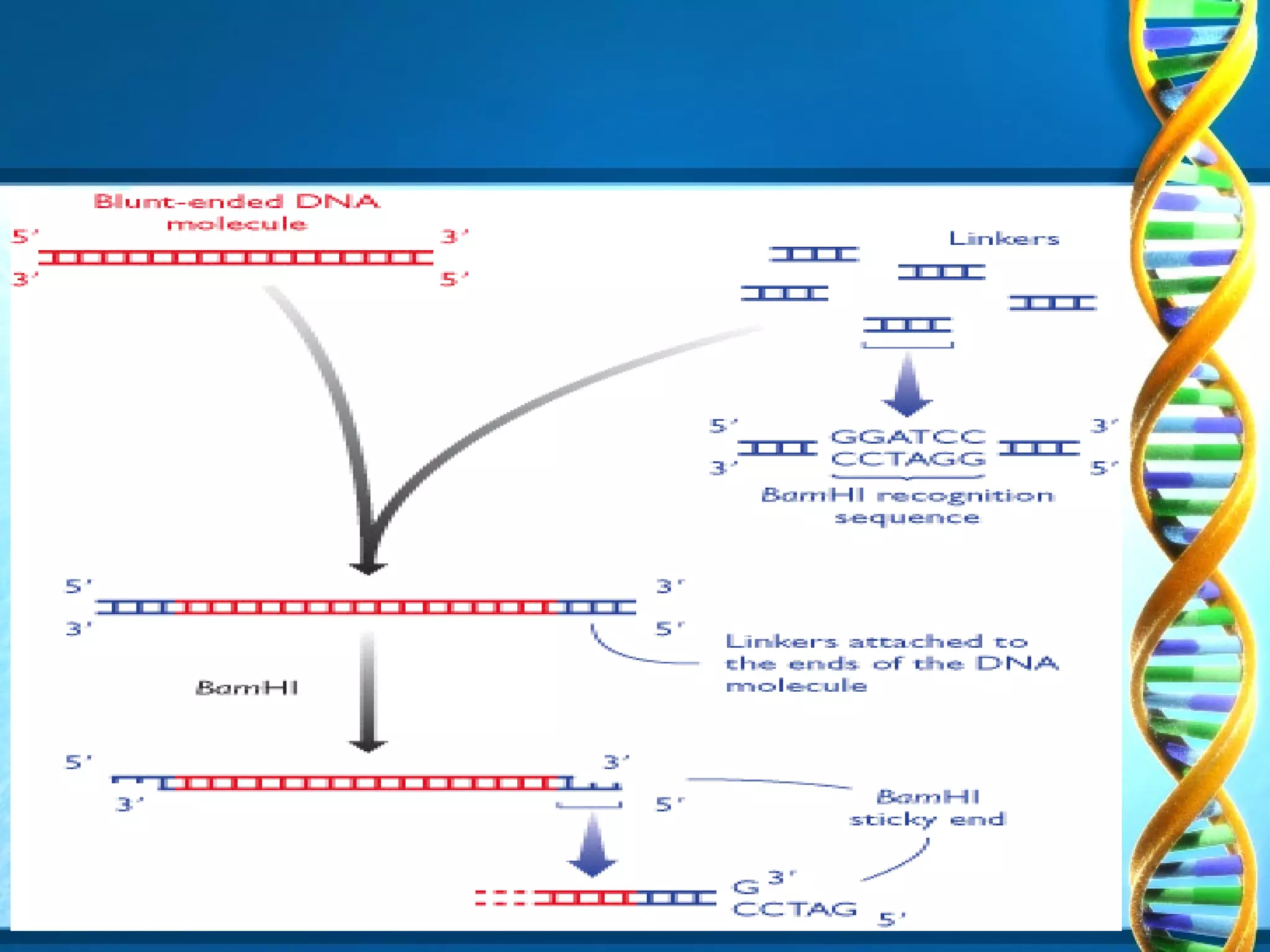
 Linker is a synthetic ,short and known double
stranded oligonucleotides sequence.
 Having blunted ends on both sides and
restriction sites.
 E.Coli DNA ligase will not catalyse blunt end
ligation except under special condition.
 Linker can be ligated to both ends of the
foreign DNA.
 Treatment with R.E produces sticky ends after
ligation with target DNA.
 Sticky ends are desirable for DNA cloning
experiments.
 One drawback is R.E. used to generate
cohesive end in the linker will also cut foreign
DNA at internal sites.
 Solution to the problem is to choose another
restriction enzyme or to methylate internal
restriction sites on the foreign DNA.
 Alternatively a chemically synthesized adaptor
molecule which have a performed cohesive
end can be used.
 An adaptor is a short, chemically
synthesized, double stranded DNA molecule
which is used to link the ends of two other
DNA molecules.
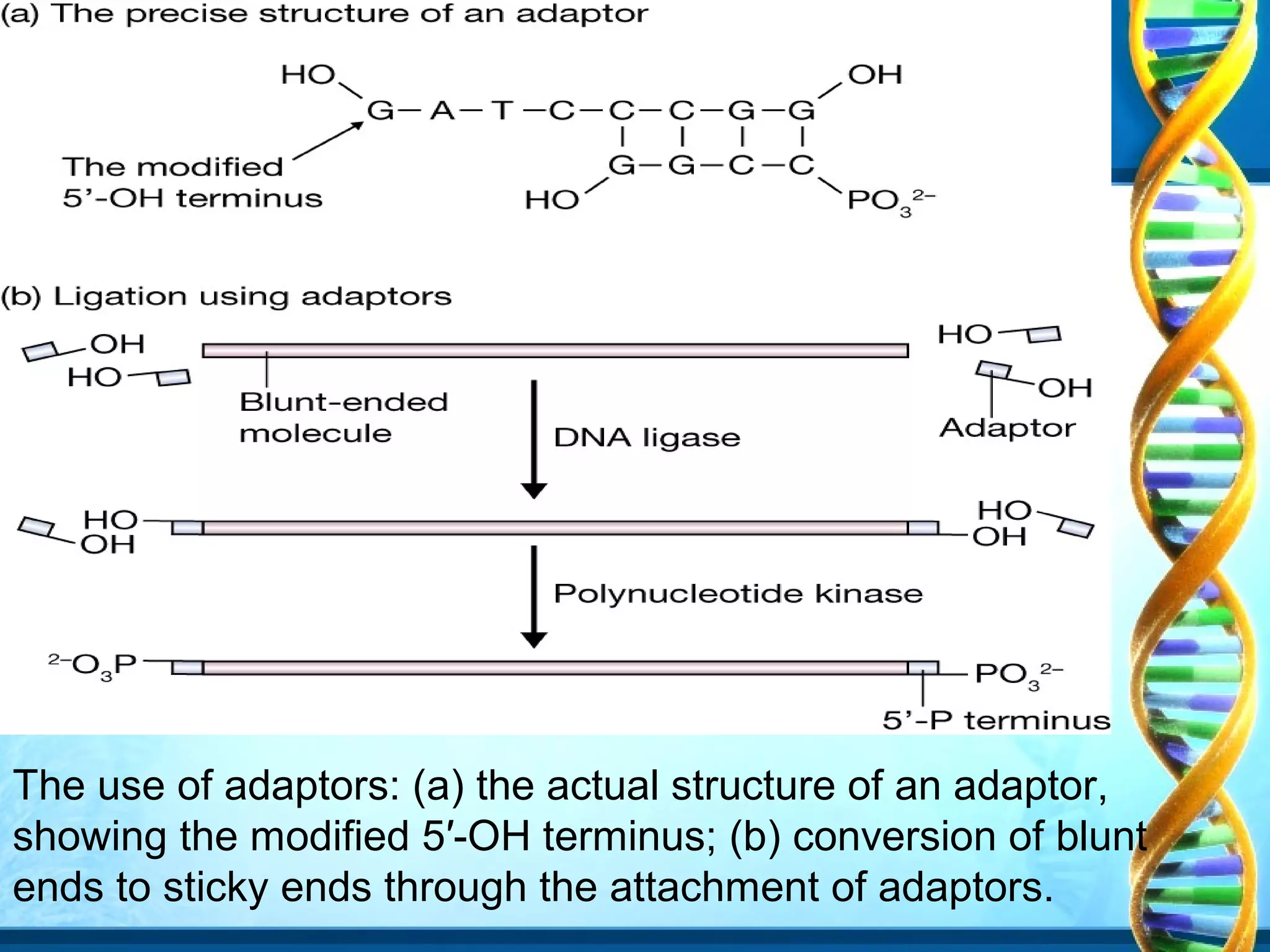
 The adaptor molecule have one blunt end
bearing 5’ phosphate group & a cohesive end
which is not phosphorylated.
The use of adaptors: (a) the actual structure of an adaptor,
showing the modified 5′-OH terminus; (b) conversion of blunt
ends to sticky ends through the attachment of adaptors.
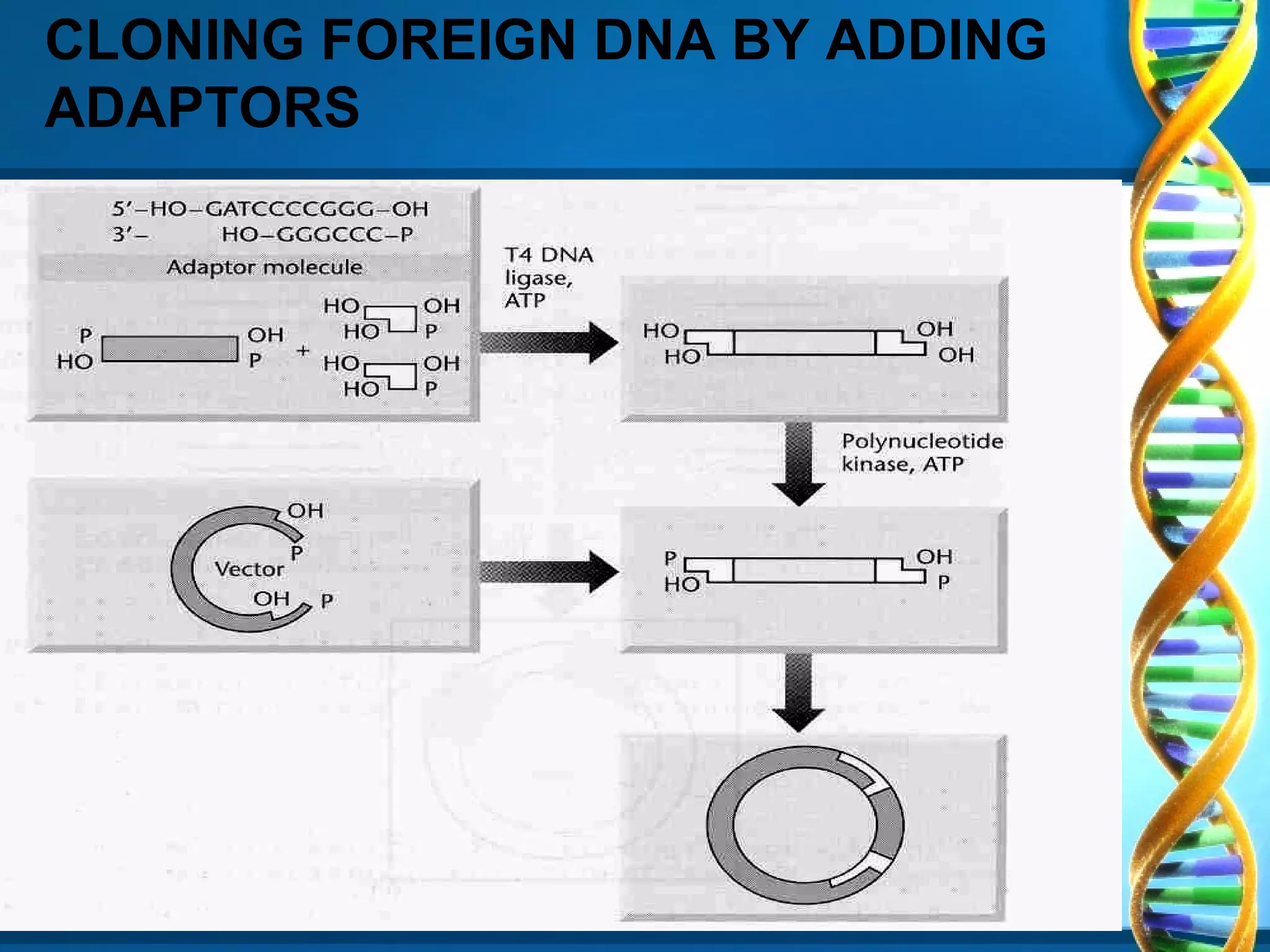
 The foreign DNA plus added adaptors is then
phosphorylated at the 5’ termini and ligated into
the vector.
 Problems: sticky end of adaptors will binds with
each other so treatment with Alkaline
Phosphates.
 After attachment with target…… treatment
 Polynucleotide Kinase to add P–OH at 5 prime.
 The basic difference between an adaptor &
linker is that the former has cohesive ends &
the latter has blunt ends.
CLONING FOREIGN DNA BY ADDING
ADAPTORS
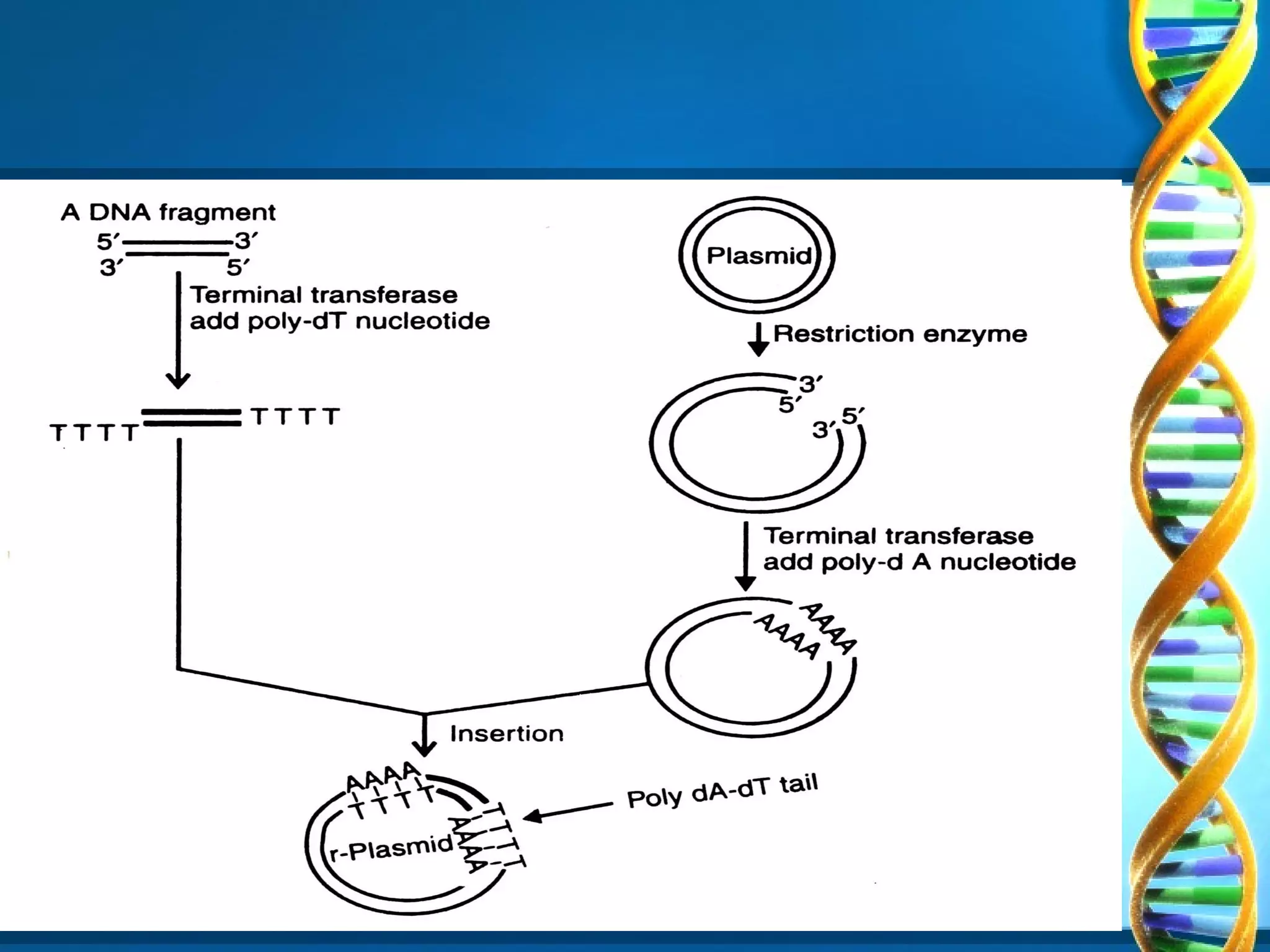
HOMOPOLYMER TAILING
 Method for joining DNA molecules make use of
the annealing of complementary homopolymer
sequence.
 Addition of oligo(dA) sequences to the 3’ ends
of one DNA molecule & oligo(dT) blocks to the
3’ end of another population.
 The enzyme terminal deoxynucleotidyl
transferase will catalyze the addition of a string
of nucleotides to the 3' end of a DNA fragment.
 One can add a string of G's to the 3' ends of
one fragment and a string of C's to the 3' ends
of the other fragment.
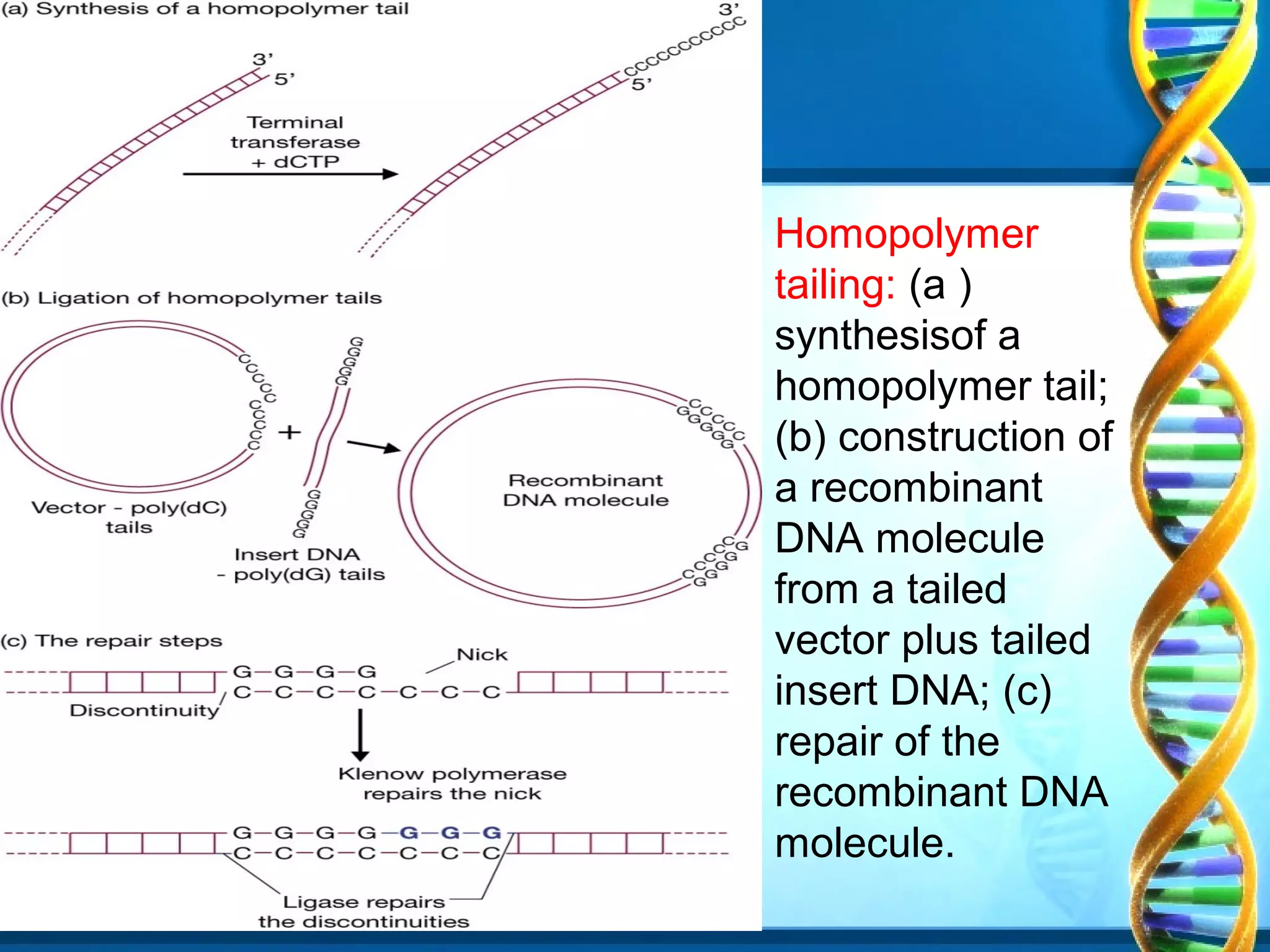
Homopolymer
tailing: (a )
synthesisof a
homopolymer tail;
(b) construction of
a recombinant
DNA molecule
from a tailed
vector plus tailed
insert DNA; (c)
repair of the
recombinant DNA
molecule.
REFERENCES
 Sandy primrose.2006 Principle of gene
manipulation and genomics.
 Brown T.A.2004 Gene clonning and DNA
analysis.
LIGATION OF DNA

LIGATION OF DNA

  • 1.
    LIGATION OF DNAFRAGMENTS WITH VECTORS HOMOPOLYMER TAILING LINKERS & ADAPTORS MOHD SAQUIB KHAN M.SC 3rd SEM PONDICHERRY UNIVERSITY
  • 2.
    LIGATION OF DNAFRAGMENT WITH VECTORS  DNA ligation is the act of joining together DNA strands with covalent bonds with the aim of making new viable DNA or plasmid.  There are currently three methods for joining DNA fragments in vitro.  The 1st of these is DNA ligase that covalently joins the annealed cohesive ends produced by certain restriction enzymes.  The 2nd depends upon the ability of DNA ligase from phage T4-infected E. coli to catalyse the formation of phosphodiester bonds.
  • 3.
     The 3rdutilizes the enzyme terminal deoxynucleotidyl transferase to synthesize homopolymeric 3′ single-stranded tails at the ends of fragments.  E.coli and phage T4 encode an enzyme DNA ligase -T4 enzyme requires ATP while the E. coli enzyme requires NAD+.  DNA fragments with either sticky ends or blunt ends can be inserted into vector DNA with the aid of DNA ligases.
  • 4.
    LINKERS & ADAPTORS Linker is a synthetic ,short and known double stranded oligonucleotides sequence.  Having blunted ends on both sides and restriction sites.  E.Coli DNA ligase will not catalyse blunt end ligation except under special condition.  Linker can be ligated to both ends of the foreign DNA.
  • 5.
     Treatment withR.E produces sticky ends after ligation with target DNA.  Sticky ends are desirable for DNA cloning experiments.  One drawback is R.E. used to generate cohesive end in the linker will also cut foreign DNA at internal sites.  Solution to the problem is to choose another restriction enzyme or to methylate internal restriction sites on the foreign DNA.
  • 7.
     Alternatively achemically synthesized adaptor molecule which have a performed cohesive end can be used.  An adaptor is a short, chemically synthesized, double stranded DNA molecule which is used to link the ends of two other DNA molecules.  The adaptor molecule have one blunt end bearing 5’ phosphate group & a cohesive end which is not phosphorylated.
  • 8.
    The use ofadaptors: (a) the actual structure of an adaptor, showing the modified 5′-OH terminus; (b) conversion of blunt ends to sticky ends through the attachment of adaptors.
  • 9.
     The foreignDNA plus added adaptors is then phosphorylated at the 5’ termini and ligated into the vector.  Problems: sticky end of adaptors will binds with each other so treatment with Alkaline Phosphates.  After attachment with target…… treatment  Polynucleotide Kinase to add P–OH at 5 prime.  The basic difference between an adaptor & linker is that the former has cohesive ends & the latter has blunt ends.
  • 10.
    CLONING FOREIGN DNABY ADDING ADAPTORS
  • 11.
    HOMOPOLYMER TAILING  Methodfor joining DNA molecules make use of the annealing of complementary homopolymer sequence.  Addition of oligo(dA) sequences to the 3’ ends of one DNA molecule & oligo(dT) blocks to the 3’ end of another population.  The enzyme terminal deoxynucleotidyl transferase will catalyze the addition of a string of nucleotides to the 3' end of a DNA fragment.  One can add a string of G's to the 3' ends of one fragment and a string of C's to the 3' ends of the other fragment.
  • 12.
    Homopolymer tailing: (a ) synthesisofa homopolymer tail; (b) construction of a recombinant DNA molecule from a tailed vector plus tailed insert DNA; (c) repair of the recombinant DNA molecule.
  • 14.
    REFERENCES  Sandy primrose.2006Principle of gene manipulation and genomics.  Brown T.A.2004 Gene clonning and DNA analysis.