1
DNA Ligation
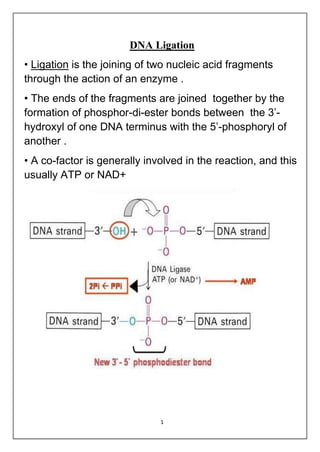
• Ligation is the joining of two nucleic acid fragments
through the action of an enzyme .
• The ends of the fragments are joined together by the
formation of phosphor-di-ester bonds between the 3’-
hydroxyl of one DNA terminus with the 5’-phosphoryl of
another .
• A co-factor is generally involved in the reaction, and this
usually ATP or NAD+
2
Factor Affecting Ligation
• Factor that affecting an Enzyme-mediated chemical
reaction would naturally affect a ligation reaction .
Such as :-
◘ The concentration of enzyme and the reactants .
◘ The temperature of the reaction .
◘ The length of time of incubation .
○◘○
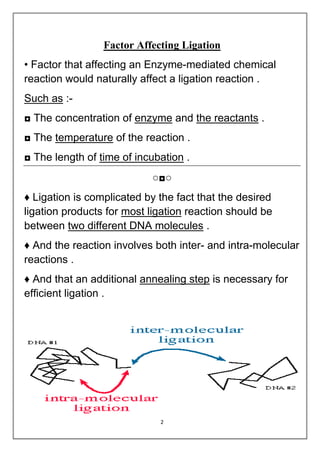
♦ Ligation is complicated by the fact that the desired
ligation products for most ligation reaction should be
between two different DNA molecules .
♦ And the reaction involves both inter- and intra-molecular
reactions .
♦ And that an additional annealing step is necessary for
efficient ligation .
3
DNA Concentration
• The concentration of DNA can affect the rate of ligation .
• And whether the ligation is an inter-molecular or intra-
molecular reaction .
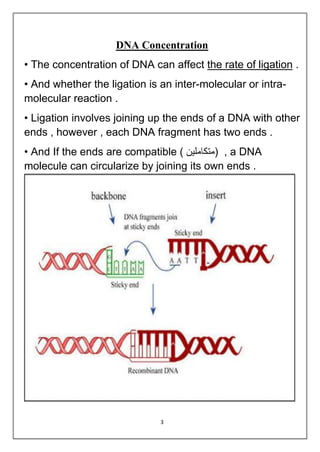
• Ligation involves joining up the ends of a DNA with other
ends , however , each DNA fragment has two ends .
• And If the ends are compatible ) ‫(متكاملين‬ , a DNA
molecule can circularize by joining its own ends .
4
• At High DNA concentration , there is a greater chance
of forming inter-molecular ligation .
• While at lower DNA concentration , intra-molecular
reaction that circularizes the DNA is more likely .
• The Transformation efficiency of linear DNA is much
lower than circular DNA , and for the DNA to circularize ,
the DNA concentration should not be too high .
• As a general rule , the total DNA concentration should
be less than 10 µg/ml .
5
• the relative concentration of the DNA
fragments , as well as their length , are
also factors that can affect whether
intermolecular or intermolecular
reactions are favored .
• The concentration of DNA can be
artificially increased by adding
condensing agents such as cobalt
Hexamine and biogenic polyamines such
as spermidine.
• or by using crowding agents such as
polyethelene glycol ( PEG ) which also
increase the effective concentration of
enzymes .
6
Ligase concentration
♣ The higher the ligase concentration , the faster the
rate of ligation .
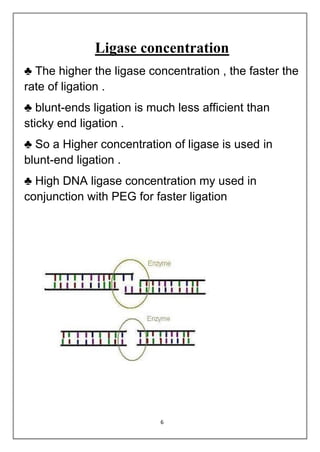
♣ blunt-ends ligation is much less afficient than
sticky end ligation .
♣ So a Higher concentration of ligase is used in
blunt-end ligation .
♣ High DNA ligase concentration my used in
conjunction with PEG for faster ligation
7
Tempertaure
♥ Two issues are involved when considering the temperture of
a ligation reaction .
♦ First : the optimum temperture for DNA ligase activities
which is 37o
C .
♦ Second : Tthe melting temperture ( TM ) of the DNA ends to
be ligated .
• The melting temperture is dependent on the length and
base composition of the DNA overhang .
• The greater the number of G and C , The higher the TM since
there are three hydrogen bonds formed , between G-C base
pair compared to two For A-T base .
• Ligation reaction to proceed the ends should be stably
annealed .
• and in ligation experiments , the TM of the DNA ends is
generally much lower than 37o
C .
• The Optimal temperature for ligation cohesive ends is
therefore a compromise between) ‫بينهم‬ ‫ما‬ ‫وسط‬ ( the best
temperature For DNA ligase activity and TM where the ends
can associate .
• Most protocols simply choose 12-16 o
C , room temperature ,
or 4o
C .
8
Buffer composition
• The Ionic strength of the buffer used
can affect the ligation .
• The kinds of cations presence can also
influence the ligation reaction .
• For example , excess amount of NA+
can cause the DNA to become more rigid
) ‫(صلب‬ and increase the likelihood )‫(احتمالية‬
of intermolecular ligation .
• At high concentration of Monovalent
()‫التكافؤ‬ ‫احادي‬ cations ( >200 mM) Ligation
can be almost completely inhibited.
• The standard buffer used for ligation is
designed to be minimize ionic effects .
9
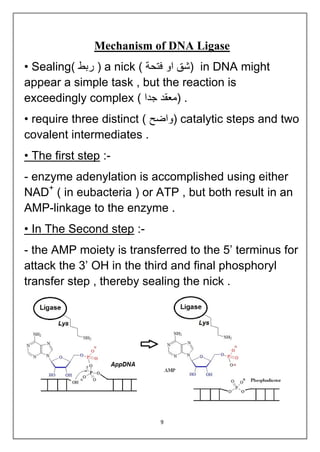
Mechanism of DNA Ligase
• Sealing) ‫ربط‬ ( a nick ) ‫فتحة‬ ‫او‬ ‫(شق‬ in DNA might
appear a simple task , but the reaction is
exceedingly complex ) ‫جدا‬ ‫(معقد‬ .
• require three distinct ) ‫(واضح‬ catalytic steps and two
covalent intermediates .
• The first step :-
- enzyme adenylation is accomplished using either
NAD+
( in eubacteria ) or ATP , but both result in an
AMP-linkage to the enzyme .
• In The Second step :-
- the AMP moiety is transferred to the 5’ terminus for
attack the 3’ OH in the third and final phosphoryl
transfer step , thereby sealing the nick .
10
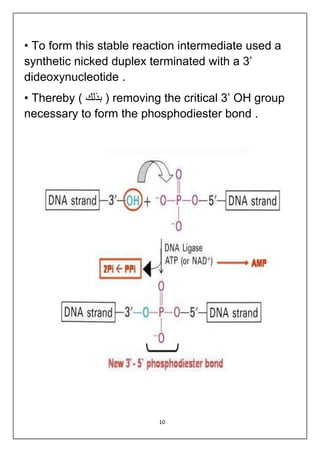
• To form this stable reaction intermediate used a
synthetic nicked duplex terminated with a 3’
dideoxynucleotide .
• Thereby ) ‫بذلك‬ ( removing the critical 3’ OH group
necessary to form the phosphodiester bond .
11

DNA Ligation

  • 1.
    1 DNA Ligation • Ligationis the joining of two nucleic acid fragments through the action of an enzyme . • The ends of the fragments are joined together by the formation of phosphor-di-ester bonds between the 3’- hydroxyl of one DNA terminus with the 5’-phosphoryl of another . • A co-factor is generally involved in the reaction, and this usually ATP or NAD+
  • 2.
    2 Factor Affecting Ligation •Factor that affecting an Enzyme-mediated chemical reaction would naturally affect a ligation reaction . Such as :- ◘ The concentration of enzyme and the reactants . ◘ The temperature of the reaction . ◘ The length of time of incubation . ○◘○ ♦ Ligation is complicated by the fact that the desired ligation products for most ligation reaction should be between two different DNA molecules . ♦ And the reaction involves both inter- and intra-molecular reactions . ♦ And that an additional annealing step is necessary for efficient ligation .
  • 3.
    3 DNA Concentration • Theconcentration of DNA can affect the rate of ligation . • And whether the ligation is an inter-molecular or intra- molecular reaction . • Ligation involves joining up the ends of a DNA with other ends , however , each DNA fragment has two ends . • And If the ends are compatible ) ‫(متكاملين‬ , a DNA molecule can circularize by joining its own ends .
  • 4.
    4 • At HighDNA concentration , there is a greater chance of forming inter-molecular ligation . • While at lower DNA concentration , intra-molecular reaction that circularizes the DNA is more likely . • The Transformation efficiency of linear DNA is much lower than circular DNA , and for the DNA to circularize , the DNA concentration should not be too high . • As a general rule , the total DNA concentration should be less than 10 µg/ml .
  • 5.
    5 • the relativeconcentration of the DNA fragments , as well as their length , are also factors that can affect whether intermolecular or intermolecular reactions are favored . • The concentration of DNA can be artificially increased by adding condensing agents such as cobalt Hexamine and biogenic polyamines such as spermidine. • or by using crowding agents such as polyethelene glycol ( PEG ) which also increase the effective concentration of enzymes .
  • 6.
    6 Ligase concentration ♣ Thehigher the ligase concentration , the faster the rate of ligation . ♣ blunt-ends ligation is much less afficient than sticky end ligation . ♣ So a Higher concentration of ligase is used in blunt-end ligation . ♣ High DNA ligase concentration my used in conjunction with PEG for faster ligation
  • 7.
    7 Tempertaure ♥ Two issuesare involved when considering the temperture of a ligation reaction . ♦ First : the optimum temperture for DNA ligase activities which is 37o C . ♦ Second : Tthe melting temperture ( TM ) of the DNA ends to be ligated . • The melting temperture is dependent on the length and base composition of the DNA overhang . • The greater the number of G and C , The higher the TM since there are three hydrogen bonds formed , between G-C base pair compared to two For A-T base . • Ligation reaction to proceed the ends should be stably annealed . • and in ligation experiments , the TM of the DNA ends is generally much lower than 37o C . • The Optimal temperature for ligation cohesive ends is therefore a compromise between) ‫بينهم‬ ‫ما‬ ‫وسط‬ ( the best temperature For DNA ligase activity and TM where the ends can associate . • Most protocols simply choose 12-16 o C , room temperature , or 4o C .
  • 8.
    8 Buffer composition • TheIonic strength of the buffer used can affect the ligation . • The kinds of cations presence can also influence the ligation reaction . • For example , excess amount of NA+ can cause the DNA to become more rigid ) ‫(صلب‬ and increase the likelihood )‫(احتمالية‬ of intermolecular ligation . • At high concentration of Monovalent ()‫التكافؤ‬ ‫احادي‬ cations ( >200 mM) Ligation can be almost completely inhibited. • The standard buffer used for ligation is designed to be minimize ionic effects .
  • 9.
    9 Mechanism of DNALigase • Sealing) ‫ربط‬ ( a nick ) ‫فتحة‬ ‫او‬ ‫(شق‬ in DNA might appear a simple task , but the reaction is exceedingly complex ) ‫جدا‬ ‫(معقد‬ . • require three distinct ) ‫(واضح‬ catalytic steps and two covalent intermediates . • The first step :- - enzyme adenylation is accomplished using either NAD+ ( in eubacteria ) or ATP , but both result in an AMP-linkage to the enzyme . • In The Second step :- - the AMP moiety is transferred to the 5’ terminus for attack the 3’ OH in the third and final phosphoryl transfer step , thereby sealing the nick .
  • 10.
    10 • To formthis stable reaction intermediate used a synthetic nicked duplex terminated with a 3’ dideoxynucleotide . • Thereby ) ‫بذلك‬ ( removing the critical 3’ OH group necessary to form the phosphodiester bond .
  • 11.