Solutions
- In physicochemical terms, solutions may be
prepared from any combination of solid, liquid or
gas, the three states of matter
- Liquid preparations that contain one or more
soluble chemical substances dissolved in a suitable
solvent or mixture of mutually miscible solvents
-Homogenous mixture that is prepared by dissolving
a solid, liquid or gas in another liquid and represents
a group of preparations in which the molecules of
the solute or dissolved substance are dispersed.
Types of Solutions
1. Solid Solution – the solvent is solid
a. Solid in solid
Example: Cu + gold= 12 karat yellow gold
b. Liquid in solid
Example: Hg dissolved in Ag = amalgam
c. Gas in solid
Example: air dissolved in soap = floating soap
2. Liquid Solution – the solvent is liquid
a. solid in liquid
Ex: salt in water
b. Liquid in liquid
Ex: alcohol and water
c. Gases in liquid
Ex: carbonated beverages
3. Gaseous Solutions – the solvent is gas
a. Solid in gas
Example: sulfur in air
b. Liquid in gas
Example: water vapor in air
c. Gas in gas
Example: oxygenated air
Factors affecting the “rate” of solubility
1. Particle size – an increase in surface area to the solvent
will increase rate of solution. So the particle size should
be reduced by comminution before it is dissolved.
2. Agitation – increases the rate of solution by removing
from the surface of the solute. The more concentrated
solution around it the less concentrated the solvent.
3. Temperature
heating a liquid also causes solution to take place more
rapidly by increasing the frequency which solvent
molecules collide with the surface of the dissolving
mixture
Factors Affecting Solubility of Solute
1. Temperature
Endothermic reaction – The process of solution
where heat is applied and absorption of the heat
takes place in the solutes, this increase in
temperature will cause more of the solute to go
into solution.
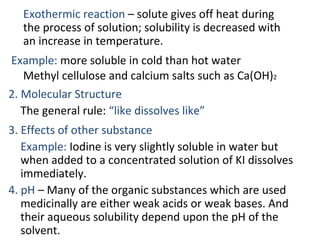
Exothermic reaction – solute gives off heat during
the process of solution; solubility is decreased with
an increase in temperature.
Example: more soluble in cold than hot water
Methyl cellulose and calcium salts such as Ca(OH)2
2. Molecular Structure
The general rule: “like dissolves like”
3. Effects of other substance
Example: Iodine is very slightly soluble in water but
when added to a concentrated solution of KI dissolves
immediately.
4. pH – Many of the organic substances which are used
medicinally are either weak acids or weak bases. And
their aqueous solubility depend upon the pH of the
solvent.
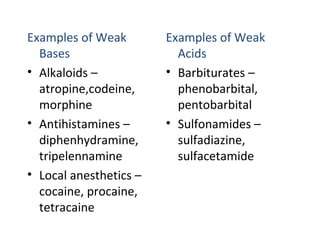
Examples of Weak
Bases
• Alkaloids –
atropine,codeine,
morphine
• Antihistamines –
diphenhydramine,
tripelennamine
• Local anesthetics –
cocaine, procaine,
tetracaine
Examples of Weak
Acids
• Barbiturates –
phenobarbital,
pentobarbital
• Sulfonamides –
sulfadiazine,
sulfacetamide
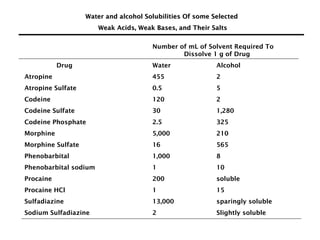
Water and alcohol Solubilities Of some Selected
Weak Acids, Weak Bases, and Their Salts
Number of mL of Solvent Required To
Dissolve 1 g of Drug
Drug Water Alcohol
Atropine 455 2
Atropine Sulfate 0.5 5
Codeine 120 2
Codeine Sulfate 30 1,280
Codeine Phosphate 2.5 325
Morphine 5,000 210
Morphine Sulfate 16 565
Phenobarbital 1,000 8
Phenobarbital sodium 1 10
Procaine 200 soluble
Procaine HCl 1 15
Sulfadiazine 13,000 sparingly soluble
Sodium Sulfadiazine 2 Slightly soluble
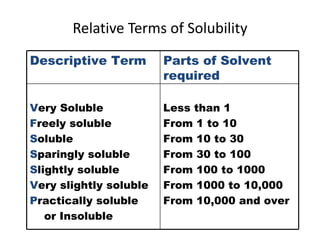
Relative Terms of Solubility
Descriptive Term Parts of Solvent
required
Very Soluble
Freely soluble
Soluble
Sparingly soluble
Slightly soluble
Very slightly soluble
Practically soluble
or Insoluble
Less than 1
From 1 to 10
From 10 to 30
From 30 to 100
From 100 to 1000
From 1000 to 10,000
From 10,000 and over
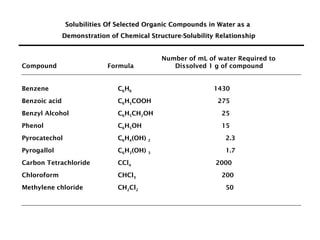
Solubilities Of Selected Organic Compounds in Water as a
Demonstration of Chemical Structure-Solubility Relationship
Number of mL of water Required to
Compound Formula Dissolved 1 g of compound
Benzene C6H6 1430
Benzoic acid C6H5COOH 275
Benzyl Alcohol C6H5CH2OH 25
Phenol C6H5OH 15
Pyrocatechol C6H4(OH) 2 2.3
Pyrogallol C6H3(OH) 3 1.7
Carbon Tetrachloride CCl4 2000
Chloroform CHCl3 200
Methylene chloride CH2Cl2 50
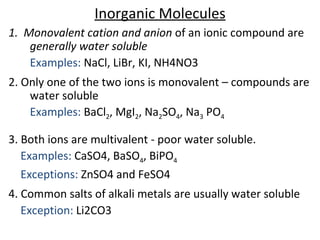
Inorganic Molecules
1. Monovalent cation and anion of an ionic compound are
generally water soluble
Examples: NaCl, LiBr, KI, NH4NO3
2. Only one of the two ions is monovalent – compounds are
water soluble
Examples: BaCl2, MgI2, Na2SO4, Na3 PO4
3. Both ions are multivalent - poor water soluble.
Examples: CaSO4, BaSO4, BiPO4
Exceptions: ZnSO4 and FeSO4
4. Common salts of alkali metals are usually water soluble
Exception: Li2CO3
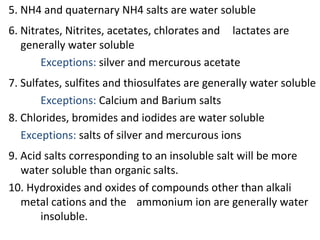
5. NH4 and quaternary NH4 salts are water soluble
6. Nitrates, Nitrites, acetates, chlorates and lactates are
generally water soluble
Exceptions: silver and mercurous acetate
7. Sulfates, sulfites and thiosulfates are generally water soluble
Exceptions: Calcium and Barium salts
8. Chlorides, bromides and iodides are water soluble
Exceptions: salts of silver and mercurous ions
9. Acid salts corresponding to an insoluble salt will be more
water soluble than organic salts.
10. Hydroxides and oxides of compounds other than alkali
metal cations and the ammonium ion are generally water
insoluble.
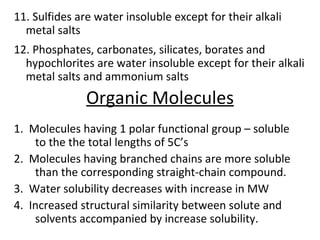
11. Sulfides are water insoluble except for their alkali
metal salts
12. Phosphates, carbonates, silicates, borates and
hypochlorites are water insoluble except for their alkali
metal salts and ammonium salts
Organic Molecules
1. Molecules having 1 polar functional group – soluble
to the the total lengths of 5C’s
2. Molecules having branched chains are more soluble
than the corresponding straight-chain compound.
3. Water solubility decreases with increase in MW
4. Increased structural similarity between solute and
solvents accompanied by increase solubility.
Solvents for Liquid Preparations
1. Water – has the widest range of usefulness of all the
solvents employed in pharmaceutical dispensing or
manufacturing. It is a good solvent for most
inorganic and organic
2. Alcohol USP, Ethyl Alcohol, Ethanol – good solvent for
many organic substances both natural and synthetic.
Is 94.9 to 96.0% alcohol at 15.560
C.
Limit: 0.5% = 6 to 12 years, 5% = over 12, 10% =
adult
3. Dehydrated Alcohol – 99.5% absolute alcohol is
partially free from water.
4. Diluted Alcohol NF- prepared by mixing equal volume of
Alcohol USP and purified water.
5. Alcohol, Rubbing – contains about 70% of ethyl alcohol by
volume the remainder consists of water, denaturants with
or without color additives and perfume oils and stabilizers.
6. Glycerin USP ( Glycerol) – clear syrupy liquid with sweet
taste. It is miscible both with water and alcohol. Excellent
solvent for tannins, phenol and boric acid. It has a
preservative qualities.
7. Propylene Glycol – miscible in water, acetone, alcohol and
chloroform
8. Polyethylene glycol 400 – miscible in water, acetone
alcohol and other glycols
9. Chloroform – miscible with alcohol, ether, benzene, hexane
and both fixed and volatile oils
10. Acetone – miscible with water, alcohol, ether, chloroform
and most of the volatile oils.
Methods of Preparing Solutions
1. Simple Solution – prepared by dissolving the
solute in the solvent
Examples: Calcium hydroxide solution USP
(lime water), Sodium Phosphate solution and
Strong Iodine solution USP (lugol’s)
2. Solution by Chemical reaction – prepared by
reacting two or more solutes with each other in
a suitable solvent.
Examples: Aluminum subacetate – prepared by
reacting aluminum sulfate sol. with calcium
carbonate and acetic acid forming magma.
Magnesium Citrate = prepared by reacting official
magnesium carbonate with citric acid, flavoring and
sweetening agents, filtering talc and carbonating it by
potassium or sodium bicarbonate.
Use: Saline cathartic
Sodium Citrate and Citric acid oral solution = contains 100
mg sodium citrate and 67 mg citric acid in each ml od
aqueous solution. Use: Systemic alkalinizer
3. Solution by Extraction – vegetables or animal
origin are often extracted with suitable solvent.
Preparation of this type may be classified as solutions
but more often EXTRACTIVES
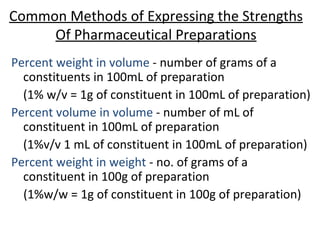
Common Methods of Expressing the Strengths
Of Pharmaceutical Preparations
Percent weight in volume - number of grams of a
constituents in 100mL of preparation
(1% w/v = 1g of constituent in 100mL of preparation)
Percent volume in volume - number of mL of
constituent in 100mL of preparation
(1%v/v 1 mL of constituent in 100mL of preparation)
Percent weight in weight - no. of grams of a
constituent in 100g of preparation
(1%w/w = 1g of constituent in 100g of preparation)
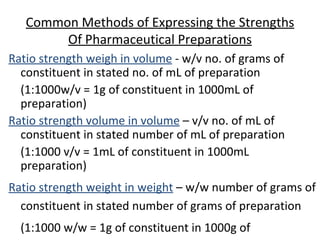
Common Methods of Expressing the Strengths
Of Pharmaceutical Preparations
Ratio strength weigh in volume - w/v no. of grams of
constituent in stated no. of mL of preparation
(1:1000w/v = 1g of constituent in 1000mL of
preparation)
Ratio strength volume in volume – v/v no. of mL of
constituent in stated number of mL of preparation
(1:1000 v/v = 1mL of constituent in 1000mL
preparation)
Ratio strength weight in weight – w/w number of grams of
constituent in stated number of grams of preparation
(1:1000 w/w = 1g of constituent in 1000g of
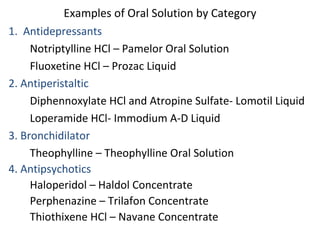
Examples of Oral Solution by Category
1. Antidepressants
Notriptylline HCl – Pamelor Oral Solution
Fluoxetine HCl – Prozac Liquid
2. Antiperistaltic
Diphennoxylate HCl and Atropine Sulfate- Lomotil Liquid
Loperamide HCl- Immodium A-D Liquid
3. Bronchidilator
Theophylline – Theophylline Oral Solution
4. Antipsychotics
Haloperidol – Haldol Concentrate
Perphenazine – Trilafon Concentrate
Thiothixene HCl – Navane Concentrate
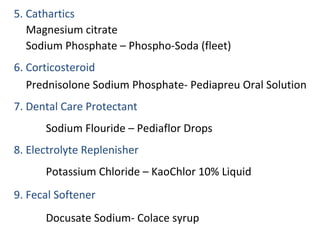
5. Cathartics
Magnesium citrate
Sodium Phosphate – Phospho-Soda (fleet)
6. Corticosteroid
Prednisolone Sodium Phosphate- Pediapreu Oral Solution
7. Dental Care Protectant
Sodium Flouride – Pediaflor Drops
8. Electrolyte Replenisher
Potassium Chloride – KaoChlor 10% Liquid
9. Fecal Softener
Docusate Sodium- Colace syrup
10. Hematinic
Ferrous Sulfate - Fer-in-sol Drops
11. Histamine hydrogen Antagonist
Cimetidine HCl liquid – Tagamet HCl Liquid
12. Narcotic Agonist Analgesic
Methadone HCl – Methadone HCl
13. Vitamin D source
Ergocalciferol – Calciferol drops
AQUEOUS SOLUTIONS
Is one where water is used as a major ingredient.
Water is used as a vehicle and a solvent for the
desired flavoring or medical agent.
CHARACTERISTICS OF WATER
1. Tasteless
2. Freedom from irritating qualities
3. Lack of pharmacologic activity
DISADVANTAGES
1. Favorable medium for many chemical reactions
2. Support growth of microorganisms when
contaminated
3. In pure form add cost to production
PREPARATION
1. Distillation
2. Demineralization or Deionization
3. Reverse Osmosis
**Demineralization – This ionization process is the well
known Zeolite process of softening water high mineral
content. This resin may be acid or cations exchanger
and base or anion exchanger.
• Zeolite – act as a catalyst such as dehydrated aluminum.
Calcium sodium sulfate.
* Deionization process do not necessarily produce purified
water which will comply with USPHS ( US Public Health
Service) requirements for drinking water, the water
should be purified before they can used for
pharmaceuticals
**Reverse Osmosis – Transport of solvent through
semipermeable membrane separating 2 solutions
of different concentrations (less concentrated
and more concentrated)
A reversely new separation process w/c in
principle may be applied to the separation,
concentration and fractionalization of inorganic
or organic substances in aqueous or non-aqueous
solutions in the liquid or the gaseous phase is
known reverse osmosis.
Also referred as “crossflow or tangential
flow” membrane filtration
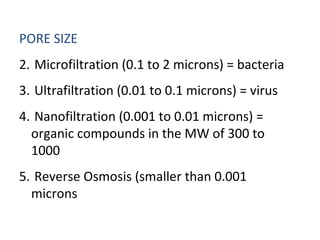
PORE SIZE
2. Microfiltration (0.1 to 2 microns) = bacteria
3. Ultrafiltration (0.01 to 0.1 microns) = virus
4. Nanofiltration (0.001 to 0.01 microns) =
organic compounds in the MW of 300 to
1000
5. Reverse Osmosis (smaller than 0.001
microns
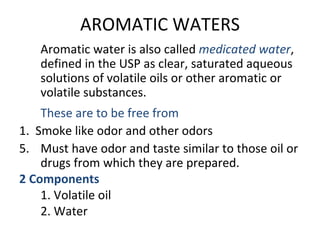
AROMATIC WATERS
Aromatic water is also called medicated water,
defined in the USP as clear, saturated aqueous
solutions of volatile oils or other aromatic or
volatile substances.
These are to be free from
1. Smoke like odor and other odors
5. Must have odor and taste similar to those oil or
drugs from which they are prepared.
2 Components
1. Volatile oil
2. Water
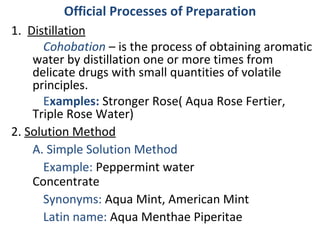
Official Processes of Preparation
1. Distillation
Cohobation – is the process of obtaining aromatic
water by distillation one or more times from
delicate drugs with small quantities of volatile
principles.
Examples: Stronger Rose( Aqua Rose Fertier,
Triple Rose Water)
2. Solution Method
A. Simple Solution Method
Example: Peppermint water
Concentrate
Synonyms: Aqua Mint, American Mint
Latin name: Aqua Menthae Piperitae
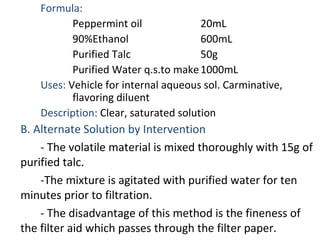
Formula:
Peppermint oil 20mL
90%Ethanol 600mL
Purified Talc 50g
Purified Water q.s.to make1000mL
Uses: Vehicle for internal aqueous sol. Carminative,
flavoring diluent
Description: Clear, saturated solution
B. Alternate Solution by Intervention
- The volatile material is mixed thoroughly with 15g of
purified talc.
-The mixture is agitated with purified water for ten
minutes prior to filtration.
- The disadvantage of this method is the fineness of
the filter aid which passes through the filter paper.
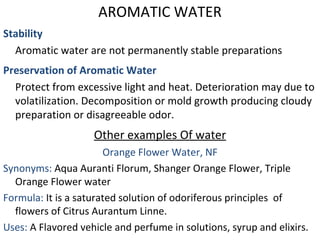
AROMATIC WATER
Stability
Aromatic water are not permanently stable preparations
Preservation of Aromatic Water
Protect from excessive light and heat. Deterioration may due to
volatilization. Decomposition or mold growth producing cloudy
preparation or disagreeable odor.
Orange Flower Water, NF
Synonyms: Aqua Auranti Florum, Shanger Orange Flower, Triple
Orange Flower water
Formula: It is a saturated solution of odoriferous principles of
flowers of Citrus Aurantum Linne.
Uses: A Flavored vehicle and perfume in solutions, syrup and elixirs.
Other examples Of water
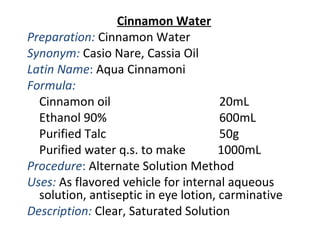
Cinnamon Water
Preparation: Cinnamon Water
Synonym: Casio Nare, Cassia Oil
Latin Name: Aqua Cinnamoni
Formula:
Cinnamon oil 20mL
Ethanol 90% 600mL
Purified Talc 50g
Purified water q.s. to make 1000mL
Procedure: Alternate Solution Method
Uses: As flavored vehicle for internal aqueous
solution, antiseptic in eye lotion, carminative
Description: Clear, Saturated Solution
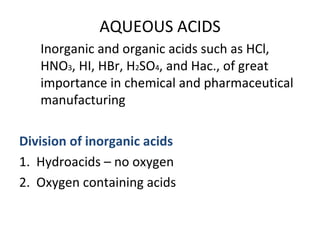
AQUEOUS ACIDS
Inorganic and organic acids such as HCl,
HNO3, HI, HBr, H2SO4, and Hac., of great
importance in chemical and pharmaceutical
manufacturing
Division of inorganic acids
1. Hydroacids – no oxygen
2. Oxygen containing acids
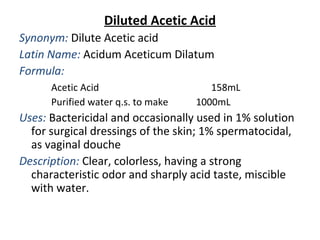
Diluted Acetic Acid
Synonym: Dilute Acetic acid
Latin Name: Acidum Aceticum Dilatum
Formula:
Acetic Acid 158mL
Purified water q.s. to make 1000mL
Uses: Bactericidal and occasionally used in 1% solution
for surgical dressings of the skin; 1% spermatocidal,
as vaginal douche
Description: Clear, colorless, having a strong
characteristic odor and sharply acid taste, miscible
with water.
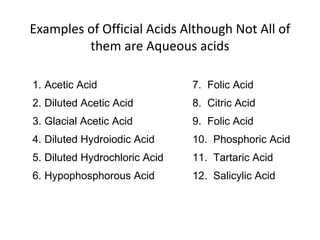
Examples of Official Acids Although Not All of
them are Aqueous acids
1. Acetic Acid 7. Folic Acid
2. Diluted Acetic Acid 8. Citric Acid
3. Glacial Acetic Acid 9. Folic Acid
4. Diluted Hydroiodic Acid 10. Phosphoric Acid
5. Diluted Hydrochloric Acid 11. Tartaric Acid
6. Hypophosphorous Acid 12. Salicylic Acid
GARGLES
Are aqueous solutions used for treating the
pharynx and nasopharynx by forcing air from
the lungs through gargle which is held in the
throat. Many gargles must be diluted with
water prior to use.
Gargles
Examples: Phenol Gargle and Potassium Chlorate
(also known as Golden Gargle) and Phenol
Gargle are official in B.P.C
Preparation: Phenol Gargle
Synonym: Phenolic Solution, Carbolic gargle
Latin name: Gargarisma Phenol
Formula: Contains 50mL of Phenol Glycerin (16%
w/w phenol and 84% w/w glycerin), 10mL
amaranth solution(1%w/v in chloroform water)
and water to make 1L. This is diluted with warm
water equal volume before use . For external use
Uses: antiseptic and soothing effect
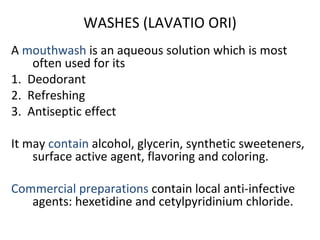
WASHES (LAVATIO ORI)
A mouthwash is an aqueous solution which is most
often used for its
1. Deodorant
2. Refreshing
3. Antiseptic effect
It may contain alcohol, glycerin, synthetic sweeteners,
surface active agent, flavoring and coloring.
Commercial preparations contain local anti-infective
agents: hexetidine and cetylpyridinium chloride.
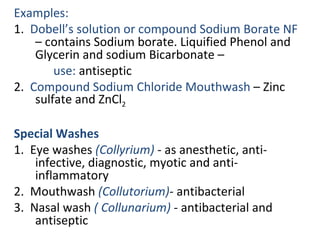
Examples:
1. Dobell’s solution or compound Sodium Borate NF
– contains Sodium borate. Liquified Phenol and
Glycerin and sodium Bicarbonate –
use: antiseptic
2. Compound Sodium Chloride Mouthwash – Zinc
sulfate and ZnCl2
Special Washes
1. Eye washes (Collyrium) - as anesthetic, anti-
infective, diagnostic, myotic and anti-
inflammatory
2. Mouthwash (Collutorium)- antibacterial
3. Nasal wash ( Collunarium) - antibacterial and
antiseptic
JUICES
Juices are formerly known as INPISSATED JUICES. A
juice prepared from ripe fruit, aqueous in
character, and it is used in making syrups
employed as vehicle.
Examples: Cherry juice and Raspberry juices are
official in USP
SPRAYS
• Aqueous solutions in the form of coarse droplets or
as finely divided solids to be applied topically, most
usually to the nasal- pharyngeal tract or to skin
• Applied to the mucous membrane of the nose and
throat by means of an atomizer or nebulizer
• Such sprays may contain antibiotics, antihistamine,
vasoconstrictor, alcohol and suitable solubilizing and
wetting agents
• Another device to deliver spray is called “spray-o-
mizer”, this is for throat
Examples: Nasalide(Syntex), Nostrilla
COLLODIONS
COLLODIONS
Are liquid preparation composed by
pyroxillin dissolved a solvent mixture. Usually
composed of alcohol and ether with or without
added substances
Pyroxillin (nitrocellulose soluble gun cotton,
collodion cotton) is obtained by the action of
mixture of nitric acid and sulfuric acids on cotton
and consists chiefly of cellulose tetranitrate.
Uses Of Collodion
Uses Of Collodion
1. As a protective coating to the skin
2. As medication where a thin layer of the
medication is firmly placed against the
skin
Direction Of Use
Direction Of Use
Collodion are applied to the skin by
means of a soft brush or other suitable
applicators. The solvent rapidly evaporates,
leaving a film residue of pyroxillin.
Example Of Official Collodion
1. Which provides protective coating
A. Collodion, USP is a clear or slightly opalescent
viscous liquid prepared by dissolving 4% W/V pyroxillin in
3:1 mixture of ether and alcohol.
B. Flexible Collodion, USP is prepared by adding 2%
of Camphor and 3% castor oil to the Collodion
2. Which provides medication
A. Salicylic acid Collodion, USP is 10% solution of
salicylic acid in flexible collodion. Used as keratolytic effect (
topical drug that softens the superficial keratin-containing
layer of the skin and promotes its desquamation) especially
in the removal of corns from the toes
Synonym: Corn solvent
SPIRITS
Formerly called “Essences”
alcoholic or hydroalcoholic solutions of volatile
substances.
First Spirits
1. Brandy – Spiritus Vini vitis – 48 to 54% alcohol from
grapes
2. Whisky - Spiritus frumenti – 47 to 53% of alcohol
from cereals
Uses:
1. As flavoring agents pharmaceutically
2. For therapeutic value of the aromatic solute
medicinally
Preparation of Spirits
1. Simple Solution
Majority of spirits are prepared by dissolving the solute in
alcohol by agitation. Filtration is generally desirable to
obtain a sparking clear product.
Example: Aromatic Spirit - 62 to 68% hydroalcoholic solution of
ammonia and ammonium carbonate flavored and
perfumed with lemon, lavender and myristica oil.
2. Solution with Maceration
Macerate the vegetable materials in a suitable solvent to
remove the undesired constituents or to extract one which is
desired.
Example: Peppermint Spirit (Spiritus Menthae Piperitae) – 79 to
85% hydroalcoholic solution containing 10% peppermint oil
Use: digestive aid or carminative
Preparation of Spirits
3. Solution by Chemical Reaction
Only the preparation of Aromatic Spirit of Ammonia NF,
involves a chemical reaction where the official Ammonium
carbonate
4. Distillation
No spirits currently official are prepared by
distillation, However, two products of historical
significance which is official in NF are prepared by
distillation.
Examples: Brandy and whisky
TOOTHACHE DROPS
Are preparations used for the temporary relief of
toothache by application of a small cotton saturated with
the product into the tooth cavity
Example: Clove oil and mixture of phenol with camphor or
creosote
DENTAL ORAL SOLUTION
A variety of medicinal substances are employed topically in
the oral cavity.
Examples:
1. Benzocaine – Topical anesthetic Indicated for temporary relief
of pain, soreness and irritation in the mouth associated with
teething and others
2. Caphorated Parachlorophenol – Dental anti-infective. A
eutectic liquid composed of 65% camphor and 35%
parachlorophenol. Use in the dentistry of the sterilization of
deep root canals.
3. Carbamide Peroxide – Dental anti-ineffective . Acts as
chemomechanical cleansing and debriding agent through
the release of bubbling oxygen. Commercial product Gly-
Oxide - contains 10% carbamide in flavored anhydrous
glycerin.
4. Cetylpyridinium Chloride Solution and Lozenges- Local
anti-infective. Commercial counter parts. Cepacol
Mouthwash/Gargles and Lozenges
5. Erythrosine Sodium Solution/tablets-Diagnostic Aid.
Solution applied to the teeth to reveal plaque left by
inadequate brushing. Tablets same purpose and are not to
be swallowed.
6. Eugenol - Dental Analgesic. Applied to dental cavities and
dental protectives
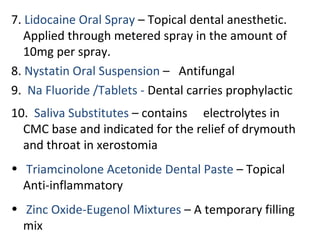
7. Lidocaine Oral Spray – Topical dental anesthetic.
Applied through metered spray in the amount of
10mg per spray.
8. Nystatin Oral Suspension – Antifungal
9. Na Fluoride /Tablets - Dental carries prophylactic
10. Saliva Substitutes – contains electrolytes in
CMC base and indicated for the relief of drymouth
and throat in xerostomia
• Triamcinolone Acetonide Dental Paste – Topical
Anti-inflammatory
• Zinc Oxide-Eugenol Mixtures – A temporary filling
mix
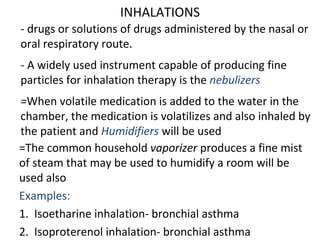
INHALATIONS
- drugs or solutions of drugs administered by the nasal or
oral respiratory route.
- A widely used instrument capable of producing fine
particles for inhalation therapy is the nebulizers
=When volatile medication is added to the water in the
chamber, the medication is volatilizes and also inhaled by
the patient and Humidifiers will be used
=The common household vaporizer produces a fine mist
of steam that may be used to humidify a room will be
used also
Examples:
1. Isoetharine inhalation- bronchial asthma
2. Isoproterenol inhalation- bronchial asthma
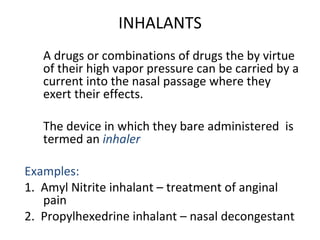
INHALANTS
A drugs or combinations of drugs the by virtue
of their high vapor pressure can be carried by a
current into the nasal passage where they
exert their effects.
The device in which they bare administered is
termed an inhaler
Examples:
1. Amyl Nitrite inhalant – treatment of anginal
pain
2. Propylhexedrine inhalant – nasal decongestant
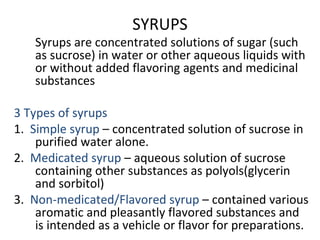
SYRUPS
Syrups are concentrated solutions of sugar (such
as sucrose) in water or other aqueous liquids with
or without added flavoring agents and medicinal
substances
3 Types of syrups
1. Simple syrup – concentrated solution of sucrose in
purified water alone.
2. Medicated syrup – aqueous solution of sucrose
containing other substances as polyols(glycerin
and sorbitol)
3. Non-medicated/Flavored syrup – contained various
aromatic and pleasantly flavored substances and
is intended as a vehicle or flavor for preparations.
Classification of syrups
A. Medicinal Classification
1. Non-medicated/Flavoring syrups – are used as
vehicles and have no official formulas and
therefore no detailed descriptions of the product
are found in compedia.
B. Pharmaceutical Classification
Based on their basic formula
1. sugar based syrups – syrups which are
concentrated solutions
2. artificial sweeteners and non-nutritive syrups –
formulated with artificial sweetening agents and
viscosity builders
Examples of Flavoring Syrups
1. Orange Syrup - This sucrose - based syrup utilizes sweet orange
peel tincture, and citric acid as the source of flavor and tartness.
Syrupus Aurantii, syrup of orange peel, sweet orange peel 50
mL;citric acid 5 g; talc 15 g; sucrose 820 g; purified water q.s to
make 1000 mL
2. Ora - Sweet and Ora-Sweet SF -Commercially available vehicles
for the extemporaneous compounding of Syrups. Ora sweet SF
syrup is sugar free.
5.Raspberry Syrup - A sucrose - based syrup containing about 48%
by volume of raspberry juice
4. Glycyrrhiza Syrup - Licorice syrup, Glycyrrhiza fluid extract 250
mL; Fennel oil 0.55 mL; Anise oil 0.5 mL; syrups, q.s to make 1000
mL
5. Cocoa Syrup - Syrupus cacao, Cacao syrup, chocolate flavored,
cocoa 180 g; sucrose 600 g; liquid glucose 180 g; glycerin 50 mL;
Sodium chloride 2 g; Vanilla 0.2 g; Sodium benzoate 1 g; water q.s.
to make 1000 mL
2.Cherry Syrup - Syrupus Gerasi - Cherry juice 475 mL; sucrose 800
g; alcohol 20 mL; water q.s. to make 1000 mL
7. Acacia Syrup - Syrupus acaciae - Acacia powder 100g; Sodium
benzoate 1 g; Vanilla tincture 5 mL; Sucrose 800 g; Purified water
q.s to make 1000 mL.
8. Citric acid Syrup - Syrupus Acidi Citrici, Syrup lemon -
Lemon tincture 10 mL; Citric acid 10 g: Purified water q.s to
make 1000 mL
9. Simple Syrup - This is an 85% of sucrose in purified
water. This simple syrup may be used as the basis for the
preparation of flavored or medicated syrup.
2. Medicated Syrups - contain ingredients giving them
therapeutic value
Example: Ephedrine Sulfate Syrup -(for cough) - Ephedrine
sulfate 4 g; Citric acid 1 g;Amaranth solution 4 mL; Caramel 0.4 g;
Lemon oil 0.125 mL; orange oil 0.25 mL; Benzaldehyde 0.06 mL;
Vanillin 0.016 g; alcohol 25 mL; Sucrose 800 g; Purified water, q.s to
make 1000 mL
Ipecac Syrup - emetic
Note: Some syrup are use as Cathartic, Cholinergic,
Decongestant, Expectorant, Fecal Softener, Sedative and others
Examples Of Medicated Syrups By Category
1. Analgesic Meperidine HCl Syrup - Demerol Syrup
2. Anticholinergics
Dicyclomine HCl Syrup - Bentyl Syrup
Oxybutynin Chloride - Ditropan syrup
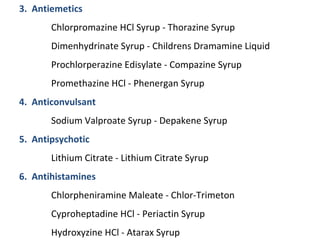
3. Antiemetics
Chlorpromazine HCl Syrup - Thorazine Syrup
Dimenhydrinate Syrup - Childrens Dramamine Liquid
Prochlorperazine Edisylate - Compazine Syrup
Promethazine HCl - Phenergan Syrup
4. Anticonvulsant
Sodium Valproate Syrup - Depakene Syrup
5. Antipsychotic
Lithium Citrate - Lithium Citrate Syrup
6. Antihistamines
Chlorpheniramine Maleate - Chlor-Trimeton
Cyproheptadine HCl - Periactin Syrup
Hydroxyzine HCl - Atarax Syrup
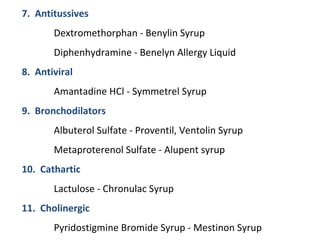
7. Antitussives
Dextromethorphan - Benylin Syrup
Diphenhydramine - Benelyn Allergy Liquid
8. Antiviral
Amantadine HCl - Symmetrel Syrup
9. Bronchodilators
Albuterol Sulfate - Proventil, Ventolin Syrup
Metaproterenol Sulfate - Alupent syrup
10. Cathartic
Lactulose - Chronulac Syrup
11. Cholinergic
Pyridostigmine Bromide Syrup - Mestinon Syrup
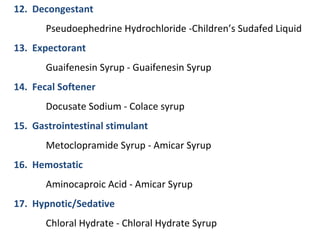
12. Decongestant
Pseudoephedrine Hydrochloride -Children’s Sudafed Liquid
13. Expectorant
Guaifenesin Syrup - Guaifenesin Syrup
14. Fecal Softener
Docusate Sodium - Colace syrup
15. Gastrointestinal stimulant
Metoclopramide Syrup - Amicar Syrup
16. Hemostatic
Aminocaproic Acid - Amicar Syrup
17. Hypnotic/Sedative
Chloral Hydrate - Chloral Hydrate Syrup
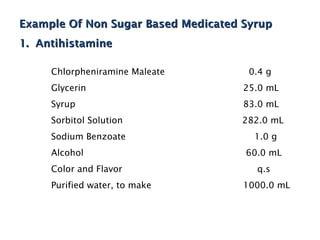
Example Of Non Sugar Based Medicated Syrup
1. Antihistamine
1. Antihistamine
Chlorpheniramine Maleate 0.4 g
Glycerin 25.0 mL
Syrup 83.0 mL
Sorbitol Solution 282.0 mL
Sodium Benzoate 1.0 g
Alcohol 60.0 mL
Color and Flavor q.s
Purified water, to make 1000.0 mL
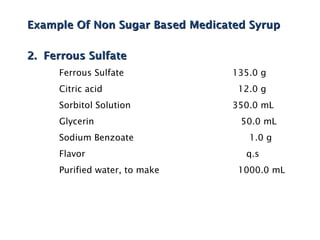
Example Of Non Sugar Based Medicated Syrup
2. Ferrous Sulfate
2. Ferrous Sulfate
Ferrous Sulfate 135.0 g
Citric acid 12.0 g
Sorbitol Solution 350.0 mL
Glycerin 50.0 mL
Sodium Benzoate 1.0 g
Flavor q.s
Purified water, to make 1000.0 mL
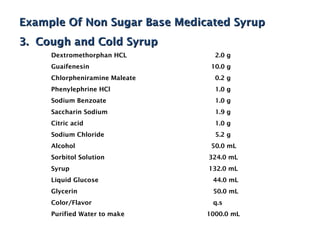
Example Of Non Sugar Base Medicated Syrup
3. Cough and Cold Syrup
Dextromethorphan HCL 2.0 g
Guaifenesin 10.0 g
Chlorpheniramine Maleate 0.2 g
Phenylephrine HCl 1.0 g
Sodium Benzoate 1.0 g
Saccharin Sodium 1.9 g
Citric acid 1.0 g
Sodium Chloride 5.2 g
Alcohol 50.0 mL
Sorbitol Solution 324.0 mL
Syrup 132.0 mL
Liquid Glucose 44.0 mL
Glycerin 50.0 mL
Color/Flavor q.s
Purified Water to make 1000.0 mL
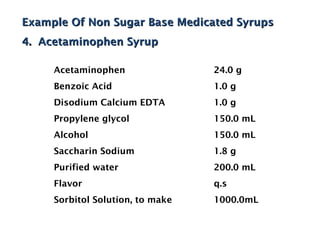
Example Of Non Sugar Base Medicated Syrups
4. Acetaminophen Syrup
Acetaminophen 24.0 g
Benzoic Acid 1.0 g
Disodium Calcium EDTA 1.0 g
Propylene glycol 150.0 mL
Alcohol 150.0 mL
Saccharin Sodium 1.8 g
Purified water 200.0 mL
Flavor q.s
Sorbitol Solution, to make 1000.0mL
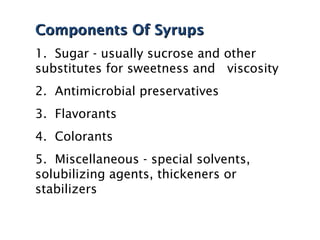
Components Of Syrups
1. Sugar - usually sucrose and other
substitutes for sweetness and viscosity
2. Antimicrobial preservatives
3. Flavorants
4. Colorants
5. Miscellaneous - special solvents,
solubilizing agents, thickeners or
stabilizers
Pharmaceutical Classification based on
their basic formula
1. Sugar Based syrups – sucrose and dextrose are
usually employed in the preparation of syrups
2. Artificial sweeteners – sugar-free syrups which are
intended as substitute for sugar-based syrups and
are intended to be administerd to persons who
must regulate their sugar/calorie intake.
Preservation and Storage of Syrups
Generally, syrups are stored at room temperature
in tightly closed bottle and well-filled bottles.
Antimicrobial Preservatives
The amount of preservatives required in a syrup
varies with the proportions of water available for
microbial growth.
Among the preservatives
1. Benzoic acid-0.1% to 0.2%
2. Sodium benzoate – 0.1 to 0.2%
3. Combination of methyl, propyl, butyl parabens
totaling 0.1%
DEXTROSE
Dextrose may be used as a substitute for sucrose in syrups
containing strong acids in order to eliminate the
discoloration associated with caramelization.
Example: Hydroiodic syrup
The difficulty or problem with dextrose are as
follows:
1. It forms a saturated solutions in water at 70%w/v
which is less viscous than simple syrup.
2. Dextrose dissolves more slowly
3. Dextrose is less sweet
4. Saturated solution supports growth of
microorganism and therefore more easily
fermented.
DEXTROSE
So with the use of dextrose, it is necessary to improve the
keeping qualities by adding:
1. Preservatives which may be glycerin in 30 to 45%
which is also serves to increase viscosity.
2. Sweeteners
3. However, glycerin tends to develop a butyric odor or
aging
Flavorants for syrup
Most syrups flavored with synthetic flavorants or
with naturally occurring materials as volatile oil,
vanillin, and others, to render the syrup pleasant
tasting. Since syrups are aqueous preparations, these
flavorants must be possess sufficient water solubility
Colorants for Syrup
To enhance appeal of the syrup, a coloring agent is
generally used which correlates with the flavorant
employed. The colorant used is generally water-soluble,
non-reactive with other components, and color stable
at the pH range and under intensity of light that the
syrup is likely to encounter during its shelf life.
Sweeteners
• Non-nutritive, synthetic sweetening agents required in the
formulation
• Saccharin sodium is 300 - 550 time as sweet as sucrose. It may
be used in concentration of 0.1 to 0.2% but characterized by a
bitter after taste.
• Aspartylphenylalanine methyl ester is a potential low calories –
160 times sweeter than sucrose in aqueous solution.
Sweeteners and Viscosity Builders-Sorbitol Based Syrup
Sorbitol, A hexahydric alcohol, C6H14O6, made by
hydrogenation of glucose is used mostly in the 70% aqueous
solution USP trademark “Sorbo”
Characteristics of Sorbitol
1. Sorbitol solution is not irritating to the membrane of the
mouth and the throat
2. Unlike sucrose, it does not contribute to the formation of
dental caries
3. Although it is metabolized and converted into glucose it
is not absorbed from the GIT as rapid as sugars, so no
significant hyperglycemia is formed
4. Although it is 60% as sweet as sucrose and half as
viscous as simple syrup, it has excellent “mouth feel” and
lacks acrid characteristics.
5. Sorbitol is compatible with other polyol and simple
syrup
6. Sorbitol is chemically stable and practically inert.
7. Sorbitol inhibits the sticking and locking of bottle caps
which occurs with high concentration of sucrose so they
are usually combined
8. Many drugs are more stable in sorbitol than in sucrose
solution thus may have extended shelf-life
9. As much as 10% v/v of alcohol can be added before
crystallization is observed same as sucrose.
Uses Of Syrups
Uses Of Syrups
1. Due to sweetness, can mask the taste of
salty and bitter drugs and therefore
serve as pleasant tasting vehicle
2. Used as vehicle for pediatric use due to
to their high viscosity and the
“smoothness” and mouth feel qualities.
3. Due to the wide variety of flavors of
syrups such as orange, lemon, peppermint,
these are widely acceptable.
Preparation Of Syrups
Syrups are most frequently prepared by any one
of the four methods depending upon the physical and
chemical characteristics of the ingredients.
1. Solution of the ingredients with the aid of heat
2. Solution of the ingredients by agitation without the
use of heat or the simple admixture of liquid
components
3. Addition of sucrose to a prepared medicated liquid
or to a flavored liquid
4. By percolation of either the sucrose of the
medicating substance or of the sucrose.
1. Solution of ingredients with the aid of heat
Syrups are prepared by this method for the following reasons:
A. When desired to prepare the syrup as quickly as possible
B. When the syrups components are not damaged or volatilized by heat
Procedure
1. Add the sugar to the purified water and heat until solution is
affected.
2. Heat stable components are added to the hot syrup
3. Cool and made up to volume.
4. If other components are heat labile, they are added after cooling
like alcohol and oil.
Caution: Do not apply excessive heat - inversion of sucrose causing
discoloration due to caramelization
Examples : Acacia syrup, NF; Cocoa Syrup, NF; Syrup USP (85% sugar,
made by cold and hot process, percolation)
2. Solution of ingredients by agitation without the aid of
heat
heat
To avoid heat-induced inversion of sucrose, a syrup
maybe prepared without heat by agitation
Procedure:
1. Sucrose and other formulative agents maybe dissolved in
purified water.
2. Place the ingredients in a bottle of greater capacity than the
volume of syrup.
3. Agitate the mixture
Examples: Ferrous Sulfate Syrup, Ephedrine Sulfate, Citric acid
Syrup, and Glycyrrhiza Syrup
3. Percolation
3. Percolation
In this method, either sucrose maybe
percolated to prepare the syrup or the sucrose of
the medicinal component may be percolated to
form an extractive to which sucrose or syrup may
be added
Procedure:
1. Purified water or aqueous solution of a
medicating or flavoring liquid is allowed to pass
slowly through a column of crystalline sucrose to
dissolve it.
2. The percolate is collected and returned to the percolator as
required until all of the sucrose has been dissolved.
3. Percolator with a pledget of cotton at the bottom is used
Example: Tolu Balsam syrup - flavor for cough syrup
4. Addition of Sucrose to a Medicated liquid or to a
Flavored liquid
Flavored liquid
Occasionally, a medicated liquid, as a tincture of
fluidextract is employed as the source of medication in the
preparation of a syrup.
Many such tinctures and fluidextract contain alcohol-
soluble constituents and are prepared with alcoholic vehicles.
Examples: Senna Syrup, NF and Cherry Syrup
HONEY
• Honey is also called “Clarified honey” or “Strained
Honey”
• Honey instead of syrup was used as a base for thick
liquid preparation known as Honeys or Mels.
• Honey is the secretion deposited in the honeycomb of
the bee and consists of a mixture of invert sugar –
62-83%; sucrose – 8%; dextrin – 0.2%
Examples: Oxymel (acid honey) – contains acetic acid – 150
mL; Purified water 150 mL; honey q.s to make 1000 mL
Squill Oxymel = squill, water, acetic acid and honey
MUCILAGES
• Are thick, viscid, adhesive liquids, produced by
dispersing gum in water or by extracting with
water mucilagenous principle from vegetable
substances.
• Mucilages are used primarily to aid in suspending
insoluble substances in liquids due to their
1. colloidal character
2. viscosity which prevents the
immediate sedimentation
Example:
Preparation: Acacia Mucilage NF
Synonym: Mucilago Acaciae; Mucilage of Gum Arabic
Formula : Acacia, in small fragments 350 g
Benzoic acid 2 g
Purified water, q.s to make 1000 mL
Method: Place acacia in wide mouth graduated bottle with
capacity not exceeding 1000 mL. Wash the drug with cold water,
drain and add sufficient quantity of purified water in which
benzoic acid has been dissolved to make 1000 mL, Stopper and
lay the bottle, rotate occasionally, and when acacia has been
dissolved, strain the mucilage
Uses: Demulcent, suspending agent, excipient in making pills
and troches,and as emulsifying agent for cod liver oil
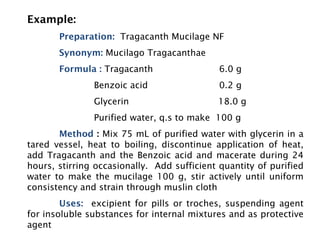
Example:
Preparation: Tragacanth Mucilage NF
Synonym: Mucilago Tragacanthae
Formula : Tragacanth 6.0 g
Benzoic acid 0.2 g
Glycerin 18.0 g
Purified water, q.s to make 100 g
Method : Mix 75 mL of purified water with glycerin in a
tared vessel, heat to boiling, discontinue application of heat,
add Tragacanth and the Benzoic acid and macerate during 24
hours, stirring occasionally. Add sufficient quantity of purified
water to make the mucilage 100 g, stir actively until uniform
consistency and strain through muslin cloth
Uses: excipient for pills or troches, suspending agent
for insoluble substances for internal mixtures and as protective
agent
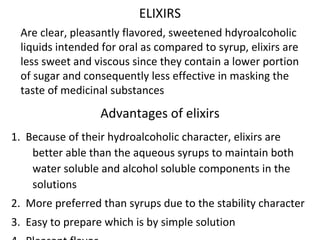
ELIXIRS
Are clear, pleasantly flavored, sweetened hdyroalcoholic
liquids intended for oral as compared to syrup, elixirs are
less sweet and viscous since they contain a lower portion
of sugar and consequently less effective in masking the
taste of medicinal substances
Advantages of elixirs
1. Because of their hydroalcoholic character, elixirs are
better able than the aqueous syrups to maintain both
water soluble and alcohol soluble components in the
solutions
2. More preferred than syrups due to the stability character
3. Easy to prepare which is by simple solution
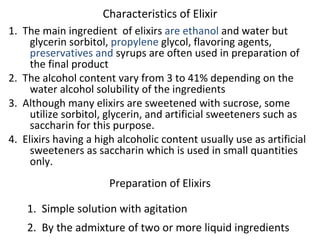
Characteristics of Elixir
1. The main ingredient of elixirs are ethanol and water but
glycerin sorbitol, propylene glycol, flavoring agents,
preservatives and syrups are often used in preparation of
the final product
2. The alcohol content vary from 3 to 41% depending on the
water alcohol solubility of the ingredients
3. Although many elixirs are sweetened with sucrose, some
utilize sorbitol, glycerin, and artificial sweeteners such as
saccharin for this purpose.
4. Elixirs having a high alcoholic content usually use as artificial
sweeteners as saccharin which is used in small quantities
only.
Preparation of Elixirs
1. Simple solution with agitation
2. By the admixture of two or more liquid ingredients
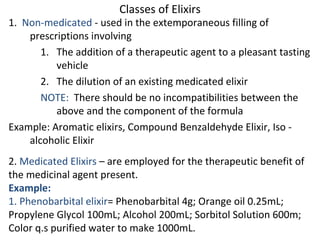
Classes of Elixirs
1. Non-medicated - used in the extemporaneous filling of
prescriptions involving
1. The addition of a therapeutic agent to a pleasant tasting
vehicle
2. The dilution of an existing medicated elixir
NOTE: There should be no incompatibilities between the
above and the component of the formula
Example: Aromatic elixirs, Compound Benzaldehyde Elixir, Iso -
alcoholic Elixir
2. Medicated Elixirs – are employed for the therapeutic benefit of
the medicinal agent present.
Example:
1. Phenobarbital elixir= Phenobarbital 4g; Orange oil 0.25mL;
Propylene Glycol 100mL; Alcohol 200mL; Sorbitol Solution 600m;
Color q.s purified water to make 1000mL.
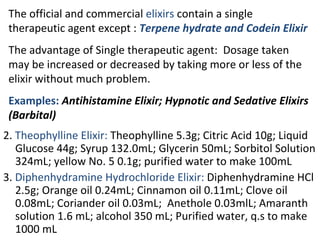
The official and commercial elixirs contain a single
therapeutic agent except : Terpene hydrate and Codein Elixir
The advantage of Single therapeutic agent: Dosage taken
may be increased or decreased by taking more or less of the
elixir without much problem.
Examples: Antihistamine Elixir; Hypnotic and Sedative Elixirs
(Barbital)
2. Theophylline Elixir: Theophylline 5.3g; Citric Acid 10g; Liquid
Glucose 44g; Syrup 132.0mL; Glycerin 50mL; Sorbitol Solution
324mL; yellow No. 5 0.1g; purified water to make 100mL
3. Diphenhydramine Hydrochloride Elixir: Diphenhydramine HCl
2.5g; Orange oil 0.24mL; Cinnamon oil 0.11mL; Clove oil
0.08mL; Coriander oil 0.03mL; Anethole 0.03mlL; Amaranth
solution 1.6 mL; alcohol 350 mL; Purified water, q.s to make
1000 mL
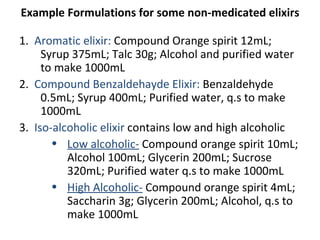
Example Formulations for some non-medicated elixirs
1. Aromatic elixir: Compound Orange spirit 12mL;
Syrup 375mL; Talc 30g; Alcohol and purified water
to make 1000mL
2. Compound Benzaldehayde Elixir: Benzaldehyde
0.5mL; Syrup 400mL; Purified water, q.s to make
1000mL
3. Iso-alcoholic elixir contains low and high alcoholic
• Low alcoholic- Compound orange spirit 10mL;
Alcohol 100mL; Glycerin 200mL; Sucrose
320mL; Purified water q.s to make 1000mL
• High Alcoholic- Compound orange spirit 4mL;
Saccharin 3g; Glycerin 200mL; Alcohol, q.s to
make 1000mL
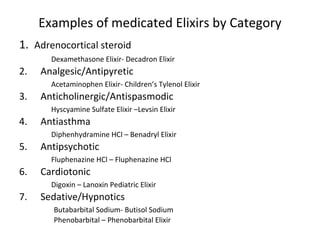
Examples of medicated Elixirs by Category
1. Adrenocortical steroid
Dexamethasone Elixir- Decadron Elixir
2. Analgesic/Antipyretic
Acetaminophen Elixir- Children’s Tylenol Elixir
3. Anticholinergic/Antispasmodic
Hyscyamine Sulfate Elixir –Levsin Elixir
4. Antiasthma
Diphenhydramine HCl – Benadryl Elixir
5. Antipsychotic
Fluphenazine HCl – Fluphenazine HCl
6. Cardiotonic
Digoxin – Lanoxin Pediatric Elixir
7. Sedative/Hypnotics
Butabarbital Sodium- Butisol Sodium
Phenobarbital – Phenobarbital Elixir
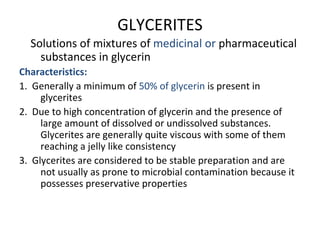
GLYCERITES
Solutions of mixtures of medicinal or pharmaceutical
substances in glycerin
Characteristics:
1. Generally a minimum of 50% of glycerin is present in
glycerites
2. Due to high concentration of glycerin and the presence of
large amount of dissolved or undissolved substances.
Glycerites are generally quite viscous with some of them
reaching a jelly like consistency
3. Glycerites are considered to be stable preparation and are
not usually as prone to microbial contamination because it
possesses preservative properties
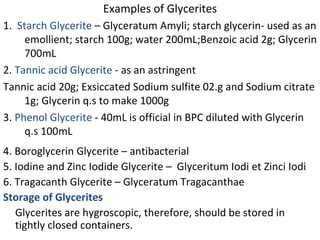
Examples of Glycerites
1. Starch Glycerite – Glyceratum Amyli; starch glycerin- used as an
emollient; starch 100g; water 200mL;Benzoic acid 2g; Glycerin
700mL
2. Tannic acid Glycerite - as an astringent
Tannic acid 20g; Exsiccated Sodium sulfite 02.g and Sodium citrate
1g; Glycerin q.s to make 1000g
3. Phenol Glycerite - 40mL is official in BPC diluted with Glycerin
q.s 100mL
4. Boroglycerin Glycerite – antibacterial
5. Iodine and Zinc Iodide Glycerite – Glyceritum Iodi et Zinci Iodi
6. Tragacanth Glycerite – Glyceratum Tragacanthae
Storage of Glycerites
Glycerites are hygroscopic, therefore, should be stored in
tightly closed containers.
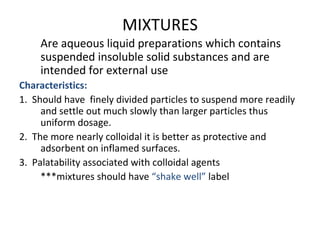
MIXTURES
Are aqueous liquid preparations which contains
suspended insoluble solid substances and are
intended for external use
Characteristics:
1. Should have finely divided particles to suspend more readily
and settle out much slowly than larger particles thus
uniform dosage.
2. The more nearly colloidal it is better as protective and
adsorbent on inflamed surfaces.
3. Palatability associated with colloidal agents
***mixtures should have “shake well” label
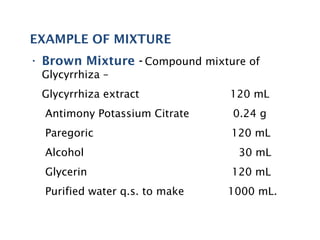
EXAMPLE OF MIXTURE
• Brown Mixture - Compound mixture of
Glycyrrhiza –
Glycyrrhiza extract 120 mL
Antimony Potassium Citrate 0.24 g
Paregoric 120 mL
Alcohol 30 mL
Glycerin 120 mL
Purified water q.s. to make 1000 mL.
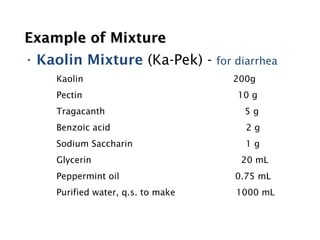
Example of Mixture
Example of Mixture
• Kaolin Mixture (Ka-Pek) - for diarrhea
Kaolin 200g
Pectin 10 g
Tragacanth 5 g
Benzoic acid 2 g
Sodium Saccharin 1 g
Glycerin 20 mL
Peppermint oil 0.75 mL
Purified water, q.s. to make 1000 mL
EXTRACTIVES
Extraction involves the separation of medicinally active
portions of plant or animal tissues from the
inactive components through the use of selective
solvents
Galenicals include classes of preparations knows as:
1. Decoction
2. Infusion
3. Fluidextracts
4. Tinctures
5. Pilular (semi solid) extracts
6. Powdered extracts
Methods of Extraction
1. Maceration
• term derived from latin word “macerare”
meaning to soak.
• Process in which the properly comminuted
drug is permitted to soak in the menstruum
and the soluble constituents are dissolved
Examples: (Process M)
Compound Benzoin, Sweet orange Peel
Tincture; Compound Cardamon; Tolu Balsam
Tincture
Methods of Extraction
2. Percolation – Per =“through”; Colare = “strain”
The process in which the comminuted drug is extracted
of its soluble constituents by the slow passage of a
suitable solvent through a column of drug.
The drug is packed in a special extraction apparatus
termed as percolator with the extractive collected called
the percolate
Different shapes of percolator
1. Cylindrical with little if any taper except for the lower
orifice also called Oldberg percolator
2. Cylindrical like but with a definite taper downward
3. Conical or funnel shape
The choice of type of Percolator depends upon
1. Nature of the drug
2. Type of product prepared
3. Quantity of drug to be extracted
Processes and steps of Percolation
1. Preparation of the dried crude drug for percolation
a. Powdering
b. Moistening
2. Packing the percolator
3. Period of Maceration
4. Percolation and collection of percolate
5. Adjustment of concentration of percolation as required
The rates of flow
1. Percolate slowly – rate will not exceeding 1 mL of
percolate/minute
2. Percolate at a moderate rate - rate of 1 to 3mL/minute.
3. Percolate rapidly – rate of 3 to 5 mL per minute.
Methods of Extraction
3. Digestion
form of maceration with gentle heat
4. Infusion
process in which vegetable drugs, generally coarsely
comminuted, are extracted of the water-soluble constituents
5. Decoction
process of boiling vegetable substances with water to
extract the soluble principles
EXTRACTS
EXTRACTS
Are concentrated preparations of vegetable or
animal drugs obtained by removal of the active
constituents of the respective drugs with suitable
menstruum, evaporation of all or nearly all the
solvents, and adjustment of the residual masses or
powders to the prescribed standards.
Methods of Preparation
Prepared by percolation then evaporation off
the solvent either by distillation under pressured and
using reduced heat.
3 Forms of Extract (depending upon
the extent of the removal of solvent)
1. Semiliquid extracts are those of a syrupy
consistency
2. Pilular or solid extracts of a plastic consistency
3. Powdered extracts prepared to be dry by the
removal of all the solvent
Packaging and Storage of Extracts
Must be packaged in wide mouth containers or plastic
tubes and closely tight to prevent loss of moisture which would
result in its becoming hard and unstable for use
Examples: Belladonna Extract NF; Cascara Sagrada
Extract NF and Pure Glycyrrhiza Extract
TINCTURES
Are defined as alcoholic or hydro alcoholic solution
prepared from vegetable material or from chemical
substance.
TOPICAL SOLUTIONS AND TINCTURES
Topical solutions employ an aqueous vehicle, whereas the
topical tinctures characteristically employ an alcoholic vehicle. As
required, co-solvents or adjuncts to enhance stability or the
solubility of the solute are employed.
Topical solutions and Tinctures are prepared by simple
solution and self -preserved.
Are usually packaged in glass bottles having an applicator
tip as part of the cap assembly, or in plastic squeeze bottles which
deliver the medication in drops.
All medication intended for external use should be clearly
labeled “FOR EXTERNAL USE ONLY” and kept out of the reach of
youngsters.
Examples Of Solutions Applied Topically
1. Aluminum acetate - Aqueous vehicle -
Astringent (Burow’s Solution)
2. Aluminum Subacetate - Aqueous vehicle -
Astringent (Modified Burow’s)
3. Calcium Hydroxide - Aqueous vehicle -
Astringent - (Lime Water; Liquor Calcis)
4. Coal Tar - Alcoholic vehicle - Antieczematic,
antipsoriatic (Liquor Carbonis Detergens:
Liquor Picis carbonis; LCD)
5. Hydrogen Peroxide Topical Solution -
Aqueous vehicle - Anti-infective (Peroxide)
6. Chlorhexidine Gluconate Solution - for skin wound
and general skin cleanser, surgical scrub, and
preoperative skin preparation, effective in gram negative
and positive such as Pseudomonas aeruginosa
7. Povidone-Iodine - Aqueous vehicle - Anti-infective
(Betadine Solution)
8. Thimerosal - Aqueous vehicle - Antibacterial and
mild fungistatic (Merthiolate Solution)
Examples Of Tinctures Applied Topically
1. Green soap Tincture - Alcohol vehicle - Detergent.
Also contains 2% lavender oil as perfume
2. Iodine Tincture - Alcohol - water vehicle - Anti-
infective
3. Compound Benzoin Tincture - alcohol - Topical
protectant
Variations of Official Tinctures are on:
1. Method of Preparation
2. Strength of their active constituent
3. Alcohol content
4. Intended use in medicine or pharmacy
Method of Preparation of Tinctures
1. By simple solution - tinctures prepared from
chemical substances.
Example: Iodine, Thimerosal, Nitromersol
green soap tinctures
2. By extraction - by maceration or percolation
Examples: Compound Cardamon
Tincture
Strength of their Active components
• There is no set strength for compound tincture. They vary
with particular preparation.
• The amount of crude drugs used to prepare each 100mL of
tincture is generally as follows: (Belladona Tincture)
• Potent drugs: Balledona leaf –10 g
• Non potent drug: Tolu Balsam – 20 g
• Undried fresh fruit peel: sweet orange peel – 50 g
Preparation of Tinctures
1. Maceration
Examples: Compound Benzoin Tinctures; Sweet Orange
Peel Tincture and ToLu Balsam Tincture
2. Percolation
Examples: Belladona Tincture and Vanilla Tincture
Alcohol Content
Tinctures are considered to be stable preparation
containing alcohol to protect against microbial growth.
Green soap Tincture - 28 to 32% alcohol
Tolu Balsam Tincture - 77 to 83% alcohol
Pharmaceutical Uses
As flavoring tinctures like vanilla, sweet orange
peel, Tolu balsam tinctures.
Medicinal use - Iodine Tincture, Thimerosal,
Nitromersol Tinctures - Anti-infective; Compound Benzoin
Tincture - Topical protectant; Green soap Tincture - Topical
detergent; Paregoric Tincture - Antiperistalsis; Belladona
Tincture - Anticholinergic
Disadvantages of Tinctures
1. Unpleasant tasting
2. Physician will prefer single drug instead of preparation
from plants
3. High alcohol content
FLUIDEXTRACT
Are liquid preparations of vegetable drugs containing
alcohol as a solvent or as a preservative or both, and so
made that each mL contains the therapeutic
constituents of 1g of the standard drug that it
represents
Characteristics of Fluidextract
1. Because they contain alcohol and are highly
concentrated, fluidextracts are sometimes referred to
as “100% tinctures”
2. Fluidextracts of potent drugs are ten times as
concentrated or as potent as corresponding tincture
Example: Belladonna Tincture is 0.6mL while its
fluidextract is 0.06mL
Disadvantages of Fluidextract
1. Because of their concentrated nature, many
fluidextracts are considered too potent for safe self
administration
2. Too bitter tasting or otherwise unpalatable
Preparations of Fluidextracts
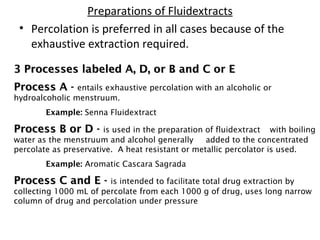
• Percolation is preferred in all cases because of the
exhaustive extraction required.
3 Processes labeled A, D, or B and C or E
Process A -
Process A - entails exhaustive percolation with an alcoholic or
hydroalcoholic menstruum.
Example: Senna Fluidextract
Process B or D -
Process B or D - is used in the preparation of fluidextract with boiling
water as the menstruum and alcohol generally added to the concentrated
percolate as preservative. A heat resistant or metallic percolator is used.
Example: Aromatic Cascara Sagrada
Process C and E -
Process C and E - is intended to facilitate total drug extraction by
collecting 1000 mL of percolate from each 1000 g of drug, uses long narrow
column of drug and percolation under pressure
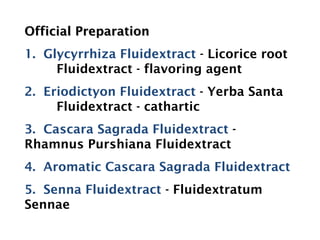
Official Preparation
1. Glycyrrhiza Fluidextract - Licorice root
Fluidextract - flavoring agent
2. Eriodictyon Fluidextract - Yerba Santa
Fluidextract - cathartic
3. Cascara Sagrada Fluidextract -
Rhamnus Purshiana Fluidextract
4. Aromatic Cascara Sagrada Fluidextract
5. Senna Fluidextract - Fluidextratum
Sennae
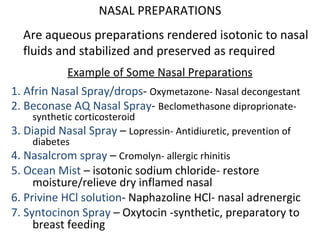
NASAL PREPARATIONS
Are aqueous preparations rendered isotonic to nasal
fluids and stabilized and preserved as required
Example of Some Nasal Preparations
1. Afrin Nasal Spray/drops- Oxymetazone- Nasal decongestant
2. Beconase AQ Nasal Spray- Beclomethasone diproprionate-
synthetic corticosteroid
3. Diapid Nasal Spray – Lopressin- Antidiuretic, prevention of
diabetes
4. Nasalcrom spray – Cromolyn- allergic rhinitis
5. Ocean Mist – isotonic sodium chloride- restore
moisture/relieve dry inflamed nasal
6. Privine HCl solution- Naphazoline HCl- nasal adrenergic
7. Syntocinon Spray – Oxytocin -synthetic, preparatory to
breast feeding
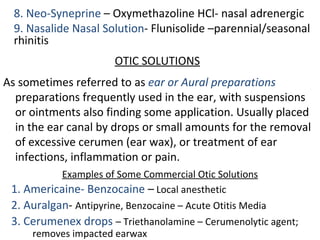
8. Neo-Syneprine – Oxymethazoline HCl- nasal adrenergic
9. Nasalide Nasal Solution- Flunisolide –parennial/seasonal
rhinitis
OTIC SOLUTIONS
As sometimes referred to as ear or Aural preparations
preparations frequently used in the ear, with suspensions
or ointments also finding some application. Usually placed
in the ear canal by drops or small amounts for the removal
of excessive cerumen (ear wax), or treatment of ear
infections, inflammation or pain.
Examples of Some Commercial Otic Solutions
1. Americaine- Benzocaine – Local anesthetic
2. Auralgan- Antipyrine, Benzocaine – Acute Otitis Media
3. Cerumenex drops – Triethanolamine – Cerumenolytic agent;
removes impacted earwax
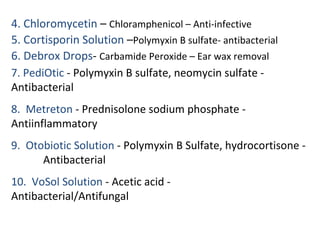
4. Chloromycetin – Chloramphenicol – Anti-infective
5. Cortisporin Solution –Polymyxin B sulfate- antibacterial
6. Debrox Drops- Carbamide Peroxide – Ear wax removal
7. PediOtic - Polymyxin B sulfate, neomycin sulfate -
Antibacterial
8. Metreton - Prednisolone sodium phosphate -
Antiinflammatory
9. Otobiotic Solution - Polymyxin B Sulfate, hydrocortisone -
Antibacterial
10. VoSol Solution - Acetic acid -
Antibacterial/Antifungal
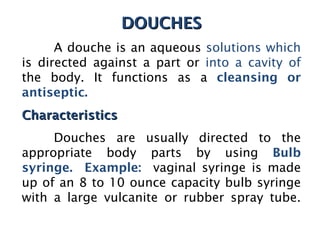
DOUCHES
DOUCHES
A douche is an aqueous solutions which
is directed against a part or into a cavity of
the body. It functions as a cleansing or
antiseptic.
Characteristics
Characteristics
Douches are usually directed to the
appropriate body parts by using Bulb
syringe. Example: vaginal syringe is made
up of an 8 to 10 ounce capacity bulb syringe
with a large vulcanite or rubber spray tube.
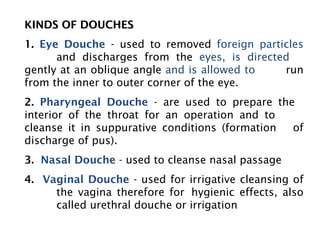
KINDS OF DOUCHES
KINDS OF DOUCHES
1. Eye Douche - used to removed foreign particles
and discharges from the eyes, is directed
gently at an oblique angle and is allowed to run
from the inner to outer corner of the eye.
2. Pharyngeal Douche - are used to prepare the
interior of the throat for an operation and to
cleanse it in suppurative conditions (formation of
discharge of pus).
3. Nasal Douche - used to cleanse nasal passage
4. Vaginal Douche - used for irrigative cleansing of
the vagina therefore for hygienic effects, also
called urethral douche or irrigation
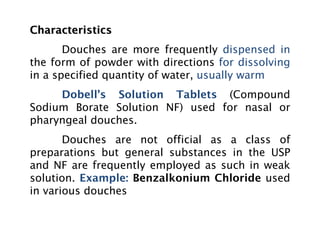
Characteristics
Characteristics
Douches are more frequently dispensed in
the form of powder with directions for dissolving
in a specified quantity of water, usually warm
Dobell’s Solution Tablets (Compound
Sodium Borate Solution NF) used for nasal or
pharyngeal douches.
Douches are not official as a class of
preparations but general substances in the USP
and NF are frequently employed as such in weak
solution. Example: Benzalkonium Chloride used
in various douches
ENEMAS
ENEMAS
Enemas are also known as CLYSTER, they are
rectal injections employed to:
1. Evacuate the bowel
2. To influence the general system by absorption
3. Affect locally the seat of disease and for
4. For diagnostic visualization of GIT
USES:
USES: antihelmintic, nutritive, sedative or
stimulating properties or they may contain
radiopaque substances for roentgenographic
examination of the lower bowel
Characteristics:
Characteristics:
Enemas are usually given at body temperature
in quantities of 1 to 2 pints injected slowly with
enema syringe.
If they are to be retained in the intestine, they
should not be used in larger quantities than 6 fluid
ounces for an adult.
Examples:
Examples:
1. Enema of soft soap - prepared by dissolving 50 g
of soft soap with purified water to make 1000 mL.
Example
Example
Preparation: Barium Sulfate Enema
Synonym: Barium Salt
Latin Name : Baric Sulfae
Formula : Barium Sulfate 120 g
Acacia Mucilage 100 mL
Starch Enema, q.s
To make 500 mL
Procedure: Prepared by mixing Barium Sulfate (120 g)
with 100 mLof acacia mucilage and sufficient Starch Enema
to make 500 mL Starch Enema is made by triturating 30 g
of powdered starch with 200 mL cold water then sufficient
quantity of water added to make 1 Liter.
Use: For diagnostic visualization of GIT
2 Types Of Enema
2 Types Of Enema
1. Evacuation Enemas - are rectal enemas employed to
promote evacuation of bowel and to cleanse the colon for
retention and for diagnosis. Available in disposable
plastic squeeze bottles containing a pre measured
amount of enema solution.
The agents present are solutions of sodium phosphate,
sodium biphosphate, glycerin and docusate potassium
and light mineral oil.
2. Retention Enemas - a number of solutions are
administered rectally for the local effects of the
medication
Examples: Hydrocortisone - local; aminophylline -
systemic effect
Types Of Retention Enema
1. Nutritive Enema
1. Nutritive Enema - supply nutrient to the patient
2. Medicated Enema -
2. Medicated Enema - supply medication for
systemic effect
3. Disgnostic Enema -
3. Disgnostic Enema - BaSO4 and Fleet Enema
Other Enemas
Other Enemas
1. Aminophylline Enema - NLT 90% and NMT 110%
of C6H24N10 . 2H2O
2. Methyl Prednisolone Acetate - NLT 90% and NMT
110% of C24H32O6
3. Cortisol Enema - NLT 90% and NMT 110% of
C21H30O5
Miscellaneous Preparations for Topical Application
1. Rubbing Alcohol contains about 70% of ethyl alcohol by
volume, the remainder consisting of water, denaturants
with or without color additives and perfume oils, and
stabilizers.
Uses: employed as rubefacient externally, as a soothing
rub for bedridden patients, a germicide for instrument,
and skin cleanser prior to injection
Synonym: Alcohol Rubbing Compound
2. Isopropyl Rubbing Alcohol is about 70% by volume of
isopropyl alcohol, the remainder consisting of water with or
without color additives, stabilizers, and perfume oils.
Uses: as rubefacient and soothing rub; 91% isopropyl
alcohol - employed by diabetic patients in preparing
needles and syringes for hypodermic injections of insulin
and for disinfecting the skin
Miscellaneous Preparations for Topical
Application
Application
3. Hexachlorophene Liquid Cleanser - is an
antibacterial sudsing emulsion containing colloidal
dispersion of hexachlorophene 3% W/W in a stable
emulsion consisting of entsufon sodium (synthetic
detergent), petrolatum,lanolin cholesterols,
methylcellulose, polyethylene glycol, PG
monostearate, lauryl myristyl diethanolamide,
sodium benzoate and water
Uses: bacteriostatic cleansing agent, surgical
scrub
LINIMENTS
LINIMENTS
Are alcoholic or oleaginous solutions or
emulsions of various medicinal substances intended
for external application to the skin, generally with
rubbing. Formerly called “embrocations” for
substance applied with rubbing.
Types Of Liniments
Types Of Liniments
1. Alcoholic liniments
2. Oil
3. Dental liniments - not official
Different Forms by which Liniments can occur
1. As a emulsion
2. As a suspension
3. As a solution
Components of Liniments
1. Counterirritant 3. Local Anesthetics
2. Antiseptic 4. Analgesics
Alcoholic liniment - used as rubefacient ( induce mild
irritation with reddening of the skin), counterirritant,
mildly astringent, and penetrating effect.
Oily liniment are milder in action and less
irritating to the skin than the alcoholic, used as
protective coating and use as rubefacient for muscular
pain
Methods of Preparation
Liniments are prepared in the same manner
as solutions, emulsions or suspensions
All liniments Must Bear A Label
Indicating
Indicating
1. For external use only
2. Shake well for emulsion or suspension
3. Store in tight containers
4. Not to be applied to bruises or broken
skin areas
Factors to be considered in using solvents or
vehicle
vehicle
1. Type of action desired, whether rubefacient,
counterirritant or just massage - alcohol or
oil
2. Solubility of the desired components in the
various solvents. For oleaginous liniments -
the solvents may be fixed oil, almond oil,
peanut oil, sesame oil or cotton seed oil or
volatile oil such as wintergreen or turpentine
oil or combination of fixed or volatile oil.
NOTE: There are presently no official liniments in
the USP and NF
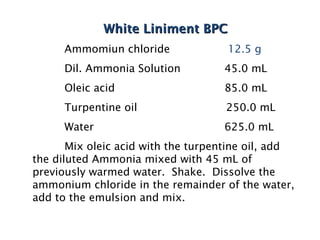
White Liniment BPC
White Liniment BPC
Ammomiun chloride 12.5 g
Dil. Ammonia Solution 45.0 mL
Oleic acid 85.0 mL
Turpentine oil 250.0 mL
Water 625.0 mL
Mix oleic acid with the turpentine oil, add
the diluted Ammonia mixed with 45 mL of
previously warmed water. Shake. Dissolve the
ammonium chloride in the remainder of the water,
add to the emulsion and mix.
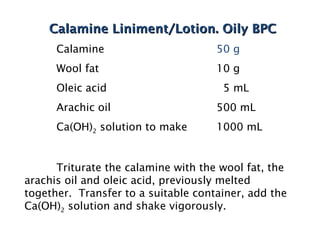
Calamine Liniment/Lotion. Oily BPC
Calamine 50 g
Wool fat 10 g
Oleic acid 5 mL
Arachic oil 500 mL
Ca(OH)2 solution to make 1000 mL
Triturate the calamine with the wool fat, the
arachis oil and oleic acid, previously melted
together. Transfer to a suitable container, add the
Ca(OH)2 solution and shake vigorously.
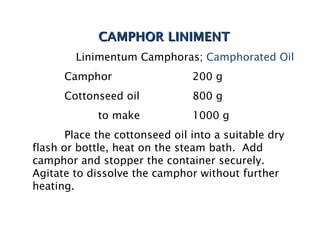
CAMPHOR LINIMENT
CAMPHOR LINIMENT
Linimentum Camphoras; Camphorated Oil
Camphor 200 g
Cottonseed oil 800 g
to make 1000 g
Place the cottonseed oil into a suitable dry
flash or bottle, heat on the steam bath. Add
camphor and stopper the container securely.
Agitate to dissolve the camphor without further
heating.

c-13solutionsedited.pdf

  • 1.
    Solutions - In physicochemicalterms, solutions may be prepared from any combination of solid, liquid or gas, the three states of matter - Liquid preparations that contain one or more soluble chemical substances dissolved in a suitable solvent or mixture of mutually miscible solvents -Homogenous mixture that is prepared by dissolving a solid, liquid or gas in another liquid and represents a group of preparations in which the molecules of the solute or dissolved substance are dispersed.
  • 2.
    Types of Solutions 1.Solid Solution – the solvent is solid a. Solid in solid Example: Cu + gold= 12 karat yellow gold b. Liquid in solid Example: Hg dissolved in Ag = amalgam c. Gas in solid Example: air dissolved in soap = floating soap 2. Liquid Solution – the solvent is liquid a. solid in liquid Ex: salt in water b. Liquid in liquid Ex: alcohol and water c. Gases in liquid Ex: carbonated beverages
  • 3.
    3. Gaseous Solutions– the solvent is gas a. Solid in gas Example: sulfur in air b. Liquid in gas Example: water vapor in air c. Gas in gas Example: oxygenated air Factors affecting the “rate” of solubility 1. Particle size – an increase in surface area to the solvent will increase rate of solution. So the particle size should be reduced by comminution before it is dissolved. 2. Agitation – increases the rate of solution by removing from the surface of the solute. The more concentrated solution around it the less concentrated the solvent.
  • 4.
    3. Temperature heating aliquid also causes solution to take place more rapidly by increasing the frequency which solvent molecules collide with the surface of the dissolving mixture Factors Affecting Solubility of Solute 1. Temperature Endothermic reaction – The process of solution where heat is applied and absorption of the heat takes place in the solutes, this increase in temperature will cause more of the solute to go into solution.
  • 5.
    Exothermic reaction –solute gives off heat during the process of solution; solubility is decreased with an increase in temperature. Example: more soluble in cold than hot water Methyl cellulose and calcium salts such as Ca(OH)2 2. Molecular Structure The general rule: “like dissolves like” 3. Effects of other substance Example: Iodine is very slightly soluble in water but when added to a concentrated solution of KI dissolves immediately. 4. pH – Many of the organic substances which are used medicinally are either weak acids or weak bases. And their aqueous solubility depend upon the pH of the solvent.
  • 6.
    Examples of Weak Bases •Alkaloids – atropine,codeine, morphine • Antihistamines – diphenhydramine, tripelennamine • Local anesthetics – cocaine, procaine, tetracaine Examples of Weak Acids • Barbiturates – phenobarbital, pentobarbital • Sulfonamides – sulfadiazine, sulfacetamide
  • 7.
    Water and alcoholSolubilities Of some Selected Water and alcohol Solubilities Of some Selected Weak Acids, Weak Bases, and Their Salts Weak Acids, Weak Bases, and Their Salts Number of mL of Solvent Required To Dissolve 1 g of Drug Drug Water Alcohol Atropine 455 2 Atropine Sulfate 0.5 5 Codeine 120 2 Codeine Sulfate 30 1,280 Codeine Phosphate 2.5 325 Morphine 5,000 210 Morphine Sulfate 16 565 Phenobarbital 1,000 8 Phenobarbital sodium 1 10 Procaine 200 soluble Procaine HCl 1 15 Sulfadiazine 13,000 sparingly soluble Sodium Sulfadiazine 2 Slightly soluble
  • 8.
    Relative Terms ofSolubility Descriptive Term Parts of Solvent required Very Soluble Freely soluble Soluble Sparingly soluble Slightly soluble Very slightly soluble Practically soluble or Insoluble Less than 1 From 1 to 10 From 10 to 30 From 30 to 100 From 100 to 1000 From 1000 to 10,000 From 10,000 and over
  • 9.
    Solubilities Of SelectedOrganic Compounds in Water as a Solubilities Of Selected Organic Compounds in Water as a Demonstration of Chemical Structure-Solubility Relationship Demonstration of Chemical Structure-Solubility Relationship Number of mL of water Required to Compound Formula Dissolved 1 g of compound Benzene C6H6 1430 Benzoic acid C6H5COOH 275 Benzyl Alcohol C6H5CH2OH 25 Phenol C6H5OH 15 Pyrocatechol C6H4(OH) 2 2.3 Pyrogallol C6H3(OH) 3 1.7 Carbon Tetrachloride CCl4 2000 Chloroform CHCl3 200 Methylene chloride CH2Cl2 50
  • 10.
    Inorganic Molecules 1. Monovalentcation and anion of an ionic compound are generally water soluble Examples: NaCl, LiBr, KI, NH4NO3 2. Only one of the two ions is monovalent – compounds are water soluble Examples: BaCl2, MgI2, Na2SO4, Na3 PO4 3. Both ions are multivalent - poor water soluble. Examples: CaSO4, BaSO4, BiPO4 Exceptions: ZnSO4 and FeSO4 4. Common salts of alkali metals are usually water soluble Exception: Li2CO3
  • 11.
    5. NH4 andquaternary NH4 salts are water soluble 6. Nitrates, Nitrites, acetates, chlorates and lactates are generally water soluble Exceptions: silver and mercurous acetate 7. Sulfates, sulfites and thiosulfates are generally water soluble Exceptions: Calcium and Barium salts 8. Chlorides, bromides and iodides are water soluble Exceptions: salts of silver and mercurous ions 9. Acid salts corresponding to an insoluble salt will be more water soluble than organic salts. 10. Hydroxides and oxides of compounds other than alkali metal cations and the ammonium ion are generally water insoluble.
  • 12.
    11. Sulfides arewater insoluble except for their alkali metal salts 12. Phosphates, carbonates, silicates, borates and hypochlorites are water insoluble except for their alkali metal salts and ammonium salts Organic Molecules 1. Molecules having 1 polar functional group – soluble to the the total lengths of 5C’s 2. Molecules having branched chains are more soluble than the corresponding straight-chain compound. 3. Water solubility decreases with increase in MW 4. Increased structural similarity between solute and solvents accompanied by increase solubility.
  • 13.
    Solvents for LiquidPreparations 1. Water – has the widest range of usefulness of all the solvents employed in pharmaceutical dispensing or manufacturing. It is a good solvent for most inorganic and organic 2. Alcohol USP, Ethyl Alcohol, Ethanol – good solvent for many organic substances both natural and synthetic. Is 94.9 to 96.0% alcohol at 15.560 C. Limit: 0.5% = 6 to 12 years, 5% = over 12, 10% = adult 3. Dehydrated Alcohol – 99.5% absolute alcohol is partially free from water.
  • 14.
    4. Diluted AlcoholNF- prepared by mixing equal volume of Alcohol USP and purified water. 5. Alcohol, Rubbing – contains about 70% of ethyl alcohol by volume the remainder consists of water, denaturants with or without color additives and perfume oils and stabilizers. 6. Glycerin USP ( Glycerol) – clear syrupy liquid with sweet taste. It is miscible both with water and alcohol. Excellent solvent for tannins, phenol and boric acid. It has a preservative qualities. 7. Propylene Glycol – miscible in water, acetone, alcohol and chloroform 8. Polyethylene glycol 400 – miscible in water, acetone alcohol and other glycols 9. Chloroform – miscible with alcohol, ether, benzene, hexane and both fixed and volatile oils 10. Acetone – miscible with water, alcohol, ether, chloroform and most of the volatile oils.
  • 15.
    Methods of PreparingSolutions 1. Simple Solution – prepared by dissolving the solute in the solvent Examples: Calcium hydroxide solution USP (lime water), Sodium Phosphate solution and Strong Iodine solution USP (lugol’s) 2. Solution by Chemical reaction – prepared by reacting two or more solutes with each other in a suitable solvent. Examples: Aluminum subacetate – prepared by reacting aluminum sulfate sol. with calcium carbonate and acetic acid forming magma.
  • 16.
    Magnesium Citrate =prepared by reacting official magnesium carbonate with citric acid, flavoring and sweetening agents, filtering talc and carbonating it by potassium or sodium bicarbonate. Use: Saline cathartic Sodium Citrate and Citric acid oral solution = contains 100 mg sodium citrate and 67 mg citric acid in each ml od aqueous solution. Use: Systemic alkalinizer 3. Solution by Extraction – vegetables or animal origin are often extracted with suitable solvent. Preparation of this type may be classified as solutions but more often EXTRACTIVES
  • 17.
    Common Methods ofExpressing the Strengths Of Pharmaceutical Preparations Percent weight in volume - number of grams of a constituents in 100mL of preparation (1% w/v = 1g of constituent in 100mL of preparation) Percent volume in volume - number of mL of constituent in 100mL of preparation (1%v/v 1 mL of constituent in 100mL of preparation) Percent weight in weight - no. of grams of a constituent in 100g of preparation (1%w/w = 1g of constituent in 100g of preparation)
  • 18.
    Common Methods ofExpressing the Strengths Of Pharmaceutical Preparations Ratio strength weigh in volume - w/v no. of grams of constituent in stated no. of mL of preparation (1:1000w/v = 1g of constituent in 1000mL of preparation) Ratio strength volume in volume – v/v no. of mL of constituent in stated number of mL of preparation (1:1000 v/v = 1mL of constituent in 1000mL preparation) Ratio strength weight in weight – w/w number of grams of constituent in stated number of grams of preparation (1:1000 w/w = 1g of constituent in 1000g of
  • 19.
    Examples of OralSolution by Category 1. Antidepressants Notriptylline HCl – Pamelor Oral Solution Fluoxetine HCl – Prozac Liquid 2. Antiperistaltic Diphennoxylate HCl and Atropine Sulfate- Lomotil Liquid Loperamide HCl- Immodium A-D Liquid 3. Bronchidilator Theophylline – Theophylline Oral Solution 4. Antipsychotics Haloperidol – Haldol Concentrate Perphenazine – Trilafon Concentrate Thiothixene HCl – Navane Concentrate
  • 20.
    5. Cathartics Magnesium citrate SodiumPhosphate – Phospho-Soda (fleet) 6. Corticosteroid Prednisolone Sodium Phosphate- Pediapreu Oral Solution 7. Dental Care Protectant Sodium Flouride – Pediaflor Drops 8. Electrolyte Replenisher Potassium Chloride – KaoChlor 10% Liquid 9. Fecal Softener Docusate Sodium- Colace syrup
  • 21.
    10. Hematinic Ferrous Sulfate- Fer-in-sol Drops 11. Histamine hydrogen Antagonist Cimetidine HCl liquid – Tagamet HCl Liquid 12. Narcotic Agonist Analgesic Methadone HCl – Methadone HCl 13. Vitamin D source Ergocalciferol – Calciferol drops
  • 22.
    AQUEOUS SOLUTIONS Is onewhere water is used as a major ingredient. Water is used as a vehicle and a solvent for the desired flavoring or medical agent. CHARACTERISTICS OF WATER 1. Tasteless 2. Freedom from irritating qualities 3. Lack of pharmacologic activity DISADVANTAGES 1. Favorable medium for many chemical reactions 2. Support growth of microorganisms when contaminated 3. In pure form add cost to production
  • 23.
    PREPARATION 1. Distillation 2. Demineralizationor Deionization 3. Reverse Osmosis **Demineralization – This ionization process is the well known Zeolite process of softening water high mineral content. This resin may be acid or cations exchanger and base or anion exchanger. • Zeolite – act as a catalyst such as dehydrated aluminum. Calcium sodium sulfate. * Deionization process do not necessarily produce purified water which will comply with USPHS ( US Public Health Service) requirements for drinking water, the water should be purified before they can used for pharmaceuticals
  • 24.
    **Reverse Osmosis –Transport of solvent through semipermeable membrane separating 2 solutions of different concentrations (less concentrated and more concentrated) A reversely new separation process w/c in principle may be applied to the separation, concentration and fractionalization of inorganic or organic substances in aqueous or non-aqueous solutions in the liquid or the gaseous phase is known reverse osmosis. Also referred as “crossflow or tangential flow” membrane filtration
  • 25.
    PORE SIZE 2. Microfiltration(0.1 to 2 microns) = bacteria 3. Ultrafiltration (0.01 to 0.1 microns) = virus 4. Nanofiltration (0.001 to 0.01 microns) = organic compounds in the MW of 300 to 1000 5. Reverse Osmosis (smaller than 0.001 microns
  • 26.
    AROMATIC WATERS Aromatic wateris also called medicated water, defined in the USP as clear, saturated aqueous solutions of volatile oils or other aromatic or volatile substances. These are to be free from 1. Smoke like odor and other odors 5. Must have odor and taste similar to those oil or drugs from which they are prepared. 2 Components 1. Volatile oil 2. Water
  • 27.
    Official Processes ofPreparation 1. Distillation Cohobation – is the process of obtaining aromatic water by distillation one or more times from delicate drugs with small quantities of volatile principles. Examples: Stronger Rose( Aqua Rose Fertier, Triple Rose Water) 2. Solution Method A. Simple Solution Method Example: Peppermint water Concentrate Synonyms: Aqua Mint, American Mint Latin name: Aqua Menthae Piperitae
  • 28.
    Formula: Peppermint oil 20mL 90%Ethanol600mL Purified Talc 50g Purified Water q.s.to make1000mL Uses: Vehicle for internal aqueous sol. Carminative, flavoring diluent Description: Clear, saturated solution B. Alternate Solution by Intervention - The volatile material is mixed thoroughly with 15g of purified talc. -The mixture is agitated with purified water for ten minutes prior to filtration. - The disadvantage of this method is the fineness of the filter aid which passes through the filter paper.
  • 29.
    AROMATIC WATER Stability Aromatic waterare not permanently stable preparations Preservation of Aromatic Water Protect from excessive light and heat. Deterioration may due to volatilization. Decomposition or mold growth producing cloudy preparation or disagreeable odor. Orange Flower Water, NF Synonyms: Aqua Auranti Florum, Shanger Orange Flower, Triple Orange Flower water Formula: It is a saturated solution of odoriferous principles of flowers of Citrus Aurantum Linne. Uses: A Flavored vehicle and perfume in solutions, syrup and elixirs. Other examples Of water
  • 30.
    Cinnamon Water Preparation: CinnamonWater Synonym: Casio Nare, Cassia Oil Latin Name: Aqua Cinnamoni Formula: Cinnamon oil 20mL Ethanol 90% 600mL Purified Talc 50g Purified water q.s. to make 1000mL Procedure: Alternate Solution Method Uses: As flavored vehicle for internal aqueous solution, antiseptic in eye lotion, carminative Description: Clear, Saturated Solution
  • 31.
    AQUEOUS ACIDS Inorganic andorganic acids such as HCl, HNO3, HI, HBr, H2SO4, and Hac., of great importance in chemical and pharmaceutical manufacturing Division of inorganic acids 1. Hydroacids – no oxygen 2. Oxygen containing acids
  • 32.
    Diluted Acetic Acid Synonym:Dilute Acetic acid Latin Name: Acidum Aceticum Dilatum Formula: Acetic Acid 158mL Purified water q.s. to make 1000mL Uses: Bactericidal and occasionally used in 1% solution for surgical dressings of the skin; 1% spermatocidal, as vaginal douche Description: Clear, colorless, having a strong characteristic odor and sharply acid taste, miscible with water.
  • 33.
    Examples of OfficialAcids Although Not All of them are Aqueous acids 1. Acetic Acid 7. Folic Acid 2. Diluted Acetic Acid 8. Citric Acid 3. Glacial Acetic Acid 9. Folic Acid 4. Diluted Hydroiodic Acid 10. Phosphoric Acid 5. Diluted Hydrochloric Acid 11. Tartaric Acid 6. Hypophosphorous Acid 12. Salicylic Acid
  • 34.
    GARGLES Are aqueous solutionsused for treating the pharynx and nasopharynx by forcing air from the lungs through gargle which is held in the throat. Many gargles must be diluted with water prior to use.
  • 35.
    Gargles Examples: Phenol Gargleand Potassium Chlorate (also known as Golden Gargle) and Phenol Gargle are official in B.P.C Preparation: Phenol Gargle Synonym: Phenolic Solution, Carbolic gargle Latin name: Gargarisma Phenol Formula: Contains 50mL of Phenol Glycerin (16% w/w phenol and 84% w/w glycerin), 10mL amaranth solution(1%w/v in chloroform water) and water to make 1L. This is diluted with warm water equal volume before use . For external use Uses: antiseptic and soothing effect
  • 36.
    WASHES (LAVATIO ORI) Amouthwash is an aqueous solution which is most often used for its 1. Deodorant 2. Refreshing 3. Antiseptic effect It may contain alcohol, glycerin, synthetic sweeteners, surface active agent, flavoring and coloring. Commercial preparations contain local anti-infective agents: hexetidine and cetylpyridinium chloride.
  • 37.
    Examples: 1. Dobell’s solutionor compound Sodium Borate NF – contains Sodium borate. Liquified Phenol and Glycerin and sodium Bicarbonate – use: antiseptic 2. Compound Sodium Chloride Mouthwash – Zinc sulfate and ZnCl2 Special Washes 1. Eye washes (Collyrium) - as anesthetic, anti- infective, diagnostic, myotic and anti- inflammatory 2. Mouthwash (Collutorium)- antibacterial 3. Nasal wash ( Collunarium) - antibacterial and antiseptic
  • 38.
    JUICES Juices are formerlyknown as INPISSATED JUICES. A juice prepared from ripe fruit, aqueous in character, and it is used in making syrups employed as vehicle. Examples: Cherry juice and Raspberry juices are official in USP
  • 39.
    SPRAYS • Aqueous solutionsin the form of coarse droplets or as finely divided solids to be applied topically, most usually to the nasal- pharyngeal tract or to skin • Applied to the mucous membrane of the nose and throat by means of an atomizer or nebulizer • Such sprays may contain antibiotics, antihistamine, vasoconstrictor, alcohol and suitable solubilizing and wetting agents • Another device to deliver spray is called “spray-o- mizer”, this is for throat Examples: Nasalide(Syntex), Nostrilla
  • 40.
    COLLODIONS COLLODIONS Are liquid preparationcomposed by pyroxillin dissolved a solvent mixture. Usually composed of alcohol and ether with or without added substances Pyroxillin (nitrocellulose soluble gun cotton, collodion cotton) is obtained by the action of mixture of nitric acid and sulfuric acids on cotton and consists chiefly of cellulose tetranitrate.
  • 41.
    Uses Of Collodion UsesOf Collodion 1. As a protective coating to the skin 2. As medication where a thin layer of the medication is firmly placed against the skin Direction Of Use Direction Of Use Collodion are applied to the skin by means of a soft brush or other suitable applicators. The solvent rapidly evaporates, leaving a film residue of pyroxillin.
  • 42.
    Example Of OfficialCollodion Example Of Official Collodion 1. Which provides protective coating 1. Which provides protective coating A. Collodion, USP is a clear or slightly opalescent viscous liquid prepared by dissolving 4% W/V pyroxillin in 3:1 mixture of ether and alcohol. B. Flexible Collodion, USP is prepared by adding 2% of Camphor and 3% castor oil to the Collodion 2. Which provides medication A. Salicylic acid Collodion, USP is 10% solution of salicylic acid in flexible collodion. Used as keratolytic effect ( topical drug that softens the superficial keratin-containing layer of the skin and promotes its desquamation) especially in the removal of corns from the toes Synonym: Corn solvent
  • 43.
    SPIRITS Formerly called “Essences” alcoholicor hydroalcoholic solutions of volatile substances. First Spirits 1. Brandy – Spiritus Vini vitis – 48 to 54% alcohol from grapes 2. Whisky - Spiritus frumenti – 47 to 53% of alcohol from cereals Uses: 1. As flavoring agents pharmaceutically 2. For therapeutic value of the aromatic solute medicinally
  • 44.
    Preparation of Spirits 1.Simple Solution Majority of spirits are prepared by dissolving the solute in alcohol by agitation. Filtration is generally desirable to obtain a sparking clear product. Example: Aromatic Spirit - 62 to 68% hydroalcoholic solution of ammonia and ammonium carbonate flavored and perfumed with lemon, lavender and myristica oil. 2. Solution with Maceration Macerate the vegetable materials in a suitable solvent to remove the undesired constituents or to extract one which is desired. Example: Peppermint Spirit (Spiritus Menthae Piperitae) – 79 to 85% hydroalcoholic solution containing 10% peppermint oil Use: digestive aid or carminative
  • 45.
    Preparation of Spirits 3.Solution by Chemical Reaction Only the preparation of Aromatic Spirit of Ammonia NF, involves a chemical reaction where the official Ammonium carbonate 4. Distillation No spirits currently official are prepared by distillation, However, two products of historical significance which is official in NF are prepared by distillation. Examples: Brandy and whisky
  • 46.
    TOOTHACHE DROPS Are preparationsused for the temporary relief of toothache by application of a small cotton saturated with the product into the tooth cavity Example: Clove oil and mixture of phenol with camphor or creosote DENTAL ORAL SOLUTION A variety of medicinal substances are employed topically in the oral cavity. Examples: 1. Benzocaine – Topical anesthetic Indicated for temporary relief of pain, soreness and irritation in the mouth associated with teething and others 2. Caphorated Parachlorophenol – Dental anti-infective. A eutectic liquid composed of 65% camphor and 35% parachlorophenol. Use in the dentistry of the sterilization of deep root canals.
  • 47.
    3. Carbamide Peroxide– Dental anti-ineffective . Acts as chemomechanical cleansing and debriding agent through the release of bubbling oxygen. Commercial product Gly- Oxide - contains 10% carbamide in flavored anhydrous glycerin. 4. Cetylpyridinium Chloride Solution and Lozenges- Local anti-infective. Commercial counter parts. Cepacol Mouthwash/Gargles and Lozenges 5. Erythrosine Sodium Solution/tablets-Diagnostic Aid. Solution applied to the teeth to reveal plaque left by inadequate brushing. Tablets same purpose and are not to be swallowed. 6. Eugenol - Dental Analgesic. Applied to dental cavities and dental protectives
  • 48.
    7. Lidocaine OralSpray – Topical dental anesthetic. Applied through metered spray in the amount of 10mg per spray. 8. Nystatin Oral Suspension – Antifungal 9. Na Fluoride /Tablets - Dental carries prophylactic 10. Saliva Substitutes – contains electrolytes in CMC base and indicated for the relief of drymouth and throat in xerostomia • Triamcinolone Acetonide Dental Paste – Topical Anti-inflammatory • Zinc Oxide-Eugenol Mixtures – A temporary filling mix
  • 49.
    INHALATIONS - drugs orsolutions of drugs administered by the nasal or oral respiratory route. - A widely used instrument capable of producing fine particles for inhalation therapy is the nebulizers =When volatile medication is added to the water in the chamber, the medication is volatilizes and also inhaled by the patient and Humidifiers will be used =The common household vaporizer produces a fine mist of steam that may be used to humidify a room will be used also Examples: 1. Isoetharine inhalation- bronchial asthma 2. Isoproterenol inhalation- bronchial asthma
  • 50.
    INHALANTS A drugs orcombinations of drugs the by virtue of their high vapor pressure can be carried by a current into the nasal passage where they exert their effects. The device in which they bare administered is termed an inhaler Examples: 1. Amyl Nitrite inhalant – treatment of anginal pain 2. Propylhexedrine inhalant – nasal decongestant
  • 51.
    SYRUPS Syrups are concentratedsolutions of sugar (such as sucrose) in water or other aqueous liquids with or without added flavoring agents and medicinal substances 3 Types of syrups 1. Simple syrup – concentrated solution of sucrose in purified water alone. 2. Medicated syrup – aqueous solution of sucrose containing other substances as polyols(glycerin and sorbitol) 3. Non-medicated/Flavored syrup – contained various aromatic and pleasantly flavored substances and is intended as a vehicle or flavor for preparations.
  • 52.
    Classification of syrups A.Medicinal Classification 1. Non-medicated/Flavoring syrups – are used as vehicles and have no official formulas and therefore no detailed descriptions of the product are found in compedia. B. Pharmaceutical Classification Based on their basic formula 1. sugar based syrups – syrups which are concentrated solutions 2. artificial sweeteners and non-nutritive syrups – formulated with artificial sweetening agents and viscosity builders
  • 53.
    Examples of FlavoringSyrups Examples of Flavoring Syrups 1. Orange Syrup - This sucrose - based syrup utilizes sweet orange peel tincture, and citric acid as the source of flavor and tartness. Syrupus Aurantii, syrup of orange peel, sweet orange peel 50 mL;citric acid 5 g; talc 15 g; sucrose 820 g; purified water q.s to make 1000 mL 2. Ora - Sweet and Ora-Sweet SF -Commercially available vehicles for the extemporaneous compounding of Syrups. Ora sweet SF syrup is sugar free. 5.Raspberry Syrup - A sucrose - based syrup containing about 48% by volume of raspberry juice 4. Glycyrrhiza Syrup - Licorice syrup, Glycyrrhiza fluid extract 250 mL; Fennel oil 0.55 mL; Anise oil 0.5 mL; syrups, q.s to make 1000 mL
  • 54.
    5. Cocoa Syrup- Syrupus cacao, Cacao syrup, chocolate flavored, cocoa 180 g; sucrose 600 g; liquid glucose 180 g; glycerin 50 mL; Sodium chloride 2 g; Vanilla 0.2 g; Sodium benzoate 1 g; water q.s. to make 1000 mL 2.Cherry Syrup - Syrupus Gerasi - Cherry juice 475 mL; sucrose 800 g; alcohol 20 mL; water q.s. to make 1000 mL 7. Acacia Syrup - Syrupus acaciae - Acacia powder 100g; Sodium benzoate 1 g; Vanilla tincture 5 mL; Sucrose 800 g; Purified water q.s to make 1000 mL. 8. Citric acid Syrup - Syrupus Acidi Citrici, Syrup lemon - Lemon tincture 10 mL; Citric acid 10 g: Purified water q.s to make 1000 mL 9. Simple Syrup - This is an 85% of sucrose in purified water. This simple syrup may be used as the basis for the preparation of flavored or medicated syrup.
  • 55.
    2. Medicated Syrups- contain ingredients giving them therapeutic value Example: Ephedrine Sulfate Syrup -(for cough) - Ephedrine sulfate 4 g; Citric acid 1 g;Amaranth solution 4 mL; Caramel 0.4 g; Lemon oil 0.125 mL; orange oil 0.25 mL; Benzaldehyde 0.06 mL; Vanillin 0.016 g; alcohol 25 mL; Sucrose 800 g; Purified water, q.s to make 1000 mL Ipecac Syrup - emetic Note: Some syrup are use as Cathartic, Cholinergic, Decongestant, Expectorant, Fecal Softener, Sedative and others Examples Of Medicated Syrups By Category Examples Of Medicated Syrups By Category 1. Analgesic Meperidine HCl Syrup - Demerol Syrup 2. Anticholinergics Dicyclomine HCl Syrup - Bentyl Syrup Oxybutynin Chloride - Ditropan syrup
  • 56.
    3. Antiemetics Chlorpromazine HClSyrup - Thorazine Syrup Dimenhydrinate Syrup - Childrens Dramamine Liquid Prochlorperazine Edisylate - Compazine Syrup Promethazine HCl - Phenergan Syrup 4. Anticonvulsant Sodium Valproate Syrup - Depakene Syrup 5. Antipsychotic Lithium Citrate - Lithium Citrate Syrup 6. Antihistamines Chlorpheniramine Maleate - Chlor-Trimeton Cyproheptadine HCl - Periactin Syrup Hydroxyzine HCl - Atarax Syrup
  • 57.
    7. Antitussives Dextromethorphan -Benylin Syrup Diphenhydramine - Benelyn Allergy Liquid 8. Antiviral Amantadine HCl - Symmetrel Syrup 9. Bronchodilators Albuterol Sulfate - Proventil, Ventolin Syrup Metaproterenol Sulfate - Alupent syrup 10. Cathartic Lactulose - Chronulac Syrup 11. Cholinergic Pyridostigmine Bromide Syrup - Mestinon Syrup
  • 58.
    12. Decongestant Pseudoephedrine Hydrochloride-Children’s Sudafed Liquid 13. Expectorant Guaifenesin Syrup - Guaifenesin Syrup 14. Fecal Softener Docusate Sodium - Colace syrup 15. Gastrointestinal stimulant Metoclopramide Syrup - Amicar Syrup 16. Hemostatic Aminocaproic Acid - Amicar Syrup 17. Hypnotic/Sedative Chloral Hydrate - Chloral Hydrate Syrup
  • 59.
    Example Of NonSugar Based Medicated Syrup Example Of Non Sugar Based Medicated Syrup 1. Antihistamine 1. Antihistamine Chlorpheniramine Maleate 0.4 g Glycerin 25.0 mL Syrup 83.0 mL Sorbitol Solution 282.0 mL Sodium Benzoate 1.0 g Alcohol 60.0 mL Color and Flavor q.s Purified water, to make 1000.0 mL
  • 60.
    Example Of NonSugar Based Medicated Syrup Example Of Non Sugar Based Medicated Syrup 2. Ferrous Sulfate 2. Ferrous Sulfate Ferrous Sulfate 135.0 g Citric acid 12.0 g Sorbitol Solution 350.0 mL Glycerin 50.0 mL Sodium Benzoate 1.0 g Flavor q.s Purified water, to make 1000.0 mL
  • 61.
    Example Of NonSugar Base Medicated Syrup Example Of Non Sugar Base Medicated Syrup 3. Cough and Cold Syrup 3. Cough and Cold Syrup Dextromethorphan HCL 2.0 g Guaifenesin 10.0 g Chlorpheniramine Maleate 0.2 g Phenylephrine HCl 1.0 g Sodium Benzoate 1.0 g Saccharin Sodium 1.9 g Citric acid 1.0 g Sodium Chloride 5.2 g Alcohol 50.0 mL Sorbitol Solution 324.0 mL Syrup 132.0 mL Liquid Glucose 44.0 mL Glycerin 50.0 mL Color/Flavor q.s Purified Water to make 1000.0 mL
  • 62.
    Example Of NonSugar Base Medicated Syrups Example Of Non Sugar Base Medicated Syrups 4. Acetaminophen Syrup 4. Acetaminophen Syrup Acetaminophen 24.0 g Benzoic Acid 1.0 g Disodium Calcium EDTA 1.0 g Propylene glycol 150.0 mL Alcohol 150.0 mL Saccharin Sodium 1.8 g Purified water 200.0 mL Flavor q.s Sorbitol Solution, to make 1000.0mL
  • 63.
    Components Of Syrups ComponentsOf Syrups 1. Sugar - usually sucrose and other substitutes for sweetness and viscosity 2. Antimicrobial preservatives 3. Flavorants 4. Colorants 5. Miscellaneous - special solvents, solubilizing agents, thickeners or stabilizers
  • 64.
    Pharmaceutical Classification basedon their basic formula 1. Sugar Based syrups – sucrose and dextrose are usually employed in the preparation of syrups 2. Artificial sweeteners – sugar-free syrups which are intended as substitute for sugar-based syrups and are intended to be administerd to persons who must regulate their sugar/calorie intake.
  • 65.
    Preservation and Storageof Syrups Generally, syrups are stored at room temperature in tightly closed bottle and well-filled bottles. Antimicrobial Preservatives The amount of preservatives required in a syrup varies with the proportions of water available for microbial growth. Among the preservatives 1. Benzoic acid-0.1% to 0.2% 2. Sodium benzoate – 0.1 to 0.2% 3. Combination of methyl, propyl, butyl parabens totaling 0.1%
  • 66.
    DEXTROSE Dextrose may beused as a substitute for sucrose in syrups containing strong acids in order to eliminate the discoloration associated with caramelization. Example: Hydroiodic syrup The difficulty or problem with dextrose are as follows: 1. It forms a saturated solutions in water at 70%w/v which is less viscous than simple syrup. 2. Dextrose dissolves more slowly 3. Dextrose is less sweet 4. Saturated solution supports growth of microorganism and therefore more easily fermented.
  • 67.
    DEXTROSE So with theuse of dextrose, it is necessary to improve the keeping qualities by adding: 1. Preservatives which may be glycerin in 30 to 45% which is also serves to increase viscosity. 2. Sweeteners 3. However, glycerin tends to develop a butyric odor or aging Flavorants for syrup Most syrups flavored with synthetic flavorants or with naturally occurring materials as volatile oil, vanillin, and others, to render the syrup pleasant tasting. Since syrups are aqueous preparations, these flavorants must be possess sufficient water solubility
  • 68.
    Colorants for Syrup Toenhance appeal of the syrup, a coloring agent is generally used which correlates with the flavorant employed. The colorant used is generally water-soluble, non-reactive with other components, and color stable at the pH range and under intensity of light that the syrup is likely to encounter during its shelf life. Sweeteners • Non-nutritive, synthetic sweetening agents required in the formulation • Saccharin sodium is 300 - 550 time as sweet as sucrose. It may be used in concentration of 0.1 to 0.2% but characterized by a bitter after taste. • Aspartylphenylalanine methyl ester is a potential low calories – 160 times sweeter than sucrose in aqueous solution.
  • 69.
    Sweeteners and ViscosityBuilders-Sorbitol Based Syrup Sweeteners and Viscosity Builders-Sorbitol Based Syrup Sorbitol, A hexahydric alcohol, C6H14O6, made by hydrogenation of glucose is used mostly in the 70% aqueous solution USP trademark “Sorbo” Characteristics of Sorbitol 1. Sorbitol solution is not irritating to the membrane of the mouth and the throat 2. Unlike sucrose, it does not contribute to the formation of dental caries 3. Although it is metabolized and converted into glucose it is not absorbed from the GIT as rapid as sugars, so no significant hyperglycemia is formed
  • 70.
    4. Although itis 60% as sweet as sucrose and half as viscous as simple syrup, it has excellent “mouth feel” and lacks acrid characteristics. 5. Sorbitol is compatible with other polyol and simple syrup 6. Sorbitol is chemically stable and practically inert. 7. Sorbitol inhibits the sticking and locking of bottle caps which occurs with high concentration of sucrose so they are usually combined 8. Many drugs are more stable in sorbitol than in sucrose solution thus may have extended shelf-life 9. As much as 10% v/v of alcohol can be added before crystallization is observed same as sucrose.
  • 71.
    Uses Of Syrups UsesOf Syrups 1. Due to sweetness, can mask the taste of salty and bitter drugs and therefore serve as pleasant tasting vehicle 2. Used as vehicle for pediatric use due to to their high viscosity and the “smoothness” and mouth feel qualities. 3. Due to the wide variety of flavors of syrups such as orange, lemon, peppermint, these are widely acceptable.
  • 72.
    Preparation Of Syrups PreparationOf Syrups Syrups are most frequently prepared by any one of the four methods depending upon the physical and chemical characteristics of the ingredients. 1. Solution of the ingredients with the aid of heat 2. Solution of the ingredients by agitation without the use of heat or the simple admixture of liquid components 3. Addition of sucrose to a prepared medicated liquid or to a flavored liquid 4. By percolation of either the sucrose of the medicating substance or of the sucrose.
  • 73.
    1. Solution ofingredients with the aid of heat 1. Solution of ingredients with the aid of heat Syrups are prepared by this method for the following reasons: A. When desired to prepare the syrup as quickly as possible B. When the syrups components are not damaged or volatilized by heat Procedure 1. Add the sugar to the purified water and heat until solution is affected. 2. Heat stable components are added to the hot syrup 3. Cool and made up to volume. 4. If other components are heat labile, they are added after cooling like alcohol and oil. Caution: Do not apply excessive heat - inversion of sucrose causing discoloration due to caramelization Examples : Acacia syrup, NF; Cocoa Syrup, NF; Syrup USP (85% sugar, made by cold and hot process, percolation)
  • 74.
    2. Solution ofingredients by agitation without the aid of 2. Solution of ingredients by agitation without the aid of heat heat To avoid heat-induced inversion of sucrose, a syrup maybe prepared without heat by agitation Procedure: 1. Sucrose and other formulative agents maybe dissolved in purified water. 2. Place the ingredients in a bottle of greater capacity than the volume of syrup. 3. Agitate the mixture Examples: Ferrous Sulfate Syrup, Ephedrine Sulfate, Citric acid Syrup, and Glycyrrhiza Syrup
  • 75.
    3. Percolation 3. Percolation Inthis method, either sucrose maybe percolated to prepare the syrup or the sucrose of the medicinal component may be percolated to form an extractive to which sucrose or syrup may be added Procedure: 1. Purified water or aqueous solution of a medicating or flavoring liquid is allowed to pass slowly through a column of crystalline sucrose to dissolve it.
  • 76.
    2. The percolateis collected and returned to the percolator as required until all of the sucrose has been dissolved. 3. Percolator with a pledget of cotton at the bottom is used Example: Tolu Balsam syrup - flavor for cough syrup 4. Addition of Sucrose to a Medicated liquid or to a 4. Addition of Sucrose to a Medicated liquid or to a Flavored liquid Flavored liquid Occasionally, a medicated liquid, as a tincture of fluidextract is employed as the source of medication in the preparation of a syrup. Many such tinctures and fluidextract contain alcohol- soluble constituents and are prepared with alcoholic vehicles. Examples: Senna Syrup, NF and Cherry Syrup
  • 77.
    HONEY • Honey isalso called “Clarified honey” or “Strained Honey” • Honey instead of syrup was used as a base for thick liquid preparation known as Honeys or Mels. • Honey is the secretion deposited in the honeycomb of the bee and consists of a mixture of invert sugar – 62-83%; sucrose – 8%; dextrin – 0.2% Examples: Oxymel (acid honey) – contains acetic acid – 150 mL; Purified water 150 mL; honey q.s to make 1000 mL Squill Oxymel = squill, water, acetic acid and honey
  • 78.
    MUCILAGES • Are thick,viscid, adhesive liquids, produced by dispersing gum in water or by extracting with water mucilagenous principle from vegetable substances. • Mucilages are used primarily to aid in suspending insoluble substances in liquids due to their 1. colloidal character 2. viscosity which prevents the immediate sedimentation
  • 79.
    Example: Preparation: Acacia MucilageNF Synonym: Mucilago Acaciae; Mucilage of Gum Arabic Formula : Acacia, in small fragments 350 g Benzoic acid 2 g Purified water, q.s to make 1000 mL Method: Place acacia in wide mouth graduated bottle with capacity not exceeding 1000 mL. Wash the drug with cold water, drain and add sufficient quantity of purified water in which benzoic acid has been dissolved to make 1000 mL, Stopper and lay the bottle, rotate occasionally, and when acacia has been dissolved, strain the mucilage Uses: Demulcent, suspending agent, excipient in making pills and troches,and as emulsifying agent for cod liver oil
  • 80.
    Example: Preparation: Tragacanth MucilageNF Synonym: Mucilago Tragacanthae Formula : Tragacanth 6.0 g Benzoic acid 0.2 g Glycerin 18.0 g Purified water, q.s to make 100 g Method : Mix 75 mL of purified water with glycerin in a tared vessel, heat to boiling, discontinue application of heat, add Tragacanth and the Benzoic acid and macerate during 24 hours, stirring occasionally. Add sufficient quantity of purified water to make the mucilage 100 g, stir actively until uniform consistency and strain through muslin cloth Uses: excipient for pills or troches, suspending agent for insoluble substances for internal mixtures and as protective agent
  • 81.
    ELIXIRS Are clear, pleasantlyflavored, sweetened hdyroalcoholic liquids intended for oral as compared to syrup, elixirs are less sweet and viscous since they contain a lower portion of sugar and consequently less effective in masking the taste of medicinal substances Advantages of elixirs 1. Because of their hydroalcoholic character, elixirs are better able than the aqueous syrups to maintain both water soluble and alcohol soluble components in the solutions 2. More preferred than syrups due to the stability character 3. Easy to prepare which is by simple solution
  • 82.
    Characteristics of Elixir 1.The main ingredient of elixirs are ethanol and water but glycerin sorbitol, propylene glycol, flavoring agents, preservatives and syrups are often used in preparation of the final product 2. The alcohol content vary from 3 to 41% depending on the water alcohol solubility of the ingredients 3. Although many elixirs are sweetened with sucrose, some utilize sorbitol, glycerin, and artificial sweeteners such as saccharin for this purpose. 4. Elixirs having a high alcoholic content usually use as artificial sweeteners as saccharin which is used in small quantities only. Preparation of Elixirs 1. Simple solution with agitation 2. By the admixture of two or more liquid ingredients
  • 83.
    Classes of Elixirs 1.Non-medicated - used in the extemporaneous filling of prescriptions involving 1. The addition of a therapeutic agent to a pleasant tasting vehicle 2. The dilution of an existing medicated elixir NOTE: There should be no incompatibilities between the above and the component of the formula Example: Aromatic elixirs, Compound Benzaldehyde Elixir, Iso - alcoholic Elixir 2. Medicated Elixirs – are employed for the therapeutic benefit of the medicinal agent present. Example: 1. Phenobarbital elixir= Phenobarbital 4g; Orange oil 0.25mL; Propylene Glycol 100mL; Alcohol 200mL; Sorbitol Solution 600m; Color q.s purified water to make 1000mL.
  • 84.
    The official andcommercial elixirs contain a single therapeutic agent except : Terpene hydrate and Codein Elixir The advantage of Single therapeutic agent: Dosage taken may be increased or decreased by taking more or less of the elixir without much problem. Examples: Antihistamine Elixir; Hypnotic and Sedative Elixirs (Barbital) 2. Theophylline Elixir: Theophylline 5.3g; Citric Acid 10g; Liquid Glucose 44g; Syrup 132.0mL; Glycerin 50mL; Sorbitol Solution 324mL; yellow No. 5 0.1g; purified water to make 100mL 3. Diphenhydramine Hydrochloride Elixir: Diphenhydramine HCl 2.5g; Orange oil 0.24mL; Cinnamon oil 0.11mL; Clove oil 0.08mL; Coriander oil 0.03mL; Anethole 0.03mlL; Amaranth solution 1.6 mL; alcohol 350 mL; Purified water, q.s to make 1000 mL
  • 85.
    Example Formulations forsome non-medicated elixirs 1. Aromatic elixir: Compound Orange spirit 12mL; Syrup 375mL; Talc 30g; Alcohol and purified water to make 1000mL 2. Compound Benzaldehayde Elixir: Benzaldehyde 0.5mL; Syrup 400mL; Purified water, q.s to make 1000mL 3. Iso-alcoholic elixir contains low and high alcoholic • Low alcoholic- Compound orange spirit 10mL; Alcohol 100mL; Glycerin 200mL; Sucrose 320mL; Purified water q.s to make 1000mL • High Alcoholic- Compound orange spirit 4mL; Saccharin 3g; Glycerin 200mL; Alcohol, q.s to make 1000mL
  • 86.
    Examples of medicatedElixirs by Category 1. Adrenocortical steroid Dexamethasone Elixir- Decadron Elixir 2. Analgesic/Antipyretic Acetaminophen Elixir- Children’s Tylenol Elixir 3. Anticholinergic/Antispasmodic Hyscyamine Sulfate Elixir –Levsin Elixir 4. Antiasthma Diphenhydramine HCl – Benadryl Elixir 5. Antipsychotic Fluphenazine HCl – Fluphenazine HCl 6. Cardiotonic Digoxin – Lanoxin Pediatric Elixir 7. Sedative/Hypnotics Butabarbital Sodium- Butisol Sodium Phenobarbital – Phenobarbital Elixir
  • 87.
    GLYCERITES Solutions of mixturesof medicinal or pharmaceutical substances in glycerin Characteristics: 1. Generally a minimum of 50% of glycerin is present in glycerites 2. Due to high concentration of glycerin and the presence of large amount of dissolved or undissolved substances. Glycerites are generally quite viscous with some of them reaching a jelly like consistency 3. Glycerites are considered to be stable preparation and are not usually as prone to microbial contamination because it possesses preservative properties
  • 88.
    Examples of Glycerites 1.Starch Glycerite – Glyceratum Amyli; starch glycerin- used as an emollient; starch 100g; water 200mL;Benzoic acid 2g; Glycerin 700mL 2. Tannic acid Glycerite - as an astringent Tannic acid 20g; Exsiccated Sodium sulfite 02.g and Sodium citrate 1g; Glycerin q.s to make 1000g 3. Phenol Glycerite - 40mL is official in BPC diluted with Glycerin q.s 100mL 4. Boroglycerin Glycerite – antibacterial 5. Iodine and Zinc Iodide Glycerite – Glyceritum Iodi et Zinci Iodi 6. Tragacanth Glycerite – Glyceratum Tragacanthae Storage of Glycerites Glycerites are hygroscopic, therefore, should be stored in tightly closed containers.
  • 89.
    MIXTURES Are aqueous liquidpreparations which contains suspended insoluble solid substances and are intended for external use Characteristics: 1. Should have finely divided particles to suspend more readily and settle out much slowly than larger particles thus uniform dosage. 2. The more nearly colloidal it is better as protective and adsorbent on inflamed surfaces. 3. Palatability associated with colloidal agents ***mixtures should have “shake well” label
  • 90.
    EXAMPLE OF MIXTURE •Brown Mixture - Compound mixture of Glycyrrhiza – Glycyrrhiza extract 120 mL Antimony Potassium Citrate 0.24 g Paregoric 120 mL Alcohol 30 mL Glycerin 120 mL Purified water q.s. to make 1000 mL.
  • 91.
    Example of Mixture Exampleof Mixture • Kaolin Mixture (Ka-Pek) - for diarrhea Kaolin 200g Pectin 10 g Tragacanth 5 g Benzoic acid 2 g Sodium Saccharin 1 g Glycerin 20 mL Peppermint oil 0.75 mL Purified water, q.s. to make 1000 mL
  • 92.
    EXTRACTIVES Extraction involves theseparation of medicinally active portions of plant or animal tissues from the inactive components through the use of selective solvents Galenicals include classes of preparations knows as: 1. Decoction 2. Infusion 3. Fluidextracts 4. Tinctures 5. Pilular (semi solid) extracts 6. Powdered extracts
  • 93.
    Methods of Extraction 1.Maceration • term derived from latin word “macerare” meaning to soak. • Process in which the properly comminuted drug is permitted to soak in the menstruum and the soluble constituents are dissolved Examples: (Process M) Compound Benzoin, Sweet orange Peel Tincture; Compound Cardamon; Tolu Balsam Tincture
  • 94.
    Methods of Extraction 2.Percolation – Per =“through”; Colare = “strain” The process in which the comminuted drug is extracted of its soluble constituents by the slow passage of a suitable solvent through a column of drug. The drug is packed in a special extraction apparatus termed as percolator with the extractive collected called the percolate Different shapes of percolator 1. Cylindrical with little if any taper except for the lower orifice also called Oldberg percolator 2. Cylindrical like but with a definite taper downward 3. Conical or funnel shape
  • 95.
    The choice oftype of Percolator depends upon 1. Nature of the drug 2. Type of product prepared 3. Quantity of drug to be extracted Processes and steps of Percolation 1. Preparation of the dried crude drug for percolation a. Powdering b. Moistening 2. Packing the percolator 3. Period of Maceration 4. Percolation and collection of percolate 5. Adjustment of concentration of percolation as required
  • 96.
    The rates offlow 1. Percolate slowly – rate will not exceeding 1 mL of percolate/minute 2. Percolate at a moderate rate - rate of 1 to 3mL/minute. 3. Percolate rapidly – rate of 3 to 5 mL per minute. Methods of Extraction 3. Digestion form of maceration with gentle heat 4. Infusion process in which vegetable drugs, generally coarsely comminuted, are extracted of the water-soluble constituents 5. Decoction process of boiling vegetable substances with water to extract the soluble principles
  • 97.
    EXTRACTS EXTRACTS Are concentrated preparationsof vegetable or animal drugs obtained by removal of the active constituents of the respective drugs with suitable menstruum, evaporation of all or nearly all the solvents, and adjustment of the residual masses or powders to the prescribed standards. Methods of Preparation Methods of Preparation Prepared by percolation then evaporation off the solvent either by distillation under pressured and using reduced heat.
  • 98.
    3 Forms ofExtract (depending upon 3 Forms of Extract (depending upon the extent of the removal of solvent) the extent of the removal of solvent) 1. Semiliquid extracts are those of a syrupy consistency 2. Pilular or solid extracts of a plastic consistency 3. Powdered extracts prepared to be dry by the removal of all the solvent Packaging and Storage of Extracts Packaging and Storage of Extracts Must be packaged in wide mouth containers or plastic tubes and closely tight to prevent loss of moisture which would result in its becoming hard and unstable for use Examples: Belladonna Extract NF; Cascara Sagrada Extract NF and Pure Glycyrrhiza Extract
  • 99.
    TINCTURES Are defined asalcoholic or hydro alcoholic solution prepared from vegetable material or from chemical substance. TOPICAL SOLUTIONS AND TINCTURES TOPICAL SOLUTIONS AND TINCTURES Topical solutions employ an aqueous vehicle, whereas the topical tinctures characteristically employ an alcoholic vehicle. As required, co-solvents or adjuncts to enhance stability or the solubility of the solute are employed. Topical solutions and Tinctures are prepared by simple solution and self -preserved. Are usually packaged in glass bottles having an applicator tip as part of the cap assembly, or in plastic squeeze bottles which deliver the medication in drops. All medication intended for external use should be clearly labeled “FOR EXTERNAL USE ONLY” and kept out of the reach of youngsters.
  • 100.
    Examples Of SolutionsApplied Topically Examples Of Solutions Applied Topically 1. Aluminum acetate - Aqueous vehicle - Astringent (Burow’s Solution) 2. Aluminum Subacetate - Aqueous vehicle - Astringent (Modified Burow’s) 3. Calcium Hydroxide - Aqueous vehicle - Astringent - (Lime Water; Liquor Calcis) 4. Coal Tar - Alcoholic vehicle - Antieczematic, antipsoriatic (Liquor Carbonis Detergens: Liquor Picis carbonis; LCD) 5. Hydrogen Peroxide Topical Solution - Aqueous vehicle - Anti-infective (Peroxide)
  • 101.
    6. Chlorhexidine GluconateSolution - for skin wound and general skin cleanser, surgical scrub, and preoperative skin preparation, effective in gram negative and positive such as Pseudomonas aeruginosa 7. Povidone-Iodine - Aqueous vehicle - Anti-infective (Betadine Solution) 8. Thimerosal - Aqueous vehicle - Antibacterial and mild fungistatic (Merthiolate Solution) Examples Of Tinctures Applied Topically Examples Of Tinctures Applied Topically 1. Green soap Tincture - Alcohol vehicle - Detergent. Also contains 2% lavender oil as perfume 2. Iodine Tincture - Alcohol - water vehicle - Anti- infective 3. Compound Benzoin Tincture - alcohol - Topical protectant
  • 102.
    Variations of OfficialTinctures are on: 1. Method of Preparation 2. Strength of their active constituent 3. Alcohol content 4. Intended use in medicine or pharmacy Method of Preparation of Tinctures 1. By simple solution - tinctures prepared from chemical substances. Example: Iodine, Thimerosal, Nitromersol green soap tinctures 2. By extraction - by maceration or percolation Examples: Compound Cardamon Tincture
  • 103.
    Strength of theirActive components • There is no set strength for compound tincture. They vary with particular preparation. • The amount of crude drugs used to prepare each 100mL of tincture is generally as follows: (Belladona Tincture) • Potent drugs: Balledona leaf –10 g • Non potent drug: Tolu Balsam – 20 g • Undried fresh fruit peel: sweet orange peel – 50 g Preparation of Tinctures 1. Maceration Examples: Compound Benzoin Tinctures; Sweet Orange Peel Tincture and ToLu Balsam Tincture 2. Percolation Examples: Belladona Tincture and Vanilla Tincture
  • 104.
    Alcohol Content Tinctures areconsidered to be stable preparation containing alcohol to protect against microbial growth. Green soap Tincture - 28 to 32% alcohol Tolu Balsam Tincture - 77 to 83% alcohol Pharmaceutical Uses As flavoring tinctures like vanilla, sweet orange peel, Tolu balsam tinctures. Medicinal use - Iodine Tincture, Thimerosal, Nitromersol Tinctures - Anti-infective; Compound Benzoin Tincture - Topical protectant; Green soap Tincture - Topical detergent; Paregoric Tincture - Antiperistalsis; Belladona Tincture - Anticholinergic
  • 105.
    Disadvantages of Tinctures 1.Unpleasant tasting 2. Physician will prefer single drug instead of preparation from plants 3. High alcohol content FLUIDEXTRACT Are liquid preparations of vegetable drugs containing alcohol as a solvent or as a preservative or both, and so made that each mL contains the therapeutic constituents of 1g of the standard drug that it represents
  • 106.
    Characteristics of Fluidextract 1.Because they contain alcohol and are highly concentrated, fluidextracts are sometimes referred to as “100% tinctures” 2. Fluidextracts of potent drugs are ten times as concentrated or as potent as corresponding tincture Example: Belladonna Tincture is 0.6mL while its fluidextract is 0.06mL Disadvantages of Fluidextract 1. Because of their concentrated nature, many fluidextracts are considered too potent for safe self administration 2. Too bitter tasting or otherwise unpalatable
  • 107.
    Preparations of Fluidextracts •Percolation is preferred in all cases because of the exhaustive extraction required. 3 Processes labeled A, D, or B and C or E 3 Processes labeled A, D, or B and C or E Process A - Process A - entails exhaustive percolation with an alcoholic or hydroalcoholic menstruum. Example: Senna Fluidextract Process B or D - Process B or D - is used in the preparation of fluidextract with boiling water as the menstruum and alcohol generally added to the concentrated percolate as preservative. A heat resistant or metallic percolator is used. Example: Aromatic Cascara Sagrada Process C and E - Process C and E - is intended to facilitate total drug extraction by collecting 1000 mL of percolate from each 1000 g of drug, uses long narrow column of drug and percolation under pressure
  • 108.
    Official Preparation Official Preparation 1.Glycyrrhiza Fluidextract - Licorice root Fluidextract - flavoring agent 2. Eriodictyon Fluidextract - Yerba Santa Fluidextract - cathartic 3. Cascara Sagrada Fluidextract - Rhamnus Purshiana Fluidextract 4. Aromatic Cascara Sagrada Fluidextract 5. Senna Fluidextract - Fluidextratum Sennae
  • 109.
    NASAL PREPARATIONS Are aqueouspreparations rendered isotonic to nasal fluids and stabilized and preserved as required Example of Some Nasal Preparations 1. Afrin Nasal Spray/drops- Oxymetazone- Nasal decongestant 2. Beconase AQ Nasal Spray- Beclomethasone diproprionate- synthetic corticosteroid 3. Diapid Nasal Spray – Lopressin- Antidiuretic, prevention of diabetes 4. Nasalcrom spray – Cromolyn- allergic rhinitis 5. Ocean Mist – isotonic sodium chloride- restore moisture/relieve dry inflamed nasal 6. Privine HCl solution- Naphazoline HCl- nasal adrenergic 7. Syntocinon Spray – Oxytocin -synthetic, preparatory to breast feeding
  • 110.
    8. Neo-Syneprine –Oxymethazoline HCl- nasal adrenergic 9. Nasalide Nasal Solution- Flunisolide –parennial/seasonal rhinitis OTIC SOLUTIONS As sometimes referred to as ear or Aural preparations preparations frequently used in the ear, with suspensions or ointments also finding some application. Usually placed in the ear canal by drops or small amounts for the removal of excessive cerumen (ear wax), or treatment of ear infections, inflammation or pain. Examples of Some Commercial Otic Solutions 1. Americaine- Benzocaine – Local anesthetic 2. Auralgan- Antipyrine, Benzocaine – Acute Otitis Media 3. Cerumenex drops – Triethanolamine – Cerumenolytic agent; removes impacted earwax
  • 111.
    4. Chloromycetin –Chloramphenicol – Anti-infective 5. Cortisporin Solution –Polymyxin B sulfate- antibacterial 6. Debrox Drops- Carbamide Peroxide – Ear wax removal 7. PediOtic - Polymyxin B sulfate, neomycin sulfate - Antibacterial 8. Metreton - Prednisolone sodium phosphate - Antiinflammatory 9. Otobiotic Solution - Polymyxin B Sulfate, hydrocortisone - Antibacterial 10. VoSol Solution - Acetic acid - Antibacterial/Antifungal
  • 112.
    DOUCHES DOUCHES A douche isan aqueous solutions which is directed against a part or into a cavity of the body. It functions as a cleansing or antiseptic. Characteristics Characteristics Douches are usually directed to the appropriate body parts by using Bulb syringe. Example: vaginal syringe is made up of an 8 to 10 ounce capacity bulb syringe with a large vulcanite or rubber spray tube.
  • 113.
    KINDS OF DOUCHES KINDSOF DOUCHES 1. Eye Douche - used to removed foreign particles and discharges from the eyes, is directed gently at an oblique angle and is allowed to run from the inner to outer corner of the eye. 2. Pharyngeal Douche - are used to prepare the interior of the throat for an operation and to cleanse it in suppurative conditions (formation of discharge of pus). 3. Nasal Douche - used to cleanse nasal passage 4. Vaginal Douche - used for irrigative cleansing of the vagina therefore for hygienic effects, also called urethral douche or irrigation
  • 114.
    Characteristics Characteristics Douches are morefrequently dispensed in the form of powder with directions for dissolving in a specified quantity of water, usually warm Dobell’s Solution Tablets (Compound Sodium Borate Solution NF) used for nasal or pharyngeal douches. Douches are not official as a class of preparations but general substances in the USP and NF are frequently employed as such in weak solution. Example: Benzalkonium Chloride used in various douches
  • 115.
    ENEMAS ENEMAS Enemas are alsoknown as CLYSTER, they are rectal injections employed to: 1. Evacuate the bowel 2. To influence the general system by absorption 3. Affect locally the seat of disease and for 4. For diagnostic visualization of GIT USES: USES: antihelmintic, nutritive, sedative or stimulating properties or they may contain radiopaque substances for roentgenographic examination of the lower bowel
  • 116.
    Characteristics: Characteristics: Enemas are usuallygiven at body temperature in quantities of 1 to 2 pints injected slowly with enema syringe. If they are to be retained in the intestine, they should not be used in larger quantities than 6 fluid ounces for an adult. Examples: Examples: 1. Enema of soft soap - prepared by dissolving 50 g of soft soap with purified water to make 1000 mL.
  • 117.
    Example Example Preparation: Barium SulfateEnema Synonym: Barium Salt Latin Name : Baric Sulfae Formula : Barium Sulfate 120 g Acacia Mucilage 100 mL Starch Enema, q.s To make 500 mL Procedure: Prepared by mixing Barium Sulfate (120 g) with 100 mLof acacia mucilage and sufficient Starch Enema to make 500 mL Starch Enema is made by triturating 30 g of powdered starch with 200 mL cold water then sufficient quantity of water added to make 1 Liter. Use: For diagnostic visualization of GIT
  • 118.
    2 Types OfEnema 2 Types Of Enema 1. Evacuation Enemas - are rectal enemas employed to promote evacuation of bowel and to cleanse the colon for retention and for diagnosis. Available in disposable plastic squeeze bottles containing a pre measured amount of enema solution. The agents present are solutions of sodium phosphate, sodium biphosphate, glycerin and docusate potassium and light mineral oil. 2. Retention Enemas - a number of solutions are administered rectally for the local effects of the medication Examples: Hydrocortisone - local; aminophylline - systemic effect
  • 119.
    Types Of RetentionEnema Types Of Retention Enema 1. Nutritive Enema 1. Nutritive Enema - supply nutrient to the patient 2. Medicated Enema - 2. Medicated Enema - supply medication for systemic effect 3. Disgnostic Enema - 3. Disgnostic Enema - BaSO4 and Fleet Enema Other Enemas Other Enemas 1. Aminophylline Enema - NLT 90% and NMT 110% of C6H24N10 . 2H2O 2. Methyl Prednisolone Acetate - NLT 90% and NMT 110% of C24H32O6 3. Cortisol Enema - NLT 90% and NMT 110% of C21H30O5
  • 120.
    Miscellaneous Preparations forTopical Application Miscellaneous Preparations for Topical Application 1. Rubbing Alcohol contains about 70% of ethyl alcohol by volume, the remainder consisting of water, denaturants with or without color additives and perfume oils, and stabilizers. Uses: employed as rubefacient externally, as a soothing rub for bedridden patients, a germicide for instrument, and skin cleanser prior to injection Synonym: Alcohol Rubbing Compound 2. Isopropyl Rubbing Alcohol is about 70% by volume of isopropyl alcohol, the remainder consisting of water with or without color additives, stabilizers, and perfume oils. Uses: as rubefacient and soothing rub; 91% isopropyl alcohol - employed by diabetic patients in preparing needles and syringes for hypodermic injections of insulin and for disinfecting the skin
  • 121.
    Miscellaneous Preparations forTopical Miscellaneous Preparations for Topical Application Application 3. Hexachlorophene Liquid Cleanser - is an antibacterial sudsing emulsion containing colloidal dispersion of hexachlorophene 3% W/W in a stable emulsion consisting of entsufon sodium (synthetic detergent), petrolatum,lanolin cholesterols, methylcellulose, polyethylene glycol, PG monostearate, lauryl myristyl diethanolamide, sodium benzoate and water Uses: bacteriostatic cleansing agent, surgical scrub
  • 122.
    LINIMENTS LINIMENTS Are alcoholic oroleaginous solutions or emulsions of various medicinal substances intended for external application to the skin, generally with rubbing. Formerly called “embrocations” for substance applied with rubbing. Types Of Liniments Types Of Liniments 1. Alcoholic liniments 2. Oil 3. Dental liniments - not official
  • 123.
    Different Forms bywhich Liniments can occur Different Forms by which Liniments can occur 1. As a emulsion 2. As a suspension 3. As a solution Components of Liniments Components of Liniments 1. Counterirritant 3. Local Anesthetics 2. Antiseptic 4. Analgesics Alcoholic liniment - used as rubefacient ( induce mild irritation with reddening of the skin), counterirritant, mildly astringent, and penetrating effect. Oily liniment are milder in action and less irritating to the skin than the alcoholic, used as protective coating and use as rubefacient for muscular pain
  • 124.
    Methods of Preparation Methodsof Preparation Liniments are prepared in the same manner as solutions, emulsions or suspensions All liniments Must Bear A Label All liniments Must Bear A Label Indicating Indicating 1. For external use only 2. Shake well for emulsion or suspension 3. Store in tight containers 4. Not to be applied to bruises or broken skin areas
  • 125.
    Factors to beconsidered in using solvents or Factors to be considered in using solvents or vehicle vehicle 1. Type of action desired, whether rubefacient, counterirritant or just massage - alcohol or oil 2. Solubility of the desired components in the various solvents. For oleaginous liniments - the solvents may be fixed oil, almond oil, peanut oil, sesame oil or cotton seed oil or volatile oil such as wintergreen or turpentine oil or combination of fixed or volatile oil. NOTE: There are presently no official liniments in the USP and NF
  • 126.
    White Liniment BPC WhiteLiniment BPC Ammomiun chloride 12.5 g Dil. Ammonia Solution 45.0 mL Oleic acid 85.0 mL Turpentine oil 250.0 mL Water 625.0 mL Mix oleic acid with the turpentine oil, add the diluted Ammonia mixed with 45 mL of previously warmed water. Shake. Dissolve the ammonium chloride in the remainder of the water, add to the emulsion and mix.
  • 127.
    Calamine Liniment/Lotion. OilyBPC Calamine Liniment/Lotion. Oily BPC Calamine 50 g Wool fat 10 g Oleic acid 5 mL Arachic oil 500 mL Ca(OH)2 solution to make 1000 mL Triturate the calamine with the wool fat, the arachis oil and oleic acid, previously melted together. Transfer to a suitable container, add the Ca(OH)2 solution and shake vigorously.
  • 128.
    CAMPHOR LINIMENT CAMPHOR LINIMENT LinimentumCamphoras; Camphorated Oil Camphor 200 g Cottonseed oil 800 g to make 1000 g Place the cottonseed oil into a suitable dry flash or bottle, heat on the steam bath. Add camphor and stopper the container securely. Agitate to dissolve the camphor without further heating.