Making Sense of the ingredients label! Chemical Names & Formulas
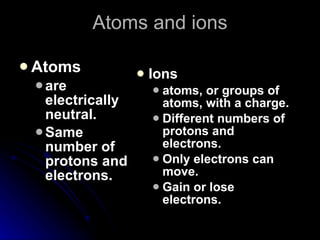
Atoms and ions Atoms  are electrically neutral. Same number of protons and electrons. Ions  atoms, or groups of atoms, with a charge. Different numbers of protons and electrons. Only electrons can move. Gain or lose electrons.
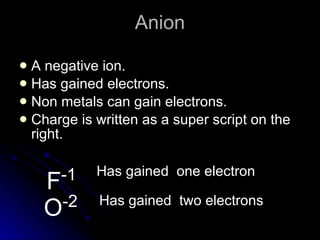
Anion A negative ion. Has gained electrons. Non metals can gain electrons. Charge is written as a super script on the right. F -1 Has gained  one electron O -2 Has gained  two electrons
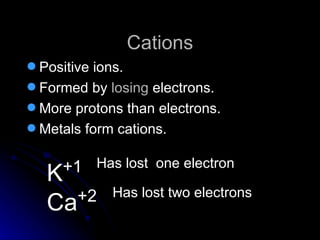
Cations Positive ions. Formed by  losing  electrons. More protons than electrons. Metals form cations. K +1 Has lost  one electron Ca +2 Has lost two electrons
Compounds Follow the Law of Definite Proportion. Have a constant composition. Have to add the same number of atoms every time. Two types.
Two Types of Compounds Molecular compounds Made of molecules. Made by joining nonmetal atoms together into molecules.
Two Types of Compounds Ionic Compounds Made of cations and anions. Metals and nonmetals. The electrons lost by the cation are gained by the anion. The cation and anions surround each other. Smallest piece is a  FORMULA UNIT.
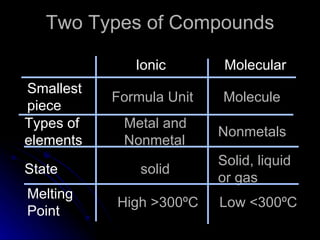
Two Types of Compounds Smallest  piece Melting Point State Types of elements Formula Unit Molecule Metal and Nonmetal Nonmetals solid Solid, liquid or gas High >300ºC Low <300ºC Ionic Molecular
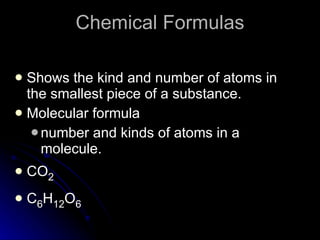
Chemical Formulas Shows the kind and number of atoms in the smallest piece of a substance. Molecular formula number and kinds of atoms in a molecule. CO 2   C 6 H 12 O 6
Formula Unit The smallest whole number ratio of atoms in an ionic compound.
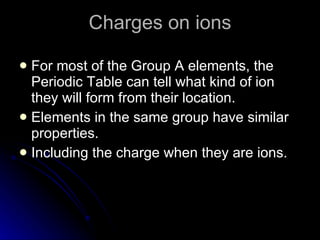
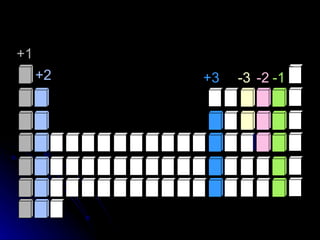
Charges on ions For most of the Group A elements, the Periodic Table can tell what kind of ion they will form from their location. Elements in the same group have similar properties. Including the charge when they are ions.
+2 +1 +3 -3 -2 -1
What about the others? We have to figure those out some other way. More on this later.
Naming ions Two methods Stock System & Classical Cation- if the charge is always the same (Group A) just write the name of the metal. Transition metals can have more than one type of charge. Indicate the charge  with roman numerals in parenthesis.
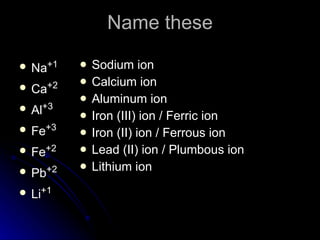
Name these Na +1   Ca +2   Al +3   Fe +3   Fe +2   Pb +2   Li +1   Sodium ion Calcium ion Aluminum ion Iron (III) ion / Ferric ion Iron (II) ion / Ferrous ion Lead (II) ion / Plumbous ion Lithium ion
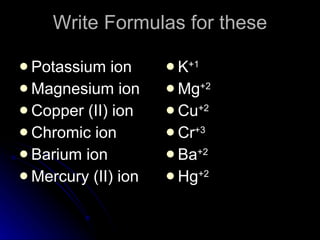
Write Formulas for these Potassium ion Magnesium ion  Copper (II) ion Chromic ion Barium ion Mercury (II) ion K +1 Mg +2 Cu +2 Cr +3 Ba +2 Hg +2
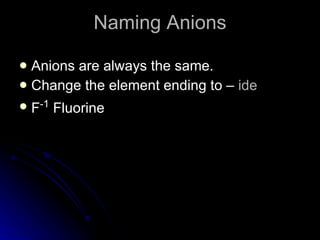
Naming Anions Anions are always the same. Change the element ending to –  ide F -1  Fluorine
Naming Anions Anions are always the same. Change the element ending to –  ide F -1  Fluorin
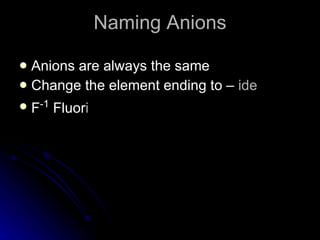
Naming Anions Anions are always the same Change the element ending to –  ide F -1  Fluori
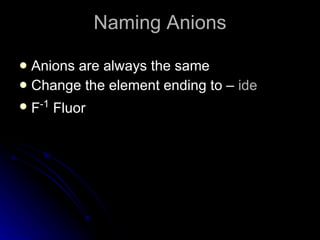
Naming Anions Anions are always the same Change the element ending to –  ide F -1  Fluor
Naming Anions Anions are always the same Change the element ending to –  ide F -1  Fluor i
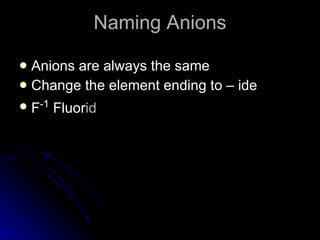
Naming Anions Anions are always the same Change the element ending to – ide F -1  Fluor id
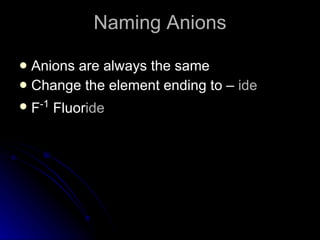
Naming Anions Anions are always the same Change the element ending to –  ide F -1  Fluor ide
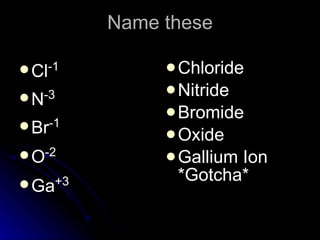
Name these Cl -1   N -3   Br -1   O -2 Ga +3 Chloride Nitride Bromide Oxide Gallium Ion *Gotcha*
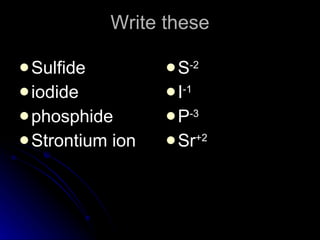
Write these Sulfide iodide phosphide Strontium ion S -2 I -1 P -3 Sr +2
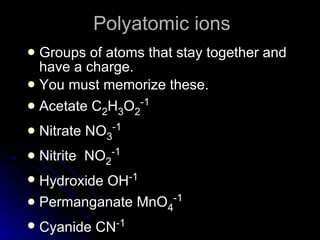
Polyatomic ions Groups of atoms that stay together and have a charge. You must memorize these. Acetate C 2 H 3 O 2 -1 Nitrate NO 3 -1 Nitrite  NO 2 -1 Hydroxide OH -1 Permanganate MnO 4 -1   Cyanide CN -1
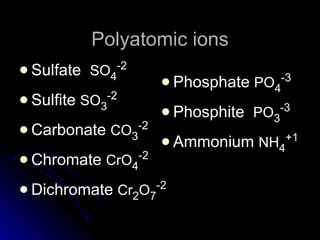
Polyatomic ions Sulfate  SO 4 -2 Sulfite  SO 3 -2 Carbonate  CO 3 -2 Chromate  CrO 4 -2 Dichromate  Cr 2 O 7 -2 Phosphate  PO 4 -3 Phosphite  PO 3 -3  Ammonium  NH 4 +1

Nomenclature 1 ions

  • 1.
    Making Sense ofthe ingredients label! Chemical Names & Formulas
  • 2.
    Atoms and ionsAtoms are electrically neutral. Same number of protons and electrons. Ions atoms, or groups of atoms, with a charge. Different numbers of protons and electrons. Only electrons can move. Gain or lose electrons.
  • 3.
    Anion A negativeion. Has gained electrons. Non metals can gain electrons. Charge is written as a super script on the right. F -1 Has gained one electron O -2 Has gained two electrons
  • 4.
    Cations Positive ions.Formed by losing electrons. More protons than electrons. Metals form cations. K +1 Has lost one electron Ca +2 Has lost two electrons
  • 5.
    Compounds Follow theLaw of Definite Proportion. Have a constant composition. Have to add the same number of atoms every time. Two types.
  • 6.
    Two Types ofCompounds Molecular compounds Made of molecules. Made by joining nonmetal atoms together into molecules.
  • 7.
    Two Types ofCompounds Ionic Compounds Made of cations and anions. Metals and nonmetals. The electrons lost by the cation are gained by the anion. The cation and anions surround each other. Smallest piece is a FORMULA UNIT.
  • 8.
    Two Types ofCompounds Smallest piece Melting Point State Types of elements Formula Unit Molecule Metal and Nonmetal Nonmetals solid Solid, liquid or gas High >300ºC Low <300ºC Ionic Molecular
  • 9.
    Chemical Formulas Showsthe kind and number of atoms in the smallest piece of a substance. Molecular formula number and kinds of atoms in a molecule. CO 2 C 6 H 12 O 6
  • 10.
    Formula Unit Thesmallest whole number ratio of atoms in an ionic compound.
  • 11.
    Charges on ionsFor most of the Group A elements, the Periodic Table can tell what kind of ion they will form from their location. Elements in the same group have similar properties. Including the charge when they are ions.
  • 12.
    +2 +1 +3-3 -2 -1
  • 13.
    What about theothers? We have to figure those out some other way. More on this later.
  • 14.
    Naming ions Twomethods Stock System & Classical Cation- if the charge is always the same (Group A) just write the name of the metal. Transition metals can have more than one type of charge. Indicate the charge with roman numerals in parenthesis.
  • 15.
    Name these Na+1 Ca +2 Al +3 Fe +3 Fe +2 Pb +2 Li +1 Sodium ion Calcium ion Aluminum ion Iron (III) ion / Ferric ion Iron (II) ion / Ferrous ion Lead (II) ion / Plumbous ion Lithium ion
  • 16.
    Write Formulas forthese Potassium ion Magnesium ion Copper (II) ion Chromic ion Barium ion Mercury (II) ion K +1 Mg +2 Cu +2 Cr +3 Ba +2 Hg +2
  • 17.
    Naming Anions Anionsare always the same. Change the element ending to – ide F -1 Fluorine
  • 18.
    Naming Anions Anionsare always the same. Change the element ending to – ide F -1 Fluorin
  • 19.
    Naming Anions Anionsare always the same Change the element ending to – ide F -1 Fluori
  • 20.
    Naming Anions Anionsare always the same Change the element ending to – ide F -1 Fluor
  • 21.
    Naming Anions Anionsare always the same Change the element ending to – ide F -1 Fluor i
  • 22.
    Naming Anions Anionsare always the same Change the element ending to – ide F -1 Fluor id
  • 23.
    Naming Anions Anionsare always the same Change the element ending to – ide F -1 Fluor ide
  • 24.
    Name these Cl-1 N -3 Br -1 O -2 Ga +3 Chloride Nitride Bromide Oxide Gallium Ion *Gotcha*
  • 25.
    Write these Sulfideiodide phosphide Strontium ion S -2 I -1 P -3 Sr +2
  • 26.
    Polyatomic ions Groupsof atoms that stay together and have a charge. You must memorize these. Acetate C 2 H 3 O 2 -1 Nitrate NO 3 -1 Nitrite NO 2 -1 Hydroxide OH -1 Permanganate MnO 4 -1 Cyanide CN -1
  • 27.
    Polyatomic ions Sulfate SO 4 -2 Sulfite SO 3 -2 Carbonate CO 3 -2 Chromate CrO 4 -2 Dichromate Cr 2 O 7 -2 Phosphate PO 4 -3 Phosphite PO 3 -3 Ammonium NH 4 +1