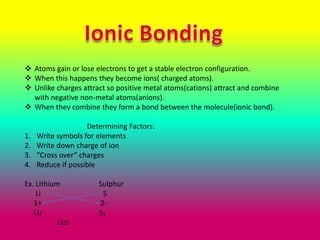
 Atoms gain or lose electrons to get a stable electron configuration.
 When this happens they become ions( charged atoms).
 Unlike charges attract so positive metal atoms(cations) attract and combine
  with negative non-metal atoms(anions).
 When they combine they form a bond between the molecule(ionic bond).

                    Determining Factors:
1.   Write symbols for elements
2.   Write down charge of ion
3.   “Cross over” charges
4.   Reduce if possible

Ex. Lithium            Sulphur
    Li                  S
   1+                  2-
   Li2                 S1
           Li2S
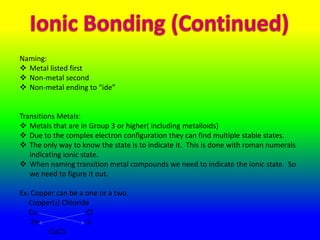
Naming:
 Metal listed first
 Non-metal second
 Non-metal ending to “ide”


Transitions Metals:
 Metals that are in Group 3 or higher( including metalloids)
 Due to the complex electron configuration they can find multiple stable states.
 The only way to know the state is to indicate it. This is done with roman numerals
   indicating ionic state.
 When naming transition metal compounds we need to indicate the ionic state. So
   we need to figure it out.

Ex. Copper can be a one or a two.
   Copper(2) Chloride
   Cu               Cl
    2+              1-
        CuCl2
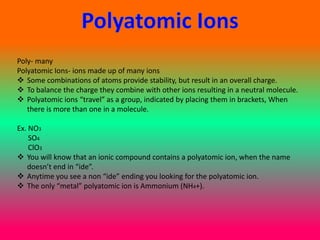
Poly- many
Polyatomic Ions- ions made up of many ions
 Some combinations of atoms provide stability, but result in an overall charge.
 To balance the charge they combine with other ions resulting in a neutral molecule.
 Polyatomic ions “travel” as a group, indicated by placing them in brackets, When
   there is more than one in a molecule.

Ex. NO3
    SO4
    ClO3
 You will know that an ionic compound contains a polyatomic ion, when the name
   doesn’t end in “ide”.
 Anytime you see a non “ide” ending you looking for the polyatomic ion.
 The only “metal” polyatomic ion is Ammonium (NH4+).
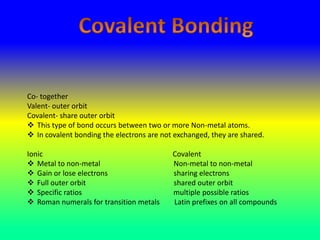
Co- together
Valent- outer orbit
Covalent- share outer orbit
 This type of bond occurs between two or more Non-metal atoms.
 In covalent bonding the electrons are not exchanged, they are shared.

Ionic                                      Covalent
 Metal to non-metal                       Non-metal to non-metal
 Gain or lose electrons                   sharing electrons
 Full outer orbit                         shared outer orbit
 Specific ratios                          multiple possible ratios
 Roman numerals for transition metals     Latin prefixes on all compounds
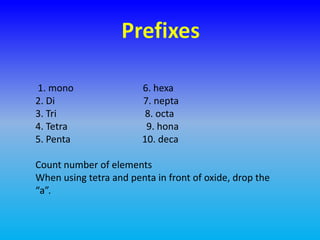
1. mono                 6. hexa
2. Di                   7. nepta
3. Tri                   8. octa
4. Tetra                 9. hona
5. Penta                10. deca

Count number of elements
When using tetra and penta in front of oxide, drop the
“a”.
Notes
Text book
Mr. Baker

Periodic table 2

  • 2.
     Atoms gainor lose electrons to get a stable electron configuration.  When this happens they become ions( charged atoms).  Unlike charges attract so positive metal atoms(cations) attract and combine with negative non-metal atoms(anions).  When they combine they form a bond between the molecule(ionic bond). Determining Factors: 1. Write symbols for elements 2. Write down charge of ion 3. “Cross over” charges 4. Reduce if possible Ex. Lithium Sulphur Li S 1+ 2- Li2 S1 Li2S
  • 3.
    Naming:  Metal listedfirst  Non-metal second  Non-metal ending to “ide” Transitions Metals:  Metals that are in Group 3 or higher( including metalloids)  Due to the complex electron configuration they can find multiple stable states.  The only way to know the state is to indicate it. This is done with roman numerals indicating ionic state.  When naming transition metal compounds we need to indicate the ionic state. So we need to figure it out. Ex. Copper can be a one or a two. Copper(2) Chloride Cu Cl 2+ 1- CuCl2
  • 4.
    Poly- many Polyatomic Ions-ions made up of many ions  Some combinations of atoms provide stability, but result in an overall charge.  To balance the charge they combine with other ions resulting in a neutral molecule.  Polyatomic ions “travel” as a group, indicated by placing them in brackets, When there is more than one in a molecule. Ex. NO3 SO4 ClO3  You will know that an ionic compound contains a polyatomic ion, when the name doesn’t end in “ide”.  Anytime you see a non “ide” ending you looking for the polyatomic ion.  The only “metal” polyatomic ion is Ammonium (NH4+).
  • 5.
    Co- together Valent- outerorbit Covalent- share outer orbit  This type of bond occurs between two or more Non-metal atoms.  In covalent bonding the electrons are not exchanged, they are shared. Ionic Covalent  Metal to non-metal Non-metal to non-metal  Gain or lose electrons sharing electrons  Full outer orbit shared outer orbit  Specific ratios multiple possible ratios  Roman numerals for transition metals Latin prefixes on all compounds
  • 6.
    1. mono 6. hexa 2. Di 7. nepta 3. Tri 8. octa 4. Tetra 9. hona 5. Penta 10. deca Count number of elements When using tetra and penta in front of oxide, drop the “a”.
  • 7.