SOME SPECIAL REACTIONS
SPECIAL REACTION TYPES GAS FORMING RXNs PRECIPITATE RXNs NEUTRALIZATION RXNs COMBUSTION RXNs
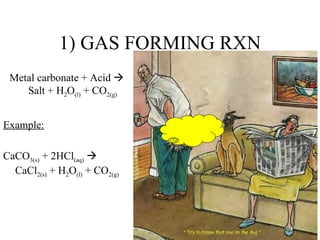
1) GAS FORMING RXN Metal carbonate + Acid    Salt + H 2 O (l)  + CO 2(g) Example: CaCO 3(s)  + 2HCl (aq)     CaCl 2(s)  + H 2 O (l)  + CO 2(g)
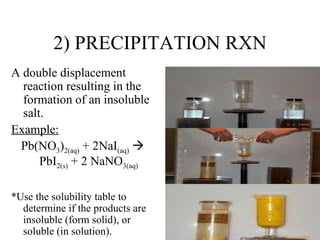
2) PRECIPITATION RXN A double displacement reaction resulting in the formation of an insoluble salt. Example: Pb(NO 3 ) 2(aq)  + 2NaI (aq)     PbI 2(s)  + 2 NaNO 3(aq) *Use the solubility table to determine if the products are insoluble (form solid), or soluble (in solution).
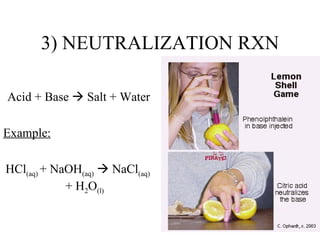
3) NEUTRALIZATION RXN Acid + Base    Salt + Water Example: HCl (aq)  + NaOH (aq)     NaCl (aq)  + H 2 O (l)
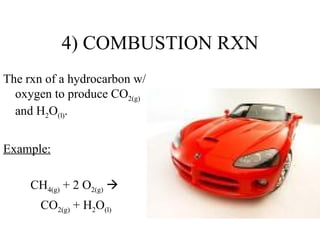
4) COMBUSTION RXN The rxn of a hydrocarbon w/ oxygen to produce CO 2(g)  and H 2 O (l) . Example: CH 4(g)  + 2 O 2(g)      CO 2(g)  + H 2 O (l)
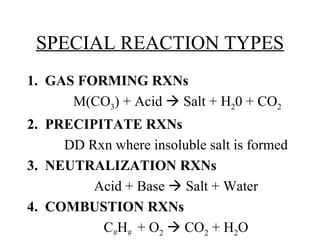
SPECIAL REACTION TYPES 1.  GAS FORMING RXNs M(CO 3 ) + Acid    Salt + H 2 0 + CO 2 2.  PRECIPITATE RXNs DD Rxn where insoluble salt is formed 3.  NEUTRALIZATION RXNs Acid + Base    Salt + Water 4.  COMBUSTION RXNs C # H #  + O 2     CO 2  + H 2 O

Special rxn types

  • 1.
  • 2.
    SPECIAL REACTION TYPESGAS FORMING RXNs PRECIPITATE RXNs NEUTRALIZATION RXNs COMBUSTION RXNs
  • 3.
    1) GAS FORMINGRXN Metal carbonate + Acid  Salt + H 2 O (l) + CO 2(g) Example: CaCO 3(s) + 2HCl (aq)  CaCl 2(s) + H 2 O (l) + CO 2(g)
  • 4.
    2) PRECIPITATION RXNA double displacement reaction resulting in the formation of an insoluble salt. Example: Pb(NO 3 ) 2(aq) + 2NaI (aq)  PbI 2(s) + 2 NaNO 3(aq) *Use the solubility table to determine if the products are insoluble (form solid), or soluble (in solution).
  • 5.
    3) NEUTRALIZATION RXNAcid + Base  Salt + Water Example: HCl (aq) + NaOH (aq)  NaCl (aq) + H 2 O (l)
  • 6.
    4) COMBUSTION RXNThe rxn of a hydrocarbon w/ oxygen to produce CO 2(g) and H 2 O (l) . Example: CH 4(g) + 2 O 2(g)  CO 2(g) + H 2 O (l)
  • 7.
    SPECIAL REACTION TYPES1. GAS FORMING RXNs M(CO 3 ) + Acid  Salt + H 2 0 + CO 2 2. PRECIPITATE RXNs DD Rxn where insoluble salt is formed 3. NEUTRALIZATION RXNs Acid + Base  Salt + Water 4. COMBUSTION RXNs C # H # + O 2  CO 2 + H 2 O