Chapter 6 “The Periodic Table Revisited”
Section 6.1 Organizing the Elements OBJECTIVES: Explain  how elements are organized in a periodic table.
Section 6.1 Organizing the Elements OBJECTIVES: Compare  early and modern periodic tables.
Section 6.1 Organizing the Elements OBJECTIVES: Identify  three broad classes of elements.
Section 6.1 Organizing the Elements A few elements, such as gold and copper, have been known for  thousands of years  - since ancient times Yet, only about 13 had been identified by the year 1700. As more were discovered, chemists realized they needed a way to  organize  the elements.
 
The Periodic Law says: When elements are arranged in order of increasing atomic number, there is a  periodic repetition  of their physical and chemical properties. Horizontal rows =  periods There are 7 periods Vertical column =  group  (or family) Similar physical & chemical prop.
Section 6.2 Classifying the Elements OBJECTIVES: Describe  the information in a periodic table.
Section 6.2 Classifying the Elements OBJECTIVES: Classify  elements based on electron configuration.
Section 6.2 Classifying the Elements OBJECTIVES: Distinguish  representative elements and transition metals.
Squares in the Periodic Table The periodic table displays the  symbols  and  names  of the elements, along with information about the structure of their atoms: Atomic number and atomic mass Black symbol = solid ;  red = gas ;  blue = liquid  (from the Periodic Table on our classroom wall)
 
Groups of elements  - family names Group 1,IA  –  alkali metals Forms a “base” (or alkali) when  reacting  with water   (not just dissolved!) Group 2, 2A  –  alkaline earth metals Also form bases with water; do not dissolve well, hence “earth metals” Group 17, 7A  –  halogens Means “salt-forming”
Electron Configurations in Groups Elements can be sorted into 4 different groupings  based on their electron configurations : Noble gases Representative elements Transition metals Inner transition metals Let’s now take a closer look at these.
Electron Configurations in Groups Noble gases  are the elements in Group 18, 8A   (also called Group 0) Previously called “ inert gases ” because they rarely take part in a reaction;  very stable  = don’t react Noble gases have an electron configuration that has the outer s and p sublevels  completely full
Electron Configurations in Groups Representative Elements  are in Groups 1,1A through 17,7A Display  wide range  of properties, thus a good “representative”  Some are metals, or nonmetals, or metalloids; some are solid, others are gases or liquids Their outer s and p electron configurations are  NOT filled
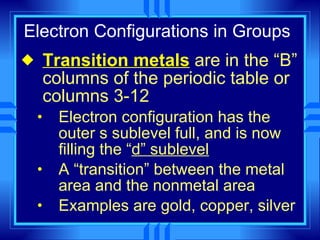
Electron Configurations in Groups Transition metals  are in the “B” columns of the periodic table or columns 3-12 Electron configuration has the outer s sublevel full, and is now filling the “ d” sublevel A “transition” between the metal area and the nonmetal area Examples are gold, copper, silver
Electron Configurations in Groups Inner Transition Metals  are located below the main body of the table, in two horizontal rows Electron configuration has the outer s sublevel full, and is now filling the  “f” sublevel Formerly called “rare-earth” elements, but this is not true because some are very abundant
Elements in the 1A-7A (1,2,13-17) groups are called the  representative  elements outer s or p filling 1A 2A 3A 4A 5A 6A 7A 8A
The  group B  are called the  transition elements These are called the inner transition elements, and they belong here
Group 1A, 1 are the alkali metals  (but NOT H) Group 2A, 2 are the alkaline earth metals H
Group 8A are the  noble gases Group 7A is called the  halogens
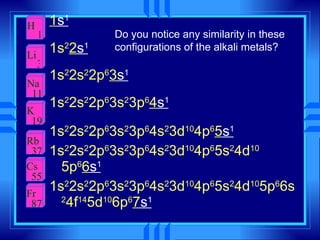
1 s 1 1s 2 2 s 1 1s 2 2s 2 2p 6 3 s 1 1s 2 2s 2 2p 6 3s 2 3p 6 4 s 1 1s 2 2s 2 2p 6 3s 2 3p 6 4s 2 3d 10 4p 6 5 s 1 1s 2 2s 2 2p 6 3s 2 3p 6 4s 2 3d 10 4p 6 5s 2 4d 10  5p 6 6 s 1 1s 2 2s 2 2p 6 3s 2 3p 6 4s 2 3d 10 4p 6 5s 2 4d 10 5p 6 6s 2 4f 14 5d 10 6p 6 7 s 1 Do you notice any similarity in these configurations of the alkali metals? H 1 Li 3 Na 11 K 19 Rb 37 Cs 55 Fr 87
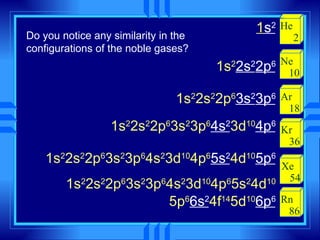
1 s 2 1s 2 2s 2 2p 6 1s 2 2s 2 2p 6 3s 2 3p 6 1s 2 2s 2 2p 6 3s 2 3p 6 4s 2 3d 10 4p 6 1s 2 2s 2 2p 6 3s 2 3p 6 4s 2 3d 10 4p 6 5s 2 4d 10 5p 6 1s 2 2s 2 2p 6 3s 2 3p 6 4s 2 3d 10 4p 6 5s 2 4d 10  5p 6 6s 2 4f 14 5d 10 6p 6 He 2 Ne 10 Ar 18 Kr 36 Xe 54 Rn 86 Do you notice any similarity in the configurations of the noble gases?
Alkali metals all end in  s 1 Alkaline earth metals all end in  s 2 really should include He, but it fits better in a different spot, since He has the properties of the noble  gases , and has a full outer level of electrons. Elements in the s - blocks s 2 s 1 He
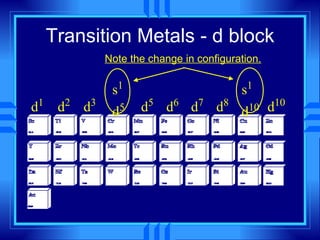
Transition Metals - d block d 1 d 2 d 3 s 1  d 5 d 5 d 6 d 7 d 8 s 1  d 10 d 10 Note the change in configuration.
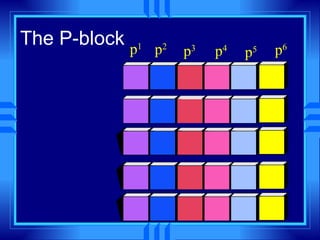
The P-block p 1 p 2 p 3 p 4 p 5 p 6
F - block Called the “inner transition elements” f 1 f 5 f 2 f 3 f 4 f 6 f 7 f 8 f 9 f 10 f 11 f 12 f 14 f 13
Each row (or period) is the  energy level  for s and p orbitals. 1 2 3 4 5 6 7 Period Number
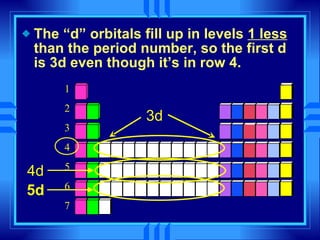
The “d” orbitals fill up in levels  1 less  than the period number, so the first d is 3d even though it’s in row 4. 1 2 3 4 5 6 7 3d 4d 5d
f orbitals start filling at 4f, and are  2 less  than the period number 1 2 3 4 5 6 7 4f 5f
Section 6.3 Periodic Trends OBJECTIVES: Describe   trends  among the elements for  atomic size .
Section 6.3 Periodic Trends OBJECTIVES: Explain  how  ions  form.
Section 6.3 Periodic Trends OBJECTIVES: Describe  periodic  trends  for first ionization energy, ionic size, and electronegativity.
Trends in Atomic Size First problem: Where do you start measuring from? The electron cloud doesn’t have a definite edge. They get around this by measuring more than 1 atom at a time.
Atomic Size Measure the Atomic Radius - this is half the distance between the two nuclei of a diatomic molecule. } Radius
ALL  Periodic Table Trends   Influenced by three factors: 1.  Energy Level Higher energy levels are further away from the nucleus. 2.  Charge on nucleus  (# protons) More charge pulls electrons in closer. (+ and – attract each other) 3.  Shielding effect ( blocking effect?)
What do they influence? Energy levels  and  Shielding  have an effect on the  GROUP  (    ) Nuclear charge  has an effect on a  PERIOD   (    )
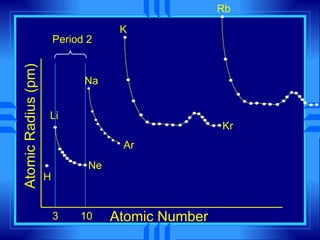
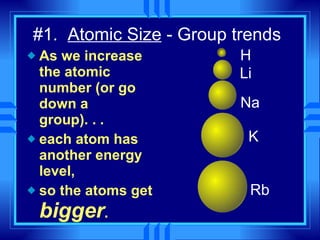
#1.  Atomic Size  - Group trends As we increase the atomic number (or go down a group). . . each atom has another energy level, so the atoms get  bigger . H Li Na K Rb
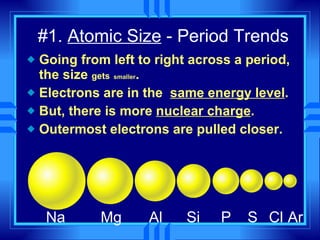
#1.  Atomic Size  - Period Trends Going from left to right across a period, the size  gets   smaller . Electrons are in the  same energy level . But, there is more  nuclear charge . Outermost electrons are pulled closer. Na Mg Al Si P S Cl Ar
Atomic Number Atomic Radius (pm) H Li Ne Ar 10 Na K Kr 3 Period 2 Rb
Ions Some compounds are composed of particles called “ions” An  ion  is an atom (or group of atoms) that has a  positive or negative charge Atoms  are neutral because the number of protons equals electrons Positive and negative ions are formed when electrons are  transferred  (lost or gained) between atoms
Ions Metals tend to LOSE electrons , from their outer energy level Sodium loses one: there are now more protons (11) than electrons (10), and thus a positively charged particle is formed = “ cation ” The charge is written as a number followed by a plus sign:  Na 1+ Now named a “ sodium ion ”
Ions Nonmetals tend to GAIN  one or more electrons Chlorine will gain one electron Protons (17) no longer equals the electrons (18), so a charge of -1 Cl 1-  is re-named a “chloride ion” Negative ions are called “ anions ”
#2.  Trends in Ionization Energy Ionization energy is the amount of energy required to  completely remove an electron  (from a gaseous atom). Removing one electron makes a  1+  ion. The energy required to remove only the first electron is called the  first  ionization energy.
Ionization Energy The  second  ionization energy is the energy required to remove the second electron. Always greater than first IE. The  third  IE is the energy required to remove a third electron. Greater than 1st or 2nd IE.
Symbol First Second   Third HHeLiBeBCNO F Ne 1312 2731 520 900 800 1086 1402 1314 1681 2080  5247 7297 1757 2430 2352 2857 3391 3375 3963 11810 14840 3569 4619 4577 5301 6045 6276  Table 6.1, p. 173
Symbol First Second   Third HHeLiBeBCNO F Ne 1312 2731 520 900 800 1086 1402 1314 1681 2080  5247 7297 1757 2430 2352 2857 3391 3375 3963 11810 14840 3569 4619 4577 5301 6045 6276  Why did these values increase  so much ?
What factors determine IE The greater the nuclear charge, the  greater  IE. Greater distance from nucleus  decreases  IE Filled and half-filled orbitals have lower energy, so achieving them is easier, lower IE. Shielding effect
Shielding The electron on the outermost energy level has to look through all the other energy levels to see the nucleus. Second electron has  same  shielding, if it is in the  same period
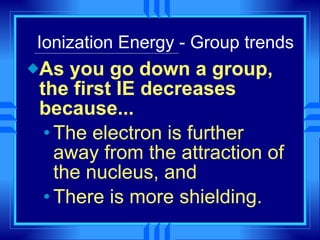
Ionization Energy - Group trends As you go down a group, the first IE decreases because... The electron is further away from the attraction of the nucleus, and There is more shielding.
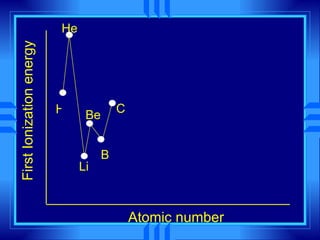
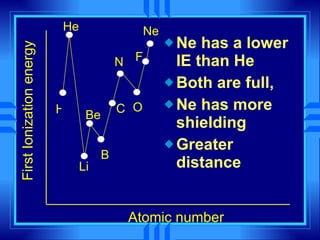
Ionization Energy - Period trends All the atoms in the same period have the same energy level. Same shielding. But, increasing nuclear charge So IE generally  increases  from left to right. Exceptions at full and 1/2 full orbitals.
He has a greater IE than H. Both elements have the same shielding since electrons are only in the first level  But He has a greater nuclear charge   First Ionization energy Atomic number He H
First Ionization energy Atomic number H He Li has lower IE than H more shielding  further away These outweigh the greater nuclear charge   Li
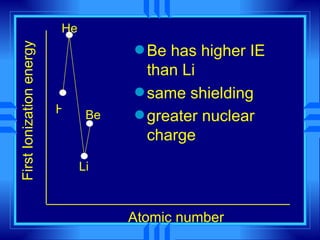
First Ionization energy Atomic number H He Be has higher IE than Li same shielding  greater nuclear charge   Li Be
First Ionization energy Atomic number H He B has lower IE than Be same shielding  greater nuclear charge By removing an electron we make s orbital half-filled   Li Be B
First Ionization energy Atomic number H He Li Be B C
First Ionization energy Atomic number H He Li Be B C N
Oxygen breaks the pattern, because removing an electron leaves it with a 1/2 filled p orbital   First Ionization energy Atomic number H He Li Be B C N O
First Ionization energy Atomic number H He Li Be B C N O F
Ne has a lower IE than He Both are full, Ne has more shielding Greater distance First Ionization energy Atomic number H He Li Be B C N O F Ne
First Ionization energy Atomic number H He Li Be B C N O F Ne Na has a lower IE than Li Both are s 1 Na has more shielding Greater distance Na
First Ionization energy Atomic number
Driving Forces Full Energy Levels  require lots of energy to remove their electrons. Noble Gases have full orbitals. Atoms behave in ways to try and achieve a noble gas configuration.
2nd Ionization Energy For elements that reach a filled or half-filled orbital by removing 2 electrons, 2nd IE is lower than expected. True for s 2  Alkaline earth metals form 2+ ions.
3rd IE Using the same logic s 2 p 1   atoms have an low 3rd IE. Atoms in the aluminum family form 3+ ions. 2nd IE and 3rd IE are always higher than 1st IE!!!
Trends in Ionic Size: Cations Cations form by  losing  electrons. Cations are  smaller  than the atom they came from  – not only do they lose electrons, they lose an  entire energy level . Metals form cations. Cations of representative elements have the noble gas configuration  before  them.
Ionic size: Anions Anions form by  gaining  electrons. Anions are  bigger  than the atom they came from  – have the same energy level, but a greater area the nuclear charge needs to cover Nonmetals form anions. Anions of representative elements have the noble gas configuration  after  them.
Configuration of Ions Ions always have noble gas configurations ( = a full outer level) Na atom is: 1s 2 2s 2 2p 6 3s 1   Forms a 1+ sodium ion: 1s 2 2s 2 2p 6   Same configuration as neon. Metals form ions with the configuration of the noble gas  before  them - they lose electrons.
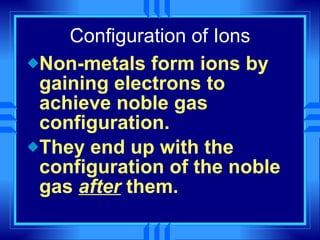
Configuration of Ions Non-metals form ions by gaining electrons to achieve noble gas configuration. They end up with the configuration of the noble gas  after  them.
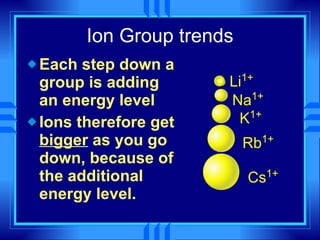
Ion Group trends Each step down a group is adding an energy level Ions therefore get  bigger  as you go down, because of the additional energy level. Li 1+ Na 1+ K 1+ Rb 1+ Cs 1+
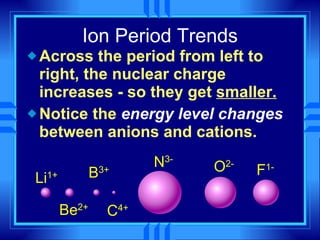
Ion Period Trends Across the period from left to right, the nuclear charge increases - so they get  smaller. Notice the  energy level changes  between anions and cations. Li 1+ Be 2+ B 3+ C 4+ N 3- O 2- F 1-
Size of Isoelectronic ions Iso- means “the same” Isoelectronic ions have the same # of electrons Al 3+  Mg 2+  Na 1+  Ne  F 1-  O 2-  and N 3-   all have 10 electrons all have the same configuration: 1s 2 2s 2 2p 6  (which is the noble gas: neon)
Size of Isoelectronic ions? Positive ions that have more protons would be  smaller   (more protons would pull the same # of electrons in closer) Al 3+ Mg 2+ Na 1+ Ne F 1- O 2- N 3- 13 12 11 10 9 8 7
#3.  Trends in Electronegativity Electronegativity is the tendency for an atom to  attract  electrons to itself when it is  chemically combined  with another element. They share the electron, but how equally do they share it? An element with a big electronegativity means it pulls the electron towards itself strongly!
Electronegativity Group Trend The further down a group, the farther the electron is away from the nucleus, plus the more electrons an atom has. Thus, more willing to share. Low electronegativity.
Electronegativity Period Trend Metals are at the left of the table. They let their electrons go easily Thus, low electronegativity At the right end are the nonmetals. They want  more  electrons. Try to take them away from others High electronegativity.
The arrows indicate the trend: Ionization energy and Electronegativity  INCREASE  in these directions
Atomic size and Ionic size increase in these directions:
Summary Chart of the trends:  Figure 6.22, p.178 End of Chapter 6

Chemistry - Chp 6 - The Periodic Table Revisited - PowerPoint

  • 1.
    Chapter 6 “ThePeriodic Table Revisited”
  • 2.
    Section 6.1 Organizingthe Elements OBJECTIVES: Explain how elements are organized in a periodic table.
  • 3.
    Section 6.1 Organizingthe Elements OBJECTIVES: Compare early and modern periodic tables.
  • 4.
    Section 6.1 Organizingthe Elements OBJECTIVES: Identify three broad classes of elements.
  • 5.
    Section 6.1 Organizingthe Elements A few elements, such as gold and copper, have been known for thousands of years - since ancient times Yet, only about 13 had been identified by the year 1700. As more were discovered, chemists realized they needed a way to organize the elements.
  • 6.
  • 7.
    The Periodic Lawsays: When elements are arranged in order of increasing atomic number, there is a periodic repetition of their physical and chemical properties. Horizontal rows = periods There are 7 periods Vertical column = group (or family) Similar physical & chemical prop.
  • 8.
    Section 6.2 Classifyingthe Elements OBJECTIVES: Describe the information in a periodic table.
  • 9.
    Section 6.2 Classifyingthe Elements OBJECTIVES: Classify elements based on electron configuration.
  • 10.
    Section 6.2 Classifyingthe Elements OBJECTIVES: Distinguish representative elements and transition metals.
  • 11.
    Squares in thePeriodic Table The periodic table displays the symbols and names of the elements, along with information about the structure of their atoms: Atomic number and atomic mass Black symbol = solid ; red = gas ; blue = liquid (from the Periodic Table on our classroom wall)
  • 12.
  • 13.
    Groups of elements - family names Group 1,IA – alkali metals Forms a “base” (or alkali) when reacting with water (not just dissolved!) Group 2, 2A – alkaline earth metals Also form bases with water; do not dissolve well, hence “earth metals” Group 17, 7A – halogens Means “salt-forming”
  • 14.
    Electron Configurations inGroups Elements can be sorted into 4 different groupings based on their electron configurations : Noble gases Representative elements Transition metals Inner transition metals Let’s now take a closer look at these.
  • 15.
    Electron Configurations inGroups Noble gases are the elements in Group 18, 8A (also called Group 0) Previously called “ inert gases ” because they rarely take part in a reaction; very stable = don’t react Noble gases have an electron configuration that has the outer s and p sublevels completely full
  • 16.
    Electron Configurations inGroups Representative Elements are in Groups 1,1A through 17,7A Display wide range of properties, thus a good “representative” Some are metals, or nonmetals, or metalloids; some are solid, others are gases or liquids Their outer s and p electron configurations are NOT filled
  • 17.
    Electron Configurations inGroups Transition metals are in the “B” columns of the periodic table or columns 3-12 Electron configuration has the outer s sublevel full, and is now filling the “ d” sublevel A “transition” between the metal area and the nonmetal area Examples are gold, copper, silver
  • 18.
    Electron Configurations inGroups Inner Transition Metals are located below the main body of the table, in two horizontal rows Electron configuration has the outer s sublevel full, and is now filling the “f” sublevel Formerly called “rare-earth” elements, but this is not true because some are very abundant
  • 19.
    Elements in the1A-7A (1,2,13-17) groups are called the representative elements outer s or p filling 1A 2A 3A 4A 5A 6A 7A 8A
  • 20.
    The groupB are called the transition elements These are called the inner transition elements, and they belong here
  • 21.
    Group 1A, 1are the alkali metals (but NOT H) Group 2A, 2 are the alkaline earth metals H
  • 22.
    Group 8A arethe noble gases Group 7A is called the halogens
  • 23.
    1 s 11s 2 2 s 1 1s 2 2s 2 2p 6 3 s 1 1s 2 2s 2 2p 6 3s 2 3p 6 4 s 1 1s 2 2s 2 2p 6 3s 2 3p 6 4s 2 3d 10 4p 6 5 s 1 1s 2 2s 2 2p 6 3s 2 3p 6 4s 2 3d 10 4p 6 5s 2 4d 10 5p 6 6 s 1 1s 2 2s 2 2p 6 3s 2 3p 6 4s 2 3d 10 4p 6 5s 2 4d 10 5p 6 6s 2 4f 14 5d 10 6p 6 7 s 1 Do you notice any similarity in these configurations of the alkali metals? H 1 Li 3 Na 11 K 19 Rb 37 Cs 55 Fr 87
  • 24.
    1 s 21s 2 2s 2 2p 6 1s 2 2s 2 2p 6 3s 2 3p 6 1s 2 2s 2 2p 6 3s 2 3p 6 4s 2 3d 10 4p 6 1s 2 2s 2 2p 6 3s 2 3p 6 4s 2 3d 10 4p 6 5s 2 4d 10 5p 6 1s 2 2s 2 2p 6 3s 2 3p 6 4s 2 3d 10 4p 6 5s 2 4d 10 5p 6 6s 2 4f 14 5d 10 6p 6 He 2 Ne 10 Ar 18 Kr 36 Xe 54 Rn 86 Do you notice any similarity in the configurations of the noble gases?
  • 25.
    Alkali metals allend in s 1 Alkaline earth metals all end in s 2 really should include He, but it fits better in a different spot, since He has the properties of the noble gases , and has a full outer level of electrons. Elements in the s - blocks s 2 s 1 He
  • 26.
    Transition Metals -d block d 1 d 2 d 3 s 1 d 5 d 5 d 6 d 7 d 8 s 1 d 10 d 10 Note the change in configuration.
  • 27.
    The P-block p1 p 2 p 3 p 4 p 5 p 6
  • 28.
    F - blockCalled the “inner transition elements” f 1 f 5 f 2 f 3 f 4 f 6 f 7 f 8 f 9 f 10 f 11 f 12 f 14 f 13
  • 29.
    Each row (orperiod) is the energy level for s and p orbitals. 1 2 3 4 5 6 7 Period Number
  • 30.
    The “d” orbitalsfill up in levels 1 less than the period number, so the first d is 3d even though it’s in row 4. 1 2 3 4 5 6 7 3d 4d 5d
  • 31.
    f orbitals startfilling at 4f, and are 2 less than the period number 1 2 3 4 5 6 7 4f 5f
  • 32.
    Section 6.3 PeriodicTrends OBJECTIVES: Describe trends among the elements for atomic size .
  • 33.
    Section 6.3 PeriodicTrends OBJECTIVES: Explain how ions form.
  • 34.
    Section 6.3 PeriodicTrends OBJECTIVES: Describe periodic trends for first ionization energy, ionic size, and electronegativity.
  • 35.
    Trends in AtomicSize First problem: Where do you start measuring from? The electron cloud doesn’t have a definite edge. They get around this by measuring more than 1 atom at a time.
  • 36.
    Atomic Size Measurethe Atomic Radius - this is half the distance between the two nuclei of a diatomic molecule. } Radius
  • 37.
    ALL PeriodicTable Trends Influenced by three factors: 1. Energy Level Higher energy levels are further away from the nucleus. 2. Charge on nucleus (# protons) More charge pulls electrons in closer. (+ and – attract each other) 3. Shielding effect ( blocking effect?)
  • 38.
    What do theyinfluence? Energy levels and Shielding have an effect on the GROUP (  ) Nuclear charge has an effect on a PERIOD (  )
  • 39.
    #1. AtomicSize - Group trends As we increase the atomic number (or go down a group). . . each atom has another energy level, so the atoms get bigger . H Li Na K Rb
  • 40.
    #1. AtomicSize - Period Trends Going from left to right across a period, the size gets smaller . Electrons are in the same energy level . But, there is more nuclear charge . Outermost electrons are pulled closer. Na Mg Al Si P S Cl Ar
  • 41.
    Atomic Number AtomicRadius (pm) H Li Ne Ar 10 Na K Kr 3 Period 2 Rb
  • 42.
    Ions Some compoundsare composed of particles called “ions” An ion is an atom (or group of atoms) that has a positive or negative charge Atoms are neutral because the number of protons equals electrons Positive and negative ions are formed when electrons are transferred (lost or gained) between atoms
  • 43.
    Ions Metals tendto LOSE electrons , from their outer energy level Sodium loses one: there are now more protons (11) than electrons (10), and thus a positively charged particle is formed = “ cation ” The charge is written as a number followed by a plus sign: Na 1+ Now named a “ sodium ion ”
  • 44.
    Ions Nonmetals tendto GAIN one or more electrons Chlorine will gain one electron Protons (17) no longer equals the electrons (18), so a charge of -1 Cl 1- is re-named a “chloride ion” Negative ions are called “ anions ”
  • 45.
    #2. Trendsin Ionization Energy Ionization energy is the amount of energy required to completely remove an electron (from a gaseous atom). Removing one electron makes a 1+ ion. The energy required to remove only the first electron is called the first ionization energy.
  • 46.
    Ionization Energy The second ionization energy is the energy required to remove the second electron. Always greater than first IE. The third IE is the energy required to remove a third electron. Greater than 1st or 2nd IE.
  • 47.
    Symbol First Second Third HHeLiBeBCNO F Ne 1312 2731 520 900 800 1086 1402 1314 1681 2080 5247 7297 1757 2430 2352 2857 3391 3375 3963 11810 14840 3569 4619 4577 5301 6045 6276 Table 6.1, p. 173
  • 48.
    Symbol First Second Third HHeLiBeBCNO F Ne 1312 2731 520 900 800 1086 1402 1314 1681 2080 5247 7297 1757 2430 2352 2857 3391 3375 3963 11810 14840 3569 4619 4577 5301 6045 6276 Why did these values increase so much ?
  • 49.
    What factors determineIE The greater the nuclear charge, the greater IE. Greater distance from nucleus decreases IE Filled and half-filled orbitals have lower energy, so achieving them is easier, lower IE. Shielding effect
  • 50.
    Shielding The electronon the outermost energy level has to look through all the other energy levels to see the nucleus. Second electron has same shielding, if it is in the same period
  • 51.
    Ionization Energy -Group trends As you go down a group, the first IE decreases because... The electron is further away from the attraction of the nucleus, and There is more shielding.
  • 52.
    Ionization Energy -Period trends All the atoms in the same period have the same energy level. Same shielding. But, increasing nuclear charge So IE generally increases from left to right. Exceptions at full and 1/2 full orbitals.
  • 53.
    He has agreater IE than H. Both elements have the same shielding since electrons are only in the first level But He has a greater nuclear charge First Ionization energy Atomic number He H
  • 54.
    First Ionization energyAtomic number H He Li has lower IE than H more shielding further away These outweigh the greater nuclear charge Li
  • 55.
    First Ionization energyAtomic number H He Be has higher IE than Li same shielding greater nuclear charge Li Be
  • 56.
    First Ionization energyAtomic number H He B has lower IE than Be same shielding greater nuclear charge By removing an electron we make s orbital half-filled Li Be B
  • 57.
    First Ionization energyAtomic number H He Li Be B C
  • 58.
    First Ionization energyAtomic number H He Li Be B C N
  • 59.
    Oxygen breaks thepattern, because removing an electron leaves it with a 1/2 filled p orbital First Ionization energy Atomic number H He Li Be B C N O
  • 60.
    First Ionization energyAtomic number H He Li Be B C N O F
  • 61.
    Ne has alower IE than He Both are full, Ne has more shielding Greater distance First Ionization energy Atomic number H He Li Be B C N O F Ne
  • 62.
    First Ionization energyAtomic number H He Li Be B C N O F Ne Na has a lower IE than Li Both are s 1 Na has more shielding Greater distance Na
  • 63.
  • 64.
    Driving Forces FullEnergy Levels require lots of energy to remove their electrons. Noble Gases have full orbitals. Atoms behave in ways to try and achieve a noble gas configuration.
  • 65.
    2nd Ionization EnergyFor elements that reach a filled or half-filled orbital by removing 2 electrons, 2nd IE is lower than expected. True for s 2 Alkaline earth metals form 2+ ions.
  • 66.
    3rd IE Usingthe same logic s 2 p 1 atoms have an low 3rd IE. Atoms in the aluminum family form 3+ ions. 2nd IE and 3rd IE are always higher than 1st IE!!!
  • 67.
    Trends in IonicSize: Cations Cations form by losing electrons. Cations are smaller than the atom they came from – not only do they lose electrons, they lose an entire energy level . Metals form cations. Cations of representative elements have the noble gas configuration before them.
  • 68.
    Ionic size: AnionsAnions form by gaining electrons. Anions are bigger than the atom they came from – have the same energy level, but a greater area the nuclear charge needs to cover Nonmetals form anions. Anions of representative elements have the noble gas configuration after them.
  • 69.
    Configuration of IonsIons always have noble gas configurations ( = a full outer level) Na atom is: 1s 2 2s 2 2p 6 3s 1 Forms a 1+ sodium ion: 1s 2 2s 2 2p 6 Same configuration as neon. Metals form ions with the configuration of the noble gas before them - they lose electrons.
  • 70.
    Configuration of IonsNon-metals form ions by gaining electrons to achieve noble gas configuration. They end up with the configuration of the noble gas after them.
  • 71.
    Ion Group trendsEach step down a group is adding an energy level Ions therefore get bigger as you go down, because of the additional energy level. Li 1+ Na 1+ K 1+ Rb 1+ Cs 1+
  • 72.
    Ion Period TrendsAcross the period from left to right, the nuclear charge increases - so they get smaller. Notice the energy level changes between anions and cations. Li 1+ Be 2+ B 3+ C 4+ N 3- O 2- F 1-
  • 73.
    Size of Isoelectronicions Iso- means “the same” Isoelectronic ions have the same # of electrons Al 3+ Mg 2+ Na 1+ Ne F 1- O 2- and N 3- all have 10 electrons all have the same configuration: 1s 2 2s 2 2p 6 (which is the noble gas: neon)
  • 74.
    Size of Isoelectronicions? Positive ions that have more protons would be smaller (more protons would pull the same # of electrons in closer) Al 3+ Mg 2+ Na 1+ Ne F 1- O 2- N 3- 13 12 11 10 9 8 7
  • 75.
    #3. Trendsin Electronegativity Electronegativity is the tendency for an atom to attract electrons to itself when it is chemically combined with another element. They share the electron, but how equally do they share it? An element with a big electronegativity means it pulls the electron towards itself strongly!
  • 76.
    Electronegativity Group TrendThe further down a group, the farther the electron is away from the nucleus, plus the more electrons an atom has. Thus, more willing to share. Low electronegativity.
  • 77.
    Electronegativity Period TrendMetals are at the left of the table. They let their electrons go easily Thus, low electronegativity At the right end are the nonmetals. They want more electrons. Try to take them away from others High electronegativity.
  • 78.
    The arrows indicatethe trend: Ionization energy and Electronegativity INCREASE in these directions
  • 79.
    Atomic size andIonic size increase in these directions:
  • 80.
    Summary Chart ofthe trends: Figure 6.22, p.178 End of Chapter 6