Chapter 2
Nomenclature
Dr. Sapna Gupta
Introduction
• Compounds are elements combined in different proportions.
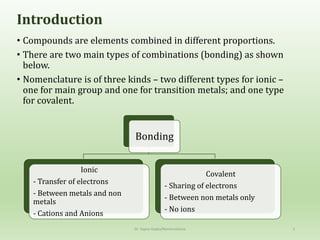
• There are two main types of combinations (bonding) as shown
below.
• Nomenclature is of three kinds – two different types for ionic –
one for main group and one for transition metals; and one type
for covalent.
Bonding
Ionic
- Transfer of electrons
- Between metals and non
metals
- Cations and Anions
Covalent
- Sharing of electrons
- Between non metals only
- No ions
Dr. Sapna Gupta/Nomenclature 2
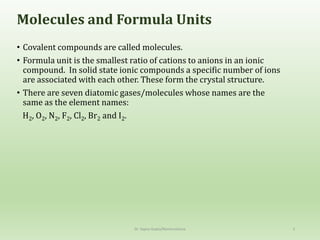
Molecules and Formula Units
• Covalent compounds are called molecules.
• Formula unit is the smallest ratio of cations to anions in an ionic
compound. In solid state ionic compounds a specific number of ions
are associated with each other. These form the crystal structure.
• There are seven diatomic gases/molecules whose names are the
same as the element names:
H2, O2, N2, F2, Cl2, Br2 and I2.
Dr. Sapna Gupta/Nomenclature 3
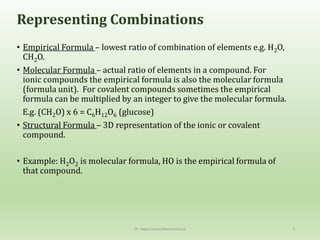
Representing Combinations
• Empirical Formula – lowest ratio of combination of elements e.g. H2O,
CH2O.
• Molecular Formula – actual ratio of elements in a compound. For
ionic compounds the empirical formula is also the molecular formula
(formula unit). For covalent compounds sometimes the empirical
formula can be multiplied by an integer to give the molecular formula.
E.g. (CH2O) x 6 = C6H12O6 (glucose)
• Structural Formula – 3D representation of the ionic or covalent
compound.
• Example: H2O2 is molecular formula, HO is the empirical formula of
that compound.
Dr. Sapna Gupta/Nomenclature 4
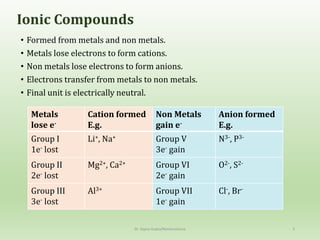
Ionic Compounds
• Formed from metals and non metals.
• Metals lose electrons to form cations.
• Non metals lose electrons to form anions.
• Electrons transfer from metals to non metals.
• Final unit is electrically neutral.
Metals
lose e-
Cation formed
E.g.
Non Metals
gain e-
Anion formed
E.g.
Group I
1e- lost
Li+, Na+ Group V
3e- gain
N3-, P3-
Group II
2e- lost
Mg2+, Ca2+ Group VI
2e- gain
O2-, S2-
Group III
3e- lost
Al3+ Group VII
1e- gain
Cl-, Br-
Dr. Sapna Gupta/Nomenclature 5
Naming Ionic Compounds – Main Group
• Naming cations
• Name the element and add the word “ion”
• Example: Na+, sodium ion
• Naming Anions
• Name the element and modify the ending to “-ide”
• Example: Cl-(chloride), O2- (oxide)
• Naming ionic compounds: leave the name of the metal as is,
change the name of the non metal to element ending with –ide.
For example, sodium chloride, calcium oxide.
• Note: The name does not say anything about the ratio of the
elements. This is because there is only one combination
possible for main group elements .
• There are two exceptions –
Pb in Group IV has two ions Pb2+ and Pb4+; and
Tl in Group III has two ions Tl+ and Tl3+
Dr. Sapna Gupta/Nomenclature 6
Forming Compounds (Formula Units)
Compound formed is electrically neutral so the sum of the charges on
the cation(s) and anion(s) in each formula unit must be zero. The cris-
cross method is given below to easily form compounds.
Al3+ and O2 Al2O3
Dr. Sapna Gupta/Nomenclature 7
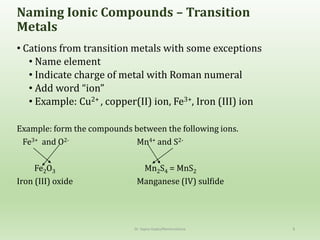
Naming Ionic Compounds – Transition
Metals
• Cations from transition metals with some exceptions
• Name element
• Indicate charge of metal with Roman numeral
• Add word “ion”
• Example: Cu2+ , copper(II) ion, Fe3+, Iron (III) ion
Example: form the compounds between the following ions.
Fe3+ and O2- Mn4+ and S2-
Fe2O3 Mn2S4 = MnS2
Iron (III) oxide Manganese (IV) sulfide
Dr. Sapna Gupta/Nomenclature 8
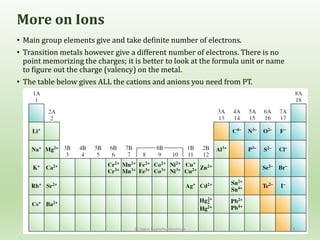
More on Ions
• Main group elements give and take definite number of electrons.
• Transition metals however give a different number of electrons. There is no
point memorizing the charges; it is better to look at the formula unit or name
to figure out the charge (valency) on the metal.
• The table below gives ALL the cations and anions you need from PT.
Dr. Sapna Gupta/Nomenclature 9
Polyatomic Ions
• These are ions (cations and
anions) formed from
combination of non metals.
• Most polyatomic ions are
anions meaning they have
excess electrons. (Where are
these excess electrons coming
from? From the metals they
combine with).
Positive Polyatomic Cations
H3O+ hydronium ion (exists only in acidic solutions)
NH4
+ ammonium ion (formed from NH3: ammonia)
Simple Polyatomic Anions
OH- hydroxide
CN- cyanide
Polyatomic Ions Containing Oxygen
(all end in “ate” or “ite”)
Formula Name Formula Name
CO3
2- Carbonate CrO4
2- Chromate
HCO3
- Hydrogen carbonate Cr2O7
2- Dichromate
SO4
2- Sulfate MnO4
- Permanganate
HSO4- Hydrogen sulfate SCN- Thiocyanate
SO3
2- Sulfite S2O3
2- Thiosulfate
HSO3
- Hydrogen sulfite ClO- Hypochlorite
NO3
- Nitrate ClO2
- Chlorite
NO2- Nitrite ClO3
- Chlorate
PO4
3- Phosphate ClO4
- Hypochlorate
HPO4
2- Hydrogen phosphate
H2PO4- Dihydrogen phosphate
C2H3O2
-
CH3COO-
Acetate
Dr. Sapna Gupta/Nomenclature 10
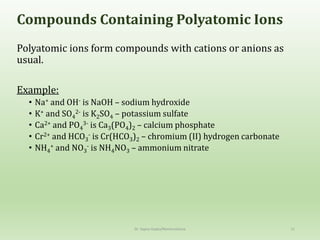
Compounds Containing Polyatomic Ions
Polyatomic ions form compounds with cations or anions as
usual.
Example:
• Na+ and OH- is NaOH – sodium hydroxide
• K+ and SO4
2- is K2SO4 – potassium sulfate
• Ca2+ and PO4
3- is Ca3(PO4)2 – calcium phosphate
• Cr2+ and HCO3
- is Cr(HCO3)2 – chromium (II) hydrogen carbonate
• NH4
+ and NO3
- is NH4NO3 – ammonium nitrate
Dr. Sapna Gupta/Nomenclature 11
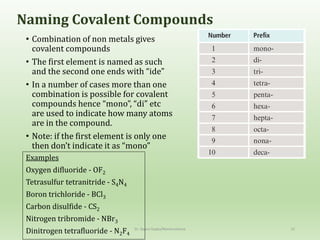
Naming Covalent Compounds
• Combination of non metals gives
covalent compounds
• The first element is named as such
and the second one ends with “ide”
• In a number of cases more than one
combination is possible for covalent
compounds hence “mono”, “di” etc
are used to indicate how many atoms
are in the compound.
• Note: if the first element is only one
then don’t indicate it as “mono”
Examples
Oxygen difluoride - OF2
Tetrasulfur tetranitride - S4N4
Boron trichloride - BCl3
Carbon disulfide - CS2
Nitrogen tribromide - NBr3
Dinitrogen tetrafluoride - N2F4
Dr. Sapna Gupta/Nomenclature 12
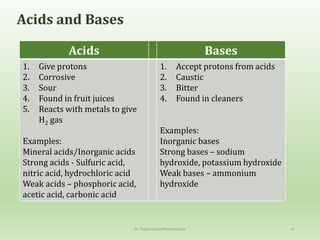
Acids and Bases
Acids Bases
1. Give protons
2. Corrosive
3. Sour
4. Found in fruit juices
5. Reacts with metals to give
H2 gas
Examples:
Mineral acids/Inorganic acids
Strong acids - Sulfuric acid,
nitric acid, hydrochloric acid
Weak acids – phosphoric acid,
acetic acid, carbonic acid
1. Accept protons from acids
2. Caustic
3. Bitter
4. Found in cleaners
Examples:
Inorganic bases
Strong bases – sodium
hydroxide, potassium hydroxide
Weak bases – ammonium
hydroxide
Dr. Sapna Gupta/Nomenclature 13
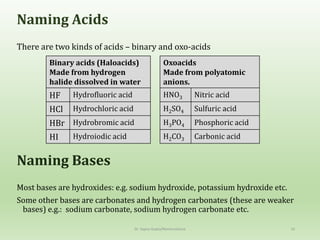
Naming Acids
There are two kinds of acids – binary and oxo-acids
Binary acids (Haloacids)
Made from hydrogen
halide dissolved in water
Oxoacids
Made from polyatomic
anions.
HF Hydrofluoric acid HNO3 Nitric acid
HCl Hydrochloric acid H2SO4 Sulfuric acid
HBr Hydrobromic acid H3PO4 Phosphoric acid
HI Hydroiodic acid H2CO3 Carbonic acid
Naming Bases
Most bases are hydroxides: e.g. sodium hydroxide, potassium hydroxide etc.
Some other bases are carbonates and hydrogen carbonates (these are weaker
bases) e.g.: sodium carbonate, sodium hydrogen carbonate etc.
Dr. Sapna Gupta/Nomenclature 14
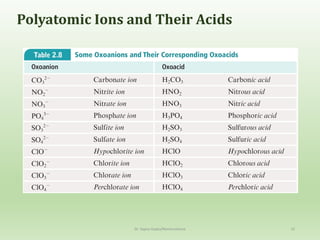
Polyatomic Ions and Their Acids
Dr. Sapna Gupta/Nomenclature 15
Naming Hydrates
• Hydrates are ionic compounds that are associated with water.
• The water gets trapped in the ions when the solid crystallizes, and in
some cases the solids absorb water (hygroscopic)
• This water can be removed from the compound by heating the
compound.
• Naming is as usual for the ionic compound and then add the water as
hydrate with the appropriate prefix of the number of water
molecules.
Examples and Names:
FeSO4  7H2O - Iron(II) sulfate heptahydrate
CuSO4· 5H2O - Copper (II) sulfate pentahydrate
Dr. Sapna Gupta/Nomenclature 16
Some Compounds with Common Names
Dr. Sapna Gupta/Nomenclature 17
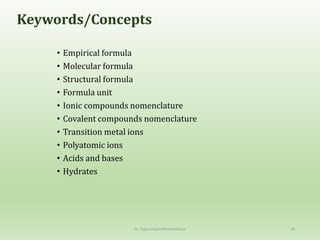
Keywords/Concepts
• Empirical formula
• Molecular formula
• Structural formula
• Formula unit
• Ionic compounds nomenclature
• Covalent compounds nomenclature
• Transition metal ions
• Polyatomic ions
• Acids and bases
• Hydrates
Dr. Sapna Gupta/Nomenclature 18
PP02-2Nomenclaturechemsirty solutions.pdf

  • 1.
  • 2.
    Introduction • Compounds areelements combined in different proportions. • There are two main types of combinations (bonding) as shown below. • Nomenclature is of three kinds – two different types for ionic – one for main group and one for transition metals; and one type for covalent. Bonding Ionic - Transfer of electrons - Between metals and non metals - Cations and Anions Covalent - Sharing of electrons - Between non metals only - No ions Dr. Sapna Gupta/Nomenclature 2
  • 3.
    Molecules and FormulaUnits • Covalent compounds are called molecules. • Formula unit is the smallest ratio of cations to anions in an ionic compound. In solid state ionic compounds a specific number of ions are associated with each other. These form the crystal structure. • There are seven diatomic gases/molecules whose names are the same as the element names: H2, O2, N2, F2, Cl2, Br2 and I2. Dr. Sapna Gupta/Nomenclature 3
  • 4.
    Representing Combinations • EmpiricalFormula – lowest ratio of combination of elements e.g. H2O, CH2O. • Molecular Formula – actual ratio of elements in a compound. For ionic compounds the empirical formula is also the molecular formula (formula unit). For covalent compounds sometimes the empirical formula can be multiplied by an integer to give the molecular formula. E.g. (CH2O) x 6 = C6H12O6 (glucose) • Structural Formula – 3D representation of the ionic or covalent compound. • Example: H2O2 is molecular formula, HO is the empirical formula of that compound. Dr. Sapna Gupta/Nomenclature 4
  • 5.
    Ionic Compounds • Formedfrom metals and non metals. • Metals lose electrons to form cations. • Non metals lose electrons to form anions. • Electrons transfer from metals to non metals. • Final unit is electrically neutral. Metals lose e- Cation formed E.g. Non Metals gain e- Anion formed E.g. Group I 1e- lost Li+, Na+ Group V 3e- gain N3-, P3- Group II 2e- lost Mg2+, Ca2+ Group VI 2e- gain O2-, S2- Group III 3e- lost Al3+ Group VII 1e- gain Cl-, Br- Dr. Sapna Gupta/Nomenclature 5
  • 6.
    Naming Ionic Compounds– Main Group • Naming cations • Name the element and add the word “ion” • Example: Na+, sodium ion • Naming Anions • Name the element and modify the ending to “-ide” • Example: Cl-(chloride), O2- (oxide) • Naming ionic compounds: leave the name of the metal as is, change the name of the non metal to element ending with –ide. For example, sodium chloride, calcium oxide. • Note: The name does not say anything about the ratio of the elements. This is because there is only one combination possible for main group elements . • There are two exceptions – Pb in Group IV has two ions Pb2+ and Pb4+; and Tl in Group III has two ions Tl+ and Tl3+ Dr. Sapna Gupta/Nomenclature 6
  • 7.
    Forming Compounds (FormulaUnits) Compound formed is electrically neutral so the sum of the charges on the cation(s) and anion(s) in each formula unit must be zero. The cris- cross method is given below to easily form compounds. Al3+ and O2 Al2O3 Dr. Sapna Gupta/Nomenclature 7
  • 8.
    Naming Ionic Compounds– Transition Metals • Cations from transition metals with some exceptions • Name element • Indicate charge of metal with Roman numeral • Add word “ion” • Example: Cu2+ , copper(II) ion, Fe3+, Iron (III) ion Example: form the compounds between the following ions. Fe3+ and O2- Mn4+ and S2- Fe2O3 Mn2S4 = MnS2 Iron (III) oxide Manganese (IV) sulfide Dr. Sapna Gupta/Nomenclature 8
  • 9.
    More on Ions •Main group elements give and take definite number of electrons. • Transition metals however give a different number of electrons. There is no point memorizing the charges; it is better to look at the formula unit or name to figure out the charge (valency) on the metal. • The table below gives ALL the cations and anions you need from PT. Dr. Sapna Gupta/Nomenclature 9
  • 10.
    Polyatomic Ions • Theseare ions (cations and anions) formed from combination of non metals. • Most polyatomic ions are anions meaning they have excess electrons. (Where are these excess electrons coming from? From the metals they combine with). Positive Polyatomic Cations H3O+ hydronium ion (exists only in acidic solutions) NH4 + ammonium ion (formed from NH3: ammonia) Simple Polyatomic Anions OH- hydroxide CN- cyanide Polyatomic Ions Containing Oxygen (all end in “ate” or “ite”) Formula Name Formula Name CO3 2- Carbonate CrO4 2- Chromate HCO3 - Hydrogen carbonate Cr2O7 2- Dichromate SO4 2- Sulfate MnO4 - Permanganate HSO4- Hydrogen sulfate SCN- Thiocyanate SO3 2- Sulfite S2O3 2- Thiosulfate HSO3 - Hydrogen sulfite ClO- Hypochlorite NO3 - Nitrate ClO2 - Chlorite NO2- Nitrite ClO3 - Chlorate PO4 3- Phosphate ClO4 - Hypochlorate HPO4 2- Hydrogen phosphate H2PO4- Dihydrogen phosphate C2H3O2 - CH3COO- Acetate Dr. Sapna Gupta/Nomenclature 10
  • 11.
    Compounds Containing PolyatomicIons Polyatomic ions form compounds with cations or anions as usual. Example: • Na+ and OH- is NaOH – sodium hydroxide • K+ and SO4 2- is K2SO4 – potassium sulfate • Ca2+ and PO4 3- is Ca3(PO4)2 – calcium phosphate • Cr2+ and HCO3 - is Cr(HCO3)2 – chromium (II) hydrogen carbonate • NH4 + and NO3 - is NH4NO3 – ammonium nitrate Dr. Sapna Gupta/Nomenclature 11
  • 12.
    Naming Covalent Compounds •Combination of non metals gives covalent compounds • The first element is named as such and the second one ends with “ide” • In a number of cases more than one combination is possible for covalent compounds hence “mono”, “di” etc are used to indicate how many atoms are in the compound. • Note: if the first element is only one then don’t indicate it as “mono” Examples Oxygen difluoride - OF2 Tetrasulfur tetranitride - S4N4 Boron trichloride - BCl3 Carbon disulfide - CS2 Nitrogen tribromide - NBr3 Dinitrogen tetrafluoride - N2F4 Dr. Sapna Gupta/Nomenclature 12
  • 13.
    Acids and Bases AcidsBases 1. Give protons 2. Corrosive 3. Sour 4. Found in fruit juices 5. Reacts with metals to give H2 gas Examples: Mineral acids/Inorganic acids Strong acids - Sulfuric acid, nitric acid, hydrochloric acid Weak acids – phosphoric acid, acetic acid, carbonic acid 1. Accept protons from acids 2. Caustic 3. Bitter 4. Found in cleaners Examples: Inorganic bases Strong bases – sodium hydroxide, potassium hydroxide Weak bases – ammonium hydroxide Dr. Sapna Gupta/Nomenclature 13
  • 14.
    Naming Acids There aretwo kinds of acids – binary and oxo-acids Binary acids (Haloacids) Made from hydrogen halide dissolved in water Oxoacids Made from polyatomic anions. HF Hydrofluoric acid HNO3 Nitric acid HCl Hydrochloric acid H2SO4 Sulfuric acid HBr Hydrobromic acid H3PO4 Phosphoric acid HI Hydroiodic acid H2CO3 Carbonic acid Naming Bases Most bases are hydroxides: e.g. sodium hydroxide, potassium hydroxide etc. Some other bases are carbonates and hydrogen carbonates (these are weaker bases) e.g.: sodium carbonate, sodium hydrogen carbonate etc. Dr. Sapna Gupta/Nomenclature 14
  • 15.
    Polyatomic Ions andTheir Acids Dr. Sapna Gupta/Nomenclature 15
  • 16.
    Naming Hydrates • Hydratesare ionic compounds that are associated with water. • The water gets trapped in the ions when the solid crystallizes, and in some cases the solids absorb water (hygroscopic) • This water can be removed from the compound by heating the compound. • Naming is as usual for the ionic compound and then add the water as hydrate with the appropriate prefix of the number of water molecules. Examples and Names: FeSO4  7H2O - Iron(II) sulfate heptahydrate CuSO4· 5H2O - Copper (II) sulfate pentahydrate Dr. Sapna Gupta/Nomenclature 16
  • 17.
    Some Compounds withCommon Names Dr. Sapna Gupta/Nomenclature 17
  • 18.
    Keywords/Concepts • Empirical formula •Molecular formula • Structural formula • Formula unit • Ionic compounds nomenclature • Covalent compounds nomenclature • Transition metal ions • Polyatomic ions • Acids and bases • Hydrates Dr. Sapna Gupta/Nomenclature 18