Intermolecular Forces
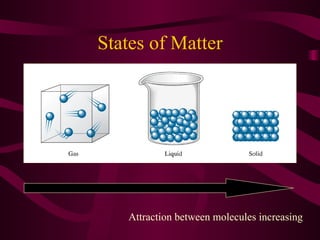
States of Matter Attraction between molecules increasing
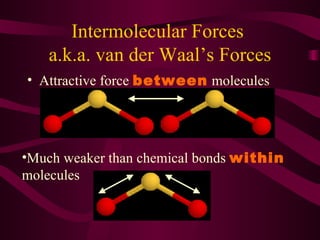
Intermolecular Forces  a.k.a. van der Waal’s Forces Attractive force  between  molecules Much weaker than chemical bonds  within  molecules
Types of Intermolecular Forces London Dispersion Forces:  an attractive force acting between all molecules * attraction of electrons of one atom to nucleus of another atom * very weak force * increases in strength as molar  mass increases (more electrons)
Dipole-Dipole Forces:  attractive force acting between oppositely charged ends of polar molecules. * medium strength * strongest when molecules close together
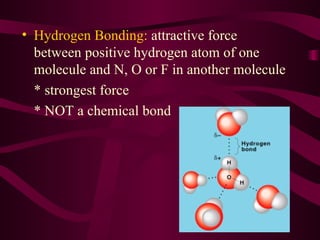
Hydrogen Bonding:  attractive force between positive hydrogen atom of one molecule and N, O or F in another molecule * strongest force * NOT a chemical bond
Predict IMF acting between molecules of: F 2   - London dispersion PH 3 - dipole-dipole, London dispersion CH 4 - London dispersion H 2 O - Hydrogen bonds, dipole-dipole, London dispersion
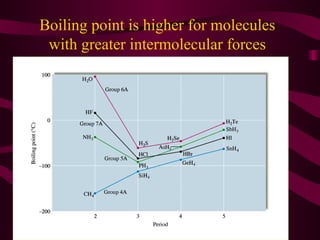
Properties of Liquids Boiling Point:  Temperature at which a liquid becomes a gas * It represents the amount of energy to overcome the intermolecular forces holding the liquid molecules together * Substances with greater intermolecular forces have higher boiling points
Boiling point is higher for molecules with greater intermolecular forces

01 intermolecular forces

  • 1.
  • 2.
    States of MatterAttraction between molecules increasing
  • 3.
    Intermolecular Forces a.k.a. van der Waal’s Forces Attractive force between molecules Much weaker than chemical bonds within molecules
  • 4.
    Types of IntermolecularForces London Dispersion Forces: an attractive force acting between all molecules * attraction of electrons of one atom to nucleus of another atom * very weak force * increases in strength as molar mass increases (more electrons)
  • 5.
    Dipole-Dipole Forces: attractive force acting between oppositely charged ends of polar molecules. * medium strength * strongest when molecules close together
  • 6.
    Hydrogen Bonding: attractive force between positive hydrogen atom of one molecule and N, O or F in another molecule * strongest force * NOT a chemical bond
  • 7.
    Predict IMF actingbetween molecules of: F 2 - London dispersion PH 3 - dipole-dipole, London dispersion CH 4 - London dispersion H 2 O - Hydrogen bonds, dipole-dipole, London dispersion
  • 8.
    Properties of LiquidsBoiling Point: Temperature at which a liquid becomes a gas * It represents the amount of energy to overcome the intermolecular forces holding the liquid molecules together * Substances with greater intermolecular forces have higher boiling points
  • 9.
    Boiling point ishigher for molecules with greater intermolecular forces