This work is licensed under a Creative Commons Attribution-Noncommercial-Share Alike 2.0 UK: England & Wales License   Inorganic Compounds- nomenclature University of Lincoln presentation
INORGANIC COMPOUNDS Compounds composed of elements other than carbon. Associated with the nonliving portion of the world This work is licensed under a Creative Commons Attribution-Noncommercial-Share Alike 2.0 UK: England & Wales License
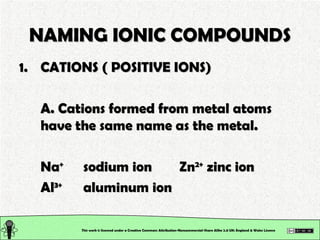
NAMING IONIC COMPOUNDS CATIONS ( POSITIVE IONS) A. Cations formed from metal atoms have the same name as the metal. Na + sodium ion Zn 2+  zinc ion Al 3+ aluminum ion This work is licensed under a Creative Commons Attribution-Noncommercial-Share Alike 2.0 UK: England & Wales License
Naming Ionic compounds with Transition metals B. If a metal can form cations of different charges, the positive charge is given by a Roman numeral in parenthesis following the name of the metal. Fe 2+ iron (II) ion Cu +  copper (I) ion Fe 3+ iron (III) ion Cu 2+  copper (II) ion  This work is licensed under a Creative Commons Attribution-Noncommercial-Share Alike 2.0 UK: England & Wales License
Naming Ionic compounds (classic name) Apply  –ous  or  –ic The endings represent the lower and higher charged ions, respectively.   Fe 2+ ferrous ion Cu +  cuprous ion   Fe 3+ ferric ion Cu 2+  cupric ion  This work is licensed under a Creative Commons Attribution-Noncommercial-Share Alike 2.0 UK: England & Wales License
IONIC CHARGES OF REPRESENTATIVE ELEMENTS This work is licensed under a Creative Commons Attribution-Noncommercial-Share Alike 2.0 UK: England & Wales License   1A 2A 3A 4A 5A 6A 7A 0 Li + Be 2+ N 3- O 2- F - Na + Mg 2+ Al +3 P 3- S 2- Cl - K + Ca 2+ As 3- Se 2- Br - Rb + Sr 2+ I - Cs + Ba 2+
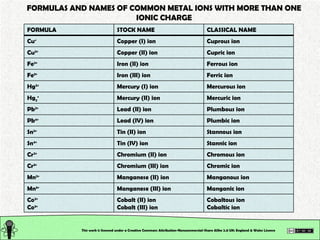
FORMULAS  AND  NAMES OF COMMON METAL IONS WITH MORE THAN ONE IONIC CHARGE This work is licensed under a Creative Commons Attribution-Noncommercial-Share Alike 2.0 UK: England & Wales License   FORMULA STOCK NAME CLASSICAL NAME Cu + Copper (I) ion Cuprous ion Cu 2+ Copper (II) ion Cupric ion Fe 2+ Iron (II) ion Ferrous ion Fe 3+ Iron (III) ion Ferric ion Hg 2+ Mercury (I) ion Mercurous ion Hg 2 + Mercury (II) ion Mercuric ion Pb 2+ Lead (II) ion Plumbous ion Pb 4+ Lead (IV) ion Plumbic ion Sn 2+ Tin (II) ion Stannous ion Sn 4+ Tin (IV) ion Stannic ion Cr 2+ Chromium (II) ion Chromous ion Cr 3+ Chromium (III) ion Chromic ion Mn 2+ Manganese (II) ion Manganous ion Mn 3+ Manganese (III) ion Manganic ion Co 2+ Co 3+ Cobalt (II) ion Cobalt (III) ion Cobaltous ion Cobaltic ion
EXERCISES: Name each of the following: Sn 2+ Sn 4+ K + Ba 2+ Co 2+ Co 3+ This work is licensed under a Creative Commons Attribution-Noncommercial-Share Alike 2.0 UK: England & Wales License
Continue: Fe 2+  Fe 3+ Al +3 Sr 2+ Cr 2+ Cr 3+ This work is licensed under a Creative Commons Attribution-Noncommercial-Share Alike 2.0 UK: England & Wales License
2. ANIONS (NEGATIVE IONS) A. Monoatomic (one-atom) anions have names formed by replacing the ending of the name  of the element with  –ide H -   O 2- N 3-  OH - Hydride ion Oxide ion   Nitride ion  Hydroxide ion   This work is licensed under a Creative Commons Attribution-Noncommercial-Share Alike 2.0 UK: England & Wales License
B. Polyatomic anions containing oxygen have names ending in  –ate  or  –ite These are called  oxyanions NO 3 -  nitrate ion SO 4 2-  sulfate ion NO 2 -  nitrite ion SO 3 2-  sulfite ion CO 3 2- carbonate ion HCO 3 - hydrogen carbonate ion PO 4 3- phosphate ion This work is licensed under a Creative Commons Attribution-Noncommercial-Share Alike 2.0 UK: England & Wales License
ClO 4 -  perchlorate ion (one more O atom than chlorate) ClO 3 -   chlorate ion ClO 2 -  chlorite ion (one less O atom than chlorate) ClO -  hypochlorite ion (one less O atom than chlorite) This work is licensed under a Creative Commons Attribution-Noncommercial-Share Alike 2.0 UK: England & Wales License
COMMON POLYATOMIC IONS This work is licensed under a Creative Commons Attribution-Noncommercial-Share Alike 2.0 UK: England & Wales License   3- charge PO 3 3- Phosphite PO 4 3- Phosphate 1+ charge NH 4 + Ammonium 1- charge H 2 PO 4 - Dihydrogen phosphate C 2 H 3 O 2 - Acetate HSO 3 - Hydrogen sulfite HSO 4 - Hydrogen sulfate HCO 3 - Hydrogen carbonate NO 2 - Nitrite NO 3 - Nitrate CN- Cyanide OH- Hydroxide MnO 4 - Permanganate ClO- Hypochlorite ClO 2 - Chlorite ClO 3 - Chlorate ClO 4 - Perchlorate 2- charge HPO 4 2- Hydrogen phosphate C 2 O 4 2- Oxalate SO 3 2- Sulfite SO 4 2- Sulfate CO 3 2- Carbonate CrO 4 2- Chromate Cr 2 O 7 2- Dichromate SiO 3 2- Silicate
3. IONIC COMPOUNDS Names of ionic compounds consist of the cation name followed by the anion name CaCl 2 calcium chloride Al(NO 3 ) 3 aluminum nitrate Cu(ClO 4 ) 2 copper (II)perchlorate  cupric perchlorate This work is licensed under a Creative Commons Attribution-Noncommercial-Share Alike 2.0 UK: England & Wales License
Name the following compounds: CuS K 3 N SnCl 2 K 2 S CaI 2 NaI This work is licensed under a Creative Commons Attribution-Noncommercial-Share Alike 2.0 UK: England & Wales License
Answers CuS Copper (II) sulfide K 3 N Potassium Nitride SnCl 2 Tin (II) chloride K 2 S Potassium sulfide CaI 2 Calcium Iodide NaI Sodium Iodide This work is licensed under a Creative Commons Attribution-Noncommercial-Share Alike 2.0 UK: England & Wales License
Name the following: MgCl 2 SnCl 4 HgBr 2 PbS 2 FeO Write the formula for each of the following: Magnesium bromide Aluminum oxide Ferrous bromide Lead (II) sulfide Stannic oxide This work is licensed under a Creative Commons Attribution-Noncommercial-Share Alike 2.0 UK: England & Wales License
HOMEWORK: Name the following: CoI 2 Cs 2 O ZnS KCI BaO CuBr 2 This work is licensed under a Creative Commons Attribution-Noncommercial-Share Alike 2.0 UK: England & Wales License
NAMES OF FORMULAS OF ACIDS An acid is a substance whose molecules yield hydrogen ions (H + ) when dissolved in water.  This work is licensed under a Creative Commons Attribution-Noncommercial-Share Alike 2.0 UK: England & Wales License
Acid based on anions whose names end in  –ide.  Anions whose names end in  –ide  have he asociated acids that have the  hydro-  prefix and an  –ic  ending ANION CORRESPONDING ACIDS  Cl -  (chloride) HCl (hydrochloric acid) S 2-  (sulfide) H 2 S (hydrosulfuric acid) This work is licensed under a Creative Commons Attribution-Noncommercial-Share Alike 2.0 UK: England & Wales License
2. Anions whose names end in  –ate  have associated acids with an  –ic  ending, whereas anions whose names end in  –ite  have acids with an  -ous  ending.  Prefixes in the name of the anion are retained in the name of the acid. This work is licensed under a Creative Commons Attribution-Noncommercial-Share Alike 2.0 UK: England & Wales License
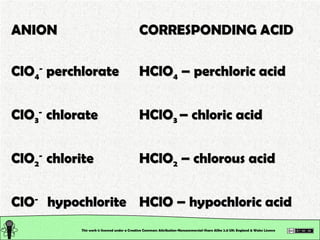
ANION CORRESPONDING ACID ClO 4 -   perchlorate  H ClO 4  – perchloric acid ClO 3 -  chlorate  HClO 3  – chloric acid ClO 2 -  chlorite  H ClO 2  – chlorous acid ClO -  hypochlorite  H ClO  – hypochloric acid This work is licensed under a Creative Commons Attribution-Noncommercial-Share Alike 2.0 UK: England & Wales License
EXERCISES: Give the name or formula for the following: H 2 SO 4 H 2 CO 3 Nitric acid Phosphoric acid This work is licensed under a Creative Commons Attribution-Noncommercial-Share Alike 2.0 UK: England & Wales License
This work is licensed under a Creative Commons Attribution-Noncommercial-Share Alike 2.0 UK: England & Wales License   Acknowledgements JISC HEA Centre for Educational Research and Development School of natural and applied sciences School of Journalism SirenFM http://tango.freedesktop.org

Nomenclature 2

  • 1.
    This work islicensed under a Creative Commons Attribution-Noncommercial-Share Alike 2.0 UK: England & Wales License Inorganic Compounds- nomenclature University of Lincoln presentation
  • 2.
    INORGANIC COMPOUNDS Compoundscomposed of elements other than carbon. Associated with the nonliving portion of the world This work is licensed under a Creative Commons Attribution-Noncommercial-Share Alike 2.0 UK: England & Wales License
  • 3.
    NAMING IONIC COMPOUNDSCATIONS ( POSITIVE IONS) A. Cations formed from metal atoms have the same name as the metal. Na + sodium ion Zn 2+ zinc ion Al 3+ aluminum ion This work is licensed under a Creative Commons Attribution-Noncommercial-Share Alike 2.0 UK: England & Wales License
  • 4.
    Naming Ionic compoundswith Transition metals B. If a metal can form cations of different charges, the positive charge is given by a Roman numeral in parenthesis following the name of the metal. Fe 2+ iron (II) ion Cu + copper (I) ion Fe 3+ iron (III) ion Cu 2+ copper (II) ion This work is licensed under a Creative Commons Attribution-Noncommercial-Share Alike 2.0 UK: England & Wales License
  • 5.
    Naming Ionic compounds(classic name) Apply –ous or –ic The endings represent the lower and higher charged ions, respectively. Fe 2+ ferrous ion Cu + cuprous ion Fe 3+ ferric ion Cu 2+ cupric ion This work is licensed under a Creative Commons Attribution-Noncommercial-Share Alike 2.0 UK: England & Wales License
  • 6.
    IONIC CHARGES OFREPRESENTATIVE ELEMENTS This work is licensed under a Creative Commons Attribution-Noncommercial-Share Alike 2.0 UK: England & Wales License 1A 2A 3A 4A 5A 6A 7A 0 Li + Be 2+ N 3- O 2- F - Na + Mg 2+ Al +3 P 3- S 2- Cl - K + Ca 2+ As 3- Se 2- Br - Rb + Sr 2+ I - Cs + Ba 2+
  • 7.
    FORMULAS AND NAMES OF COMMON METAL IONS WITH MORE THAN ONE IONIC CHARGE This work is licensed under a Creative Commons Attribution-Noncommercial-Share Alike 2.0 UK: England & Wales License FORMULA STOCK NAME CLASSICAL NAME Cu + Copper (I) ion Cuprous ion Cu 2+ Copper (II) ion Cupric ion Fe 2+ Iron (II) ion Ferrous ion Fe 3+ Iron (III) ion Ferric ion Hg 2+ Mercury (I) ion Mercurous ion Hg 2 + Mercury (II) ion Mercuric ion Pb 2+ Lead (II) ion Plumbous ion Pb 4+ Lead (IV) ion Plumbic ion Sn 2+ Tin (II) ion Stannous ion Sn 4+ Tin (IV) ion Stannic ion Cr 2+ Chromium (II) ion Chromous ion Cr 3+ Chromium (III) ion Chromic ion Mn 2+ Manganese (II) ion Manganous ion Mn 3+ Manganese (III) ion Manganic ion Co 2+ Co 3+ Cobalt (II) ion Cobalt (III) ion Cobaltous ion Cobaltic ion
  • 8.
    EXERCISES: Name eachof the following: Sn 2+ Sn 4+ K + Ba 2+ Co 2+ Co 3+ This work is licensed under a Creative Commons Attribution-Noncommercial-Share Alike 2.0 UK: England & Wales License
  • 9.
    Continue: Fe 2+ Fe 3+ Al +3 Sr 2+ Cr 2+ Cr 3+ This work is licensed under a Creative Commons Attribution-Noncommercial-Share Alike 2.0 UK: England & Wales License
  • 10.
    2. ANIONS (NEGATIVEIONS) A. Monoatomic (one-atom) anions have names formed by replacing the ending of the name of the element with –ide H - O 2- N 3- OH - Hydride ion Oxide ion Nitride ion Hydroxide ion This work is licensed under a Creative Commons Attribution-Noncommercial-Share Alike 2.0 UK: England & Wales License
  • 11.
    B. Polyatomic anionscontaining oxygen have names ending in –ate or –ite These are called oxyanions NO 3 - nitrate ion SO 4 2- sulfate ion NO 2 - nitrite ion SO 3 2- sulfite ion CO 3 2- carbonate ion HCO 3 - hydrogen carbonate ion PO 4 3- phosphate ion This work is licensed under a Creative Commons Attribution-Noncommercial-Share Alike 2.0 UK: England & Wales License
  • 12.
    ClO 4 - perchlorate ion (one more O atom than chlorate) ClO 3 - chlorate ion ClO 2 - chlorite ion (one less O atom than chlorate) ClO - hypochlorite ion (one less O atom than chlorite) This work is licensed under a Creative Commons Attribution-Noncommercial-Share Alike 2.0 UK: England & Wales License
  • 13.
    COMMON POLYATOMIC IONSThis work is licensed under a Creative Commons Attribution-Noncommercial-Share Alike 2.0 UK: England & Wales License 3- charge PO 3 3- Phosphite PO 4 3- Phosphate 1+ charge NH 4 + Ammonium 1- charge H 2 PO 4 - Dihydrogen phosphate C 2 H 3 O 2 - Acetate HSO 3 - Hydrogen sulfite HSO 4 - Hydrogen sulfate HCO 3 - Hydrogen carbonate NO 2 - Nitrite NO 3 - Nitrate CN- Cyanide OH- Hydroxide MnO 4 - Permanganate ClO- Hypochlorite ClO 2 - Chlorite ClO 3 - Chlorate ClO 4 - Perchlorate 2- charge HPO 4 2- Hydrogen phosphate C 2 O 4 2- Oxalate SO 3 2- Sulfite SO 4 2- Sulfate CO 3 2- Carbonate CrO 4 2- Chromate Cr 2 O 7 2- Dichromate SiO 3 2- Silicate
  • 14.
    3. IONIC COMPOUNDSNames of ionic compounds consist of the cation name followed by the anion name CaCl 2 calcium chloride Al(NO 3 ) 3 aluminum nitrate Cu(ClO 4 ) 2 copper (II)perchlorate cupric perchlorate This work is licensed under a Creative Commons Attribution-Noncommercial-Share Alike 2.0 UK: England & Wales License
  • 15.
    Name the followingcompounds: CuS K 3 N SnCl 2 K 2 S CaI 2 NaI This work is licensed under a Creative Commons Attribution-Noncommercial-Share Alike 2.0 UK: England & Wales License
  • 16.
    Answers CuS Copper(II) sulfide K 3 N Potassium Nitride SnCl 2 Tin (II) chloride K 2 S Potassium sulfide CaI 2 Calcium Iodide NaI Sodium Iodide This work is licensed under a Creative Commons Attribution-Noncommercial-Share Alike 2.0 UK: England & Wales License
  • 17.
    Name the following:MgCl 2 SnCl 4 HgBr 2 PbS 2 FeO Write the formula for each of the following: Magnesium bromide Aluminum oxide Ferrous bromide Lead (II) sulfide Stannic oxide This work is licensed under a Creative Commons Attribution-Noncommercial-Share Alike 2.0 UK: England & Wales License
  • 18.
    HOMEWORK: Name thefollowing: CoI 2 Cs 2 O ZnS KCI BaO CuBr 2 This work is licensed under a Creative Commons Attribution-Noncommercial-Share Alike 2.0 UK: England & Wales License
  • 19.
    NAMES OF FORMULASOF ACIDS An acid is a substance whose molecules yield hydrogen ions (H + ) when dissolved in water. This work is licensed under a Creative Commons Attribution-Noncommercial-Share Alike 2.0 UK: England & Wales License
  • 20.
    Acid based onanions whose names end in –ide. Anions whose names end in –ide have he asociated acids that have the hydro- prefix and an –ic ending ANION CORRESPONDING ACIDS Cl - (chloride) HCl (hydrochloric acid) S 2- (sulfide) H 2 S (hydrosulfuric acid) This work is licensed under a Creative Commons Attribution-Noncommercial-Share Alike 2.0 UK: England & Wales License
  • 21.
    2. Anions whosenames end in –ate have associated acids with an –ic ending, whereas anions whose names end in –ite have acids with an -ous ending. Prefixes in the name of the anion are retained in the name of the acid. This work is licensed under a Creative Commons Attribution-Noncommercial-Share Alike 2.0 UK: England & Wales License
  • 22.
    ANION CORRESPONDING ACIDClO 4 - perchlorate H ClO 4 – perchloric acid ClO 3 - chlorate HClO 3 – chloric acid ClO 2 - chlorite H ClO 2 – chlorous acid ClO - hypochlorite H ClO – hypochloric acid This work is licensed under a Creative Commons Attribution-Noncommercial-Share Alike 2.0 UK: England & Wales License
  • 23.
    EXERCISES: Give thename or formula for the following: H 2 SO 4 H 2 CO 3 Nitric acid Phosphoric acid This work is licensed under a Creative Commons Attribution-Noncommercial-Share Alike 2.0 UK: England & Wales License
  • 24.
    This work islicensed under a Creative Commons Attribution-Noncommercial-Share Alike 2.0 UK: England & Wales License Acknowledgements JISC HEA Centre for Educational Research and Development School of natural and applied sciences School of Journalism SirenFM http://tango.freedesktop.org