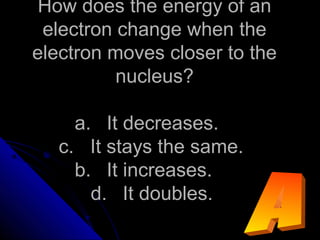
How does the energy of anHow does the energy of an
electron change when theelectron change when the
electron moves closer to theelectron moves closer to the
nucleus?nucleus?
a.a. It decreases.It decreases.
c. It stays the same.c. It stays the same.
b.b. It increases.It increases.
d.d. It doubles.It doubles.
The principal quantum number
indicates what property of an
electron?
a.position
c. energy level
b.speed
d. electron cloud shape
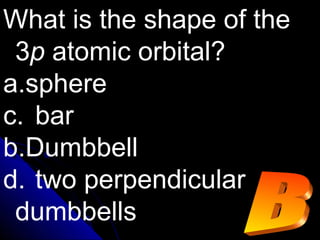
What is the shape of the
3p atomic orbital?
a.sphere
c. bar
b.Dumbbell
d. two perpendicular
dumbbells
How many energy sublevels areHow many energy sublevels are
in the second principal energyin the second principal energy
level?level?
a.a. 11 c.c. 33
b.b. 22 d.d. 44
What is the maximum number ofWhat is the maximum number of ff
orbitals in any single energy levelorbitals in any single energy level
in an atom?in an atom?
a.a. 11 c.c. 55
b.b. 33 d.d. 77
What is the maximum number ofWhat is the maximum number of
dd orbitals in a principal energyorbitals in a principal energy
level?level?
a.a. 11 c.c. 33
b.b. 22 d.d. 55
What is the maximum number ofWhat is the maximum number of
orbitals in theorbitals in the pp sublevel?sublevel?
a.a. 22 c.c. 44
b.b. 33 d.d. 55
What is the maximum number ofWhat is the maximum number of
electrons in the second principalelectrons in the second principal
energy level?energy level?
a.a. 22 c.c. 1818
b.b. 88 d.d. 3232
When an electron moves from aWhen an electron moves from a
lower to a higher energy level, thelower to a higher energy level, the
electron ____.electron ____.
a.a. always doubles its energyalways doubles its energy
b.b. absorbs a continuously variableabsorbs a continuously variable
amount of energyamount of energy
c.c. absorbs a quantum of energyabsorbs a quantum of energy
d.d. moves closer to the nucleusmoves closer to the nucleus
The shape (not the size) of anThe shape (not the size) of an
electron cloud is determined byelectron cloud is determined by
the electron's ____.the electron's ____.
a.a. energy sublevelenergy sublevel
c.c. speedspeed
b.b. positionposition
d.d. principal quantum numberprincipal quantum number
The letter "The letter "pp" in the symbol 4" in the symbol 4pp
indicates the ____.indicates the ____.
spin of an electronspin of an electron c.c.
principle energy levelprinciple energy level
orbital shapeorbital shape
speed of an electronspeed of an electron
What types of atomic orbitals areWhat types of atomic orbitals are
in the third principal energy level?in the third principal energy level?
a.a. ss andand pp onlyonly
c.c. s, p,s, p, andand dd onlyonly
b.b. pp andand dd onlyonly
d.d. s, p, d,s, p, d, andand ff
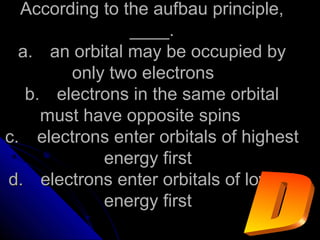
According to the aufbau principle,According to the aufbau principle,
____.____.
a.a. an orbital may be occupied byan orbital may be occupied by
only two electronsonly two electrons
b.b. electrons in the same orbitalelectrons in the same orbital
must have opposite spinsmust have opposite spins
c.c. electrons enter orbitals of highestelectrons enter orbitals of highest
energy firstenergy first
d.d. electrons enter orbitals of lowestelectrons enter orbitals of lowest
energy firstenergy first
What is the number of electrons inWhat is the number of electrons in
the outermost energy level of anthe outermost energy level of an
oxygen atom?oxygen atom?
a.a. 22 c.c. 66
b.b. 44 d.d. 88
If three electrons are available to fillIf three electrons are available to fill
three empty 2three empty 2pp atomic orbitals, howatomic orbitals, how
will the electrons be distributed in thewill the electrons be distributed in the
three orbitals?three orbitals?
a.a. one electron in each orbitalone electron in each orbital
b.b. two electrons in one orbital, onetwo electrons in one orbital, one
in another, none in the thirdin another, none in the third
c.c. three in one orbital, none in thethree in one orbital, none in the
other twoother two
d.d. Three electrons cannot fill threeThree electrons cannot fill three
empty 2empty 2pp atomic orbitals.atomic orbitals.
How many unpaired electrons areHow many unpaired electrons are
in a sulfur atom (atomic numberin a sulfur atom (atomic number
16)?16)?
a.a. 00 c.c. 22
b.b. 11 d.d. 33
How many half-filled orbitals areHow many half-filled orbitals are
in a bromine atom?in a bromine atom?
a.a. 11 c.c. 33
b.b. 22 d.d. 44
Stable electron configurations areStable electron configurations are
likely to contain ____.likely to contain ____.
a.a. filled energy sublevelsfilled energy sublevels
b.b. fewer electrons than unstablefewer electrons than unstable
configurationsconfigurations
c.c. unfilledunfilled ss orbitalsorbitals
d.d. electrons with a clockwise spinelectrons with a clockwise spin
Which electron configuration ofWhich electron configuration of
the 4the 4ff energy sublevel is the mostenergy sublevel is the most
stable?stable?
a.a. 44ff66
c.c. 44ff77
b.b. 44ff1010
d.d. 44ff1414
Which of the following electronWhich of the following electron
configurations of outer sublevelsconfigurations of outer sublevels
is the most stable?is the most stable?
a.a. 44dd55
55ss11
c.c. 44dd99
55ss22
b.b. 44dd55
55ss22
d.d. 44dd99
55ss11
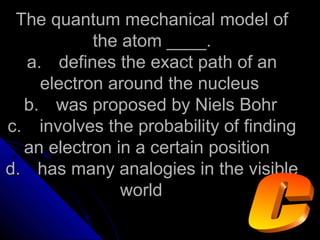
The quantum mechanical model ofThe quantum mechanical model of
the atom ____.the atom ____.
a.a. defines the exact path of andefines the exact path of an
electron around the nucleuselectron around the nucleus
b.b. was proposed by Niels Bohrwas proposed by Niels Bohr
c.c. involves the probability of findinginvolves the probability of finding
an electron in a certain positionan electron in a certain position
d.d. has many analogies in the visiblehas many analogies in the visible
worldworld
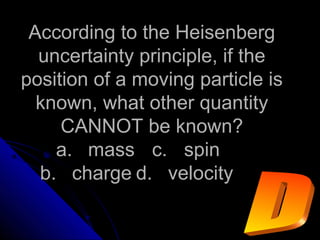
According to the HeisenbergAccording to the Heisenberg
uncertainty principle, if theuncertainty principle, if the
position of a moving particle isposition of a moving particle is
known, what other quantityknown, what other quantity
CANNOT be known?CANNOT be known?
a.a. massmass c.c. spinspin
b.b. chargecharge d.d. velocityvelocity
What is another name for theWhat is another name for the
representative elements?representative elements?
a.a. Group A elementsGroup A elements
c.c. Group C elementsGroup C elements
b.b. Group B elementsGroup B elements
d.d. transition elementstransition elements
Each period in the periodic tableEach period in the periodic table
corresponds to ____.corresponds to ____.
a.a. a principal energy levela principal energy level
c.c. an orbitalan orbital
b.b. an energy sublevelan energy sublevel
d.d. a suborbitala suborbital
The modern periodic table isThe modern periodic table is
arranged in order of increasingarranged in order of increasing
atomic ____.atomic ____.
a.a. massmass
c.c. numbernumber
b.b. chargecharge
d.d. radiusradius
Who arranged the elementsWho arranged the elements
according to atomic mass and usedaccording to atomic mass and used
the arrangement to predict thethe arrangement to predict the
properties of missing elements?properties of missing elements?
a.a. Henry MoseleyHenry Moseley
c.c. John DaltonJohn Dalton
b.b. Antoine LavoisierAntoine Lavoisier
d.d. Dmitri MendeleevDmitri Mendeleev
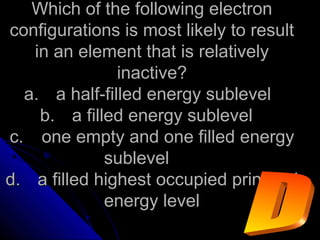
Which of the following electronWhich of the following electron
configurations is most likely to resultconfigurations is most likely to result
in an element that is relativelyin an element that is relatively
inactive?inactive?
a.a. a half-filled energy sublevela half-filled energy sublevel
b.b. a filled energy sublevela filled energy sublevel
c.c. one empty and one filled energyone empty and one filled energy
sublevelsublevel
d.d. a filled highest occupied principala filled highest occupied principal
energy levelenergy level
Which of the following statements isWhich of the following statements is
true about ions?true about ions?
a.a. Cations form when an atom gainsCations form when an atom gains
electrons.electrons.
b.b. Cations form when an atom losesCations form when an atom loses
electrons.electrons.
c.c. Anions form when an atom gainsAnions form when an atom gains
protons.protons.
d.d. Anions form when an atom losesAnions form when an atom loses
protons.protons.

Random test questions

  • 1.
    How does theenergy of anHow does the energy of an electron change when theelectron change when the electron moves closer to theelectron moves closer to the nucleus?nucleus? a.a. It decreases.It decreases. c. It stays the same.c. It stays the same. b.b. It increases.It increases. d.d. It doubles.It doubles.
  • 2.
    The principal quantumnumber indicates what property of an electron? a.position c. energy level b.speed d. electron cloud shape
  • 3.
    What is theshape of the 3p atomic orbital? a.sphere c. bar b.Dumbbell d. two perpendicular dumbbells
  • 4.
    How many energysublevels areHow many energy sublevels are in the second principal energyin the second principal energy level?level? a.a. 11 c.c. 33 b.b. 22 d.d. 44
  • 5.
    What is themaximum number ofWhat is the maximum number of ff orbitals in any single energy levelorbitals in any single energy level in an atom?in an atom? a.a. 11 c.c. 55 b.b. 33 d.d. 77
  • 6.
    What is themaximum number ofWhat is the maximum number of dd orbitals in a principal energyorbitals in a principal energy level?level? a.a. 11 c.c. 33 b.b. 22 d.d. 55
  • 7.
    What is themaximum number ofWhat is the maximum number of orbitals in theorbitals in the pp sublevel?sublevel? a.a. 22 c.c. 44 b.b. 33 d.d. 55
  • 8.
    What is themaximum number ofWhat is the maximum number of electrons in the second principalelectrons in the second principal energy level?energy level? a.a. 22 c.c. 1818 b.b. 88 d.d. 3232
  • 9.
    When an electronmoves from aWhen an electron moves from a lower to a higher energy level, thelower to a higher energy level, the electron ____.electron ____. a.a. always doubles its energyalways doubles its energy b.b. absorbs a continuously variableabsorbs a continuously variable amount of energyamount of energy c.c. absorbs a quantum of energyabsorbs a quantum of energy d.d. moves closer to the nucleusmoves closer to the nucleus
  • 10.
    The shape (notthe size) of anThe shape (not the size) of an electron cloud is determined byelectron cloud is determined by the electron's ____.the electron's ____. a.a. energy sublevelenergy sublevel c.c. speedspeed b.b. positionposition d.d. principal quantum numberprincipal quantum number
  • 11.
    The letter "Theletter "pp" in the symbol 4" in the symbol 4pp indicates the ____.indicates the ____. spin of an electronspin of an electron c.c. principle energy levelprinciple energy level orbital shapeorbital shape speed of an electronspeed of an electron
  • 12.
    What types ofatomic orbitals areWhat types of atomic orbitals are in the third principal energy level?in the third principal energy level? a.a. ss andand pp onlyonly c.c. s, p,s, p, andand dd onlyonly b.b. pp andand dd onlyonly d.d. s, p, d,s, p, d, andand ff
  • 13.
    According to theaufbau principle,According to the aufbau principle, ____.____. a.a. an orbital may be occupied byan orbital may be occupied by only two electronsonly two electrons b.b. electrons in the same orbitalelectrons in the same orbital must have opposite spinsmust have opposite spins c.c. electrons enter orbitals of highestelectrons enter orbitals of highest energy firstenergy first d.d. electrons enter orbitals of lowestelectrons enter orbitals of lowest energy firstenergy first
  • 14.
    What is thenumber of electrons inWhat is the number of electrons in the outermost energy level of anthe outermost energy level of an oxygen atom?oxygen atom? a.a. 22 c.c. 66 b.b. 44 d.d. 88
  • 15.
    If three electronsare available to fillIf three electrons are available to fill three empty 2three empty 2pp atomic orbitals, howatomic orbitals, how will the electrons be distributed in thewill the electrons be distributed in the three orbitals?three orbitals? a.a. one electron in each orbitalone electron in each orbital b.b. two electrons in one orbital, onetwo electrons in one orbital, one in another, none in the thirdin another, none in the third c.c. three in one orbital, none in thethree in one orbital, none in the other twoother two d.d. Three electrons cannot fill threeThree electrons cannot fill three empty 2empty 2pp atomic orbitals.atomic orbitals.
  • 16.
    How many unpairedelectrons areHow many unpaired electrons are in a sulfur atom (atomic numberin a sulfur atom (atomic number 16)?16)? a.a. 00 c.c. 22 b.b. 11 d.d. 33
  • 17.
    How many half-filledorbitals areHow many half-filled orbitals are in a bromine atom?in a bromine atom? a.a. 11 c.c. 33 b.b. 22 d.d. 44
  • 18.
    Stable electron configurationsareStable electron configurations are likely to contain ____.likely to contain ____. a.a. filled energy sublevelsfilled energy sublevels b.b. fewer electrons than unstablefewer electrons than unstable configurationsconfigurations c.c. unfilledunfilled ss orbitalsorbitals d.d. electrons with a clockwise spinelectrons with a clockwise spin
  • 19.
    Which electron configurationofWhich electron configuration of the 4the 4ff energy sublevel is the mostenergy sublevel is the most stable?stable? a.a. 44ff66 c.c. 44ff77 b.b. 44ff1010 d.d. 44ff1414
  • 20.
    Which of thefollowing electronWhich of the following electron configurations of outer sublevelsconfigurations of outer sublevels is the most stable?is the most stable? a.a. 44dd55 55ss11 c.c. 44dd99 55ss22 b.b. 44dd55 55ss22 d.d. 44dd99 55ss11
  • 21.
    The quantum mechanicalmodel ofThe quantum mechanical model of the atom ____.the atom ____. a.a. defines the exact path of andefines the exact path of an electron around the nucleuselectron around the nucleus b.b. was proposed by Niels Bohrwas proposed by Niels Bohr c.c. involves the probability of findinginvolves the probability of finding an electron in a certain positionan electron in a certain position d.d. has many analogies in the visiblehas many analogies in the visible worldworld
  • 22.
    According to theHeisenbergAccording to the Heisenberg uncertainty principle, if theuncertainty principle, if the position of a moving particle isposition of a moving particle is known, what other quantityknown, what other quantity CANNOT be known?CANNOT be known? a.a. massmass c.c. spinspin b.b. chargecharge d.d. velocityvelocity
  • 23.
    What is anothername for theWhat is another name for the representative elements?representative elements? a.a. Group A elementsGroup A elements c.c. Group C elementsGroup C elements b.b. Group B elementsGroup B elements d.d. transition elementstransition elements
  • 24.
    Each period inthe periodic tableEach period in the periodic table corresponds to ____.corresponds to ____. a.a. a principal energy levela principal energy level c.c. an orbitalan orbital b.b. an energy sublevelan energy sublevel d.d. a suborbitala suborbital
  • 25.
    The modern periodictable isThe modern periodic table is arranged in order of increasingarranged in order of increasing atomic ____.atomic ____. a.a. massmass c.c. numbernumber b.b. chargecharge d.d. radiusradius
  • 26.
    Who arranged theelementsWho arranged the elements according to atomic mass and usedaccording to atomic mass and used the arrangement to predict thethe arrangement to predict the properties of missing elements?properties of missing elements? a.a. Henry MoseleyHenry Moseley c.c. John DaltonJohn Dalton b.b. Antoine LavoisierAntoine Lavoisier d.d. Dmitri MendeleevDmitri Mendeleev
  • 27.
    Which of thefollowing electronWhich of the following electron configurations is most likely to resultconfigurations is most likely to result in an element that is relativelyin an element that is relatively inactive?inactive? a.a. a half-filled energy sublevela half-filled energy sublevel b.b. a filled energy sublevela filled energy sublevel c.c. one empty and one filled energyone empty and one filled energy sublevelsublevel d.d. a filled highest occupied principala filled highest occupied principal energy levelenergy level
  • 28.
    Which of thefollowing statements isWhich of the following statements is true about ions?true about ions? a.a. Cations form when an atom gainsCations form when an atom gains electrons.electrons. b.b. Cations form when an atom losesCations form when an atom loses electrons.electrons. c.c. Anions form when an atom gainsAnions form when an atom gains protons.protons. d.d. Anions form when an atom losesAnions form when an atom loses protons.protons.