Chapter 9 Covalent Bonding
9.1 The Covalent Bond Covalent Bond  – A chemical bond that results from the sharing of valence electrons. Between nonmetallic elements of similar electronegativity. A group of atoms united by a covalent bond is called a  molecule . A substance made up of molecules is called a  molecular substance . Molecules may have as few as two atoms. (CO), (O 2 )
Covalent Bonds
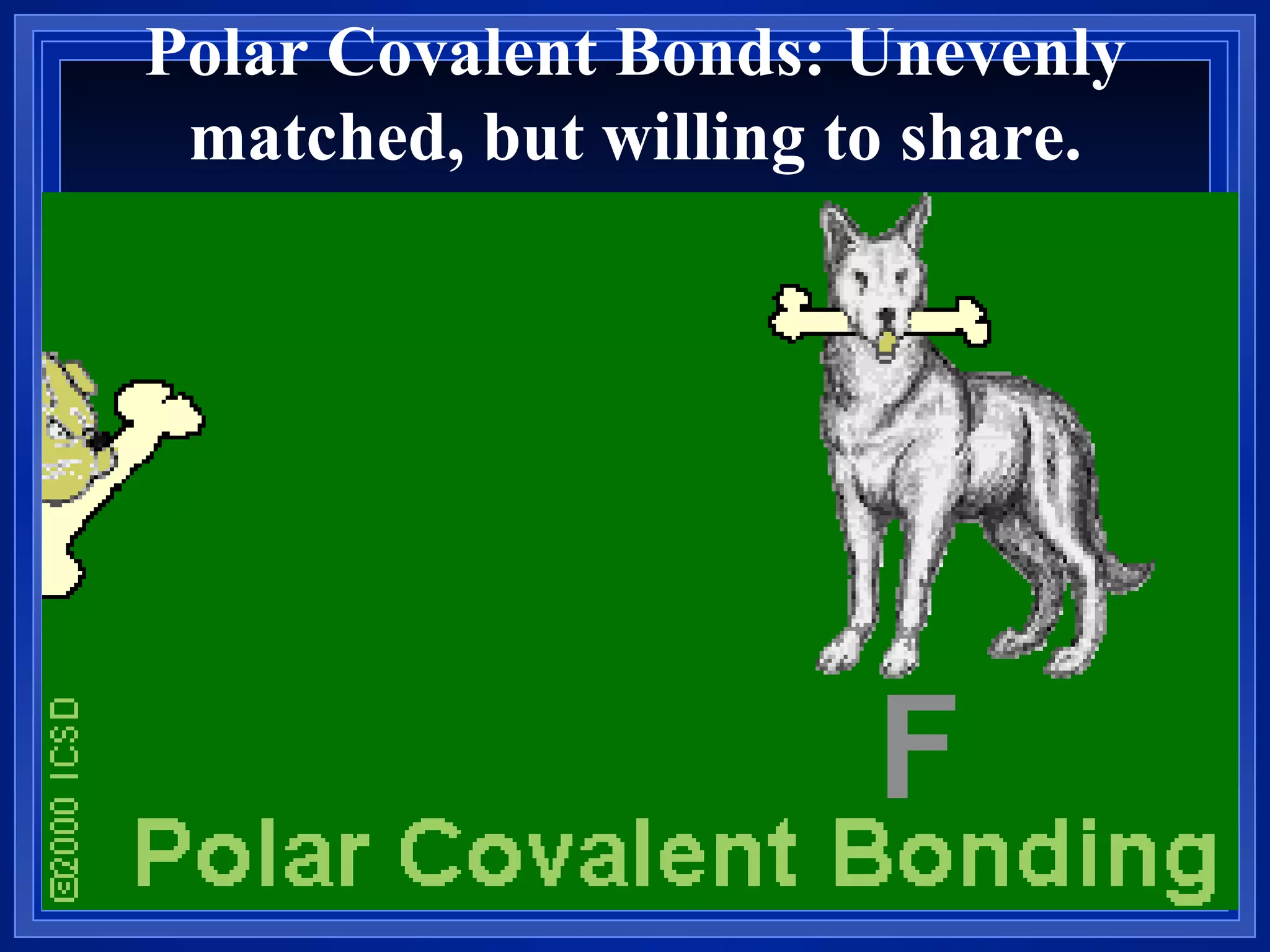
Polar Covalent Bonds: Unevenly matched, but willing to share.
To describe the composition of a molecular compound we use a  molecular formula. The molecular formula tells you how many atoms are in a single molecule of the compound. The  molecular formula  for oxygen is O 2 , which tells you that this molecule contains 2 atoms of oxygen.
The molecular formula for sucrose (table sugar) is C 12 H 22 O 11 . This indicates that one sucrose molecule contains 12 carbon atoms, 22 hydrogen atoms and 11 oxygen atoms. The  empirical formula  shows the ratio of atoms in the molecule. You get it by dividing all subscripts by the smallest subscript and rounding. C 6 H 12 O 6  becomes CH 2 O.
Molecules are often shown using a  structural formula . A  structural formula  specifies which atoms are bonded to each other in a molecule.  One type is the  Lewis structure. The  Lewis structure  uses dots as before and has a circle drawn around the dots that represent valence electrons that are joined in a covalent bond.
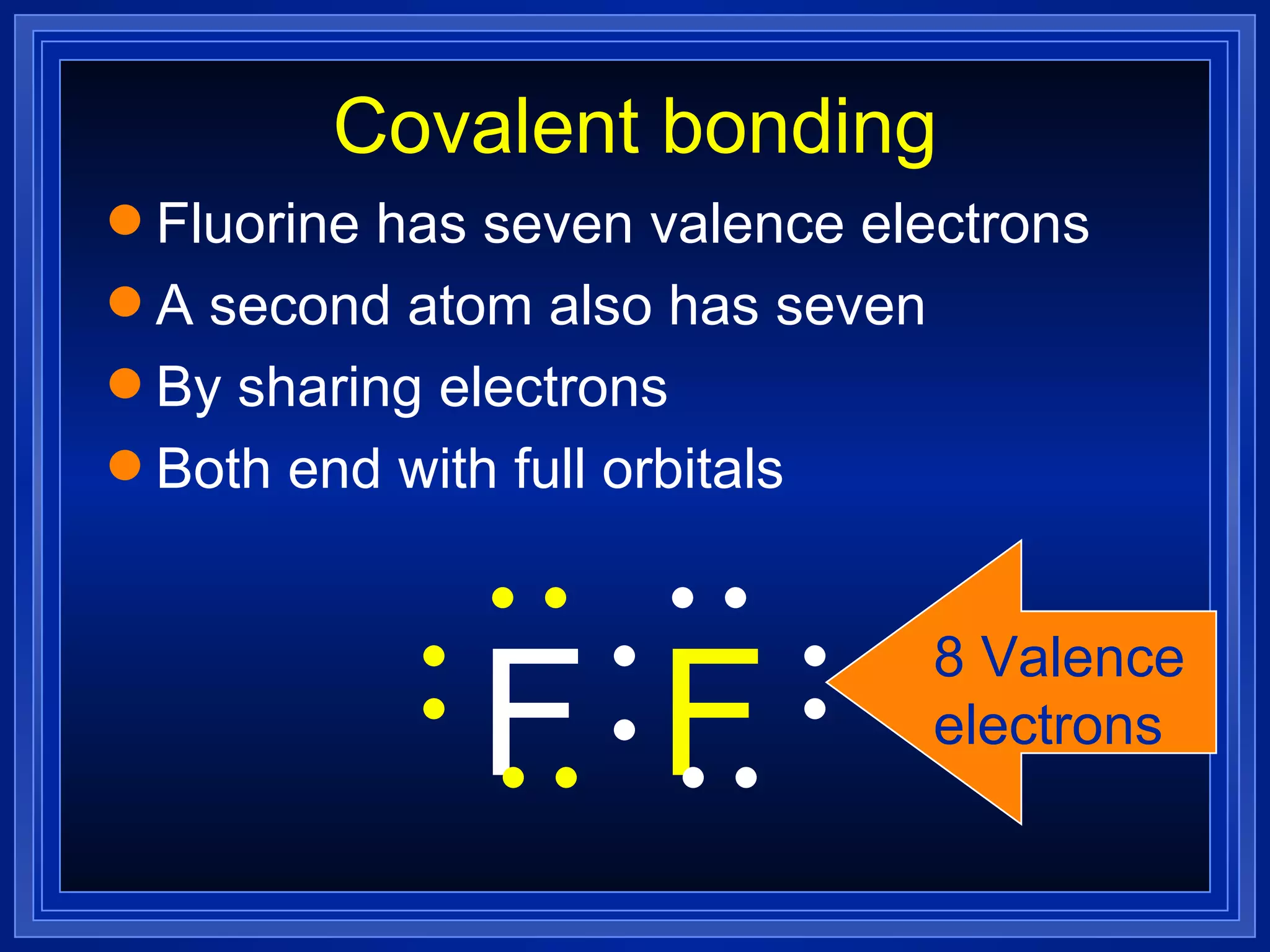
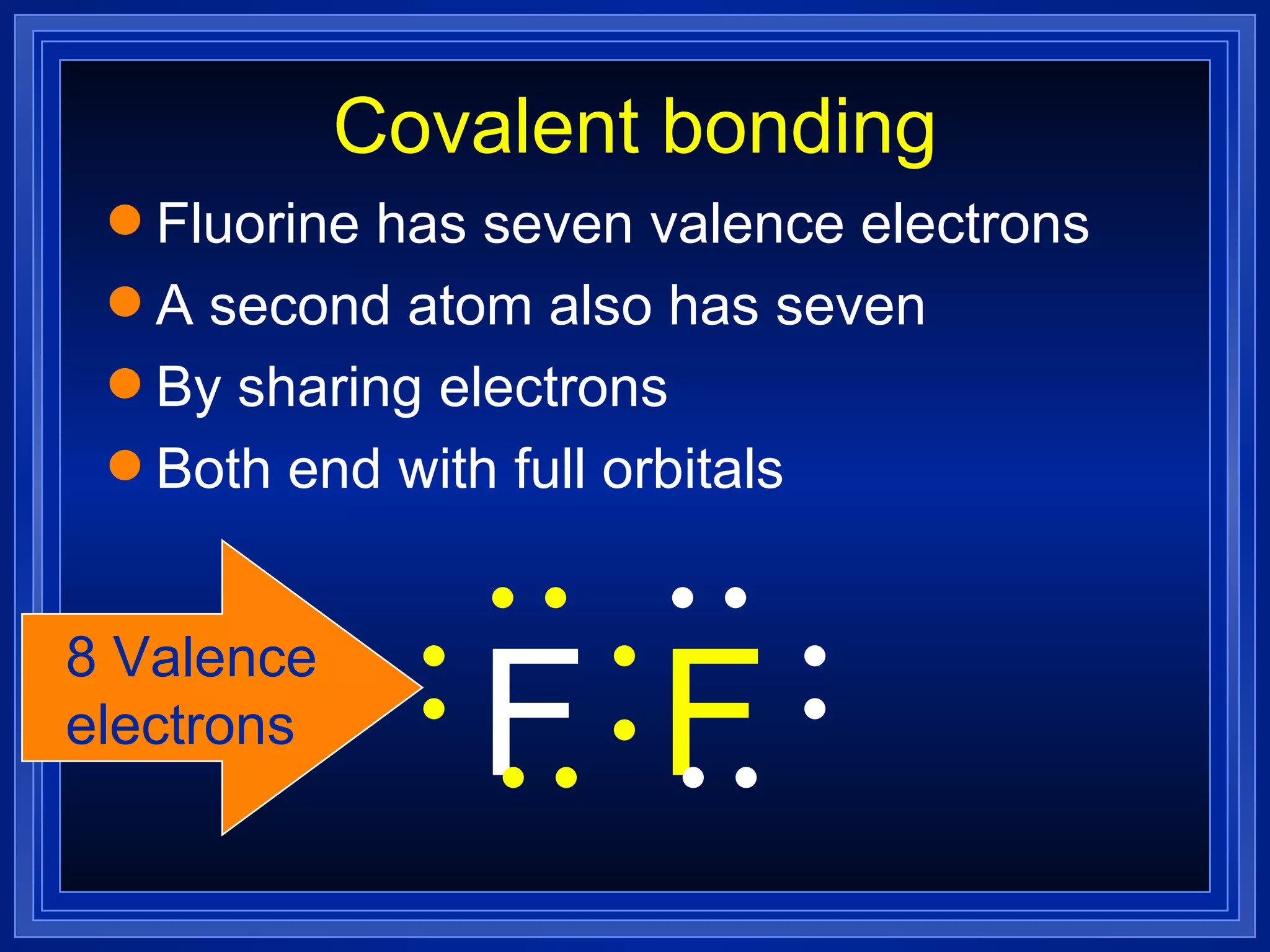
The principle that describes covalent bonding is the  octet rule . Atoms within a molecule will share electrons so as to acquire a full set (8) of valence electrons. If each atom has 7 valence electrons, then they will share one so that they both will have 8. The sharing of that electron is a  single covalent bond .
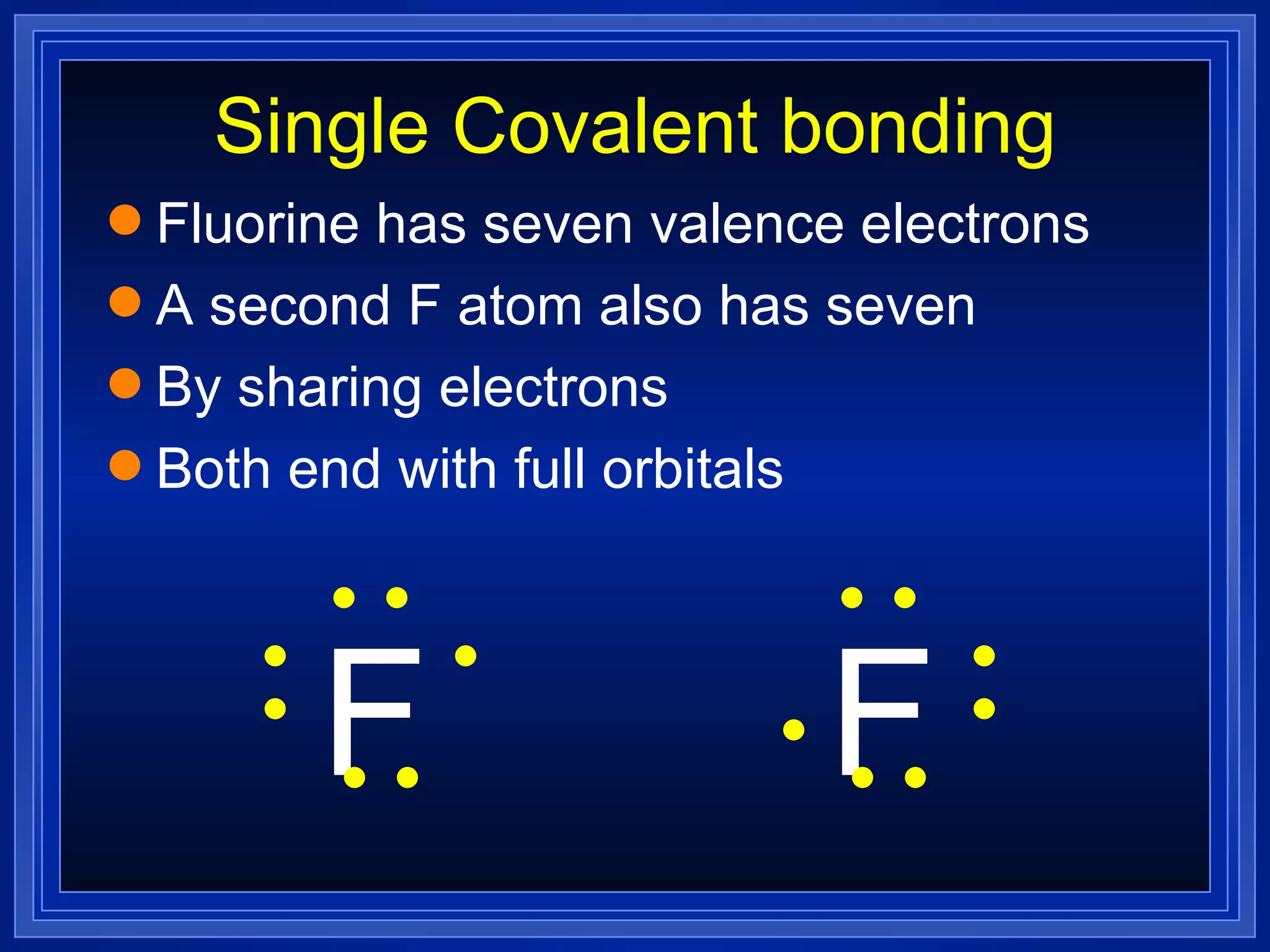
Single Covalent bonding Fluorine has seven valence electrons A second F atom also has seven By sharing electrons Both end with full orbitals F F
Covalent bonding Fluorine has seven valence electrons A second atom also has seven By sharing electrons Both end with full orbitals F F 8 Valence electrons
If more than two atoms join in a covalent bond the atoms with the fewest valence electrons will pair up with the atom that has the most up to a total of 8. If a pair of electrons is not shared, they are called an  unshared pair . If two atoms share two pairs of electrons, it is called a  double covalent bond. If two atoms share three pairs of electrons, it is called a  triple covalent bond.
The Lewis structures that you have seen so far use a pair of dots to represent covalent bonds. Another kind of Lewis structure uses  dashes  to represent covalent bonds. A  single dash  represents a single covalent bond. A  double dash  represents a double covalent bond  A  triple dash  represents a triple covalent bond.
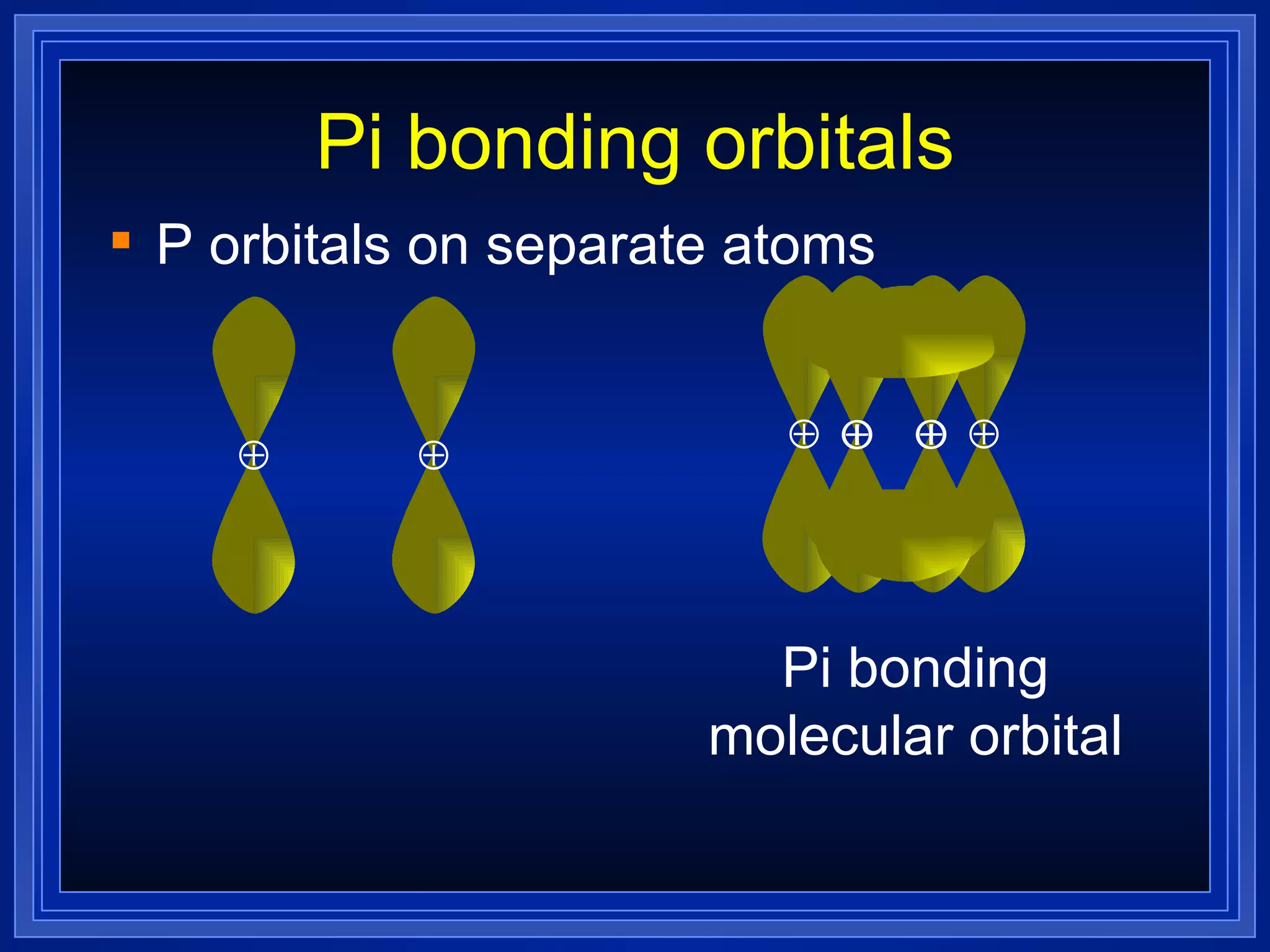
Covalent compounds (molecules) tend to have low melting and boiling points When an electron pair is shared by the direct overlap of bonding orbitals, a  sigma bond  results. Single bonds are sigma bonds. The overlap of parallel orbitals forms a  pi bond . Multiple bonds involve both sigma and pi bonds.
Bond length  depends on the sizes of the bonded atoms and the number of electron pairs they share. Bond dissociation energy  is the energy needed to break a covalent bond. Double bonds have larger bond dissociation energies than single,  triple even larger Bond length and bond dissociation energy are directly related.
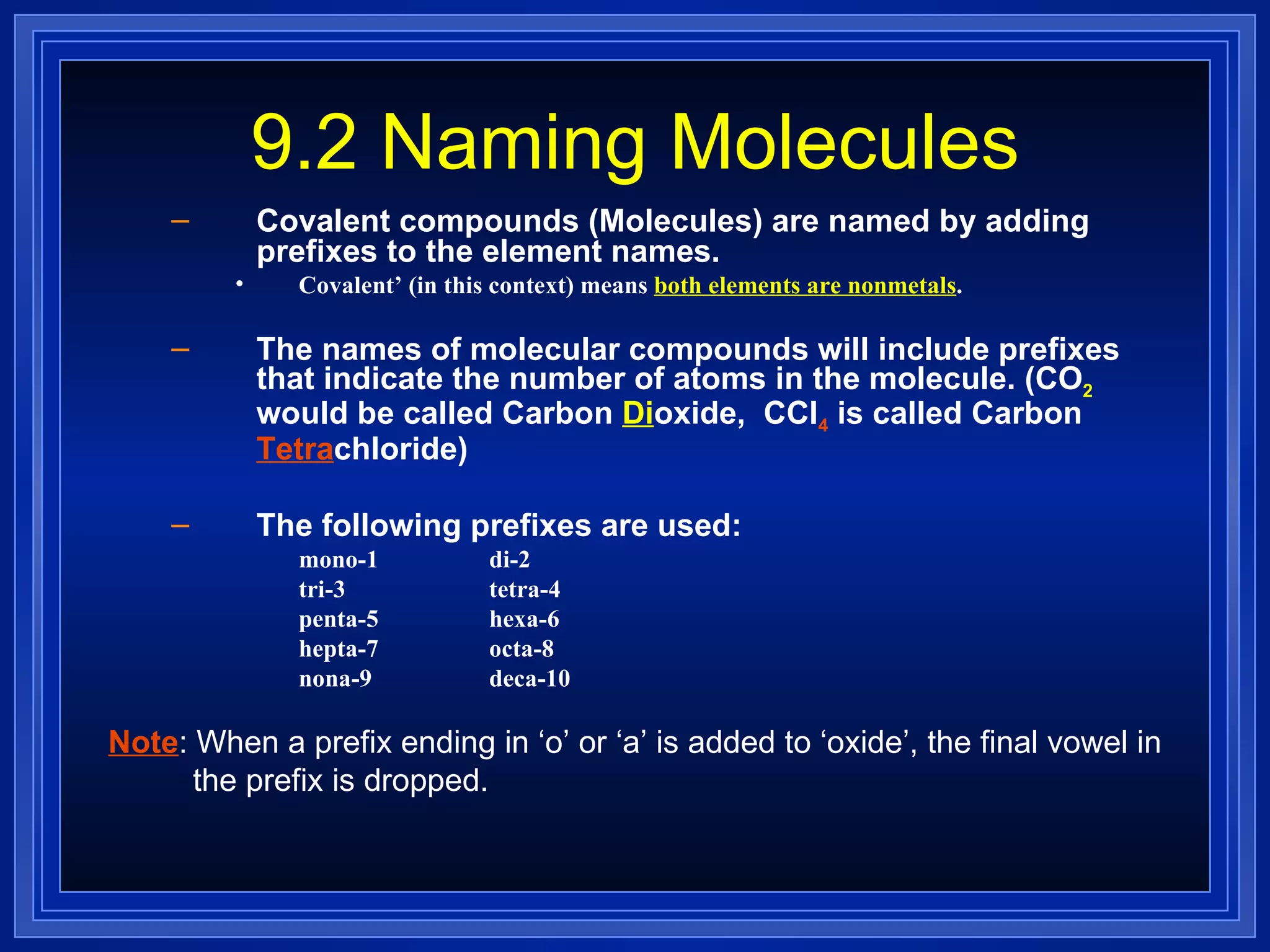
9.2 Naming Molecules Covalent compounds (Molecules) are named by adding prefixes to the element names. Covalent’ (in this context) means  both elements are nonmetals . The names of molecular compounds will include prefixes that indicate the number of atoms in the molecule. (CO 2  would be called Carbon  Di oxide,  CCl 4  is called Carbon  Tetra chloride) The following prefixes are used: mono-1 di-2 tri-3 tetra-4 penta-5 hexa-6 hepta-7 octa-8 nona-9 deca-10 Note : When a prefix ending in ‘o’ or ‘a’ is added to ‘oxide’, the final vowel in the prefix is dropped.
Remember to use the “ide” suffix. (Cl is chlor ide  not chlorine) Exceptions to the rule : The prefix “mono” is usually not written with the first word of the compounds name.  CO 2  is not called  mono carbon  di oxide,  just carbon dioxide. Some compounds have common names. (H 2 O is water or dihydrogen monoxide)
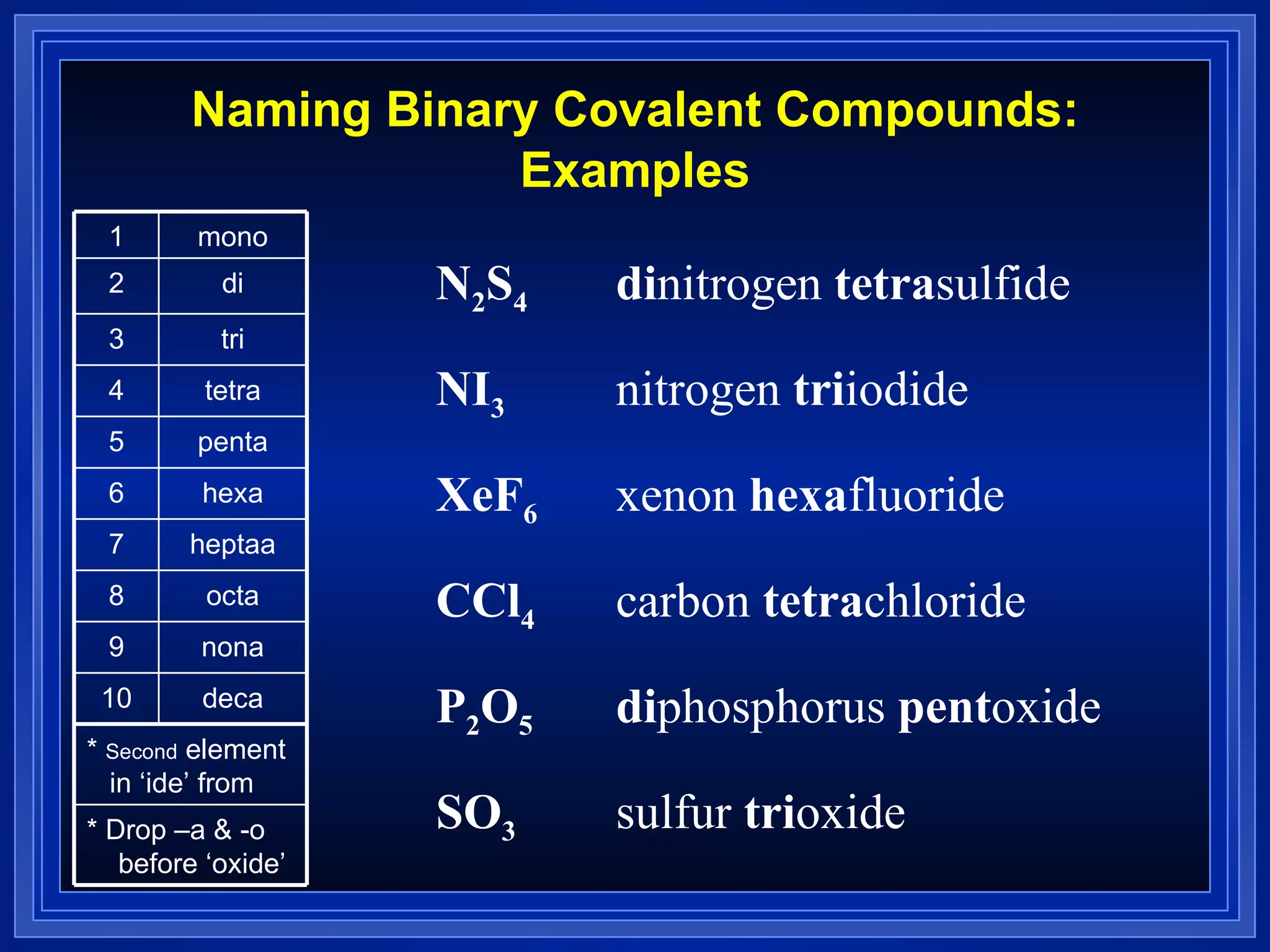
Naming Binary Covalent Compounds:   Examples N 2 S 4 di nitrogen  tetra sulfide NI 3 nitrogen  tri iodide XeF 6 xenon  hexa fluoride CCl 4 carbon  tetra chloride P 2 O 5 di phosphorus  pent oxide SO 3 sulfur  tri oxide 1 mono 2 di 3 tri 4 tetra 5 penta 6 hexa 7 heptaa 8 octa 9 nona 10 deca *  Second  element in ‘ide’ from * Drop –a & -o before ‘oxide’
Naming Acids An  acid  is a molecular substance that dissolves in water to produce hydrogen ions (H+). Acids behave like an ionic compound because when they dissolve in water, they create cations and anions. The  cation is always H+  and the anion depends on the particular acid. Example : When the acid HCl dissolves in water it forms H+ cations and Cl- anions. HNO 3  acid will form H+ and NO 3 -   ions.
Naming Acids The name of an acid usually results from the  name of the anion(-). For acids, where the anion ends with the suffix “-ide” (ex.Chloride), mainly binary acids, the name of the acid begins with the prefix hydro. The acids name also includes the root name of the anion(-) and the word acid. In addition you need to change the suffix of the anion from “ide” to “ic”. By these rules HCl is named hydrochloric acid. Other acids are named without the prefix “hydro”. The acid HNO 3 -  derives its name from NO 3 -  which is nitrate. HNO 3  is named Nitric Acid. The following are names and formulas of common acids:
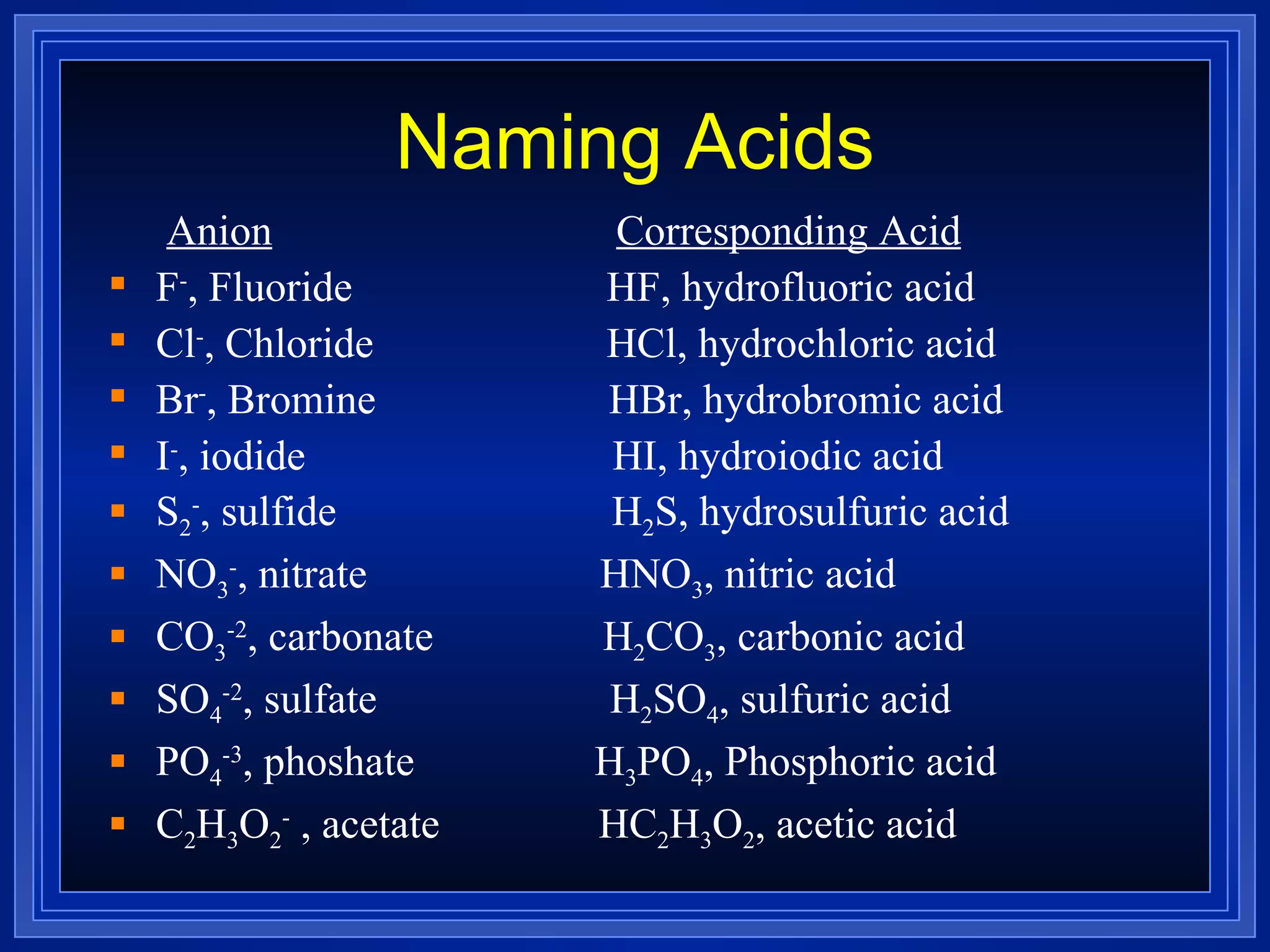
Naming Acids   Anion Corresponding Acid F - , Fluoride  HF, hydrofluoric acid  Cl - , Chloride  HCl, hydrochloric acid Br - , Bromine  HBr, hydrobromic acid I - , iodide  HI, hydroiodic acid S 2 - , sulfide  H 2 S, hydrosulfuric acid NO 3 - , nitrate  HNO 3 , nitric acid CO 3 -2 , carbonate  H 2 CO 3 , carbonic acid SO 4 -2 , sulfate  H 2 SO 4 , sulfuric acid PO 4 -3 , phoshate  H 3 PO 4 , Phosphoric acid C 2 H 3 O 2 -  , acetate  HC 2 H 3 O 2 , acetic acid
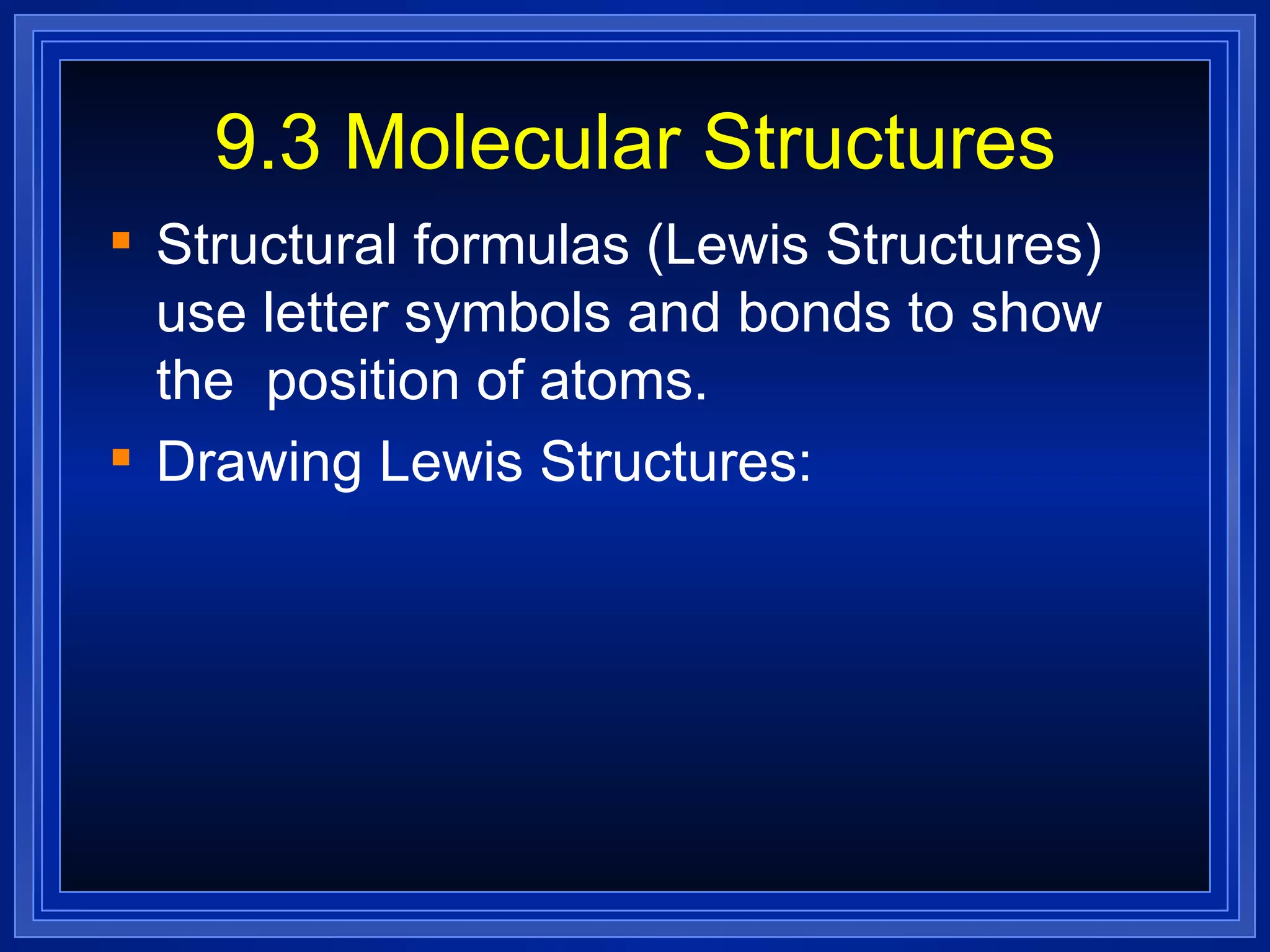
9.3 Molecular Structures Structural formulas (Lewis Structures) use letter symbols and bonds to show the  position of atoms. Drawing Lewis Structures:
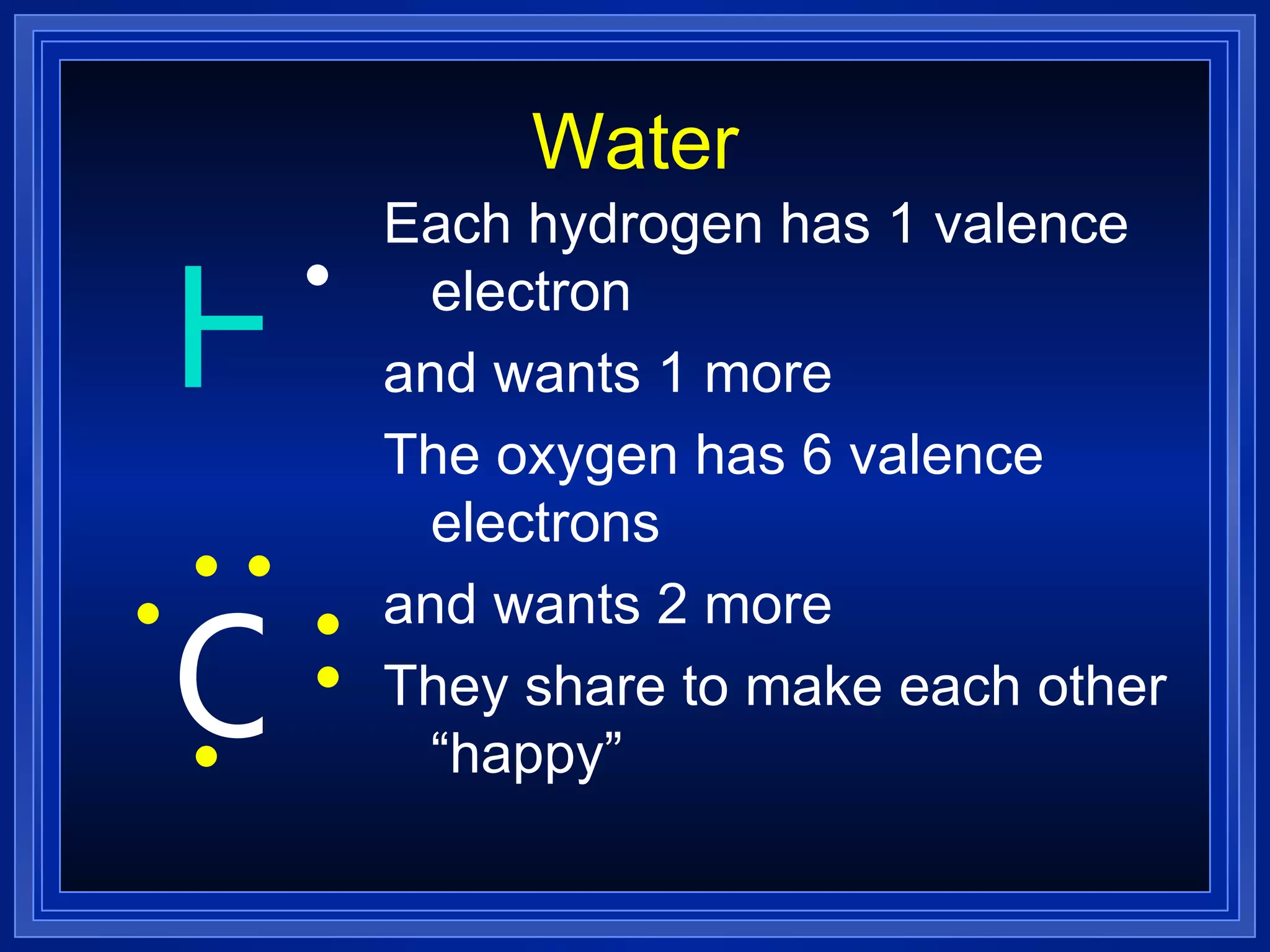
Water Each hydrogen has 1 valence electron and wants 1 more The oxygen has 6 valence electrons and wants 2 more They share to make each other “happy” H O
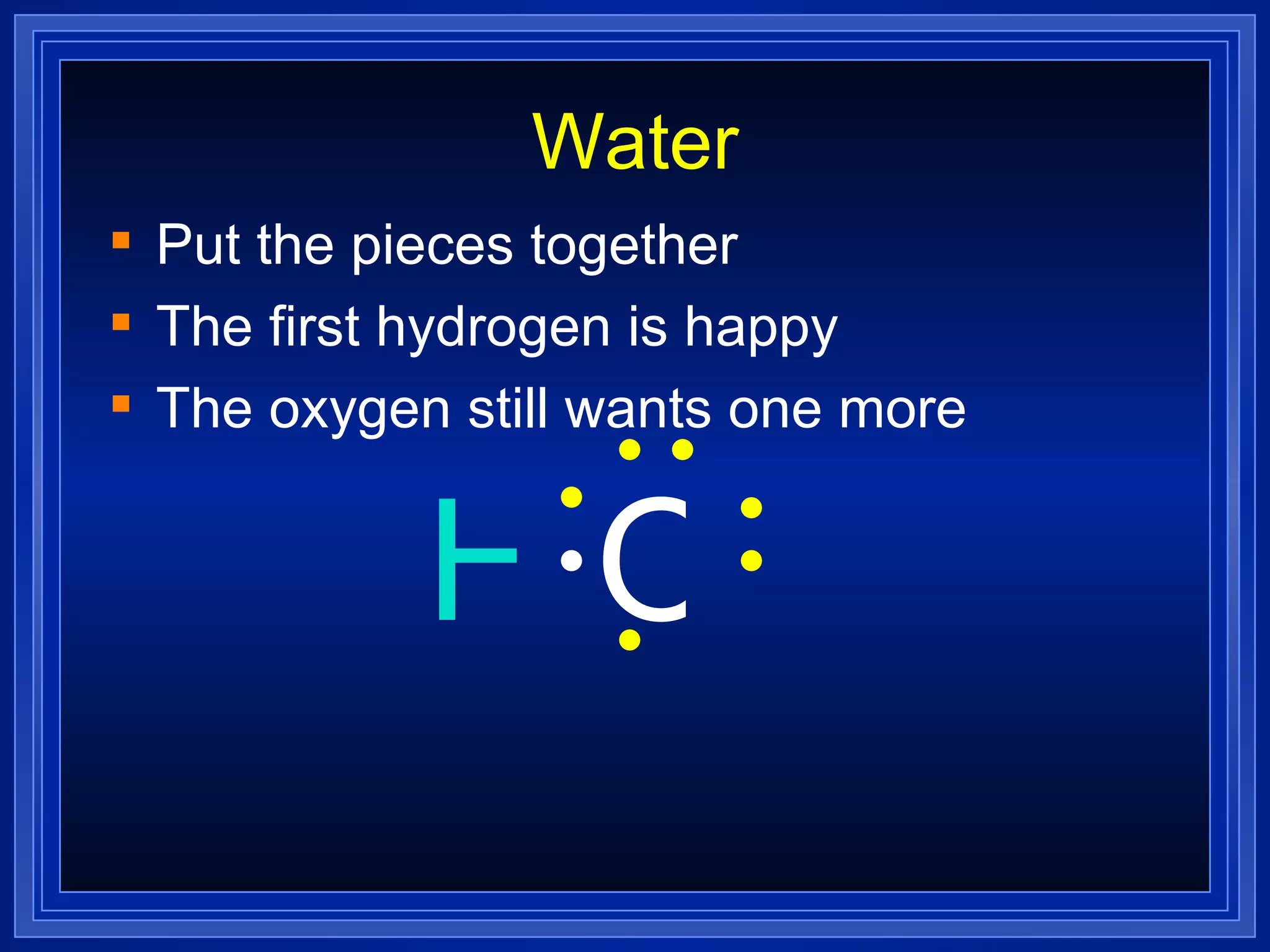
Water Put the pieces together The first hydrogen is happy The oxygen still wants one more H O
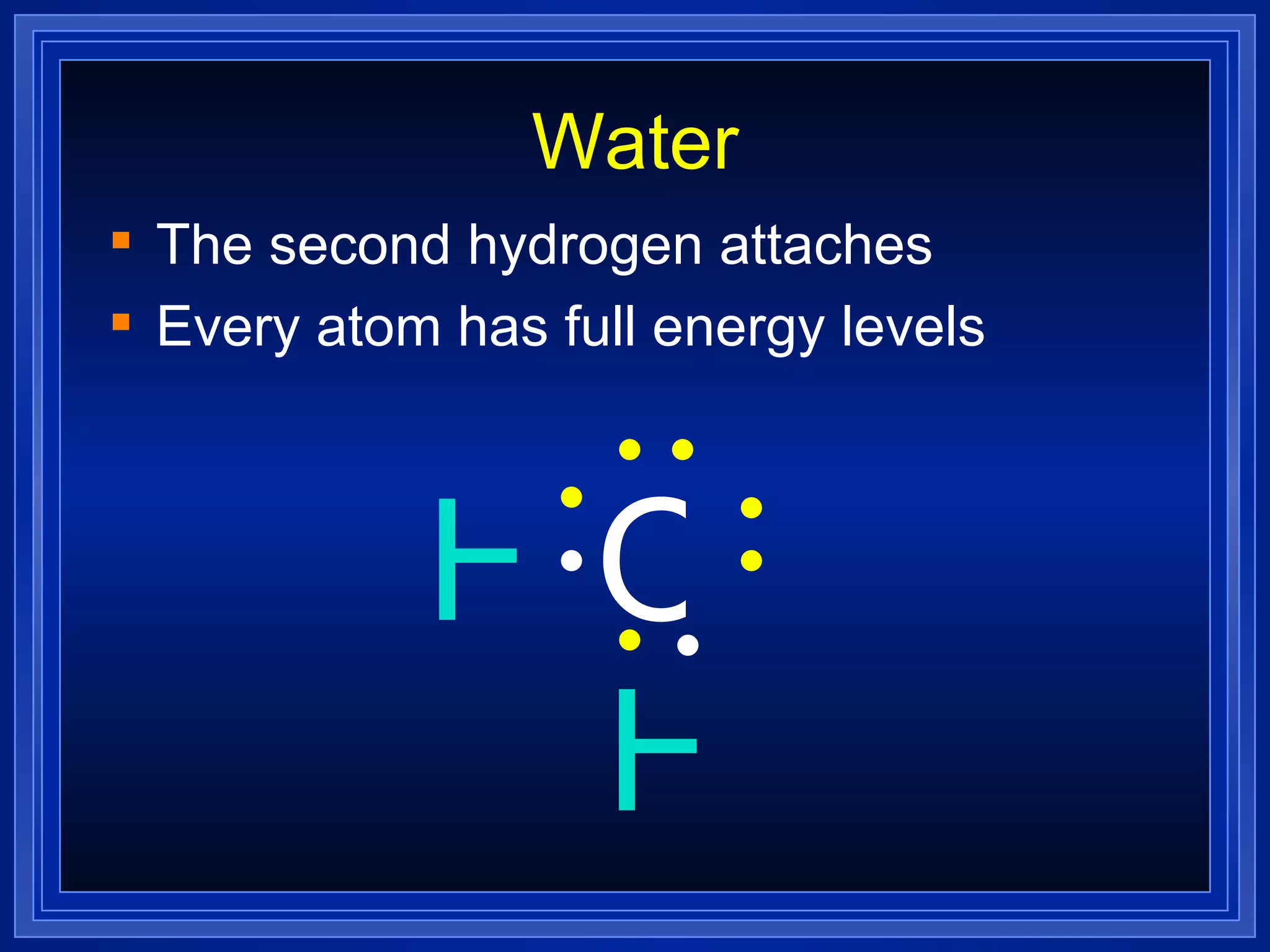
Water The second hydrogen attaches Every atom has full energy levels H H O
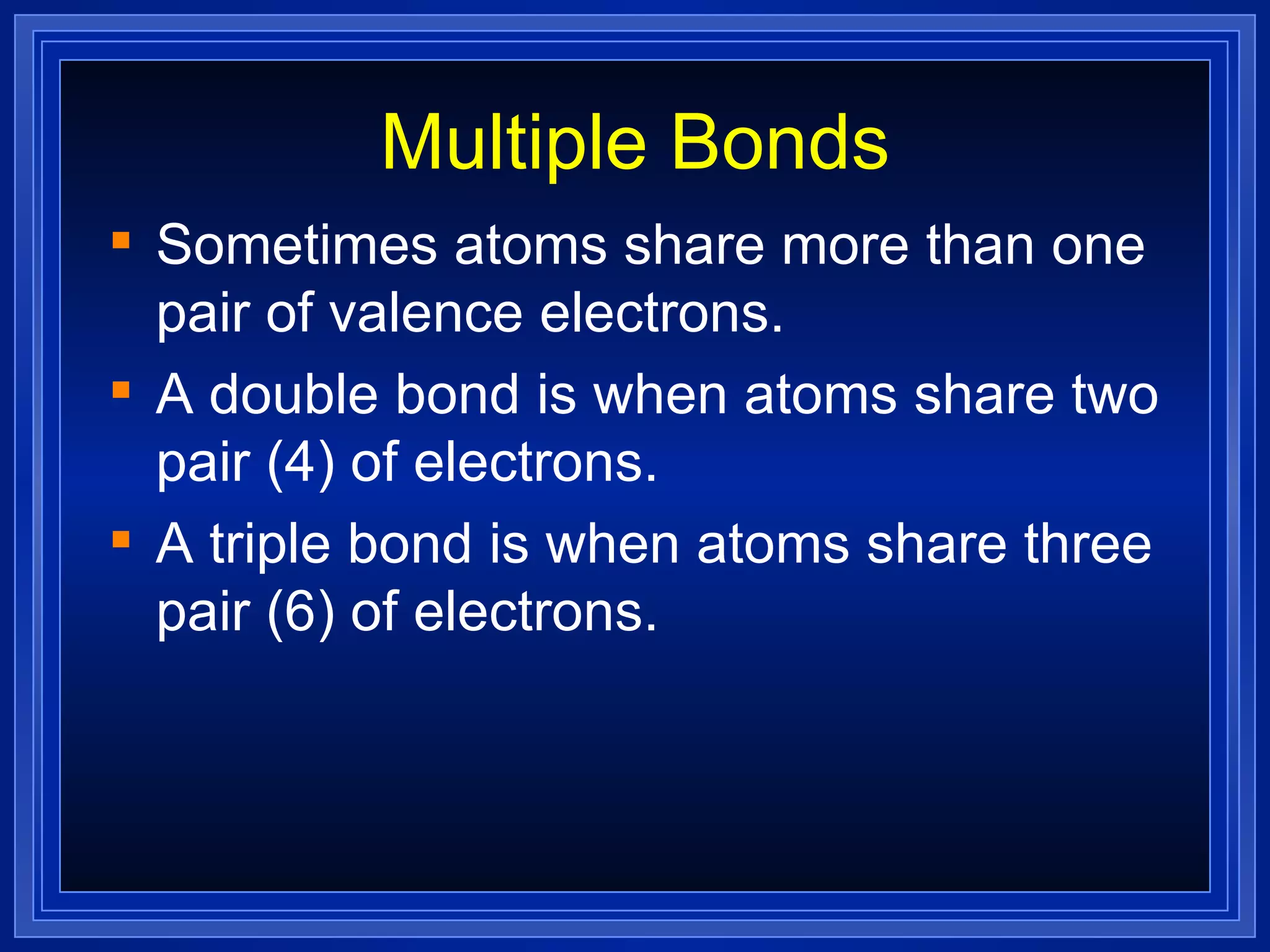
Multiple Bonds Sometimes atoms share more than one pair of valence electrons. A double bond is when atoms share two pair (4) of electrons. A triple bond is when atoms share three pair (6) of electrons.
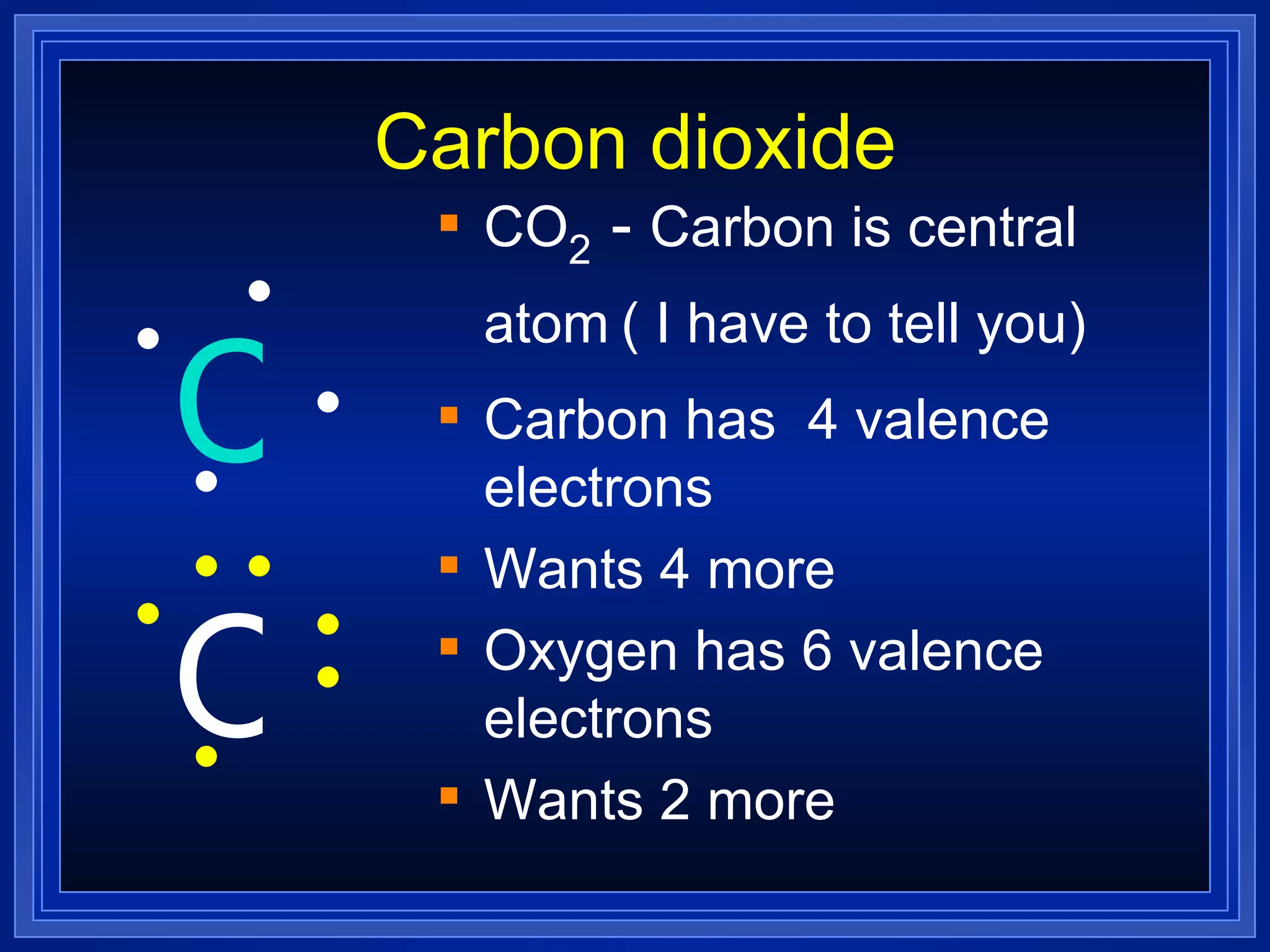
Carbon dioxide CO 2   -  Carbon is central atom   ( I have to tell you) Carbon has  4 valence electrons Wants 4 more Oxygen has 6 valence electrons Wants 2 more C O
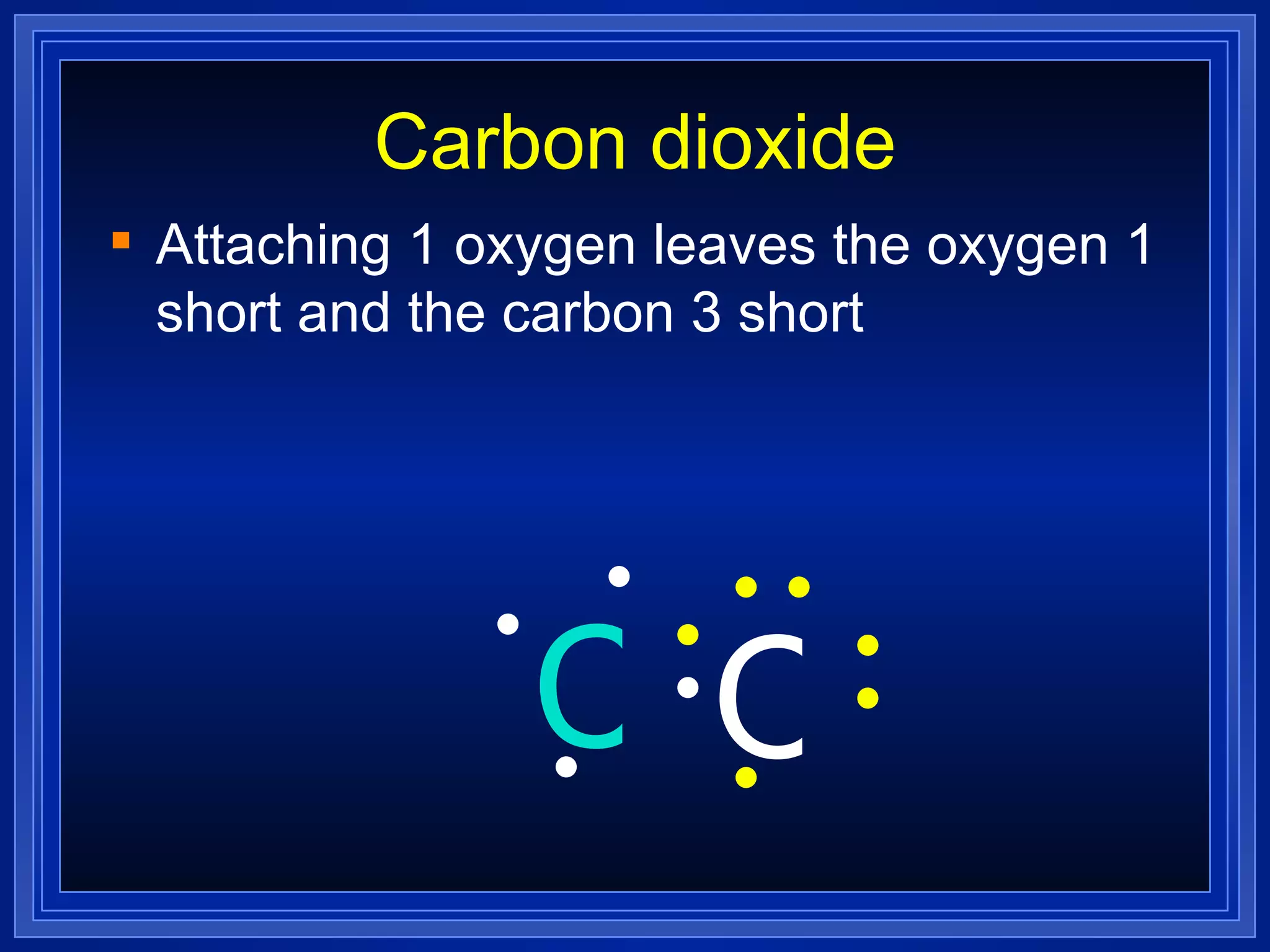
Carbon dioxide Attaching 1 oxygen leaves the oxygen 1 short and the carbon 3 short C O
Carbon dioxide Attaching the second oxygen leaves both oxygen 1 short and the carbon 2 short C O O
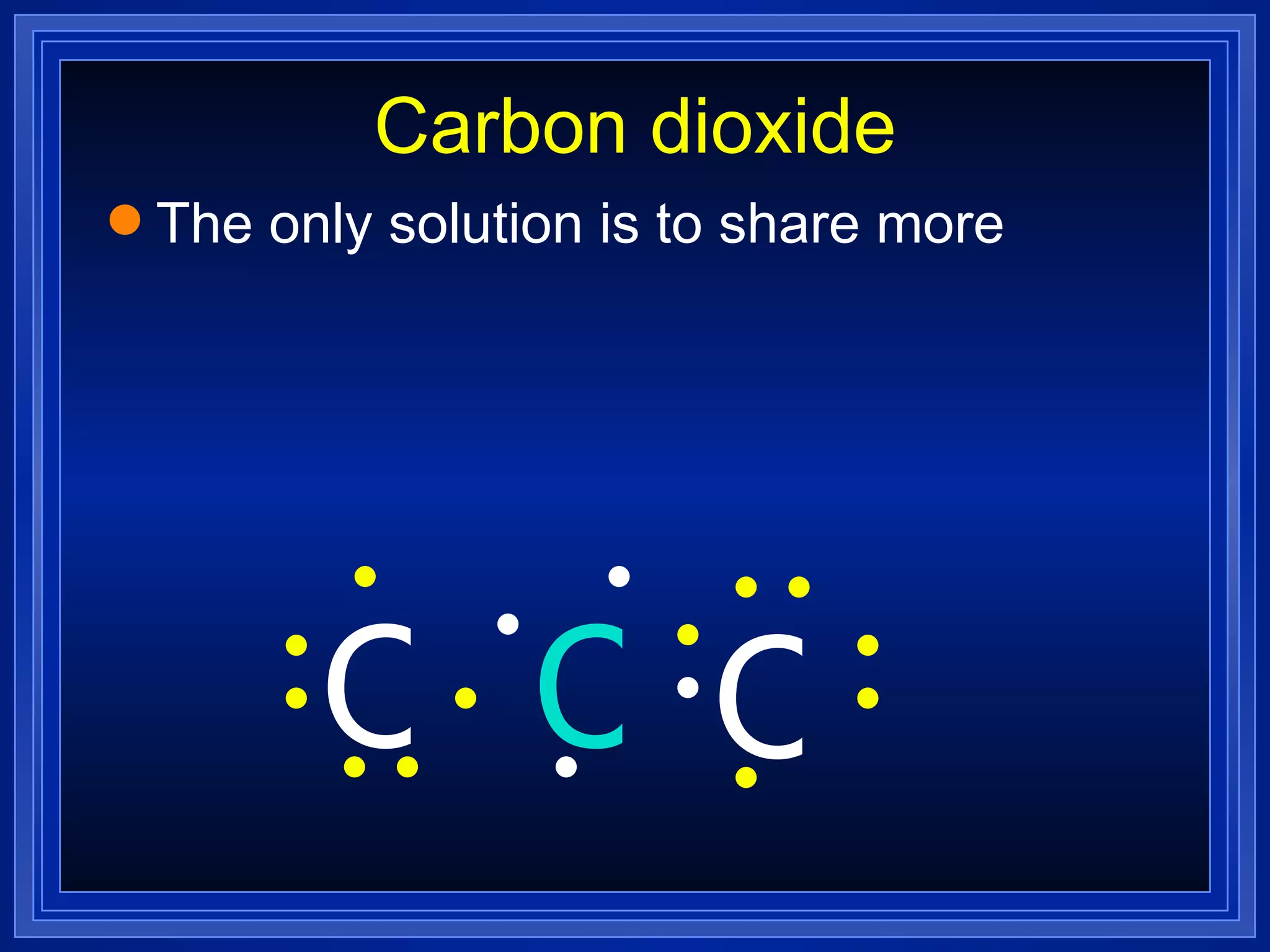
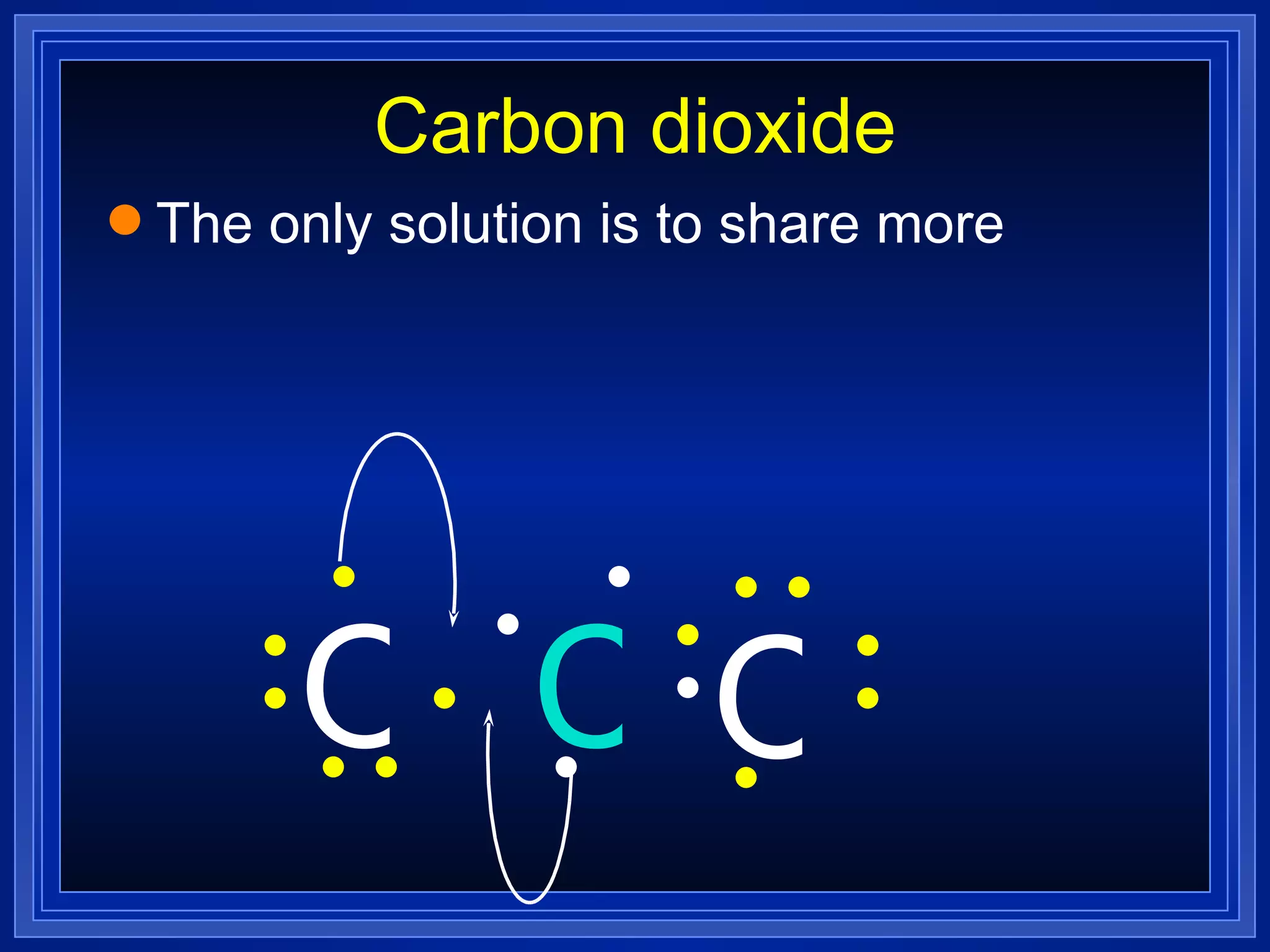
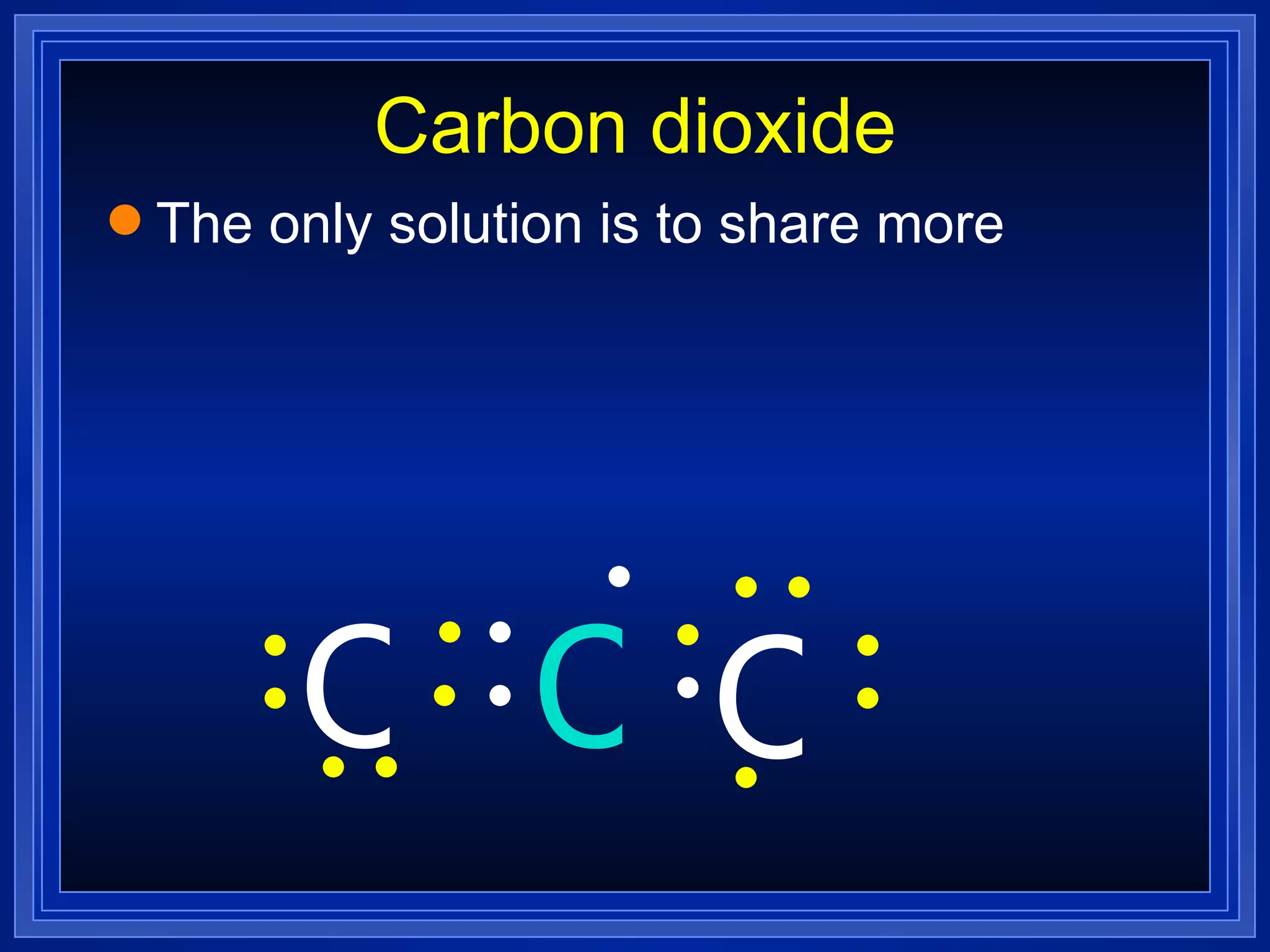
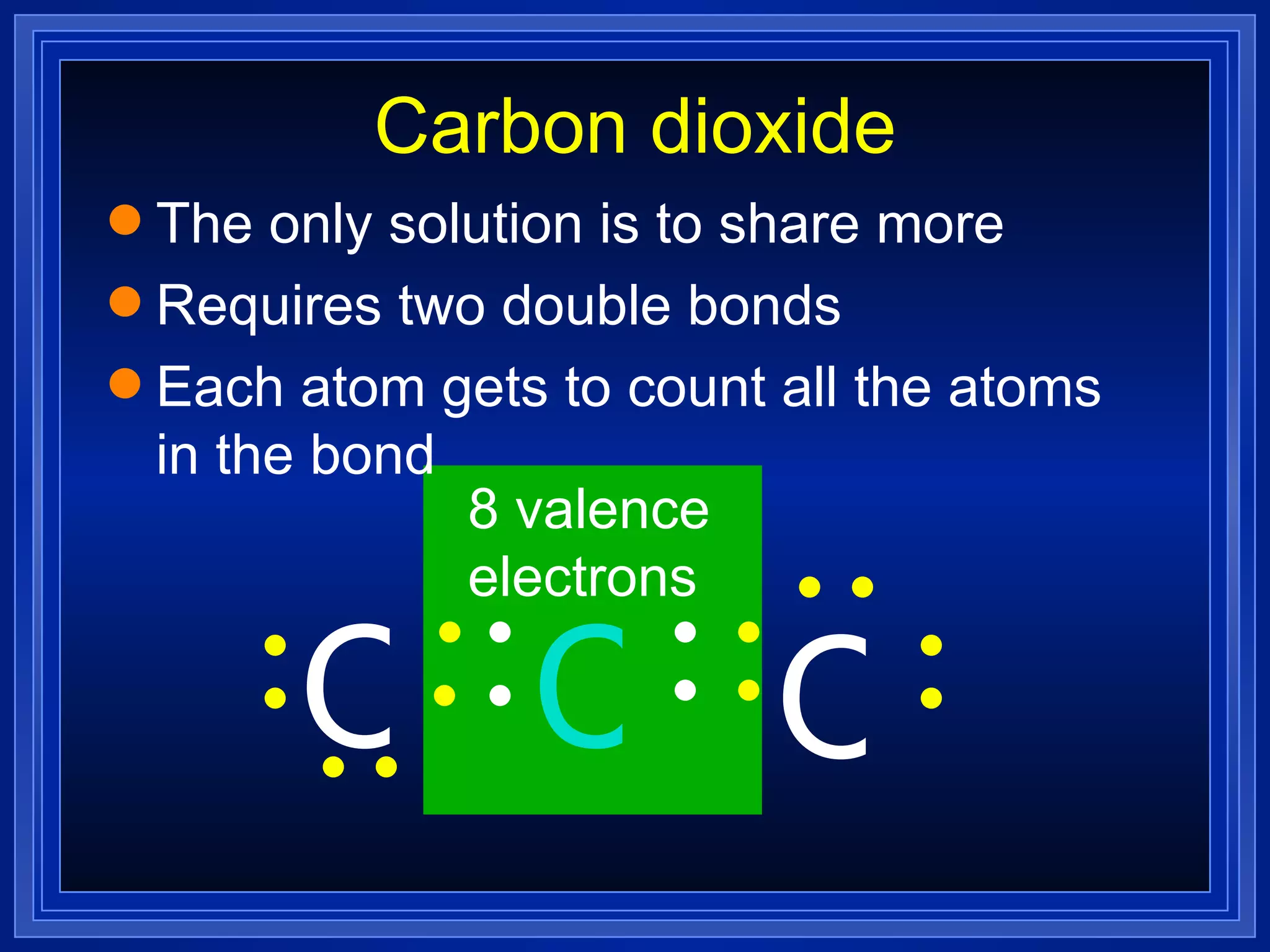
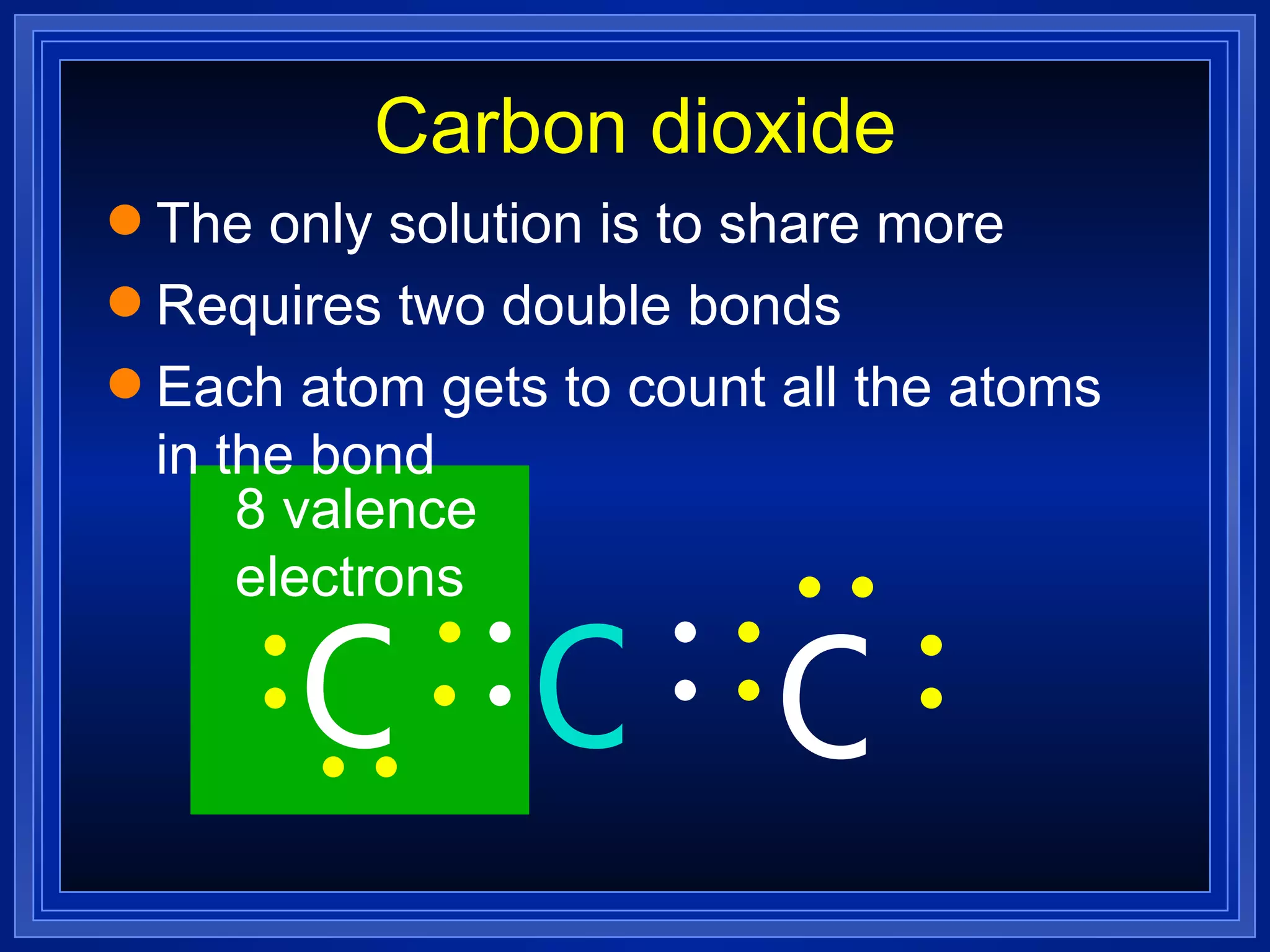
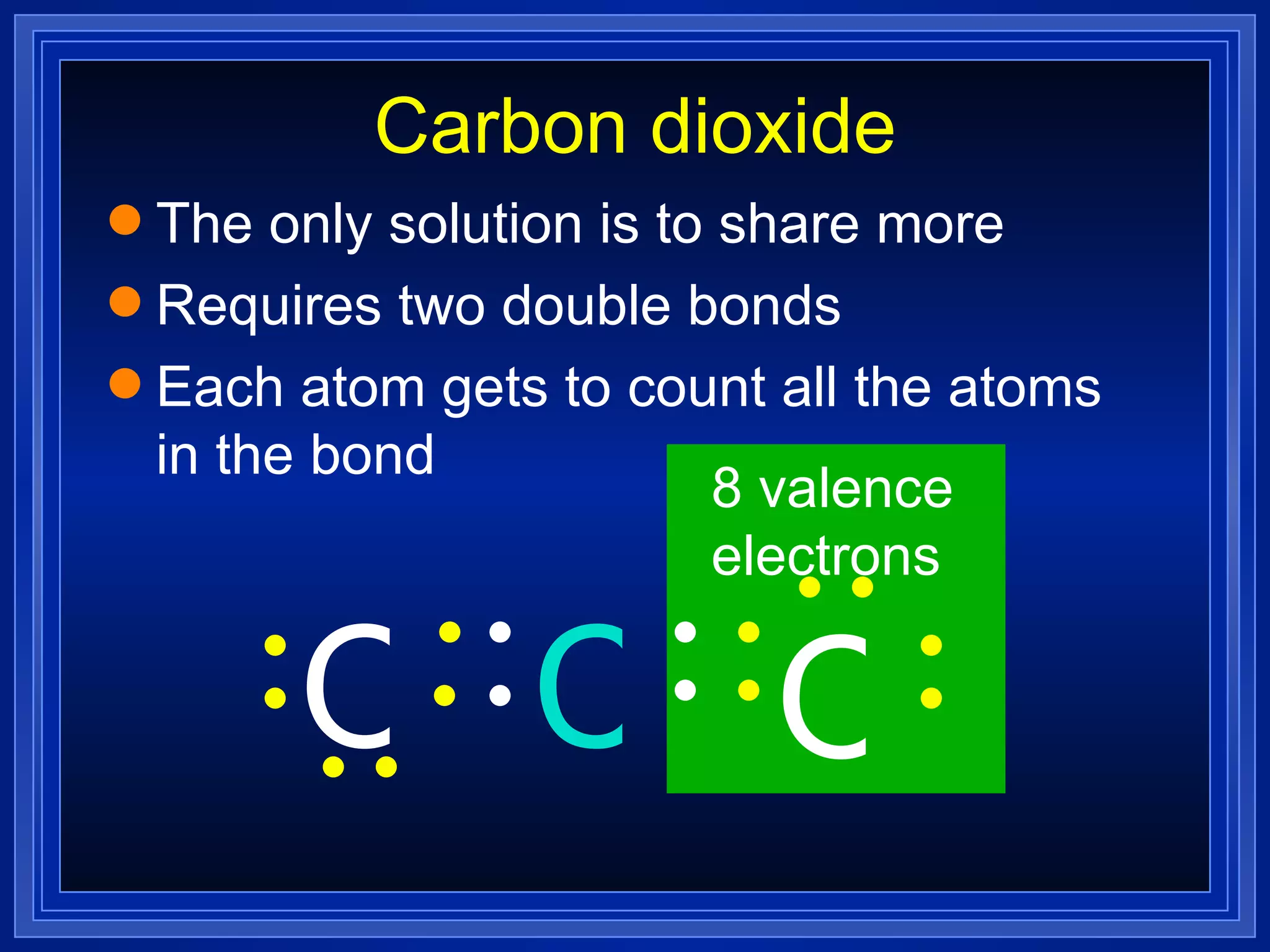
Carbon dioxide The only solution is to share more C O O
Carbon dioxide The only solution is to share more O C O
Carbon dioxide The only solution is to share more Requires two double bonds  Each atom gets to count all the atoms in the bond O C O
Carbon dioxide The only solution is to share more Requires two double bonds  Each atom gets to count all the atoms in the bond O C O 8 valence electrons
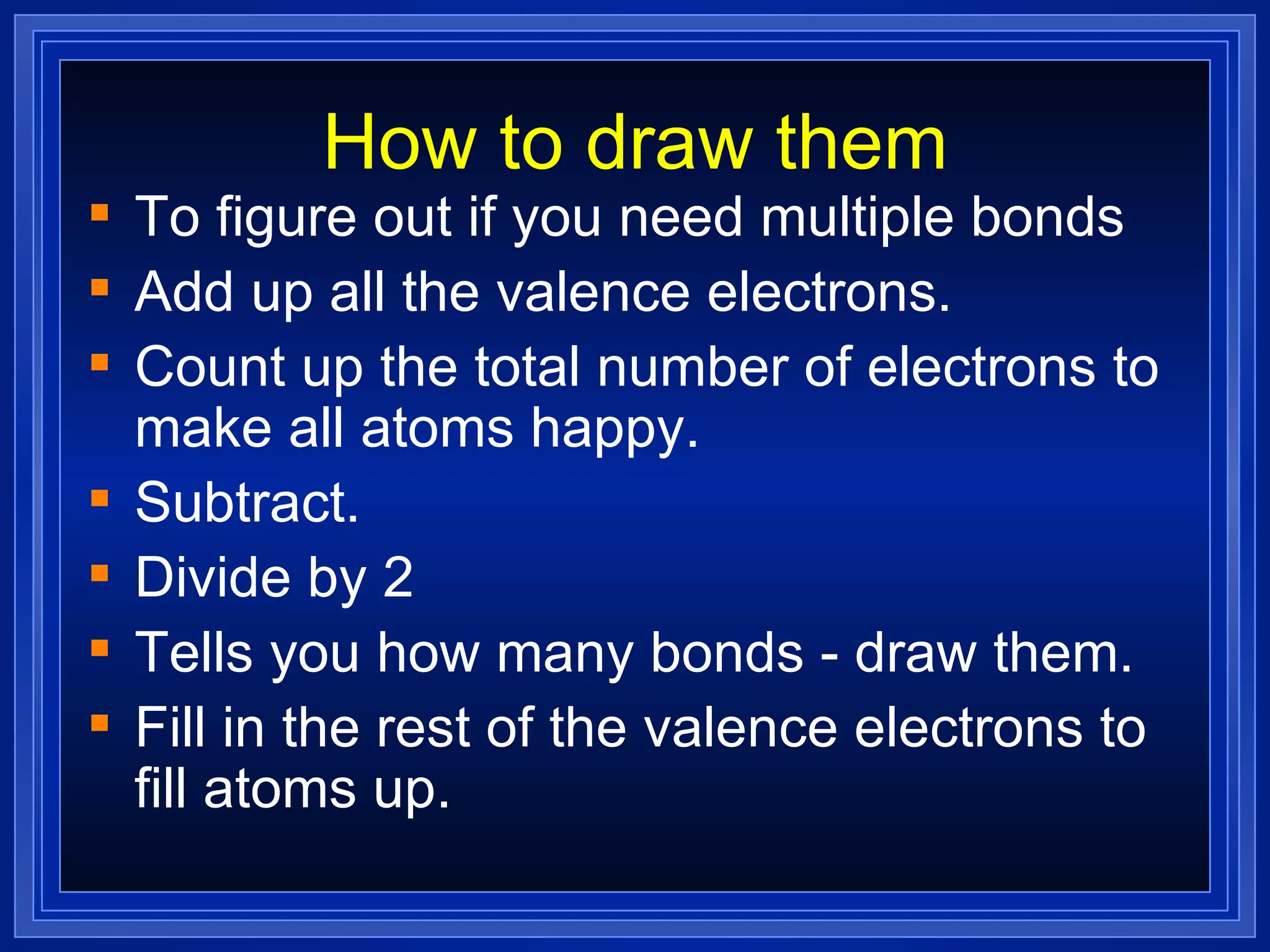
How to draw them To figure out if you need multiple bonds Add up all the valence electrons. Count up the total number of electrons to make all atoms happy. Subtract. Divide by 2 Tells you how many bonds - draw them. Fill in the rest of the valence electrons to fill atoms up.
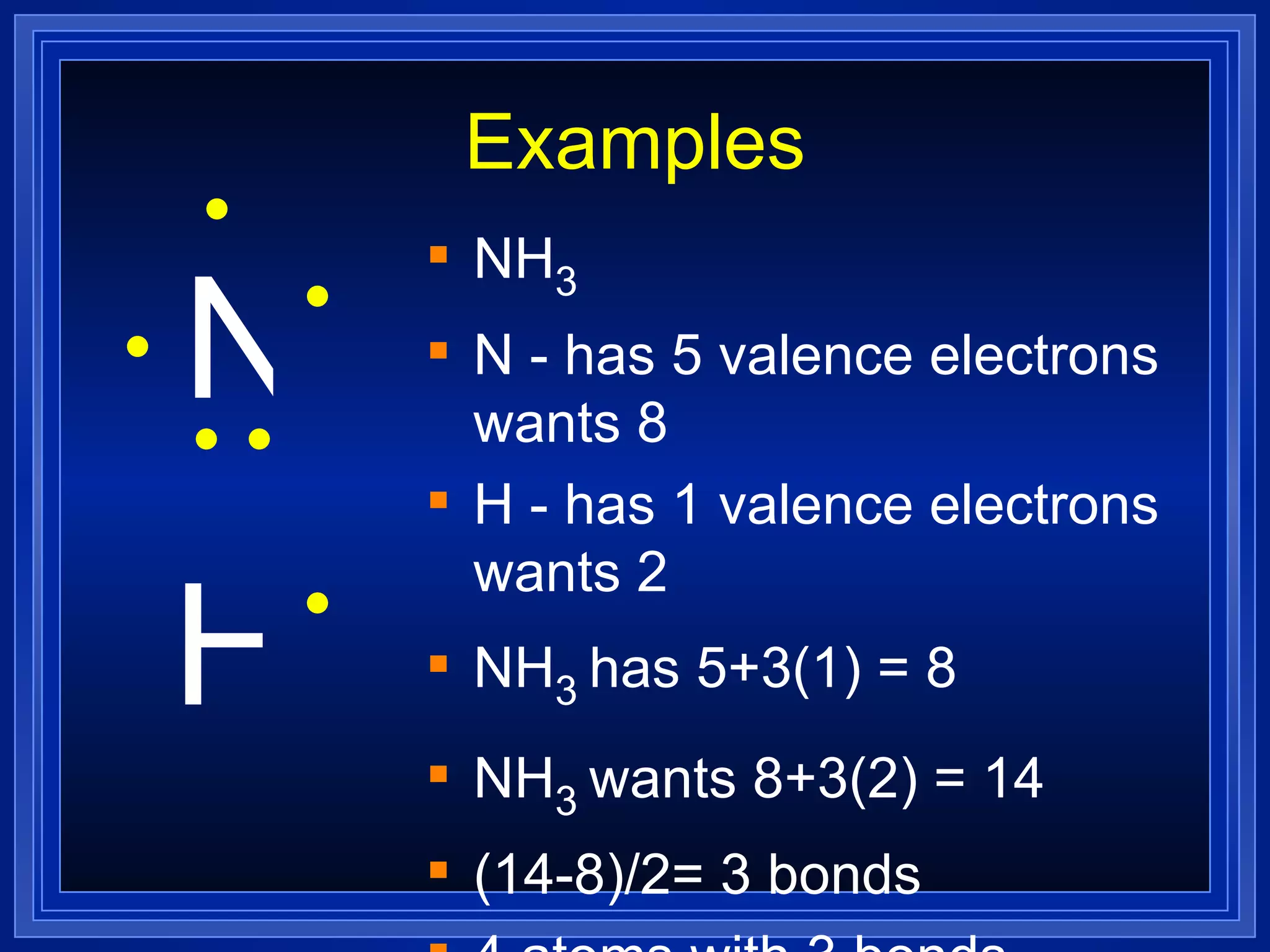
Examples NH 3   N - has 5 valence electrons wants 8 H - has 1 valence electrons wants 2 NH 3  has 5+3(1) = 8 NH 3  wants 8+3(2) = 14 (14-8)/2= 3 bonds 4 atoms with 3 bonds N H
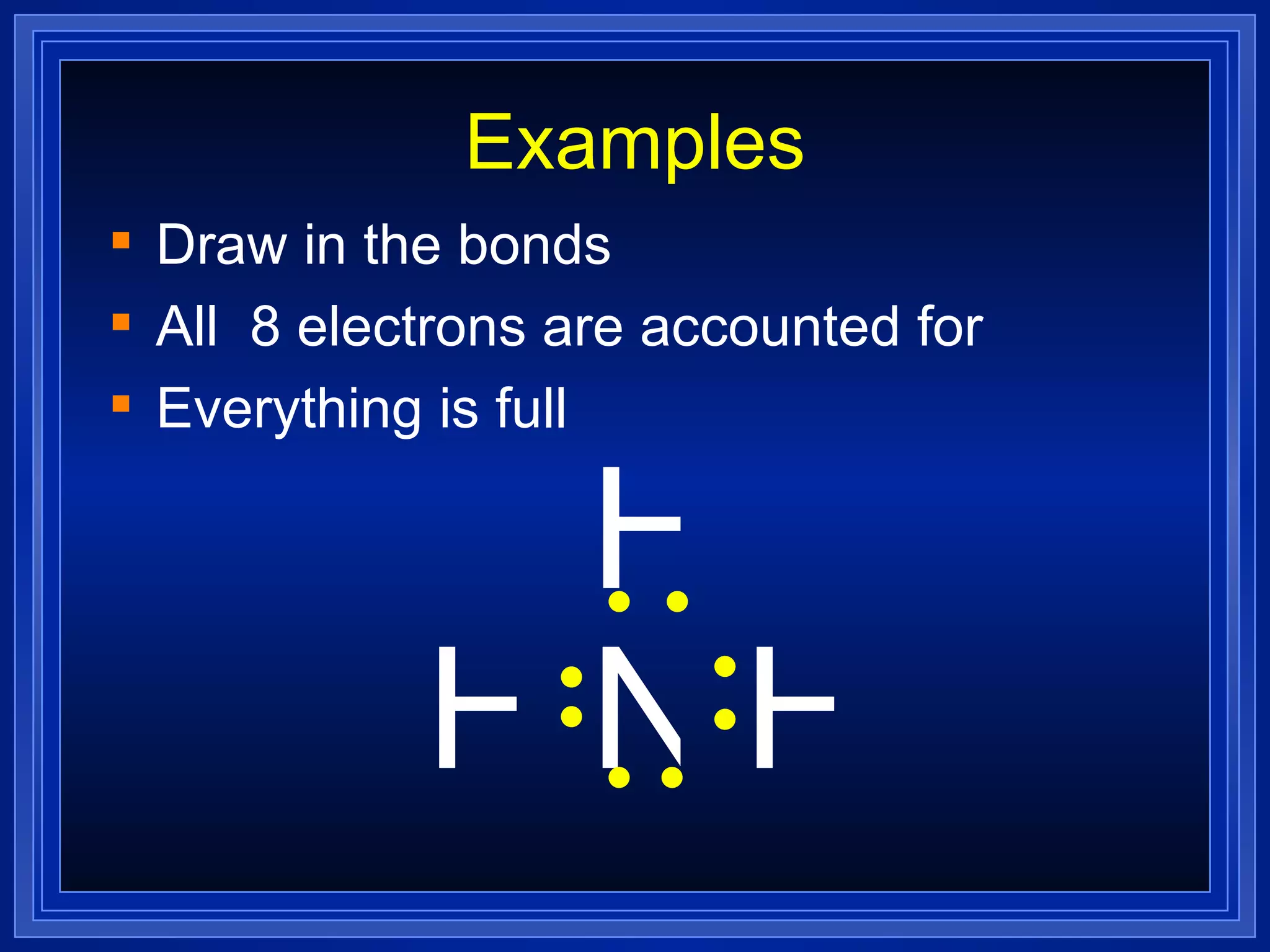
Examples Draw in the bonds All  8 electrons are accounted for Everything is full N H H H
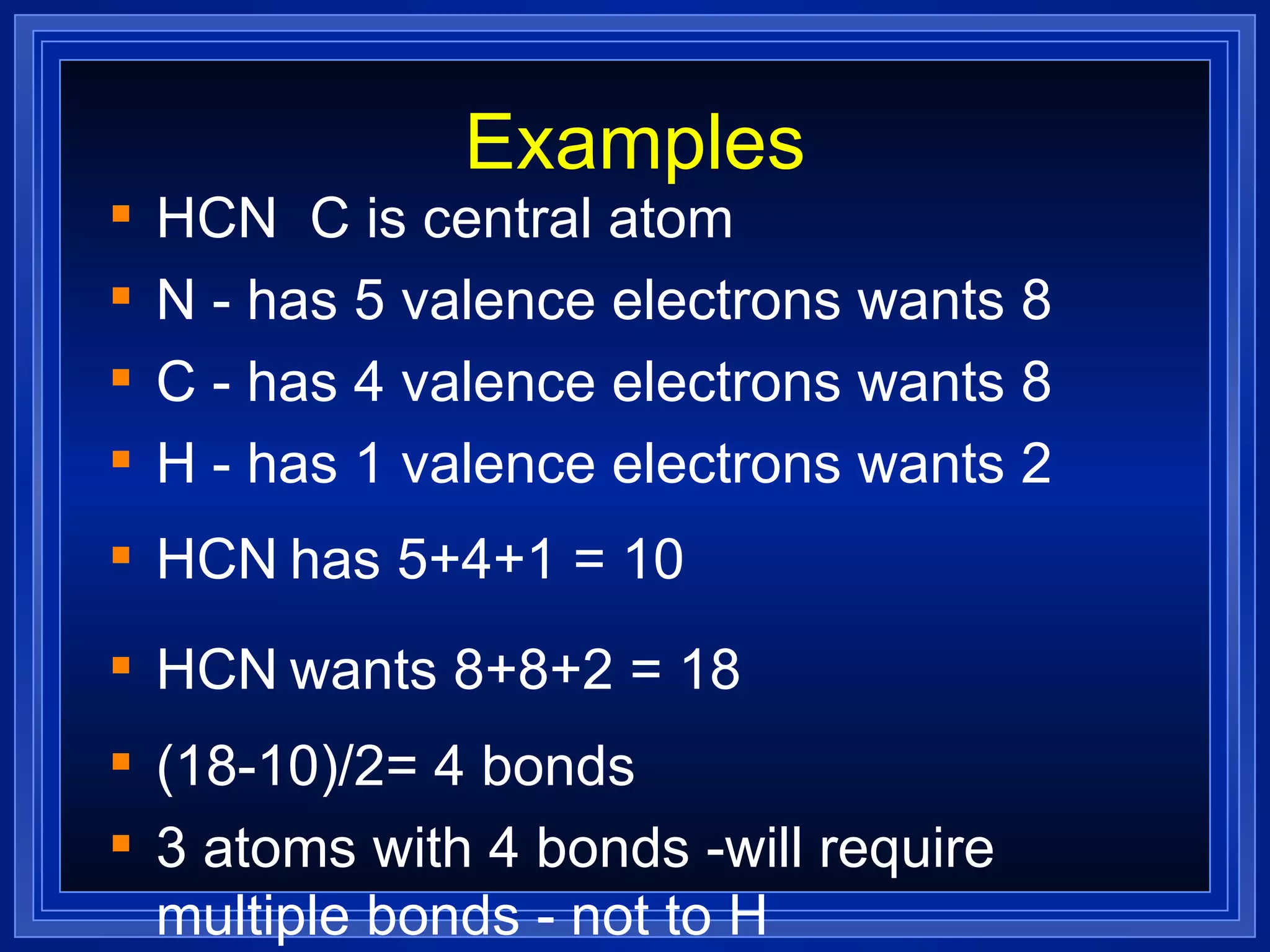
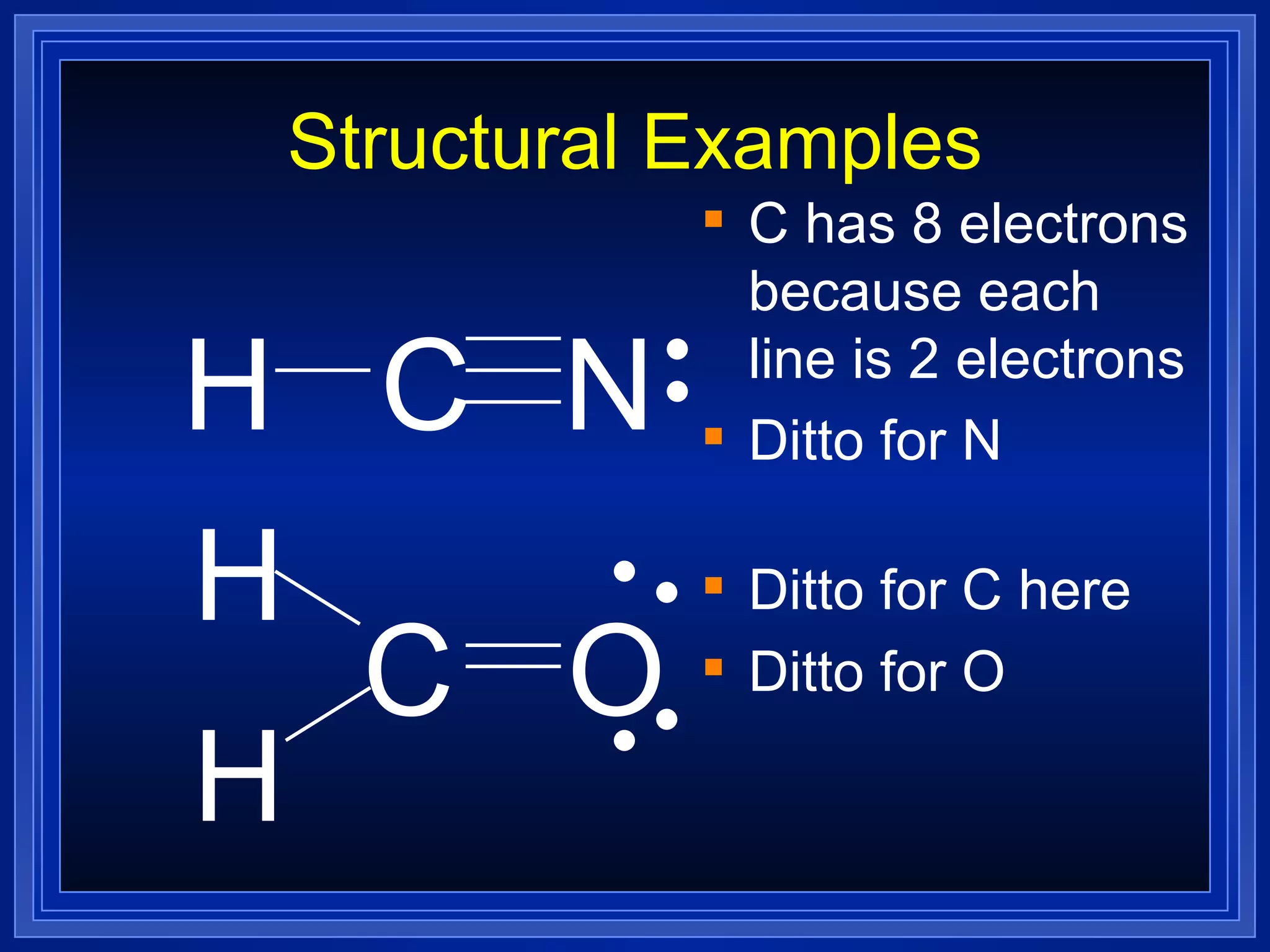
Examples HCN  C is central atom N - has 5 valence electrons wants 8 C - has 4 valence electrons wants 8 H - has 1 valence electrons wants 2 HCN   has 5+4+1 = 10 HCN   wants 8+8+2 = 18 (18-10)/2= 4 bonds 3 atoms with 4 bonds -will require multiple bonds - not to H
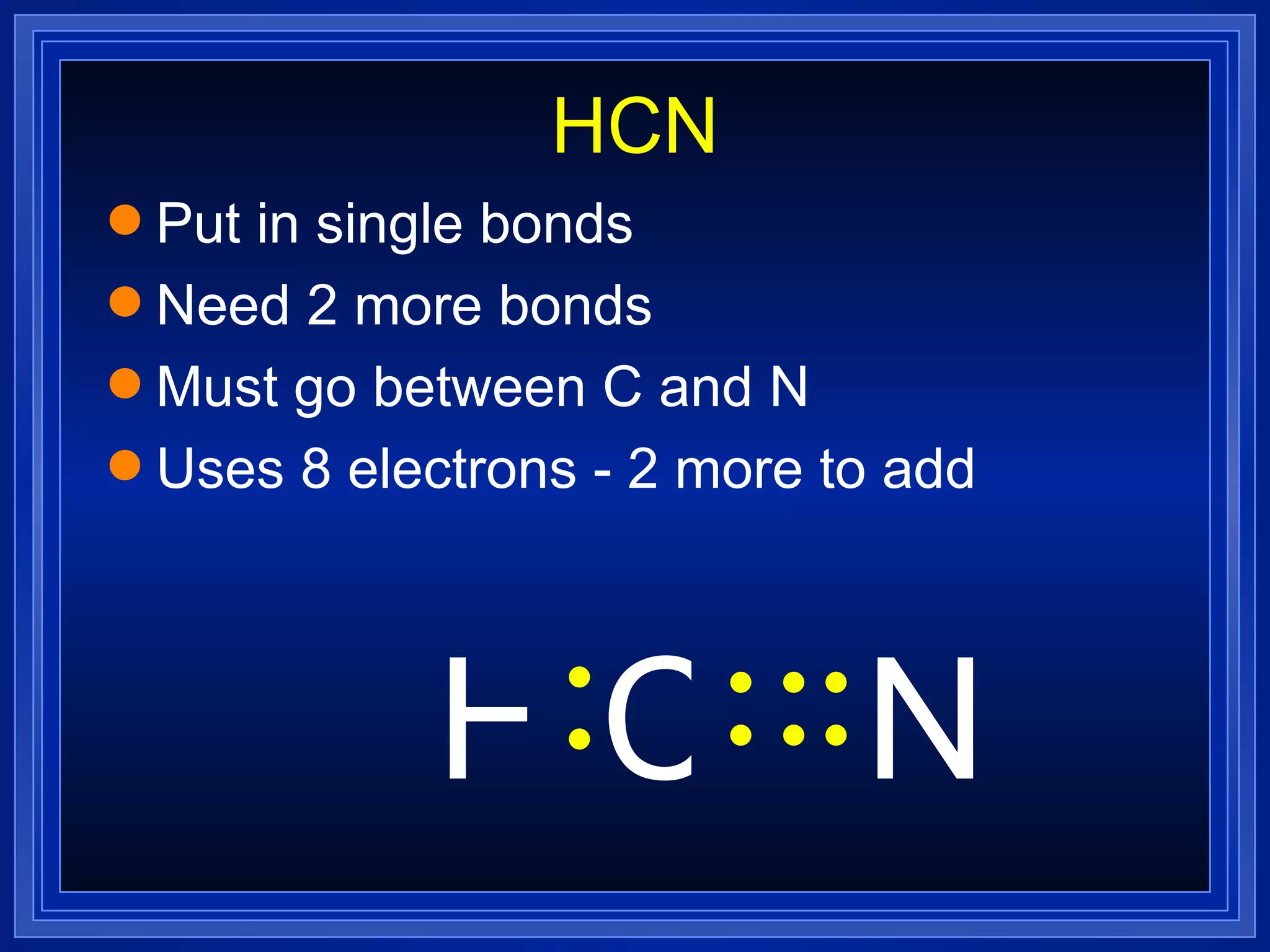
HCN Put in single bonds Need 2 more bonds Must go between C and N N H C
HCN Put in single bonds Need 2 more bonds Must go between C and N Uses 8 electrons - 2 more to add N H C
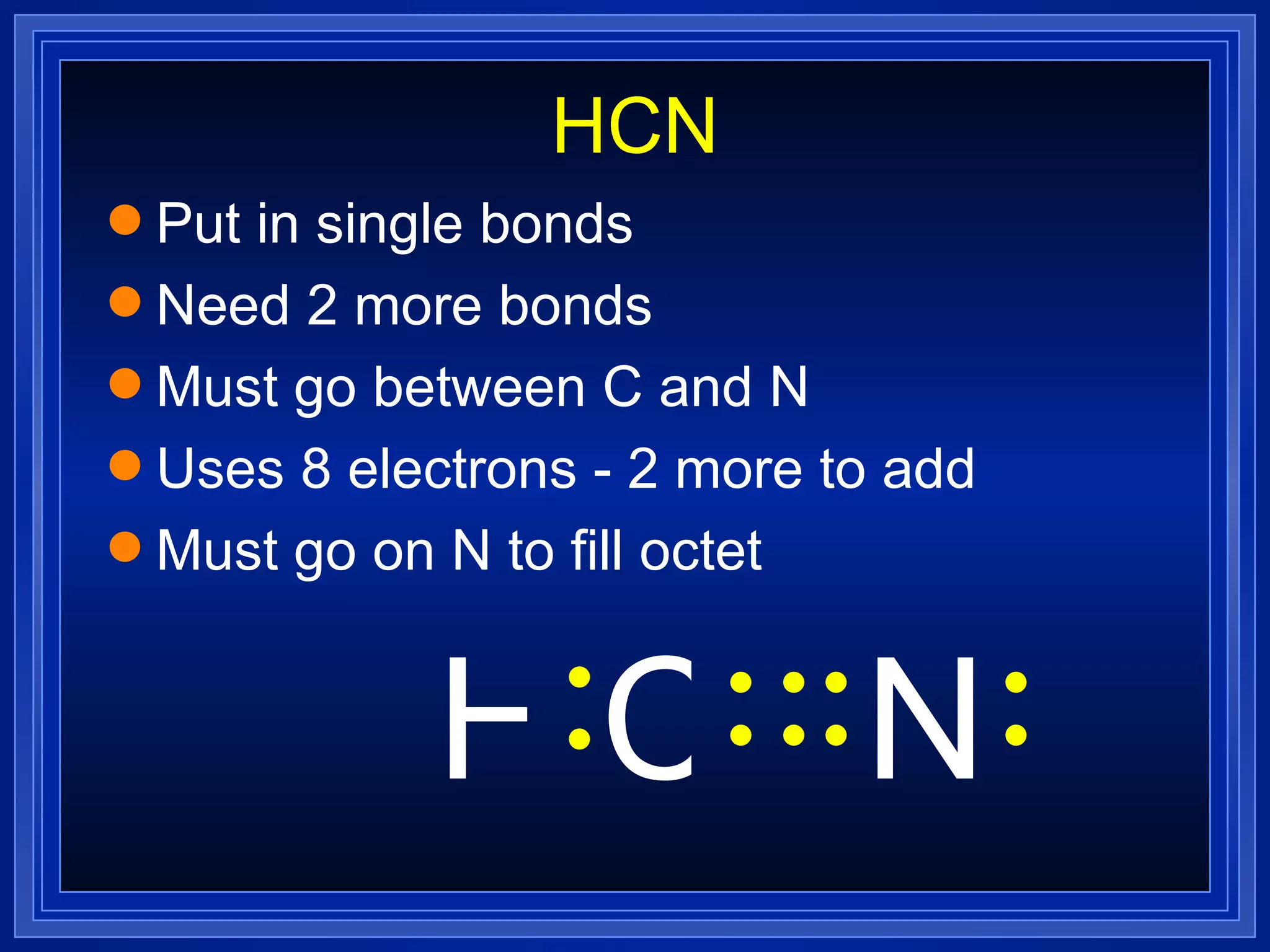
HCN Put in single bonds Need 2 more bonds Must go between C and N Uses 8 electrons - 2 more to add Must go on N to fill octet N H C
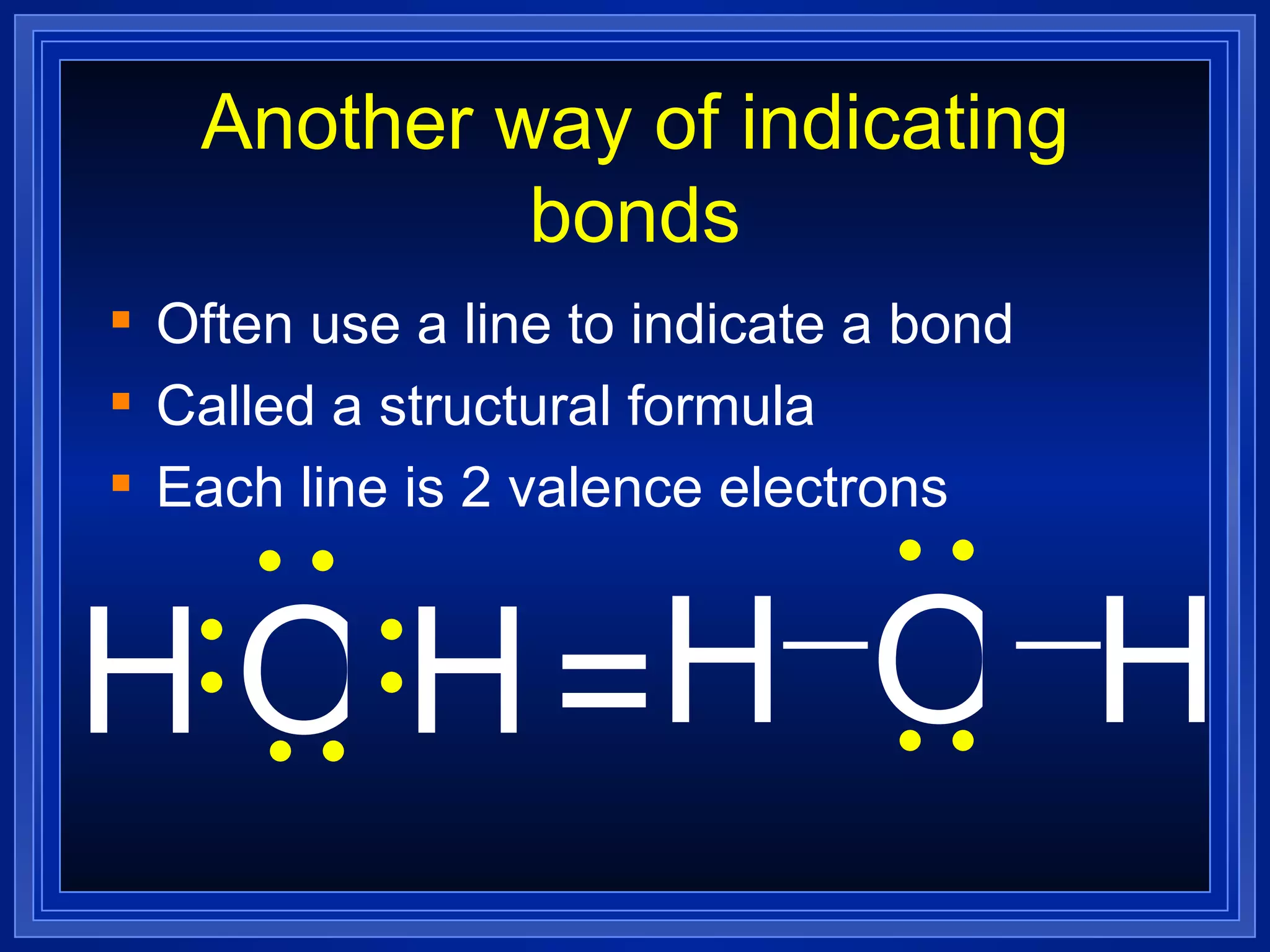
Another way of indicating bonds Often use a line to indicate a bond Called a structural formula Each line is 2 valence electrons H H O = H H O
Structural Examples C has 8 electrons because each line is 2 electrons Ditto for N Ditto for C here Ditto for O H   C N C  O H H
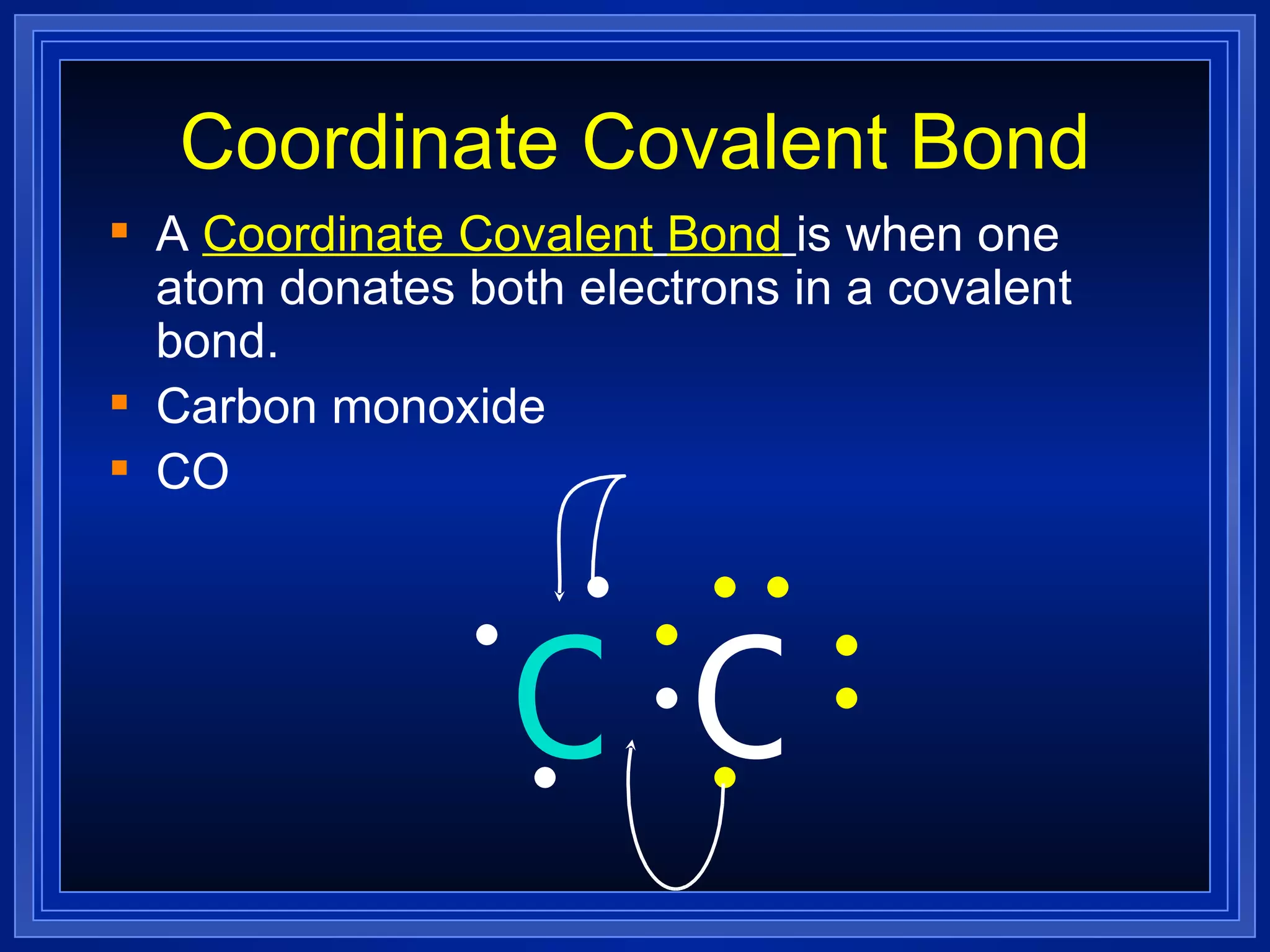
Coordinate Covalent Bond A  Coordinate Covalent   Bond   is when one atom donates both electrons in a covalent bond. Carbon monoxide CO O C
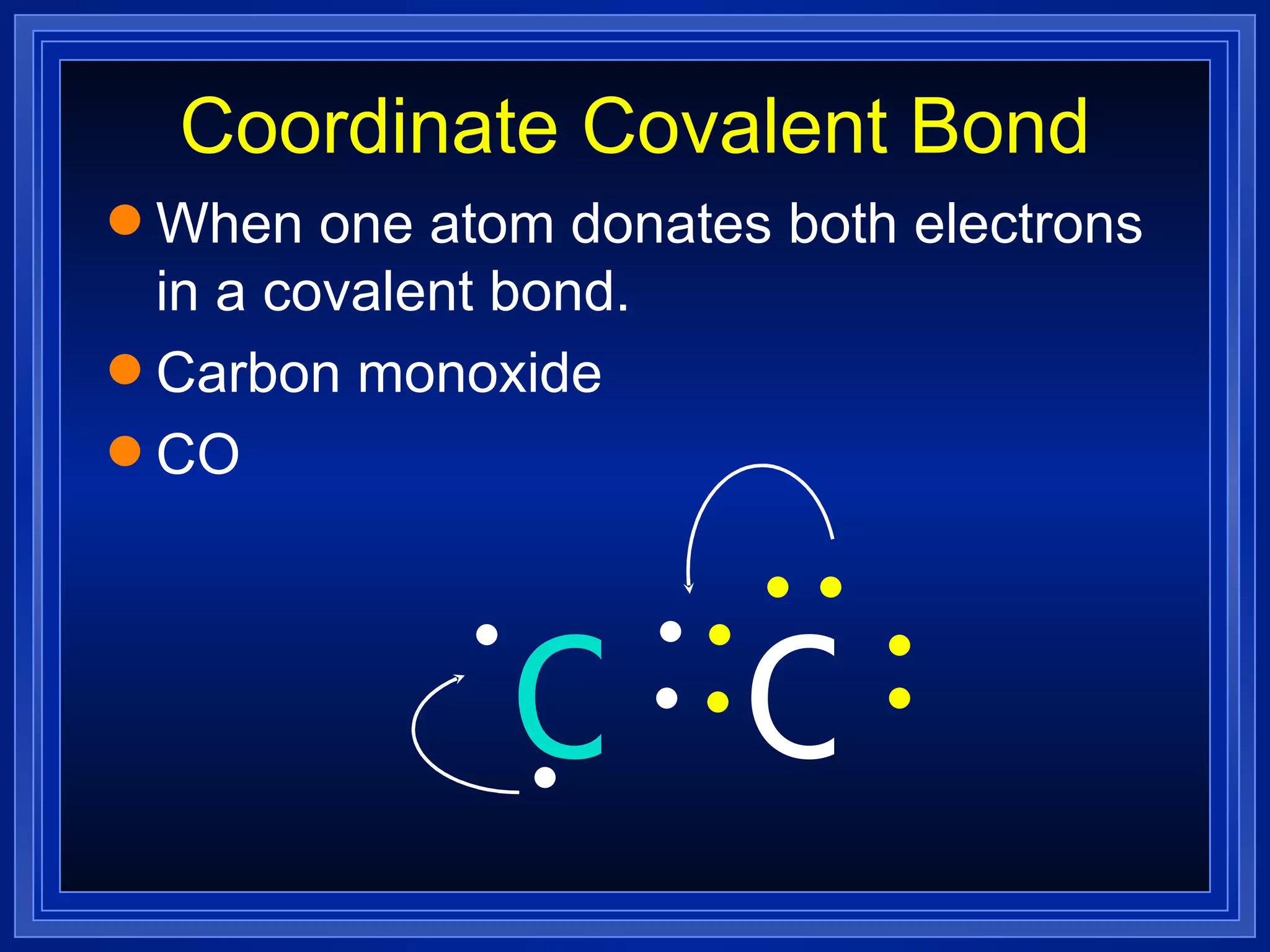
Coordinate Covalent Bond When one atom donates both electrons in a covalent bond. Carbon monoxide CO O C
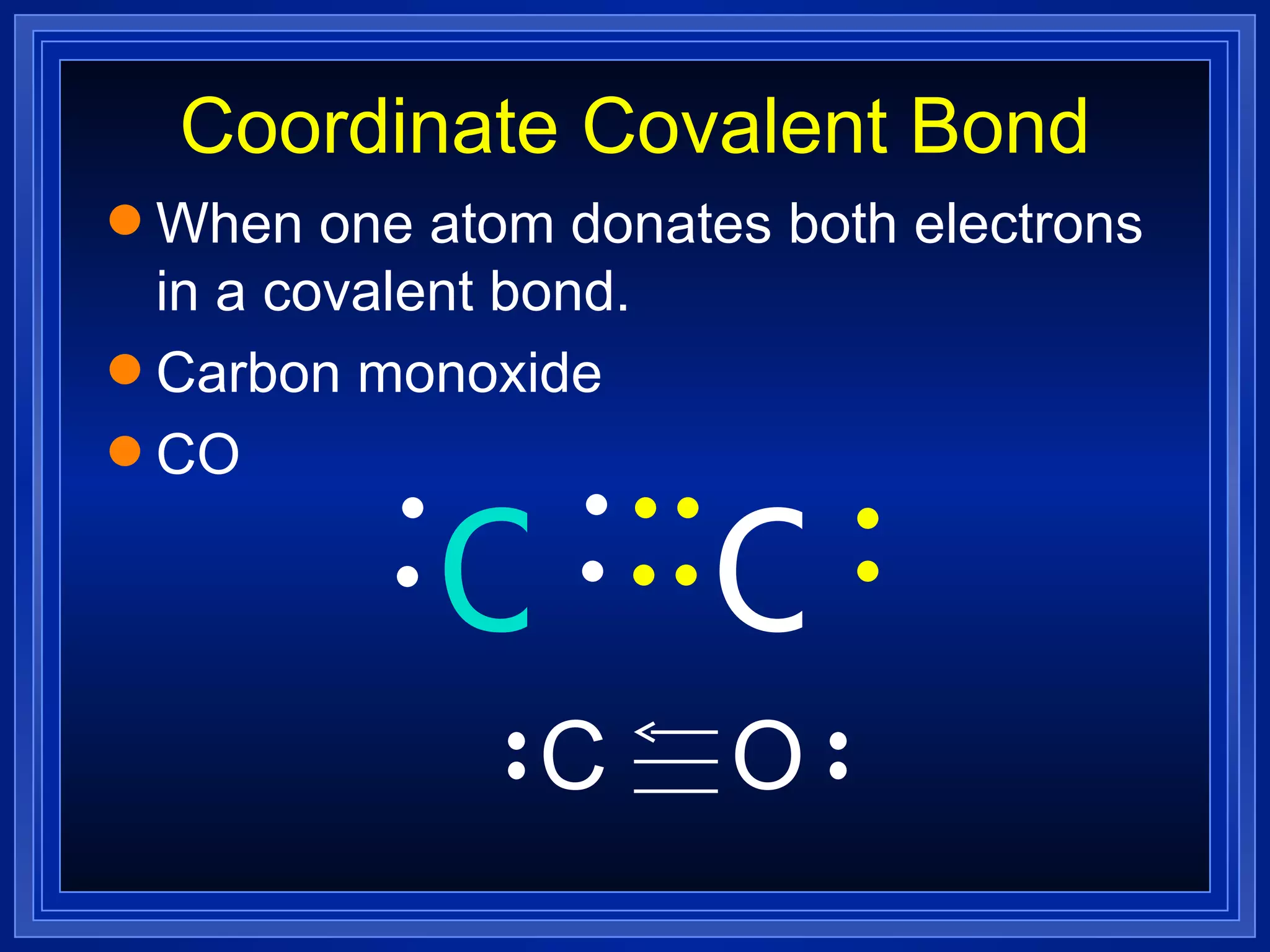
Coordinate Covalent Bond When one atom donates both electrons in a covalent bond. Carbon monoxide CO O C O C
Resonance Resonance  is a condition when more than one dot diagram with the same connections is possible. Resonance structures differ only in the position of the electron pairs, never the atom positions.
9.4 Molecular Shape (VSEPR) V alence  S hell  E lectron  P air  R epulsion.  Predicts three dimensional geometry of molecules. The name tells you the theory. Valence shell - outside electrons. Electron Pair Repulsion - electron pairs try to get as far away as possible. Can determine the angles of bonds. And the shape of molecules
VSEPR Based on the number of pairs of valence electrons both bonded and unbonded. Unbonded pair are called  lone pair . CH 4  - draw the  structural formula
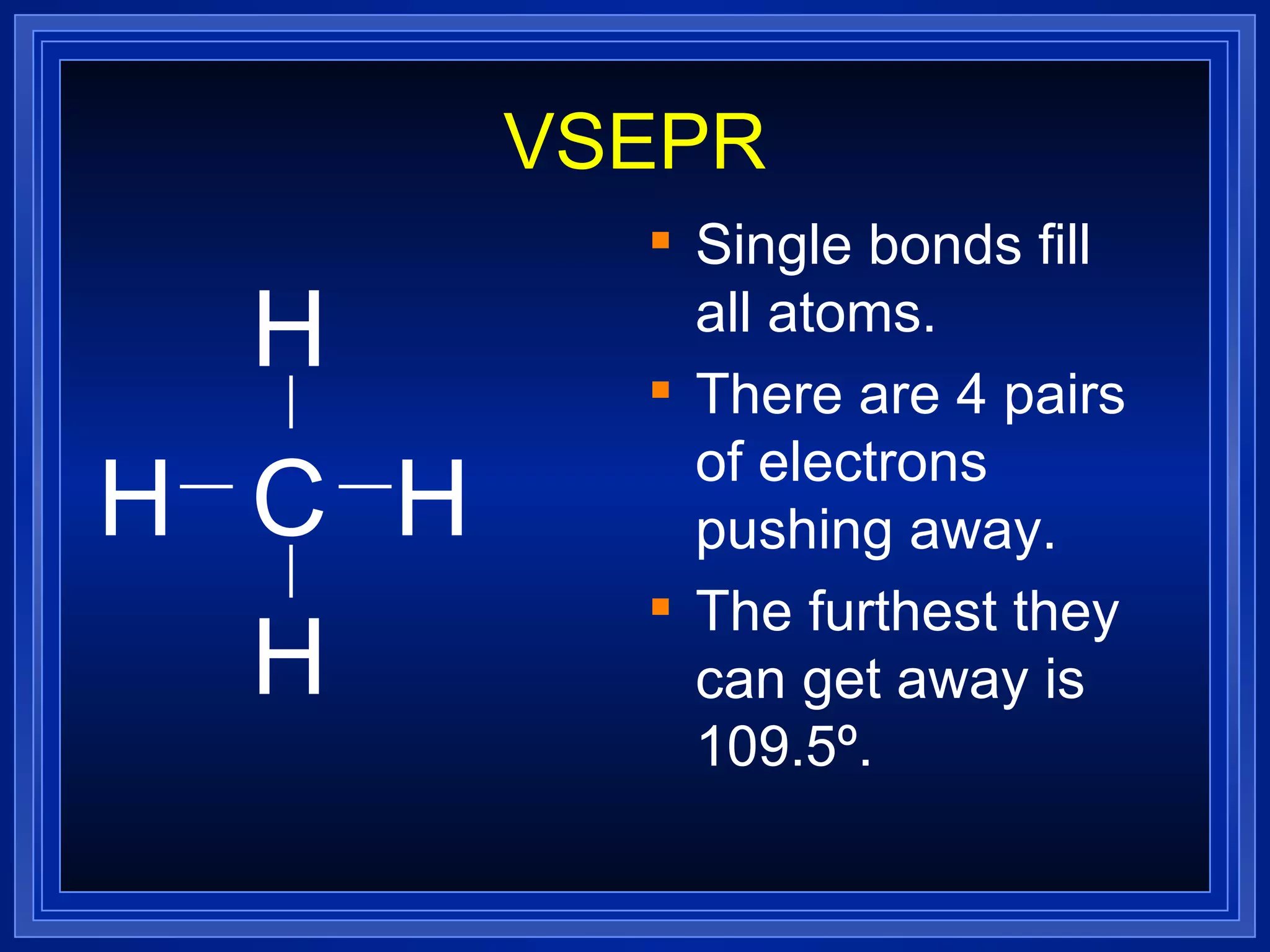
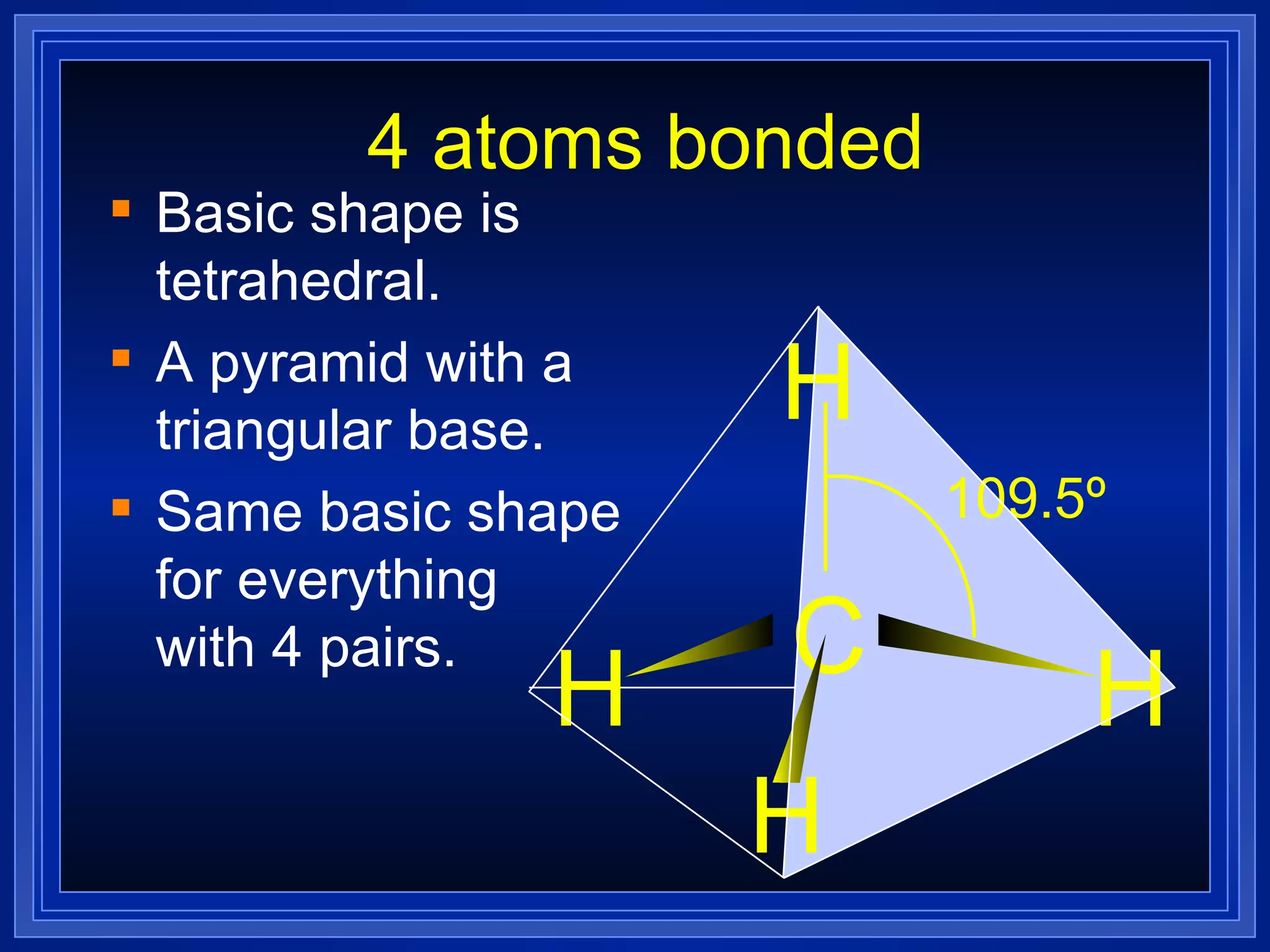
VSEPR Single bonds fill all atoms. There are 4 pairs of electrons pushing away. The furthest they can get away is 109.5º. C H H H H
4 atoms bonded Basic shape is tetrahedral. A pyramid with a triangular base. Same basic shape for everything  with 4 pairs. C H H H H 109.5º
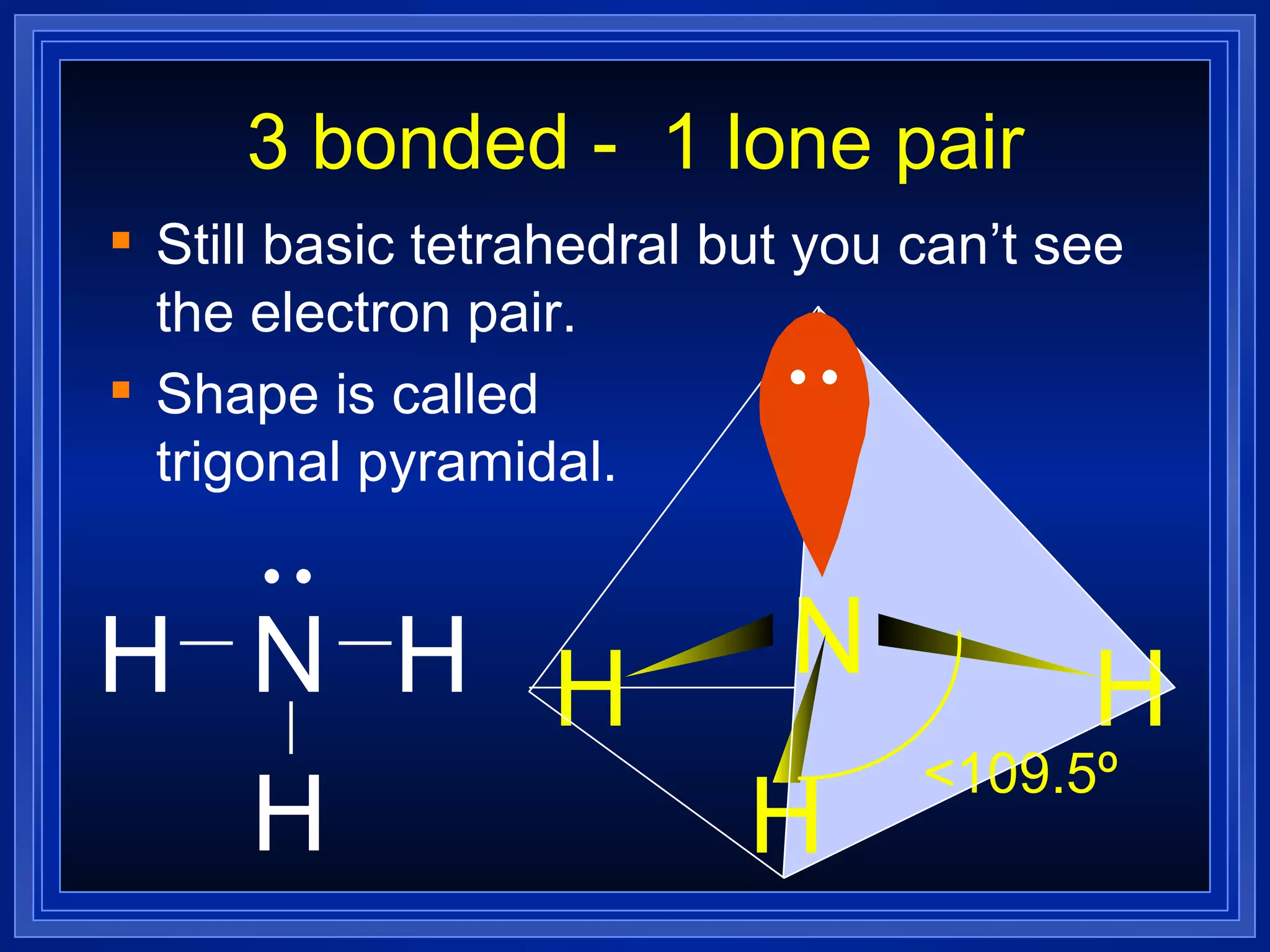
3 bonded -  1 lone pair Still basic tetrahedral but you can’t see the electron pair. Shape is called trigonal pyramidal. N H H H N H H H <109.5º
2 bonded -  2 lone pair Still basic tetrahedral but you can’t see the 2 lone pair. Shape is called bent. O H H O H H <109.5º
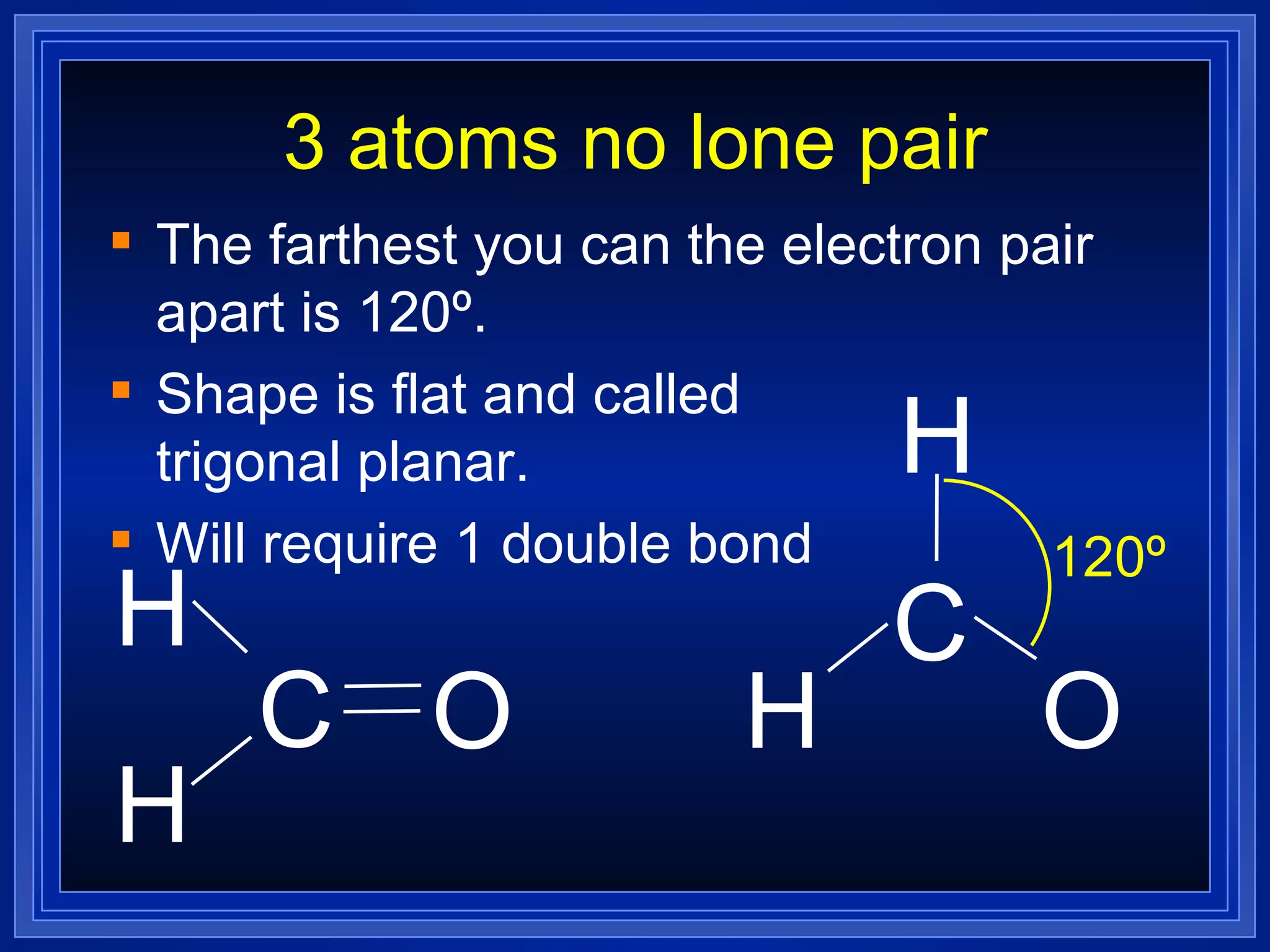
3 atoms no lone pair The farthest you can the electron pair apart is 120º. Shape is flat and called  trigonal planar. Will require 1 double bond C H H O C H H O 120º
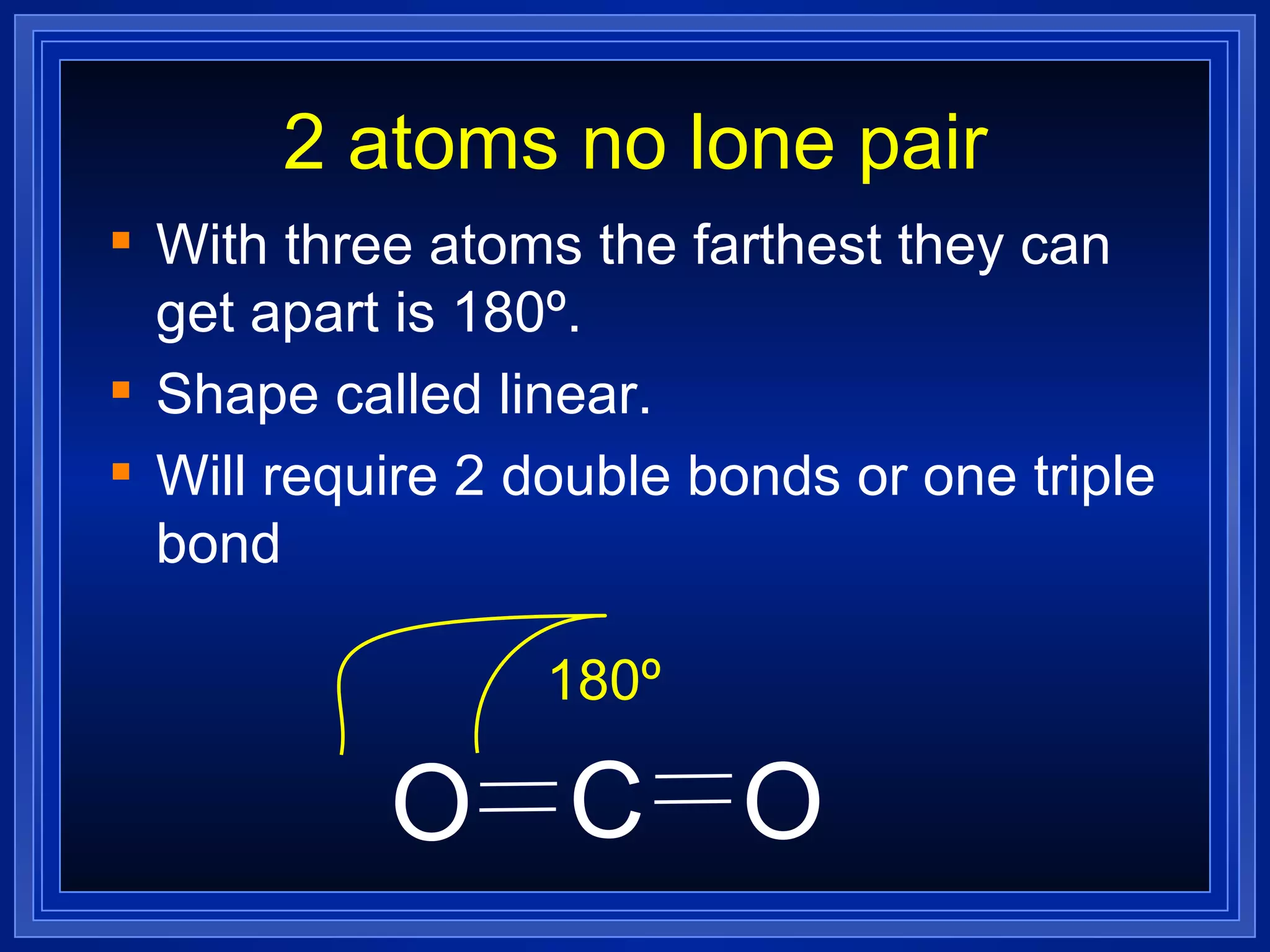
2 atoms no lone pair With three atoms the farthest they can get apart is 180º. Shape called linear. Will require 2 double bonds or one triple bond C O O 180º
Molecular Orbitals The overlap of atomic orbitals from separate atoms makes molecular orbitals Each molecular orbital has room for two electrons Two types of MO Sigma (  σ  ) between atoms Pi (  π  ) above and below atoms
Sigma bonding orbitals  From s orbitals on separate atoms + + s orbital s orbital + + +  + Sigma bonding molecular orbital
Sigma bonding orbitals  From p orbitals on separate atoms p orbital p orbital Sigma bonding molecular orbital      
Pi bonding orbitals P orbitals on separate atoms     Pi bonding molecular orbital    
Sigma and pi bonds All single bonds are sigma bonds A double bond is one sigma and one pi bond A triple bond is one sigma and two pi bonds.
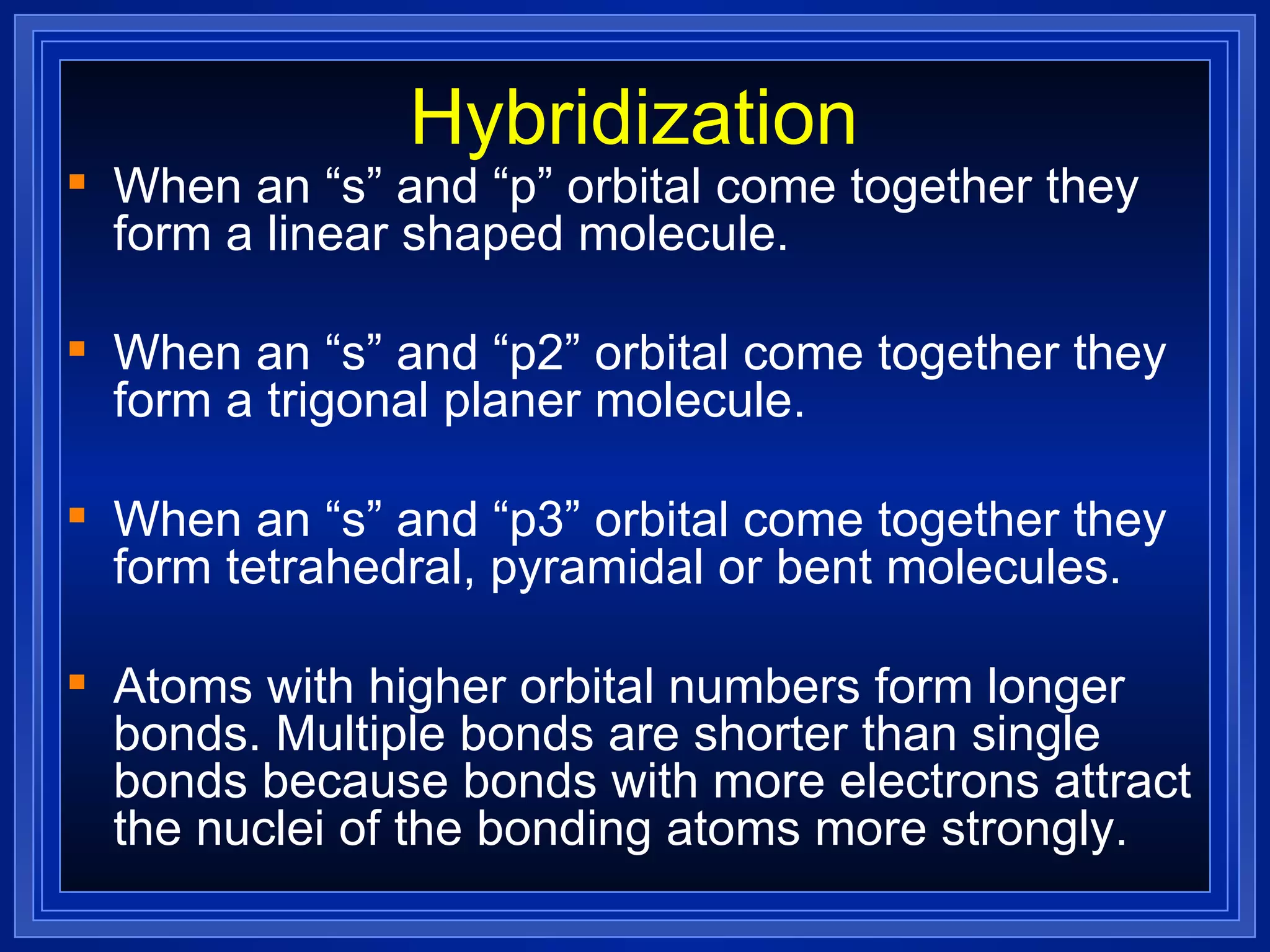
Hybridization The mixing of several atomic orbitals to form the same number of  hybrid  orbitals. When an atom approaches another atom to form a bond, the orbitals of its electrons may be changed. The changing of the orbitals forms what is called hybrid orbitals. This is a cross between all of the orbitals involved (s,p,d,f).
Hybridization When an “s” and “p” orbital come together they form a linear shaped molecule. When an “s” and “p2” orbital come together they form a trigonal planer molecule. When an “s” and “p3” orbital come together they form tetrahedral, pyramidal or bent molecules. Atoms with higher orbital numbers form longer bonds. Multiple bonds are shorter than single bonds because bonds with more electrons attract the nuclei of the bonding atoms more strongly.
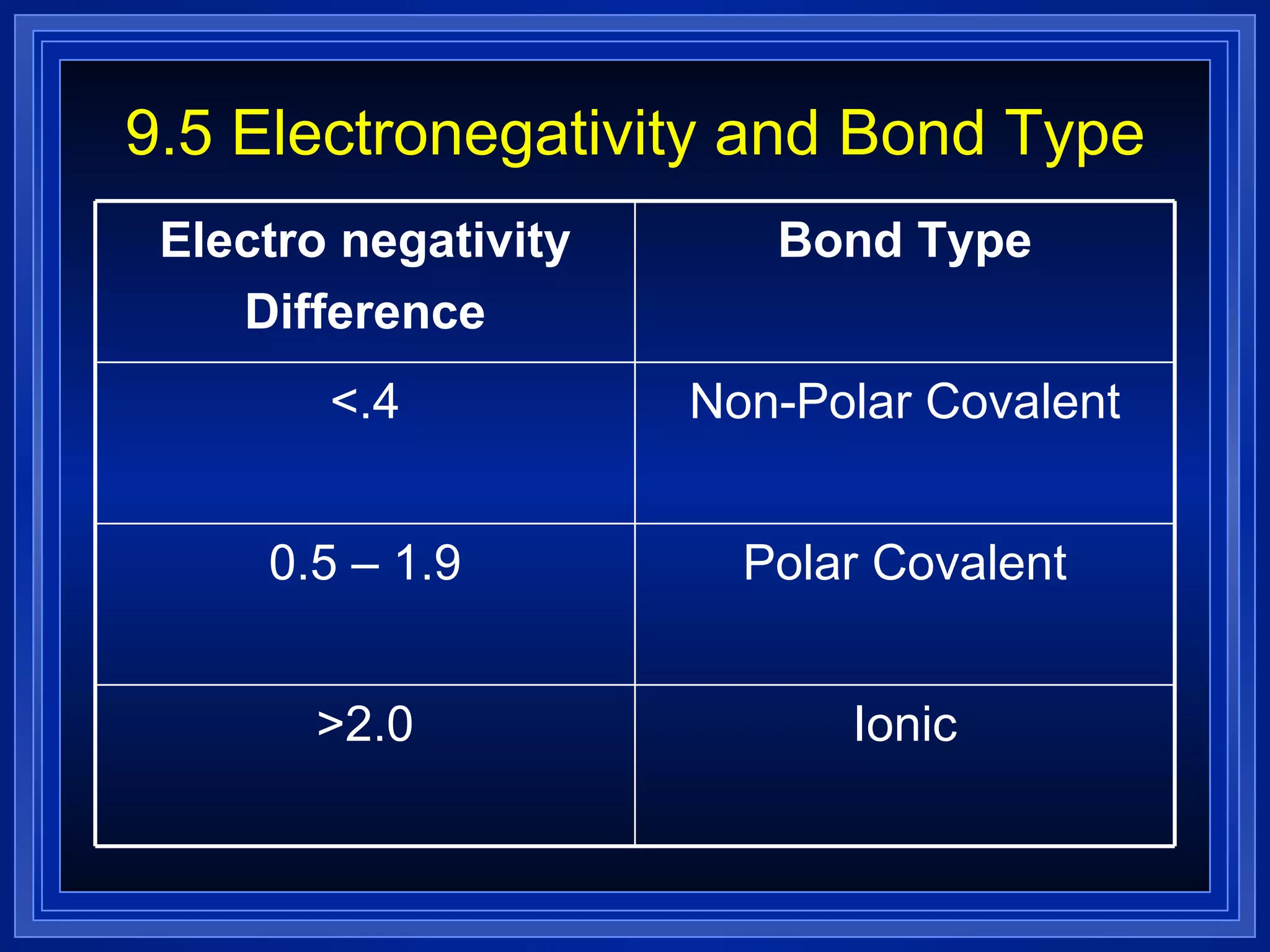
9.5 Electronegativity and Bond Type Electro negativity Difference Bond Type <.4 Non-Polar Covalent 0.5 – 1.9 Polar Covalent >2.0 Ionic
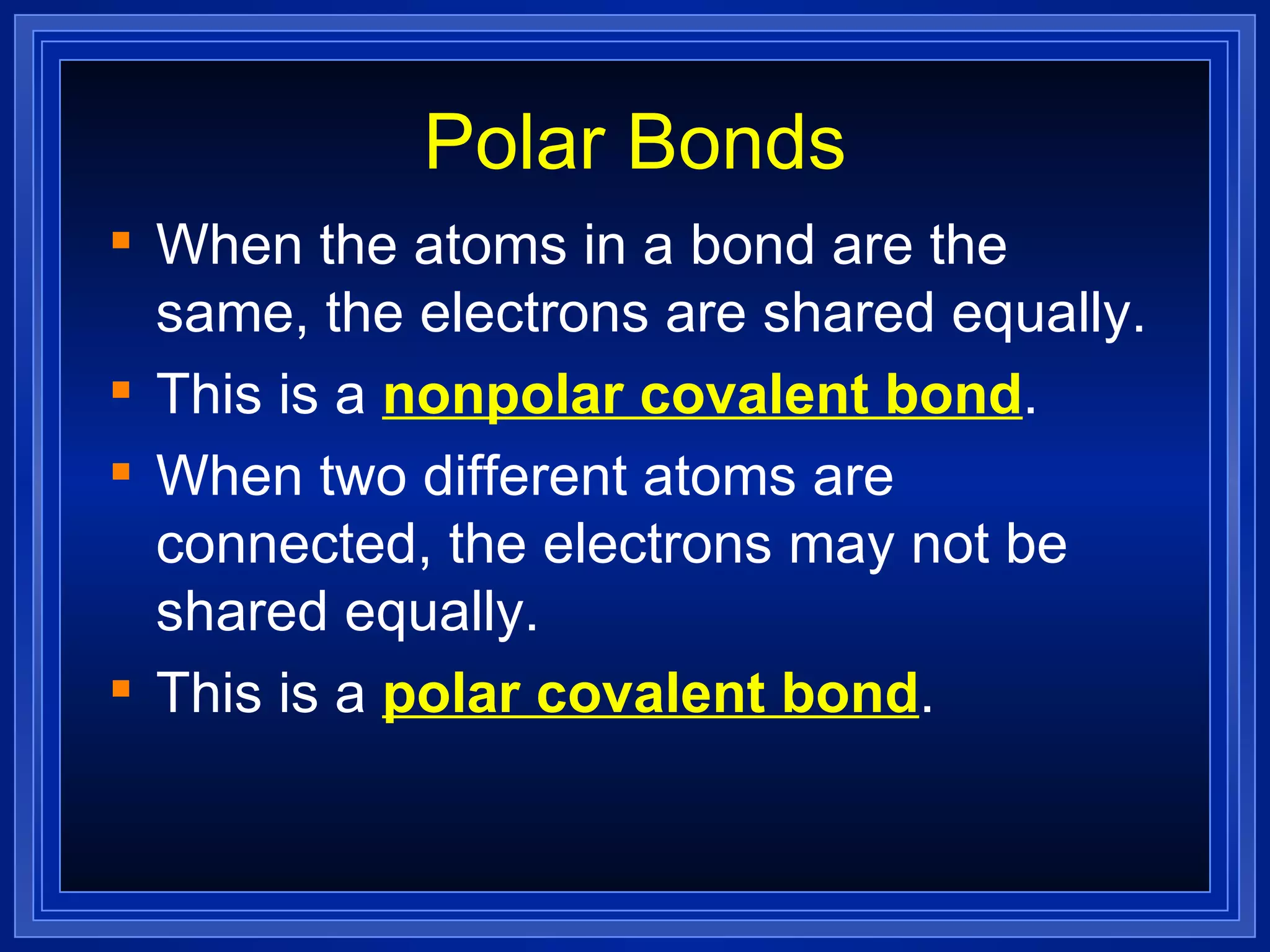
Polar Bonds When the atoms in a bond are the same, the electrons are shared equally. This is a  nonpolar covalent bond . When two different atoms are connected, the electrons may not be shared equally. This is a  polar covalent bond .
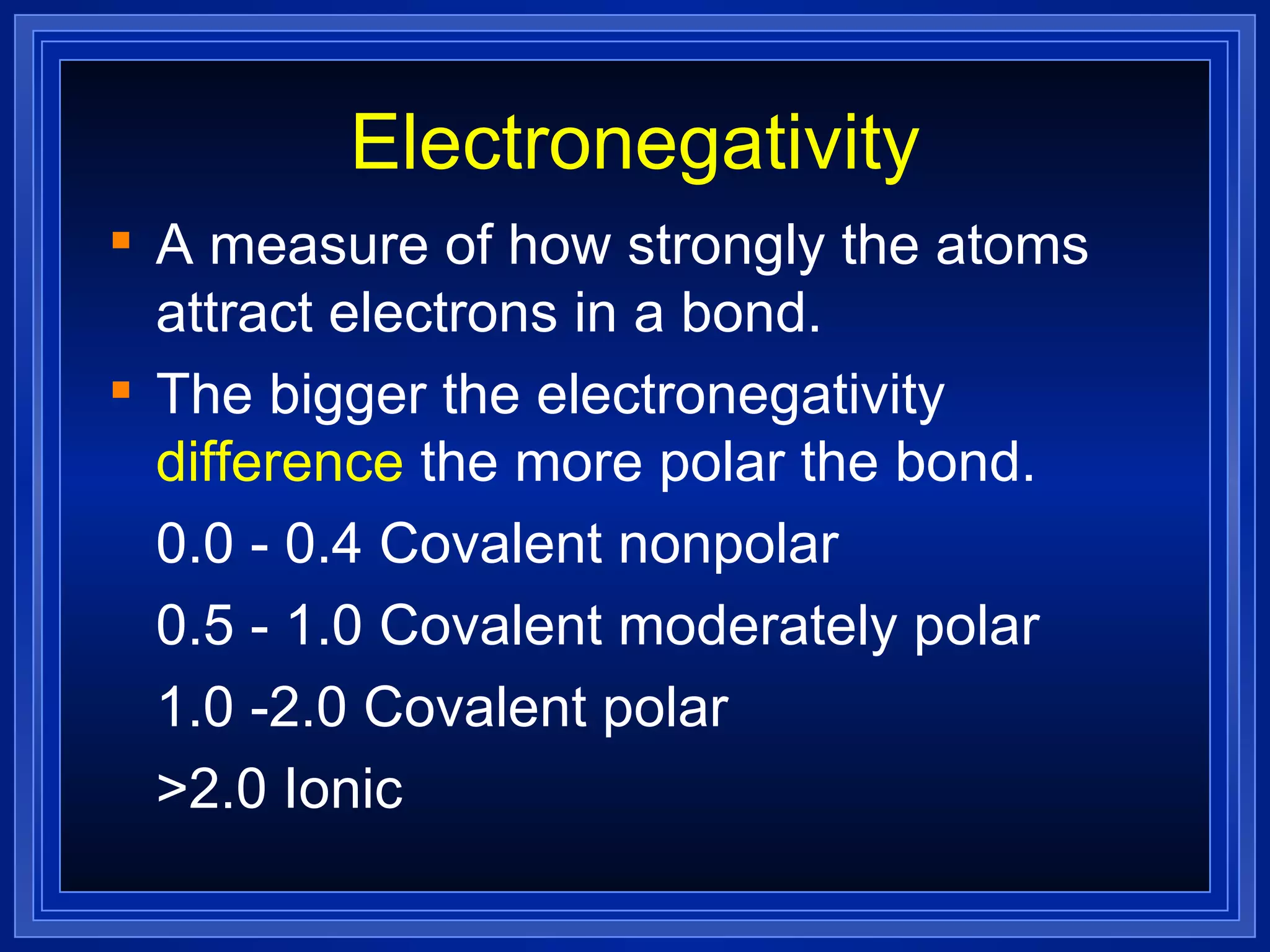
Electronegativity A measure of how strongly the atoms attract electrons in a bond. The bigger the electronegativity  difference  the more polar the bond. 0.0 - 0.4 Covalent nonpolar 0.5 - 1.0 Covalent moderately polar 1.0 -2.0 Covalent polar >2.0 Ionic
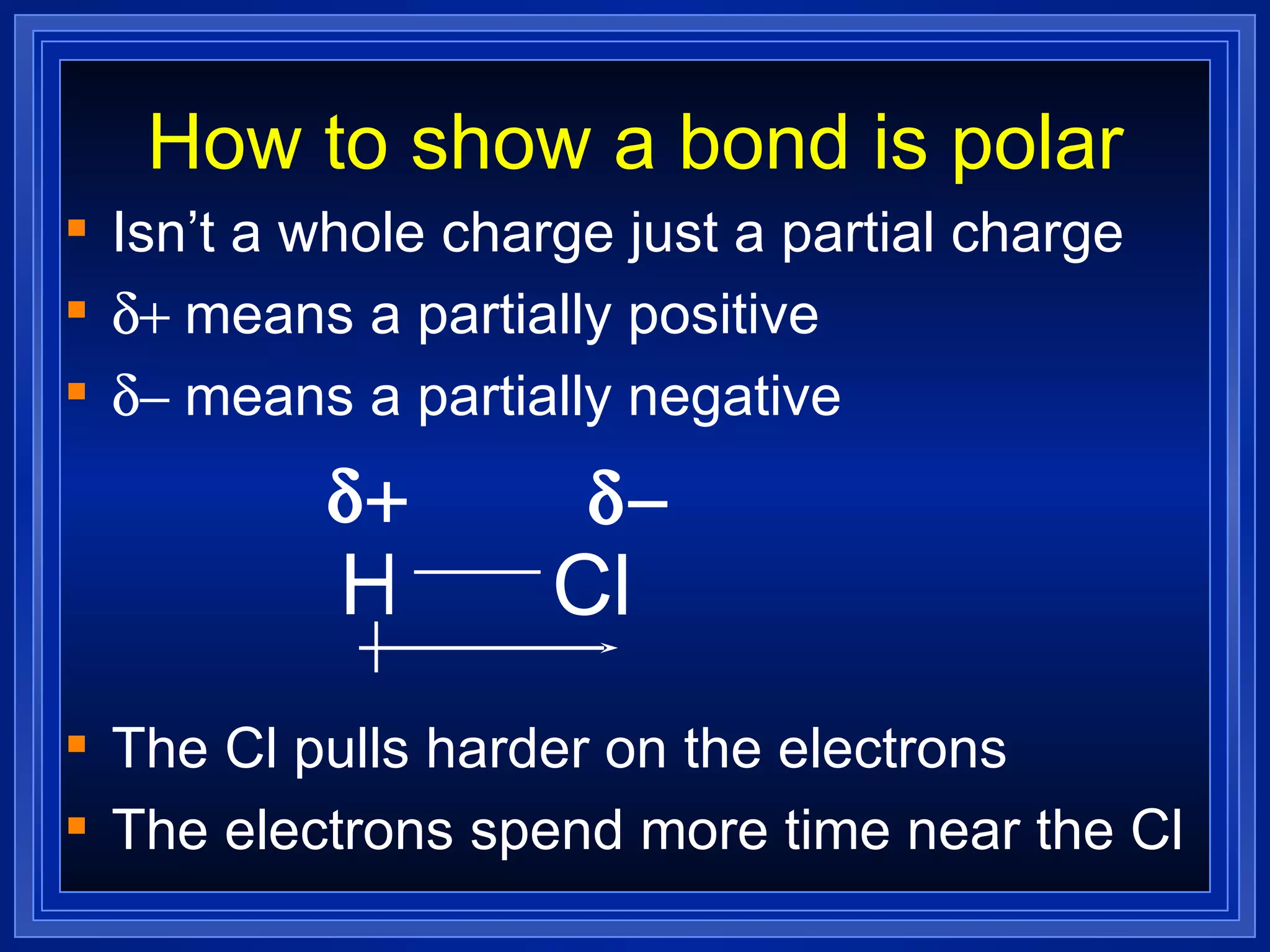
How to show a bond is polar Isn’t a whole charge just a partial charge  means a partially positive  means a partially negative The Cl pulls harder on the electrons The electrons spend more time near the Cl H Cl  
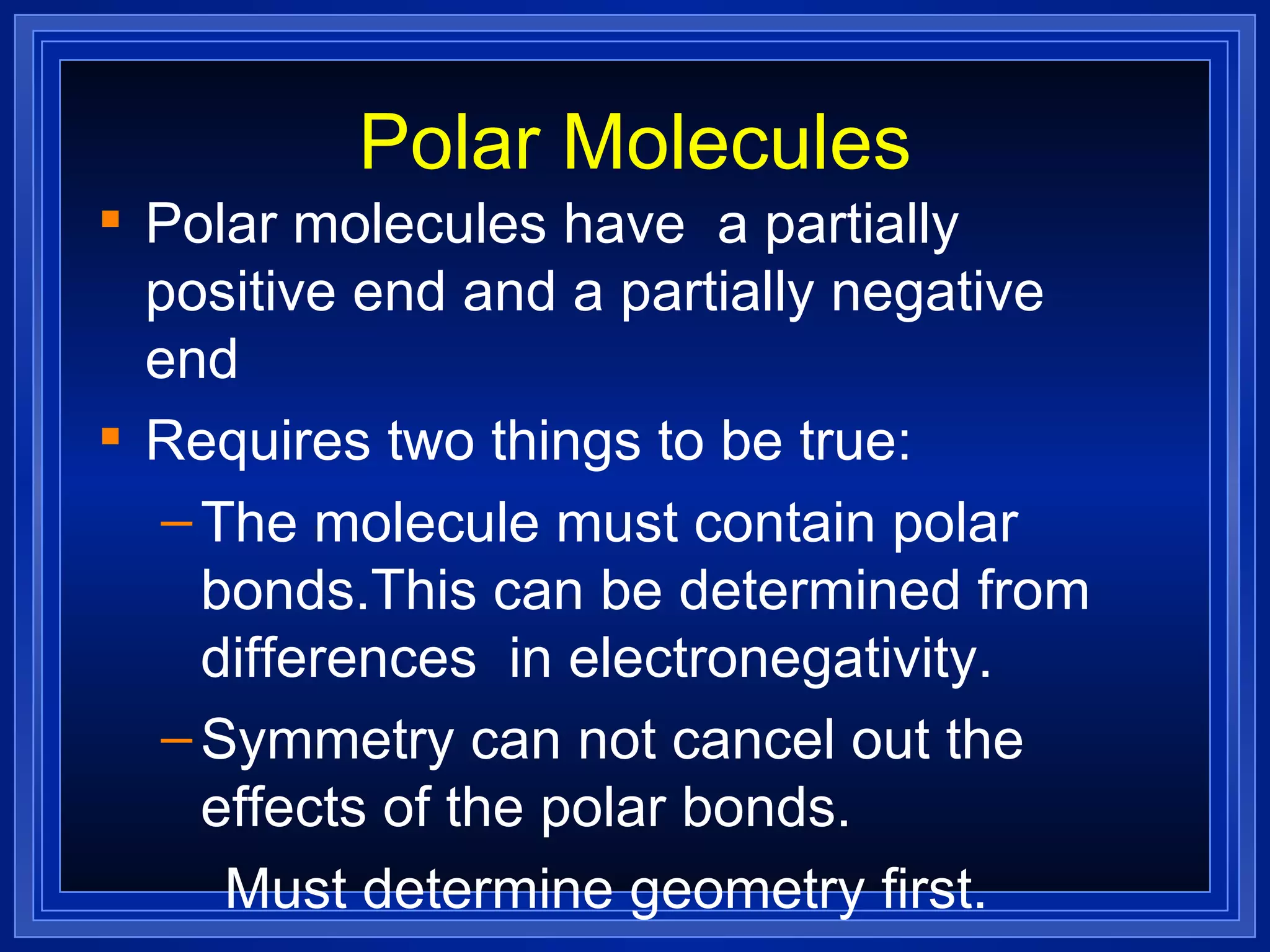
Polar Molecules Polar molecules have  a partially positive end and a partially negative end Requires two things to be true: The molecule must contain polar bonds.This can be determined from differences  in electronegativity.  Symmetry can not cancel out the effects of the polar bonds. Must determine geometry first.
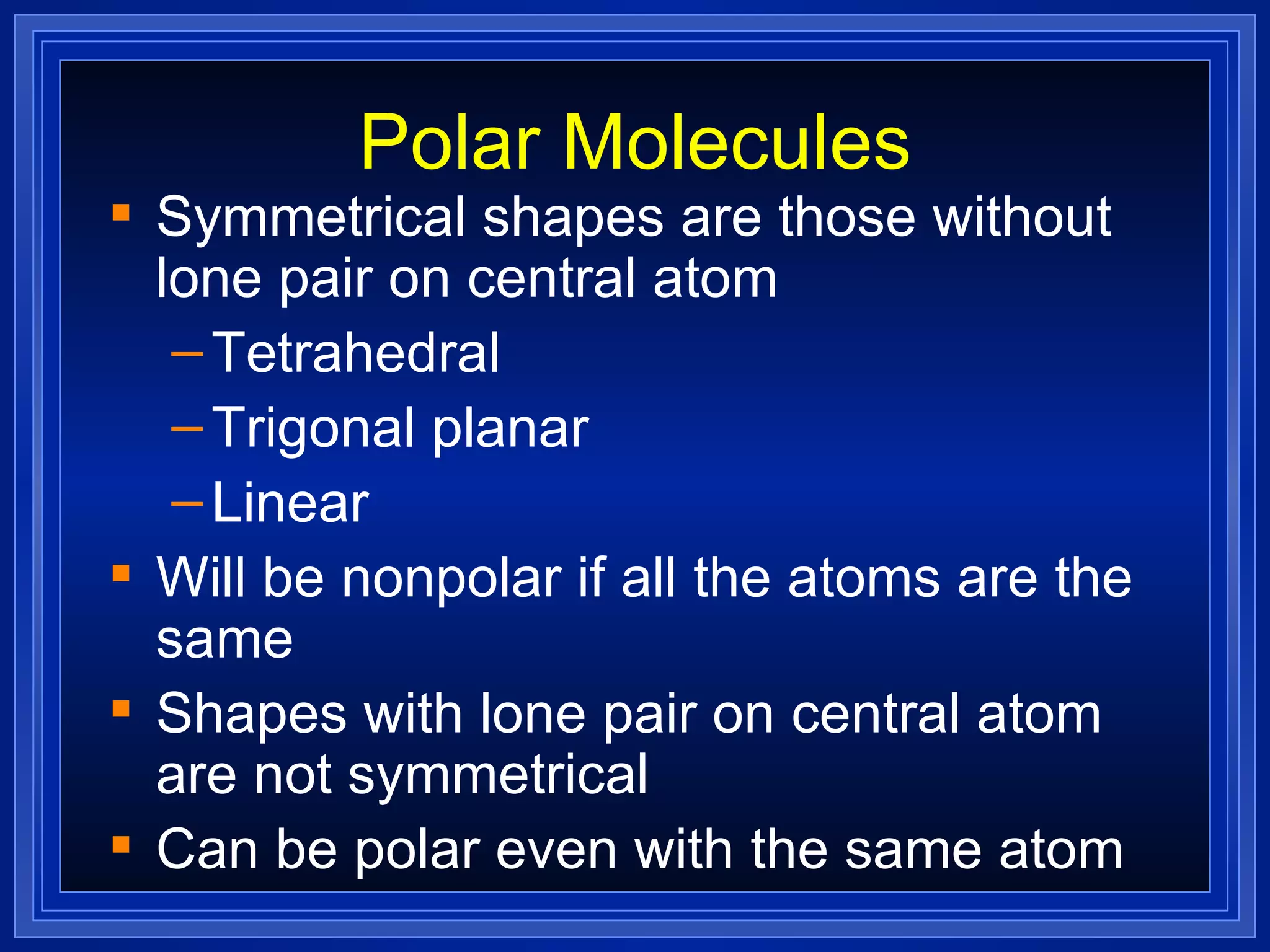
Polar Molecules Symmetrical shapes are those without lone pair on central atom  Tetrahedral Trigonal planar Linear Will be nonpolar if all the atoms are the same Shapes with lone pair on central atom are not symmetrical Can be polar even with the same atom
Intermolecular Forces They are what make solid and liquid molecular compounds possible. The weakest are called  van der Waal’s forces  - there are  two kinds Dispersion forces Dipole Interactions
Dispersion Force Depends only on the number of electrons in the molecule Bigger molecules more electrons More electrons stronger forces F 2  is a gas Br 2  is a liquid I 2  is a solid
Dipole interactions Occur when polar molecules are attracted to each other. Slightly stronger than dispersion forces. Opposites attract but not completely hooked like in ionic solids.
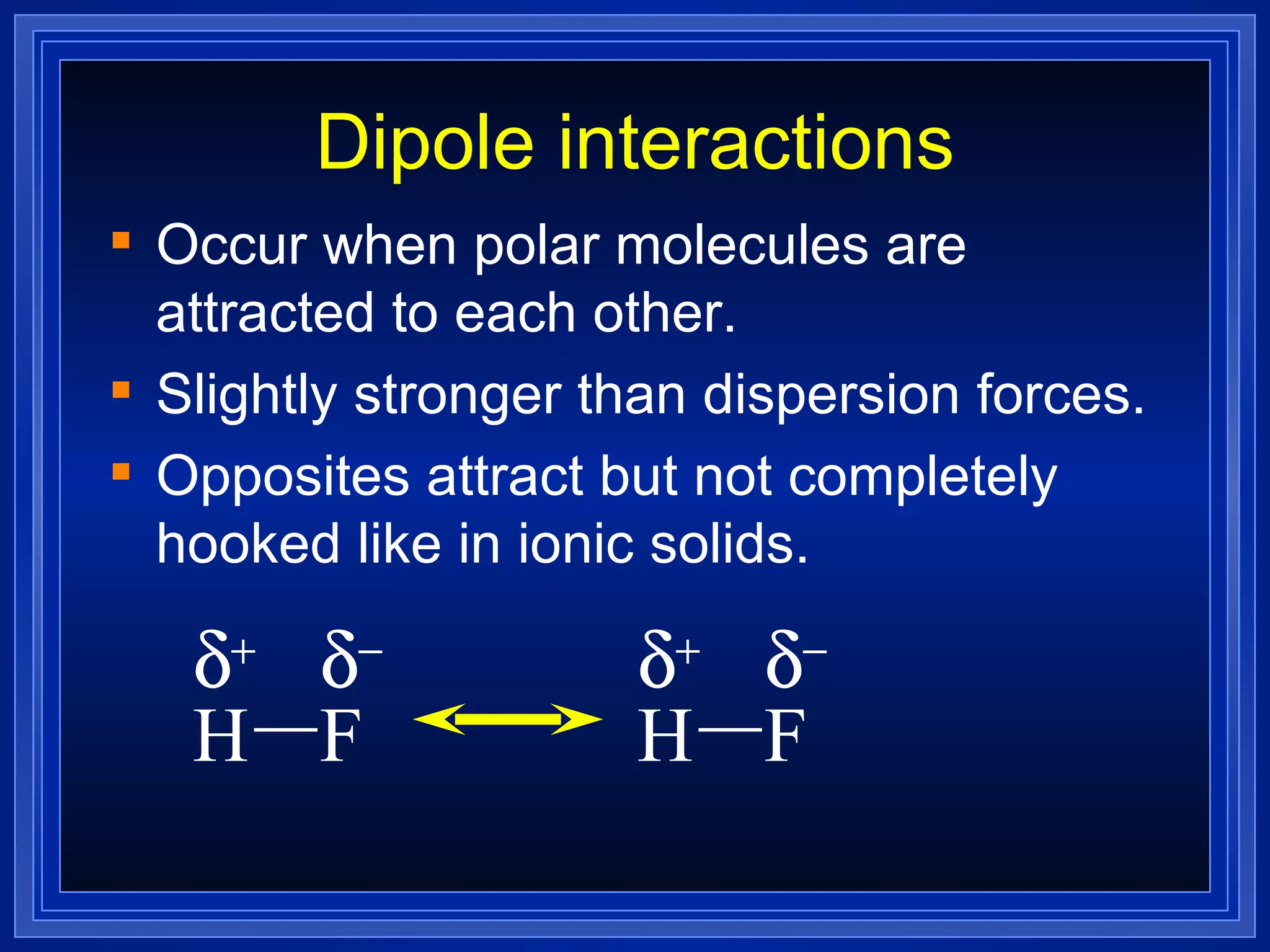
Dipole interactions Occur when polar molecules are attracted to each other. Slightly stronger than dispersion forces. Opposites attract but not completely hooked like in ionic solids. H F     H F    
Properties of Molecular Compounds Made of nonmetals Poor or nonconducting as solid, liquid or aqueous solution Low melting point Two kinds of crystals Molecular solids held together by IMF Network solids- held together by bonds One big molecule (diamond, graphite)

Ch 9 Covalent Bonding

  • 1.
  • 2.
    9.1 The CovalentBond Covalent Bond – A chemical bond that results from the sharing of valence electrons. Between nonmetallic elements of similar electronegativity. A group of atoms united by a covalent bond is called a molecule . A substance made up of molecules is called a molecular substance . Molecules may have as few as two atoms. (CO), (O 2 )
  • 3.
  • 4.
    Polar Covalent Bonds:Unevenly matched, but willing to share.
  • 5.
    To describe thecomposition of a molecular compound we use a molecular formula. The molecular formula tells you how many atoms are in a single molecule of the compound. The molecular formula for oxygen is O 2 , which tells you that this molecule contains 2 atoms of oxygen.
  • 6.
    The molecular formulafor sucrose (table sugar) is C 12 H 22 O 11 . This indicates that one sucrose molecule contains 12 carbon atoms, 22 hydrogen atoms and 11 oxygen atoms. The empirical formula shows the ratio of atoms in the molecule. You get it by dividing all subscripts by the smallest subscript and rounding. C 6 H 12 O 6 becomes CH 2 O.
  • 7.
    Molecules are oftenshown using a structural formula . A structural formula specifies which atoms are bonded to each other in a molecule. One type is the Lewis structure. The Lewis structure uses dots as before and has a circle drawn around the dots that represent valence electrons that are joined in a covalent bond.
  • 8.
    The principle thatdescribes covalent bonding is the octet rule . Atoms within a molecule will share electrons so as to acquire a full set (8) of valence electrons. If each atom has 7 valence electrons, then they will share one so that they both will have 8. The sharing of that electron is a single covalent bond .
  • 9.
    Single Covalent bondingFluorine has seven valence electrons A second F atom also has seven By sharing electrons Both end with full orbitals F F
  • 10.
    Covalent bonding Fluorinehas seven valence electrons A second atom also has seven By sharing electrons Both end with full orbitals F F 8 Valence electrons
  • 11.
    Covalent bonding Fluorinehas seven valence electrons A second atom also has seven By sharing electrons Both end with full orbitals F F 8 Valence electrons
  • 12.
    If more thantwo atoms join in a covalent bond the atoms with the fewest valence electrons will pair up with the atom that has the most up to a total of 8. If a pair of electrons is not shared, they are called an unshared pair . If two atoms share two pairs of electrons, it is called a double covalent bond. If two atoms share three pairs of electrons, it is called a triple covalent bond.
  • 13.
    The Lewis structuresthat you have seen so far use a pair of dots to represent covalent bonds. Another kind of Lewis structure uses dashes to represent covalent bonds. A single dash represents a single covalent bond. A double dash represents a double covalent bond A triple dash represents a triple covalent bond.
  • 14.
    Covalent compounds (molecules)tend to have low melting and boiling points When an electron pair is shared by the direct overlap of bonding orbitals, a sigma bond results. Single bonds are sigma bonds. The overlap of parallel orbitals forms a pi bond . Multiple bonds involve both sigma and pi bonds.
  • 15.
    Bond length depends on the sizes of the bonded atoms and the number of electron pairs they share. Bond dissociation energy is the energy needed to break a covalent bond. Double bonds have larger bond dissociation energies than single, triple even larger Bond length and bond dissociation energy are directly related.
  • 16.
    9.2 Naming MoleculesCovalent compounds (Molecules) are named by adding prefixes to the element names. Covalent’ (in this context) means both elements are nonmetals . The names of molecular compounds will include prefixes that indicate the number of atoms in the molecule. (CO 2 would be called Carbon Di oxide, CCl 4 is called Carbon Tetra chloride) The following prefixes are used: mono-1 di-2 tri-3 tetra-4 penta-5 hexa-6 hepta-7 octa-8 nona-9 deca-10 Note : When a prefix ending in ‘o’ or ‘a’ is added to ‘oxide’, the final vowel in the prefix is dropped.
  • 17.
    Remember to usethe “ide” suffix. (Cl is chlor ide not chlorine) Exceptions to the rule : The prefix “mono” is usually not written with the first word of the compounds name. CO 2 is not called mono carbon di oxide, just carbon dioxide. Some compounds have common names. (H 2 O is water or dihydrogen monoxide)
  • 18.
    Naming Binary CovalentCompounds: Examples N 2 S 4 di nitrogen tetra sulfide NI 3 nitrogen tri iodide XeF 6 xenon hexa fluoride CCl 4 carbon tetra chloride P 2 O 5 di phosphorus pent oxide SO 3 sulfur tri oxide 1 mono 2 di 3 tri 4 tetra 5 penta 6 hexa 7 heptaa 8 octa 9 nona 10 deca * Second element in ‘ide’ from * Drop –a & -o before ‘oxide’
  • 19.
    Naming Acids An acid is a molecular substance that dissolves in water to produce hydrogen ions (H+). Acids behave like an ionic compound because when they dissolve in water, they create cations and anions. The cation is always H+ and the anion depends on the particular acid. Example : When the acid HCl dissolves in water it forms H+ cations and Cl- anions. HNO 3 acid will form H+ and NO 3 - ions.
  • 20.
    Naming Acids Thename of an acid usually results from the name of the anion(-). For acids, where the anion ends with the suffix “-ide” (ex.Chloride), mainly binary acids, the name of the acid begins with the prefix hydro. The acids name also includes the root name of the anion(-) and the word acid. In addition you need to change the suffix of the anion from “ide” to “ic”. By these rules HCl is named hydrochloric acid. Other acids are named without the prefix “hydro”. The acid HNO 3 - derives its name from NO 3 - which is nitrate. HNO 3 is named Nitric Acid. The following are names and formulas of common acids:
  • 21.
    Naming Acids Anion Corresponding Acid F - , Fluoride HF, hydrofluoric acid Cl - , Chloride HCl, hydrochloric acid Br - , Bromine HBr, hydrobromic acid I - , iodide HI, hydroiodic acid S 2 - , sulfide H 2 S, hydrosulfuric acid NO 3 - , nitrate HNO 3 , nitric acid CO 3 -2 , carbonate H 2 CO 3 , carbonic acid SO 4 -2 , sulfate H 2 SO 4 , sulfuric acid PO 4 -3 , phoshate H 3 PO 4 , Phosphoric acid C 2 H 3 O 2 - , acetate HC 2 H 3 O 2 , acetic acid
  • 22.
    9.3 Molecular StructuresStructural formulas (Lewis Structures) use letter symbols and bonds to show the position of atoms. Drawing Lewis Structures:
  • 23.
    Water Each hydrogenhas 1 valence electron and wants 1 more The oxygen has 6 valence electrons and wants 2 more They share to make each other “happy” H O
  • 24.
    Water Put thepieces together The first hydrogen is happy The oxygen still wants one more H O
  • 25.
    Water The secondhydrogen attaches Every atom has full energy levels H H O
  • 26.
    Multiple Bonds Sometimesatoms share more than one pair of valence electrons. A double bond is when atoms share two pair (4) of electrons. A triple bond is when atoms share three pair (6) of electrons.
  • 27.
    Carbon dioxide CO2 - Carbon is central atom ( I have to tell you) Carbon has 4 valence electrons Wants 4 more Oxygen has 6 valence electrons Wants 2 more C O
  • 28.
    Carbon dioxide Attaching1 oxygen leaves the oxygen 1 short and the carbon 3 short C O
  • 29.
    Carbon dioxide Attachingthe second oxygen leaves both oxygen 1 short and the carbon 2 short C O O
  • 30.
    Carbon dioxide Theonly solution is to share more C O O
  • 31.
    Carbon dioxide Theonly solution is to share more C O O
  • 32.
    Carbon dioxide Theonly solution is to share more C O O
  • 33.
    Carbon dioxide Theonly solution is to share more C O O
  • 34.
    Carbon dioxide Theonly solution is to share more C O O
  • 35.
    Carbon dioxide Theonly solution is to share more O C O
  • 36.
    Carbon dioxide Theonly solution is to share more Requires two double bonds Each atom gets to count all the atoms in the bond O C O
  • 37.
    Carbon dioxide Theonly solution is to share more Requires two double bonds Each atom gets to count all the atoms in the bond O C O 8 valence electrons
  • 38.
    Carbon dioxide Theonly solution is to share more Requires two double bonds Each atom gets to count all the atoms in the bond O C O 8 valence electrons
  • 39.
    Carbon dioxide Theonly solution is to share more Requires two double bonds Each atom gets to count all the atoms in the bond O C O 8 valence electrons
  • 40.
    How to drawthem To figure out if you need multiple bonds Add up all the valence electrons. Count up the total number of electrons to make all atoms happy. Subtract. Divide by 2 Tells you how many bonds - draw them. Fill in the rest of the valence electrons to fill atoms up.
  • 41.
    Examples NH 3 N - has 5 valence electrons wants 8 H - has 1 valence electrons wants 2 NH 3 has 5+3(1) = 8 NH 3 wants 8+3(2) = 14 (14-8)/2= 3 bonds 4 atoms with 3 bonds N H
  • 42.
    Examples Draw inthe bonds All 8 electrons are accounted for Everything is full N H H H
  • 43.
    Examples HCN C is central atom N - has 5 valence electrons wants 8 C - has 4 valence electrons wants 8 H - has 1 valence electrons wants 2 HCN has 5+4+1 = 10 HCN wants 8+8+2 = 18 (18-10)/2= 4 bonds 3 atoms with 4 bonds -will require multiple bonds - not to H
  • 44.
    HCN Put insingle bonds Need 2 more bonds Must go between C and N N H C
  • 45.
    HCN Put insingle bonds Need 2 more bonds Must go between C and N Uses 8 electrons - 2 more to add N H C
  • 46.
    HCN Put insingle bonds Need 2 more bonds Must go between C and N Uses 8 electrons - 2 more to add Must go on N to fill octet N H C
  • 47.
    Another way ofindicating bonds Often use a line to indicate a bond Called a structural formula Each line is 2 valence electrons H H O = H H O
  • 48.
    Structural Examples Chas 8 electrons because each line is 2 electrons Ditto for N Ditto for C here Ditto for O H C N C O H H
  • 49.
    Coordinate Covalent BondA Coordinate Covalent Bond is when one atom donates both electrons in a covalent bond. Carbon monoxide CO O C
  • 50.
    Coordinate Covalent BondWhen one atom donates both electrons in a covalent bond. Carbon monoxide CO O C
  • 51.
    Coordinate Covalent BondWhen one atom donates both electrons in a covalent bond. Carbon monoxide CO O C O C
  • 52.
    Resonance Resonance is a condition when more than one dot diagram with the same connections is possible. Resonance structures differ only in the position of the electron pairs, never the atom positions.
  • 53.
    9.4 Molecular Shape(VSEPR) V alence S hell E lectron P air R epulsion. Predicts three dimensional geometry of molecules. The name tells you the theory. Valence shell - outside electrons. Electron Pair Repulsion - electron pairs try to get as far away as possible. Can determine the angles of bonds. And the shape of molecules
  • 54.
    VSEPR Based onthe number of pairs of valence electrons both bonded and unbonded. Unbonded pair are called lone pair . CH 4 - draw the structural formula
  • 55.
    VSEPR Single bondsfill all atoms. There are 4 pairs of electrons pushing away. The furthest they can get away is 109.5º. C H H H H
  • 56.
    4 atoms bondedBasic shape is tetrahedral. A pyramid with a triangular base. Same basic shape for everything with 4 pairs. C H H H H 109.5º
  • 57.
    3 bonded - 1 lone pair Still basic tetrahedral but you can’t see the electron pair. Shape is called trigonal pyramidal. N H H H N H H H <109.5º
  • 58.
    2 bonded - 2 lone pair Still basic tetrahedral but you can’t see the 2 lone pair. Shape is called bent. O H H O H H <109.5º
  • 59.
    3 atoms nolone pair The farthest you can the electron pair apart is 120º. Shape is flat and called trigonal planar. Will require 1 double bond C H H O C H H O 120º
  • 60.
    2 atoms nolone pair With three atoms the farthest they can get apart is 180º. Shape called linear. Will require 2 double bonds or one triple bond C O O 180º
  • 61.
    Molecular Orbitals Theoverlap of atomic orbitals from separate atoms makes molecular orbitals Each molecular orbital has room for two electrons Two types of MO Sigma ( σ ) between atoms Pi ( π ) above and below atoms
  • 62.
    Sigma bonding orbitals From s orbitals on separate atoms + + s orbital s orbital + + + + Sigma bonding molecular orbital
  • 63.
    Sigma bonding orbitals From p orbitals on separate atoms p orbital p orbital Sigma bonding molecular orbital      
  • 64.
    Pi bonding orbitalsP orbitals on separate atoms     Pi bonding molecular orbital    
  • 65.
    Sigma and pibonds All single bonds are sigma bonds A double bond is one sigma and one pi bond A triple bond is one sigma and two pi bonds.
  • 66.
    Hybridization The mixingof several atomic orbitals to form the same number of hybrid orbitals. When an atom approaches another atom to form a bond, the orbitals of its electrons may be changed. The changing of the orbitals forms what is called hybrid orbitals. This is a cross between all of the orbitals involved (s,p,d,f).
  • 67.
    Hybridization When an“s” and “p” orbital come together they form a linear shaped molecule. When an “s” and “p2” orbital come together they form a trigonal planer molecule. When an “s” and “p3” orbital come together they form tetrahedral, pyramidal or bent molecules. Atoms with higher orbital numbers form longer bonds. Multiple bonds are shorter than single bonds because bonds with more electrons attract the nuclei of the bonding atoms more strongly.
  • 68.
    9.5 Electronegativity andBond Type Electro negativity Difference Bond Type <.4 Non-Polar Covalent 0.5 – 1.9 Polar Covalent >2.0 Ionic
  • 69.
    Polar Bonds Whenthe atoms in a bond are the same, the electrons are shared equally. This is a nonpolar covalent bond . When two different atoms are connected, the electrons may not be shared equally. This is a polar covalent bond .
  • 70.
    Electronegativity A measureof how strongly the atoms attract electrons in a bond. The bigger the electronegativity difference the more polar the bond. 0.0 - 0.4 Covalent nonpolar 0.5 - 1.0 Covalent moderately polar 1.0 -2.0 Covalent polar >2.0 Ionic
  • 71.
    How to showa bond is polar Isn’t a whole charge just a partial charge  means a partially positive  means a partially negative The Cl pulls harder on the electrons The electrons spend more time near the Cl H Cl  
  • 72.
    Polar Molecules Polarmolecules have a partially positive end and a partially negative end Requires two things to be true: The molecule must contain polar bonds.This can be determined from differences in electronegativity. Symmetry can not cancel out the effects of the polar bonds. Must determine geometry first.
  • 73.
    Polar Molecules Symmetricalshapes are those without lone pair on central atom Tetrahedral Trigonal planar Linear Will be nonpolar if all the atoms are the same Shapes with lone pair on central atom are not symmetrical Can be polar even with the same atom
  • 74.
    Intermolecular Forces Theyare what make solid and liquid molecular compounds possible. The weakest are called van der Waal’s forces - there are two kinds Dispersion forces Dipole Interactions
  • 75.
    Dispersion Force Dependsonly on the number of electrons in the molecule Bigger molecules more electrons More electrons stronger forces F 2 is a gas Br 2 is a liquid I 2 is a solid
  • 76.
    Dipole interactions Occurwhen polar molecules are attracted to each other. Slightly stronger than dispersion forces. Opposites attract but not completely hooked like in ionic solids.
  • 77.
    Dipole interactions Occurwhen polar molecules are attracted to each other. Slightly stronger than dispersion forces. Opposites attract but not completely hooked like in ionic solids. H F     H F    
  • 78.
    Properties of MolecularCompounds Made of nonmetals Poor or nonconducting as solid, liquid or aqueous solution Low melting point Two kinds of crystals Molecular solids held together by IMF Network solids- held together by bonds One big molecule (diamond, graphite)