Group-6
 An ion is an atom or group of
atoms that have a net electrical
charge. An ion is formed when
electrons or protons are gained or
lost by an atom.
 There are two types of ions:
Cations and Anions.
 Cations :A positively charged ion is
known as cations. A cation is
formed by the loss of one or more
electrons by an atom.
 Anions: A negatively charged ion is
known as Anion. An anion is
formed by the gain of one or more
electrons by an atom.
 The compounds which are made up of ions
are known as ionic compounds.
 In an ionic compound, the positively charged
ions and negatively charged ions are held
together by the strong electrostatic forces of
attraction.
 The forces which hold the ions together in an
ionic compound are known as ionic bonds
and electrovalent bonds.
 Since an ionic compound consists of an equal
number of positive ions and negative ions, so
overall charge of an ionic compound is zero.
 Example: Sodium chloride- NaCl
Potassium Chloride- KCl
+ =
Na Cl NaCl
 During the formation of NaCl, one electron is
transferred from a sodium atom to a chlorine
atom
Name Formula Ions present
1. Sodium Chloride NaCl Na+ and Cl-
2.Potassiun Chloride KCl K+ and Cl-
3.Ammonium Chloride NH4Cl NH4
+ and Cl-
4.Magnesium Chloride MgCl2 Mg2+ and Cl-
5. Calcium Chloride CaCl2 Ca2+ and Cl-
6. Magnesium Oxide MgO Mg2+ and O2-
7. Calcium Oxide CaO Ca2+ and O2-
8.Aluminium Oxide Al2O3 Al3+ and O2-
9.Sodium Hydroxide NaOH Na+ and OH-
10.Copper Sulphate CuSO4 Cu2+ and SO4
2-
11.Calcium Nitrate Ca(NO3)2 Ca2+ and NO3
-
Note: Ionic compounds are made up of a metal and a non-metal(except ammonium
chloride which is made up of only non-metals.
The attraction between the cation and the anion
is known as an ionic bond. This bond is what
holds the ionic compound together.
 The simplest combination of ions that
produces an electrically neutral unit, is called
a ‘Formula Unit’ of ionic compound.
 The ‘formula unit’ of an ionic compound can
be thought of as the smallest unit that
compound, it is the equivalent of a ‘molecule’
of the compound.
 Formula mass is the sum of the atomic
masses of the atoms (or ions) represented by
its formula.
 In order to calculate the formula mass of an
ionic compound, we should know the formula
of the ionic compound as well as the atomic
masses of all the atoms (or ions) present in
the formula.
 To calculate the formula mass of potassium
carbonate (K2CO3):
 Atomic masses: K= 39u ; C= 12u ; 0= 16u
Formula
mass of
K2CO3
=
Mass of 2
K atoms +
Mass of one
C atom +
Mass of 3 O
atoms
= 2*39 + 12 + 3*16
= 78 + 12 + 48
= 138u
Thus, the formula mass of potassium carbonate is
 At room temperature, most are hard,
brittle solids that can be crushed.
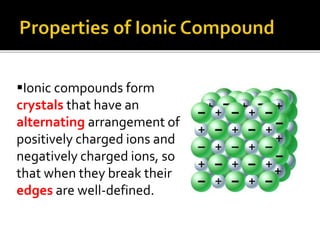
Ionic compounds form
crystals that have an
alternating arrangement of
positively charged ions and
negatively charged ions, so
that when they break their
edges are well-defined.
In an ionic crystal, every ion is attracted to
every other ion in the crystal. As a result, ionic
crystals have very high melting points
ex.) NaCl melts at 800oC
 When an ionic compound
dissolves in water, the crystal
structure breaks down and
the ions become free to
move.
 Solutions of ionic compounds can conduct
electricity.
Ionic compound

Ionic compound

  • 1.
  • 3.
     An ionis an atom or group of atoms that have a net electrical charge. An ion is formed when electrons or protons are gained or lost by an atom.  There are two types of ions: Cations and Anions.
  • 4.
     Cations :Apositively charged ion is known as cations. A cation is formed by the loss of one or more electrons by an atom.  Anions: A negatively charged ion is known as Anion. An anion is formed by the gain of one or more electrons by an atom.
  • 5.
     The compoundswhich are made up of ions are known as ionic compounds.  In an ionic compound, the positively charged ions and negatively charged ions are held together by the strong electrostatic forces of attraction.  The forces which hold the ions together in an ionic compound are known as ionic bonds and electrovalent bonds.
  • 6.
     Since anionic compound consists of an equal number of positive ions and negative ions, so overall charge of an ionic compound is zero.  Example: Sodium chloride- NaCl Potassium Chloride- KCl + = Na Cl NaCl
  • 7.
     During theformation of NaCl, one electron is transferred from a sodium atom to a chlorine atom
  • 9.
    Name Formula Ionspresent 1. Sodium Chloride NaCl Na+ and Cl- 2.Potassiun Chloride KCl K+ and Cl- 3.Ammonium Chloride NH4Cl NH4 + and Cl- 4.Magnesium Chloride MgCl2 Mg2+ and Cl- 5. Calcium Chloride CaCl2 Ca2+ and Cl- 6. Magnesium Oxide MgO Mg2+ and O2- 7. Calcium Oxide CaO Ca2+ and O2- 8.Aluminium Oxide Al2O3 Al3+ and O2- 9.Sodium Hydroxide NaOH Na+ and OH- 10.Copper Sulphate CuSO4 Cu2+ and SO4 2- 11.Calcium Nitrate Ca(NO3)2 Ca2+ and NO3 - Note: Ionic compounds are made up of a metal and a non-metal(except ammonium chloride which is made up of only non-metals.
  • 10.
    The attraction betweenthe cation and the anion is known as an ionic bond. This bond is what holds the ionic compound together.
  • 11.
     The simplestcombination of ions that produces an electrically neutral unit, is called a ‘Formula Unit’ of ionic compound.  The ‘formula unit’ of an ionic compound can be thought of as the smallest unit that compound, it is the equivalent of a ‘molecule’ of the compound.
  • 12.
     Formula massis the sum of the atomic masses of the atoms (or ions) represented by its formula.  In order to calculate the formula mass of an ionic compound, we should know the formula of the ionic compound as well as the atomic masses of all the atoms (or ions) present in the formula.
  • 13.
     To calculatethe formula mass of potassium carbonate (K2CO3):  Atomic masses: K= 39u ; C= 12u ; 0= 16u Formula mass of K2CO3 = Mass of 2 K atoms + Mass of one C atom + Mass of 3 O atoms = 2*39 + 12 + 3*16 = 78 + 12 + 48 = 138u Thus, the formula mass of potassium carbonate is
  • 14.
     At roomtemperature, most are hard, brittle solids that can be crushed.
  • 15.
    Ionic compounds form crystalsthat have an alternating arrangement of positively charged ions and negatively charged ions, so that when they break their edges are well-defined.
  • 16.
    In an ioniccrystal, every ion is attracted to every other ion in the crystal. As a result, ionic crystals have very high melting points ex.) NaCl melts at 800oC
  • 17.
     When anionic compound dissolves in water, the crystal structure breaks down and the ions become free to move.
  • 18.
     Solutions ofionic compounds can conduct electricity.