Naming covalent compounds and
            acids
              Lisa Allen
        Stonington High School
           Honors chemistry
How do you know the compound
is covalent?
1. The compound is called a molecule. Molecules are
   covalently bonded.
2. The compound doesn’t start with a metal or with
   ammonium.
3. The compound is made from elements that are
   similar in electronegativity
4. Organic compounds often have carbon for their first
   element, and that is going to form covalent bonds.
   These frequently use another naming system you will
   learn in organic chemistry!
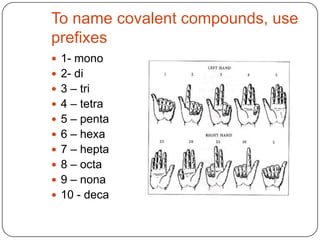
To name covalent compounds, use
prefixes
 1- mono
 2- di
 3 – tri
 4 – tetra
 5 – penta
 6 – hexa
 7 – hepta
 8 – octa
 9 – nona
 10 - deca
Simple rules
 Write the name of the less
  electronegative element first.
 If you have more than one atom of that
  element in the compound, you will need
  a prefix before its name. If not, skip the
  prefix here.
 Always put a prefix before the name of
  the more electronegative element.
 Change the ending of the second
  element to –ide.
Practice a few of these
 CO
 P2O5
 OF2
 SO2
 SO3
 N2O5
 N2O4
 H2O
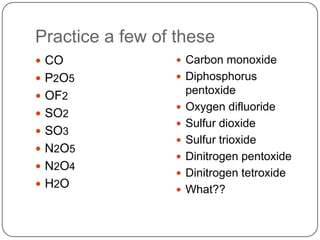
Practice a few of these
 CO              Carbon monoxide
 P2O5            Diphosphorus
 OF2
                     pentoxide
                    Oxygen difluoride
 SO2
                    Sulfur dioxide
 SO3
                    Sulfur trioxide
 N2O5
                    Dinitrogen pentoxide
 N2O4
                    Dinitrogen tetroxide
 H2O
                    What??
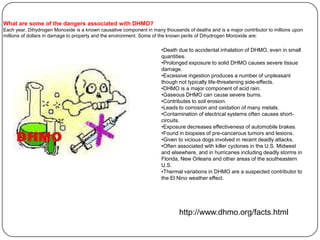
What are some of the dangers associated with DHMO?
Each year, Dihydrogen Monoxide is a known causative component in many thousands of deaths and is a major contributor to millions upon
millions of dollars in damage to property and the environment. Some of the known perils of Dihydrogen Monoxide are:

                                                                      •Death due to accidental inhalation of DHMO, even in small
                                                                      quantities.
                                                                      •Prolonged exposure to solid DHMO causes severe tissue
                                                                      damage.
                                                                      •Excessive ingestion produces a number of unpleasant
                                                                      though not typically life-threatening side-effects.
                                                                      •DHMO is a major component of acid rain.
                                                                      •Gaseous DHMO can cause severe burns.
                                                                      •Contributes to soil erosion.
                                                                      •Leads to corrosion and oxidation of many metals.
                                                                      •Contamination of electrical systems often causes short-
                                                                      circuits.
                                                                      •Exposure decreases effectiveness of automobile brakes.
                                                                      •Found in biopsies of pre-cancerous tumors and lesions.
                                                                      •Given to vicious dogs involved in recent deadly attacks.
                                                                      •Often associated with killer cyclones in the U.S. Midwest
                                                                      and elsewhere, and in hurricanes including deadly storms in
                                                                      Florida, New Orleans and other areas of the southeastern
                                                                      U.S.
                                                                      •Thermal variations in DHMO are a suspected contributor to
                                                                      the El Nino weather effect.


                                                                              http://www.dhmo.org/facts.html
Naming acids
Acids are (almost) always compounds made from
  hydrogen and an anion.
 Hydrogen plus a halogen?  hydroXXXic acid
  Example: HCl = hydrochloric acid
 Hydrogen plus a polyatomic ion that ends in –ate?
                               XXXic acid
   Example: Hydrogen plus nitrate is HNO3 = nitric acid
 Hydrogen plus a polyatomic ion that ends in –ite?
                                XXXous acid
   Example: Hydrogen plus nitrite is HNO3 = nitrous acid
How many hydrogens do you add
to the anion to make the acid
formula?
   Each H+ has a +1 charge, so add one for every
    negative charge.
   Nitric acid only needs one, since nitrate is a -1
    ion.
   Sulfuric acid is H2SO4 since sulfate has a 2-
    charge.
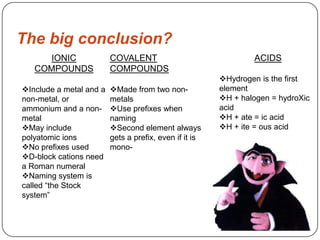
The big conclusion?
      IONIC              COVALENT                               ACIDS
   COMPOUNDS             COMPOUNDS
                                                        Hydrogen is the first
Include a metal and a   Made from two non-            element
non-metal, or            metals                         H + halogen = hydroXic
ammonium and a non-      Use prefixes when             acid
metal                    naming                         H + ate = ic acid
May include             Second element always         H + ite = ous acid
polyatomic ions          gets a prefix, even if it is
No prefixes used        mono-
D-block cations need
a Roman numeral
Naming system is
called “the Stock
system”

Naming covalent compounds and acids

  • 1.
    Naming covalent compoundsand acids Lisa Allen Stonington High School Honors chemistry
  • 2.
    How do youknow the compound is covalent? 1. The compound is called a molecule. Molecules are covalently bonded. 2. The compound doesn’t start with a metal or with ammonium. 3. The compound is made from elements that are similar in electronegativity 4. Organic compounds often have carbon for their first element, and that is going to form covalent bonds. These frequently use another naming system you will learn in organic chemistry!
  • 3.
    To name covalentcompounds, use prefixes  1- mono  2- di  3 – tri  4 – tetra  5 – penta  6 – hexa  7 – hepta  8 – octa  9 – nona  10 - deca
  • 4.
    Simple rules  Writethe name of the less electronegative element first.  If you have more than one atom of that element in the compound, you will need a prefix before its name. If not, skip the prefix here.  Always put a prefix before the name of the more electronegative element.  Change the ending of the second element to –ide.
  • 5.
    Practice a fewof these  CO  P2O5  OF2  SO2  SO3  N2O5  N2O4  H2O
  • 6.
    Practice a fewof these  CO  Carbon monoxide  P2O5  Diphosphorus  OF2 pentoxide  Oxygen difluoride  SO2  Sulfur dioxide  SO3  Sulfur trioxide  N2O5  Dinitrogen pentoxide  N2O4  Dinitrogen tetroxide  H2O  What??
  • 7.
    What are someof the dangers associated with DHMO? Each year, Dihydrogen Monoxide is a known causative component in many thousands of deaths and is a major contributor to millions upon millions of dollars in damage to property and the environment. Some of the known perils of Dihydrogen Monoxide are: •Death due to accidental inhalation of DHMO, even in small quantities. •Prolonged exposure to solid DHMO causes severe tissue damage. •Excessive ingestion produces a number of unpleasant though not typically life-threatening side-effects. •DHMO is a major component of acid rain. •Gaseous DHMO can cause severe burns. •Contributes to soil erosion. •Leads to corrosion and oxidation of many metals. •Contamination of electrical systems often causes short- circuits. •Exposure decreases effectiveness of automobile brakes. •Found in biopsies of pre-cancerous tumors and lesions. •Given to vicious dogs involved in recent deadly attacks. •Often associated with killer cyclones in the U.S. Midwest and elsewhere, and in hurricanes including deadly storms in Florida, New Orleans and other areas of the southeastern U.S. •Thermal variations in DHMO are a suspected contributor to the El Nino weather effect. http://www.dhmo.org/facts.html
  • 8.
    Naming acids Acids are(almost) always compounds made from hydrogen and an anion.  Hydrogen plus a halogen?  hydroXXXic acid  Example: HCl = hydrochloric acid  Hydrogen plus a polyatomic ion that ends in –ate?  XXXic acid  Example: Hydrogen plus nitrate is HNO3 = nitric acid  Hydrogen plus a polyatomic ion that ends in –ite?  XXXous acid  Example: Hydrogen plus nitrite is HNO3 = nitrous acid
  • 9.
    How many hydrogensdo you add to the anion to make the acid formula?  Each H+ has a +1 charge, so add one for every negative charge.  Nitric acid only needs one, since nitrate is a -1 ion.  Sulfuric acid is H2SO4 since sulfate has a 2- charge.
  • 10.
    The big conclusion? IONIC COVALENT ACIDS COMPOUNDS COMPOUNDS Hydrogen is the first Include a metal and a Made from two non- element non-metal, or metals H + halogen = hydroXic ammonium and a non- Use prefixes when acid metal naming H + ate = ic acid May include Second element always H + ite = ous acid polyatomic ions gets a prefix, even if it is No prefixes used mono- D-block cations need a Roman numeral Naming system is called “the Stock system”