The nuts and bolts of basic chemistry! Naming ionic compounds Writing formulas of ionic compounds
Naming Ionic Compounds Cation goes first! Anion gets –ide for its ending. Polyatomic anion doesn’t need its ending changed . The cation is usually a metal. D-block cations have some special rules we’ll cover in a minute. Anions are on the  right  of the periodic table.
Examples NaCl: Sodium Chloride Na 3 PO 4 : Sodium phosphate CaCl 2 : Calcium chloride KMnO 4 : Potassium permanganate Al 2 O 3 : Aluminum oxide
What should you notice about these names? The number of atoms of a particular type doesn’t influence the name The metal comes first. Monatomic anions end in -ide
Writing Chemical Formulas The subscript depends on the oxidation numbers of the ions!
Using Al Guenther’s Manipulatives Cut out the shapes of the ions on the sheet.  Notice that each cation has a point for every +1 of charge.  Each anion has a notch for each -1 of charge. Assemble ionic compounds so that no points or notches are unpaired.
NaCl is 1 sodium and 1 chloride ion CaCl 2  is 1 calcium and 2 chlorides Why?  Because Ca has a 2+ oxidation number and it takes 2 chlorides, with 1- each, to make the compound neutral overall. Sodium has a 1+ oxidation number, and balances with chlorides in a 1 to 1 ratio.
Polyatomic ions See page 226 of your textbook! Treat polyatomic ions like any other ion.  The only difference is that you might need parentheses in your chemical formulas. Don’t replace ending with –ide!
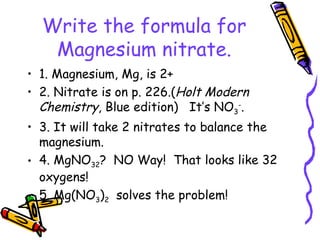
Write the formula for Magnesium nitrate. 1. Magnesium, Mg, is 2+ 2. Nitrate is on p. 226.( Holt Modern Chemistry , Blue edition)  It’s NO 3 - . 3. It will take 2 nitrates to balance the magnesium. 4. MgNO 32 ?  NO Way!  That looks like 32 oxygens! 5. Mg(NO 3 ) 2   solves the problem!
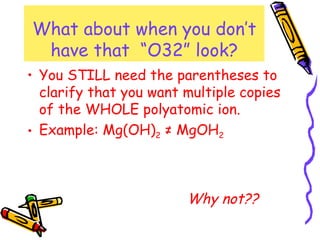
What about when you don’t have that  “O32” look? You STILL need the parentheses to clarify that you want multiple copies of the WHOLE polyatomic ion. Example: Mg(OH) 2  ≠ MgOH 2 Why not??
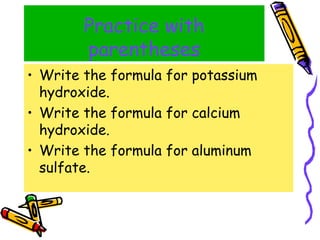
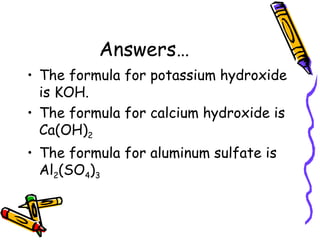
Practice with parentheses Write the formula for potassium hydroxide. Write the formula for calcium hydroxide. Write the formula for aluminum sulfate.
Answers… The formula for potassium hydroxide is KOH. The formula for calcium hydroxide is Ca(OH) 2 The formula for aluminum sulfate is Al 2 (SO 4 ) 3
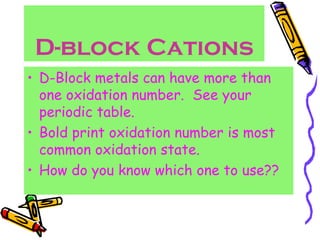
D-block Cations D-Block metals can have more than one oxidation number.  See your periodic table. Bold print oxidation number is most common oxidation state. How do you know which one to use??
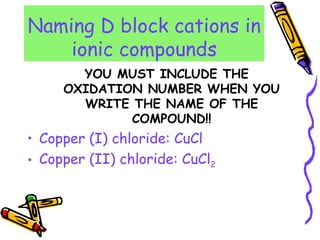
Naming D block cations in ionic compounds YOU MUST INCLUDE THE OXIDATION NUMBER WHEN YOU WRITE THE NAME OF THE COMPOUND!! Copper (I) chloride: CuCl Copper (II) chloride: CuCl 2
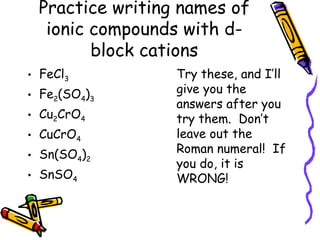
Practice writing names of ionic compounds with d-block cations FeCl 3 Fe 2 (SO 4 ) 3 Cu 2 CrO 4 CuCrO 4 Sn(SO 4 ) 2 SnSO 4 Try these, and I’ll give you the answers after you try them.  Don’t leave out the Roman numeral!  If you do, it is WRONG!
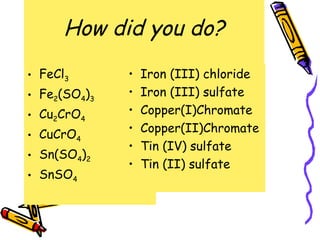
How did you do? FeCl 3 Fe 2 (SO 4 ) 3 Cu 2 CrO 4 CuCrO 4 Sn(SO 4 ) 2 SnSO 4 Iron (III) chloride Iron (III) sulfate Copper(I)Chromate Copper(II)Chromate Tin (IV) sulfate Tin (II) sulfate
Formula Mass Calculating formula masses- calculator optional
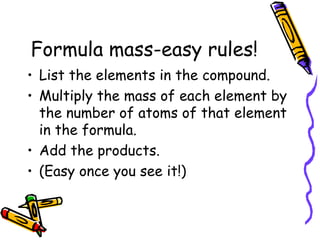
Formula mass-easy rules! List the elements in the compound. Multiply the mass of each element by the number of atoms of that element in the formula. Add the products. (Easy once you see it!)
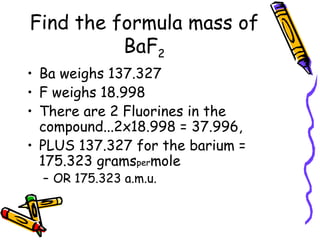
Find the formula mass of BaF 2 Ba weighs 137.327 F weighs 18.998 There are 2 Fluorines in the compound...2x18.998 = 37.996, PLUS 137.327 for the barium = 175.323 grams per mole  OR 175.323 a.m.u.
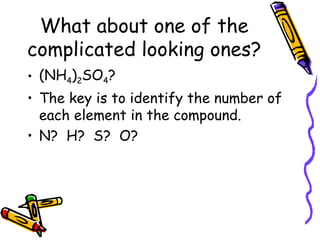
What about one of the complicated looking ones? (NH 4 ) 2 SO 4 ? The key is to identify the number of each element in the compound. N?  H?  S?  O?
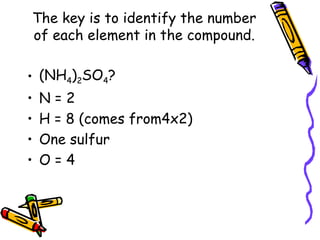
The key is to identify the number of each element in the compound. (NH 4 ) 2 SO 4 ? N = 2 H = 8 (comes from4x2) One sulfur O = 4
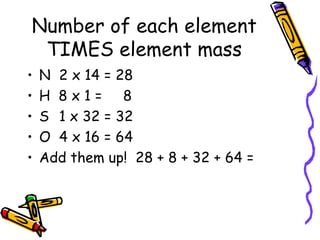
Number of each element TIMES element mass N  2 x 14 = 28 H  8 x 1 =  8 S  1 x 32 = 32 O  4 x 16 = 64 Add them up!  28 + 8 + 32 + 64 =
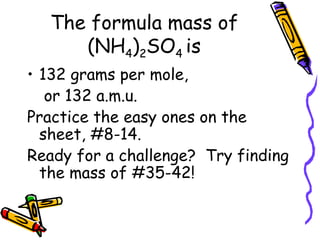
The formula mass of (NH 4 ) 2 SO 4  is 132 grams per mole,   or 132 a.m.u. Practice the easy ones on the sheet, #8-14. Ready for a challenge?  Try finding the mass of #35-42!
Significant figures Yep, here we go again!  If a question is given to you with a number in it, you must pay attention to sigfigs when you answer that question.  Beware careless rounding in calculating formula masses!

Naming Compounds

  • 1.
    The nuts andbolts of basic chemistry! Naming ionic compounds Writing formulas of ionic compounds
  • 2.
    Naming Ionic CompoundsCation goes first! Anion gets –ide for its ending. Polyatomic anion doesn’t need its ending changed . The cation is usually a metal. D-block cations have some special rules we’ll cover in a minute. Anions are on the right of the periodic table.
  • 3.
    Examples NaCl: SodiumChloride Na 3 PO 4 : Sodium phosphate CaCl 2 : Calcium chloride KMnO 4 : Potassium permanganate Al 2 O 3 : Aluminum oxide
  • 4.
    What should younotice about these names? The number of atoms of a particular type doesn’t influence the name The metal comes first. Monatomic anions end in -ide
  • 5.
    Writing Chemical FormulasThe subscript depends on the oxidation numbers of the ions!
  • 6.
    Using Al Guenther’sManipulatives Cut out the shapes of the ions on the sheet. Notice that each cation has a point for every +1 of charge. Each anion has a notch for each -1 of charge. Assemble ionic compounds so that no points or notches are unpaired.
  • 7.
    NaCl is 1sodium and 1 chloride ion CaCl 2 is 1 calcium and 2 chlorides Why? Because Ca has a 2+ oxidation number and it takes 2 chlorides, with 1- each, to make the compound neutral overall. Sodium has a 1+ oxidation number, and balances with chlorides in a 1 to 1 ratio.
  • 8.
    Polyatomic ions Seepage 226 of your textbook! Treat polyatomic ions like any other ion. The only difference is that you might need parentheses in your chemical formulas. Don’t replace ending with –ide!
  • 9.
    Write the formulafor Magnesium nitrate. 1. Magnesium, Mg, is 2+ 2. Nitrate is on p. 226.( Holt Modern Chemistry , Blue edition) It’s NO 3 - . 3. It will take 2 nitrates to balance the magnesium. 4. MgNO 32 ? NO Way! That looks like 32 oxygens! 5. Mg(NO 3 ) 2 solves the problem!
  • 10.
    What about whenyou don’t have that “O32” look? You STILL need the parentheses to clarify that you want multiple copies of the WHOLE polyatomic ion. Example: Mg(OH) 2 ≠ MgOH 2 Why not??
  • 11.
    Practice with parenthesesWrite the formula for potassium hydroxide. Write the formula for calcium hydroxide. Write the formula for aluminum sulfate.
  • 12.
    Answers… The formulafor potassium hydroxide is KOH. The formula for calcium hydroxide is Ca(OH) 2 The formula for aluminum sulfate is Al 2 (SO 4 ) 3
  • 13.
    D-block Cations D-Blockmetals can have more than one oxidation number. See your periodic table. Bold print oxidation number is most common oxidation state. How do you know which one to use??
  • 14.
    Naming D blockcations in ionic compounds YOU MUST INCLUDE THE OXIDATION NUMBER WHEN YOU WRITE THE NAME OF THE COMPOUND!! Copper (I) chloride: CuCl Copper (II) chloride: CuCl 2
  • 15.
    Practice writing namesof ionic compounds with d-block cations FeCl 3 Fe 2 (SO 4 ) 3 Cu 2 CrO 4 CuCrO 4 Sn(SO 4 ) 2 SnSO 4 Try these, and I’ll give you the answers after you try them. Don’t leave out the Roman numeral! If you do, it is WRONG!
  • 16.
    How did youdo? FeCl 3 Fe 2 (SO 4 ) 3 Cu 2 CrO 4 CuCrO 4 Sn(SO 4 ) 2 SnSO 4 Iron (III) chloride Iron (III) sulfate Copper(I)Chromate Copper(II)Chromate Tin (IV) sulfate Tin (II) sulfate
  • 17.
    Formula Mass Calculatingformula masses- calculator optional
  • 18.
    Formula mass-easy rules!List the elements in the compound. Multiply the mass of each element by the number of atoms of that element in the formula. Add the products. (Easy once you see it!)
  • 19.
    Find the formulamass of BaF 2 Ba weighs 137.327 F weighs 18.998 There are 2 Fluorines in the compound...2x18.998 = 37.996, PLUS 137.327 for the barium = 175.323 grams per mole OR 175.323 a.m.u.
  • 20.
    What about oneof the complicated looking ones? (NH 4 ) 2 SO 4 ? The key is to identify the number of each element in the compound. N? H? S? O?
  • 21.
    The key isto identify the number of each element in the compound. (NH 4 ) 2 SO 4 ? N = 2 H = 8 (comes from4x2) One sulfur O = 4
  • 22.
    Number of eachelement TIMES element mass N 2 x 14 = 28 H 8 x 1 = 8 S 1 x 32 = 32 O 4 x 16 = 64 Add them up! 28 + 8 + 32 + 64 =
  • 23.
    The formula massof (NH 4 ) 2 SO 4 is 132 grams per mole, or 132 a.m.u. Practice the easy ones on the sheet, #8-14. Ready for a challenge? Try finding the mass of #35-42!
  • 24.
    Significant figures Yep,here we go again! If a question is given to you with a number in it, you must pay attention to sigfigs when you answer that question. Beware careless rounding in calculating formula masses!