How to identify if a substance contains ionic
or covalent bonds.
As with most things, this is not an absolute rule. There are
many exceptions.
Purpose
• The type of bonding present in a substance greatly influences
its properties. Additionally, it will determine how we name a
substance. For example, the systematic name of H2O is
dihydrogen monoxide, while the systematic name of Li2O is
lithium oxide – one has covalent bonds and uses the prefix di-
and the other has ionic bonds and does not use prefixes. For
these reasons, we need to be able to identify if a compound
presented to us contains ionic or covalent bonds.
If the substance contains a metal and one or
more non-metals, it is likely ionic.
• Some examples of ionic compounds
– NaCl
• Sodium is a metal and chlorine is a non-metal
– Fe(NO3)2
• iron is a metal and nitrogen and oxygen are non-metals
– ZnSO4
• Zinc is a metal and sulfur and oxygen are non-metals
– MgS
• Magnesium is a metal and sulfur is a non-metal
If the substance contains all non-metals, it is
likely covalent.
• Some examples of covalent compounds
– HCl
– C6H12O6
– CS2
– H2O
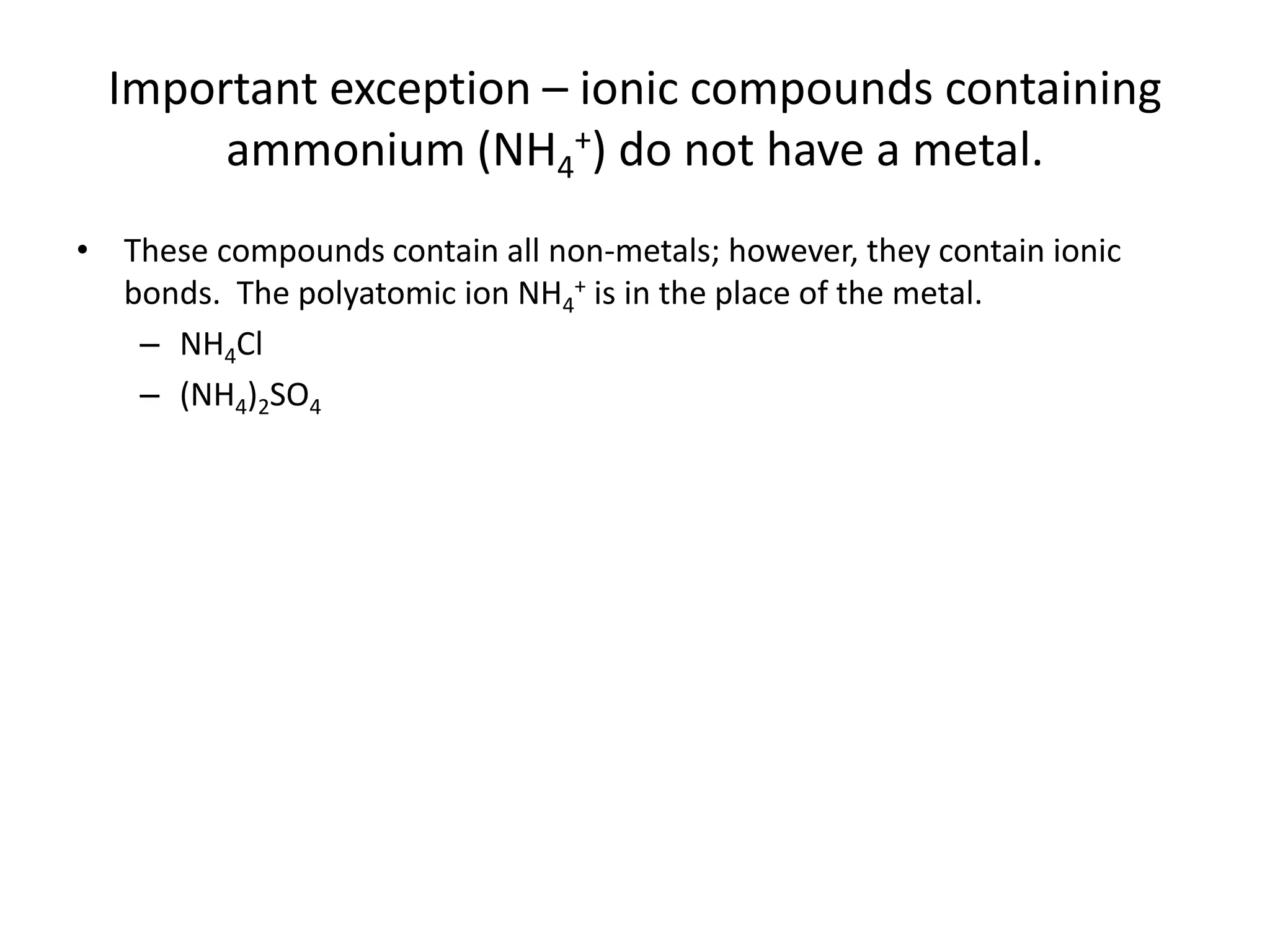
Important exception – ionic compounds containing
ammonium (NH4
+) do not have a metal.
• These compounds contain all non-metals; however, they contain ionic
bonds. The polyatomic ion NH4
+ is in the place of the metal.
– NH4Cl
– (NH4)2SO4
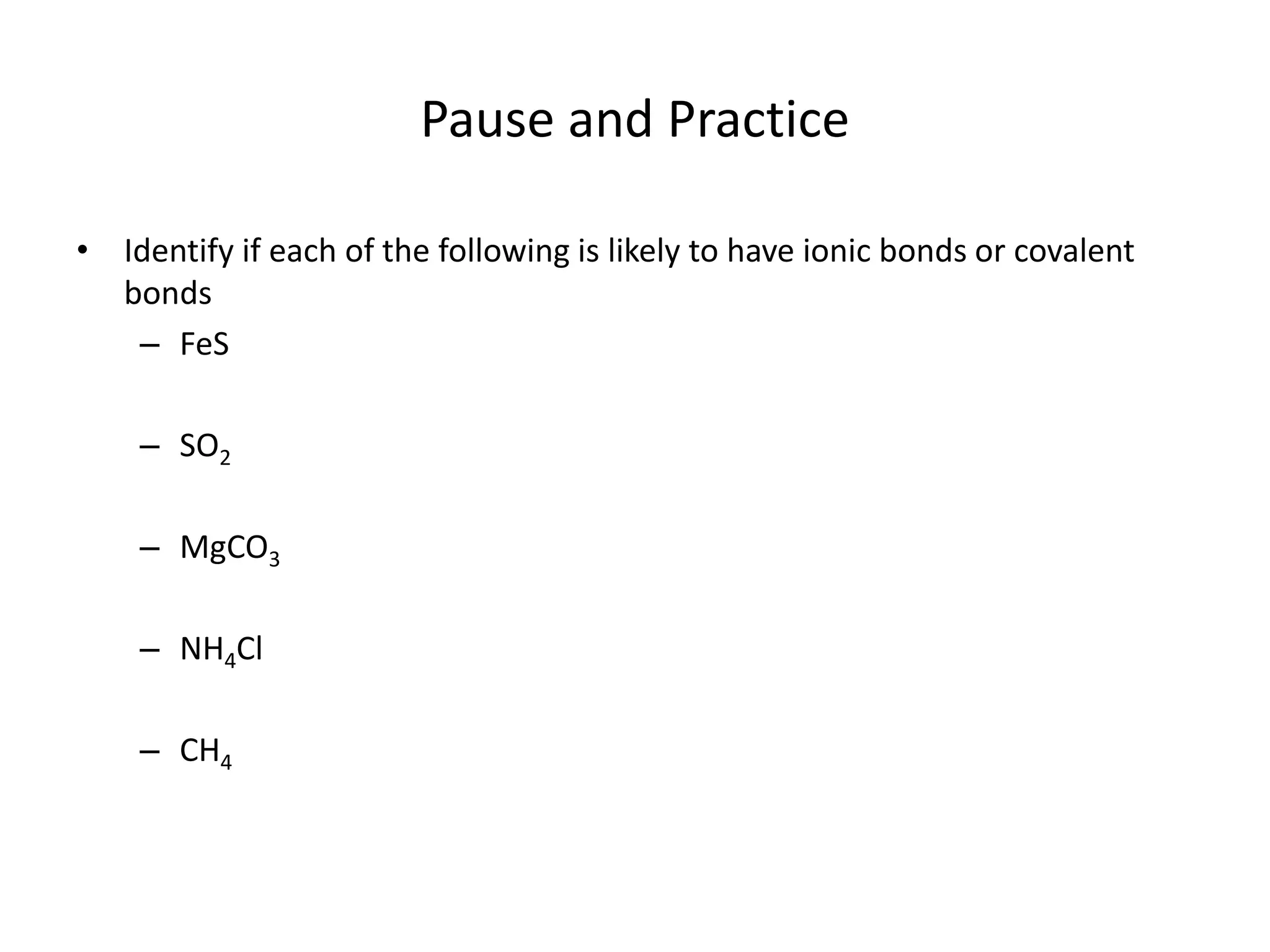
Pause and Practice
• Identify if each of the following is likely to have ionic bonds or covalent
bonds
– FeS
– SO2
– MgCO3
– NH4Cl
– CH4
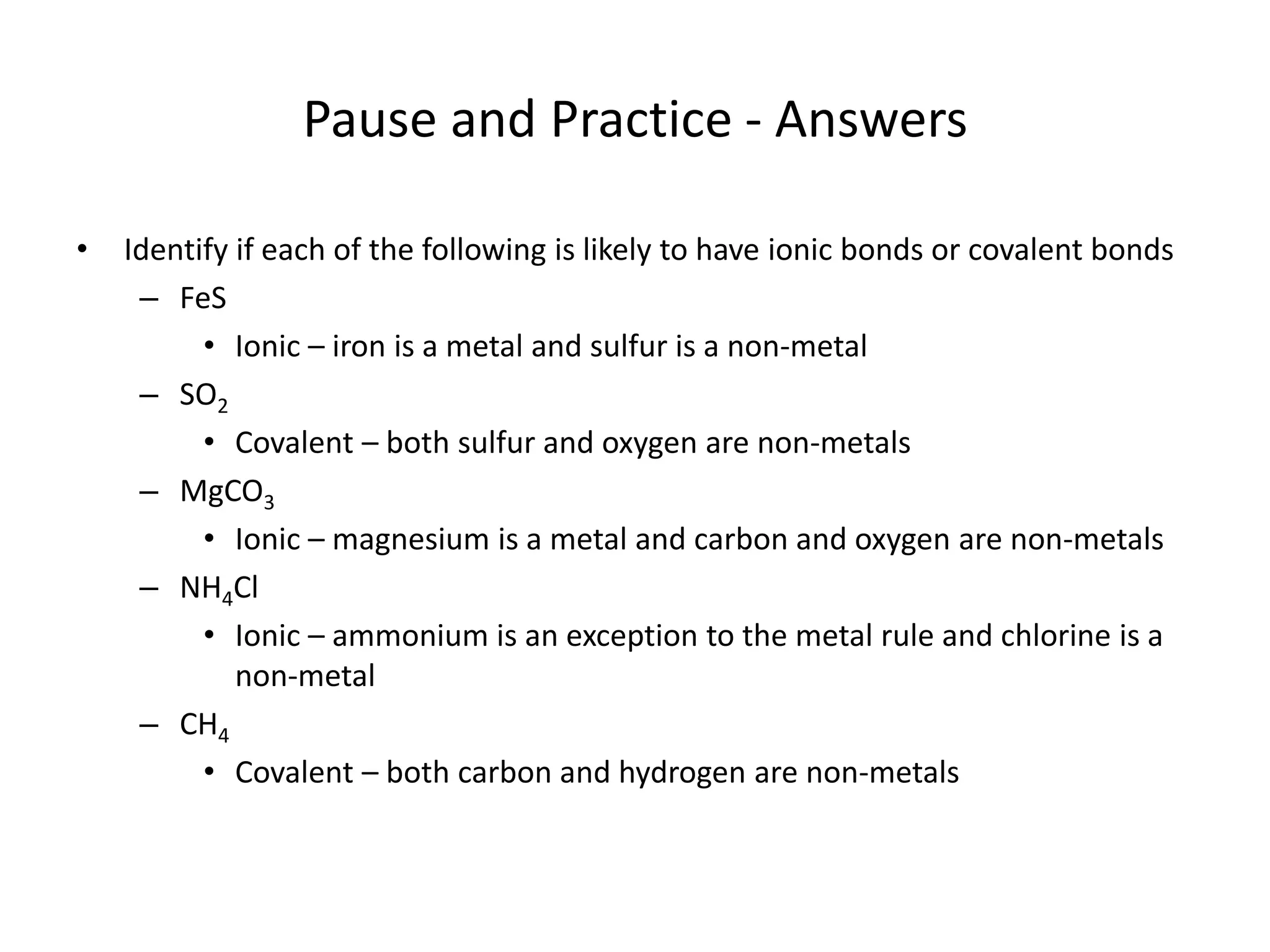
Pause and Practice - Answers
• Identify if each of the following is likely to have ionic bonds or covalent bonds
– FeS
• Ionic – iron is a metal and sulfur is a non-metal
– SO2
• Covalent – both sulfur and oxygen are non-metals
– MgCO3
• Ionic – magnesium is a metal and carbon and oxygen are non-metals
– NH4Cl
• Ionic – ammonium is an exception to the metal rule and chlorine is a
non-metal
– CH4
• Covalent – both carbon and hydrogen are non-metals
Try the exercise.

Unit 5 2 determining if a compound is ionic or covalent

  • 1.
    How to identifyif a substance contains ionic or covalent bonds. As with most things, this is not an absolute rule. There are many exceptions.
  • 2.
    Purpose • The typeof bonding present in a substance greatly influences its properties. Additionally, it will determine how we name a substance. For example, the systematic name of H2O is dihydrogen monoxide, while the systematic name of Li2O is lithium oxide – one has covalent bonds and uses the prefix di- and the other has ionic bonds and does not use prefixes. For these reasons, we need to be able to identify if a compound presented to us contains ionic or covalent bonds.
  • 3.
    If the substancecontains a metal and one or more non-metals, it is likely ionic. • Some examples of ionic compounds – NaCl • Sodium is a metal and chlorine is a non-metal – Fe(NO3)2 • iron is a metal and nitrogen and oxygen are non-metals – ZnSO4 • Zinc is a metal and sulfur and oxygen are non-metals – MgS • Magnesium is a metal and sulfur is a non-metal
  • 4.
    If the substancecontains all non-metals, it is likely covalent. • Some examples of covalent compounds – HCl – C6H12O6 – CS2 – H2O
  • 5.
    Important exception –ionic compounds containing ammonium (NH4 +) do not have a metal. • These compounds contain all non-metals; however, they contain ionic bonds. The polyatomic ion NH4 + is in the place of the metal. – NH4Cl – (NH4)2SO4
  • 6.
    Pause and Practice •Identify if each of the following is likely to have ionic bonds or covalent bonds – FeS – SO2 – MgCO3 – NH4Cl – CH4
  • 7.
    Pause and Practice- Answers • Identify if each of the following is likely to have ionic bonds or covalent bonds – FeS • Ionic – iron is a metal and sulfur is a non-metal – SO2 • Covalent – both sulfur and oxygen are non-metals – MgCO3 • Ionic – magnesium is a metal and carbon and oxygen are non-metals – NH4Cl • Ionic – ammonium is an exception to the metal rule and chlorine is a non-metal – CH4 • Covalent – both carbon and hydrogen are non-metals
  • 8.